“A decade, not out” – celebrating 10 years of Formula E

Formula E burst into life for the first time ten years ago next month, with the 2014 Beijing E-Prix. Arguably, the incident between Nico Prost and Nick Heidfeld on the final lap remains the championship’s most iconic moment.

Since then, the series has crowned nine different Drivers’ Champions, with the series evolving year-on-year. Mandatory car swaps have disappeared, and Attack Mode has replaced Fanboost. More importantly, the electric machinery is significantly faster now thanks to improvements in battery technology.

Off-track on the broadcasting front, the series has faced hurdles both domestically in the UK and abroad. So, what lies ahead for the championship? We explored the paddock and went behind the scenes during the London E-Prix season finale…

The 12th team

Aurora Media Worldwide and Whisper are responsible for production of Formula E’s television feed. Aurora produces the Track Feed on location and the International Feed. Whisper handles the English language programme (ELP) from WestWorks in London.

Whisper’s feed comes with different ‘opt in’ and ‘opt out’ points, allowing broadcasters to join the build-up at different stages. Some territories take the race itself without pre- and post-race amble while others take Whisper’s ‘full fat’ programme.

Supporting Formula E with the technical aspects of the broadcast are companies including Gravity Media, Tata, and Timeline TV.

Season 10 was Formula E’s first primarily behind a pay wall in the UK, the series airing on TNT Sports. Only the season finale in London aired for free via Quest, Discovery’s free-to-air outlet.

Over the past decade, the championship has exhausted all other free-to-air partners, never finding the right home. ITV, BBC, Channel 4, and Channel 5 all came and fell by the wayside. What the series has long yearned for is channel consistency, something that TNT Sports and Discovery+ provides.

Despite the change, sources suggest that Formula E are happy with the audience figures. The series is likely analysing the overall reach across all of Discovery’s platforms, rather than a single channel in isolation.

Whisper won the contract to produce the English feed for season 10, bringing some recognisable faces with them. The likes of Billy Monger, David Coulthard and Karun Chandhok joined Formula E mainstays Nicki Shields and Dario Franchitti on-air. Tom Brooks remained lead commentator, a role he started in 2023.

Vernon Kay’s decision to leave Formula E and focus on his radio commitments meant Whisper needed a new presenter. The team opted to bring in ex-footballer and now presenter of BBC’s The One Show Jermaine Jenas. Jenas has improved since the start of the season, helping to explain basic concepts to new viewers.

Harry Allen, who leads Whisper’s Formula E production, was complimentary of Jenas and the way everyone has “embraced” the team.

“Since we’ve been at the centre of it, it’s been an amazing experience,” Allen says. “We’ve really enjoyed working with all the drivers and the teams on the grid. We feel that the programming has done the series justice. It’s been fun telling those stories and getting stuck into what is an intriguing and fast-growing sport.”

“We knew coming in that there was an opportunity to bring in a new face in to anchor the series. Formula E loved having somebody from outside the sport to lead the presentation, and they wanted to continue that.”

“Jermaine is somebody we’ve worked with for years and we were happy to bring him on board. His intrinsic understanding of sport, plus having someone with the mindset of somebody who plays elite sport has been good.”

“He brings people along with him who maybe aren’t motor sport experts. I think that’s what we need to concentrate on if we’re going to capture audiences,” Allen believes.

Allen cited Jaguar’s issues during the London weekend as one example where Jenas asked the key questions. In Allen’s view, Jenas helped put into context the “things that the rest of us take for granted.”

Inside the commentary booth

We jumped into the commentary booth on Sunday morning in London to see the set up during qualifying. Commentary box fridges aside (a topic for another outlet!), it was fascinating seeing Brooks, Chandhok, and Allan McNish first hand doing what they do best.

The trio during qualifying were a well-oiled machine, to the betterment of the product. It reminded me that a three-person team works better than two, Whisper moving in that direction for Formula E.
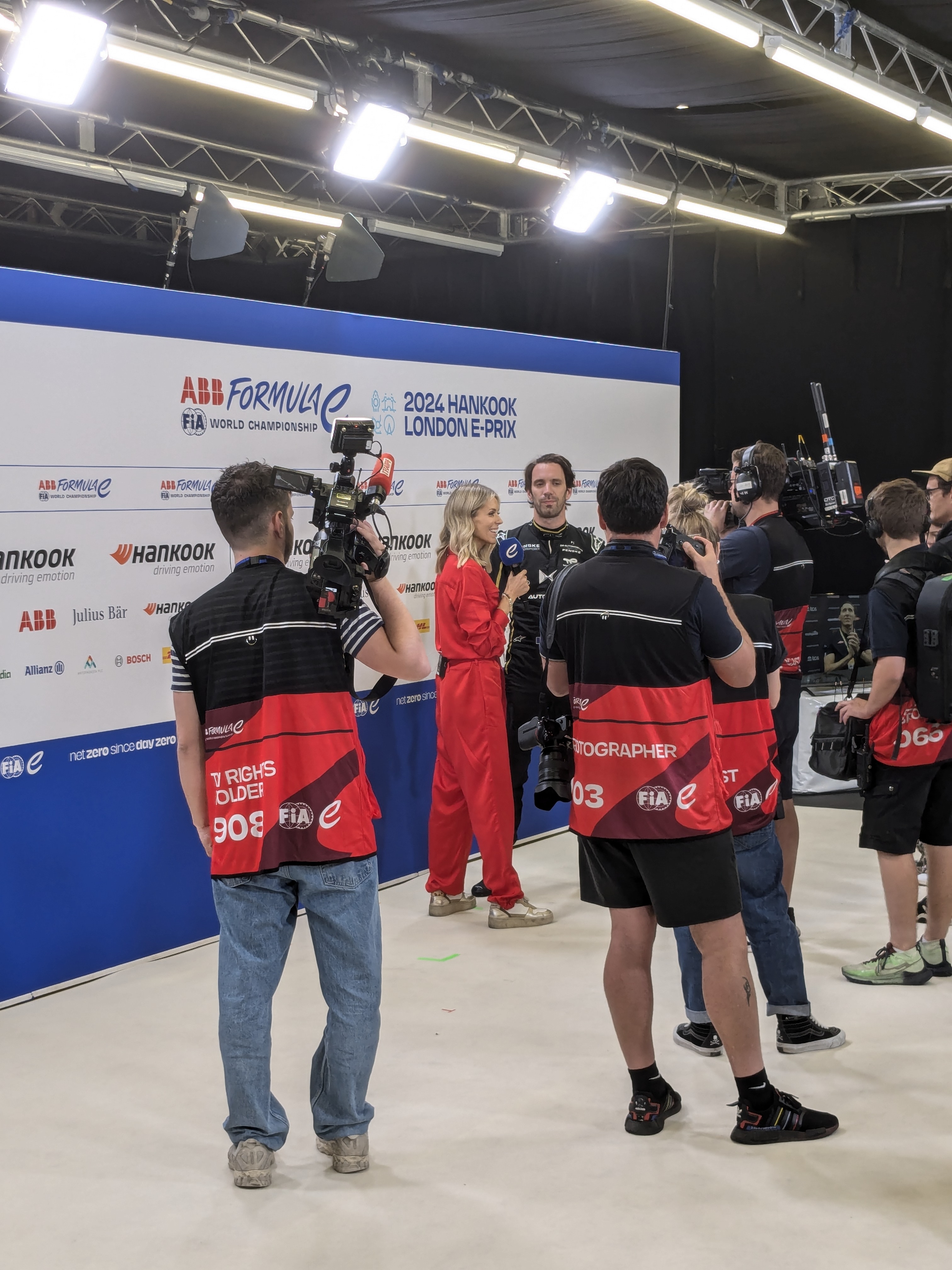
Nick Shields interviewing Jean-Eric Vergne after qualifying for the 2024 London E-Prix.

Brooks, Chandhok and McNish have not have worked together much on-air, but there was clear rapport between the three. Always animated when describing the action, the trio gestured to one another when they wanted to contribute on-air.

For a commentator of any sport, the job does not stop when the live microphones go off. Instead, they are in constant dialogue with the production team. During qualifying, the trio relayed information back to WestWorks, requesting that the team replayed key moments on the broadcast.

Seven different commentators joined Brooks on race day during season 10. Chandhok and Monger led the way, with the line-up rotating from race-to-race.

Co-CommentatorRaces
Karun Chandhok10
Billy Monger6
Allan McNish4
David Coulthard4
Andre Lotterer3
Dario Franchitti3
James Rossiter2

The lack of consistency is suboptimal, leaving fans guessing as to who they will hear race-by-race. The crowded motor sport calendar makes this a challenging area for the series to fix.

In my view, it is essential for Formula E to have a consistent commentary line-up. Jack Nicholls and Dario Franchitti were consistently together from 2014 to 2023, and became a staple of the series. Formula E need to try to replicate their success story with the same pairing in the booth across every race.

Allen noted that having a range of voices on the broadcast allows for different “perspectives on things.” He cited Andre Lotterer as someone who “can speak to the drivers on a different level.” The German has six years of electric experience, and is “Porsche’s reserve driver so has that relationship with them.”

Watching the season finale from the Track Feed gallery

Later, we watched the team direct the Track Feed live for the season finale. The team, like millions watching at home, wondered if Pascal Wehrlein, Mitch Evans, or Nick Cassidy would become Drivers’ Champion.

From the outside, it is easy to criticise the TV direction, sometimes overly so, sometimes for good reason. But watching the team direct the race live brought me an appreciation to broadcasting that I did not have before.

I have always acknowledged the effort involved, but seeing it unfold made me appreciate it much more. A strange confession for someone writing about motor sport broadcasting for 12 years, admittedly…

During a race, every Formula E team and driver strategizes, wondering when the best opportunity is to take Attack Mode. The same applies on the broadcasting side, the gallery none the wiser as to how the race will unfold. The team use the timing pages and Team Radio as a guide, but they are just that: a guide.

In the Track Feed gallery, we hear the director calling the action, focusing on the championship battle. ‘Top 3’ and ‘top 4’ are regular shouts, instructing each camera operator to focus on the leading cars.

Likewise, we hear calls for augmented reality shots (“AR on Drivers’ Standings at 16”), around 15 seconds before they air.

But how does the Track Feed produced by Aurora differ from Whisper’s English language programme feed referenced earlier? The Track Feed is a ‘dirty’ feed consisting of the cameras dotted around each circuit, overlaid with the TV graphics.

At WestWorks, the team adds other aspects to form the English language programme feed. These include replays, on-board camera angles and wrap-around coverage.

It should be noted that Aurora produces an International Feed, which goes to territories that do not take Whisper’s offering.

A simplified flow chart showing how the Formula E ELP is made and distributed to broadcasters.

With 10 on-board cameras on each Formula E car, the team have up to 220 on-board angles at their disposal. They can select up to 52 of these from 13 cars, the whittling down of angles also done from WestWorks.

Formula E’s on-site presence was much greater when we last went behind the scenes with them (see here and here). “One of the key targets for Formula E is net zero. It’s something that we’re challenged on regularly by the organisation,” Allen says.

“Thankfully, it’s something that Whisper are strong on as well. When you think about where we’re flying around the world, it becomes important that we keep the footprint small.”

“The technology at our disposal means that we can produce the show at WestWorks, regardless of where the race is. We’re working with Gravity and Timeline as the technical partners, with all the feeds fed back.”

On-track successes and struggles

From the test event in Donington to the season 10 finale in London, the series has been on a journey.

COVID halted Formula E’s growth over its first five seasons, which the series has attempted to bounce back from since.

The machinery is faster than what it was a decade ago, with the championship arguably beginning to outgrow street racing. Holding races in cities has been in Formula E’s DNA since day 1, allowing fans to travel using public transport.

The qualifying format has been a big success in recent years. Allen says that the head-to-head Duels format for the last eight cars, is “fantastic” from a TV perspective. “I personally believe that the format that Formula E have hit upon is fantastic for a TV audience,” Allen believes.

“It’s full of jeopardy and you don’t get second chances in the same way you do elsewhere, which helps.”

The Track Feed on-site gallery at the London E-Prix. The feeds shown include Timing, Track Map, Beauty Cameras, On-Board Cameras, RF Cameras, Track Feed, Preview, and Track Cameras.

Another key element of Formula E racing, as highlighted earlier, is Attack Mode. Love or loathe it, it is critical that the commentators can explain the tactics behind every decision made.

“Attack Mode is something unique to Formula E,” Allen says. “If you see that in the context of the London race, you can see how much drama you can create.”

“Mitch Evans missed two Attack Mode activations, and the commentary helped simplify what that meant from a race perspective.” (Evans would either run out of time if he missed again, or get disqualified)

Whisper, who also produce Channel 4’s F1 offering, sought to highlight Formula E’s “uniqueness” throughout their coverage.

“As a production company, we don’t really have much control over what happens [in sport]. But, as a production team, you then start to understand what the unique elements that sell the sport to fans.”

“For Formula E, it’s the access to drivers. It’s the qualifying format, it’s the fact that the races are unpredictable and the fact you have different winners.”

From this fan’s vantage point, there is improvement required on and off-track for Formula E, namely the peloton racing. In my view, the peloton style needs to disappear for season 11.

For readers unfamiliar, drivers start the race half a dozen seconds off the pace. Imagine driving on the M25 in rush-hour, but Formula E style. Eventually, half way into the race, the drivers finally hit the accelerator, spreading the pack out.

The peloton style allows the series to post outlandish overtaking statistics across social media, but is ultimately unsatisfying to watch.

A perennial problem remains the calendar structure, which remains lopsided. The upcoming 2024-25 season tentatively has 17 races across 11 locations and 8 months, which is great for the series. But, the first 5 races take place across 13 weeks, with the remaining 12 races squeezed into 15 weeks.

Of the 13 weekends in the F1 off-season, only 3 of them feature a Formula E race. Formula E becomes lost in the shuffle when F1 (and other motor sport) returns from their winter break.

The inaugural Shanghai E-Prix fell on the same weekend as the Monaco Grand Prix and the Indianapolis 500. During the winter, I would have watched, but this year’s timing meant that I missed it completely.

A decade in, Formula E should be establishing blue-ribbon events, something the series does not have right now. Yes, there are regular fixtures (Mexico City to name one), but these attract the same attention as other races.

Even excluding the COVID season in 2020, not a single circuit has been on Formula E’s calendar since the beginning.

Punta del Este is a city that should have become a blue-ribbon event, with its stunning backdrop. Sadly, the Uruguayan venue dropped off the calendar after only two events, before briefly returning in 2018.

Where next for Formula E? The series has its eyes on ‘the TikTok audience’; having recently surpassed 1 million followers on the platform. Year-on-year, this represented an increase of 235% for Formula E.

On the marketing side, Ellie Norman joins the team as Chief Communications Officer at the end of September. Norman comes into Formula E fresh from her recent stint with F1, which should only help the series.

TNT Sports will continue to cover the series in the UK next season, despite owner Warner Bros. Discovery selling their stake in Formula E to Liberty Global. The championship returns on December 7th with the Sao Paulo E-Prix.

If you enjoyed this article, consider contributing to the running costs of Motorsport Broadcasting by donating via PayPal. If you wish to reproduce the contents of this article, please contact Motorsport Broadcasting.

Article amended on August 21st to make Aurora’s responsibilities clearer.
Formula E heads to TNT as series struggles to make FTA breakthrough

After ten years of flirting with multiple free-to-air networks, Formula E has made the jump to pay television in the United Kingdom.

From ITV to Channel 5 to the BBC and onto Channel 4, the electric series has never found its belonging at any of those networks. Now, after battling for its place on free-to-air, the series has turned to TNT Sports for its next phase.

But how has Formula E ended up here, and did the series have any other options? Motorsport Broadcasting analyses the situation.

A new home for 2024

Organisers of the series, now heading into its tenth season, have announced an agreement with TNT Sports, touting the outlet as the championship’s exclusive television home, although terms of the contract (or its length) are undisclosed.

Discovery+ will stream coverage, the platform bringing together their Eurosport and TNT outlets under one roof.

Moving forward, fans will be able to access live coverage of MotoGP, World Superbikes, British Superbikes, Speedway, World Rally Championship, World Endurance Championship (including the 24 Hours of Le Mans) and Formula E via Discovery+.

Their television line-up for the new season is a hybrid of familiar Formula E names, combined with names typically associated with Whisper’s Channel 4 F1 broadcasts, the production house taking over the English language wrap-around offering from North One Television.

Joining the likes of Nicki Shields, Karun Chandhok, Dario Franchitti and Allan McNish will be Billy Monger, David Coulthard and Jamie Chadwick, the latter two names making “guest appearances” during the 2023/24 season.

Tom Brooks returns as lead commentator, this time on a full-time basis, replacing Jack Nicholls in the role.

The big talent announcement though is that former footballer Jermaine Jenas will be presenting Formula E’s race coverage, succeeding Vernon Kay. Jenas is no stranger to presenting, having presented the BBC’s magazine programme The One Show since 2020, as well as contributing to TNT’s football coverage.

“Since retiring from football I never thought I would find a sport that I loved as much but Formula E is a sport like nothing else,” Jenas said. “I couldn’t be more excited to take on this incredible presenting role and travel the world with such amazing teams.”

“To get in front of the camera and share that energy and action with viewers is a whole new challenge and adrenaline rush for me and I’m really looking forward to it.”

Formula E in the UK – at a glance

2014-15 – ITV
2015-16 – ITV
2016-17 – Channel 5
2017-18 – Channel 5, Eurosport
2018-19 – BBC, BT Sport, Eurosport, Quest
2019-20 – BBC, Eurosport, Quest
2020-21 – BBC, Eurosport, Quest
2020-21 [London only] – BBC, Channel 4, Eurosport
2021-22 – Channel 4, Eurosport
2022-23 – Channel 4, Eurosport
2023-24 – TNT Sports

Formula E’s CEO Jeff Dodds added, “This is incredible news for sports fans in the UK who already watch premium live sports on TNT Sports. From next month they will get to enjoy the new thrill of Formula E racing, the most competitive motorsport on TV.”

“For existing Formula E fans, we are excited to present TNT Sports as the new home of Formula E in the UK,” Dodds said.

“With experienced professional sportsperson and broadcaster Jermaine Jenas leading our stellar line-up of expert presenters to provide his original perspective for viewers, we cannot wait to get to work in Mexico City.”

Was this Formula E’s number one option?

The biggest surprise about Formula E’s announcement is that it did not happen earlier. Formula E was first linked with TNT Sports (then BT Sport) a decade ago, and had a brief spell on BT Sport five years ago!

At the time, their chief executive Alejandro Agag said that the series was in discussions with BT and Sky, but that the aim was “free-to-air even if we get less money. Free-to-air would be great: BBC or ITV.”

To Agag’s credit, that is exactly what Formula E did, launching in 2014 live on ITV4. Less than a year later, a peak of over 1 million viewers watched Nelson Piquet Jnr become the first Drivers’ Champion in London.

But since then, despite glimpses of optimism along the way, the series has failed to gain traction in the UK and instead has gone into reverse. ITV lost faith, as did other broadcasters.

Viewing figures have failed to reach the 2015 peak, with clashes with F1 and MotoGP, long gaps between races and a lack of promotion from both broadcasters and series organisers hampering the championship.

The pandemic only exasperated the problem that the series faced in the UK. Channel 4’s broadcast deal sought to reverse the decline, with more races airing live on free-to-air television. Note the key word: “more,” not “every.”

Some races aired live on YouTube, meaning that the series was offering a disjointed service to fans. Either way you cut the slice, audience figures on Channel 4’s YouTube broadcasts were pitifully low, while races on Channel 4’s linear channel struggled outside of London.

According to The Race, the Hyderabad E-Prix averaged 97,000 viewers for the two-hour broadcast on Saturday 11th February. Two weeks later, the Cape Town E-Prix averaged 151,000 viewers. It is with this in mind that comparisons with MotoGP, which moved to pay TV a decade ago, are invalid given that their free-to-air audience was far higher than what Formula E achieved.

With such little interest, why should Channel 4 care enough to renew, when repeats of The Simpsons would draw a higher audience? At a time where broadcasters are making efficiencies across the board, it is little surprise that Channel 4 did not renew.

Channel 4 would not be alone in their assessment of Formula E: in Germany, free-to-air station ProSieben cut ties with the championship owing to viewer interest not developing “as expected.”

Earlier suggestions of a deal between Formula E and ITV in the UK for season 10 appear to have fallen through based on the wording of the press release issued by Formula E and TNT Sports, although Autosport suggests that free-to-air deals may be agreed on a “race-by-race” basis.

What we do not know is whether TNT Sports have offered Formula E substantial sums of money. They may well have done; however, I struggle to see a situation where this has happened. TNT most likely see this as a way of boosting their existing sports portfolio at little cost to them.

TNT Sports is not a small network: it is the second biggest sports network in the UK only behind Sky and has a significant sports portfolio. And, combined with Eurosport via Discovery+, the powerhouse airs sport ranging from the Olympics through to the UEFA Champions League football.

From a Formula E perspective, they may feel that it is better for them to be in amongst those sporting properties via Discovery+ rather than on free-to-air television, or having a couple of thousand viewers watch them via Channel 4’s YouTube channel.

For those who only watch Formula E and no other sport that Discovery+ airs, the news is likely disappointing, however I understand why the series has taken the decision it has, when faced with few alternatives.

Formula E wants to, understandably, attract the wider sports fan in the UK, and this is the best they can get with the options they have at their disposal.

If you enjoyed this article, consider contributing to the running costs of Motorsport Broadcasting by donating via PayPal. If you wish to reproduce the contents of this article in any form, please contact Motorsport Broadcasting in the first instance.

Whisper takes over Formula E wrap-around offering as Tom Brooks appointed lead commentator

Whisper will produce coverage of Formula E’s wrap-around programming for the upcoming season, while Tom Brooks has been appointed as lead commentator for the electric series, the production company has confirmed.

Whisper takes over the responsibilities previously provided by North One Television in this space, with enhanced build-up coverage of all practice sessions, qualifying and the race.

In addition the company, founded by Jake Humphrey, David Coulthard and Sunil Patel, have confirmed that Tom Brooks will lead the commentary line-up, succeeding Jack Nicholls in the role. Nicki Shields, Karun Chandhok, Dario Franchitti, Radzi Chinyanganya and Allan McNish return to the presentation team, with more names to be announced soon.

Aarti Dabas, Formula E’s Chief Media Officer, said “We are excited to work with Whisper who will bring to Formula E their impressive, proven credentials for creating compelling sports and entertainment broadcast content.”

“Formula E is the most competitive motorsport world championship with unrivalled racing action, big personalities in the paddock, and genuine storylines that will capture the imagination of new and current audiences.”

Sunil Patel, Whisper’s CEO & Co-Founder, said: “Our intention for the Formula E coverage is to deliver ‘Entertainment Electrified’.”

“We have an exciting and updated talent line up, as well as ambitious coverage plans, as we seek to redefine the coverage with the inspiring Formula E team. This project will draw on our creative storytelling skills and our absolute passion for motorsport.”

Formula E part company with Jack Nicholls with immediate effect

Formula E is in search of a commentator to lead their coverage on a full-time basis after parting ways with Jack Nicholls, Motorsport Broadcasting has learnt.

Nicholls, who has been part of Formula E since its inaugural race in 2014, will not commentate on the remaining seven rounds of the 2022-23 season.

Veteran motor sport commentator Ben Edwards will cover the vacant commentary position for the remainder of the season, starting with the Jakarta race weekend, which takes place on Saturday 3th and Sunday 4th June.

The electric series has confirmed this news through a statement issued on their website, following a request for comment made by Motorsport Broadcasting.

Note: Below section added on May 31st.
Motorsport Broadcasting understands that multiple complaints were raised to Formula E about Nicholls.

As a result, Nicholls has been off-site since the Cape Town E-Prix in February, with commentary for the last three Formula E race weekends produced from London.

In parallel, the series launched an investigation into the complaint, the outcome of which was conclusive, leading to his departure for “inappropriate behaviour.”

Multiple sources close to the situation have contacted this writer in recent days, confirming the above. The news was first reported publicly by The Times, with further details included, including quotes from Formula E and Nicholls.

The Times report that the series received three complaints, claiming that they had been touched inappropriately by Nicholls.

Formula E has not yet responded to a further request for comment from Motorsport Broadcasting.

In a statement to The Times, they said “Formula E can confirm that an investigation was carried out in response to complaints of inappropriate behaviour received about Jack Nicholls.”

“Following this investigation, Jack Nicholls’s contract to provide race commentary was terminated.”

Speaking to The Times, Nicholls said “Although disappointed with the decision, I respect it and accept why it was taken.”

“I want to take full responsibility for what I did and apologise unreservedly for a couple of isolated incidents that has made those concerned feel uncomfortable. I never meant any harm and I am committed to making amends and to be more mindful of my behaviour in future.”

A surprise change

Changes in broadcasting personnel during a motor racing season are rare, especially for high-profile roles, which is what makes the Formula E’s decision surprising for fans of the series.

Formula E began in September 2014 with the Beijing E-Prix, won by Lucas di Grassi, although the dramatic last-lap accident between Nico Prost and Nick Heidfeld made headlines.

Nicholls has been there from the beginning, and his iconic “And we go green!” calls at the start of each E-Prix quickly became synonymous with Formula E’s broadcasts.

Four-time IndyCar champion Dario Franchitti joined Nicholls, and the two quickly formed a successful commentary partnership, with Nicki Shields providing additional analysis from the pit lane.

This role was Nicholls’ breakthrough into the limelight, leading to his involvement with the BBC’s 5 Live Formula 1 line-up.

While Martin Haven substituted for Nicholls on a handful of occasions, Nicholls remained the lead commentator for Formula E, providing commentary on the series’ highs and lows.

Franchitti’s decision to reduce his commitments to Formula E in the off-season affected the commentary line-up, resulting in a rotating roster that included Karun Chandhok and Oliver Askew partnering with Nicholls.

Nicholls has been off-site since the Cape Town E-Prix in February, with commentary for the last three race weekends produced from London. Formula E has not disclosed the reason for Nicholls’ departure, however it is unrelated to the recent senior leadership reshuffle within the organisation.

Edwards joins the Formula E presentation team for the remainder of the season after his stint with Formula 1, where he commentated on F1’s over-the-top platform last season.

Prior to that, Edwards has worked with Channel 4 on their F1 coverage as well as ITV, Sky Sports, and Eurosport, spanning a career of four decades.

“I am very excited to get back behind the mic with Formula E as the on-track action this season is a commentator’s dream,” said Edwards.

“The championship is more competitive than ever and I get to bring that to life for viewers around the world. I’m delighted to be joining the team and calling the action in Jakarta.”

Other changes to Formula E’s on-air team

Nicholls’ departure from Formula E is one of three changes for Jakarta, as Nicki Shields and Vernon Kay are also absent.

In Kay’s case, he is no longer part of Formula E’s full-time on-air team, as he focuses on his new role at BBC Radio 2.

These changes mean that, for the first time ever in Jakarta, none of the original ‘Formula E trio’ (Nicholls, Franchitti, or Shields) will be present during the series’ television coverage.

Pit lane reporter Radzi Chinyanganya presents coverage from Jakarta, with Saunders Carmichael-Brown stepping into Chinyanganya’s role in the pit lane. Nelson Piquet Jr., Oliver Askew, and Kelvin van der Linde will also provide analysis of the action.

Karun Chandhok partners with Edwards in the commentary booth, as the Jakarta weekend marks rounds 10 and 11 of the current season.

Jakarta was a hit with fans domestically last year, attracting over 13 million viewers, and series organisers will be hoping for a similar response this time around.

Update on May 27th – Nicholls will not fulfil his commitments with the BBC’s 5 Live F1 team for the remainder of the Monaco Grand Prix weekend in a decision taken by Nicholls rather than the broadcaster, I understand.

Tom Gaymor will replace Nicholls for the final practice session, with Harry Benjamin stepping in qualifying and the race, commentating alongside Jolyon Palmer and Rosanna Tennant.

Update on June 16th – Production company IMG have confirmed to Motorsport Broadcasting that Nicholls will no longer be part of their BBC F1 offering.

“IMG has decided to part ways with Jack Nicholls in light of the incidents that led to his departure from Formula E,” an IMG spokesperson told this site.

If you enjoyed this article, consider contributing to the running costs of Motorsport Broadcasting by donating via PayPal. If you wish to reproduce the contents of this article in any form, please contact Motorsport Broadcasting in the first instance.

Season of growth for Formula E as championship prepares for Gen3

The COVID-19 pandemic threw Formula E off-piste, and arguably hurt the championship more than its competitors.

After a period of strong growth until season 5, the arrival of the pandemic in March 2020 forced series organisers to throw together a series of double headers to finish season 6, with 6 races across 9 days in Berlin.

But now, with COVID-19 hopefully in the rear-view mirror, Formula E is hoping to become a tier 1 sport, a message reemphasised on a near monthly basis from those hoping to drive the championship forward.

In a wide-ranging interview, Formula E’s chief media officer Aarti Dabas sat down with Motorsport Broadcasting to discuss:

  • The Jakarta success story
  • The COVID-19 ‘reset’ for the series
  • The double header debate
  • The UK picture
  • The future broadcasting landscape

The Jakarta success story

Formula E has visited 9 venues so far during the 2021-22 season, most of which were fan attended prior to the pandemic.

The exception, Formula E’s debut in Indonesia, as the championship headed to Jakarta in June for its inaugural E-Prix in the Indonesian capital. Nothing out of the ordinary, except the reaction to the electric series’ arrival caught those on the ground by surprise.

For Dabas, the story begins months before the event, thanks to her relatives in Indonesia. Already, Formula E was prominent across their Facebook feeds months before the championship had even arrived, only increasing from that point onwards.

“I’m thinking, ‘okay, that’s a game changer,’ for this to happen,” Dabas says. “And she [Dabas’ relative] is from a remote part in Indonesia, it’s not like she’s from Jakarta.”

“I’m already at this point thinking that the awareness in the market is huge. And then when I got there with a week to go, I got an audience with the governor of Jakarta, and I’m thinking ‘okay, there’s something happening here’, which has not happened earlier.”

Dabas compares the situation to her previous work in cricket. “Look, I’ve worked on the cricket in India and different parts of the world, and you still don’t get an audience with the political figurehead. And Indonesia is a huge country, population wise.”

“We realised that with the government backing, everybody in the streets, it felt like a massive sport had arrived. There were team buses going past and people were waving on the streets, it was completely different, it felt like a football World Cup.”

The E-Prix itself aired on RCTI, Indonesia’s largest free-to-air network, as well as Metro TV at the suggestion of Jakarta’s governor “because he knows the market well,” with 13.4 million viewers watching on TV and 60,000 fans in attendance.

“We’ve not had that from a single market and when you start getting those numbers you know, as a sport, you’ve arrived in that territory, and people are still talking about it now,” Dabas continues.

“They’re talking about the race coming next year and, they want a double header, there’s discussions on social media channels. Everybody really bought into the sport, the government, the people, and the channel we put it on also helped.”

The “hunger to have a big sports event or a concert” after the COVID-19 pandemic, as well as the Formula E “electrification story” helped the series generate attention in Indonesia, according to Dabas.

Can Formula E replicate their success in Jakarta elsewhere, and if so, how? The answer is not straightforward, given that the situation in each market is radically different.

“What we had in Jakarta was what I call, in strategic terms, a white space, motor sport wasn’t that huge. I know that MotoGP was there before us, and we were lucky they were before us, we learned a lot of things from there.”

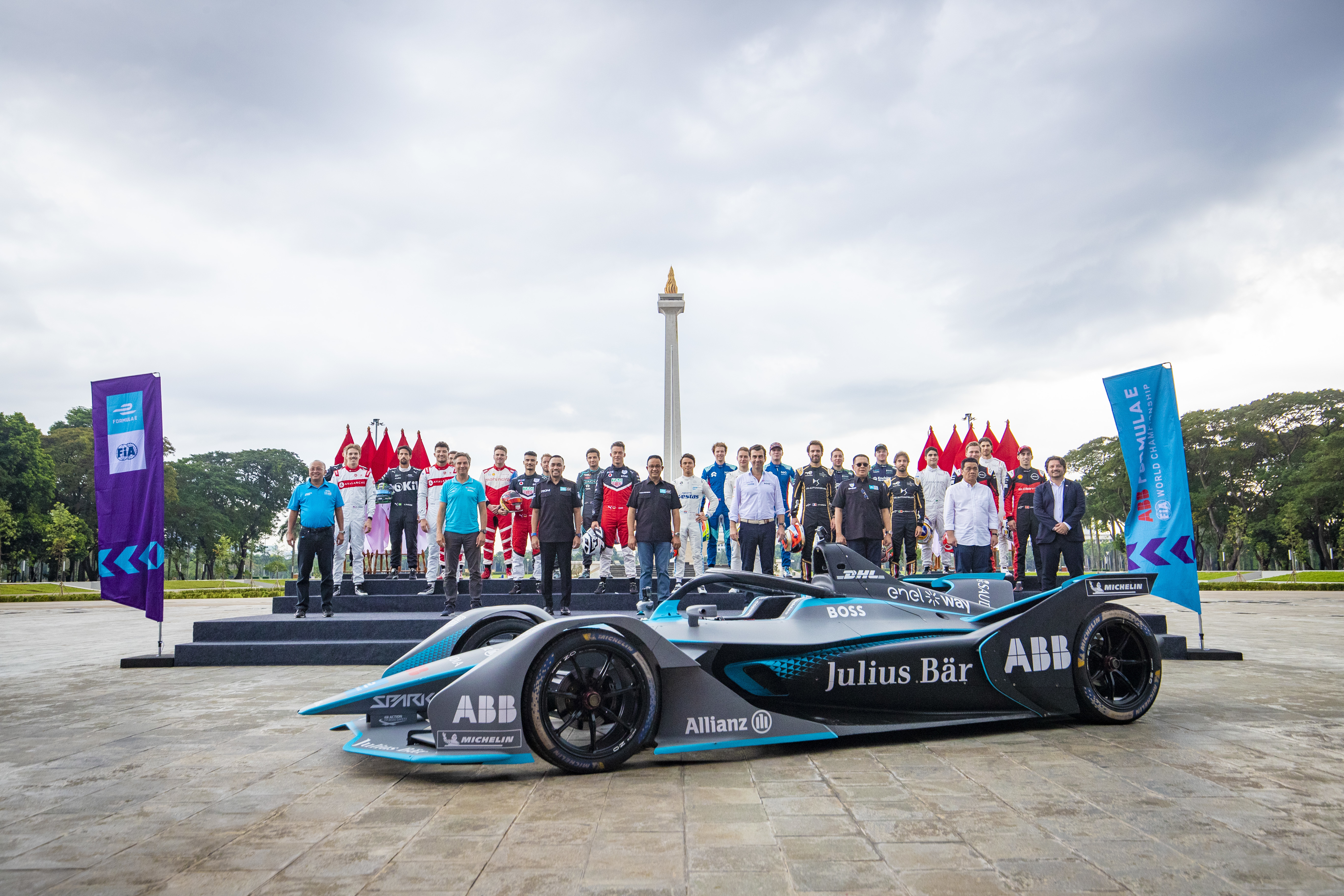
JAKARTA STREET CIRCUIT, INDONESIA – JUNE 02: Anies Baswedan, governor of Jakarta, Ahmad Sahroni chairman of FE Jakarta and Alberto Longo, Deputy CEO and Chief Championship Officer of Formula E with FE drivers during the Jakarta ePrix at Jakarta Street Circuit on Thursday June 02, 2022 in Jakarta, Indonesia. (Photo by Sam Bloxham / LAT Images)

“But I think the point is that in our key markets, UK, for example, we can’t replicate that [the Jakarta model] because we’re not the only sport, look at the clutter of sports this weekend for example [during the London E-Prix weekend].”

“We can’t replicate what happened in Indonesia, but I think I’m quite enthused by what we’re doing in each territory.”

Qualifying format helps drive engagement following COVID-19 reset

The pandemic forced Formula E into a reset, which the championship is now recovering from. On the horizon is Gen3, which makes its debut at the start of 2023.

Motorsport Broadcasting understands that Formula E will have a ‘different look and feel,’ with an overhaul of the championship’s branding on and off-air expected before season 9 and Gen3 arrive in January.

The new generation of electric machinery gives series organisers another opportunity to promote the championship’s green values, and attempt to attract more younger fans in the process, which remains the aim for Dabas.

Dabas says that engagement levels for the series have increased by 30% season-on-season at the half way stage, highlighting the new ‘Duel’ qualifying format as one of the drivers behind this.

“And when I say engagement levels, people are watching for longer and there are two reasons people watch for longer,” Dabas reiterates.

> Insight: The making of the 2021 London E-Prix

“One, which is critical is the sport must be good. You can’t put on a rubbish sport and great coverage and hope that people will watch.”

“Our qualification format has been fantastic this season. So that means that there is competition for top spots, and you can now identify who the top drivers in the championship are, and that’s important.”

“For any sport, and even with cricket we used to say, if the pitches are terrible, you will not get a good match. So, you need to have the sporting conditions right to create a good narrative.”

“Once that is right, your coverage must engage fans. This season, we’ve got a good sports format. The drivers are more recognisable because, we know who the top five or six drivers are, and then the coverage around the world which has meant that people are more engaged.”

“What I’m trying to say is we need to increase the number of people aware of Formula E, bring them into it, but then once they watch it, they need to be hooked onto the product for longer, and we are seeing that’s happening.”

Watching from one of the vantage points in London, it was clear that the television graphics for the Duel format not only worked for those watching as home, but the format also worked for those in attendance.

Every time a gap between two drivers tightened, the ‘oohs’ and ‘aahs’ echoed around the ExCeL, fans rooting behind their favourite drivers, including ex-F1 driver Antonio Giovinazzi, and home hero Jake Dennis.

Not all the metrics are rosy for Formula E: their total audience declined in season 7, although Dabas highlights the increase in live audiences for the championship.

“Season 7 was the foundational season for setting it right, as the distribution deals had all expired. When I came in, we did 40 deals with different broadcasters. Season 8 has been a growth season, 100%,” Dabas believes.

“I know season 5 people say was the biggest season for Formula E but in all honesty when I look at the numbers, we had 97 million live audience then and in season 7 we had 197 million.”

“If you look at the overall numbers people watching the live sport has gone up and that’s what the big sports will talk about. Yes, there was more consumption of highlights and different things, but the live numbers increased.”

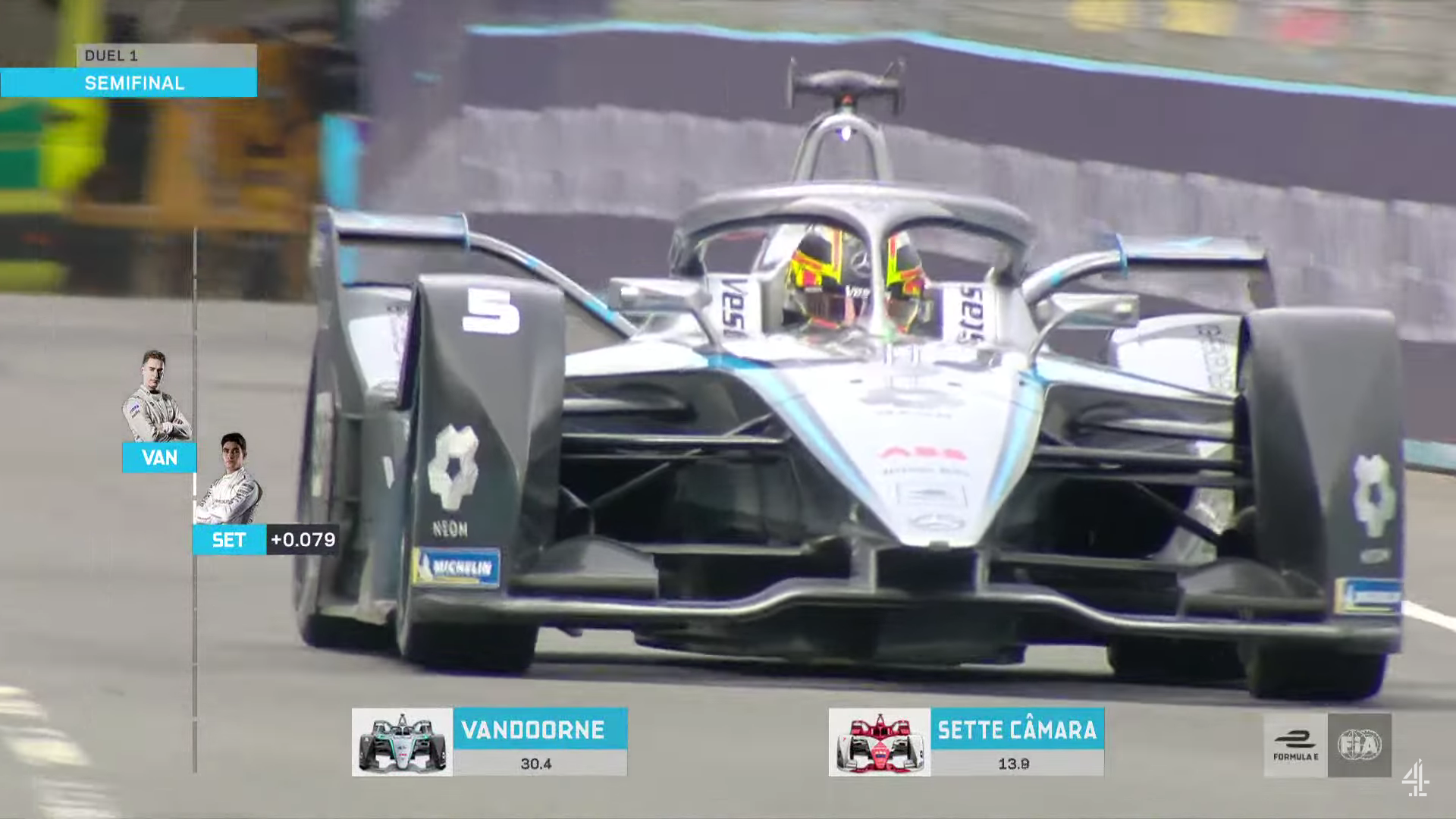
Formula E’s Duels qualifying format, here featuring Stoffel Vandoorne versus Sergio Sette Camara, was a hit with fans in London.

“I think this will probably be our biggest season ever in terms of audiences in our history, and we can only grow from here, no doubt.”

Dabas cites a recent example from the New York weekend, where Dabas met informally with multiple US broadcasters to discuss Formula E’s roadmap moving forward.

“They asked us for meetings because they wanted to know more,” Dabas says. “And that’s a sign for me, having been in this business for 22 years, that there’s market competition, which means that people watch your product.”

“And if people pay decent money for your product, then they invest in marketing it as well.”

“The more you invest, the more you spend on marketing, advertising, creating an awareness and, as we have seen in this country with what Sky Sports has done with Formula 1, if you have an invested broadcaster, that can be a game changer for you.”

Debating the ‘merits and demerits’ of double headers

London was another of Formula E’s double header weekends, an increasingly common feature of the calendar. But while Dabas sees the value in them from a broadcasting perspective, it is not something she believes will be a feature throughout the whole season.

“If you ask within Formula E, we can sit in a pub and talk for hours discussing the merits and demerits,” she says. “I think double headers has its place, but it can be an overkill sometimes.”

“But what double headers does is bring people into the ecosystem on Saturday and then you can give them something more [on Sunday].”

“If you talk to certain broadcasters, some of them have told us this is why they like double headers. You can do a tune in for the next race and there is something more coming up in the inventory.”

> Insight: Behind the scenes with Formula E’s television production team

“On the flip side, who do you say was the winner of New York? There were two winners! I don’t think it’s going to be a success everywhere, and that’s why we pick and choose, and Jakarta is a good case [where it may work].”

“We had 60,000 fans watch and honestly, you could have filled the stands again the next day, there were queues. Where there’s a demand and the narrative works from a sporting perspective, I think we can do double headers but it’s not every location in every city.”

“It’s important that we don’t end up doing 10 races in five locations or 20 races, 10 locations. We must go around the world, we are an FIA World Championship, it’s a mandate that we should be in different continents around the world.”

Provisionally, Formula E’s 2022-23 calendar features 5 double header weekends, with 18 races currently scheduled in 13 locations across 7 months.

London shines despite F1 clash

Both races over the London weekend inexplicably clashed with F1’s Hungarian Grand Prix, which The Race understands was ‘directly specified by Formula E’s TV international broadcast management.’ Sources close to the data suggest that Channel 4’s Formula E audience took a significant hit due to the clash.

Despite the congested sporting schedule which Dabas highlighted, attendance was good, with a near capacity crowd on both days at the ExCeL in London, and room for further growth in terms of activities inside the arena.

The Allianz E-Village was decent for its first year with paying fans at the ExCeL, but there was still a significant amount of unused real estate, which Formula E should look to address in future years.

On the television side, the race weekend aired live on Channel 4, with the Seoul E-Prix set to follow suit. It means that 10 of the 16 races in season 7 have broadcast live on the free-to-air channel, a higher proportion than what the BBC offered during its coverage of the series.

Formula E want ‘channel consistency’ from their broadcast deals, and Channel 4’s offering this season has helped move the series in that direction from a UK point of view. Although the BBC offers a wider reach than Channel 4, Dabas argues that the latter is a better fit for Formula E.

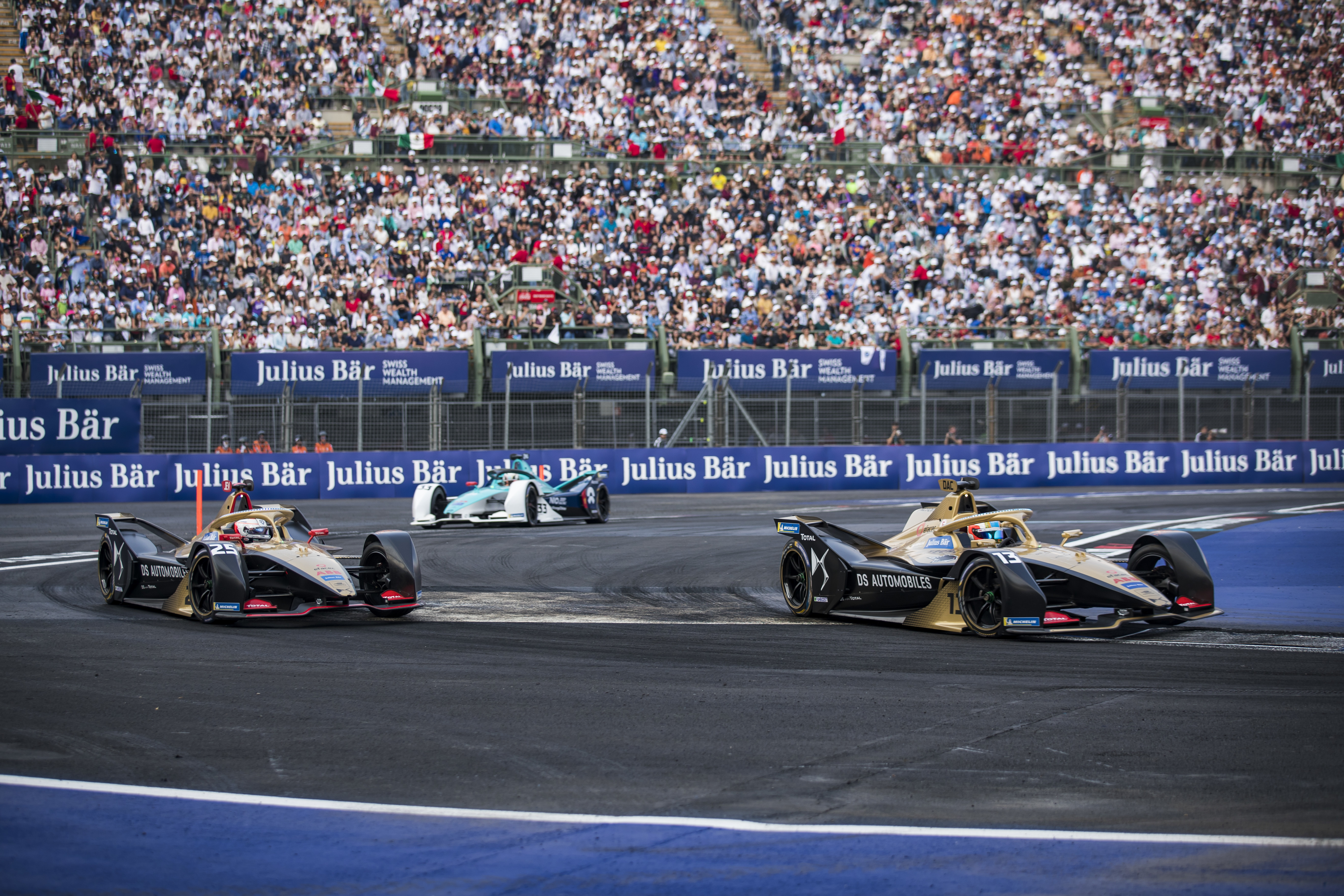
AUTODROMO HERMANOS RODRIGUEZ, MEXICO – FEBRUARY 15: Antonio Felix da Costa (PRT), DS Techeetah, DS E-Tense FE20 leadsJean-Eric Vergne (FRA), DS Techeetah, DS E-Tense FE20 during the Mexico City E-prix at Autodromo Hermanos Rodriguez on February 15, 2020 in Autodromo Hermanos Rodriguez, Mexico. (Photo by Sam Bloxham / LAT Images)

“Everyone when I joined said that the BBC is the best platform to be on [for Formula E]. But the reality is the best platform for us is where we have audiences that match our sport.”

“And if you look at all the free-to-air broadcasters, Channel 4 is probably the one that has that match. The shows they have are quirky, its progressive.”

“I speak to the Head of Programming [at Channel 4] and they love us, they’re like, you’re in and performing and you’re doing a great job. And that, for me is like an indication that we’re doing okay. We are happy with them; the partnership is solid.”

“We started last year and the product is getting better, we’re getting more races on Channel 4 than we had on BBC. And for us that visibility in our core market is important.”

Dabas also points out that Channel 4’s Formula E coverage skews younger than their F1 offering. Figures for the British Grand Prix showed that around 12% of Channel 4’s F1 race day audience were aged between 16 and 34.

“Channel 4 tells us that the audience we get for Formula E is much younger than Formula 1, and that’s an important data point for us because they carry both.”

“How do we then reach that audience is important. In Indonesia it may have been RCTI, here it’s Channel 4 and maybe in one years’ time it may be a streaming platform, I’m just saying that we have to go where the audience is and that’s really important.”

Sport ‘no longer only free-to-air reliant’

What the future looks like from a distribution perspective in the medium-term is unclear, with the streaming picture ever evolving.

And, according to Dabas, free-to-air is no longer as important as it once was, although it still plays a crucial part within the overall picture.

“I think it’s hard to ignore the streaming platforms,” Dabas believes, “and, it’s not just Amazon and Netflix. Look at what is happening with Warner Bros. Discovery with the merger. In India, for the first time for IPL, the digital rights are more expensive than broadcast rights.”

“And ultimately, I look at my daughter, she doesn’t watch TV. If we say we’re a sport for the future, we must see what the right balance is. Free-to-air is still in the picture. But I think we’ve moved on from a sport which is only free-to-air reliant, to a sport where maybe our primary carriers could become streamers in the future.”

“I think we still need the free-to-air to get the audience in, but with a deepened engagement and the products we can offer, and the coverage, maybe the streamers can help us over there, so it’s really important for us.”

“And when I say streamers, it’s not about getting someone to pay $2 for it. I don’t want to put Formula E behind a subscription pay wall. I think many sports have learned that there’s very few fans who sign up particularly for just one sport, it’s better to be in a consolidated platform, which exists with Paramount+, there’s Peacock in the US, there’s Apple.”

“Apple’s done a great deal with MLS, so we just need to look at where the market is heading. But more importantly, where are our fans consuming this sport.”

The season 7 season finale airs this weekend, live on Channel 4 on Saturday 13th August and Sunday 14th August from 07:30.

Contribute to the running costs of Motorsport Broadcasting by donating via PayPal. If you wish to reproduce the contents of this article in any form, please contact Motorsport Broadcasting in the first instance.