The sentence “There won’t be another one like…” is a frequent one whenever someone passes. But, in that case of Eddie Jordan, that sentence really is true. Jordan was one of a kind within Formula 1, both for his role as team owner and later television analyst.
As team owner, Jordan built his team from the ground up from their base near the Silverstone race track. Over 14 years, the team secured two pole positions and four race victories, most famously clinching their first victory in the 1998 Belgian Grand Prix, with Damon Hill leading home a team one-two.
The following year, Jordan nearly went one better. German driver Heinz-Harald Frentzen remained in the Drivers’ Championship fight for most of the season, fighting with McLaren and Ferrari, before reliability got the better of the Jordan. Nevertheless, it showed that on their day, Jordan could fight with the bigger F1 outfits despite running at a financial deficit in comparison.
Most obituaries today will naturally focus on Jordan’s success as team owner. But while the Jordan name disappeared from the pit lane gantry in 2005, Jordan as a paddock figure remained. In 2008, the BBC announced that Jordan would form part of their broadcast team for the 2009 season. But, hang on.
Eddie Jordan wasn’t an F1 journalist.
Eddie Jordan wasn’t an F1 driver.
What can Eddie Jordan contribute to the BBC’s F1 television output, I hear you say? Quite a lot, as it would turn out. Since Murray Walker retired in 2001, F1 was missing something on the small screen when it came to wrap-around coverage. The coverage was informative and interesting, but was missing a key ingredient.
Jordan formed the BBC’s leading trio alongside Jake Humphrey and David Coulthard, instantly turning the broadcast into one that was informative, interesting, and entertaining. Jordan injected humour, colour, personality, and opinions all in one go into the television coverage, aided by Humphrey, Coulthard, and the remainder of the BBC team.
When Jordan spoke, you listened. You laughed. Maybe you cried with laughter because he said something so unbelievably silly that later turned out to be true. Jordan’s sources were impeccable, a goldmine for the Beeb and an incredible asset to them. Who knew an ex-team owner would hold all the keys to the driver market?
The thing about Jordan was that his viewpoints felt opinionated without malice. You may disagree with him on occasion, but there was never a feeling of ill will. Instead, the Irish smile and character peered out from behind the discussion, as the presentation team mulled over the paddock gossip.
The BBC created a winning formula, which other broadcasters have struggled to replicate, and maybe that’s because you can’t. Luckily for the Beeb, the right people were available at the right time, in the right circumstances. It is a formula or presentation team that has never been bettered. Jordan was a brilliant team owner, and an equally brilliant TV pundit who entertained millions, race in, race out.
Jordan stayed with the BBC until their F1 television coverage ended in 2015, moving over to Channel 4. He remained close to both Coulthard and Humphrey, creating the Formula For Success podcast with the former in more recent years. His influence on paddock life remained, even as he battled an aggressive form of prostate cancer.
If Team Silverstone with Adrian Newey takes Aston Martin to the front in 2026, there is one man primarily responsible. His name is Eddie Jordan. Sadly, he will not be there to witness it in person, only in spirit.
Rest easy, Eddie.
Tributes to Eddie Jordan
David Coulthard: “Eddie Jordan was a force to be reckoned with beyond what anyone could expect in Formula 1. He was a gift to Formula 1 & he was a gift to Ireland. You never knew quite where his madness would take you next, but you always got there with a smile on your face. There will be endless people telling Eddie Jordan stories as long as there is still Formula 1 around. It has been an honour calling him and friend & all of our love to his family & his four children, Mikki, Zoe, Kyle & Zak”
Jake Humphrey: “His greatest achievements were Mikki, Zoe, Kyle and Zak. His incredible 4 kids who share his spirit. His wife Marie is one of the strongest, most wonderful women I have ever met. The 4 years we spent together hosting F1 on the BBC were greatest of my career. Wing-walking, scooter riding, car driving madness that I know he loved deeply. His incredible spirit and love of life lives on in me, and my children who were lucky enough to meet him and hear all about him. Eddie lit up a room whenever he entered it. That is a lesson for us all – be the light in the room. I was lucky enough to share one final, cherished meal with him and his boys a few months ago. It was special. We talked about me doing one final interview with him. Sadly that will never happen. As I left his final words were ‘I love you brother’. One of the 3 Amigos is gone. The world seems a little less bright this morning. He’s busy playing spoons in the sky ❤️”
Martin Brundle: “RIP my friend. Condolences to each and every one of your lovely family. What a character. What a rock star. What a racer. So many drivers owe you so much, you gave us our chances and believed in us. 🥲
Lee McKenzie: “There will never be anyone like him. A true friend. Thank you for everything EJ 💚🍀”
Christian Hewgill, the star of two Formula 1 podcasts, has been a fan of the sport since childhood, first getting into the sport in 1998 as Hakkinen and Schumacher battled for glory on-track.
But, for the man who grew up near Loughborough, the idea of stepping into the glitz and glamour of the Grand Prix world felt a “million miles away.”
“As much as I thought it would be a great thing to do, I just didn’t think it would be possible,” he tells me over a sit-down interview. “I’ve been brought up by working class people, I went to a non-fee-paying council run school and Formula 1 just seemed a million miles away.”
Karting was Hewgill’s first route into motor sport, however this quickly fell by the wayside, owing to the lack of funds “more than anything else.” At this point, Hewgill was also beginning to appreciate another part of sport: broadcasting, looking up to the likes of Jim Rosenthal and Steve Rider who presented motor sport at the time.
“I went to university and did a degree in Broadcast Journalism and at that point the aim was a career working in local radio because that’s what I thought was realistic.”
Joining the Newsbeat team
His breakthrough came with the BBC, where he spent ten years across various outlets, including Radio 1’s Newsbeat team. The outlet aimed to take younger people closer to the stories that mattered to them. Each week, the station aired a variety of different stories, from Eurovision to F1.
“I was pretty happy doing news and sports as a career at the Beeb, but I’ve always been a massive motor sport fan because of karting.”
“And one of the brilliant things that Newsbeat did at the time was encourage us to pitch stories about things we were interested in,” Hewgill explains. “They employed a young and very diverse team, and therefore, they got quite a diverse selection of stories. At its heart, Newsbeat featured young people doing cool things, and that’s what F1 is.”
Hewgill joined the 5 Live team as part of Newsbeat at the 2019 British Grand Prix, and it was only then that he realised that this could turn into a career.
“Formula 1 had always been a bit of a side passion that I enjoyed away from work. I didn’t know how I would feel about that becoming my job, but it was that weekend that made me realise, maybe I want to do more of this. That was the light bulb moment.”
Interest continued to increase, culminating in Hewgill presenting Newsbeat live from the Bahrain paddock in 2022. From “barely getting an F1 package” on Newsbeat back in 2017, Hewgill was now presenting a live F1 programme on Radio 1 from Bahrain just five years later. It was a weekend that changed Hewgill’s professional career for the better.
Brief spells with LBC and talkSPORT followed for Hewgill as Newsbeat relocated to Birmingham in the summer of 2022 but for him, the love for covering news had faded.
“I loved doing Newsbeat and I’m so grateful for the first 10 years of my career. But talking about the news all the time [for 10 years] had started to drain on my mental health, the negativity, the tribal approach that news has got towards politics. I did lose the love for it,” he says.
“And then it was like, what else do I do? I’m not particularly academic. Doing daily news and sports is all I’ve ever done. The only other thing I know and am truly passionate about is Formula 1.”
Presenting Newsbeat live from the F1 paddock posed its own challenges, but one that made others curious, including a certain Radio 1 DJ….
Introducing The Fast and The Curious
…even if, originally Greg James was going to have an off-mic role on The Fast and The Curious!
“The plan was always for me to present with someone else,” Hewgill reveals. “He’s an incredibly humble bloke, bless him. And he said that he presents enough stuff as it is, so Greg had talked about him potentially not being on the podcast. He really wanted to executive produce and build something from the ground up.”
Plans quickly changed once the two of them realised how well they “bounce off each other,” owing to their friendship stemming back to the days of working together at Radio 1. The pair of them wanted the new F1-themed podcast, which was James’s idea to begin with, to highlight the lighter aspects of the sport, that other podcasts do not cover as often.
“It was incredibly collaborative, discussing what isn’t out there and what can we bring that’s different? I didn’t feel that there was a podcast that lent into the humour of the sport and the silliness of the sport because the sport is mad!”
“This travelling circus that goes around the world, there’s so much humour and funniness to it. I didn’t think there was a podcast that lent into the, for want of a better word, the Drive to Survive era, in that there were more and more people coming into F1 who knew a bit, but didn’t know loads.”
“Some of the sports podcasts I listen to, they’re all football experts, they’re all F1 experts,” notes Hewgill, citing The Monday Night Club and The Race’s F1 podcast as podcasts he enjoys, but not necessarily tailored towards the casual fan.
“All the sports podcasts I’d listened to were all a panel of experts. One of Greg’s big mantras is you can love sport in whatever way you want to love it. You don’t need to be a fanatic and know everything.”
Betty Glover, nominated for 2023 Women’s Sports Journalist by the SJA, joins Hewgill and James on the podcast.
“Betty is a phenomenal sports broadcaster, but by her own admission was only just falling in love with F1,” Hewgill tells me.
“She was new to it and we wanted the audience to go on that journey with her. Betty has been amazing because she thinks to ask different questions that I do. Stuff that’s obvious to me isn’t obvious to her.”
The three are genuinely friends both on and off-air, with Hewgill’s and Glover’s friends thanks to Newsbeat: the two presented coverage of the Winter Olympics together.
“It’s the first time I’ve come off the air and gone ‘I really like being on the radio with her,’ she’s such a funny and infectious personality. I wanted to work more with her and wanted to develop that relationship on air with her.”
A successful first season
But how did the three turn an idea into a reality? Most drivers tend not to come out their shell in the media pen interviews, instead sticking to pre-rehearsed lines about the race weekend.
“Some people say that motor racing drivers are quite dull, I couldn’t disagree any more. Motor racing drivers are fascinating,” Hewgill believes.
Arguably, one of the reasons The Fast and The Curious has been as successful as it is because they have curated content away from the pressure cooker of a race weekend, giving racing drivers and team personnel alike the platform to be open about themselves.
To help achieve this, he admits the team did carefully craft some of the first season in 2023, but for very good reason, with both McLaren, Williams, and Alpine drivers’ regulars.
“We quite carefully went after some of the drivers we thought would be good fun. We wanted to have fun with them and they seem to have enjoyed being on it. The teams have been very receptive to what we’ve done in terms of, we’re trying to celebrate the sport in a different way and have some fun with it.”
“The reaction has been so warm from people within the sports. I think we expected a degree of stiffness a bit ‘who the hell are these guys.’ People have been so warm and friendly which has been lovely. All we’re trying to do is celebrate the sport and celebrate the drivers.”
With 64% of The Fast and The Curious’ audience female, and most of their audience in the aged between 18 to 29, it is fair to say that the show is attracting F1’s most sought after demographic.
“It’s all very well seeing numbers on spreadsheets, whenever you’ve been in broadcasting for long time, you know when something’s working because you get that interaction and the warmth for the audience, which has just been amazing.”
Throughout each episode, the team have always tried to be themselves, something that came across in their interview with seven-time champion Lewis Hamilton prior to the start of the 2023 season.
Hamilton has been supportive of LGBTQ+ rights with his rainbow helmet on display at various races during the past few seasons with Mercedes, as well as continuing to promote diversity and inclusion within motor sport.
Both topics are of importance to Hewgill, himself a gay man and one of Racing Pride’s ambassadors.
“Throughout my broadcasting career, I’ve always tried to be myself. I’m no good at pretending to be anyone else, and coming out as gay made me realise that,” he says.
“I spent many years trying to compress that and trying to be someone else, it made me deeply unhappy. Some people switch to an on-air persona, I just can’t do that. I am gay, it crops up in conversations sometimes, like Greg’s wife Bella sometimes does, and Betty’s boyfriend Alex does. We wanted the podcast to be authentic and I think we’ve achieved that.”
“When we interviewed Lewis, I was keen to say that as a gay guy it means a lot to me that he does go out and takes the stances that he does. I didn’t expect that me saying that to him at the end of the interview to resonate across on social media on TikTok, Twitter and Instagram.”
“And that was just through me being honest, so it does make a difference. We’re just trying to be ourselves through all of our podcasts.”
Hewgill’s Bahrain 2022 gig with Newsbeat was also the springboard for his second F1 adventure, this time with F1’s in-house team, presenting their podcast series F1 Explains alongside Katie Osbourne.
“F1 liked the Newsbeat approach to tackling F1: I was trying to explain it as I went along, and they were keen to work together on something,” he says.
“Chris Browning-Brant, who has gone on to be my editor on F1 Explains, said to me, ‘I heard the Bahrain programme and we were going to get into touch with you’, and I got in touch with them, and so the paths crossed naturally.”
“F1 didn’t feel they have a podcast that properly explains the sports and not just a new audience, but to more established audiences as well.”
The podcast explains the key terminology that fans hear race-to-race, such as explaining the intricacies of the Drag Reduction System (DRS). As well as hearing from the drivers, the podcast features “strategists and engineers and people who you don’t normally hear from.”
“There’s such a big wide world that exists in Formula 1 and we wanted to explain the sport in detail, and shine a light on some of the voices you don’t necessarily get hear from, very similar to The Fast and The Curious, it’s been so warmly received.”
“This year so far, all the episodes have been listener based because we’ve had so many questions from people saying ‘so can you explain this,’ and I’m sat there going ‘I’d never have thought to have done that, what a great idea that is.’ The fact that people are engaging with it is lovely.”
“Whether you’re a new fan or someone who’s been watching for decades like me, I’m convinced you learn something every episode.”
Hewgill has no regrets on his broadcasting journey so far.
“I’m in the happiest place I’ve ever been in my professional career because I just love making both of them. I feel very lucky with them,” he tells me.
“I said at the start of this interview, I felt a million miles from a Formula 1 paddock where I was growing up. I genuinely believed as a kid that you couldn’t be gay and be a professional sports broadcaster. Hopefully I’ve shown that it is possible to be LGBTQ+ and a motor racing presenter, and that’s really important to me.”
“I just want to enjoy it while it lasts, however long that is.”
After an off-season that no one expected, F1 roars back into life for a marathon 24 race season beginning later this month.
For fans worldwide, and for those involved in the sport, 2024 will have an unusual feel right from the get go. The opening race takes place in Bahrain on March 2nd, not only the earliest start to a season since 1992, but also the first Saturday start since 1982! Likewise, Saudi Arabia takes place on a Saturday just one week later, both changes due to Ramadan.
From there, F1 heads to Australia, Japan, and China. Japan moves up the calendar from September to April, while China returns to the calendar for the first time since 2019. The first race that takes place in a European lunchtime slot is not until Imola on May 19th.
Despite the record 24 race season, the championship does incredibly well to avoid a clash with the 24 Hours of Le Mans, the football European Championships and the Wimbledon tennis finals. Only the Belgian Grand Prix faces a major clash, facing the opening weekend of the Paris Olympics.
The year concludes with a triple header, beginning in Las Vegas on Saturday 23rd November and finishing in Abu Dhabi on December 8th which, thankfully, avoids the MotoGP finale this year.
Fan interest dipped during Verstappen’s dominant year
2023 was unquestionably Max Verstappen’s and Red Bull Racing’s year, in one of the most dominant displays by a single driver and team combination that F1 has ever seen.
Verstappen’s supremacy impacted worldwide interest in the sport, creating a mixed picture overall. Despite this viewing figures in the UK held up well compared to their neighbours. During 2023, Sky’s F1 channel reached 3.40 million viewers per month, a dip of 6% compared to the 2022 monthly reach figure of 3.62 million viewers.
It was a tale of two halves compared with 2022 for Sky: a poor spring followed by a good recovery through the summer and autumn. Audience figures slumped by 17% and 25% during April and May respectively, hindered by a disjointed start to the season thanks to the cancellation of the Chinese and Emilia Romagna rounds.
Nevertheless, audience figures rebounded by the summer, with increases in July (+5%) and September (+7%) and only marginal decreases in October (-5%) and November (-3%). Although Verstappen wrapped up the championship by early October, other stories such as McLaren’s resurgence and the inaugural Las Vegas Grand Prix kept fans engaged in Sky’s programming.
While it is fair to say that attention has dipped since the dramatic 2021 season, interest in the sport remains good in the UK and above the levels seen prior to the COVID-19 pandemic. Audience figures also decreased slightly in the US, however the season remained the second most viewed ever stateside, only behind 2022.
Ahead of the 2024 season, Sky Sports have created ‘The Greatest Track on Earth’. Generated using AI technology and voted on by the fans, the circuit brings together some of F1’s historic turns into one location. Above: The Castle Section for the Baku City Circuit, Azerbaijan. Image Credit: Sky Sports.
Over 1 million viewers continued to watch F1 in France on Canal+, however audiences held up less well in Germany and Austria, according to data supplied to Motorsport.com. Austria’s average audience across two networks dropped by around 12%, while Sky’s average audience in Germany decreased by 21%, dropping from 740,000 to 593,000 viewers.
More races, more social responsibility for broadcasters
Sky and Channel 4 return as the two broadcasters airing Formula 1 on television in the UK, now in their 13th and 9th season respectively. Every race will air live on Sky and in highlights form on Channel 4, the latter also covering the British Grand Prix weekend live across the weekend of July 4th to 6th.
As well as winning the Formula E production contract during the winter break, Whisper retained the contract to produce Channel 4’s free-to-air F1 offering, with their new agreement stretching until the end of 2026.
Motorsport Broadcasting understands that Whisper faced tough competition from North One Television, who previously produced F1 for ITV and currently produce TNT Sports’ MotoGP coverage, with the incumbent winning out.
But this year, Whisper’s offering will look a little bit different on Channel 4, as broadcasters seek to increase their focus on sustainability while cutting costs across the board. Late-night highlights for races such as Brazil, Mexico, and Miami, will air from “an innovative, immersive studio location,” believed to be the F1 Arcade space in London.
Over on Sky, this site has learnt that coverage of the Australian, Chinese, and Japanese race weekends will come from London, with only a small team travelling to the events, like how ITV covered some fly away races during their period airing F1 live. It will be the first time ever that Sky have not had an expansive presentation team on-site.
They are not the first major production to do this, with recent examples (outside of C4 F1) including ITV’s Rugby World Cup coverage where the lead broadcaster has opted to present coverage from their “interactive, mixed reality studio” in the UK, while retaining some on-site presence at the same time. Sky did not comment on the change as of writing.
All details for Sky Sports F1 unless stated.
Wednesday 28th February 15:00 to 16:00 – The F1 Show: Season Preview
Thursday 29th February 11:00 to 12:55 – Practice 1 (also Sky Sports Main Event) 14:35 to 16:15 – Practice 2 (also Sky Sports Main Event) 16:15 to 17:15 – The F1 Show (also Sky Sports Main Event)
Friday 1st March 12:15 to 14:10 – Practice 3 (also Sky Sports Main Event) 15:10 to 18:00 – Qualifying (also Sky Sports Main Event) 18:00 to 18:30 – Ted’s Qualifying Notebook (also Sky Sports Main Event) 19:30 to 21:00 – Qualifying Highlights (Channel 4)
Saturday 2nd March 13:30 to 18:30 – Race (also Sky Sports Main Event from 14:30 to 17:00) => 13:30 – Grand Prix Saturday => 14:55 – Race => 17:00 – Chequered Flag => 18:00 – Ted’s Notebook 19:50 to 22:20 – Race Highlights (Channel 4)
The full UK TV schedule for the 2024 Bahrain Grand Prix.
Alongside Sky’s F1 coverage, the F1 channel will also air Formula 2, Formula 3, the F1 Academy series, and IndyCar live this year. Formula 2 and 3 begin in Bahrain from March 1st, whilst F1 Academy and IndyCar kick off their campaigns a week later.
F1 Academy will also air live worldwide on YouTube, with Nicki Shields, a name fans may recognise from Formula E, leading the commentary line-up alongside Alex Brundle and Jordan King.
Both Sky and Channel 4 field largely unchanged punditry line-ups, with Simon Lazenby and Steve Jones leading Sky’s and Channel 4’s outputs respectively. David Croft and Martin Brundle will continue to commentate on Sky’s offering, with Channel 4 taking F1 TV’s commentary line-up featuring Alex Jacques, Jolyon Palmer, James Hinchcliffe, and David Coulthard.
For the first time though since Sky began broadcasting F1, Croft will not be part of their coverage for three races this season, with Harry Benjamin becoming Sky’s lead commentator for the Emilia Romagna, Austrian and Azerbaijan race weekends. Commenting on the change, Croft said “It’s more about keeping fresh for the whole season. I’m not getting any younger.”
In an interview with The Independent, he added “I’ve given up and sacrificed a lot for my career. I want to give a bit of time back to my family and not be on the other side of the world. I’m getting married this year as well, so I’ve got a wedding to organise!”
“But I also want to sit and watch a race at home. I want to enjoy it. Maybe I can learn something by not commentating on a race. I can spot a few things when I’m watching – I want to see what the viewer sees.”
BBC’s Radio 5 Live coverage of F1 continues, the station celebrating 30 years on the air this March, F1 forming part of its line-up during each of those years, with coverage of every session airing across BBC Radio 5 Live, 5 Live Sports Extra and the BBC Sport website.
RTL returns to the free-to-air folder whilst F1 increases the DTC prices
Meanwhile in Germany, F1 returns to free-to-air television as part of a sub licencing deal agreed between RTL and Sky. While Sky will continue to air every race live, RTL will also air 7 races live and 12 qualifying/sprint sessions live. Their old presentation team, including pit lane reporter Kai Ebel and presenter Florian König return, as well as former Haas team principal Guenther Steiner.
“For us, Formula 1 is an absolute highlight. The 30-year success story at RTL is directly linked to Florian König, Kai Ebel, Heiko Wasser and Christian Danner. Together with Laura Papendick we have the perfect grid for our motorsport fans,” explained Andreas von Thien, Head of Sports at RTL. “We are therefore very pleased that they are all at the start again!”
> Wonder how F1 TV is made? Take a look at Motorsport Broadcasting’s in-depth analysis behind the scenes at Biggin Hill (part 1, part 2, part 3) as well as our analysis comparing F1 TV and Sky F1.
Over in the direct-to-consumer space, F1 has made their first significant price changes since launching the platform in May 2018, with the cost increasing in multiple territories.
In the Netherlands, the yearly price of F1’s premium tier service, F1 TV Pro, has increased by €30.00 from €64.99 to €94.99, a 46% rise. To the north of Netherlands, in Norway, the price has increased from by a similar amount, with rises also seen in territories such as the US, France, Poland, Brazil and Canada.
Justifying the price rise, F1 themselves have noted that one reason for the price rise is that there are more races in 2024 compared to previous seasons. Responding to fans, the series says “We continue to focus on making F1TV even more valuable to fans. We have increased the number of races from 22 races in 2023 to 24 in 2024, making this the biggest season ever!”
“We are also introducing F1 Academy along with more in-depth shows and a fantastic new interface,” the message concludes.
Although price rises are understandably frustrating, on a per race basis, the cost remains very small considering the content that fans get in return. The most expensive F1 TV price in each territory is likely still cheaper than the cheapest price for MotoGP’s Video Pass, which costs fans €199.99 worldwide.
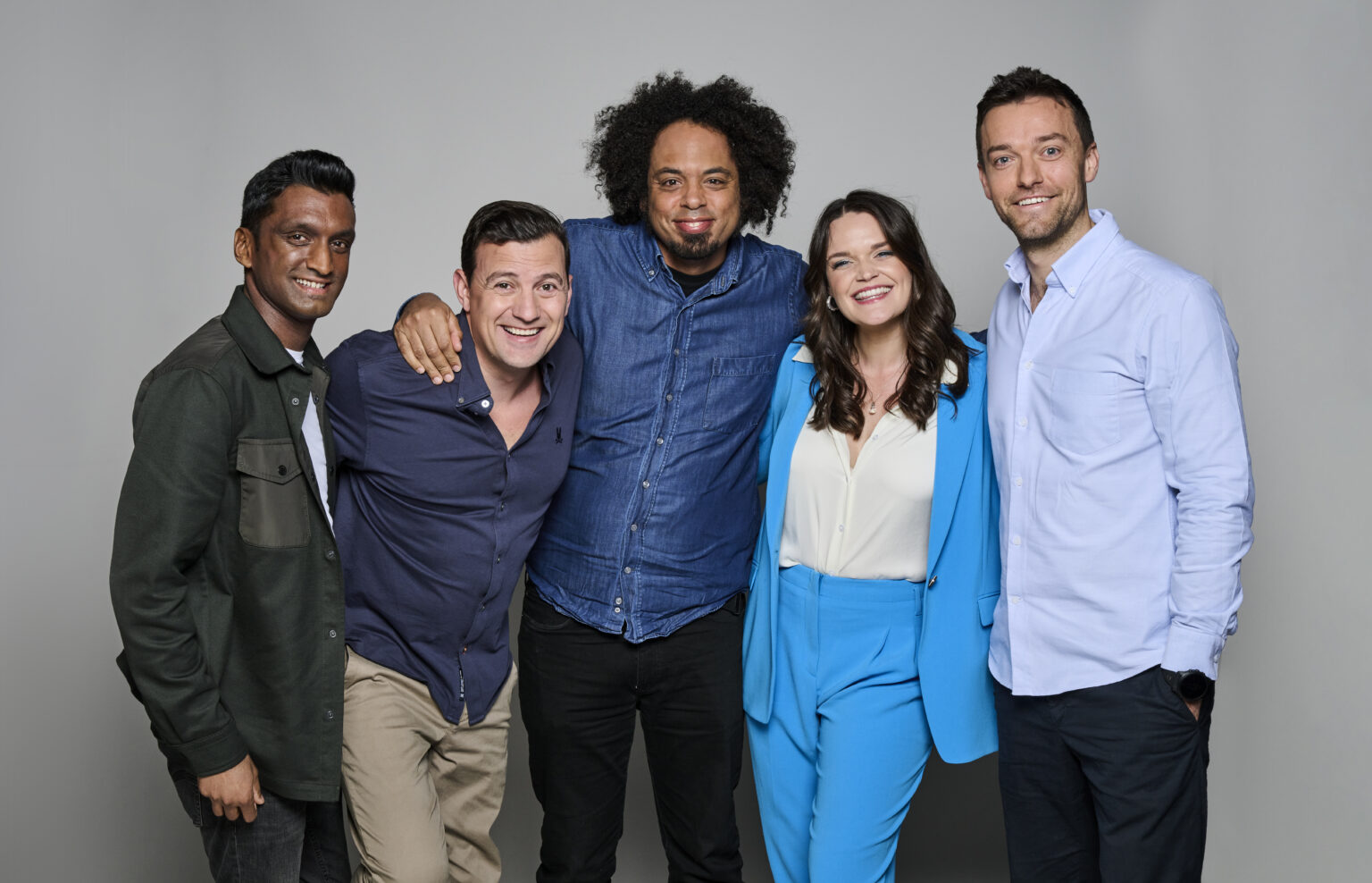
The F1 TV team, from left to right: Lawrence Barretto, Will Buxton, Sam Collins, Laura Winter and Jolyon Palmer. Image Credit: F1.
Announcing their plans for the new season, Will Buxton and Laura Winter return as F1 TV’s lead presenters, with the in-race commentary line-up identical compared with last year, led by Alex Jacques.
Jacques will also continue his Formula 2 duties alongside Alex Brundle, while Chris McCarthy returns for his first full Formula 3 season as lead commentator. Experts, including Brundle, former race engineer Julien-Simon Chautemps and 2012 GP2 Series champion Davide Valsecchi will join the core F1 TV team throughout 2024.
For UK fans, F1 TV Pro is still inaccessible, meaning that the only way for fans to watch every race live in 2024 is via Sky Sports F1. Nevertheless, fans in the UK can access the vast archive as well as F1 TV’s supplementary content during a race weekend, such as their pre-race and post-race analysis and Tech Talk segments with Sam Collins.
Into the podcasting world
After a successful first year, The Fast and The Curious podcast continues into 2024. Fronted by Greg James, Betty Glover and Christian Hewgill, the podcast series aims to shine light on F1 from a different perspective.
The trio between them had many high profile F1 guests on the podcast during 2023, including both McLaren stars Lando Norris and Oscar Piastri, and seven-time Drivers’ Champion Lewis Hamilton.
“We wanted to try and create a podcast that didn’t already exist,” explains Hewgill. “And for us the key to that was humour, it was making a bit of a community like Greg’s [Radio 1] breakfast show does so well. It was bringing people on the journey and that was where Betty really came in because she is a sports fan, but was only just starting to know and learn and love Formula 1.”
“I didn’t feel that there was a podcast that lent into the humour of the sport and the silliness of the sport, because the sport is mad! This travelling circus that goes around the world, there’s so much humour and funniness to it. I didn’t think there was a podcast that lent into the, for want of a better word, the Drive to Survive era, in that there were more people coming into F1 who knew a bit, but didn’t know loads.”
“Some people say that motor racing drivers are quite dull, I couldn’t disagree any more. Motor racing drivers are fascinating.”
2024 promises more of the same from the podcast and, already as of writing, the show has featured both Williams drivers, triple F1 drivers champion Sir Jackie Stewart, Toto Wolff, George Russell and, yes, even having a dinner date with Karun Chandhok!
Away from The Fast and The Curious, Hewgill’s other podcast vehicle, F1 Explains returns, Hewgill presenting alongside Katie Osbourne, the show helping to explain F1’s nuances to newer audiences of the sport.
Thursday 29th February 11:25 to 12:35 – Practice 1 (BBC Radio 5 Live Sports Extra) 19:30 to 20:30 – Bahrain Grand Prix Preview (BBC Radio 5 Live) 14:55 to 16:05 – Practice 2 (BBC Radio 5 Live Sports Extra)
Friday 1st March 12:25 to 13:35 – Practice 3 (BBC Radio 5 Live Sports Extra) 15:55 to 17:05 – Qualifying (BBC Radio 5 Live Sports Extra)
Saturday 2nd March 14:45 to 17:00 – Race (BBC Radio 5 Live Sports Extra)
The full UK radio schedule for the 2024 Bahrain Grand Prix.
You might be thinking, quite rightly, why podcasts are continuing to proliferate the motor racing world. Analysis released last month by YouGov shows that podcasts are most popular with those in the 18 to 34 demographic, the same demographic F1 is attracting thanks to Drive to Survive.
Sky Sports’ in-house F1 podcast returns this year, with Matt Baker continuing to lead the podcast alongside a range of guests from their F1 team and beyond. Also returning is the BBC’s usual post-race output Chequered Flag.
A pre-season addition for the Beeb this year has been the launch of a standalone eight-part podcast series. Narrated by actor Joseph Fiennes, F1: Back at Base series takes fans behind the scenes of the Mercedes and Williams team from the chequered flag in Abu Dhabi last year through the off-season and into lights out for F1 testing.
The launch of the BBC’s new podcast series is their latest effort in the F1 world, following the series in late-2022 analysing the Spygate scandal in Sport’s Strangest Crimes across ten episodes. Expect more podcasts from the likes of Autosport, The Race and P1 with Matt and Tommy as 2024 progresses.
For the second year running, The Race Media has opted to overhaul their WTF1 brand. Content creators Amber Jones and Haydon Gullis will lead the brand this year, with the company saying that now “is right to relaunch the brand, creating the perfect platform for new and younger fans to engage with motor racing.”
“We’re all looking forward to this brave new era of WTF1, Haydon and Amber work fantastically together and our fan first approach to F1 will be central to the content we’ll be releasing over the coming weeks and months,” explained Tim Silvey, Head of Talent for WTF1.
“We have significant plans for channel growth and look forward with renewed enthusiasm to this new iteration of the brand.”
The challenge for anyone generating F1 content this year worldwide, whether that be broadcasters or podcasters alike, is to keep fans engaged throughout 2024. And, based on the early evidence from testing, that might be a challenge.
Can someone take the challenge to Max Verstappen and Red Bull, or will the Dutchman take his fourth Drivers’ Championship in a row? It is time to find out…
Article last updated on Monday 26th February, with a further update made on Wednesday 6th March covering F1 Academy’s coverage plans.
Covering the world’s fastest motor sport across 24 race weekends is no easy feat. The twists and turns, come rain or shine, are covered meticulously by Formula 1’s production team week in, week out.
At the start of July, Motorsport Broadcasting was invited to F1’s revamped Media and Technology Centre as part of an F1 media day, giving us a glimpse behind the curtain. In the first part of a series of articles, we look at the tools at F1’s disposal for storytelling…
The snap decisions that decide what fans watch at home are made by a group of people on the outskirts of London, England, in F1’s Media and Technology Centre at Biggin Hill.
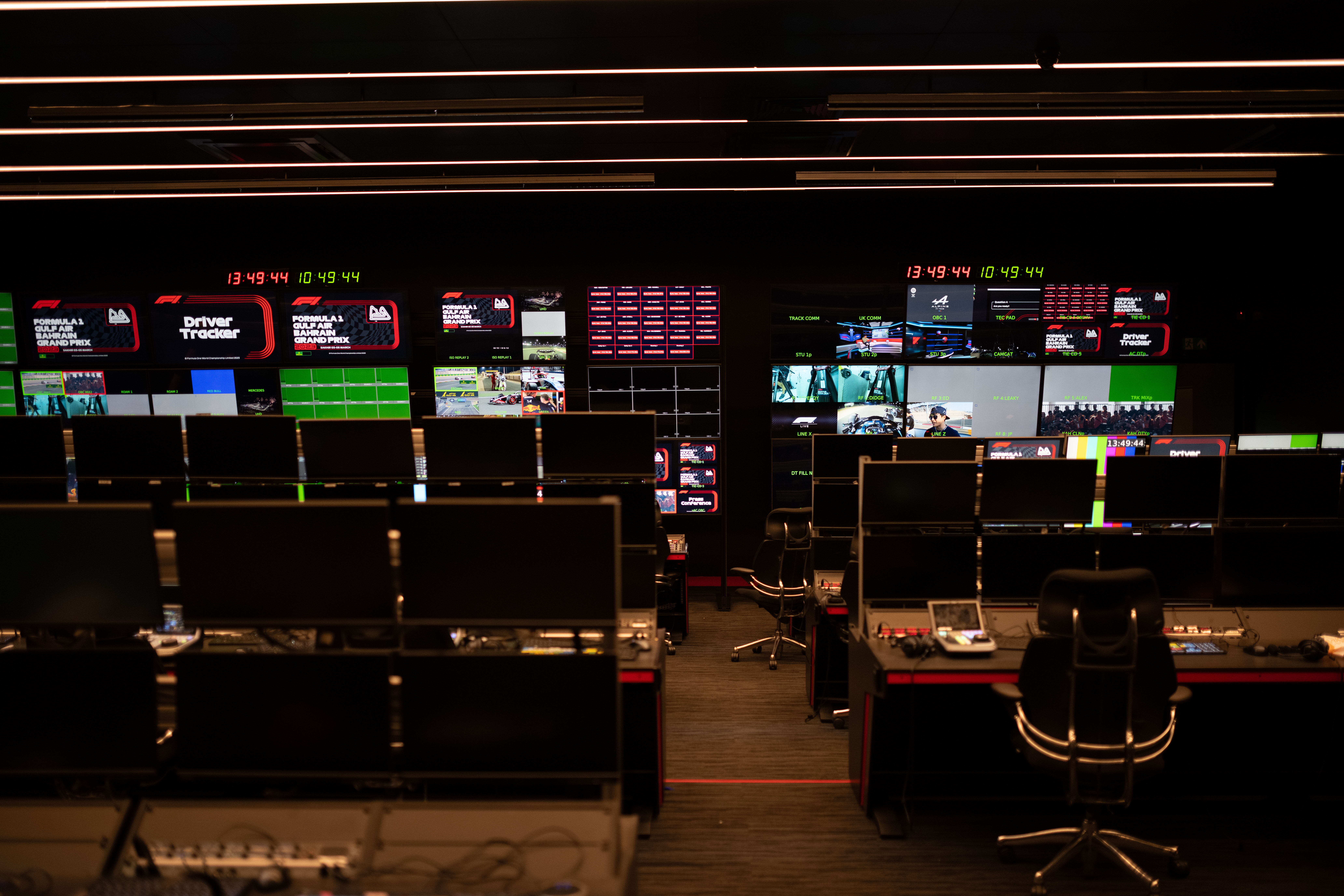
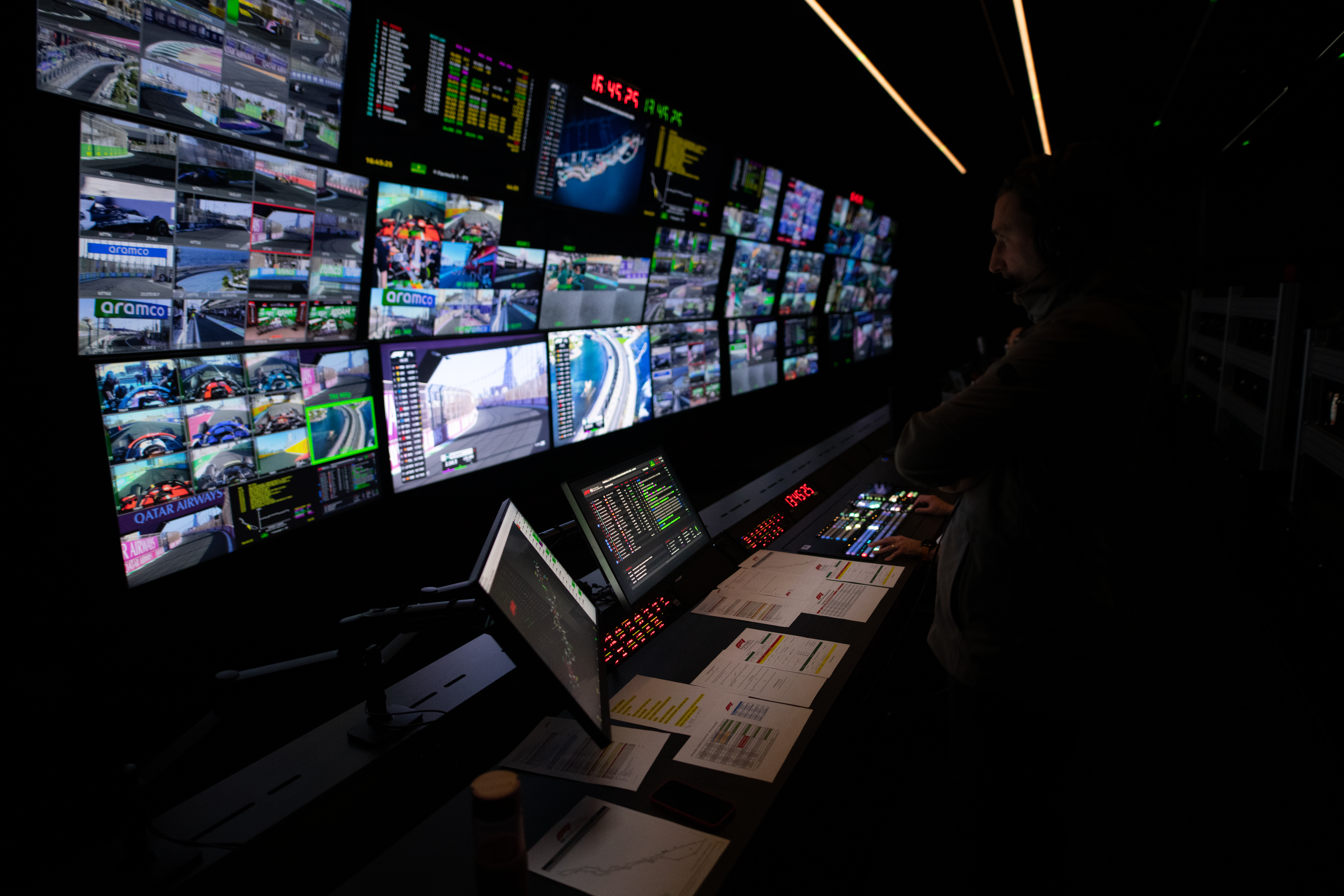
Over 300 monitors, all offering multi-view capability are on show, allowing thousands of visual sources to be moved around the building at a moment’s notice, more than many other sports.
“It’s very complicated because there’s 20 balls on a really large pitch all doing their own thing as opposed to football, where it’s one ball, and a small pitch,” F1’s Director of Broadcast and Media Dean Locke tells selected media.
“On the human side, it’s a complex sport. We’ve got a diverse viewership: entrenched viewers, new viewers, a lot of younger viewers.”
“Trying to be able to tell that story, without alienating our hardcore fans by oversimplifying it, but then also to ease [new fans in]. I think the team here finds a really good balance overall.”
So, how does it all work?
The international feed
F1 has two main galleries for their broadcast operations, which are visible from the moments you walk into F1’s main atrium. The first produces the international feed, more commonly known as the World Feed, the feed that the majority of F1’s audience watches each race.
The second produces the feed for F1’s direct-to-consumer (DTC) platform F1 TV. The F1 Live feed, including wrap-around content comes from this gallery. Logistically at Biggin Hill the two sit alongside one another.
The international feed actually consists of 15 different graphic overlays, consuming 60 pings of data a second in 4K. Why? Because the feed airs in different languages worldwide, tailored to their own regional needs.
Throughout any given session, the main World Feed director hears many different voices in their ears, however they quickly work out who needs to take priority as time progresses.
What does the World Feed director have access to?
90 on-board camera angles
28 UHD (ultra high-definition camera) around the track
8 free-roaming cameras
1 helicopter with a state-of-the-art gyro-stabilised camera
Source: F1
The first of those voices, the producer, sits next to the director on the front row. Behind are replay machines and operators, ensuring that any action not captured live is replayed later on.
“…they see Alonso put a wheel on the grass, they then notify their replay director, who then offers that to the main director to see if they want to run the actual replay,” Locke notes in mid-flow conversation.
Team radio
In a separate area of the building resides the team that selects all of the radio clips that appear on the World Feed, consisting of a team radio producer, multiple team radio editors, team radio listeners and a team radio transcriber.
All of the radio messages are beamed from the car at the circuit through to Biggin Hill, an excellent example of F1’s remote production capabilities.
“I’m responsible for choosing all the clips that you hear,” explains Ray Warner, who is F1’s Team Radio Producer. “I’ve got about a second to think about what you’re going to do with the clip, whether we’re going to use it for the World Feed, F1 Live, or the app.”
“If we do play it on the World Feed normally, do we transcribe it manually? In some instances, we use text only for commands such as ‘Box, box’, so that we don’t interrupt the commentary feed. It works extremely well on the day, it’s very fast and furious.”
In addition to the roles referenced, F1 has recently brought in new censorship roles into the team radio production, meaning that radios are now turned off if it is evident that the driver is “under an incredible amount of pressure.”
Likewise, the team manually censors team radios after accidents, a change that was brought in following Max Verstappen’s accident with Lewis Hamilton at the 2021 British Grand Prix.
Locke says that the radio messages are played out within 15 seconds or within a lap, although the team acknowledges that there are exceptions, for example during start replays, overtakes and for messages that are not time critical.
“You’re not trying to cheat anyone,” Warner says. “You’re just like ‘I really wanted to play it, but the director was just doing a couple of replays that couldn’t go without.’ Our first opportunity would be after those replays, which may be 30 seconds later. Tell the truth and you won’t get into trouble is my motto over it.”
Locke adds, “It’s not trying to create a story that isn’t there because you’ll get caught and tied up in knots. I think you’ve got to remember that we have 74 broadcasters in 180 territories. In non-English countries, the commentary has to translate everything as well.”
F1’s main gallery area. Image Credit: Jacob Niblett/Shutterstock Studios.
“If you were doing a domestic broadcast only, maybe you might [transcribe everything] but you’re primarily doing this for a multi–World Feed.”
Both Locke and Warner recognise the importance of team radio to F1’s broadcasts, especially compared to other sports. “It’s an incredible tool for telling the story, we’re very lucky to get access to the radio,” Locke tells the media.
“I remember talking to a guy who covers PGA Golf, and they were saying ‘We follow a golfer around for six hours, get nothing from them. Yours is in a cockpit with a crash helmet on going at 200mph.’”
“We get full emotion. And I think we do a good job of it editorially. Sometimes we talk a little bit internally about how long you keep stories going, and at what point does it become a bit repetitive. We’re making editorial calls on that [front].”
Team radio played its part in the controversial 2021 season, with radio communication between the FIA and teams widely played on the World Feed. Although it made for compelling television, the impact that it had on the championship decider meant that the feed was dropped for 2022.
However, while F1 would like to bring “some form of that back” in the future, there are no immediate plans in the pipeline to do so.
No matter what though, Warner and the team try not to reflect too much on the team radio output. “You can’t have a post mortem over a piece of work that’s got one out of 10,000 clips under it,” he believes.
“It is massive pressure, but I’ve done it long time now. The whole team is so, geed-up for it and you can never relax. We all love it, it’s so addictive.”
On-boards
Also, at F1’s disposal is a plethora of on-board material. The on-board angles have come a long way since their debut in 1985, when cameras were put on just two cars.
Now, around 90 cameras are housed across the 20 F1 cars, with 11 cameras on Formula Two cars, 4 cameras on Formula Three cars, 4 cameras on Porsche Supercup cars, as well as cameras on both the Safety Car and spare Safety Car!
F1 has an on-board camera director to control the feeds that are fed back from the machinery, all of which is operated from Biggin Hill.
“It still blows my mind in a remote sense. It’s mad that the car could be in Brazil, and the clear film that clears the lens in front of the camera is operated from here,” Locke says.
Not all the F1 on-board camera angles are active at any one time, with only 24 of the 90 cameras switched on. On some cars, two cameras are active, with the team having the ability to jump between cameras on each car to give a different perspective if required.
“The on-board camera director is saying ‘I want rear facer on Lewis,’ and the team here will switch from the forward camera to the rear facer, jumping around also to angles such as the helmet camera,” Locke explains.
In total, an F1 car can hold up to 7 camera angles, although most cars have five at any one time. The position that fans will recognise most, the roll hoop actually houses two different angles: the forward-facing angle and the rear-facing camera.
While wandering around F1’s Biggin Hill facility, we’re shown the roll hoop camera that was on Zhou Guanyu’s car during last year’s British Grand Prix, the car sliding “down the track on top of the camera holding it up.”
Other angles, including the chassis camera, front wing camera and the camera showing the helmet in full view, have also been around in F1 for some time.
The on-board team, led by Steve Smith, believes that camera positions on the side of the chassis and side of the front wing “gives a much bigger impression of speed,” as well as giving the director addition shots to play with.
The workshop Smith’s team are based in has also been upgraded as part of the refit at F1’s Media and Technology Centre, the team using the space to “service, maintain, upgrade and look after the equipment that goes onto the cars.”
More recent additions include the helmet/visor camera and pedal camera, while a 360 camera is also present on the car, but not currently available for live usage.
Since the helmet camera was introduced in 2021, the usage of the camera has increased rapidly across different manufacturers. Smith’s team now have the ability to put the camera “in any helmet manufacturer,” allowing them to use that vantage point for any of the 20 drivers.
F1’s main gallery area: the front desk where the producers and directors sit. Image Credit: Jacob Niblett/Shutterstock Studios.
The team are constantly looking at ways to improve the on-board experience, which includes working closely with other championships.
“We talk to a lot of people in MotoGP and NASCAR, we have a fairly close relationship with them. MotoGP has the opposite set of problems that we do,” Smith says. “They’ve got too much movement, whereas we want more movement. They can see all their rider, we can see nothing of our driver. There’s a lot of shared knowledge [between us].”
The stabilised gyro camera that F1 debuted during last year’s Dutch Grand Prix on the front wing was actually one of the cameras used by MotoGP, as opposed to something built by F1 in-house, although they are looking at moving to a different solution soon.
“We’re constantly trying to change things,” alludes Smith, referring to the recent return to the pedal camera. “What we also want to do is super impose that picture on top of the chassis, so that you see pictures from the roll hoop camera and the pedals on top of the car.”
Currently, F1 cannot access the 360 cameras live, however Locke hopes that will change in the future. “There’s a few complications around powering of the cameras and bandwidth, but the team is currently designing the systems of the future where hopefully we can get more off,” he says.
“We have 360s on the car but we can’t take those off live. There’s only so much room on the pipe [currently], we’re hoping to do a lot more with that.”
Elsewhere, not necessarily a tool for storytelling in the traditional sense, however something that has made its way into F1’s broadcasts over the past decade is virtual advertising. In more recent years, F1 has experimented with adding editorial signage to the World Feed virtually.
“We also use the system for editorial purposes, for World Championship battles for example,” explains Locke. “We did some pilot testing over Austria [as well] using the helicopter, so we can do augmented graphics as well.”
F1’s digital platforms
Gone are the days when F1 broadcast its voice through one mechanism. Now, F1 puts its content out across a variety of social media platforms, as well as their own direct-to-consumer (DTC) line of products, including F1 TV.
The service, which turned five earlier this year, gives fans in some territories access to live F1, growing in content each year.
Regardless of territory, fans on F1’s entry tier (including the UK) have access to thousands of hours of F1’s archive, as well as pre- and post-race content and supplementary studio content.
“It’s a very different experience for Formula 1 as we’ve never really been direct-to-customer before,” explains Locke.
“We’re running the DTC all year round, giving us a different way of providing those feeds to unsupported territories or alongside our broadcast partners. I think the platform technically is very reliable and intuitive in the way it’s set up.”
“Over the last year, we’ve been focusing on improving the content side, whether that’s the English language commentary, other commentaries, or programming such as pre- and post-race shows. We’ve bought them up to a very respectable level.”
As part of the redevelopments, their in-house studios have received a facelift. The studios, which sit in exactly the same space as the F1 Digital+ studio in 2002 for the anoraks reading, consist of three physical sets.
The first in the centre is the main talk show set, supplemented to the left and right by Jolyon Palmer’s analytical station and by the Tech Talk set, typically featuring analysis from the likes of Craig Scarborough and Sam Collins.
Although it houses the three studios, in the words of Locke it is a “very compact” area, something obvious as the journalists tried to squeeze into the space!
There are more developments coming down the pipeline from F1, including new shows following the Summer break, and a full-scale virtual reality set.
F1’s Head of Live Production Wendy Hendrickx outlined the benefits of the new studio.
“We’ve developed this studio as part of the growth for Formula 1,” she said. “[The studio] allows us to enhance our remote production, because we have the production team on site, but we have also a big production team here.”
“Commentators can commentate from the booths and then come in here to do analysis on the show, for example. There’s a lot of opportunity that the studio brings us [the content production team] during [the race weekend] and in between race weeks.”
“It’s a very big step for Formula 1 and our production.”
Coming up: Monaco, Vegas, the logistics of broadcasting F1 and what you will (and won’t) see on F1 TV any time soon…
Article amended on August 4th at 18:05 to better reflect F1’s team radio plans.
Formula 1’s presence on free-to-air television in the UK reached its nadir in 2019 during the first year of Channel 4’s ‘highlights only’ agreement with Sky, new research by Motorsport Broadcasting shows.
Utilising data from a range of sources, including the Radio Times, this writer has analysed trends in the Formula 1 scheduling space in the UK spanning four decades, encompassing the BBC’s, ITV’s, and Channel 4’s offering.
The main aim of the research was to understand how F1’s free-to-air presence on race day had changed over time, as different rights arrangements came into effect.
In addition, the research helps us understand how the popularity of the likes of Nigel Mansell, Damon Hill and Lewis Hamilton impacted the commitment broadcasters gave to F1, and what might have happened in an alternative universe without their success.
BBC’s appetite for live Grand Prix grows into the 1990s….
Motorsport Broadcasting’s analysis began with 1982, four years after the BBC formally launched its Grand Prix programme. While the BBC covered various races in the decades before that, the decision to launch Grand Prix in 1978 allowed the corporation to put a proper wrap around its Formula 1 offering following James Hunt’s title in 1976.
The Grand Prix strand covered highlights of every race. Live coverage of races aired during Sunday Grandstand on BBC Two on Sunday afternoons, or during a standalone live Grand Prix programme on BBC One where other sport prevented the race from airing live on BBC Two.
Live coverage of the sport was still patchy in 1982. Of the 16 races that season, only 10 aired live in some form. Brazil, Long Beach, San Marino, Detroit, Canada, and the season finale at Caesars Palace aired later as highlights.
The season opener in South Africa took place on a Saturday, with roughly 45 minutes of the action airing live on BBC One. Otherwise, it was a long wait until 23:20 before a 35-minute highlights package aired on BBC Two.
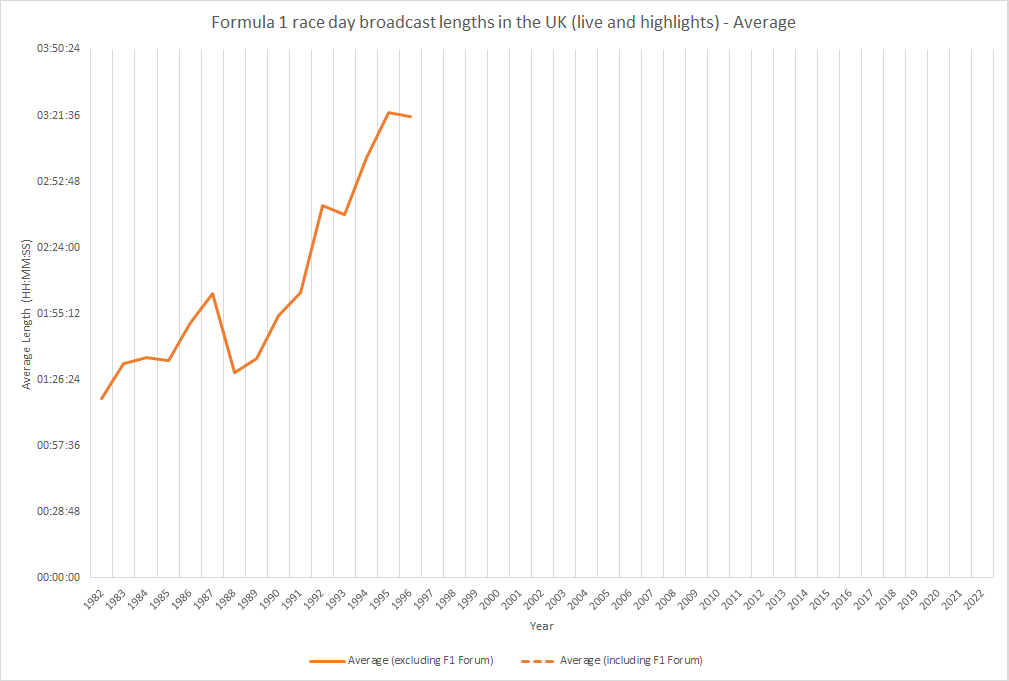
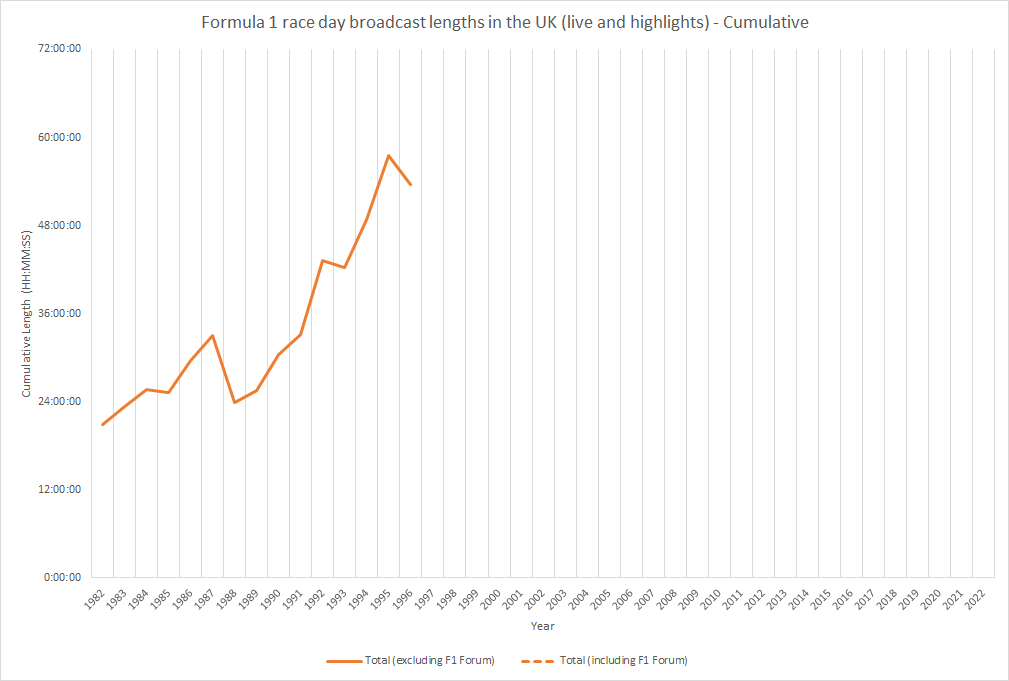
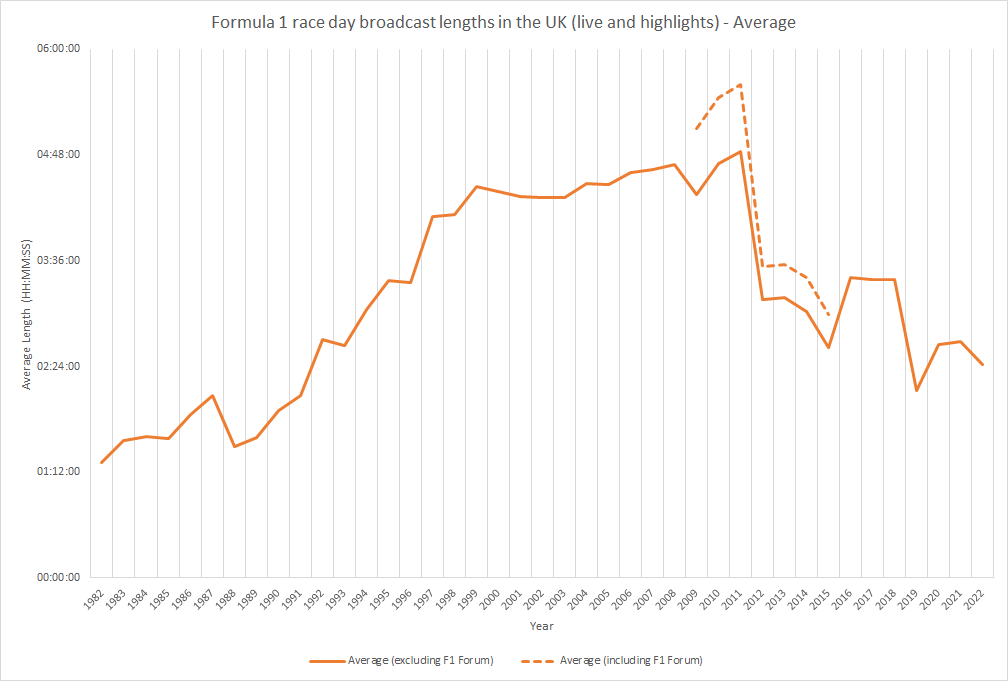
In total, across live and first-run highlights, the BBC covered 21 hours of F1 during 1982 across 16 races, roughly 1 hour and 20 minutes per race, a figure that increased sharply as the years passed, parallel with Nigel Mansell becoming a championship contender and F1 taking television seriously. Some of the early data points are incomplete, so caution is required when analysing these figures.
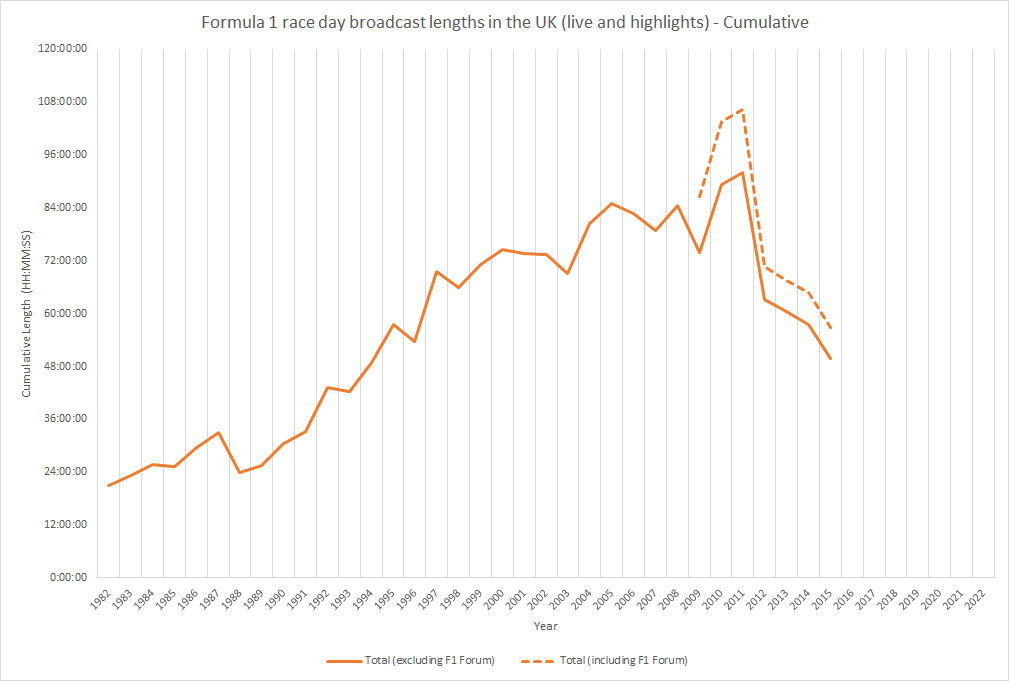
Formula 1’s race day broadcast lengths in the UK from 1982 to 1996, both average per race and cumulative across the season, covering the BBC’s first stint in the sport.. Slide the bar in the centre across to see the difference between average and cumulative.
The 1984 British Grand Prix saw the BBC begin to cover qualifying live, with a 30-minute slot during Saturday’s Grandstand programme on BBC One. However, no other races received the live qualifying treatment until a decade later.
As Mansell closed in on the 1986 title, the corporation opted to air some of the Mexican Grand Prix live. While not all the race aired live, it was a big step for F1 in the UK: the first time since the 1981 season finale in Las Vegas that live Grand Prix action had aired in primetime on BBC Two. Two weeks later, the season finale in Australia aired live.
1987 saw the initial peak in terms of F1’s free-to-air exposure: the BBC covered 33 hours of F1 during 1987 across 16 races, the sport receiving over two hours of coverage per race day for the first time ever.
However, the BBC’s commitment to Formula 1 turned as Mansell slipped back down the grid. While worldwide interest in F1 swelled thanks to Ayrton Senna and Alain Prost, the scheduling data would suggest that the Beeb became disinterested in F1 for a short period.
20:00 – On the Line Tue 18th Jul 1989, 20:00 on BBC Two England
Ray Stubbs reports on what has gone wrong with Grand Prix racing. With McLaren Honda winning virtually every race because of the technical excellence of their cars, much of the excitement has gone out of the sport. Has the driver become merely a cog in the machine?
The Beeb covered ten fewer hours of F1 in 1988 on race day compared to the previous year, setting F1 back six years. Only seven races aired live in both 1988 and 1989, less than half of the season.
By this point, the BBC aired most of the European rounds live, any title deciders involving a UK driver, and any races that could ‘if the cricket or [insert another sport here]’ finished early.
Mansell’s fortunes improved for 1991, beginning a period of strong sustained growth taking them to the end of their contract in 1996.
While the BBC covered 43 hours of F1 during 1992 across 16 races (an average of 2 hours and 42 minutes on race day) during Mansell’s championship winning season, still not every race aired live.
The primetime races, Mexico, Brazil, and Canada, aired on a delayed basis later in the evening on BBC Two, with an extended highlights programme covering action.
Slowly but surely though, F1’s presence on the BBC was increasing, aided by a wider package of motor sport which also included the British Touring Car Championship. Each Grand Prix during Sunday Grandstand received 25 minutes of build-up, with Steve Rider and Tony Jardine presenting coverage on-site.
The problem was, as the Beeb poured more resources into F1, it only served to fuel the fire over on ‘the other side’ further…
BBC TV was the unchallenged leader as far as sports coverage was concerned: they had pioneered, developed, and perfected Formula 1 on the box and they hadn’t put a foot wrong. Little did they know, though, that ITV were sick of being cut to ribbons by Grand Prix on Sunday afternoons and had decided that if they couldn’t beat it, they’d buy it.
Every race aired live in 1995 for the first time ever, possibly a pre-emption for the bid that was yet to come from ITV. Over 57 hours of F1 aired on race day during 1995 across 17 races, a massive 3 hours and 23 minutes per race (including highlights).
In the space of 13 years, the amount of F1 on the BBC on race day almost tripled, a figure undoubtedly higher when factoring in qualifying. Their Grand Prix offering went out on a high in October 1996, with Damon Hill clinching his first Drivers’ Championship at the Japanese Grand Prix.
Coverage of qualifying also increased during the final years of the BBC’s contract, with regular updates airing during Grandstand on BBC One. Every qualifying session, including those during primetime, aired live in 1996, allowing fans to follow Hill’s and Michael Schumacher’s every move.
…and eventually ITV take the cherry…
ITV’s coverage began in earnest in 1997 with a raft of supplementary programming to support their offering, including The Clive James Formula 1 Show prior to the season opener in Melbourne.
Fans became acclimatised to new faces, a new trackside studio, and of most importance, commercial breaks during the Grand Prix itself, which caused controversy on more than one occasion (Imola 2005 the main offense). With no Grandstand support, qualifying became a standalone 90-minute live show for most of the 17 races, with build-up and post session analysis.
Later, Murray and Martin’s F1 Special, hosted by commentators Murray Walker and Martin Brundle, became a regular fixture in the early evenings following qualifying, giving fans a different take on F1. Outside of their F1 offering, ITV also covered Formula 3000 highlights through their 30-minute International Motor Sport programme.
ITV’s race day show increased in length year-on-year, partly to compensate for the commercial breaks, but also to allow the broadcaster to focus on the whole grid of 11 drivers and 22 cars rather than those competing at the front.
Despite no British contenders fighting for the championship, ITV dedicated 69 hours to F1 in 1997 on race day across 17 races, a little over four hours of action, encompassing their live broadcast, same day repeat and highlights offering.
At a glance – BBC vs ITV – San Marino Grand Prix 1996 Qualifying Live – 12:00 to 13:05 – BBC One Race Live – 12:35 to 15:00 – BBC Two Highlights – 18:40 to 19:30 – BBC Two
1997 Qualifying Live – 11:45 to 13:15 – ITV Race Live – 12:25 to 15:10 – ITV Highlights – 23:05 to 00:00 – ITV
Radio Times
ITV remained the UK’s F1 broadcaster through Schumacher’s dominant years at the front of the field, covering every race and most qualifying sessions live. The exception: the 2000 United States Grand Prix which aired live on ITV2.
In addition, races that aired outside of Europe suffered from inferior treatment in ITV’s early years, with qualifying from races such as Brazil and Japan airing on tape delay, as well as some of these races (from 1999 to 2003) airing from ITV’s studio in London instead of on-site.
The low point in this regard was 2005, where both Japan and China aired on an 18-hour tape delay. Both sessions aired at almost midnight UK time on the Saturday, a situation thankfully avoided in following seasons when ITV began to utilise ITV2, ITV3 and ITV4 for live qualifying.
The commercial broadcaster switched things up from 2004 onwards, leaving their studio behind and moving closer to the action in the paddock, a set-up that has remained through various broadcasters ever since.
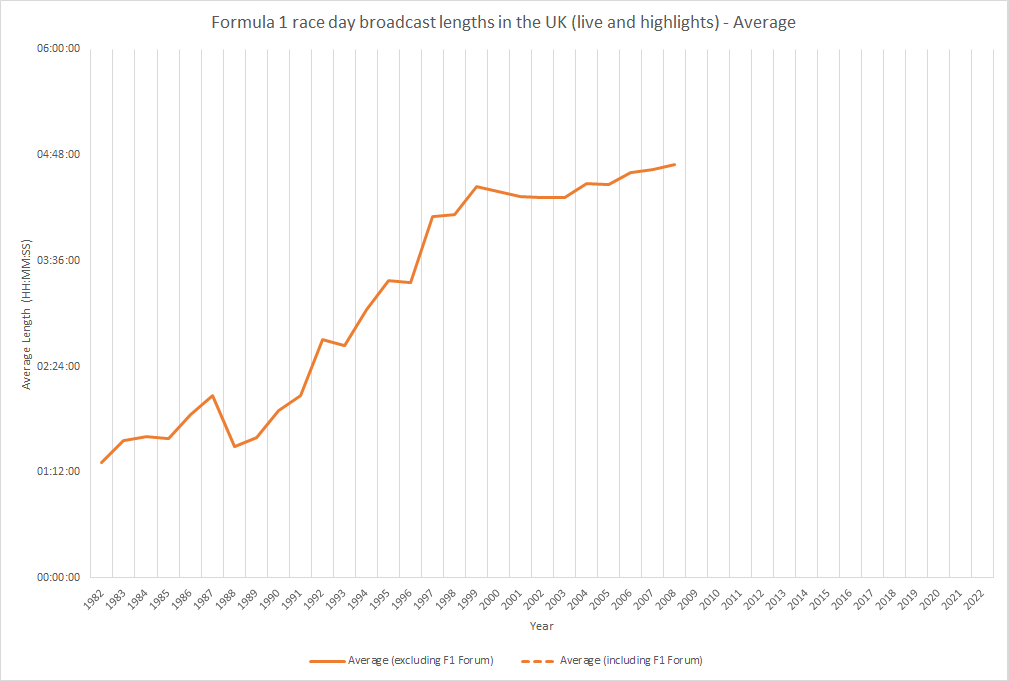
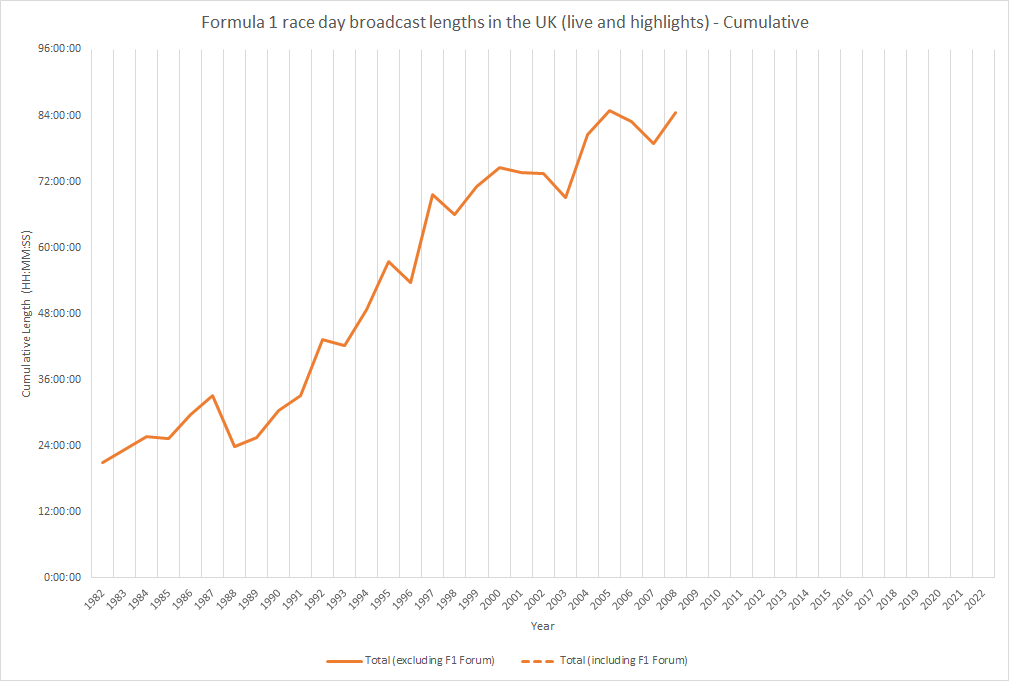
Formula 1’s race day broadcast lengths in the UK from 1982 to 2008, both average per race and cumulative across the season, covering the period until ITV’s stint in the sport ended. Slide the bar in the centre across to see the difference between average and cumulative.
Despite Schumacher’s continued stranglehold on F1 and a barren spell from a UK perspective, ITV covered F1 for 80 hours in 2004 on race day across 18 races. It would have been easy for ITV to have ‘fallen out’ with F1 at this stage, nevertheless their overarching commitment to the sport remained.
As audiences dropped across the continent, including in Germany and Italy, the emergence of Lewis Hamilton fuelled a surge in UK interest back at home.
Lift Me Up by Moby became the sport’s signature soundtrack from 2006, ITV’s F1 offering given a refresh by North One Television, with Steve Rider returning as presenter. Focus on F1 gradually increased, which made it even more puzzling when the commercial broadcaster opted to pull the plug on the sport in 2008.
But the explanation when it came was cold and brutal. At ITV, overall advertising revenue had taken a dive as the recession drew closer, and in terms of sports rights, the company had to prioritise its targets. [..] In order to pay for the [Champions League football] bid, something had to go. Formula One.
Like in 1996 when the BBC increased their offering before exiting the sport, ITV did the same in 2008 with an expanded qualifying programme.
Their live qualifying shows were regularly two and a half hours long, leading into live GP2 coverage on ITV4, with their race day programme regularly exceeding three hours, a sign of things to come back on the Beeb.
Part of the increase, while down to increased interest in the sport, was also down to an increase in advertising minutage, the length of advertising breaks increasing during ITV’s tenure covering Formula 1 from 1997 to 2008.
Nevertheless, during their final season, ITV aired over 84 hours on race day in 2008 across 18 races, an average of 4 hours and 40 minutes per race, an increase of 15 percent per race compared to 1997.
The figures may not be as dramatic as the BBC’s sizeable increases in the early 1990s, however this is more a reflection on how ITV’s figures were near the highest possible peak from the outset, and how the F1 broadcasting product was mature by this point.
ITV’s highlight was their final ever race, as a peak audience of over 13 million viewers watched Hamilton become World Champion in dramatic style in Brazil 2008, winning the championship with a last lap overtake on Timo Glock.
…but the recession bit back twice
Multi-platform was the name of the game for the BBC. The Beeb were gifted F1 when ITV opted to exit their contract two years early, and rightly exploited their new toy given the bargain they got.
There was a period from 2009 to 2011 where it was increasingly difficult to avoid F1 on the BBC, no matter how hard you tried. An advertising campaign, dubbed ‘The World’s Greatest Car Chase’ greeted viewers heading into Melbourne in 2009, as the familiar bass riff hit screens once again.
Live coverage of qualifying and the race aired on BBC One, with practice and an extended post-race show called F1 Forum airing via the BBC website and BBC’s Red Button. Highlights of each race aired in a primetime slot on BBC Three. Fans also had the option of alternative commentary, coming from either BBC Radio 5 Live or CBBC.
Fans could enjoy the action uninterrupted for the first time on free-to-air television since 1996, the broadcaster covering every minute of Jenson Button’s dominant 2009 season in the Brawn.
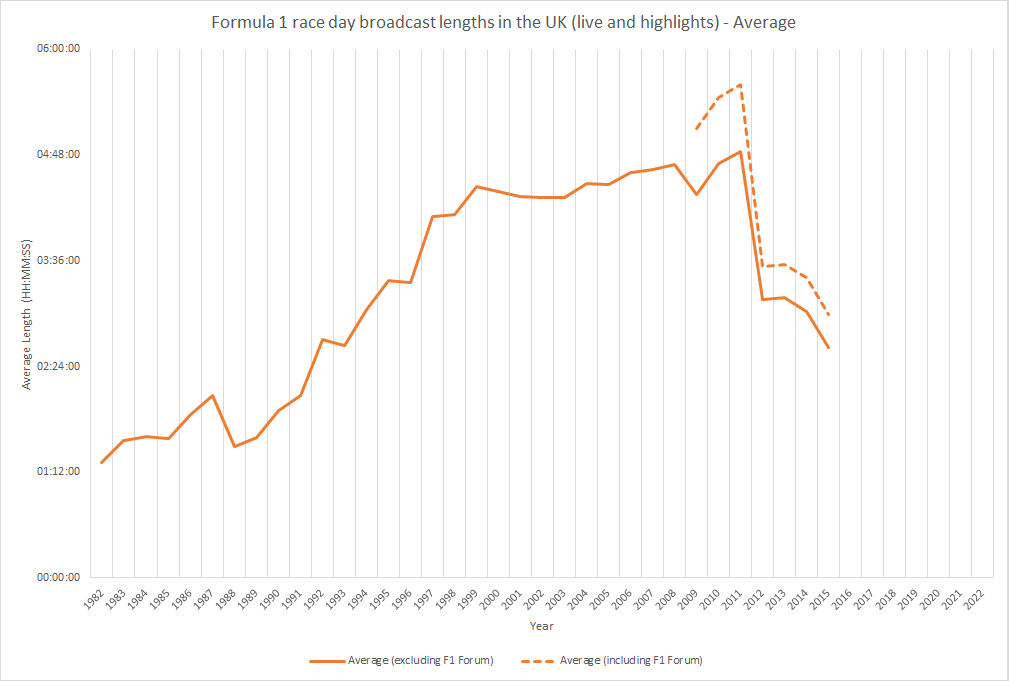
Broadcast lengths remained like that of ITV, and increased between 2009 and 2011. In 2011, the BBC aired 92 hours of action on race day across 19 races, nearly five hours of coverage on their linear outlets!
The figure excludes the F1 Forum, as well as Friday’s and Saturday’s programming. Including the F1 Forum would increase the race day average to near six hours, an astonishing figure, and an increase on their predecessor.
The forum style show allowed fans to have their say, as well as giving a chance for the team to focus on those teams typically out of the limelight following a Grand Prix.
Formula 1’s race day broadcast lengths in the UK from 1982 to 2015, both average per race and cumulative across the season, covering the period until the BBC’s second stint in the sport ended. Slide the bar in the centre across to see the difference between average and cumulative.
The BBC’s commitment was unmatched, even during Sebastian Vettel’s dominance in 2011. The highlight of BBC’s second foray into F1 was the 2011 Canadian Grand Prix. The figures in this article are primarily for the billed slot lengths in advance, however the rain-soaked Montreal race saw the BBC remain on-air across BBC One and then BBC Two to cover the dramatic race.
Viewing figures were at some of their highest levels ever seen for F1 in the UK, the BBC’s sport department were happy, while fans watching at home were pleased as well.
But while the BBC’s F1 team, both on and off-air, were delivering high-quality coverage, the BBC’s licence fee settlement with the UK government, and the need to make efficiency savings, lurked in the background.
The BBC faced a choice of getting rid of Wimbledon, Six Nations or disposing of the F1. In the end, the BBC opted to ‘safeguard’ F1’s free-to-air future by negotiating a new, long-term deal directly with Sky Sports, taking the sport from 2012 to 2018.
Half of the races aired exclusively live on Sky Sports from 2012, with BBC airing those races in highlights form. For fans whose primary method of consuming the sport was via free-to-air, the decision was a retrograde step at the time, taking the sport back nearly twenty years.
Overnight, F1’s presence on free-to-air television had dropped by a third. In 2012, the BBC aired 63 hours of F1 action on race day across 20 races, an average of 3 hours and 10 minutes of action per race, including pre-race build-up and post-race analysis.
During this period, fans knew what they were getting, and the sport benefited in some ways from the new deal with extensive coverage across both Sky’s and BBC’s portfolio of outlets. The BBC retained their radio offering, with continued online coverage as well.
While the offering served up was by no means perfect, it was a happy medium, helping to keep F1 in front of the masses on the Beeb.
There was a growing inevitability as the years passed that the BBC would pull the plug on the sport as the purses continued to tighten. The corporation pulled the plug at the end of 2015, with the free-to-air element of the contract switching to Channel 4.
At a glance – BBC vs Channel 4 – Belgian Grand Prix 2015 Qualifying Live – 12:10 to 14:30 – BBC Two Race Live – 12:10 to 15:30 – BBC One F1 Forum – 15:30 to ~16:15 – BBC Red Button
2016 Qualifying Live – 11:55 to 14:30 – Channel 4 Race Live – 12:00 to 16:00 – Channel 4 Highlights – 00:40 to 01:40 – Channel 4
Motorsport Broadcasting archive / Channel 4 Press
Channel 4 retained a similar offering to the BBC, with extensive live coverage during their live weekends. While the broadcaster had no Red Button style F1 Forum show, they made up for this with an extended post-race broadcast on their linear outlet.
Furthermore, Channel 4 committed to airing their live races without commercial breaks. Familiar faces, such as Ben Edwards, David Coulthard and Lee McKenzie moved over from the BBC, while Channel 4 faces, such as Steve Jones, joined the team.
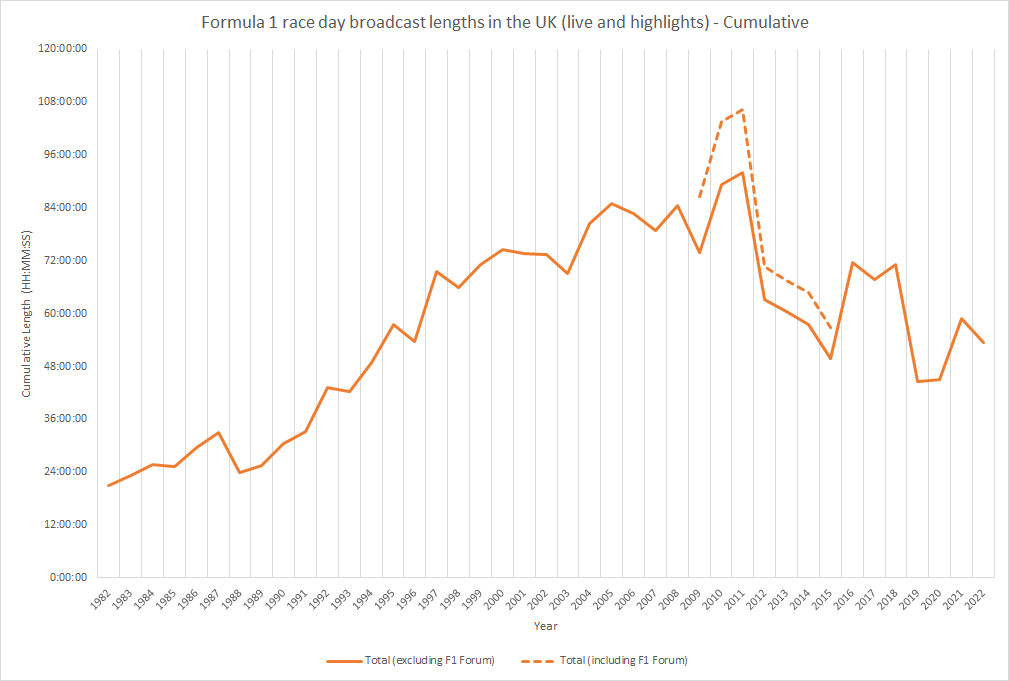
In the first year of their contract in 2016, Channel 4 aired 71 hours of F1 action across 21 races, an average of 3 hours and 24 minutes, including commercials. On a like-for-like basis, this was the highest for F1 on free-to-air television since 2012, although does not account for the BBC’s F1 Forum.
Before Channel 4 could get comfortable with F1, however, Sky swooped in immediately, taking F1 exclusively from 2019, with live coverage of the British Grand Prix and highlights of every qualifying and race session airing via free-to-air.
Figures under the new contract hit their nadir in 2019, owing to a restrictive contract imposed by Sky on Channel 4, with just 53 hours of F1 action covered across 21 races, an average of just over two hours, the lowest figure at that point since 1991.
The restrictions on Channel 4 loosened the following year, but have not moved the needle significantly. Later start times for Canada, Mexico, USA, and now Miami, have hampered Channel 4’s offering further, the broadcaster opting to air shorter shows due to the late-night (or Sunday morning in the case of qualifying) time slot.
Other races, especially last season, have seen production company Whisper opt for a skeleton crew on-site. The 2022 Japanese Grand Prix saw just Steve Jones and Felipe Massa present on-site, with the remainder of the crew back at base in Ealing.
Channel 4 remain loyal to the sport, and will continue to air highlights of every race, plus live coverage of the British Grand Prix in 2023. Their relationship with Sky remains positive, the two coming to an agreement at the end of 2021 to air the championship deciding race in Abu Dhabi live on free-to-air television.
Where are we now?
It has been over a decade now since F1 began the transition to pay television in the UK, which has given others an opportunity in the motor sport sphere to make an impact and try to break through on free-to-air television.
It is an opportunity that will remain over the next seven seasons, given Sky’s recent extension to cover F1 through to the end of 2029.
Formula 1’s race day broadcast lengths in the UK from 1982 onwards, both average per race and cumulative across the season. Slide the bar in the centre across to see the difference between average and cumulative.
Except, no one successfully has broken through. The prime candidate, Formula E, has struggled to gain momentum across each of its homes, having rotated around ITV, Channel 5, BBC and now Channel 4.
The free-to-air broadcaster shows some Formula E rounds live, however races that fall in primetime, such as the season opening Mexico City E-Prix on Saturday 13th January, do not air live on their linear platforms.
Elsewhere, MotoGP moved with F1 to pay television over to BT Sport, while the British Touring Car Championship has retained its presence on ITV4, while some races moved to ITV1 last season.
Extreme E has also had a presence on ITV1 recently, but the series has delivered poor viewing figures.
Unfortunately, television executives are simply not into motor sport enough to plough hours into it across the weekend afternoons, if they ever were at least. Let us not forget that the BBC are still covering a range of sport at weekends.
On Saturday afternoons on BBC One during 2022, the corporation aired live snooker, tennis, football, rugby league, rugby union, athletics, gymnastics, both male and female including the major events such as the Winter Olympics, Six Nations, Commonwealth Games, and the FIFA World Cup.
It is not that BBC do not have the space to cover it, it is that they simply do not want to because motor sport currently does not align with their strategic priorities.
Or, an alternative version of that statement is that motor sport is too expensive for the BBC to cover which, in the case of at least F1 or MotoGP, rings true.
World Superbikes is an interesting use case. Toprak Razgatlioglu and Alvaro Bautista have successfully challenged Britain’s Jonathan Rea dominance in recent seasons, with enticing racing, however the series has generated little in the way of additional coverage from a UK standpoint.
For F1, does it really matter that is not as accessible via the historical, linear free-to-air television route? Arguably not, otherwise commercial rights holder Liberty Media would not have agreed a new deal with Sky taking the sport to 2029.
What ‘success’ looks like for Formula 1 is changing. Once upon a time, it was the number of eyeballs watching a free-to-air broadcast, hence the sport benefited significantly from the expansive airtime that the BBC or ITV gave it.
Now, the sport has a much wider net to reach out to, across a variety of platforms, helping bring in a younger audience to the sport, instead of an aging audience that predominantly watches free-to-air television. The delivery mechanism has changed.
It makes measuring ‘success’ challenging to gauge from the outside beyond glorified media releases and PR approved quotes.
As well as looking at Channel 4’s and Sky’s audience data, F1, along with their stakeholders, will look at data from social media (Facebook, YouTube, TikTok, Instagram), combining that with data from the likes of Netflix to build a much bigger picture of their audience.
An 18-year-old watching highlights via YouTube is more attractive to F1 than someone age 60 watching linear free-to-air highlights on Channel 4. And, it is for that reason that, while it is sad to see F1’s free-to-air presence deteriorate over the years, it is also a sign of the times.
Because free-to-air, linear television for F1 is not the future, or even the present for F1.
It may just be the past.
If you enjoyed this article, the Lucky! series covers F1’s broadcasting evolution over the decades from episode five onwards, which this writer contributed to. Lucky! is an eight-part documentary series, telling the story of F1 through the lens of Bernie Ecclestone, and is available now worldwide, including in the UK via Discovery+.
Minor amendment made on January 4th to clarify that the Caesars Palace Grand Prix from Las Vegas in 1981 aired live on BBC Two. Thanks to DennisFone for the heads up on this one.


 Motorsport Broadcasting