
Six of Formula 1’s outfits based in the United Kingdom have revealed their gender pay gap publicly. In the underlying data, all bodies reveal that a significant amount of work needs to happen to bring more women into the engineering landscape.
For the first time, UK companies with more than 250 employees are reporting their pay gap to the UK government. As Ferrari, Toro Rosso, and Sauber are based outside the UK, they are exempt from this. With less than 250 employees, Haas are also exempt. The figures reveal the pay gap at Formula One Management (FOM) amongst other organisations.

This percentage gaps above show the difference between the ‘middle paid woman’ and the ‘middle paid man’.
The median gender pay gap for Formula 1’s teams is 22.9 percent, as an example if a female earned £25,000, then a male would earn £30,725. Force India’s median pay gap is least significant at 14.8 percent, with Williams at the other end of the scale at 32.9 percent.
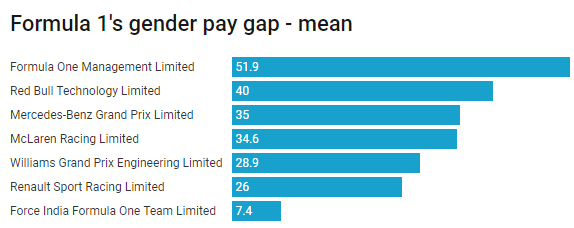
The mean gender pay gap, better known as the average pay gap, stands at 28.7 percent for Formula 1’s six teams in the UK. Red Bull has the biggest pay gap of the teams that revealed their data, with men earning on average 40 percent more than women.
The difference for Mercedes and McLaren circles around 35 percent range. There are two major outliers. Firstly, Force India is again the least significant, with an average pay gap of just 7.4 percent. Although the number of women at Force India overall is smaller in the lower quartile than other organisations, the difference between them and the other teams in this respect helps their gender pay gap overall.
Formula One Management’s mean gender pay gap stands at 51.9 percent, significantly higher than other sporting bodies such as the Football Association at 23.2 percent, and 23 percent for the Rugby Football Union. In other words, if a woman at FOM earned £20,000 across the year, a man would earn £30,380.
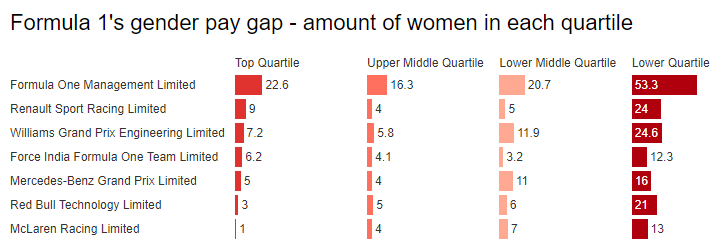
Although the proportion of women in the top quartile at FOM is higher compared with F1’s outfits, the fact that the lower quartile is filled with 53.3 percent of women means that the average is skewed in a similar manner. FOM’s average suggests that there are a small, but significant number at FOM that skews the gender pay gap overall.
The overall volumes above show that women at Formula 1 teams struggle to breakthrough to the top and middle quartile. McLaren’s figures are the most damming of the lot: only 1 percent of people at the team in the top quartile are women. Williams’ and Mercedes’ are the most balanced, but it is a very bleak picture for Formula 1.
What the data fails to reveal is whether jobs occupied by women in the lower quartile have progression paths through to the lower and upper middle quartiles. If they do, then it is possible that the percentages will move as time progresses, but it appears for every ‘lower middle quartile’ job vacancy, you may have four men and one woman vying for that role. It is also unclear if the data submitted includes contractors, as well as the two racing drivers.
Schemes such as Dare to be Different can only help, however there are still very steep barriers to overcome.
More information via The Guardian: What you need to know about gender pay gap reporting.
 Motorsport Broadcasting