
Covering the world’s fastest motor sport across 24 race weekends is no easy feat. The twists and turns, come rain or shine, are covered meticulously by Formula 1’s production team week in, week out.
At the start of July, Motorsport Broadcasting was invited to F1’s revamped Media and Technology Centre as part of an F1 media day, giving us a glimpse behind the curtain. In the first part of a series of articles, we look at the tools at F1’s disposal for storytelling…
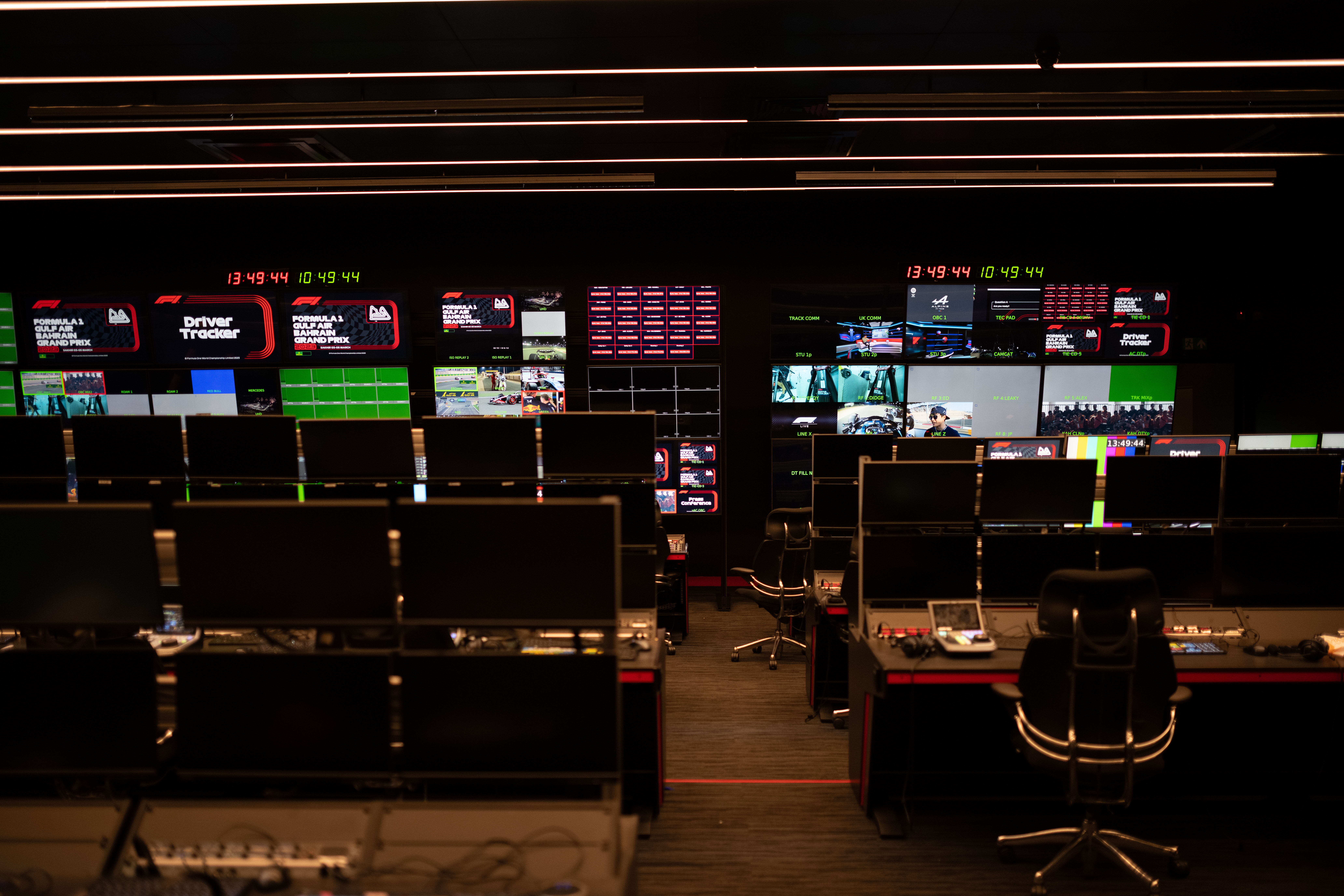
The snap decisions that decide what fans watch at home are made by a group of people on the outskirts of London, England, in F1’s Media and Technology Centre at Biggin Hill.
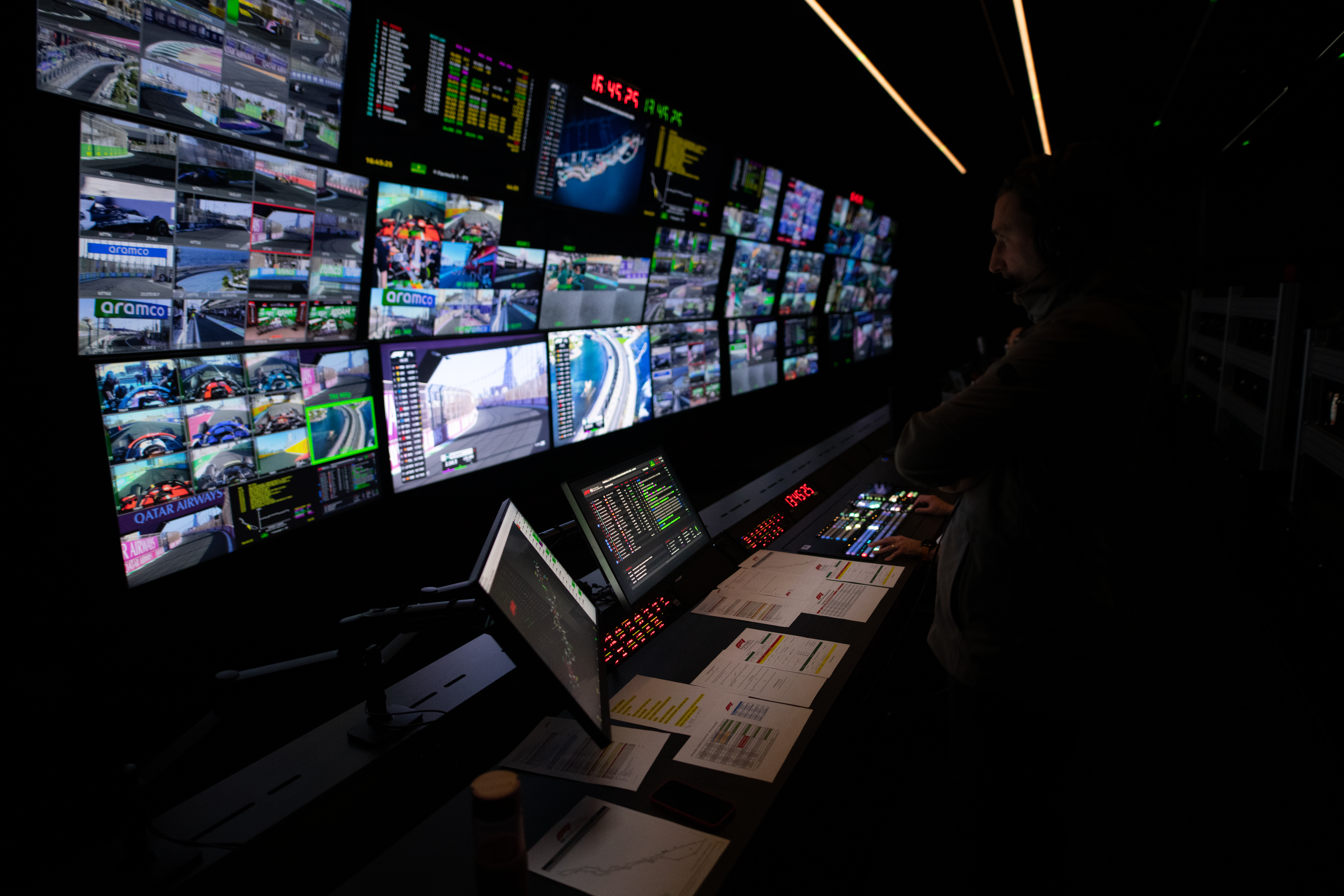
Over 300 monitors, all offering multi-view capability are on show, allowing thousands of visual sources to be moved around the building at a moment’s notice, more than many other sports.
“It’s very complicated because there’s 20 balls on a really large pitch all doing their own thing as opposed to football, where it’s one ball, and a small pitch,” F1’s Director of Broadcast and Media Dean Locke tells selected media.
“On the human side, it’s a complex sport. We’ve got a diverse viewership: entrenched viewers, new viewers, a lot of younger viewers.”
“Trying to be able to tell that story, without alienating our hardcore fans by oversimplifying it, but then also to ease [new fans in]. I think the team here finds a really good balance overall.”
So, how does it all work?
The international feed
F1 has two main galleries for their broadcast operations, which are visible from the moments you walk into F1’s main atrium. The first produces the international feed, more commonly known as the World Feed, the feed that the majority of F1’s audience watches each race.
The second produces the feed for F1’s direct-to-consumer (DTC) platform F1 TV. The F1 Live feed, including wrap-around content comes from this gallery. Logistically at Biggin Hill the two sit alongside one another.
The international feed actually consists of 15 different graphic overlays, consuming 60 pings of data a second in 4K. Why? Because the feed airs in different languages worldwide, tailored to their own regional needs.
Throughout any given session, the main World Feed director hears many different voices in their ears, however they quickly work out who needs to take priority as time progresses.
What does the World Feed director have access to?
Source: F1
- 90 on-board camera angles
- 28 UHD (ultra high-definition camera) around the track
- 8 free-roaming cameras
- 1 helicopter with a state-of-the-art gyro-stabilised camera
The first of those voices, the producer, sits next to the director on the front row. Behind are replay machines and operators, ensuring that any action not captured live is replayed later on.
“…they see Alonso put a wheel on the grass, they then notify their replay director, who then offers that to the main director to see if they want to run the actual replay,” Locke notes in mid-flow conversation.
Team radio
In a separate area of the building resides the team that selects all of the radio clips that appear on the World Feed, consisting of a team radio producer, multiple team radio editors, team radio listeners and a team radio transcriber.
All of the radio messages are beamed from the car at the circuit through to Biggin Hill, an excellent example of F1’s remote production capabilities.
“I’m responsible for choosing all the clips that you hear,” explains Ray Warner, who is F1’s Team Radio Producer. “I’ve got about a second to think about what you’re going to do with the clip, whether we’re going to use it for the World Feed, F1 Live, or the app.”
“If we do play it on the World Feed normally, do we transcribe it manually? In some instances, we use text only for commands such as ‘Box, box’, so that we don’t interrupt the commentary feed. It works extremely well on the day, it’s very fast and furious.”
In addition to the roles referenced, F1 has recently brought in new censorship roles into the team radio production, meaning that radios are now turned off if it is evident that the driver is “under an incredible amount of pressure.”
Likewise, the team manually censors team radios after accidents, a change that was brought in following Max Verstappen’s accident with Lewis Hamilton at the 2021 British Grand Prix.
Locke says that the radio messages are played out within 15 seconds or within a lap, although the team acknowledges that there are exceptions, for example during start replays, overtakes and for messages that are not time critical.
“You’re not trying to cheat anyone,” Warner says. “You’re just like ‘I really wanted to play it, but the director was just doing a couple of replays that couldn’t go without.’ Our first opportunity would be after those replays, which may be 30 seconds later. Tell the truth and you won’t get into trouble is my motto over it.”
Locke adds, “It’s not trying to create a story that isn’t there because you’ll get caught and tied up in knots. I think you’ve got to remember that we have 74 broadcasters in 180 territories. In non-English countries, the commentary has to translate everything as well.”
“If you were doing a domestic broadcast only, maybe you might [transcribe everything] but you’re primarily doing this for a multi–World Feed.”
Both Locke and Warner recognise the importance of team radio to F1’s broadcasts, especially compared to other sports. “It’s an incredible tool for telling the story, we’re very lucky to get access to the radio,” Locke tells the media.
“I remember talking to a guy who covers PGA Golf, and they were saying ‘We follow a golfer around for six hours, get nothing from them. Yours is in a cockpit with a crash helmet on going at 200mph.’”
“We get full emotion. And I think we do a good job of it editorially. Sometimes we talk a little bit internally about how long you keep stories going, and at what point does it become a bit repetitive. We’re making editorial calls on that [front].”
Team radio played its part in the controversial 2021 season, with radio communication between the FIA and teams widely played on the World Feed. Although it made for compelling television, the impact that it had on the championship decider meant that the feed was dropped for 2022.
However, while F1 would like to bring “some form of that back” in the future, there are no immediate plans in the pipeline to do so.
No matter what though, Warner and the team try not to reflect too much on the team radio output. “You can’t have a post mortem over a piece of work that’s got one out of 10,000 clips under it,” he believes.
“It is massive pressure, but I’ve done it long time now. The whole team is so, geed-up for it and you can never relax. We all love it, it’s so addictive.”
On-boards
Also, at F1’s disposal is a plethora of on-board material. The on-board angles have come a long way since their debut in 1985, when cameras were put on just two cars.
Now, around 90 cameras are housed across the 20 F1 cars, with 11 cameras on Formula Two cars, 4 cameras on Formula Three cars, 4 cameras on Porsche Supercup cars, as well as cameras on both the Safety Car and spare Safety Car!
F1 has an on-board camera director to control the feeds that are fed back from the machinery, all of which is operated from Biggin Hill.
“It still blows my mind in a remote sense. It’s mad that the car could be in Brazil, and the clear film that clears the lens in front of the camera is operated from here,” Locke says.
> “Stay on this! Stay. On. This.” – the split second decisions behind Formula 1’s television direction (August 2018)
Not all the F1 on-board camera angles are active at any one time, with only 24 of the 90 cameras switched on. On some cars, two cameras are active, with the team having the ability to jump between cameras on each car to give a different perspective if required.
“The on-board camera director is saying ‘I want rear facer on Lewis,’ and the team here will switch from the forward camera to the rear facer, jumping around also to angles such as the helmet camera,” Locke explains.
In total, an F1 car can hold up to 7 camera angles, although most cars have five at any one time. The position that fans will recognise most, the roll hoop actually houses two different angles: the forward-facing angle and the rear-facing camera.
While wandering around F1’s Biggin Hill facility, we’re shown the roll hoop camera that was on Zhou Guanyu’s car during last year’s British Grand Prix, the car sliding “down the track on top of the camera holding it up.”
Other angles, including the chassis camera, front wing camera and the camera showing the helmet in full view, have also been around in F1 for some time.
The on-board team, led by Steve Smith, believes that camera positions on the side of the chassis and side of the front wing “gives a much bigger impression of speed,” as well as giving the director addition shots to play with.
The workshop Smith’s team are based in has also been upgraded as part of the refit at F1’s Media and Technology Centre, the team using the space to “service, maintain, upgrade and look after the equipment that goes onto the cars.”
More recent additions include the helmet/visor camera and pedal camera, while a 360 camera is also present on the car, but not currently available for live usage.
Since the helmet camera was introduced in 2021, the usage of the camera has increased rapidly across different manufacturers. Smith’s team now have the ability to put the camera “in any helmet manufacturer,” allowing them to use that vantage point for any of the 20 drivers.
The team are constantly looking at ways to improve the on-board experience, which includes working closely with other championships.
“We talk to a lot of people in MotoGP and NASCAR, we have a fairly close relationship with them. MotoGP has the opposite set of problems that we do,” Smith says. “They’ve got too much movement, whereas we want more movement. They can see all their rider, we can see nothing of our driver. There’s a lot of shared knowledge [between us].”
The stabilised gyro camera that F1 debuted during last year’s Dutch Grand Prix on the front wing was actually one of the cameras used by MotoGP, as opposed to something built by F1 in-house, although they are looking at moving to a different solution soon.
“We’re constantly trying to change things,” alludes Smith, referring to the recent return to the pedal camera. “What we also want to do is super impose that picture on top of the chassis, so that you see pictures from the roll hoop camera and the pedals on top of the car.”
Currently, F1 cannot access the 360 cameras live, however Locke hopes that will change in the future. “There’s a few complications around powering of the cameras and bandwidth, but the team is currently designing the systems of the future where hopefully we can get more off,” he says.
“We have 360s on the car but we can’t take those off live. There’s only so much room on the pipe [currently], we’re hoping to do a lot more with that.”
Elsewhere, not necessarily a tool for storytelling in the traditional sense, however something that has made its way into F1’s broadcasts over the past decade is virtual advertising. In more recent years, F1 has experimented with adding editorial signage to the World Feed virtually.
“We also use the system for editorial purposes, for World Championship battles for example,” explains Locke. “We did some pilot testing over Austria [as well] using the helicopter, so we can do augmented graphics as well.”
F1’s digital platforms
Gone are the days when F1 broadcast its voice through one mechanism. Now, F1 puts its content out across a variety of social media platforms, as well as their own direct-to-consumer (DTC) line of products, including F1 TV.
The service, which turned five earlier this year, gives fans in some territories access to live F1, growing in content each year.
Regardless of territory, fans on F1’s entry tier (including the UK) have access to thousands of hours of F1’s archive, as well as pre- and post-race content and supplementary studio content.
“It’s a very different experience for Formula 1 as we’ve never really been direct-to-customer before,” explains Locke.
“We’re running the DTC all year round, giving us a different way of providing those feeds to unsupported territories or alongside our broadcast partners. I think the platform technically is very reliable and intuitive in the way it’s set up.”
“Over the last year, we’ve been focusing on improving the content side, whether that’s the English language commentary, other commentaries, or programming such as pre- and post-race shows. We’ve bought them up to a very respectable level.”
As part of the redevelopments, their in-house studios have received a facelift. The studios, which sit in exactly the same space as the F1 Digital+ studio in 2002 for the anoraks reading, consist of three physical sets.
The first in the centre is the main talk show set, supplemented to the left and right by Jolyon Palmer’s analytical station and by the Tech Talk set, typically featuring analysis from the likes of Craig Scarborough and Sam Collins.
Although it houses the three studios, in the words of Locke it is a “very compact” area, something obvious as the journalists tried to squeeze into the space!
There are more developments coming down the pipeline from F1, including new shows following the Summer break, and a full-scale virtual reality set.
F1’s Head of Live Production Wendy Hendrickx outlined the benefits of the new studio.
“We’ve developed this studio as part of the growth for Formula 1,” she said. “[The studio] allows us to enhance our remote production, because we have the production team on site, but we have also a big production team here.”
“Commentators can commentate from the booths and then come in here to do analysis on the show, for example. There’s a lot of opportunity that the studio brings us [the content production team] during [the race weekend] and in between race weeks.”
“It’s a very big step for Formula 1 and our production.”
Coming up: Monaco, Vegas, the logistics of broadcasting F1 and what you will (and won’t) see on F1 TV any time soon…
Article amended on August 4th at 18:05 to better reflect F1’s team radio plans.
If you enjoyed this article, consider contributing to the running costs of Motorsport Broadcasting by donating via PayPal. If you wish to reproduce the contents of this article in any form, please contact Motorsport Broadcasting in the first instance.
 Motorsport Broadcasting
Appreciate the hyperbole but I think Top Fuel drag racing is the fastest motorsport in the world with speeds of 330mph +. Just sayin’ and ready for all the dinks droning on about not turning corners, just driving in a straight line etc, etc but facts are facts. Good article, thanks.