
Alex Jacques has been the one of the leading voices in motor sport for the past decade.
Despite being relatively young compared to some of his compatriots, Jacques has risen rapidly up the ranks, having already covered prestigious events such as the 24 Hours of Le Mans and Indianapolis 500.
Currently, Jacques is Formula 1’s lead commentator for Channel 4 and F1 TV, combining the responsibility with his Formula 2 duties, 2024 his tenth season holding the Formula 2 microphone.
I caught up with Jacques at the Black Book Motorsport Forum on his journey so far and where he is heading next…
The road to Formula 1
Like many before him, Jacques worked with various BBC local radio stations on his way up alongside working for The Times newspaper, covering anything and everything the stations threw at him. Helping Jacques during his early broadcasting career was BBC Radio Suffolk’s sports editor Graham Mack.
“All the time, I was building a demo that I could send to producers if the right opportunity arose, and Mack was such a big help with all of that,” Jacques tells me.
“He lent me Radio Suffolk’s spare ISDN box, which was useful because I didn’t have the money for that equipment. I would get the box, go to anywhere that would have me and plug it in.”
“I did any local radio station that would take me for any sport. So, BBC Radio Suffolk, BBC Radio Leeds, BBC Radio Norfolk, BBC Radio Manchester, it didn’t matter if it was football, cricket, handball.”
While travelling around the country on a limited budget ‘couldn’t last forever’ in Alex’s own words, what it did give him was a range of opportunities that wouldn’t have otherwise presented themselves.
“I covered non-league football all the way up through to Premier League football, encountering every type of scenario,” he says.
“I was in press conferences with Premier League winning managers when just four years previously I was trembling holding the microphone outside non-league football waiting, hearing the manager shouting at players in the dressing room and knowing I’ve got to ask him three questions otherwise I’m in trouble. I loved doing all of that.”
The early days
Jacques’ breakthrough came in 2015, when Will Buxton announced his surprise departure from the GP2 commentary box (since rebranded Formula 2), in a decision Buxton called ’one of the hardest of my professional career to make.’
“It’s so odd when you recount it,” Jacques says. “It was an extreme slice of luck that I saw there was an opening because of his blog. I’ve been obsessed with motor racing my entire life, and I thought I could take my passion as a fan and distil it into commentary.”
His pitch to F1’s TV producers was simple: treat Formula 2 and Formula 3 as if the two were on an equal footing to Formula 1.
“The number one thing I said was that I will treat Formula 3 and Formula 2 like Formula 1. You fuel up the helicopter to do the start, now I know that’s a practice for Formula 1, but you still put fuel in the helicopter. You’ve still got some of the best operators in the world in that gallery, they’re not on lunch break, they’re doing Formula 2.”
“It needs to feel as vital and important [as F1], and it needs to tell the story of the people that you will eventually hear about in Formula 1 in the same way. And I think that pitch got me the job.”
The early races were challenging for Jacques, as he was subject to social media criticism following Buxton’s departure. Nevertheless, F1 stuck with Jacques and fans began to warm to his commentary alongside the likes of Jolyon Palmer and Davide Valsecchi.
“The first few races weren’t what I wanted them to sound like, but everyone, both the audience and the people behind the scenes, were very patient with me,” Jacques says, talking to me nearly 10 years on and over 500 races in the bag.
“It’s natural when you start [to overthink]. You always look back on the early days of a job and they feel like months because you’re sweating every minute of it.”
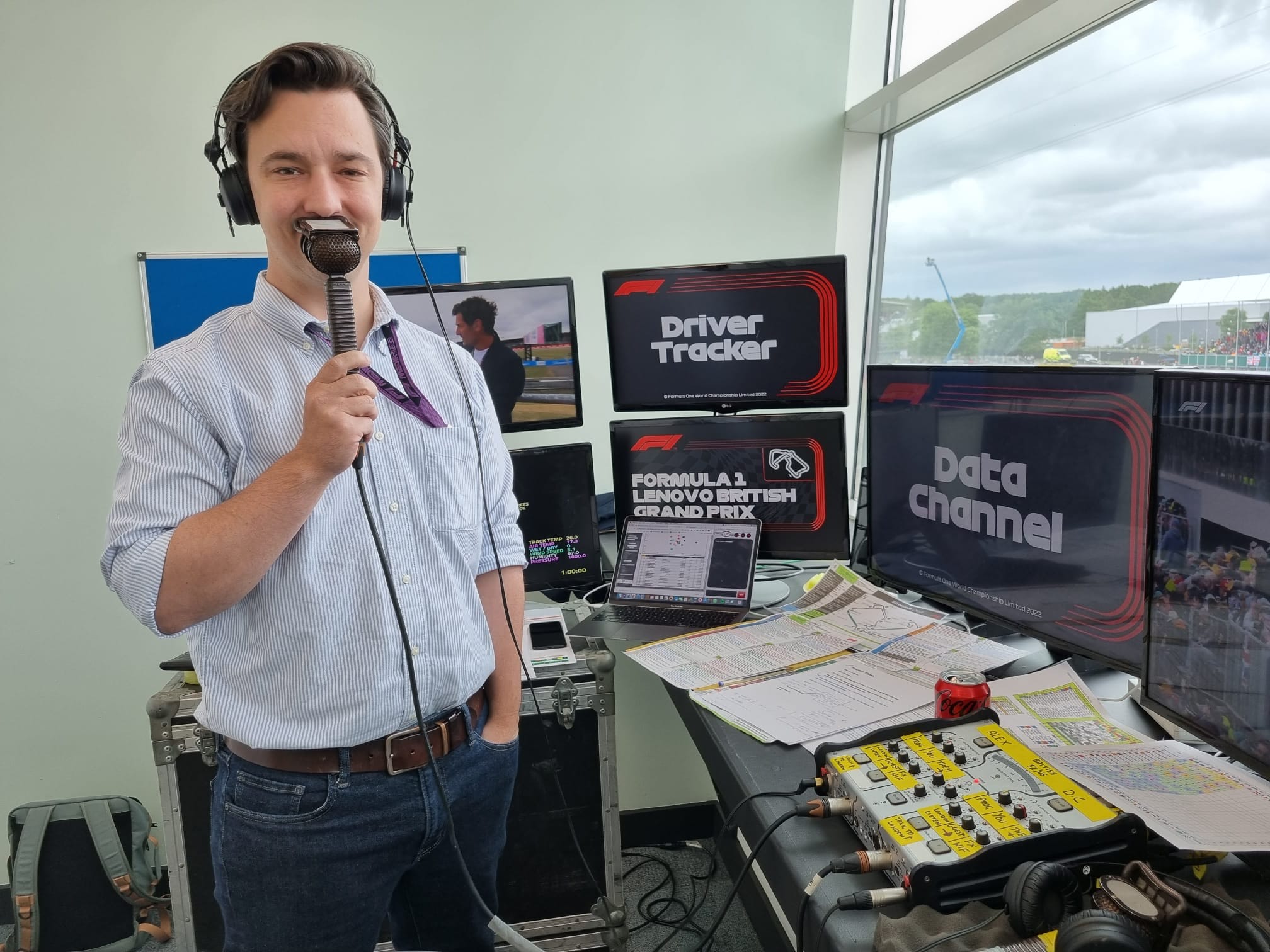
“The advice I’d give anyone at the start of their career, whether it be broadcasting, whether it be print journalism, is not to sweat it. The good days are never as good as you think they are and the bad days are never as bad as you think they are.”
“And the more reps you get, the more you get into a rhythm of it. The wonderful thing about Formula 2 is that the championship provides so much drama that you go through every conceivable circumstance.”
Talking through the highs and lows
“You cannot do unforgettable commentary unless there is a compelling story at the centre of it,” Jacques says. Luckily for Jacques and Valsecchi in the Formula 2 commentary box, that compelling story came in 2017 when Charles Leclerc took the championship by storm.
In the Bahrain sprint race, Leclerc made an unexpected pit stop, before overtaking 13 cars on his way to victory, a sign of things to come.
“Valsecchi’s next to me, saying, ‘what’s he doing, it can’t be done!’ We’re like, of course, it can’t be done, and then Charles just starts carving it up like it’s a PlayStation game!”
“You desperately want that narrative; you want the drama. People talk a lot about bias, the only thing any sports broadcaster is biased towards is it being good.”
Since the early years, Jacques’ commentary has received plaudits and colleagues alike, the most recent example being Jacques’ call at the end of the Monaco Grand Prix as Leclerc won in Formula 1 for the first time on home soil.
While Jacques is now in his element, it wasn’t until mid-2016 that Jacques began to felt more comfortable in the booth, aided by classic moments such as Leclerc’s Bahrain drive, and a drag race to the line between Pierre Gasly and Raffaele Marciello.
“It was one of those wonderful moments that didn’t matter in the grand scheme of things, but it was there where I was beginning to sound like how I wanted it,” Jacques recalls.
As lead commentator for Formula 2, Jacques has watched the future stars go wheel-to-wheel, waxing lyrical at their every move. On the other end of the spectrum, Jacques led Formula 2’s on-air tribute to Anthoine Hubert, who was tragically killed during the 2019 Belgian Grand Prix weekend.
“Anthoine was a terrific guy on and off track and it was such a cruel set of circumstances,” Jacques tells me. “I knew instantly it would be serious and then I felt an immense responsibility to the championship and my broadcast team. At that point you push all the emotion out and just deal in the facts that you have available.”
“Afterwards it was very tough when the news came through. It was difficult to comprehend that it had happened on a modern Grand Prix weekend and that someone you’d spoken to two hours ago was gone. It was just appalling for his team, friends, and family.”
At the start of Formula 2’s Italian Grand Prix broadcast the following weekend; Jacques gave a heartfelt speech.
When the sport that brings you joy suddenly brings you heartbreak, you are confronted with a choice. Stop and despair, or endure and continue. The drivers of Formula 2 reject despair, not because they do not grieve, but because they are determined in their defiance. Know this with certainty. Anthoine Hubert will never be forgotten. He was special, on and off the track, and the 17 on the grid today choose to honour him. They choose to race.
Alex Jacques, speaking at the start of Formula 2’s 2019 Italian Grand Prix broadcast.
“Those were my words and thoughts,” he says. “The thing about the production team is they have always put huge trust in me. In Italy there wasn’t even a discussion beyond checking I was okay. It will always be that way with my commentary.”
“It was seeing the determined defiance from the drivers in the paddock which inspired it. It’s the most honest and direct piece of broadcasting I’ve done and hopefully I’ll never have to do anything remotely like it again.”
Jumping to F1
Jacques moved up to covering F1 for their direct-to-consumer platform F1 TV, later becoming Channel 4’s F1 lead commentator from 2021 onwards.
“We’re all taught by the late great Murray Walker, there’s no such thing as a dull Grand Prix,” Jacques says. “And if you want to hold the microphone, you’ve got to try and make that true.”
Luckily, Jacques did not have much difficulty with that in 2021, as Lewis Hamilton and Max Verstappen raced towards a dramatic finale in Abu Dhabi.
One of their flashpoints at Silverstone was Jacques’ first live commentary on free-to-air television in the UK, joining an elite few to hold the honour of doing so, Jacques succeeding Ben Edwards in the position.
“I was talking to Ben about it in the week afterwards, it means a lot to be part of that group. There’s very few people who have had the honour of doing one of the great fixtures of the British sporting summer for a free-to-air audience.”
“That meant a lot as a 10-year-old who loved the commentary of Murray Walker and Martin Brundle. The idea then that I would be doing that, that was a very strange situation to try and wrap my head around.”
“If you tell everyone from a very young age that you want to be a Formula 1 commentator and they let you do it on Channel 4 live, you better be good! I’ve never felt pressure like that in my life and then to be rewarded with what happened.”
“It was one of the greatest distillations of what makes Formula 1 great that I’ve ever seen.” Hamilton and Verstappen raced towards Copse, but only Hamilton would continue beyond Copse, the two colliding as Verstappen slid off into the gravel.
“You just wanted it to carry on and on and on, but unfortunately it didn’t. Off the back of COVID, that felt like the first race that Formula 1 was back: it suddenly felt like it was vivid again.”
For Jacques, Silverstone 2021 was his favourite race to commentate on “by a mile, not because of who won, not because of what happened, just because of the occasion.”

Jacques is complementary of both of his co-commentators during that Silverstone race, David Coulthard, and Mark Webber.
“I was always so grateful for him [DC] for not pulling rank, understanding how I would do it differently, working with me [after Ben left]. He could not have been more accommodating, and I massively appreciated that when I switched to Channel 4”, Jacques says.
“I don’t there’s anybody else in broadcasting who will talk about the under rotation of an axle in the first part of a sentence and then give you pop lyrics in the second. He’s the same guy who has beaten Alonso, Schumacher, Hakkinen on his day suddenly then going, ‘what’s that pop song from 1980’ and then going ‘that might be because of d-rating!’”
“And with Mark [Webber], you just leave the commentary box with a smile on your face.”
As for his other co-commentators? Jacques has had just a few over the past decade and has compliments for them all, whether its Alex Brundle’s “brilliant one liners” or Jolyon Palmer’s “superb” analysis of the race.
“I think that is probably where I have been the most fortunate. Because of the range of brilliant co-commentators I’ve had, it’s given me the ability to work with so many different broadcasters with different skills.”
Jacques evolved his commentary style upon getting the Formula 1 gig, noting that the sport’s audience has radically changed over the past decade, with the sport attracting a younger audience every weekend.
“Commentary should always feel warm, and as broad as possible, especially in this era of Formula 1,” he believes. “We’ve got a large percentage of the Formula 1 audience who don’t know who Sebastian Vettel is, and he’s a four-time champion! Every time we commentate, we’re having to recap the basics.”
“I had a fan come up to me recently and say ‘why is there a safety car?’ It makes you re-examine everything. It’s wonderful that we’ve got so many more people interested in it, and that Formula 1 is pushing that into different places because it’s not rocket science. It’s prototype technology with brilliant athletes racing.”
“You do have to drive the commentary yourself, and you have to have that editorial judgement of what the commentary should sound like in someone’s living room to keep moving forward.”
Final thoughts
Jacques joined Discovery+ last year to cover the 24 Hours of Le Mans for the first time. The famous race presented him with a new, unique challenge, giving him the opportunity to start ‘from scratch.’
“You’ve got to know absolutely everything. You’re on that microphone at five in the morning with a team of experts, and you need to know everything inside out.”
“I loved going back to the start and going right, I’ve been a fan of this, now I’m going to try and wrap my head around the spectacle of the race. It was just wonderful that we got a race that matched the occasion [in 2023].”
“It was great [doing something brand new] because there are things that I learnt from that week that I then took to Formula 1. Ultimately, I just love broadcasting motor racing and I’m a commentary fan as well. It’s a consistently moving target.”
Nearly, a decade on from his opening act in 2015, Jacques does not see himself moving away from the commentary booth any time soon, openly admitting that he’s yet to have a ‘perfect’ race from a broadcasting perspective!
“Every single time I go into a pit lane or a commentary box, that moment hits. ‘Yes, this is cool!’ It never gets old and the moment it gets old you should be out of that commentary box. It should never be a job; it should mean more.”
“With broadcasting, there is nothing I enjoy more. Commentary for me is this unwinnable battle. The highest percentage you can ever get to is 99%.”
“There’s a race, and I won’t tell you which one, I got close, but I still know the thing I didn’t get quite right. It wasn’t wrong, it wasn’t a mistake. I thought I had a good race and then the next day I was like, ‘oh, you could have explained that a different way!’”
“Commentary is this wonderful thing that keeps me coming back, and long may it continue.”
If you enjoyed this article, consider contributing to the running costs of Motorsport Broadcasting by donating via PayPal. If you wish to reproduce the contents of this article in any form, please contact Motorsport Broadcasting in the first instance.
 Motorsport Broadcasting