James Allen on…

From print media, through to the small screen and now across multi-platform, James Allen is a name that is familiar with Formula 1 fans in the UK and beyond. Allen’s career has spanned multiple decades, but he was most famous as ITV’s lead Formula 1 commentator from 2002 to 2008 alongside Martin Brundle.

Now part of the Motorsport Network ship, I caught up with Allen during the Autosport Show weekend to look back at the three chapters in his broadcasting career to date. In the style of his own blog name, this post is ‘James Allen on…’ as he reflects on his story so far.

…the start of his broadcasting career
“My first broadcasting job in Formula 1 was in 1992. I had been working with Screensport, which was a forerunner of Eurosport, on their coverage of the Le Mans 24 Hours from 1990 and 1991. I got a call from ESPN, as their pit lane reporter couldn’t do the 1992 Hungarian Grand Prix, and we’d done Le Mans as a co-production between Screensport and ESPN the previous year. It was the race where Nigel won the championship, and I got a great interview with Nigel.

“I enjoyed myself very much doing the live pit lane work, so much so that ESPN offered me the job as broadcast reporter for 1993. ’93 was the season of Ayrton Senna and Michael Andretti as team mates, obviously Andretti being an American driver was exciting, so I was in the middle of all of that.

“I went to America to do Nigel Mansell’s second IndyCar season in 1994, Nigel and I got on really well. I spent a very happy year covering IndyCars and making the show for ITV working with Chrysalis, which went onto be North One.

“I carried on working with ESPN in Formula 1, until the BBC lost the UK rights in 1996 to ITV. ITV were looking for a production company from 1997 onwards, and I drafted part of the bid to win the production contract for Chrysalis, having worked with them on IndyCar, and that was the beginning of the ITV F1 adventure.”

…becoming pit lane reporter for ITV
“I’d done a lot of broadcasting before I became F1 pit lane reporter, I’d done Le Mans for two years running, which was 24 hours in the pit lane! It was much freer in those days, you could do whatever you wanted.

“There was a lot of scope for improvisation, I had a live camera with me, I could do anything I wanted with that live camera. I could interview anyone I wanted, doorstep anybody, it was a very deregulated environment back then. It did become progressively more difficult as the years went on, but it was great fun on the whole.

“I brought an American training to it, I’d spent four years by then working with really, really good sports TV directors and producers. I was very lucky to be mentored by some of the best US sports directors, so I knew exactly how to engage the audience, what kind of stuff they were looking for, how to think beyond the obvious, don’t just say what’s happened, but what that means for what happens next, and all that kind of thing. I was very lucky and brought that to the coverage on ITV.
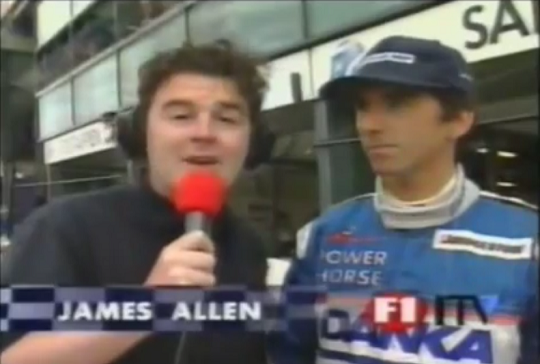
1997 Australian Grand Prix Qualifying - Allen and Hill
In ITV’s first live qualifying show at the 1997 Australian Grand Prix, James Allen interviews Arrows newest recruit and 1996 champion Damon Hill.

“Editorially I had worked at Autosport for two years, and prior to that I worked for Brabham with Martin Brundle, so I knew him very well from those days. Having worked on the inside of a Formula 1 team, I knew how that worked, how it operates, how it succeeds, how it fails.

“The pit lane role involved looking around for stories, looking around for insights. I’ve always been interested in providing insight and analysis wherever possible. I think the who, what, where and when is great, but I’ve always been interested in the how and the why.”

…his first F1 commentary
“I stood in for Murray when he bust his hip at the 2000 French Grand Prix, which was very useful because I was always the understudy, in case there was a ‘what if’ moment. I’d done a lot of commentary early in my career, Paris Dakar, Formula 3000, you name it, thousands of hours that hardly any people saw in the early satellite days. It was a great opportunity to commentate with Martin, to have a look at it and see how it sounded.

“I had a very intense post-French GP debrief with ITV’s Head of Sport Brian Barwick, who was very good to me and a very big influence on my career. He meticulously went through that commentary, what I’d done wrong, what I could have done better, what I done well, we spent hours going through it.

“It meant that the following year, when we did the transition where I did five races and Murray did the rest, I knew what I was trying to do. There was never any doubt in my mind about being commentator, it’s what I wanted to do since I was 15 years old.”

…succeeding Murray Walker
“It’s a double edge sword. On the one hand, the timing was good, plenty of other people would have liked to have followed on from Murray, but he kept going for a very long time. He and I worked very close together for the first four years [with ITV F1], and I drove him round Europe, he didn’t like driving in Europe so I always did the driving. We spent a lot of time together, which was wonderful, some very rich memories.

“It’s the job I always wanted to do, mass market, free-to-air TV in UK, Australia, South Africa, Canada, tens of millions of people watching, but on the flip-side he’s probably one of the most popular sports broadcasters there has ever been. You’re never going to be him, but nor should you ever try to be.

“I just said ‘listen, he has to stop’ because he’s 77 years old and can’t do this anymore, physically, it was taking its toll on him, and he wanted to go out on the top, so someone’s got to take over from him, and it might as well be me! I took it as a responsibility, I knew that there would be plenty of people who didn’t like it, I knew that there would have been people who did like it.

“Barry Davies, the football commentator whose daughter worked at Jordan at the time, said to me, ‘listen, you’re probably taking on the toughest job in sports broadcasting. If I can give you one piece of advice: stay philosophical, don’t listen to the people who cane you, and don’t listen to the people who think you’re the best thing since sliced bread, because you’re neither of those things. You’re neither a complete loser or the best thing since sliced bread, just somewhere in the middle, and be yourself’, and that was great advice, and that’s the way I played it for eight years.”

…commentating on motor racing
“What makes it tough is that there’s not one point of focus. If you commentate on a horse race, yes, you’ve got 20 horses, but they tend to focus on what is going on at the front because they all tend to be tightly packed together. If you are talking about a football match, or pretty much any ball sport, you basically follow what the ball does. Cycling is another one where you’ve got to talk about multiple narratives in one commentary, and it goes on for four hours.

2008-australian-gp-allen-and-brundle
Allen and Brundle here analysing the 2008 Australian Grand Prix qualifying session. Little did they know at this point was that 2008 would be ITV’s final year covering F1.

“I always looked at it in terms of a front race, a middle race and a back race. I would do it 60 percent front race, 30 percent middle race and 10 percent back race, so I gave a balanced narrative to the coverage. I always got on very well with Martin, he was very supportive. We had a lot of things that we wanted to try, we were always thinking about ‘let’s try this, let’s try that’, we never wanted to stay the same, we wanted to try to move forward. Having a racing driver like him alongside you means you’re always improving things with the broadcast coverage.

“We had some very difficult seasons to cover, ’01 was great, ’02 and ’04 were difficult, but a lot of people think that the 2005 to 2008 period is their favourite period in Formula 1. There was a lot of different winners, the cars were exciting to watch, and we had a great time.”

…ITV’s F1 exit
“We went out on a high with Lewis winning the World Championship. It was the only time in our twelve years of doing Formula 1 that we had a British champion crowned on our live coverage. It was a great moment, with 13 million watching, mass-market free-to-air TV, it was just fantastic.

“The contract we had with Formula 1 ran until 2010, and in my head, I was thinking I’d get to 2010 and do something else outside of commentary. I had a young family at that point with two young sons, and had been to every single race for 16 years. It was a little bit of a shock in ’08, when ITV decided to prioritise Champions League over Formula 1, and the BBC got the rights.

“But equally, I had also started exploring the digital media space with blogs, and so I went into that. I realised that there was a very good business to be had there, around the monetisation of blogs with sponsored brands and things. It was about leveraging my personal brand that I’d built up on the broadcast side on a blog, and then working with companies that wanted to attach themselves to it. That was like chapter two of the story, which was really interesting.

“Would I still have been commentating on Formula 1 on television in 2011 or 2012? No. I’m a bit restless, I do things for a while, then I feel like I want to move on.”

…his post-ITV exploits
“I did the blog thing, which you’re now doing very successfully, and then the BBC came knocking in 2012, to ask me if I wanted to be their F1 correspondent on 5 Live. The only reason I said yes was because I had never done radio, ever. Most people do it the other way round, they do radio first then go into television.

“The radio has been reinvented by the internet, you can really do a lot with radio, and I just wanted to see if I could do it, and actually, it’s much more difficult than television. I set myself a challenge, I really wanted to master this. I had four years in that role which I really enjoyed. I enjoyed working with the BBC radio network, trying to provide insights for people alongside running the blog and the business. Four years was just about enough, time to move on.

“I’m in the third chapter of my career now, which is building this unique vision we have at Motorsport Network. I’m in a management role, I manage 500 to 600 people in 21 countries. We’ve got the Autosport Awards, Autosport International, Autosport.com, Motorsport.com, all the digital media platforms.

“It’s a very interesting business, three different segments, media, experiences and eSports, we’re talking in the back of the Le Mans eSports truck. We’re the only ones that are across everything, it’s a unique project, no one has ever tried it before and will ever try it again. So far, it’s going well, it’s really difficult, it’s a big challenge, but I love it.”
How All Live is changing the face of rallying: production

Whilst many motor racing publications tend to focus on Formula 1 or MotoGP’s broadcasting exploits, elsewhere in the motor sport spectrum, a quiet revolution has been taking place that deserves far more attention than what it has received.

To discover more, this writer took a trip up to Deeside for the 2018 Wales Rally GB to see what the fuss was about for a three-part series. If you missed the first two parts, head over here and here

On track, 2018 was an amazing year for the World Rally Championship, with a three-way battle between Sebastien Ogier, Thierry Neuville and Ott Tanak going down to the wire in Australia. Neuville and Tanak faltered, with Ogier coming away as champion for a sixth consecutive season.

For the fans watching the action at home, 2018 was just as good, with the introduction of All Live, WRC’s over-the-top service that aimed to bring fans closer to the action by airing every stage live.

Although All Live arguably revolutionised rallying for its core fanbase, WRC’s Editor in Chief Kevin Piper emphasises that other outlets, such as the traditional highlights programme, are still important.

“The other content is still crucially important for the territories and broadcasters that rely on those. Recently social media has become far more important over the past five or six years, so you’re feeding that as well,” Piper tells me.

“The News [segments that we release] we appreciate is massively important because that’s bite-size, free-to-air content that major broadcasters may pick up on if there’s been a big moment, that’s great exposure. All Live has come on top of all of that, and added a whole new dimension for the rally fans and hopefully wider audience.”

The rotating army
On-air, All Live featured an array of talent during 2018, with different people coming in and out of the setup during each rally weekend. The studio team rotated throughout, with Abi Griffiths, Kiri Bloore and Alex Legouix sharing presenting duties. The three of them also doubled up as a reporter alongside Molly Pettit during the Service Park gaps.

Similarly, Becs Williams, who is All Live’s lead commentator, also interviewed the key players. The likes of Jon Desborough, Julian Porter, Nicky Grist and Ben Constanduros joined Williams in the commentary booth, and Piper is happy with the strength of what he calls a “versatile” team.

“One of the greatest strengths of this team, and we played our part in thinking about who comes to work for us, apart from the expertise, the experience, the motivation and the enthusiasm is we’ve got, partly by design, partly out of natural evolution, partly necessity, a group of versatile people who are capable in different disciplines,” Piper says.

“We have people who can produce, script and voice. We look for people who can do a bit of everything. We try to make each event unique, here for GB, we’ve had Nicky Grist and Robert Reed, who have added fantastic value to the co-commentary alongside Becs.”

The multilingual team is necessary in a multilingual paddock, which plays into the commentary throughout the weekend.

“I think we’ve been very good when Becs is commentating,” says Marko Viitanen, WRC’s television director. “We have different nationalities in our team who can always translate a language, if there’s something wrong with the Finnish guys I can always translate and get that back up to her, we have Swedish, German, Spanish, French, we can get those little insights.”

“I think All Live to a certain extent has changed the whole sport, because now the drivers cannot hide anything. They can’t say ‘we just overshot a corner’, when it never happened, so that’s changed a lot.”

As covered earlier, the All Live setup also allows the on-air team to speak to people from outside of rallying during the service breaks, such as former football player Sammi Hyypia, with a similar setup expected for this upcoming season.

The numbers game
In-Car Cameras – 48 cameras

45 – On-Board (3 x 15)
3 – Exta FX GoPro On-Board

Action Cameras – 24 cameras
15 – Highlights
9 – TV Live (Line Cut at SS)

Other Cameras – 14 cameras
7 – All Live (4 with RF kits)
4 – Manufacturer Area Fixed
2 – Drones
1 – Helicopter Cineflex

Behind the lens, there is an army of people putting the All Live product together, as Viitanen explains.

“There’s between 70 to 80 people in the crew in total, in operations at one time for All Live, it’s a crew of 50 to 55 people. You always see the cameramen, when you come into the production truck, you see guys doing slow-mos, mixing the pictures, you see those in action.”

“But there’s a lot of guys on the RF (radio frequency signal) and plane side that you never see or hear from, and All Live would not be possible without them. We cannot afford to put 10 or 20 cameras on every stage, across a whole event that would be impossible to manage, so the RF guys are really the heart of the operation.”

86 cameras, 1 event
Although rallying covers a wide amount of terrain, all the production for All Live is done back at Service Park.

“We’ve changed our production dramatically. Rallying is kind of a remote production, all of our production happens here at base,” explains Viitanen. “We get the ground cameras, the on-boards, the heli, the RF cameras, back via either the plane or via satellite, and the whole programme is combined here to create the package that fans see. We put graphics, slow-motions and the like, all that on top of it here.”

In total, there are around 86 cameras per event, although some shots are not available to use live. Special shots, such as the drone and various action angles, are utilised exclusively in the non-live wrap-up programme. The quality of the RF images is critically important to the success of All Live, meaning that the RF team must position the plane accurately during each stage.

“We’re doing over a 100km stretch here as well on the Saturday, the stages are so far away, so there’s more than a hundred kilo meters from base that we actually have the plane flying,” Viitanen explains. “We have two pilots in the air and two technicians, then there is one guy here who controls the plane, so he tells them from the ground where they should fly.”

“His job is to position the plane in a way so that he can receive the start camera, the finish camera, the on-boards and the helicopter. It’s always a combination of how the weather is up there, how much wind there is, what kind of stage you have, if you have mountains on this side or that side, so you have to move the plane from start to finish.”

“We’ll learn from everything this year [2018] and come back next year [2019] with more knowledge,” Steve Turvey, WRC’s Location Director adds.

“You’ve got to remember that every single event we are doing is brand new for everybody. The level of return we are getting now is absolutely staggering, we’re all amazed. To get that amount of data back, three signals from each car with telemetry, everything out in the right order is just a phenomenal achievement.”

Looking forward to 2019
Heading in 2019, what do Viitanen and Piper make of their first year of All Live?

“I think All Live has really succeeded on the way that we have put the technique to work for us, and I think that’s one of the highlights of the production, still with limited technical resources,” says Viitanen. “I have friends who’ll do F1, they cannot believe how much smaller the technical resources that we have compared to them.”

“You can compare the production style to the Tour de France, but the bikes don’t move as fast as rally cars, so that gives us a bit of a headache!”

“All Live has made this whole operation even more interesting, more complex from a technical point of view,” Piper adds, excited for what the future holds. “It’s a great challenge, a great new adventure, and after being involved in sports journalism and broadcasting for more years than what I can remember now, this is the icing on the cake.”

2018 has been year one for All Live. For fans worried that All Live was a one-year experiment, fear not. This weekend in the south of France, and at every rally in 2019, the team go again, but with the knowledge of 2018, this year promises to be even better for rallying fans.

How All Live is changing the face of rallying: planning

Whilst many motor racing publications tend to focus on Formula 1 or MotoGP’s broadcasting exploits, elsewhere in the motor sport spectrum, a quiet revolution has been taking place that deserves far more attention than what it has received.

To discover more, this writer took a trip up to Deeside to see what the fuss was about for a three-part series. If you missed the first part, head over here

So, the World Rally Championship has laid its production foundations for the future of the series. WRC gives fans 24/7 access to the championship, broadcasting every stage live on their All Live over-the-top service to fans worldwide. It is a herculean operation that requires a significant amount of planning.

Planning for a rally event, as is true for most forms of motor racing, starts years before the event takes place, sourcing out potential new locations for the rally to conquer. “Normally we get sent a provisional itinerary from the promoter, which we comment on,” says Steve Turvey, who is WRC’s Location Director.

“They already know what we want, sometimes that isn’t possible, sometimes it is a compromise, sometimes it is a negotiation, but there is a common goal to make it work for TV. Some organisers will say ‘there you are, take it or leave it’, others come to us with an open book and say ‘tell me what you want’, and that’s part of the job.”

The operational angle
The planning phase ramps up in the months leading into the rally, with a reconnaissance mission taking place beforehand. Commonly known as a ‘reccee’, the purpose of it is for the production team to source out the best shots for television.

“We drive all the stages during the reccee, choosing the action shots for the highlight packages,” Turvey tells me. “We sometimes trim the live stages to get the best section for the last part of the stage. There’s a few things we look out for, as an example, we don’t want anything that is tree covered, we want the good vantage points.”

Although the team now covers every rally stage live, there is still an element of ‘the old’ and ‘the new’ on the production side.

As in previous years, television networks around the world, such as BT Sport, cover several stages live, meaning that the production team still produces a World Feed for these stages. The remainder are exclusive to the new over-the-top platform, which brings with it a new requirement for the team to consider during planning.

“As a minimum, we want to see every WRC car through each stage for All Live, so we’ve got to consider the timings carefully. We need to make sure there’s enough time between the first WRC car starting and the final WRC car finishing, before the next stage starts to avoid any overlap.”

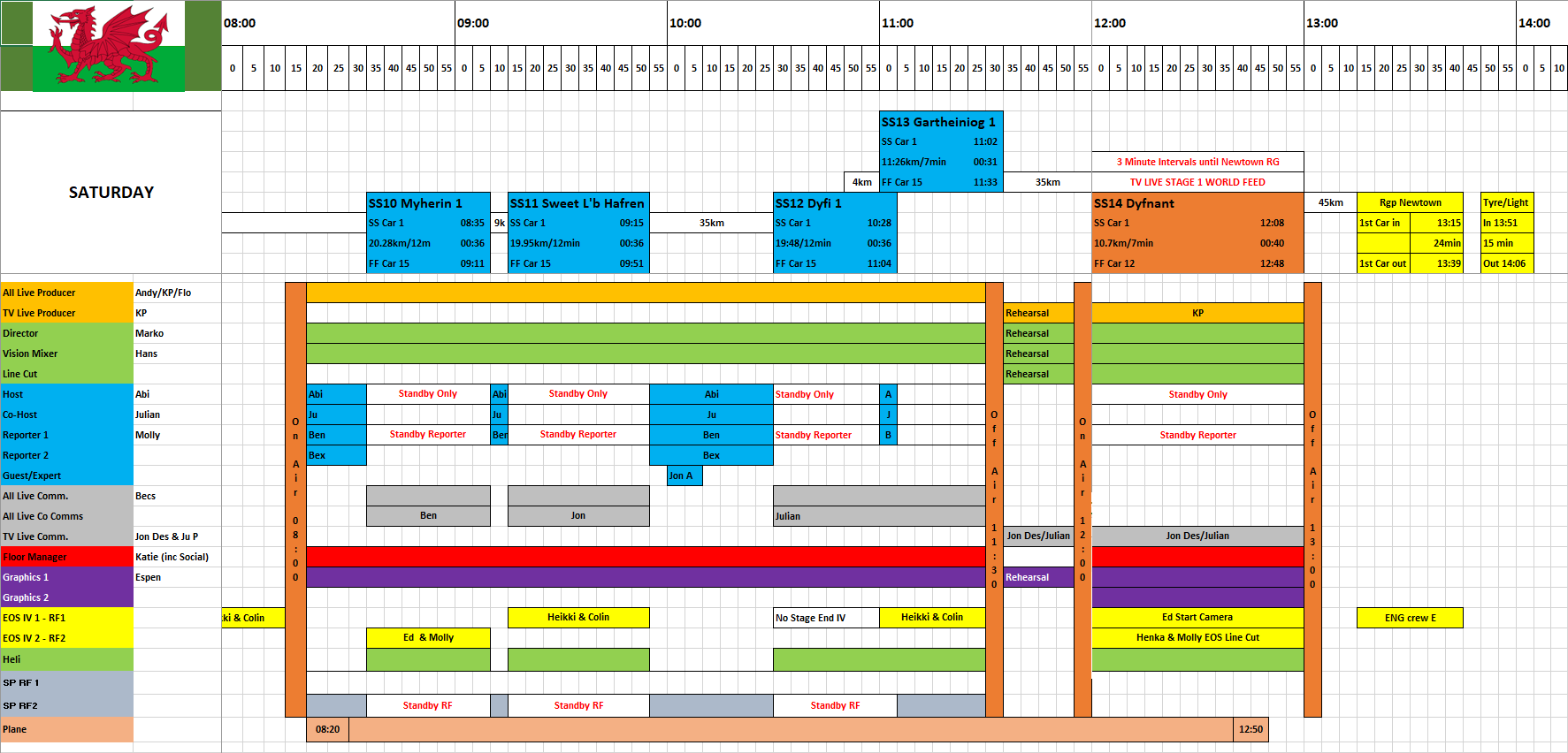
Turvey’s planning in the weeks before each rally must take this into account. A spreadsheet created by him builds up a timeline for all four days, broken into five-minute intervals, covering on and off-air times, sunrise and sunset, the talent involved with each stage (both on and off-air), the studio guests and so on.

The production team meticulously plans everything to the finest detail, down to the helicopter route! The helicopter might seem trivial, but no plane, no on-board cameras. The spreadsheet is not simply X + Y for calculating the gap between stages, but Turvey uses historical information, such as the average speed to calculate the stage gaps. Turvey describes it as “military operation”, everything reviewed with a fine-tooth comb.

“There’s absolutely nothing left to chance, everything is planned to the second. We know exactly the second the first car starts and the last car finishes. We’re trying to cover the rally, but we’re not trying to change it. The organisers have got ideas of their own, they start at 07:56 [here in Wales] for example because that is the first minute that they will get full daylight for everybody, and then they will be running until they start to get darkness.”

With rallying covering a large terrain, it means that WRC’s personnel are constantly on the move, which they monitors through a own tracking system to ensure that elements outside out of their control do not hold them up, such as marshals, closed roads, “or even if we’re snowed in during Sweden” as Turvey puts it!

“We appreciate it is live TV, so that is very much plan A, sometimes we end up with plan C,” Turvey continues. “If you have an event like Turkey, when the entry list was decimated due to the conditions, what we ended up broadcasting was nothing like the original plan, and that’s the great thing about the people we’ve got. We’ve got multi-skilled, multi-talented reporters out there.”

The editorial stance
On an editorial level, it is critical that the team is singing off the same hymn sheet. At their Deeside base for the Wales Rally GB, there are multiple production offices on the go, which Kevin Piper, WRC’s Editor in Chief, describes as a “multi-layered operation.”

There are at least four layers to the WRC production operation: highlights (both 26-minute and 52-minute), the bite-size news segments, All Live, and the World Feed; and that is ignoring all the invisible layers that are in between.

As stories unfolded during the Wales event, you could hear the production team chatting to one another, ensuring that the outlook was consistent across all of WRC’s products. “I take overall responsibility for the editorial content which is an ongoing process throughout the year,” Piper tells me.

“I take on-board ideas and proactively get suggestions from the rest of the team. We talk to each other between each event so that we know where we want to go moving forward.”

As part of the planning phase, Piper’s team are also in regular dialogue with WRC’s manufacturers and drivers, so that they can get the best on-screen product and interviews on-air. The 52-minute highlights programme contains a mixture of on-stage action, as well as feature segments, which requires co-operation from the teams involved.

“We know what the features for the highlights show are before we arrive at an event, and we’ll shoot these in advance of the event on the Wednesday and Thursday, ready for our editors to edit them during the weekend,” says James Parnis, who leads the 52-minute highlights strand of programming.

“For the Wales show, we’re doing a three-minute feature with Craig Breen and Scott Martin, who are having drone flying lessons from the guys at DJI Pilots. Because of what happened in Turkey, we’re also doing a technical feature, which we shot before the event on drivers and co-drivers having to repair their own cars out on the road section.”

2018 Wales Rally GB - time line snippet
The All Live and World Feed time line for Saturday morning’s action in the Wales Rally GB, covering stages 10 through to 14.

“By pre-planning, shooting stuff and editing stuff before the event even begins, that gets us ahead of the game. That’s the plan anyway, it doesn’t always pan out like that, sometimes we have to be reactive and come up with feature ideas during the event,” Parnis continues.

The features, which WRC also plays out on All Live, help the 52-minute programme breathe although Parnis is keen to emphasise that the on-stage action takes priority. “Look at the Saturday in Turkey, so much happened! Whilst we have our own ideas, if the action out there on the stages is incredible, then that takes precedence. That’s what people want to watch, they want to see the best action.”

Quickly as the weekend ends, Piper is looking ahead to future events. “Once the event is established, you follow the storylines on top of the features as with any live event. Afterwards we have a debrief as we look ahead straight away to at least the next rally, if not a little bit further than that.”

The television feeds
Calling the job of a television director ‘easy’ is perhaps a bit of an exaggeration, however the introduction of All Live has helped WRC’s television director Marko Viitanen this year.

“From a director’s point of view, making that one live television stage needed a lot of prep, because you needed to know what happened on the previous stages,” Viitanen says. “Now, when you’re directing All Live, you live the rally from start to finish. You know the order of the cars by heart, you know your shots, because you’re seeing all the on-board shots. You have the information burning through your brains, it is kind of easier!”

“I always compare directing rallying to cross-country skiing. In the best possible scenario, you have several cars on stage, and we can balance and bounce cars between the splits. We can actually put pictures to the stuff you, me, rally fans sitting at home have been watching on the timing screens for years.”

The set-up for the live World Feed stages is different to that for the over-the-top All Live stages. “We have a range of materials on offer for the World Feed,” Turvey notes. “There is a long action section at the end of the stage, covering the last couple of kilometres. We call this a line-cut section consisting of typically seven cameras, with an OB (outside broadcast) van.”

“We have a set team both on and off-air, with Jon Desborough leading commentary. In addition, there is a full graphics package, start camera, finish camera with interviews.”

All the work that Turvey is doing is on-top of his existing role from 2017, and as the team leaves Deeside, Turvey is already planning further ahead. “We’ll do the initial planning for [the next round in] Spain before we leave here, which is the on-air and off-air times. By the end of this weekend I’ll have this information ready for Spain.”

Beyond Spain, discussions are already beginning about next year’s rally, with the possibility of the opening stage moving to Liverpool and Manchester. And with that, the cycle for the 2019 Wales Rally GB begins already, it is the show that never stops…

Coming in the third and final part, we continue our look behind the scenes at the breadth and depth of WRC’s production suite.

How All Live is changing the face of rallying: foundations

Whilst many motor racing publications tend to focus on Formula 1 or MotoGP’s broadcasting exploits, elsewhere in the motor sport spectrum, a quiet revolution has been taking place that deserves far more attention than what it has received.

To discover more, this writer took a trip up to Deeside to see what the fuss was about for a three-part series…

Unless you know your geography very well, Deeside probably does not register on the Richter scale. But, for one week each year, the world of rallying descends onto Deeside’s Industrial Estate, as it plays host to the service park for the Wales Rally GB. This year, the event signals round 11 of the 2018 World Rally Championship.

So why rallying, and why now? In January, organisers of the championship announced that they would be launching a new over-the-top platform, airing every stage of every rally live via said platform. It is easy to see why such a move could be a revolution for a sport that usually aired as highlights in a late evening time slot.

2018 is not the first time WRC’s promoter has attempted to broadcast every stage live to fans. Back in 2011, then promoter North One Sport experimented with an ‘all live’ approach, but the experiment lasted just one season.

Now with the commercial rights in the hands of WRC Promoter GmbH (a collaboration between Red Bull Media House and sportradar), 2018 marks take two at trying to transform rallying.

“We did have a little go at it in 2011, but the resources and technology were not ready for ‘it’,” Kevin Piper tells me. Piper is currently Editor in Chief for WRC’s television output, and has worked on the championship for the past decade. “Everything has come together now; the promoter has taken a calculated gamble and hopefully it is paying off.”

Marko Viitanen, who is WRC’s television director, was involved in the 2011 test and could see the potential from the outset. “At that point I kind of knew as a director ‘this is the way’ to do rallying live, but it took some time. I must say that the promoter today had a really good vision.”

Up until 2018, rally fans had access to selected stages live, along with the traditional 26- and 52- minute highlight programmes. Arguably, in a 21st century media age where fans are viewing live sport on a variety of devices, rallying was some way behind the curve.

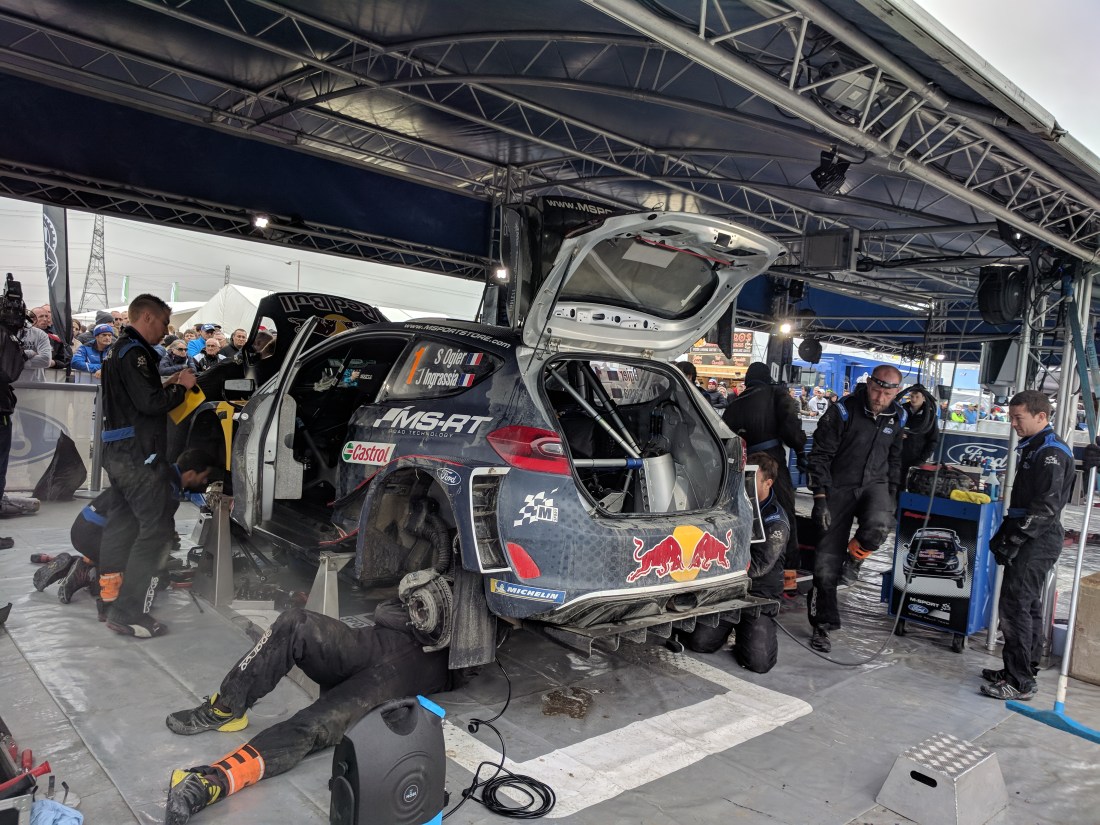
2018 Wales Rally GB - Service Park.jpg
M-Sport Ford mechanics repair Sebastien Ogier’s car following the first stages on Friday morning during the Wales Rally GB.

In his previous role, Piper worked on the 52-minute highlights package, a task that became trickier as time progressed. “Sport is best delivered live, whatever the sport, especially in this day and age when the technology is there to enable you to do that,” Piper says.

“Everyone knew what had happened already, so we always had that battle of ‘what should the editorial slant be’ on the highlights, when it’s going out a few days after the event had finished.”

“We were forever reinventing that programme, to not lose too much of the credibility and respect for the sport and the fact that there was an event at a world championship level that had happened, but this holy grail of trying to appeal to a wider audience, that proves to be really difficult.”

Monte Miracle
After a successful internal test in Portugal last year, series organisers ploughed ahead with the new product, dubbed ‘All Live‘ ready for launch in 2018, starting with the traditional curtain raiser, the Monte Carlo rally. At just £7.97 per month, the pricing is a steal for hardcore and casual rallying fans alike.

The first stages from Monte Carlo take place on a Thursday night, up in the mountains at the service park in Gap in less than ideal conditions. Series bosses wanted to launch All Live on the Thursday night, which they followed through successfully on, but Piper expressed some early reservations.

“I would think very carefully about Thursday nights in Monte Carlo, which will probably go down as one of the most testing, challenging productions I’ve been involved with ever. We knew that Thursday night, up there among the mountains, would be challenging to say the least, hell, it’s a big enough challenge as it is when the landscape is on your side!”

“But that night, to launch this All Live product, I said ‘don’t do it.’ Play safe, launch on Friday morning, okay you’ve still got the terrain to contend with, but the conditions will be a lot more user friendly,” Piper says. “The decision was taken and, to be fair from a logical point of view, we’ve called it All Live therefore it has to do what it says on the tin and cover all the stages.”

“People were understandably frustrated and criticised us on the night as there were technical problems, but they could have also quite rightly criticised us for not living up to the billing and not being on the start-line on Thursday night.”

“Producing a rally across four days is a major logistical and technical challenge that is difficult to put into words, on a much larger geographical scale than many other motor racing events. Bearing that in mind, the idea of a ‘All Live’ offering is beyond anything that has happened before.” – reviewing All Live post Monte Carlo

Viitanen was under no illusions about the challenges that lay ahead. “People in our crew come from circuit racing, and they’re stunned about the fact how difficult rallying is. Rallying, All Live, is probably the most difficult production from a technical perspective. The tech setup spreads wide.”

“You can imagine Monte Carlo, the distance between Gap and the last stage is 170km in birds eye view, and then you have obstacles like mountains to contend with.”

Nevertheless, Viitanen was extremely happy with the work that his team put in that weekend under testing circumstances. “To be that good in Monte, we were not even close to perfect there, we did pull out a miracle,” he tells me.

Beyond the stage
Whilst the main attraction of All Live is having every stage live, the cherry on top of the cake comes in the form of action between the stages, as All Live gives fans access to the rally from dusk to dawn.

Helped by a dynamic on-air team, All Live features studio interviews from stars past and present, including the rich and famous. Nicky Grist (formerly Colin McRae’s co-driver), Sami Hyypia (football manager and player) and Gary Mitchell (led the team involved in the Thailand cave rescue) were some of the names to pop by the studio for a chat during the Wales weekend.

Grist also joined All Live’s lead commentator Becs Williams in the commentary box on Friday morning in Wales to chat through the action.

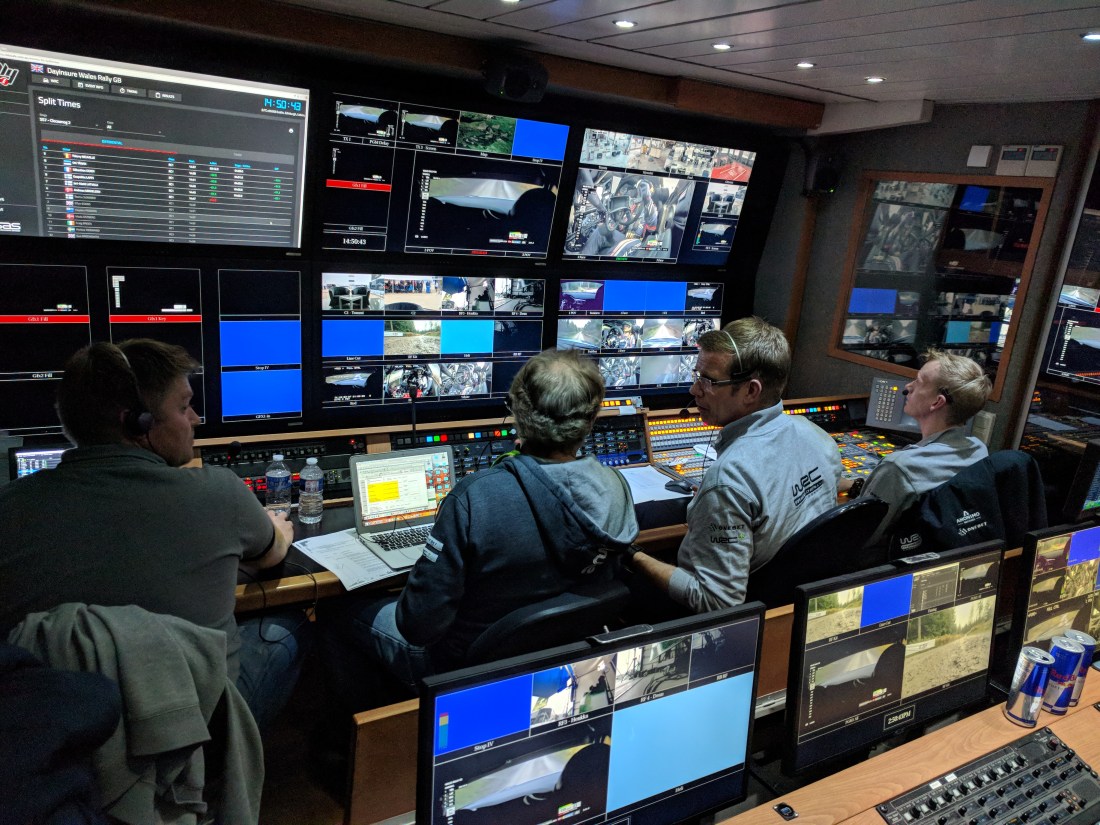
2018 Wales Rally GB - production truck
Inside the World Rally Championship production truck at their Deeside base during the Wales Rally GB, with Kevin Piper and Marko Viitanen (centre left and centre right respectively) in full flow.

Elsewhere, the platform focuses on the service park part of the rally, with roving reporters on stand-by, which has for many been one of the revelations this season. “For me, and I knew this right from the word go, what really brings a lot of added value to All Live is the insight you get from when the cars are not running, when they are in service, when there is a roadside repair,” says Piper.

Speaking to me on the Friday in Wales, Piper continued “Today was a great example in the service park, a battle against the clock to get a full gearbox change done on [Sebastien] Ogier’s car. You could have logged in, wherever you are in the world, just as that started, I defy anybody to turn that off.”

Piper hopes that, by exposing previously unseen parts of rallying via All Live, rallying can attract a new demographic of fans moving forward. “There are so many facets to this sport, different terrain, different drivers, different characters, different elements on any one given day.”

“I love my football and I love my Formula 1, but you kind of know what you’re going to get with that. Here, from one hour to the next, the storylines and characters can change, different drivers enjoying different fortunes, car rebuilds,” Piper added.

“I’ve always thought of All Live as not only for the core fans but it’s actually for the younger generation, bringing the sport to the people and WRC to their mobile devices,” Viitanen adds. “€89.99 for the whole year, it is a treat for that price. I’m really happy with the way that people have taken to the product. I was talking to some of the drivers the other day, and I think this is the best thing media wise that has happened since TV came to WRC. This has great potential.”

WRC officials tell me that they are “very happy” with the take-up of All Live worldwide, outperforming expectations in a variety of territories, which bodes well for the future of the product, as they look to evolve All Live heading into 2019.

For Viitanen, 2018 is a mix of the old and the new. “This first year is a hybrid one for us, every event is a learning curve. We’ve brought in a lot of new developments during the year, both technically and on the content front,” comments Viitanen, who is also the managing director of production company NEP Finland.

“We’ve come a hell of a long way since Monte,” Piper adds. “What the technology guys here have done is quite extraordinary, and no one at home ever sees that. We never stop learning and reinventing the wheel.”

Saturday in Turkey
Roaming around the service park in Deeside, three words cropped up repeatedly: Saturday in Turkey. Labelled as one of the most dramatic rallying days in years, title contenders Thierry Neuville and Sebastien Ogier retired from the Turkish rally, with difficulties also for Andreas Mikkelsen and Craig Breen, decimating the running order.

Toyota Yaris driver Ott Tanak took full advantage of the problems that befell the others, heading to the top of the leader board. All of that in the space of a few hours. And, for the first time, broadcast live for rally fans to watch as it unfolded in front of their very eyes, showing the capability that All Live brings to the table. No longer did rally fans have to wait until the evening highlights package to witness the action.

“If you enjoy motor sport, I defy anybody to tune into All Live for five or ten minutes and not think ‘wow, this is great, I’m part of the journey, I’m in there now!'” Piper tells me. “And that’s just the actual stages.”

Although All Live is a live product, the benefits of it stretches far beyond All Live and into the highlights output. “When I worked on the ITV’s F1 coverage, the highlights basically cut themselves, there were no surprises,” says Piper.

“Whereas here, before All Live, because of the incredible footprint of WRC, if a car had gone off 100km from here, it’s not until we get it back and see the on-board, you realise ‘jeez, what happened there!’ That then becomes an important part of that day’s highlights. Now we see pretty much all of it and more.”

For the team working on the 26- and 52- minute highlights programming, the difference between 2017 and 2018 is night and day. James Parnis is the producer for the 52-minute highlights programme.

“Right now, as we sit here, we’re watching it all unfold!” says Parnis, talking to me during the Wales Rally GB weekend. “We know the shots already that we want to use, and we’re able to keep across the story much better than before.”

“In Turkey, when Neuville had his incident and limped into service, we had live shots of him standing there watching Ogier’s roadside problems! In terms of how All Live and the highlights work, they work very much in tandem.”

Inevitably there is a resourcing challenge with All Live – a similar budget and level of expertise compared to previous years, but a much bigger operation, meaning that everyone both on and off-air has had to rise to the challenge presented.

“It is more challenging with the long hours,” Viitanen says. “It feels like work when you’ve sat there 25 hours in front of the screen, but on the other hand, it’s fascinating. You’re telling the story for the whole weekend, and in the end, TV is about telling stories to millions of fans worldwide.”

Coming up in part two, we take a deep-dive into the World Rally Championship production area, looking at the effort that goes into the planning phase, including the pre-event recce.

Behind the scenes with BT Sport’s MotoGP production team: evolution

From Qatar to Valencia, from Friday morning to Sunday evening, BT Sport cover every session of the MotoGP season exclusively live. Their coverage encompasses both the main championship as well as the feeder Moto2 and Moto3 championships.

North One Television produce BT Sport’s coverage, and in the second and final part of this series, I went behind the scenes with them during the British Grand Prix weekend last month to find out how their programming has evolved.

If you have yet to read part one, head over here

When BT’s MotoGP coverage started in 2014, North One did not cover every race on-site, with BT’s Olympic Park studio in regular use. Fast forward four years, and North One now take the same size team to every race, with all the action presented on-site.

“What we want to do is make sure we offer the same service to fans, whether it is on in the middle of the night for the fly away races, or in prime time viewing hours,” explains Kevin Brown, who is MotoGP series editor for North One. “We want to serve the people who care and want to switch on in the middle of the night, they should get the same service as they would do if the race was on at 1 on a Sunday afternoon.”

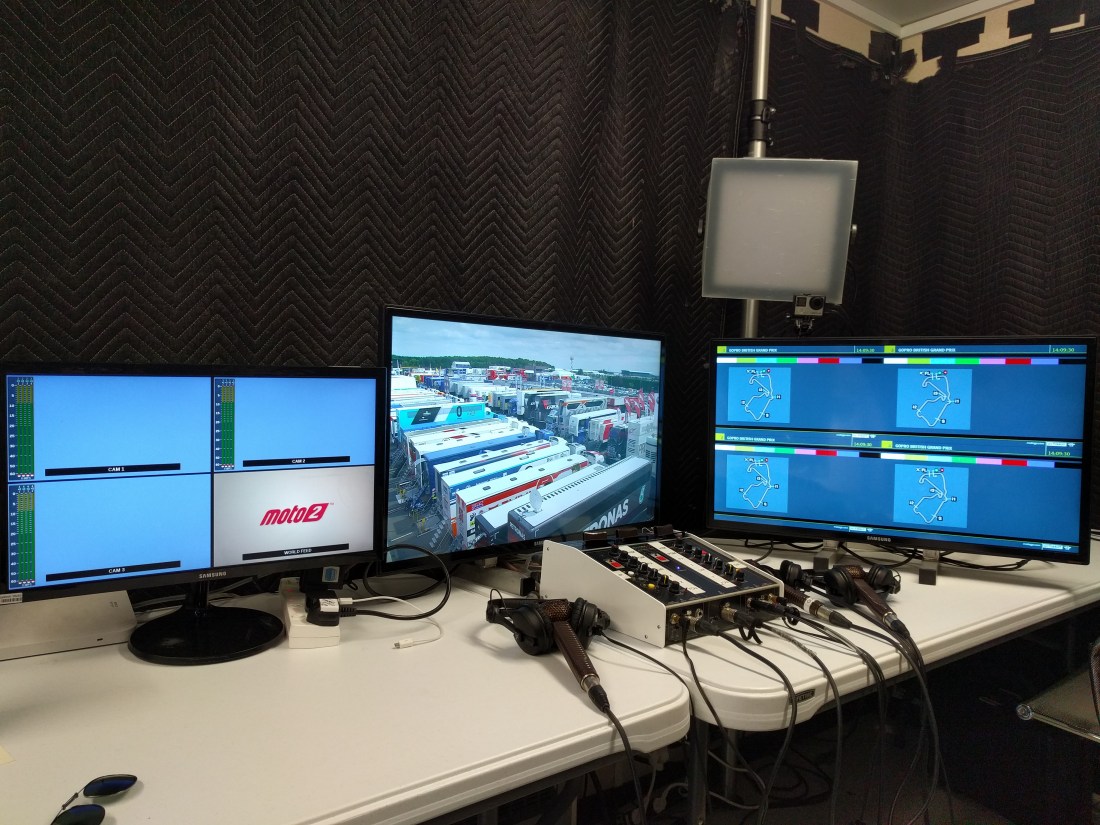
2018 British MotoGP - BT commentary booth.jpg
The BT Sport commentary booth. Note that BT do not commentate from the main grandstand, or in Silverstone’s case from Woodcote. Instead, they commentate from one of their TV compound buildings, allowing them to easily rotate the commentary duo throughout the day.

26 people make up the MotoGP production team for North One, a number that includes on-air talent as well. Removing the seven on-air talent means that there are 19 people behind the lens that work on BT’s MotoGP programming race in, race out, including floor managers, researchers, producers, a sound assistant, and so on.  For Silverstone, the number is slightly higher to accommodate the additional material that BT puts out on-air.

Brown is happy with how the team currently operates with one another. “We’re very lucky that we do have a team that gets on exceptionally well with each other, and works exceptionally hard to make it happen.”

“When we get here, we have to hit the ground running, they need to know what their jobs are, what they are doing. As an example, you land in Japan, you are as jet-lagged as you can be. But you still get in a car, drive to the circuit, and have to perform as you would have done in Europe.”

“‘I’ll tell you what, let’s have a day off because we need to!’ is not an option in live sports broadcasting. Generally, everyone working for us are bike fans, we have a group of people who in some cases also work on other bike sports, and that is because they love it.”

Viewers watching at home may not realise that, but some of the production crew working on BT Sport’s MotoGP coverage also work on other aspects of motor racing. For example, Charlie Hiscott, who is a reporter for Eurosport’s World Superbikes coverage, works with North One during MotoGP weekends as a floor manager.

After an unsettled start, BT’s MotoGP coverage started to find its gear as their second season in 2015 progressed, something that Gavin Emmett acknowledges. “The first year or two we were just trying to work out what was going on, and since then we have only got better as we’ve become familiar with each other,” says Emmett.

2018 British MotoGP - BT touch-screen
The glamarous life of broadcasting. Neil Hodgson, furthest from the camera, analyses action on BT’s touch-screen device. The black tarpaulin is around the outside to prevent shadows from appearing on the screen.

“We have had changes over the years, whether it has been the presenters or Julian [Ryder] leaving at the end of last year. Like anything, as people become more familiar with it, and as fans become more familiar with us, hopefully they see the little things we throw in there.”

Suzi Perry presents BT’s output, with a six-man band led by Keith Huewen on commentary. Emmett, James Toseland, Colin Edwards, Neil Hodgson, and Michael Laverty provide analysis, Laverty the latest addition to their team for 2018. All of them bring a wealth of motorcycling knowledge from their years in the paddock and out on the race track.

The departure of Ryder from their coverage at the end of 2017 left a hole in the show, but the strength of BT’s team has allowed them to cover for Ryder’s absence. Instead of a single commentary team throughout the day, North One opted to rotate the commentary line-up. Emmett joins Huewen for Moto3, with Toseland on Moto2 duty and Hodgson giving his opinion on the MotoGP action.

“We all love Jules, but he wanted a break from all the travelling,” Emmett tells me. “The change has meant that we can experiment with commentary pairings, and I quite like that, it keeps it all fresh.”

“You keep the familiarity with each series, but you also get different voices throughout the day which keeps it interesting. When you have the same two people all through the day, it’s hard to then get ‘up’ for MotoGP at the end of it, but if you’re changing it up, the co-commentator then has energy for that race. I like it.”

For Emmett, 2018 is a return to the commentary box, having done commentary work for Dorna prior to joining BT’s coverage. His long-standing paddock reputation means that he is the ‘go-to’ man for stories, as well as his multilingual background.

“Gavin is the best-connected man in the paddock, he knows everyone,” says Brown. “Gavin finds the stories that you can see, but also those that you can’t see, that people will tell him because of who you are.”

“I’ve been lucky because I’ve been in this paddock since 2001. I’ve seen most of these riders grow up. I remember giving Jorge his first interview I remember on his birthday in Jerez. I speak Spanish, French and Italian, so I’ve got to know them in their own language, you get to know them on a different level which helps.

“We all have different ways of getting information as well, mine are through getting to know people, everyone feeds in their own little bit and that comes together over a weekend.” – Gavin Emmett

Brown is confident that North One have plugged the gap left by Ryder, thanks to the strength and depth of their team. “Our audience are people who know and care about bikes, and we can’t pull the wool over their eyes, we have to make sure we are providing the right information. That comes from a great on-screen talent team.”

“We have these people who know it so deeply, and that then feeds back into the production team,” Brown tells me. “Editorially we’re joining up as well as we have ever been. I would say that story-telling is our strongest aspect at the moment. We have story-tellers, we have the access to the people in the paddock to tell the stories properly.”

“The teams help us out an awful lot, and when we ask, we tend to get the right people even though they know we’re going to ask a difficult question. They know we’re not trying to mess around with them, we’re just asking a genuine question and we’d like a genuine answer. We’re not trying to misrepresent anything, we’re always trying to tell the right story.”

What does the future hold for BT’s coverage of MotoGP? Earlier this year, BT retained the rights to the championship, keeping the series until the end of 2021. A new aspect for 2018 has been the touch-screen. Like the Sky Pad seen in Sky’s coverage of Formula 1, it allows BT to give viewers a perspective they have not seen before.

“With the touch-screen, we can show people things that they wouldn’t otherwise have seen. We can have a feed of the helicopter to show different lines, or for example the sheer power of the Ducati compared to the Honda, just things that help people’s understanding. It’s easy to tell them ‘what’ but it’s harder to tell them ‘why’,” says Brown.

And Brown is keen to continue using the touch-screen moving forward. “I think that’s what our guys are very good at, and if we can give them the tools to do that better then that’s good. BT are a technology company, and they want us to be using technology, and we are happy to use it, to help people’s understanding of what is a brilliant sport.”

You can argue about BT’s pricing structure, and whether the service is too expensive. But one thing is for certain. Neither BT or North One leave MotoGP fans short-changed. And long may that continue.

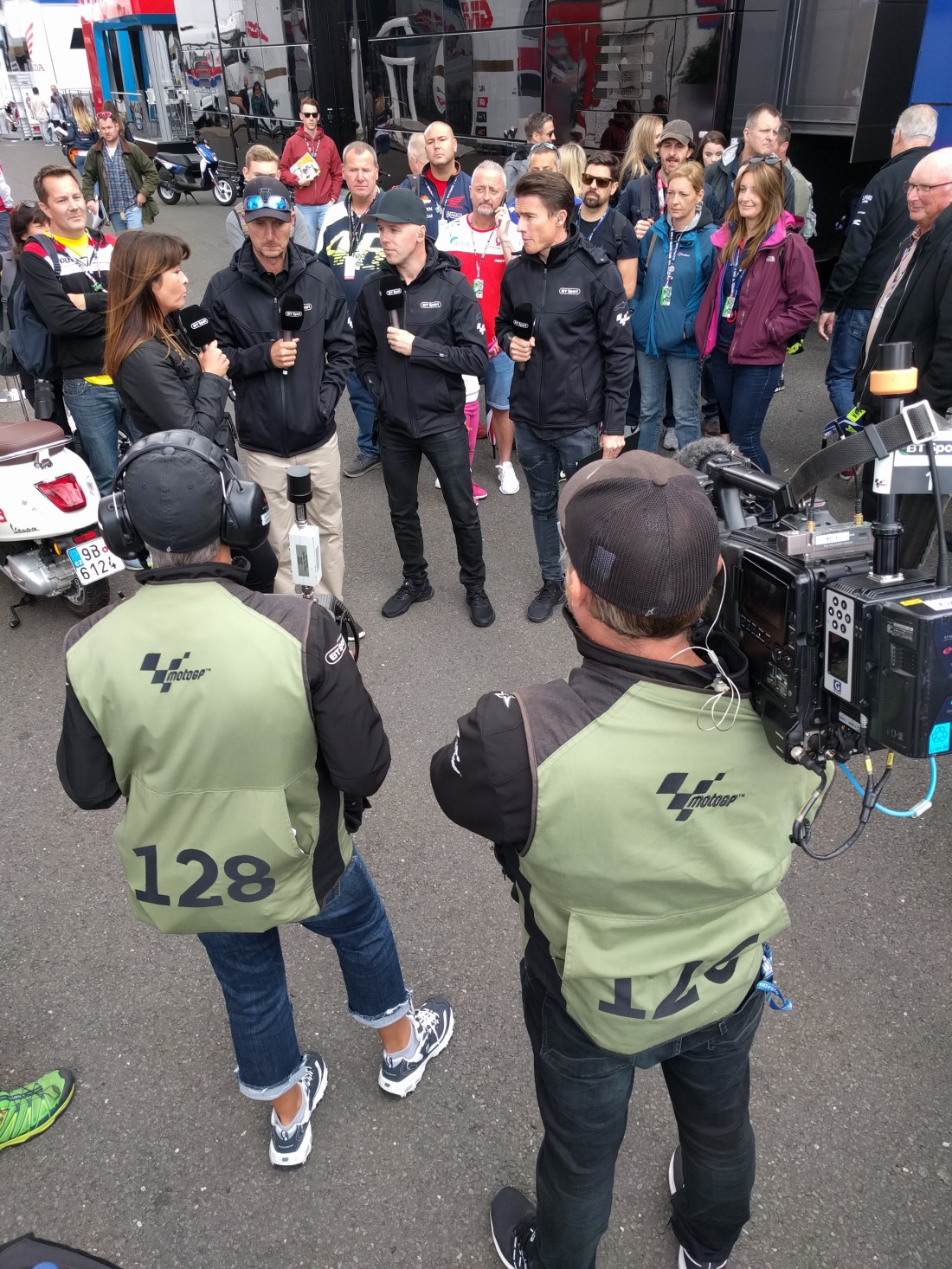
2018 British MotoGP - BT on Saturday.jpg