“A decade, not out” – celebrating 10 years of Formula E

Formula E burst into life for the first time ten years ago next month, with the 2014 Beijing E-Prix. Arguably, the incident between Nico Prost and Nick Heidfeld on the final lap remains the championship’s most iconic moment.

Since then, the series has crowned nine different Drivers’ Champions, with the series evolving year-on-year. Mandatory car swaps have disappeared, and Attack Mode has replaced Fanboost. More importantly, the electric machinery is significantly faster now thanks to improvements in battery technology.

Off-track on the broadcasting front, the series has faced hurdles both domestically in the UK and abroad. So, what lies ahead for the championship? We explored the paddock and went behind the scenes during the London E-Prix season finale…

The 12th team

Aurora Media Worldwide and Whisper are responsible for production of Formula E’s television feed. Aurora produces the Track Feed on location and the International Feed. Whisper handles the English language programme (ELP) from WestWorks in London.

Whisper’s feed comes with different ‘opt in’ and ‘opt out’ points, allowing broadcasters to join the build-up at different stages. Some territories take the race itself without pre- and post-race amble while others take Whisper’s ‘full fat’ programme.

Supporting Formula E with the technical aspects of the broadcast are companies including Gravity Media, Tata, and Timeline TV.

Season 10 was Formula E’s first primarily behind a pay wall in the UK, the series airing on TNT Sports. Only the season finale in London aired for free via Quest, Discovery’s free-to-air outlet.

Over the past decade, the championship has exhausted all other free-to-air partners, never finding the right home. ITV, BBC, Channel 4, and Channel 5 all came and fell by the wayside. What the series has long yearned for is channel consistency, something that TNT Sports and Discovery+ provides.

Despite the change, sources suggest that Formula E are happy with the audience figures. The series is likely analysing the overall reach across all of Discovery’s platforms, rather than a single channel in isolation.

Whisper won the contract to produce the English feed for season 10, bringing some recognisable faces with them. The likes of Billy Monger, David Coulthard and Karun Chandhok joined Formula E mainstays Nicki Shields and Dario Franchitti on-air. Tom Brooks remained lead commentator, a role he started in 2023.

Vernon Kay’s decision to leave Formula E and focus on his radio commitments meant Whisper needed a new presenter. The team opted to bring in ex-footballer and now presenter of BBC’s The One Show Jermaine Jenas. Jenas has improved since the start of the season, helping to explain basic concepts to new viewers.

Harry Allen, who leads Whisper’s Formula E production, was complimentary of Jenas and the way everyone has “embraced” the team.

“Since we’ve been at the centre of it, it’s been an amazing experience,” Allen says. “We’ve really enjoyed working with all the drivers and the teams on the grid. We feel that the programming has done the series justice. It’s been fun telling those stories and getting stuck into what is an intriguing and fast-growing sport.”

“We knew coming in that there was an opportunity to bring in a new face in to anchor the series. Formula E loved having somebody from outside the sport to lead the presentation, and they wanted to continue that.”

“Jermaine is somebody we’ve worked with for years and we were happy to bring him on board. His intrinsic understanding of sport, plus having someone with the mindset of somebody who plays elite sport has been good.”

“He brings people along with him who maybe aren’t motor sport experts. I think that’s what we need to concentrate on if we’re going to capture audiences,” Allen believes.

Allen cited Jaguar’s issues during the London weekend as one example where Jenas asked the key questions. In Allen’s view, Jenas helped put into context the “things that the rest of us take for granted.”

Inside the commentary booth

We jumped into the commentary booth on Sunday morning in London to see the set up during qualifying. Commentary box fridges aside (a topic for another outlet!), it was fascinating seeing Brooks, Chandhok, and Allan McNish first hand doing what they do best.

The trio during qualifying were a well-oiled machine, to the betterment of the product. It reminded me that a three-person team works better than two, Whisper moving in that direction for Formula E.
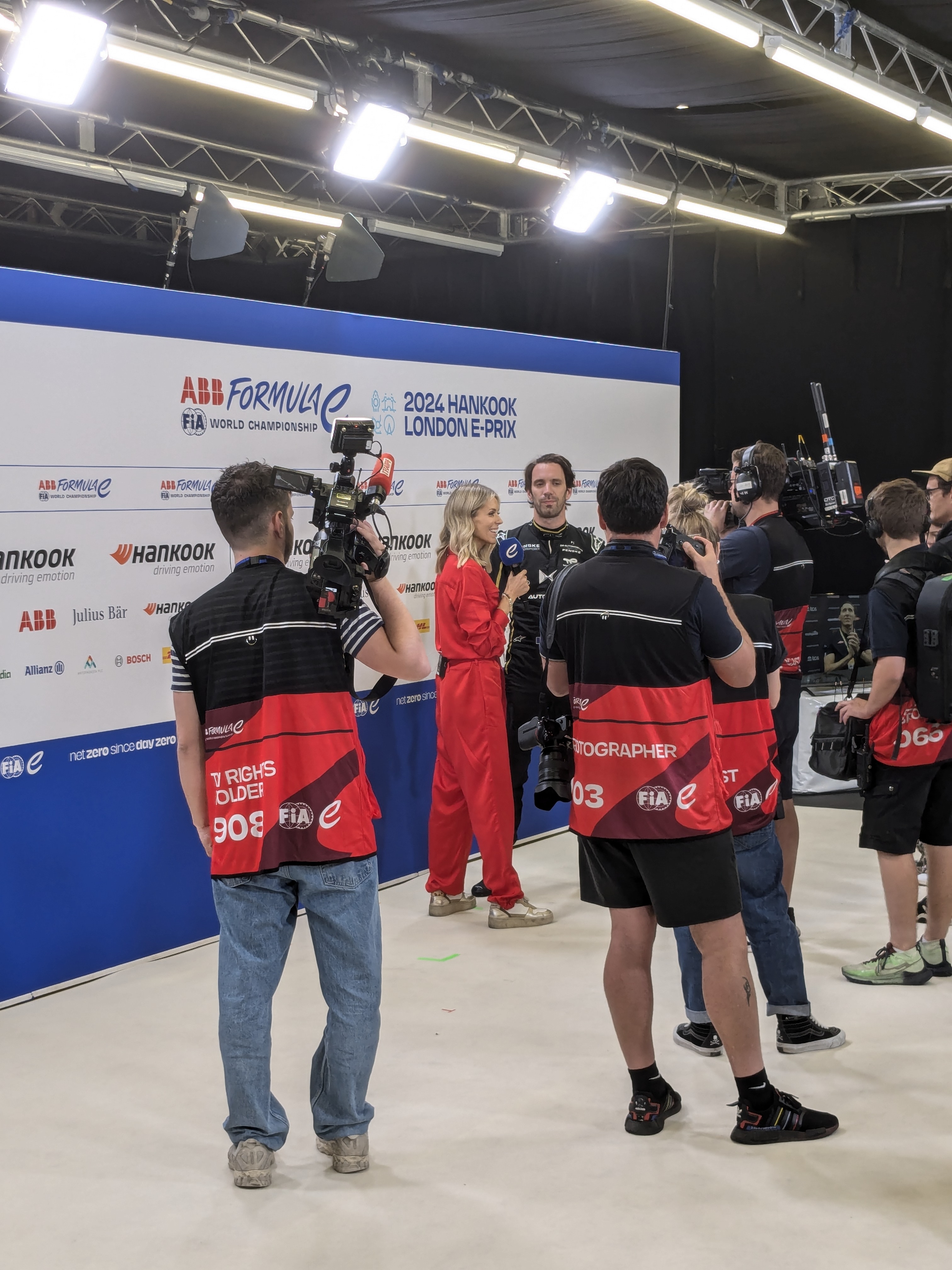
Nick Shields interviewing Jean-Eric Vergne after qualifying for the 2024 London E-Prix.

Brooks, Chandhok and McNish have not have worked together much on-air, but there was clear rapport between the three. Always animated when describing the action, the trio gestured to one another when they wanted to contribute on-air.

For a commentator of any sport, the job does not stop when the live microphones go off. Instead, they are in constant dialogue with the production team. During qualifying, the trio relayed information back to WestWorks, requesting that the team replayed key moments on the broadcast.

Seven different commentators joined Brooks on race day during season 10. Chandhok and Monger led the way, with the line-up rotating from race-to-race.

Co-CommentatorRaces
Karun Chandhok10
Billy Monger6
Allan McNish4
David Coulthard4
Andre Lotterer3
Dario Franchitti3
James Rossiter2

The lack of consistency is suboptimal, leaving fans guessing as to who they will hear race-by-race. The crowded motor sport calendar makes this a challenging area for the series to fix.

In my view, it is essential for Formula E to have a consistent commentary line-up. Jack Nicholls and Dario Franchitti were consistently together from 2014 to 2023, and became a staple of the series. Formula E need to try to replicate their success story with the same pairing in the booth across every race.

Allen noted that having a range of voices on the broadcast allows for different “perspectives on things.” He cited Andre Lotterer as someone who “can speak to the drivers on a different level.” The German has six years of electric experience, and is “Porsche’s reserve driver so has that relationship with them.”

Watching the season finale from the Track Feed gallery

Later, we watched the team direct the Track Feed live for the season finale. The team, like millions watching at home, wondered if Pascal Wehrlein, Mitch Evans, or Nick Cassidy would become Drivers’ Champion.

From the outside, it is easy to criticise the TV direction, sometimes overly so, sometimes for good reason. But watching the team direct the race live brought me an appreciation to broadcasting that I did not have before.

I have always acknowledged the effort involved, but seeing it unfold made me appreciate it much more. A strange confession for someone writing about motor sport broadcasting for 12 years, admittedly…

During a race, every Formula E team and driver strategizes, wondering when the best opportunity is to take Attack Mode. The same applies on the broadcasting side, the gallery none the wiser as to how the race will unfold. The team use the timing pages and Team Radio as a guide, but they are just that: a guide.

In the Track Feed gallery, we hear the director calling the action, focusing on the championship battle. ‘Top 3’ and ‘top 4’ are regular shouts, instructing each camera operator to focus on the leading cars.

Likewise, we hear calls for augmented reality shots (“AR on Drivers’ Standings at 16”), around 15 seconds before they air.

But how does the Track Feed produced by Aurora differ from Whisper’s English language programme feed referenced earlier? The Track Feed is a ‘dirty’ feed consisting of the cameras dotted around each circuit, overlaid with the TV graphics.

At WestWorks, the team adds other aspects to form the English language programme feed. These include replays, on-board camera angles and wrap-around coverage.

It should be noted that Aurora produces an International Feed, which goes to territories that do not take Whisper’s offering.

A simplified flow chart showing how the Formula E ELP is made and distributed to broadcasters.

With 10 on-board cameras on each Formula E car, the team have up to 220 on-board angles at their disposal. They can select up to 52 of these from 13 cars, the whittling down of angles also done from WestWorks.

Formula E’s on-site presence was much greater when we last went behind the scenes with them (see here and here). “One of the key targets for Formula E is net zero. It’s something that we’re challenged on regularly by the organisation,” Allen says.

“Thankfully, it’s something that Whisper are strong on as well. When you think about where we’re flying around the world, it becomes important that we keep the footprint small.”

“The technology at our disposal means that we can produce the show at WestWorks, regardless of where the race is. We’re working with Gravity and Timeline as the technical partners, with all the feeds fed back.”

On-track successes and struggles

From the test event in Donington to the season 10 finale in London, the series has been on a journey.

COVID halted Formula E’s growth over its first five seasons, which the series has attempted to bounce back from since.

The machinery is faster than what it was a decade ago, with the championship arguably beginning to outgrow street racing. Holding races in cities has been in Formula E’s DNA since day 1, allowing fans to travel using public transport.

The qualifying format has been a big success in recent years. Allen says that the head-to-head Duels format for the last eight cars, is “fantastic” from a TV perspective. “I personally believe that the format that Formula E have hit upon is fantastic for a TV audience,” Allen believes.

“It’s full of jeopardy and you don’t get second chances in the same way you do elsewhere, which helps.”

The Track Feed on-site gallery at the London E-Prix. The feeds shown include Timing, Track Map, Beauty Cameras, On-Board Cameras, RF Cameras, Track Feed, Preview, and Track Cameras.

Another key element of Formula E racing, as highlighted earlier, is Attack Mode. Love or loathe it, it is critical that the commentators can explain the tactics behind every decision made.

“Attack Mode is something unique to Formula E,” Allen says. “If you see that in the context of the London race, you can see how much drama you can create.”

“Mitch Evans missed two Attack Mode activations, and the commentary helped simplify what that meant from a race perspective.” (Evans would either run out of time if he missed again, or get disqualified)

Whisper, who also produce Channel 4’s F1 offering, sought to highlight Formula E’s “uniqueness” throughout their coverage.

“As a production company, we don’t really have much control over what happens [in sport]. But, as a production team, you then start to understand what the unique elements that sell the sport to fans.”

“For Formula E, it’s the access to drivers. It’s the qualifying format, it’s the fact that the races are unpredictable and the fact you have different winners.”

From this fan’s vantage point, there is improvement required on and off-track for Formula E, namely the peloton racing. In my view, the peloton style needs to disappear for season 11.

For readers unfamiliar, drivers start the race half a dozen seconds off the pace. Imagine driving on the M25 in rush-hour, but Formula E style. Eventually, half way into the race, the drivers finally hit the accelerator, spreading the pack out.

The peloton style allows the series to post outlandish overtaking statistics across social media, but is ultimately unsatisfying to watch.

A perennial problem remains the calendar structure, which remains lopsided. The upcoming 2024-25 season tentatively has 17 races across 11 locations and 8 months, which is great for the series. But, the first 5 races take place across 13 weeks, with the remaining 12 races squeezed into 15 weeks.

Of the 13 weekends in the F1 off-season, only 3 of them feature a Formula E race. Formula E becomes lost in the shuffle when F1 (and other motor sport) returns from their winter break.

The inaugural Shanghai E-Prix fell on the same weekend as the Monaco Grand Prix and the Indianapolis 500. During the winter, I would have watched, but this year’s timing meant that I missed it completely.

A decade in, Formula E should be establishing blue-ribbon events, something the series does not have right now. Yes, there are regular fixtures (Mexico City to name one), but these attract the same attention as other races.

Even excluding the COVID season in 2020, not a single circuit has been on Formula E’s calendar since the beginning.

Punta del Este is a city that should have become a blue-ribbon event, with its stunning backdrop. Sadly, the Uruguayan venue dropped off the calendar after only two events, before briefly returning in 2018.

Where next for Formula E? The series has its eyes on ‘the TikTok audience’; having recently surpassed 1 million followers on the platform. Year-on-year, this represented an increase of 235% for Formula E.

On the marketing side, Ellie Norman joins the team as Chief Communications Officer at the end of September. Norman comes into Formula E fresh from her recent stint with F1, which should only help the series.

TNT Sports will continue to cover the series in the UK next season, despite owner Warner Bros. Discovery selling their stake in Formula E to Liberty Global. The championship returns on December 7th with the Sao Paulo E-Prix.

If you enjoyed this article, consider contributing to the running costs of Motorsport Broadcasting by donating via PayPal. If you wish to reproduce the contents of this article, please contact Motorsport Broadcasting.

Article amended on August 21st to make Aurora’s responsibilities clearer.
Formula E heads to TNT as series struggles to make FTA breakthrough

After ten years of flirting with multiple free-to-air networks, Formula E has made the jump to pay television in the United Kingdom.

From ITV to Channel 5 to the BBC and onto Channel 4, the electric series has never found its belonging at any of those networks. Now, after battling for its place on free-to-air, the series has turned to TNT Sports for its next phase.

But how has Formula E ended up here, and did the series have any other options? Motorsport Broadcasting analyses the situation.

A new home for 2024

Organisers of the series, now heading into its tenth season, have announced an agreement with TNT Sports, touting the outlet as the championship’s exclusive television home, although terms of the contract (or its length) are undisclosed.

Discovery+ will stream coverage, the platform bringing together their Eurosport and TNT outlets under one roof.

Moving forward, fans will be able to access live coverage of MotoGP, World Superbikes, British Superbikes, Speedway, World Rally Championship, World Endurance Championship (including the 24 Hours of Le Mans) and Formula E via Discovery+.

Their television line-up for the new season is a hybrid of familiar Formula E names, combined with names typically associated with Whisper’s Channel 4 F1 broadcasts, the production house taking over the English language wrap-around offering from North One Television.

Joining the likes of Nicki Shields, Karun Chandhok, Dario Franchitti and Allan McNish will be Billy Monger, David Coulthard and Jamie Chadwick, the latter two names making “guest appearances” during the 2023/24 season.

Tom Brooks returns as lead commentator, this time on a full-time basis, replacing Jack Nicholls in the role.

The big talent announcement though is that former footballer Jermaine Jenas will be presenting Formula E’s race coverage, succeeding Vernon Kay. Jenas is no stranger to presenting, having presented the BBC’s magazine programme The One Show since 2020, as well as contributing to TNT’s football coverage.

“Since retiring from football I never thought I would find a sport that I loved as much but Formula E is a sport like nothing else,” Jenas said. “I couldn’t be more excited to take on this incredible presenting role and travel the world with such amazing teams.”

“To get in front of the camera and share that energy and action with viewers is a whole new challenge and adrenaline rush for me and I’m really looking forward to it.”

Formula E in the UK – at a glance

2014-15 – ITV
2015-16 – ITV
2016-17 – Channel 5
2017-18 – Channel 5, Eurosport
2018-19 – BBC, BT Sport, Eurosport, Quest
2019-20 – BBC, Eurosport, Quest
2020-21 – BBC, Eurosport, Quest
2020-21 [London only] – BBC, Channel 4, Eurosport
2021-22 – Channel 4, Eurosport
2022-23 – Channel 4, Eurosport
2023-24 – TNT Sports

Formula E’s CEO Jeff Dodds added, “This is incredible news for sports fans in the UK who already watch premium live sports on TNT Sports. From next month they will get to enjoy the new thrill of Formula E racing, the most competitive motorsport on TV.”

“For existing Formula E fans, we are excited to present TNT Sports as the new home of Formula E in the UK,” Dodds said.

“With experienced professional sportsperson and broadcaster Jermaine Jenas leading our stellar line-up of expert presenters to provide his original perspective for viewers, we cannot wait to get to work in Mexico City.”

Was this Formula E’s number one option?

The biggest surprise about Formula E’s announcement is that it did not happen earlier. Formula E was first linked with TNT Sports (then BT Sport) a decade ago, and had a brief spell on BT Sport five years ago!

At the time, their chief executive Alejandro Agag said that the series was in discussions with BT and Sky, but that the aim was “free-to-air even if we get less money. Free-to-air would be great: BBC or ITV.”

To Agag’s credit, that is exactly what Formula E did, launching in 2014 live on ITV4. Less than a year later, a peak of over 1 million viewers watched Nelson Piquet Jnr become the first Drivers’ Champion in London.

But since then, despite glimpses of optimism along the way, the series has failed to gain traction in the UK and instead has gone into reverse. ITV lost faith, as did other broadcasters.

Viewing figures have failed to reach the 2015 peak, with clashes with F1 and MotoGP, long gaps between races and a lack of promotion from both broadcasters and series organisers hampering the championship.

The pandemic only exasperated the problem that the series faced in the UK. Channel 4’s broadcast deal sought to reverse the decline, with more races airing live on free-to-air television. Note the key word: “more,” not “every.”

Some races aired live on YouTube, meaning that the series was offering a disjointed service to fans. Either way you cut the slice, audience figures on Channel 4’s YouTube broadcasts were pitifully low, while races on Channel 4’s linear channel struggled outside of London.

According to The Race, the Hyderabad E-Prix averaged 97,000 viewers for the two-hour broadcast on Saturday 11th February. Two weeks later, the Cape Town E-Prix averaged 151,000 viewers. It is with this in mind that comparisons with MotoGP, which moved to pay TV a decade ago, are invalid given that their free-to-air audience was far higher than what Formula E achieved.

With such little interest, why should Channel 4 care enough to renew, when repeats of The Simpsons would draw a higher audience? At a time where broadcasters are making efficiencies across the board, it is little surprise that Channel 4 did not renew.

Channel 4 would not be alone in their assessment of Formula E: in Germany, free-to-air station ProSieben cut ties with the championship owing to viewer interest not developing “as expected.”

Earlier suggestions of a deal between Formula E and ITV in the UK for season 10 appear to have fallen through based on the wording of the press release issued by Formula E and TNT Sports, although Autosport suggests that free-to-air deals may be agreed on a “race-by-race” basis.

What we do not know is whether TNT Sports have offered Formula E substantial sums of money. They may well have done; however, I struggle to see a situation where this has happened. TNT most likely see this as a way of boosting their existing sports portfolio at little cost to them.

TNT Sports is not a small network: it is the second biggest sports network in the UK only behind Sky and has a significant sports portfolio. And, combined with Eurosport via Discovery+, the powerhouse airs sport ranging from the Olympics through to the UEFA Champions League football.

From a Formula E perspective, they may feel that it is better for them to be in amongst those sporting properties via Discovery+ rather than on free-to-air television, or having a couple of thousand viewers watch them via Channel 4’s YouTube channel.

For those who only watch Formula E and no other sport that Discovery+ airs, the news is likely disappointing, however I understand why the series has taken the decision it has, when faced with few alternatives.

Formula E wants to, understandably, attract the wider sports fan in the UK, and this is the best they can get with the options they have at their disposal.

If you enjoyed this article, consider contributing to the running costs of Motorsport Broadcasting by donating via PayPal. If you wish to reproduce the contents of this article in any form, please contact Motorsport Broadcasting in the first instance.

The challenges facing BT Sport and MotoGP during 2023

Ten years ago, the landscape of MotoGP for fans in the UK changed when it was announced that the series would be moving behind a paywall to BT Sport for the 2014 season and onwards.

Since then, the premier bike series has undergone changes both on and off the circuit. The stars of yesteryear have retired, making way for a new fresh breed of talented riders at the forefront of the field.

Over the same time period, the way fans consume sports has evolved, with rights holders seeking to attract a more diverse audience across a plethora of different platforms: linear and live, vertical viewing, highlights, YouTube, TikTok, and feeds tailored to the fans of tomorrow.

Some sports have adapted to the changing landscape better than others, while some have found themselves left behind.

Although MotoGP managed to navigate the pandemic successfully, the series is faced with a fresh set of challenges if it is to thrive into the future. As Motorsport Broadcasting explores, the sport needs to stay ahead of the curve and adapt to changing fan expectations and media consumption habits.

Understanding why MotoGP moved to pay television

MotoGP enjoyed a long period of live free-to-air coverage in the UK, with a passionate fan base watching the likes of Valentino Rossi, Casey Stoner, Nicky Hayden, Dani Pedrosa and Jorge Lorenzo through the 2000s.

The MotoGP era we know and love today began in 2002, with coverage of the series airing for UK fans on Channel 5, and a more extensive offering available via Eurosport. Free-to-air coverage moved to the BBC from 2003, initially on a two-year agreement.

At the time, MotoGP joined both the British Superbikes and World Superbikes on the Beeb, making the broadcaster the home of bikes for a short period until both Superbikes championships moved to pastures new.

MotoGP’s presence on the BBC expanded year-on-year, from just three races airing live in 2003 (Donington, Motegi, and Valencia), to every race airing live in 2006 via either the BBC’s Red Button service or BBC Two.

The demise of Sunday Grandstand led to MotoGP coverage airing in a standalone 90-minute slot on BBC Two, with further coverage available on the Red Button.

Suzi Perry, Jennie Gow, and Matt Roberts led the BBC’s on-site team through the years, steering viewers through every twist and turn. Their coverage attracted an audience of around one million viewers per race. Charlie Cox and Steve Parrish provided commentary for every race, giving new fans a gateway into the sport.

Opening titles for the BBC’s MotoGP coverage in 2010.

For fans who wanted more, Eurosport was the place to be.

The trio of Toby Moody, Julian Ryder, and Randy Mamola rank among this writer’s all-time favourite commentary teams, bringing their own raw style to Eurosport’s offering.

Eurosport’s involvement in MotoGP faded thanks to a deal that granted BBC more exclusivity from 2009, with the broadcaster’s offering increasing to include Moto2 and Moto3 via the Red Button, as well as exclusive coverage of the MotoGP race.

Soon after, the financial crisis hit MotoGP, and Dorna opted to prioritise money over reach, as BT Group’s pay TV proposition, attached with it a significant amount of money, was too good to refuse for Dorna. BT Group was prepared to pay far more than what both the BBC and Eurosport were able to at the time for MotoGP.

Instead of taking a step-change approach to let audiences adjust, like what happened with F1 (forced by the BBC’s and Sky’s hand in the matter or not) from 2012 onwards, Dorna went ‘all-in’ on the pay TV approach in the UK.

The story that this writer has heard on multiple occasions is that, without pay TV money, several outfits further down the grid in Moto2 and Moto3 would have struggled to survive. Put simply, the teams needed the money to keep the show on the road, and in some cases still do.

Since 2014, every race has aired live on BT Sport, with free-to-air highlights airing on either ITV4, Channel 5, or Quest on Monday nights.

Marquez shines on social media

Since moving to BT, MotoGP’s viewership in the UK has declined. Under a quarter of the BBC’s MotoGP audience made the jump, with a typical race attracting 200,000 to 250,000 viewers on average.

The free-to-air highlights package has made up some of the deficit, but even this has shrunk over the past decade, due to changes in broadcasters and scheduling, making it difficult for the casual fan to catch-up with the sport.

On-track factors have impacted the sport too. The stars of yesterday – Rossi, Stoner, Hayden, Pedrosa, Lorenzo – have all retired, with their replacements struggling to break through into the mainstream, partly thanks to the subscription model used in countries like the UK and Spain.

Spanish rider and Repsol Honda star Marc Marquez is the exception. Marquez lit up the track as soon as he entered the sport, and since 2013, Marquez has won 6 of the 10 possible MotoGP championships.

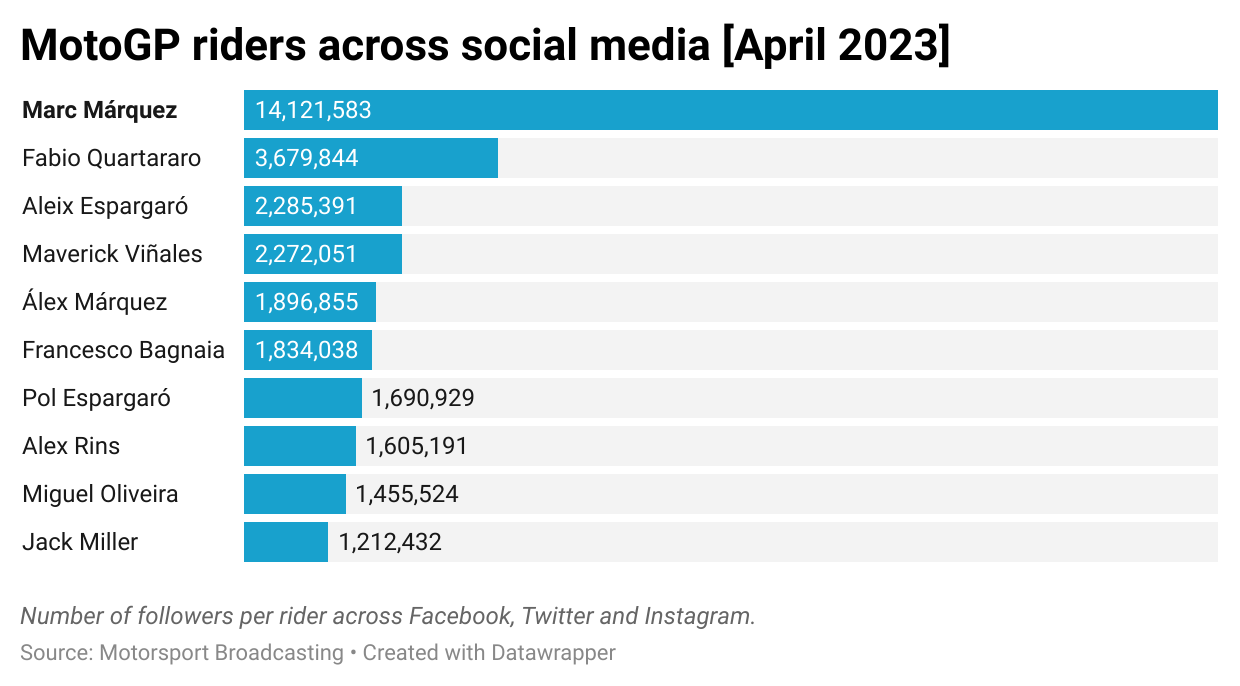
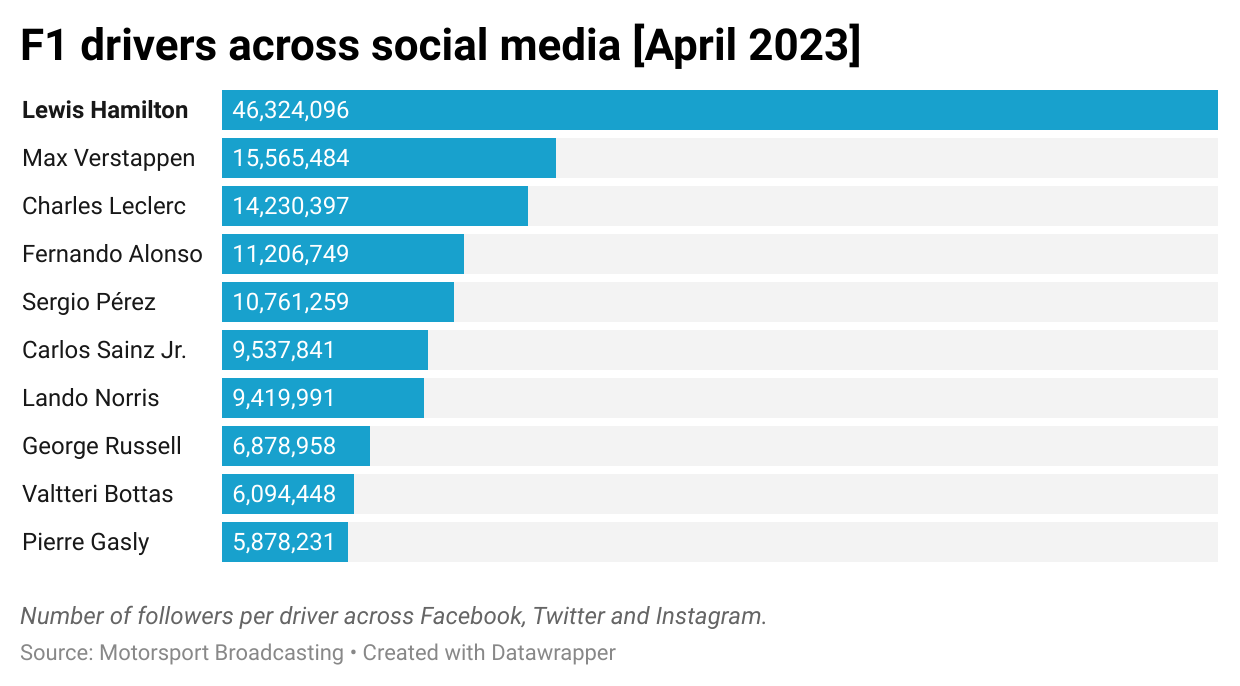
Analysis by Motorsport Broadcasting shows that Marquez is to MotoGP what Lewis Hamilton is to Formula 1 from a social media perspective, across Facebook, Twitter, and Instagram.

Marquez has 3.84 times more followers compared to MotoGP’s next best, while Hamilton has 2.92 times more followers than the second most followed F1 driver, showing how their on-track performances have perforated through onto social media.

Slide the bar across left and right to compare the top 10 F1 and MotoGP stars on social media.

But this is where the similarities between Marquez and Hamilton, MotoGP and F1, BT Sport and Sky, end. While F1 has built stars around Hamilton, MotoGP has failed to do so.

Across social media, the 2022 MotoGP champion Pecco Bagnaia is the sixth most popular rider on the grid, with 1.83 million followers.

The sixth most followed driver in F1 is Carlos Sainz with 9.5 million followers, and if you look at it from a raw number perspective, 1.83 million followers put Bagnaia alongside Alpha Tauri driver Yuki Tsunoda.

This is no sight on the riders at all, but rather a criticism of those responsible for not maximising its potential in the digital age.

One factor that hindered Dorna was Marquez’s accident as soon as the series returned to action post-COVID. It meant that organisers had to navigate 2020 minus their star, a challenging task considering his dominance. But it also shows the championship’s inability to prepare for such a scenario unfolding.

Perhaps the most significant moments that have captured widespread attention in MotoGP over the last decade are the controversial Sepang 2015 clash between Marquez and Rossi, and the horror accident that unfolded at the Red Bull Ring in 2020.

A decade ago, compared to F1, MotoGP was on the front foot where its television broadcasts and social media presence was concerned, however the tide has turned over the past five years.

What factors have contributed to F1’s success while MotoGP has struggled to gain momentum?

MotoGP Unlimited given the chop

F1’s new owners Liberty Media have prioritised growth across all platforms, with documentaries such as Netflix’s Drive to Survive launching in 2019.

MotoGP responded to Drive to Survive with their own documentary series. MotoGP Unlimited premiered on Amazon Prime in early 2022. But while Drive to Survive was a hit from early on, teething issues and a lukewarm reception plagued MotoGP Unlimited at launch.

The result was that the series failed to break through in the way that either Dorna or Amazon hoped. Sources close to this site have indicated that the series will not be returning.

As one person told me last year, once you have a failed product like MotoGP Unlimited in the market, it becomes a barrier to enter the market again for the next few years.

F1 has benefited from Drive to Survive across all platforms, helping the series to reach a younger, more diverse audience across social media and linear, with record crowds throughout 2022 as race circuits opened following the pandemic.

In the UK, Sky Sports F1 have seized the opportunity, grabbing some of the lucrative Drive to Survive audience. 2022 was their most watched season ever, recording a higher average audience than 2021’s titanic duel between Verstappen and Hamilton.

In comparison, BT Sport’s MotoGP audience figures have stagnated, while analysis from Crash.net reveals that circuit attendances dropped last season compared to pre-pandemic levels.

With F1 clearly on the front foot and in the limelight, MotoGP has found itself very much in F1’s shadow in recent years.

And, while it is not BT Sport’s fault that Dorna have made some missteps, it is their responsibility to look at how they can broaden their own reach, with Dorna’s support where possible.

After fixing some early issues during their infancy, BT’s coverage of MotoGP has been of high quality. Their coverage, produced by North One Television (also responsible for ITV’s F1 coverage and Formula E’s television feed), gives all three tiers of MotoGP extensive coverage.

The BT team is talented and knowledgeable across the board. Gavin Emmett commentates across all three classes, joined by Michael Laverty, Neil Hodgson, and Sylvain Guintoli, with Suzi Perry and Natalie Quirk on presenting duties.

However, the broadcaster enters a time of change, which may have ramifications for the long-term future of their MotoGP programming, and for fans who watch it. BT Sport’s contract with Dorna finishes at the end of 2024, but before then, the landscape will change radically.

BT Sport and Warner Bros. Discovery (WBD) agreed to form a 50:50 joint venture last year, and will launch the TNT Sports brand in the UK this Summer. The new TNT brand, led by ex-Sky Sports F1 head Scott Young, will bring down the curtain on both the BT Sport and Eurosport brand names.

On the face of it, this is good news for motor sport fans, as content such as MotoGP, World Superbikes, British Superbikes, the World Endurance Championship and World Rally Championship will in the long term be available through TNT. WBD have yet to announce a pricing strategy for the new venture.

It gives TNT the chance to properly cross-promote their bike properties, something that has already started to happen on both BT and Eurosport ahead of the 2023 season, which should help drive up MotoGP’s viewing figures.

However, one question that Warner Bros. Discovery may ask is whether MotoGP justifies the price tag that BT Sport are currently paying for their investment, considering that their return on investment is low, and viewing figures have failed to move in the past decade.

How do Dorna plan to change the status quo?

Introducing the MotoGP Sprint

Like F1, Dorna has taken steps to make all three days of the race weekend a more attractive proposition for fans and broadcasters alike.

For 2023, a 20-minute sprint race takes place on Saturdays at each of the 21 race weekends, a contrast to F1’s ‘pick and choose’ approach.

While the sprint races have been full of thrills and spills, the distribution method is the same as the feature race for fans in the UK: behind a paywall. If Dorna genuinely wants to attract a new audience, this is not the right approach.

BT Sport’s highlights of the first ever Sprint race.

When announcing the decision to add sprint races to the calendar, Dorna said, “The introduction of Sprint Races allows every day of a race weekend to offer fans and broadcasters the best possible experience on track and off, with track action  on Friday, Saturday and Sunday focused on maximum spectacle to show off the best of MotoGP.”

“In addition, the new format will provide increased engagement opportunities for fans, broadcasters and media across the event and increase the profile of the MotoGP class without reducing that of Moto2 and Moto3,” they added.

In my view, the sprint races need to be more accessible, whether that is, in the case of the UK, through BT Sport airing the sprints on a ‘free to view’ basis, or streaming via YouTube, Dorna need to think outside of the box rather than sticking with tried and tested methods.

Some may feel that pay broadcasters would not benefit from such a move. However, I would argue that a strong, easily accessible sprint race on Saturdays would entice fans to seek out the main event on Sunday via pay TV, not only benefiting MotoGP but also Moto2 and Moto3.

F1’s pay TV audience has grown in recent years, so why should MotoGP be any different in this regard?

Dorna has adjusted their Saturday schedule so that the sprint is the last event of the day. MotoGP’s final practice session and qualifying have both moved to Saturday mornings, which has caused some broadcasters, such as BT, to change how they cover the day.

2022’s Saturday schedule (local time)2023’s Saturday schedule (local time)
09:00 to 09:40 – Moto3 Practice08:40 to 09:10 – Moto3 Practice
09:55 to 10:40 – MotoGP Practice09:25 to 09:55 – Moto2 Practice
10:55 to 11:35 – Moto2 Practice10:10 to 10:40 – MotoGP Practice
 10:55 to 11:30 – MotoGP Qualifying
12:35 to 13:15 – Moto3 Qualifying
13:30 to 14:00 – MotoGP Practice12:50 to 13:30 – Moto3 Qualifying
14:10 to 14:50 – MotoGP Qualifying13:45 to 14:25 – Moto2 Qualifying
15:10 to 15:50 – Moto2 Qualifying15:00 – MotoGP Sprint

Previously, BT began their Saturday presentation offering at 11:00 UK time (12:00 local time), giving them ample time to discuss all three classes, and analyse the crucial qualifying sessions.

Retaining this structure would have resulted in neither the final MotoGP practice session nor qualifying receiving the full ‘bells and whistles’ treatment as in previous years.

For the first round in Portugal, BT made a few adjustments to their MotoGP broadcasts:

  • Friday – Taking the World Feed commentary instead of producing their own commentary.
  • Saturday – Extending their presentation offering, coming on-air two hours earlier at 10:00 local time, allowing them to cover MotoGP qualifying through their own presentation team. All three morning practice sessions for the three classes aired via BT Sport 5 (the Red Button for viewers on Sky).
  • Sunday – Airing the post-race Chequered Flag programme later in the evening as a standalone show instead of following the MotoGP race.

 For BT, covering the MotoGP qualifying session in detail is essential, as it determines the starting grid for both Saturday’s sprint and Sunday’s main event.

A longer show means additional preparation time, not just for the production team, but also for those in front of the camera.

Five minutes of television do not happen by magic, and every segment or feature requires resources: a presenter, a camera operator, and someone to edit it all together to make compelling television.

While BT adjusted for Argentina and last weekend in America (notably producing their commentary feed for Friday’s and airing MotoGP practice on the main channel), the broadcaster is at the behest of series organisers who dictate the weekend schedules.

From a fan perspective, MotoGP qualifying feels too early in the weekend. From a broadcaster’s perspective, a difficult-to-fill 80-minute filler gap follows the session.

A better approach would be to move MotoGP qualifying to after the lunch break at 12:00 local time, with Moto3 and Moto2 qualifying following, the two series benefiting from having the main class immediately before it.

Some fans criticised the decision to move Moto3 and Moto2 practice off BT Sport 2 on Saturday mornings, which shows the need to strike a balance between appealing to the hardcore fanatic who wants every session live and the new fan who wants to know more about the stories in the main class.

While sympathising with those who do want to watch practice over additional MotoGP content, the fact is that airing the latter has a better chance of increasing the audience than the former.

A source compared the situation to thinking of it in a “multi-screen way,” giving viewers the choice of what they want to watch, like how Discovery treats other significant events, such as the tennis Australian Open tournament.

A similar problem exists on Sunday’s, but for a completely different reason: the Rider’s Parade would be better after Moto3 and Moto2, to benefit from a higher attendance rather than taking place in front of half empty grandstands.

The need to go further

Aside from the sprint, Dorna has made other changes for 2023, notably the introduction of a new signature theme for the series.

Academy Award nominee and Emmy-winning composer Marco Beltrami is the man behind the MotoGP theme. Beltrami approached MotoGP with his idea, saying that the new theme had to be “something simple, rhythmic, heroic.”

Beethoven inspired Beltrami for the theme. “The first place I looked was Beethoven, his ninth symphony, in the second movement you have a really simple rhythmic motif and I thought maybe that’s the starting place for my theme. That’s basically what I did.”

Comparisons with Formula 1’s opening theme are inevitable: Hollywood composers pitch both, with similar structures throughout both sets of titles.

F1’s theme, composed by Brian Tyler, launched in 2018, with F1 working with third parties on new opening titles each year since. Instead of comparing MotoGP’s first version with F1’s sixth, a better comparison would be to compare with MotoGP’s inaugural effort with F1’s 2018 titles.

The cinematography in MotoGP’s effort is superb, arguably better than some of F1’s recent efforts from a visual perspective. The intro does well to introduce the stars of the show, which is Dorna’s main intention.

Unfortunately, what lets the sequence down is that it is pedestrian, ironically the opposite problem to what F1’s first opening sequence encountered, which introduced the 20 drivers at breakneck speed. Shaving ten seconds off the opening titles would still get the message across to newer viewers watching at home.

When F1 launched their new branding, it came at a time of change for the sport, and the sport’s owners wanted to emphasise that across the screen.

MotoGP is not in such a position: there are no new owners, and what we have on-screen this year is a mix between new and old. New sprint, new theme, same owners, same logo, same graphics, same over-the-top platform.

The latter is a sticking point where Dorna was once ahead of F1 but has fallen behind. The Video Pass service uploads sessions as soon as they have finished and has a rich archive dating back to 1992, which should make it a hot commodity for MotoGP fans.

F1’s direct-to-consumer (DTC) proposition is significantly cheaper than MotoGP. The MotoGP service costs €199.99 across a full season compared to roughly €74.99 (territory dependent) for the F1 equivalent. Meanwhile, MotoGP’s YouTube channel is light years behind F1’s channel.

Does MotoGP need an overhaul that goes far and beyond what current owners Dorna have delivered? Maybe that is what Dan Rossomondo, MotoGP’s new Chief Commercial Officer, will help deliver.

Rossomondo joins Dorna with a wealth of experience, having previously been Senior Vice President of Global Partnerships and Media at the NBA.

“Dan’s vision for the commercial future of MotoGP fits perfectly with our views: fresh ideas, increased reach, and commitment to take the sport to new heights,” said Carmelo Ezpeleta, CEO of Dorna Sports.

“At the helm, I’m confident he will provide existing partners with the best possible results and relationships, and at the same time will work to search out new, like-minded media, marketing and licensing partners.”

“We know Dan can bring a lot to Dorna and our biggest property, MotoGP, and on a personal level we’re also very much looking forward to working with him. We’re very excited to begin this new chapter.”

MotoGP has started 2023 off on the right note. Now, it is for the team at Dorna to continue that work so MotoGP can thrive into the future.

If you enjoyed this article, consider contributing to the running costs of Motorsport Broadcasting by donating via PayPal. If you wish to reproduce the contents of this article in any form, please contact Motorsport Broadcasting in the first instance.

Scheduling: The 2022 MotoGP and Supercars season openers

The motor racing season continues to roar back into action this weekend, with the return of MotoGP and Supercars action!

For UK fans, both championships air live on BT Sport, however, there are other viewing options available across the board for fans wanting to dip their toes into the action.

MotoGP – the coverage

2022 is BT’s ninth season covering MotoGP, along with feeder series Moto2 and Moto3, with every session airing live on BT Sport 2.

In addition to BT Sport’s pay TV offering, free-to-air highlights will air on Monday evenings on ITV4.

In a new element to the ITV deal that began last season, the broadcaster will also cover two races live. The British MotoGP race will air live on ITV, while ITV4 will cover action from one other round live.

Both BT’s and ITV’s current arrangements with commercial rights holder Dorna run until the end of 2024.

The new season begins in Qatar, which is the earliest for the championship, and its predecessors, since 1964. Back then, the first race took place on 2nd February in America, with Mike Hailwood coming out victorious.

Not only does the championship start earlier, but so does the race, with all sessions two hours earlier than last year for UK fans.

The switch from British Summer Time (BST) to Greenwich Mean Time (GMT) offsets one hour, with the sessions taking place one hour earlier than previously.

ITV4’s highlights package airs later than usual on Monday thanks to FA Cup action.

Alternatively, fans can watch MotoGP via Dorna’s in-house over-the-top platform. Priced at €199.99 across the year, or £167.13 based on current conversion rates, the price gives fans access to all the action live, and access to MotoGP’s rich and ever-expanding archive.

Considering the increase in races this season, the price represents better value for money than in previous years.

MotoGP – the personnel

It is in-house where the biggest changes come for MotoGP, following Steve Day’s decision to step down as lead commentator at the end of 2021.

Day, who succeeded Nick Harris in the role, stepped down after four years as World Feed lead commentator.

Writing on his Instagram at the time, Day said that he had made the “incredibly difficult decision to leave my role in order to spend some more time at home with my family, my friends and to work on some new and exciting projects.”

Replacing Day is Louis Suddaby. Suddaby is already a familiar voice to MotoGP’s fanbase, having been part of their social media presenting and editorial team in recent years.

Suzi Perry continues to lead BT Sport’s MotoGP offering, with Gavin Emmett and Neil Hodgson providing analysis throughout the weekend.

Friday 4th March
08:45 to 16:00 – Practice (BT Sport 2)
=> 08:50 – Moto3: Practice 1
=> 09:45 – Moto2: Practice 1
=> 10:40 – MotoGP: Practice 1
=> 13:10 – Moto3: Practice 2
=> 14:05 – Moto2: Practice 2
=> 15:00 – MotoGP: Practice 2

Saturday 5th March
08:15 to 11:15 – Practice (BT Sport 2)
=> 08:25 – Moto3: Practice 3
=> 09:20 – Moto2: Practice 3
=> 10:15 – MotoGP: Practice 3
12:00 to 16:15 – Qualifying (BT Sport 2)
=> 12:30 – Moto3: Qualifying
=> 13:25 – Moto2: Qualifying
=> 14:20 – MotoGP: Practice 4
=> 15:00 – MotoGP: Qualifying

Sunday 6th March
08:30 to 09:45 – Asia Talent Cup (BT Sport 2)
10:00 to 17:00 – Races (BT Sport 2)
=> 10:00 – Warm Ups
=> 11:15 – Moto3: Race
=> 13:00 – Moto2: Race
=> 14:30 – MotoGP: Race
=> 16:00 – Chequered Flag

Monday 7th March
21:45 to 22:45 – Highlights (ITV4)

Full scheduling details for the 2022 Qatar MotoGP. Scheduling details correct as of Monday 28th February and are subject to change.

Supercars returns

Down under in Australia, the Supercars series gets back underway with the Sydney SuperNight event!

Triple Eight’s Shane van Gisbergen is looking to successfully defend his championship after winning his second title last year.

While BT Sport airs every race live for UK based readers, fans wanting to get closer to the action can do by subscribing to the SuperView service. New for 2022, fans can also access SuperView via YouTube.

The service, which costs £38.14 across the year based on current conversion rates, gives fans access to every race, including feeder series, as well as on-demand replays of qualifying and the race itself.

Like MotoGP, Supercars has their own in-house broadcast team, which international broadcasters use.

> Full details: the 2022 Supercars broadcasting line-up

Neil Crompton and five-time champion Mark Skaife lead the commentary line-up, supported by an expert team including three-time champion Craig Lowndes and Triple Eight endurance co-driver Garth Tander.

Friday 4th March
02:00 to 08:00 – Practice
=> 04:15 – Practice 1
=> 07:10 – Practice 2

Saturday 5th March
01:15 to 10:45 – Race 1
=> 03:45 – Qualifying, Race 1
=> 05:30 – Top 10 Shootout, Race 1
=> 08:10 – Race 1
=> Race 1 airs live on BT Sport Extra 1 from 08:00 to 10:45

Sunday 6th March
21:00 (Saturday) to 07:00 – Race 2
=> 23:50 (Saturday) – Qualifying, Race 2
=> 01:05 – Top 10 Shootout, Race 2
=> 03:30 – Race 2
=> Race 2 airs live on BT Sport/ESPN from 03:30 to 06:00

Full scheduling details for the 2022 Sydney SuperNight event. Scheduling details correct as of Tuesday 1st March and are subject to change.

If scheduling details change, this article will be updated.

Additional Supercars details provided by Joshua Kerr.

Contribute to the running costs of Motorsport Broadcasting by donating via PayPal. If you wish to reproduce the contents of this article in any form, please contact Motorsport Broadcasting in the first instance.

Scheduling: The 2022 Rally Monte Carlo

A new era begins for the World Rally Championship this weekend, as the championship moves to hybrid-power cars for the first time, under the Rally1 banner.

Sebastien Ogier fended off competition from Elfyn Evans to win his eighth championship last year.

While Ogier will be part of the Monte Carlo season opener, Ogier is not competing in a full season, meaning it is all to play for in the hybrid era.

WRC’s over-the-top platform All Live returns for its fifth season, allowing fans to see all the rallying action live.

New for 2022, the platform also allows fans to watch its European companion, the European Rally Championship live, for £99.99 across the whole year.

As usual, the All Live offering, including studio analysis and service park coverage, will air across BT Sport’s platforms, including their Red Button service and online platforms.

Free-to-air highlights will continue to air on ITV4 in the week following each event.

The usual broadcast team returns to cover the action, with Becs Williams leading the commentary line-up for All Live viewers throughout the event, alongside the likes of Julian Porter, Molly Pettit, and Kevin Piper.

Thursday 20th January
08:30 to 09:30 – Shakedown (BT Sport Extra 1)
17:30 to 18:30 – Pre-Show and Ceremonial Start (BT Sport Extra 1)
19:00 to 21:30 – Stages 1 and 2 (BT Sport Extra 1)
=> 19:00 – Stage 1 (also on BT Sport 2)
=> 20:30 – Stage 2

Friday 21st January
06:00 to 18:30 – Stages 3 to 8 (BT Sport Extra 1)
=> 08:14 – Stage 3
=> 09:17 – Stage 4
=> 10:35 – Stage 5
=> 13:16 – Stage 6
=> 14:16 – Stage 7
=> 15:37 – Stage 8
23:15 to 23:45 – Day 1 Highlights (BT Sport 2)

Saturday 22nd January
04:45 to 19:00 – Stages 9 to 13 (BT Sport Extra 1)
=> 07:15 – Stage 9
=> 09:00 – Stage 10
=> 10:15 – Stage 11
=> 13:00 – Stage 12
=> 14:15 – Stage 13
01:00 to 01:30 – Day 2 Highlights (BT Sport 1)

Sunday 23rd January
05:30 to 12:45 – Stages 14 to 17 (BT Sport Extra 1)
=> 07:45 – Stage 14
=> 09:00 – Stage 15 (also on BT Sport 2)
=> 10:00 – Stage 16
=> 11:00 – Stage 17 (also on BT Sport 2)
02:00 to 02:30 – Day 3 Highlights (BT Sport 3)

Wednesday 26th January
20:00 to 21:00 – Highlights (ITV4)

Full scheduling details for the 2022 Rally Monte Carlo. Scheduling details correct as of Wednesday 19th January and are subject to change.

If scheduling details do change, this article will be updated.

Contribute to the running costs of Motorsport Broadcasting by donating via PayPal. If you wish to reproduce the contents of this article in any form, please contact Motorsport Broadcasting in the first instance.