As 2025 ends, I want to use this as an opportunity to tie up a loose end of my own. After nearly 14 years, I’m formally bringing the curtain down on the Motorsport Broadcasting website. Why am I writing this when I’ve only published two articles in the past 18 months? For me, it’s important to acknowledge the closure of this chapter in my life rather than let it drift off into the sunset.
I started Motorsport Broadcasting, then The F1 Broadcasting Blog, when I was 19 back in April 2012 towards the end of my first year at university, my love of motor sport broadcasting having stemmed from many a day over on Digital Spy Forum (which still exists). Motorsport Broadcasting served me well through my twenties, with countless hours spent writing articles, combining the blog with my day job. For the first few years, it really was a side gig. Attending Channel 4’s F1 press day in 2016 changed that, and made me realise that there was so much more to this, as the years that followed showed: 8 x MotoGP weekends, 4 x Formula E weekends amongst many included.
While my love and interest in sports broadcasting remained into my 30s, I felt my love for writing regular pieces waning, not helped by a challenging content landscape. My interests outside of this site are more varied than what they were five to ten years ago, with running (a marathon runner too!), swimming, and an increased social circle filling the time, as well as going through a process of self-discovery. I’ve spent long periods this year without even thinking about this site. A few years ago, I would have resented writing that sentence, but now, I’m genuinely at peace with it. Time has moved on, the moment has passed, and I’ve come to accept that is okay.
As Motorsport Broadcasting grew, so did I. I made mistakes, some terrible ones to boot. I wrote things that I later regretted, but we live and learn. There’s things I didn’t do that I wish I did, but you can’t do everything. I must admit in hindsight, I do wince at how much content I wrote pre-COVID. Wait, did I really write that? Yes, Dave, yes you did…
Across the 13 years, I’ve been incredibly fortunate to see first hand what goes into creating the product you see on television. It’s tough. For every presenter or commentator on-air, there’s an editor, a producer, a replay operator amongst many working out of view keeping the show on the road. I don’t envy the person who makes the tough calls. But being close to the action has given me an appreciate for all the hard yards that goes into producing motor sport broadcasting.
No one goes into their shift on-air or in the booth thinking “hey, I’ll only give it 80% or 90% today.” No one. You’ll be found out, quickly. It’s easy to be an armchair critic without having access to all the facts, thinking that you can do it better. I’ve always tried to be fair and present different perspectives, sometimes with success and on other occasions less so. But hopefully I’ve never come across as unnecessarily critical towards a single party or another. In more recent years, I’ve made a concerted effort to shine a light on the wonderful voices and faces that make up our sport.
I’ve been lucky enough to interview many stars in front and behind the camera, and there are a few I want to thank. Firstly, a special thanks go to Kevin Brown and Billy McGinty. Kevin and Billy lead up TNT’s MotoGP operation and Sky’s F1 coverage respectively, both of whom have been extremely kind to me in terms of access – helping facilitate behind the scenes pieces and helping me to get closer to the production process.
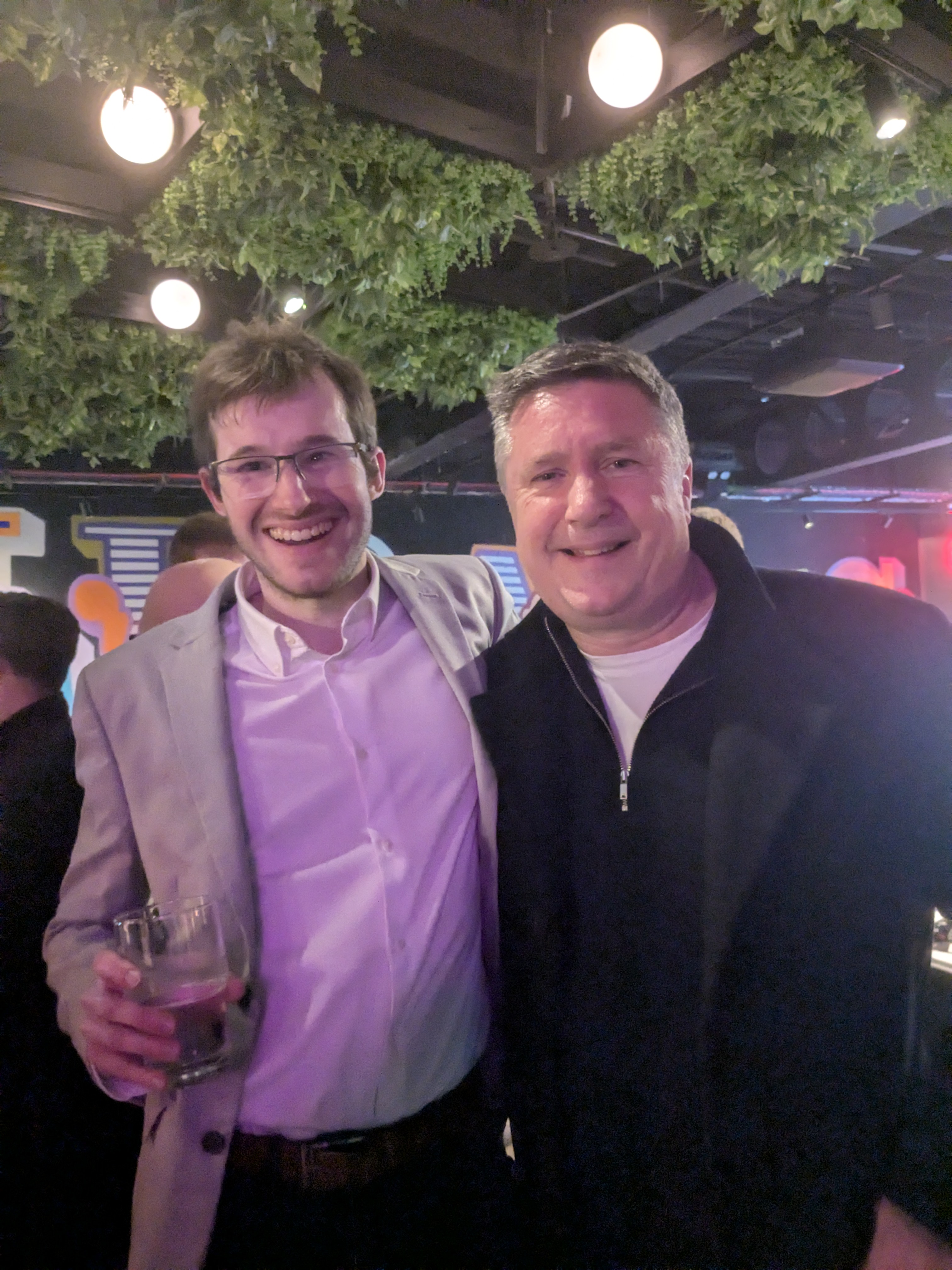
Sticking with MotoGP, David Emmett, and Simon Patterson for their support with two-wheel coverage. Karun Chandhok for always being a friendly face in the Formula E paddock and during various Autosport weekends. To the person that once called me an “angry student,” David Croft, I should probably admit all these later that this quote was justified despite my best attempts to deny it! Genuinely though, Crofty, thank you for the support, and for the hours of entertainment over the years.
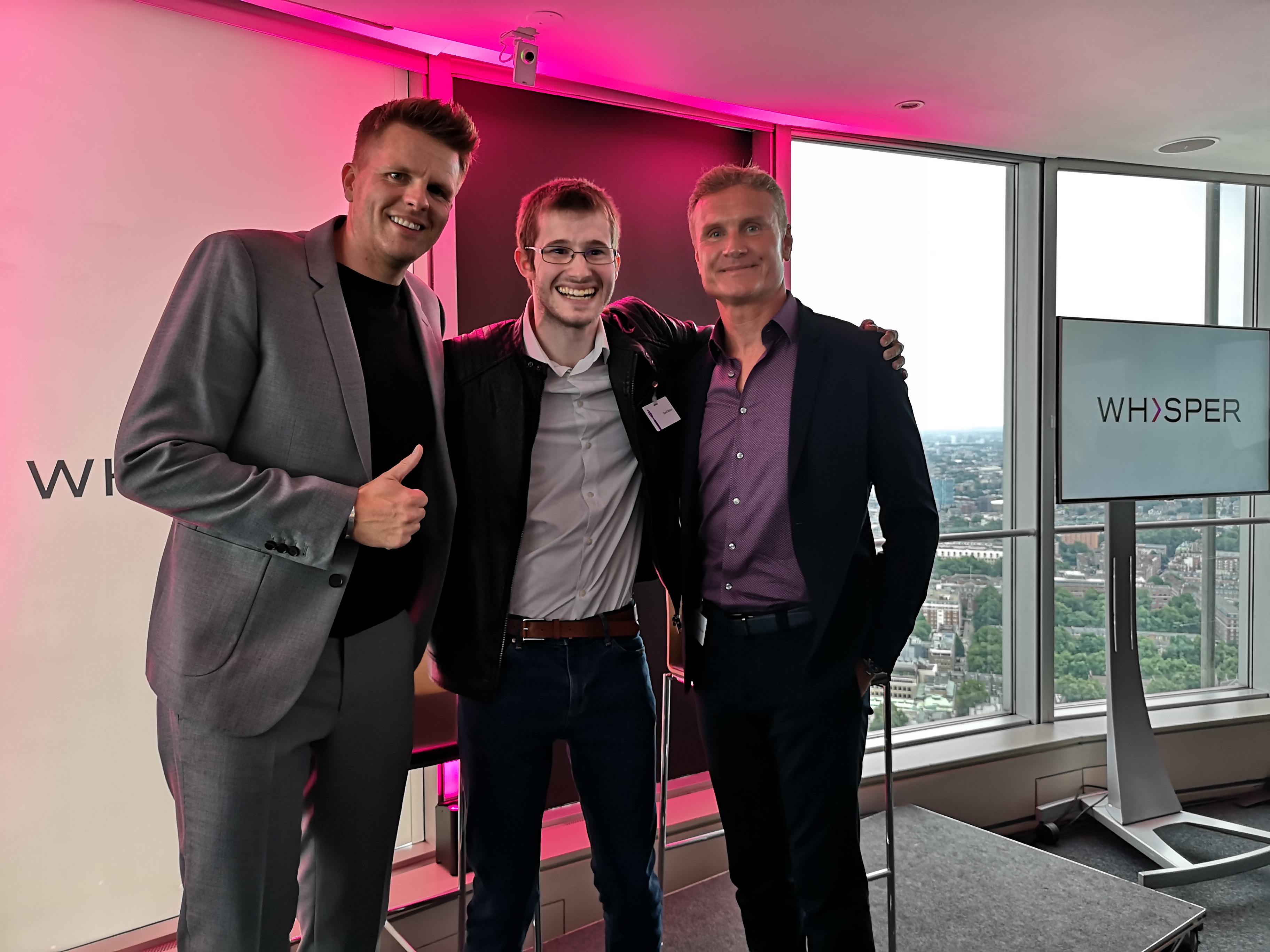
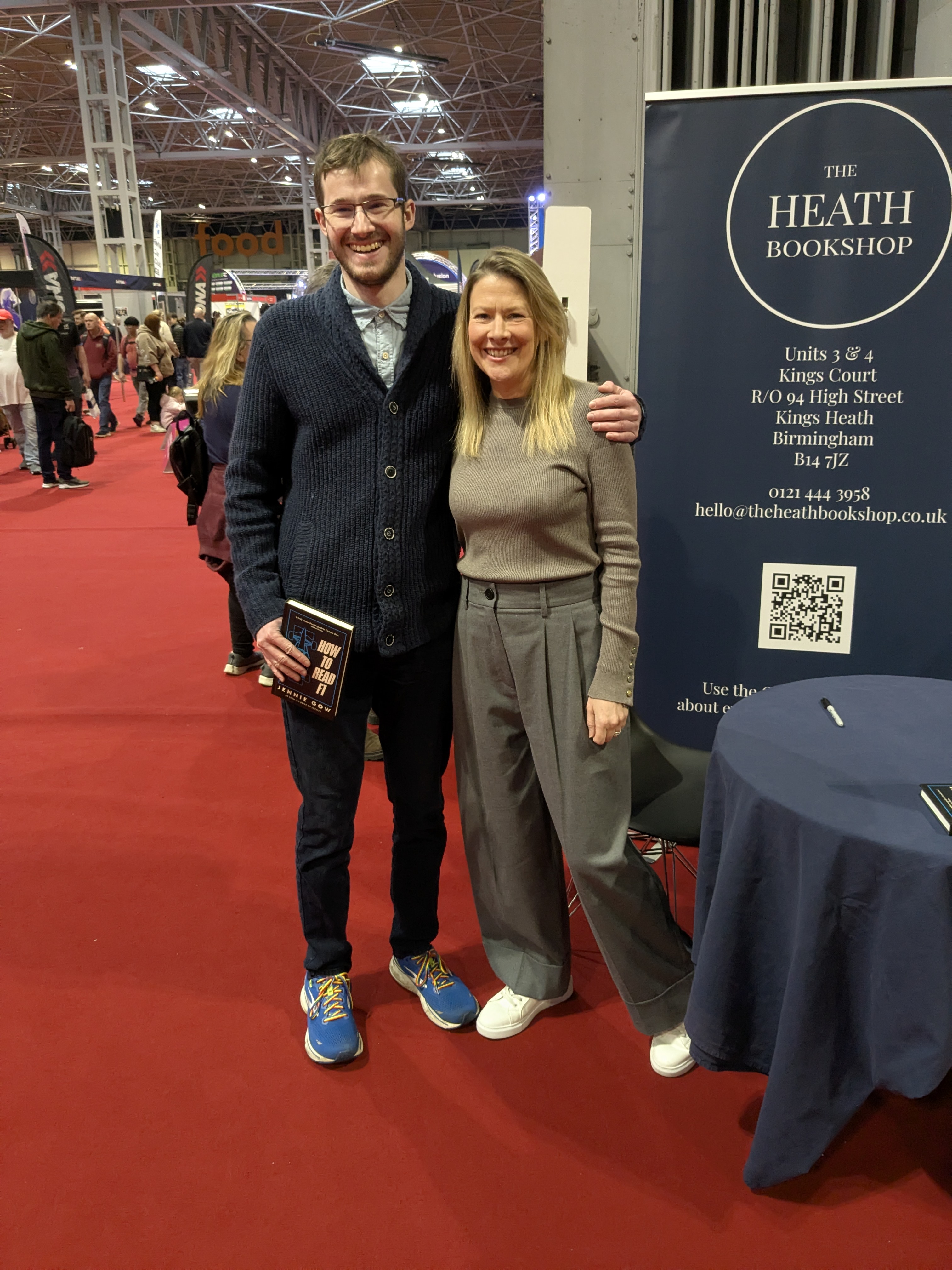
To the whole Whisper team, led by Jake Humphrey, David Coulthard and Sunil Patel, thank you for your generous access and hospitality behind the scenes at both W Series and Formula E. The last thank you needs to go to someone who isn’t just a great broadcaster, but frankly an inspiration to me and many others: Jennie Gow. Jennie had a stroke three years ago and has since returned to broadcasting on 5 Live F1. Jennie’s words to me ring true every day: “When you’re having a bad day, just remember that a good day is just round the corner.” Those words struck a chord when she first said that to me, and they still do now. Thank you, Jennie.
There’s countless other people I could thank, but I worry I’d invertedly miss someone off, and it may turn into a “who’s who” role call of motor sport broadcasting personalities. Thanks to this small corner of the internet, and through my role as Community Champion with Racing Pride, I’ve met people who I’m proud to call friends. It’s opened doors that I didn’t realise existed, and I’ll be forever grateful for that. While this chapter may be ending, I will never be too far away from a motor sport paddock.
There’s one last thanks to give, and that is to you, the reader. Because without you, there wouldn’t have been 3.5 million hits, 2 million words, 1,500 articles and 7,500 comments on this site. Thank you for engaging, whether you have been there from day one, or a more recent follower. Nearly 14 years isn’t bad for something that I never intended to last anywhere near that long!
All posts will stay online, but there will be no new content moving forward. If you want to see what I’m up to moving forward you can find me on LinkedIn or follow my Substack. As I said up front, my love for sports broadcasting has not waned, so if you’re working on a project and you feel my input would be valuable, I’m still happy for you to drop me a message and I’ll see how I can help. If you’ve met me and want to follow my Instagram, I’m also happy for you to do so.
For now, thank you, and I hope you have a happy and healthy 2026. From me, over, and out.
Dave
Me with Jake Humphrey and David Coulthard at a Whisper event in 2019.Me with David Croft at the F1 75 Lego activation event in 2025.Me with Jennie Gow at the Autosport Show in 2025.
The sentence “There won’t be another one like…” is a frequent one whenever someone passes. But, in that case of Eddie Jordan, that sentence really is true. Jordan was one of a kind within Formula 1, both for his role as team owner and later television analyst.
As team owner, Jordan built his team from the ground up from their base near the Silverstone race track. Over 14 years, the team secured two pole positions and four race victories, most famously clinching their first victory in the 1998 Belgian Grand Prix, with Damon Hill leading home a team one-two.
The following year, Jordan nearly went one better. German driver Heinz-Harald Frentzen remained in the Drivers’ Championship fight for most of the season, fighting with McLaren and Ferrari, before reliability got the better of the Jordan. Nevertheless, it showed that on their day, Jordan could fight with the bigger F1 outfits despite running at a financial deficit in comparison.
Most obituaries today will naturally focus on Jordan’s success as team owner. But while the Jordan name disappeared from the pit lane gantry in 2005, Jordan as a paddock figure remained. In 2008, the BBC announced that Jordan would form part of their broadcast team for the 2009 season. But, hang on.
Eddie Jordan wasn’t an F1 journalist.
Eddie Jordan wasn’t an F1 driver.
What can Eddie Jordan contribute to the BBC’s F1 television output, I hear you say? Quite a lot, as it would turn out. Since Murray Walker retired in 2001, F1 was missing something on the small screen when it came to wrap-around coverage. The coverage was informative and interesting, but was missing a key ingredient.
Jordan formed the BBC’s leading trio alongside Jake Humphrey and David Coulthard, instantly turning the broadcast into one that was informative, interesting, and entertaining. Jordan injected humour, colour, personality, and opinions all in one go into the television coverage, aided by Humphrey, Coulthard, and the remainder of the BBC team.
When Jordan spoke, you listened. You laughed. Maybe you cried with laughter because he said something so unbelievably silly that later turned out to be true. Jordan’s sources were impeccable, a goldmine for the Beeb and an incredible asset to them. Who knew an ex-team owner would hold all the keys to the driver market?
The thing about Jordan was that his viewpoints felt opinionated without malice. You may disagree with him on occasion, but there was never a feeling of ill will. Instead, the Irish smile and character peered out from behind the discussion, as the presentation team mulled over the paddock gossip.
The BBC created a winning formula, which other broadcasters have struggled to replicate, and maybe that’s because you can’t. Luckily for the Beeb, the right people were available at the right time, in the right circumstances. It is a formula or presentation team that has never been bettered. Jordan was a brilliant team owner, and an equally brilliant TV pundit who entertained millions, race in, race out.
Jordan stayed with the BBC until their F1 television coverage ended in 2015, moving over to Channel 4. He remained close to both Coulthard and Humphrey, creating the Formula For Success podcast with the former in more recent years. His influence on paddock life remained, even as he battled an aggressive form of prostate cancer.
If Team Silverstone with Adrian Newey takes Aston Martin to the front in 2026, there is one man primarily responsible. His name is Eddie Jordan. Sadly, he will not be there to witness it in person, only in spirit.
Rest easy, Eddie.
Tributes to Eddie Jordan
David Coulthard: “Eddie Jordan was a force to be reckoned with beyond what anyone could expect in Formula 1. He was a gift to Formula 1 & he was a gift to Ireland. You never knew quite where his madness would take you next, but you always got there with a smile on your face. There will be endless people telling Eddie Jordan stories as long as there is still Formula 1 around. It has been an honour calling him and friend & all of our love to his family & his four children, Mikki, Zoe, Kyle & Zak”
Jake Humphrey: “His greatest achievements were Mikki, Zoe, Kyle and Zak. His incredible 4 kids who share his spirit. His wife Marie is one of the strongest, most wonderful women I have ever met. The 4 years we spent together hosting F1 on the BBC were greatest of my career. Wing-walking, scooter riding, car driving madness that I know he loved deeply. His incredible spirit and love of life lives on in me, and my children who were lucky enough to meet him and hear all about him. Eddie lit up a room whenever he entered it. That is a lesson for us all – be the light in the room. I was lucky enough to share one final, cherished meal with him and his boys a few months ago. It was special. We talked about me doing one final interview with him. Sadly that will never happen. As I left his final words were ‘I love you brother’. One of the 3 Amigos is gone. The world seems a little less bright this morning. He’s busy playing spoons in the sky ❤️”
Martin Brundle: “RIP my friend. Condolences to each and every one of your lovely family. What a character. What a rock star. What a racer. So many drivers owe you so much, you gave us our chances and believed in us. 🥲
Lee McKenzie: “There will never be anyone like him. A true friend. Thank you for everything EJ 💚🍀”
Formula E burst into life for the first time ten years ago next month, with the 2014 Beijing E-Prix. Arguably, the incident between Nico Prost and Nick Heidfeld on the final lap remains the championship’s most iconic moment.
Since then, the series has crowned nine different Drivers’ Champions, with the series evolving year-on-year. Mandatory car swaps have disappeared, and Attack Mode has replaced Fanboost. More importantly, the electric machinery is significantly faster now thanks to improvements in battery technology.
Off-track on the broadcasting front, the series has faced hurdles both domestically in the UK and abroad. So, what lies ahead for the championship? We explored the paddock and went behind the scenes during the London E-Prix season finale…
The 12th team
Aurora Media Worldwide and Whisper are responsible for production of Formula E’s television feed. Aurora produces the Track Feed on location and the International Feed. Whisper handles the English language programme (ELP) from WestWorks in London.
Whisper’s feed comes with different ‘opt in’ and ‘opt out’ points, allowing broadcasters to join the build-up at different stages. Some territories take the race itself without pre- and post-race amble while others take Whisper’s ‘full fat’ programme.
Supporting Formula E with the technical aspects of the broadcast are companies including Gravity Media, Tata, and Timeline TV.
Season 10 was Formula E’s first primarily behind a pay wall in the UK, the series airing on TNT Sports. Only the season finale in London aired for free via Quest, Discovery’s free-to-air outlet.
Over the past decade, the championship has exhausted all other free-to-air partners, never finding the right home. ITV, BBC, Channel 4, and Channel 5 all came and fell by the wayside. What the series has long yearned for is channel consistency, something that TNT Sports and Discovery+ provides.
Despite the change, sources suggest that Formula E are happy with the audience figures. The series is likely analysing the overall reach across all of Discovery’s platforms, rather than a single channel in isolation.
Whisper won the contract to produce the English feed for season 10, bringing some recognisable faces with them. The likes of Billy Monger, David Coulthard and Karun Chandhok joined Formula E mainstays Nicki Shields and Dario Franchitti on-air. Tom Brooks remained lead commentator, a role he started in 2023.
Vernon Kay’s decision to leave Formula E and focus on his radio commitments meant Whisper needed a new presenter. The team opted to bring in ex-footballer and now presenter of BBC’s The One Show Jermaine Jenas. Jenas has improved since the start of the season, helping to explain basic concepts to new viewers.
Harry Allen, who leads Whisper’s Formula E production, was complimentary of Jenas and the way everyone has “embraced” the team.
“Since we’ve been at the centre of it, it’s been an amazing experience,” Allen says. “We’ve really enjoyed working with all the drivers and the teams on the grid. We feel that the programming has done the series justice. It’s been fun telling those stories and getting stuck into what is an intriguing and fast-growing sport.”
“We knew coming in that there was an opportunity to bring in a new face in to anchor the series. Formula E loved having somebody from outside the sport to lead the presentation, and they wanted to continue that.”
“Jermaine is somebody we’ve worked with for years and we were happy to bring him on board. His intrinsic understanding of sport, plus having someone with the mindset of somebody who plays elite sport has been good.”
“He brings people along with him who maybe aren’t motor sport experts. I think that’s what we need to concentrate on if we’re going to capture audiences,” Allen believes.
Allen cited Jaguar’s issues during the London weekend as one example where Jenas asked the key questions. In Allen’s view, Jenas helped put into context the “things that the rest of us take for granted.”
Inside the commentary booth
We jumped into the commentary booth on Sunday morning in London to see the set up during qualifying. Commentary box fridges aside (a topic for another outlet!), it was fascinating seeing Brooks, Chandhok, and Allan McNish first hand doing what they do best.
The trio during qualifying were a well-oiled machine, to the betterment of the product. It reminded me that a three-person team works better than two, Whisper moving in that direction for Formula E.
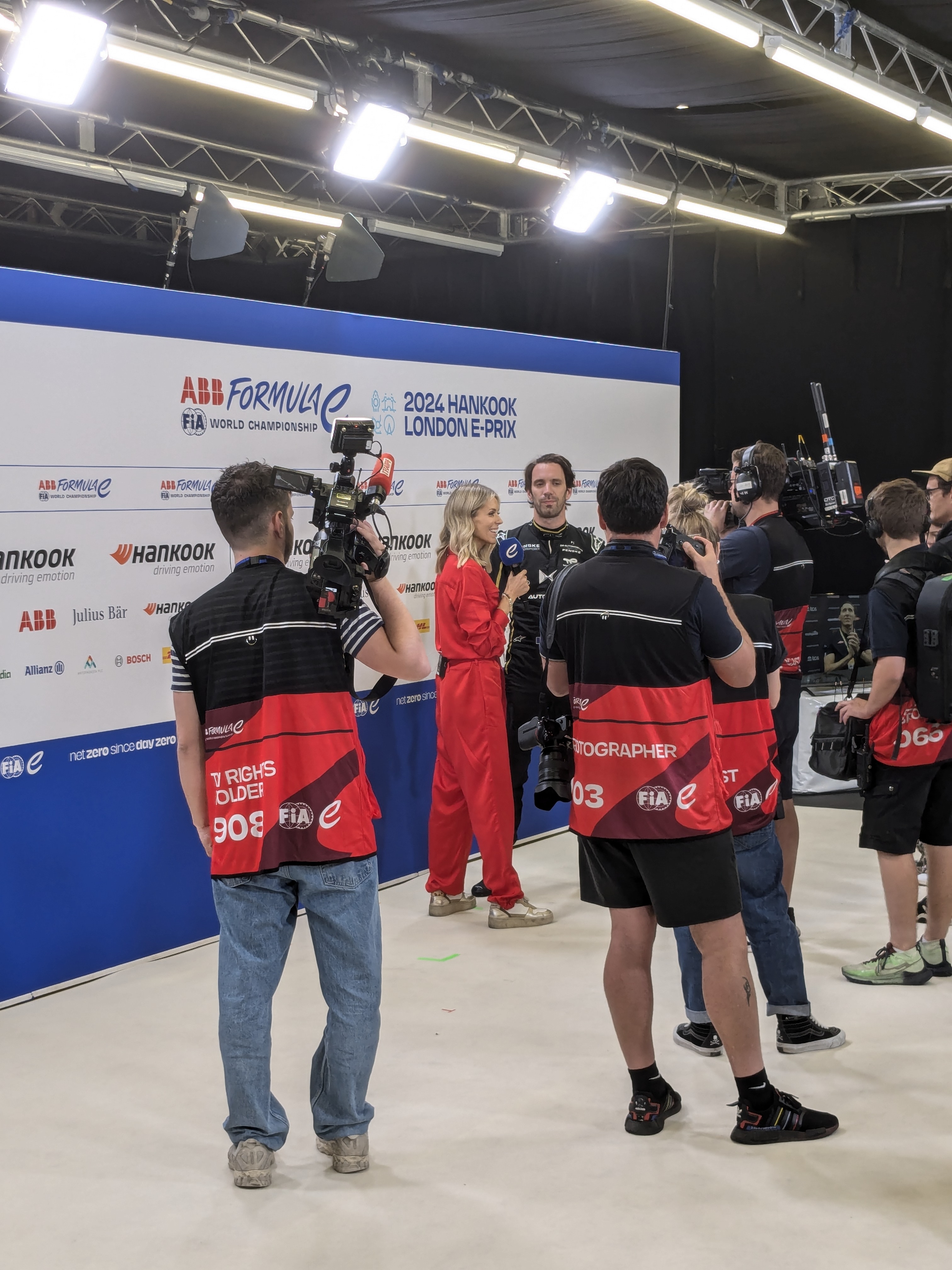
Nick Shields interviewing Jean-Eric Vergne after qualifying for the 2024 London E-Prix.
Brooks, Chandhok and McNish have not have worked together much on-air, but there was clear rapport between the three. Always animated when describing the action, the trio gestured to one another when they wanted to contribute on-air.
For a commentator of any sport, the job does not stop when the live microphones go off. Instead, they are in constant dialogue with the production team. During qualifying, the trio relayed information back to WestWorks, requesting that the team replayed key moments on the broadcast.
Seven different commentators joined Brooks on race day during season 10. Chandhok and Monger led the way, with the line-up rotating from race-to-race.
Co-Commentator
Races
Karun Chandhok
10
Billy Monger
6
Allan McNish
4
David Coulthard
4
Andre Lotterer
3
Dario Franchitti
3
James Rossiter
2
The lack of consistency is suboptimal, leaving fans guessing as to who they will hear race-by-race. The crowded motor sport calendar makes this a challenging area for the series to fix.
In my view, it is essential for Formula E to have a consistent commentary line-up. Jack Nicholls and Dario Franchitti were consistently together from 2014 to 2023, and became a staple of the series. Formula E need to try to replicate their success story with the same pairing in the booth across every race.
Allen noted that having a range of voices on the broadcast allows for different “perspectives on things.” He cited Andre Lotterer as someone who “can speak to the drivers on a different level.” The German has six years of electric experience, and is “Porsche’s reserve driver so has that relationship with them.”
Watching the season finale from the Track Feed gallery
Later, we watched the team direct the Track Feed live for the season finale. The team, like millions watching at home, wondered if Pascal Wehrlein, Mitch Evans, or Nick Cassidy would become Drivers’ Champion.
From the outside, it is easy to criticise the TV direction, sometimes overly so, sometimes for good reason. But watching the team direct the race live brought me an appreciation to broadcasting that I did not have before.
I have always acknowledged the effort involved, but seeing it unfold made me appreciate it much more. A strange confession for someone writing about motor sport broadcasting for 12 years, admittedly…
During a race, every Formula E team and driver strategizes, wondering when the best opportunity is to take Attack Mode. The same applies on the broadcasting side, the gallery none the wiser as to how the race will unfold. The team use the timing pages and Team Radio as a guide, but they are just that: a guide.
In the Track Feed gallery, we hear the director calling the action, focusing on the championship battle. ‘Top 3’ and ‘top 4’ are regular shouts, instructing each camera operator to focus on the leading cars.
Likewise, we hear calls for augmented reality shots (“AR on Drivers’ Standings at 16”), around 15 seconds before they air.
But how does the Track Feed produced by Aurora differ from Whisper’s English language programme feed referenced earlier? The Track Feed is a ‘dirty’ feed consisting of the cameras dotted around each circuit, overlaid with the TV graphics.
At WestWorks, the team adds other aspects to form the English language programme feed. These include replays, on-board camera angles and wrap-around coverage.
It should be noted that Aurora produces an International Feed, which goes to territories that do not take Whisper’s offering.
A simplified flow chart showing how the Formula E ELP is made and distributed to broadcasters.
With 10 on-board cameras on each Formula E car, the team have up to 220 on-board angles at their disposal. They can select up to 52 of these from 13 cars, the whittling down of angles also done from WestWorks.
Formula E’s on-site presence was much greater when we last went behind the scenes with them (see here and here). “One of the key targets for Formula E is net zero. It’s something that we’re challenged on regularly by the organisation,” Allen says.
“Thankfully, it’s something that Whisper are strong on as well. When you think about where we’re flying around the world, it becomes important that we keep the footprint small.”
“The technology at our disposal means that we can produce the show at WestWorks, regardless of where the race is. We’re working with Gravity and Timeline as the technical partners, with all the feeds fed back.”
On-track successes and struggles
From the test event in Donington to the season 10 finale in London, the series has been on a journey.
The machinery is faster than what it was a decade ago, with the championship arguably beginning to outgrow street racing. Holding races in cities has been in Formula E’s DNA since day 1, allowing fans to travel using public transport.
The qualifying format has been a big success in recent years. Allen says that the head-to-head Duels format for the last eight cars, is “fantastic” from a TV perspective. “I personally believe that the format that Formula E have hit upon is fantastic for a TV audience,” Allen believes.
“It’s full of jeopardy and you don’t get second chances in the same way you do elsewhere, which helps.”
The Track Feed on-site gallery at the London E-Prix. The feeds shown include Timing, Track Map, Beauty Cameras, On-Board Cameras, RF Cameras, Track Feed, Preview, and Track Cameras.
Another key element of Formula E racing, as highlighted earlier, is Attack Mode. Love or loathe it, it is critical that the commentators can explain the tactics behind every decision made.
“Attack Mode is something unique to Formula E,” Allen says. “If you see that in the context of the London race, you can see how much drama you can create.”
“Mitch Evans missed two Attack Mode activations, and the commentary helped simplify what that meant from a race perspective.” (Evans would either run out of time if he missed again, or get disqualified)
Whisper, who also produce Channel 4’s F1 offering, sought to highlight Formula E’s “uniqueness” throughout their coverage.
“As a production company, we don’t really have much control over what happens [in sport]. But, as a production team, you then start to understand what the unique elements that sell the sport to fans.”
“For Formula E, it’s the access to drivers. It’s the qualifying format, it’s the fact that the races are unpredictable and the fact you have different winners.”
From this fan’s vantage point, there is improvement required on and off-track for Formula E, namely the peloton racing. In my view, the peloton style needs to disappear for season 11.
For readers unfamiliar, drivers start the race half a dozen seconds off the pace. Imagine driving on the M25 in rush-hour, but Formula E style. Eventually, half way into the race, the drivers finally hit the accelerator, spreading the pack out.
The peloton style allows the series to post outlandish overtaking statistics across social media, but is ultimately unsatisfying to watch.
A perennial problem remains the calendar structure, which remains lopsided. The upcoming 2024-25 season tentatively has 17 races across 11 locations and 8 months, which is great for the series. But, the first 5 races take place across 13 weeks, with the remaining 12 races squeezed into 15 weeks.
Of the 13 weekends in the F1 off-season, only 3 of them feature a Formula E race. Formula E becomes lost in the shuffle when F1 (and other motor sport) returns from their winter break.
The inaugural Shanghai E-Prix fell on the same weekend as the Monaco Grand Prix and the Indianapolis 500. During the winter, I would have watched, but this year’s timing meant that I missed it completely.
A decade in, Formula E should be establishing blue-ribbon events, something the series does not have right now. Yes, there are regular fixtures (Mexico City to name one), but these attract the same attention as other races.
Even excluding the COVID season in 2020, not a single circuit has been on Formula E’s calendar since the beginning.
Punta del Este is a city that should have become a blue-ribbon event, with its stunning backdrop. Sadly, the Uruguayan venue dropped off the calendar after only two events, before briefly returning in 2018.
Where next for Formula E? The series has its eyes on ‘the TikTok audience’; having recently surpassed 1 million followers on the platform. Year-on-year, this represented an increase of 235% for Formula E.
On the marketing side, Ellie Norman joins the team as Chief Communications Officer at the end of September. Norman comes into Formula E fresh from her recent stint with F1, which should only help the series.
TNT Sports will continue to cover the series in the UK next season, despite owner Warner Bros. Discovery selling their stake in Formula E to Liberty Global. The championship returns on December 7th with the Sao Paulo E-Prix.
Alex Jacques has been the one of the leading voices in motor sport for the past decade.
Despite being relatively young compared to some of his compatriots, Jacques has risen rapidly up the ranks, having already covered prestigious events such as the 24 Hours of Le Mans and Indianapolis 500.
Currently, Jacques is Formula 1’s lead commentator for Channel 4 and F1 TV, combining the responsibility with his Formula 2 duties, 2024 his tenth season holding the Formula 2 microphone.
I caught up with Jacques at the Black Book Motorsport Forum on his journey so far and where he is heading next…
The road to Formula 1
Like many before him, Jacques worked with various BBC local radio stations on his way up alongside working for The Times newspaper, covering anything and everything the stations threw at him. Helping Jacques during his early broadcasting career was BBC Radio Suffolk’s sports editor Graham Mack.
“All the time, I was building a demo that I could send to producers if the right opportunity arose, and Mack was such a big help with all of that,” Jacques tells me.
“He lent me Radio Suffolk’s spare ISDN box, which was useful because I didn’t have the money for that equipment. I would get the box, go to anywhere that would have me and plug it in.”
“I did any local radio station that would take me for any sport. So, BBC Radio Suffolk, BBC Radio Leeds, BBC Radio Norfolk, BBC Radio Manchester, it didn’t matter if it was football, cricket, handball.”
While travelling around the country on a limited budget ‘couldn’t last forever’ in Alex’s own words, what it did give him was a range of opportunities that wouldn’t have otherwise presented themselves.
“I covered non-league football all the way up through to Premier League football, encountering every type of scenario,” he says.
“I was in press conferences with Premier League winning managers when just four years previously I was trembling holding the microphone outside non-league football waiting, hearing the manager shouting at players in the dressing room and knowing I’ve got to ask him three questions otherwise I’m in trouble. I loved doing all of that.”
The early days
Jacques’ breakthrough came in 2015, when Will Buxton announced his surprise departure from the GP2 commentary box (since rebranded Formula 2), in a decision Buxton called ’one of the hardest of my professional career to make.’
“It’s so odd when you recount it,” Jacques says. “It was an extreme slice of luck that I saw there was an opening because of his blog. I’ve been obsessed with motor racing my entire life, and I thought I could take my passion as a fan and distil it into commentary.”
His pitch to F1’s TV producers was simple: treat Formula 2 and Formula 3 as if the two were on an equal footing to Formula 1.
“The number one thing I said was that I will treat Formula 3 and Formula 2 like Formula 1. You fuel up the helicopter to do the start, now I know that’s a practice for Formula 1, but you still put fuel in the helicopter. You’ve still got some of the best operators in the world in that gallery, they’re not on lunch break, they’re doing Formula 2.”
“It needs to feel as vital and important [as F1], and it needs to tell the story of the people that you will eventually hear about in Formula 1 in the same way. And I think that pitch got me the job.”
The early races were challenging for Jacques, as he was subject to social media criticism following Buxton’s departure. Nevertheless, F1 stuck with Jacques and fans began to warm to his commentary alongside the likes of Jolyon Palmer and Davide Valsecchi.
“The first few races weren’t what I wanted them to sound like, but everyone, both the audience and the people behind the scenes, were very patient with me,” Jacques says, talking to me nearly 10 years on and over 500 races in the bag.
“It’s natural when you start [to overthink]. You always look back on the early days of a job and they feel like months because you’re sweating every minute of it.”
Alex Jacques in the commentary booth during the British Grand Prix weekend.
“The advice I’d give anyone at the start of their career, whether it be broadcasting, whether it be print journalism, is not to sweat it. The good days are never as good as you think they are and the bad days are never as bad as you think they are.”
“And the more reps you get, the more you get into a rhythm of it. The wonderful thing about Formula 2 is that the championship provides so much drama that you go through every conceivable circumstance.”
Talking through the highs and lows
“You cannot do unforgettable commentary unless there is a compelling story at the centre of it,” Jacques says. Luckily for Jacques and Valsecchi in the Formula 2 commentary box, that compelling story came in 2017 when Charles Leclerc took the championship by storm.
In the Bahrain sprint race, Leclerc made an unexpected pit stop, before overtaking 13 cars on his way to victory, a sign of things to come.
“Valsecchi’s next to me, saying, ‘what’s he doing, it can’t be done!’ We’re like, of course, it can’t be done, and then Charles just starts carving it up like it’s a PlayStation game!”
“You desperately want that narrative; you want the drama. People talk a lot about bias, the only thing any sports broadcaster is biased towards is it being good.”
Since the early years, Jacques’ commentary has received plaudits and colleagues alike, the most recent example being Jacques’ call at the end of the Monaco Grand Prix as Leclerc won in Formula 1 for the first time on home soil.
While Jacques is now in his element, it wasn’t until mid-2016 that Jacques began to felt more comfortable in the booth, aided by classic moments such as Leclerc’s Bahrain drive, and a drag race to the line between Pierre Gasly and Raffaele Marciello.
“It was one of those wonderful moments that didn’t matter in the grand scheme of things, but it was there where I was beginning to sound like how I wanted it,” Jacques recalls.
As lead commentator for Formula 2, Jacques has watched the future stars go wheel-to-wheel, waxing lyrical at their every move. On the other end of the spectrum, Jacques led Formula 2’s on-air tribute to Anthoine Hubert, who was tragically killed during the 2019 Belgian Grand Prix weekend.
“Anthoine was a terrific guy on and off track and it was such a cruel set of circumstances,” Jacques tells me. “I knew instantly it would be serious and then I felt an immense responsibility to the championship and my broadcast team. At that point you push all the emotion out and just deal in the facts that you have available.”
“Afterwards it was very tough when the news came through. It was difficult to comprehend that it had happened on a modern Grand Prix weekend and that someone you’d spoken to two hours ago was gone. It was just appalling for his team, friends, and family.”
At the start of Formula 2’s Italian Grand Prix broadcast the following weekend; Jacques gave a heartfelt speech.
When the sport that brings you joy suddenly brings you heartbreak, you are confronted with a choice. Stop and despair, or endure and continue. The drivers of Formula 2 reject despair, not because they do not grieve, but because they are determined in their defiance. Know this with certainty. Anthoine Hubert will never be forgotten. He was special, on and off the track, and the 17 on the grid today choose to honour him. They choose to race.
Alex Jacques, speaking at the start of Formula 2’s 2019 Italian Grand Prix broadcast.
“Those were my words and thoughts,” he says. “The thing about the production team is they have always put huge trust in me. In Italy there wasn’t even a discussion beyond checking I was okay. It will always be that way with my commentary.”
“It was seeing the determined defiance from the drivers in the paddock which inspired it. It’s the most honest and direct piece of broadcasting I’ve done and hopefully I’ll never have to do anything remotely like it again.”
Jumping to F1
Jacques moved up to covering F1 for their direct-to-consumer platform F1 TV, later becoming Channel 4’s F1 lead commentator from 2021 onwards.
“We’re all taught by the late great Murray Walker, there’s no such thing as a dull Grand Prix,” Jacques says. “And if you want to hold the microphone, you’ve got to try and make that true.”
Luckily, Jacques did not have much difficulty with that in 2021, as Lewis Hamilton and Max Verstappen raced towards a dramatic finale in Abu Dhabi.
One of their flashpoints at Silverstone was Jacques’ first live commentary on free-to-air television in the UK, joining an elite few to hold the honour of doing so, Jacques succeeding Ben Edwards in the position.
“I was talking to Ben about it in the week afterwards, it means a lot to be part of that group. There’s very few people who have had the honour of doing one of the great fixtures of the British sporting summer for a free-to-air audience.”
“That meant a lot as a 10-year-old who loved the commentary of Murray Walker and Martin Brundle. The idea then that I would be doing that, that was a very strange situation to try and wrap my head around.”
“If you tell everyone from a very young age that you want to be a Formula 1 commentator and they let you do it on Channel 4 live, you better be good! I’ve never felt pressure like that in my life and then to be rewarded with what happened.”
“It was one of the greatest distillations of what makes Formula 1 great that I’ve ever seen.” Hamilton and Verstappen raced towards Copse, but only Hamilton would continue beyond Copse, the two colliding as Verstappen slid off into the gravel.
“You just wanted it to carry on and on and on, but unfortunately it didn’t. Off the back of COVID, that felt like the first race that Formula 1 was back: it suddenly felt like it was vivid again.”
For Jacques, Silverstone 2021 was his favourite race to commentate on “by a mile, not because of who won, not because of what happened, just because of the occasion.”
Alex Jacques presenting alongside Billy Monger in the paddock for Channel 4.
Jacques is complementary of both of his co-commentators during that Silverstone race, David Coulthard, and Mark Webber.
“I was always so grateful for him [DC] for not pulling rank, understanding how I would do it differently, working with me [after Ben left]. He could not have been more accommodating, and I massively appreciated that when I switched to Channel 4”, Jacques says.
“I don’t there’s anybody else in broadcasting who will talk about the under rotation of an axle in the first part of a sentence and then give you pop lyrics in the second. He’s the same guy who has beaten Alonso, Schumacher, Hakkinen on his day suddenly then going, ‘what’s that pop song from 1980’ and then going ‘that might be because of d-rating!’”
“And with Mark [Webber], you just leave the commentary box with a smile on your face.”
As for his other co-commentators? Jacques has had just a few over the past decade and has compliments for them all, whether its Alex Brundle’s “brilliant one liners” or Jolyon Palmer’s “superb” analysis of the race.
“I think that is probably where I have been the most fortunate. Because of the range of brilliant co-commentators I’ve had, it’s given me the ability to work with so many different broadcasters with different skills.”
Jacques evolved his commentary style upon getting the Formula 1 gig, noting that the sport’s audience has radically changed over the past decade, with the sport attracting a younger audience every weekend.
“Commentary should always feel warm, and as broad as possible, especially in this era of Formula 1,” he believes. “We’ve got a large percentage of the Formula 1 audience who don’t know who Sebastian Vettel is, and he’s a four-time champion! Every time we commentate, we’re having to recap the basics.”
“I had a fan come up to me recently and say ‘why is there a safety car?’ It makes you re-examine everything. It’s wonderful that we’ve got so many more people interested in it, and that Formula 1 is pushing that into different places because it’s not rocket science. It’s prototype technology with brilliant athletes racing.”
“You do have to drive the commentary yourself, and you have to have that editorial judgement of what the commentary should sound like in someone’s living room to keep moving forward.”
Final thoughts
Jacques joined Discovery+ last year to cover the 24 Hours of Le Mans for the first time. The famous race presented him with a new, unique challenge, giving him the opportunity to start ‘from scratch.’
“You’ve got to know absolutely everything. You’re on that microphone at five in the morning with a team of experts, and you need to know everything inside out.”
“I loved going back to the start and going right, I’ve been a fan of this, now I’m going to try and wrap my head around the spectacle of the race. It was just wonderful that we got a race that matched the occasion [in 2023].”
“It was great [doing something brand new] because there are things that I learnt from that week that I then took to Formula 1. Ultimately, I just love broadcasting motor racing and I’m a commentary fan as well. It’s a consistently moving target.”
Nearly, a decade on from his opening act in 2015, Jacques does not see himself moving away from the commentary booth any time soon, openly admitting that he’s yet to have a ‘perfect’ race from a broadcasting perspective!
“Every single time I go into a pit lane or a commentary box, that moment hits. ‘Yes, this is cool!’ It never gets old and the moment it gets old you should be out of that commentary box. It should never be a job; it should mean more.”
“With broadcasting, there is nothing I enjoy more. Commentary for me is this unwinnable battle. The highest percentage you can ever get to is 99%.”
“There’s a race, and I won’t tell you which one, I got close, but I still know the thing I didn’t get quite right. It wasn’t wrong, it wasn’t a mistake. I thought I had a good race and then the next day I was like, ‘oh, you could have explained that a different way!’”
“Commentary is this wonderful thing that keeps me coming back, and long may it continue.”
Christian Hewgill, the star of two Formula 1 podcasts, has been a fan of the sport since childhood, first getting into the sport in 1998 as Hakkinen and Schumacher battled for glory on-track.
But, for the man who grew up near Loughborough, the idea of stepping into the glitz and glamour of the Grand Prix world felt a “million miles away.”
“As much as I thought it would be a great thing to do, I just didn’t think it would be possible,” he tells me over a sit-down interview. “I’ve been brought up by working class people, I went to a non-fee-paying council run school and Formula 1 just seemed a million miles away.”
Karting was Hewgill’s first route into motor sport, however this quickly fell by the wayside, owing to the lack of funds “more than anything else.” At this point, Hewgill was also beginning to appreciate another part of sport: broadcasting, looking up to the likes of Jim Rosenthal and Steve Rider who presented motor sport at the time.
“I went to university and did a degree in Broadcast Journalism and at that point the aim was a career working in local radio because that’s what I thought was realistic.”
Joining the Newsbeat team
His breakthrough came with the BBC, where he spent ten years across various outlets, including Radio 1’s Newsbeat team. The outlet aimed to take younger people closer to the stories that mattered to them. Each week, the station aired a variety of different stories, from Eurovision to F1.
“I was pretty happy doing news and sports as a career at the Beeb, but I’ve always been a massive motor sport fan because of karting.”
“And one of the brilliant things that Newsbeat did at the time was encourage us to pitch stories about things we were interested in,” Hewgill explains. “They employed a young and very diverse team, and therefore, they got quite a diverse selection of stories. At its heart, Newsbeat featured young people doing cool things, and that’s what F1 is.”
Hewgill joined the 5 Live team as part of Newsbeat at the 2019 British Grand Prix, and it was only then that he realised that this could turn into a career.
“Formula 1 had always been a bit of a side passion that I enjoyed away from work. I didn’t know how I would feel about that becoming my job, but it was that weekend that made me realise, maybe I want to do more of this. That was the light bulb moment.”
Interest continued to increase, culminating in Hewgill presenting Newsbeat live from the Bahrain paddock in 2022. From “barely getting an F1 package” on Newsbeat back in 2017, Hewgill was now presenting a live F1 programme on Radio 1 from Bahrain just five years later. It was a weekend that changed Hewgill’s professional career for the better.
Brief spells with LBC and talkSPORT followed for Hewgill as Newsbeat relocated to Birmingham in the summer of 2022 but for him, the love for covering news had faded.
“I loved doing Newsbeat and I’m so grateful for the first 10 years of my career. But talking about the news all the time [for 10 years] had started to drain on my mental health, the negativity, the tribal approach that news has got towards politics. I did lose the love for it,” he says.
“And then it was like, what else do I do? I’m not particularly academic. Doing daily news and sports is all I’ve ever done. The only other thing I know and am truly passionate about is Formula 1.”
Presenting Newsbeat live from the F1 paddock posed its own challenges, but one that made others curious, including a certain Radio 1 DJ….
Introducing The Fast and The Curious
…even if, originally Greg James was going to have an off-mic role on The Fast and The Curious!
“The plan was always for me to present with someone else,” Hewgill reveals. “He’s an incredibly humble bloke, bless him. And he said that he presents enough stuff as it is, so Greg had talked about him potentially not being on the podcast. He really wanted to executive produce and build something from the ground up.”
Plans quickly changed once the two of them realised how well they “bounce off each other,” owing to their friendship stemming back to the days of working together at Radio 1. The pair of them wanted the new F1-themed podcast, which was James’s idea to begin with, to highlight the lighter aspects of the sport, that other podcasts do not cover as often.
“It was incredibly collaborative, discussing what isn’t out there and what can we bring that’s different? I didn’t feel that there was a podcast that lent into the humour of the sport and the silliness of the sport because the sport is mad!”
“This travelling circus that goes around the world, there’s so much humour and funniness to it. I didn’t think there was a podcast that lent into the, for want of a better word, the Drive to Survive era, in that there were more and more people coming into F1 who knew a bit, but didn’t know loads.”
“Some of the sports podcasts I listen to, they’re all football experts, they’re all F1 experts,” notes Hewgill, citing The Monday Night Club and The Race’s F1 podcast as podcasts he enjoys, but not necessarily tailored towards the casual fan.
“All the sports podcasts I’d listened to were all a panel of experts. One of Greg’s big mantras is you can love sport in whatever way you want to love it. You don’t need to be a fanatic and know everything.”
Betty Glover, nominated for 2023 Women’s Sports Journalist by the SJA, joins Hewgill and James on the podcast.
“Betty is a phenomenal sports broadcaster, but by her own admission was only just falling in love with F1,” Hewgill tells me.
“She was new to it and we wanted the audience to go on that journey with her. Betty has been amazing because she thinks to ask different questions that I do. Stuff that’s obvious to me isn’t obvious to her.”
The three are genuinely friends both on and off-air, with Hewgill’s and Glover’s friends thanks to Newsbeat: the two presented coverage of the Winter Olympics together.
“It’s the first time I’ve come off the air and gone ‘I really like being on the radio with her,’ she’s such a funny and infectious personality. I wanted to work more with her and wanted to develop that relationship on air with her.”
A successful first season
But how did the three turn an idea into a reality? Most drivers tend not to come out their shell in the media pen interviews, instead sticking to pre-rehearsed lines about the race weekend.
“Some people say that motor racing drivers are quite dull, I couldn’t disagree any more. Motor racing drivers are fascinating,” Hewgill believes.
Arguably, one of the reasons The Fast and The Curious has been as successful as it is because they have curated content away from the pressure cooker of a race weekend, giving racing drivers and team personnel alike the platform to be open about themselves.
To help achieve this, he admits the team did carefully craft some of the first season in 2023, but for very good reason, with both McLaren, Williams, and Alpine drivers’ regulars.
“We quite carefully went after some of the drivers we thought would be good fun. We wanted to have fun with them and they seem to have enjoyed being on it. The teams have been very receptive to what we’ve done in terms of, we’re trying to celebrate the sport in a different way and have some fun with it.”
“The reaction has been so warm from people within the sports. I think we expected a degree of stiffness a bit ‘who the hell are these guys.’ People have been so warm and friendly which has been lovely. All we’re trying to do is celebrate the sport and celebrate the drivers.”
With 64% of The Fast and The Curious’ audience female, and most of their audience in the aged between 18 to 29, it is fair to say that the show is attracting F1’s most sought after demographic.
“It’s all very well seeing numbers on spreadsheets, whenever you’ve been in broadcasting for long time, you know when something’s working because you get that interaction and the warmth for the audience, which has just been amazing.”
Throughout each episode, the team have always tried to be themselves, something that came across in their interview with seven-time champion Lewis Hamilton prior to the start of the 2023 season.
Hamilton has been supportive of LGBTQ+ rights with his rainbow helmet on display at various races during the past few seasons with Mercedes, as well as continuing to promote diversity and inclusion within motor sport.
Both topics are of importance to Hewgill, himself a gay man and one of Racing Pride’s ambassadors.
“Throughout my broadcasting career, I’ve always tried to be myself. I’m no good at pretending to be anyone else, and coming out as gay made me realise that,” he says.
“I spent many years trying to compress that and trying to be someone else, it made me deeply unhappy. Some people switch to an on-air persona, I just can’t do that. I am gay, it crops up in conversations sometimes, like Greg’s wife Bella sometimes does, and Betty’s boyfriend Alex does. We wanted the podcast to be authentic and I think we’ve achieved that.”
“When we interviewed Lewis, I was keen to say that as a gay guy it means a lot to me that he does go out and takes the stances that he does. I didn’t expect that me saying that to him at the end of the interview to resonate across on social media on TikTok, Twitter and Instagram.”
“And that was just through me being honest, so it does make a difference. We’re just trying to be ourselves through all of our podcasts.”
Hewgill’s Bahrain 2022 gig with Newsbeat was also the springboard for his second F1 adventure, this time with F1’s in-house team, presenting their podcast series F1 Explains alongside Katie Osbourne.
“F1 liked the Newsbeat approach to tackling F1: I was trying to explain it as I went along, and they were keen to work together on something,” he says.
“Chris Browning-Brant, who has gone on to be my editor on F1 Explains, said to me, ‘I heard the Bahrain programme and we were going to get into touch with you’, and I got in touch with them, and so the paths crossed naturally.”
“F1 didn’t feel they have a podcast that properly explains the sports and not just a new audience, but to more established audiences as well.”
The podcast explains the key terminology that fans hear race-to-race, such as explaining the intricacies of the Drag Reduction System (DRS). As well as hearing from the drivers, the podcast features “strategists and engineers and people who you don’t normally hear from.”
“There’s such a big wide world that exists in Formula 1 and we wanted to explain the sport in detail, and shine a light on some of the voices you don’t necessarily get hear from, very similar to The Fast and The Curious, it’s been so warmly received.”
“This year so far, all the episodes have been listener based because we’ve had so many questions from people saying ‘so can you explain this,’ and I’m sat there going ‘I’d never have thought to have done that, what a great idea that is.’ The fact that people are engaging with it is lovely.”
“Whether you’re a new fan or someone who’s been watching for decades like me, I’m convinced you learn something every episode.”
Hewgill has no regrets on his broadcasting journey so far.
“I’m in the happiest place I’ve ever been in my professional career because I just love making both of them. I feel very lucky with them,” he tells me.
“I said at the start of this interview, I felt a million miles from a Formula 1 paddock where I was growing up. I genuinely believed as a kid that you couldn’t be gay and be a professional sports broadcaster. Hopefully I’ve shown that it is possible to be LGBTQ+ and a motor racing presenter, and that’s really important to me.”
“I just want to enjoy it while it lasts, however long that is.”





 Motorsport Broadcasting