My fourth calendar year of running The F1 Broadcasting Blog is coming to an end. The past month and a half has been more packed and crammed than the previous ten months combined, but that is the way the broadcasting land works. You just never know what might come next! I’d like to wish all my blog readers and beyond a Merry Christmas and a Happy New Year!
Thanks for all the comments and thoughts throughout the year, it is much appreciated as the blog speeds into 2016. Unfortunately, some battles were lost this year, and some battles continue. Jules and Justin: we remember you. And almost two years on: #KeepFightingMichael.
The start of 2016 looks set to be fascinating as Channel 4 unveil their Formula 1 line-up. For the moment, please stay safe over the holiday period and I hope 2016 gives us a lot more to talk about.
Over the Christmas and New Year period, I tend to post a bit on how the blog has performed across the year. This particular post I normally push online in the lull between Christmas and New Year. The news this past Monday means no such lull exists this year. I am splitting the Channel 4 posts up so they are not all going online in one block. As a side note, if anyone has noticed that something has not been updated yet on the blog, please give me a shout and I will endeavour to update it.
Off the back of the BBC and Sky Sports deal in 2011, The F1 Broadcasting Blog launched in April 2012, and has since amassed nearly close to one million views, with just shy of 500,000 visitors in total. But just where do the visitors come from, and how do readers access the blog?
The site in 2015 has attracted nearly 280,000 hits, which works out at around 770 views a day. That is a decrease of around 100,000 hits year-on-year, as (until last Monday) 2014 was the more eventful year from a broadcasting perspective. The raw percentage of people accessing from the United Kingdom has dropped slightly again, that also is the case in the United States. The biggest jumps come from Australia, Netherlands and Spain.
Top 10 Countries – Percentage of all hits
01 – 74.3 percent (2014: 75.0) – United Kingdom
02 – 3.8 percent (2014: 5.8) – United States
03 – 2.4 percent (2014: 1.7) – Australia
04 – 2.0 percent (2014: 2.0) – Ireland
05 – 1.5 percent (2014: 1.5) – Canada
06 – 1.3 percent (2014: 1.0) – Netherlands
07 – 1.0 percent (2014: 0.7) – Spain
08 – 1.0 percent (2014: 0.9) – Germany
09 – 0.9 percent (2014: 0.9) – Italy
10 – 0.8 percent (2014: 0.9) – France
The amount of people coming to the website from search engines has dropped compared with 2014, whilst the proportion of users coming from Twitter has increased again. As mentioned earlier, the lack of a big story early in the year meant that there was not as much activity, comparatively speaking year-on-year. No doubt that will change in early 2016…
The top ten search queries makes for interesting reading, with some similarities compared with 2014, and one surprising entry.
Top 10 Search Queries
01 – f1 broadcasting
02 – f1 broadcasting blog
03 – tom clarkson
04 – tom clarkson f1
05 – gary anderson f1
06 – simon lazenby
07 – bbc f1
08 – f1 viewing figures
09 – sky f1 channel
10 – a1 gp
A lot of references to BBC’s Formula 1 coverage in there, with Tom Clarkson and Gary Anderson making the list. Despite the whole Anderson story happening in early 2014, it clearly still had an effect on the 2015 numbers, presumably people were keen to see what Anderson has been up to this season, if anything. Everything is Formula 1 related, and then at the bottom of the top ten you have ‘a1 gp’! Weirdly, the stats for the one A1 Grand Prix article on the site shows that particular piece spikes during Formula E weekends, you can read into that what you will.
The top ten articles published during 2015 will be summarised on New Year’s Eve. I suspect the current top ten will change drastically between now and then, but we shall see.
Statistics compiled and correct as of December 23rd, 2015.
The dust has settled (sort of) on the news that Channel 4 will be broadcasting Formula 1 from the 2016 season. With just three months until the Australian Grand Prix, it leaves very little time for the broadcaster and the chosen production team to negotiate with talent and put in place a strong team that can challenge Sky Sports F1’s team on screen.
When I did this with BT Sport’s MotoGP team in 2013, the post was chunks of paragraphs, which I don’t think is going to work this time, when the talent pool is big. You have BBC’s Formula 1 team (both TV and radio), anyone from ITV’s old Formula 1 team that realistically could jump. The chances of anyone jumping from Sky Sports to Channel 4 is unlikely, but still a possibility. And then there are those that are not currently tied to a broadcaster that could become part of Channel 4’s team. You have to assume that Channel 4 will want a mixture of existing BBC talent, along with some fresh faces. Channel 4 have their own 4Talent scheme, and it is plausible that they may want to groom someone from within that scheme to become part of their Formula 1 coverage, I don’t know.
I need to state from the outset that the points below are my opinion. Given that the deal has only been in the public domain for a day, I have no inside information on who Channel 4 are planning to sign up to cover Formula 1. Of course, some predictions will be wildly out, but it is definitely worth doing to compare with later.
Presenters Suzi Perry – The BBC Formula 1 presenter from 2013 to 2015 and before that MotoGP presenter in the mid 2000s. Perry must be one of Channel 4’s number one targets for the presenter role, given the way that she had settled nicely into the role, improving compared to the start of 2013. Whether Channel 4 would want a new face up front, I don’t know, but they will certainly want a steady ship at the top of the programme to lead it with control, and I feel Perry is that person – potentially.
Jennie Gow – The current BBC Radio 5 Live pit lane reporter and Formula E presenter for ITV is bound to be in the frame for some sort of role at Channel 4 given that she is a hot commodity for the majority of broadcasters’ at the moment. She did have some experience presenting a season of MotoGP with the BBC in 2010, but was replaced by Matt Roberts. If she moved, she would obviously no longer be BBC’s pit lane reporter. This is a tough one. My gut instinct says no, certainly for the main presenter role.
Jake Humphrey – The former BBC Formula 1 presenter from 2009 to 2012, and currently BT Sport’s Premier League presenter. As Humphrey is part of Whisper Films, this is viable, but unlikely. The rationale behind Humphrey leaving BBC’s Formula 1 team was to spend more time at home, understandably. Unless Channel 4 take a studio based approach to proceedings or create a magazine show, I don’t see Humphrey being involved.
It is difficult to think of any other presenters currently involved at the top level. Matt Roberts (current Eurosport’s British Superbikes presenter) and Charlie Webster (ex ITV GP2 presenter) are other possibilities, but outside shots, if that for the role. Webster did present the Race of Champions for Whisper Films/Channel 4 in November. The name Clare Balding is bound to crop up somewhere given her links to Channel 4. And lastly, Chris Evans who first mooted the Channel 4 deal last month. Realistically though, I think it is difficult to look past Suzi Perry getting the presenter gig. Quite frankly, Channel 4 cannot afford to “do a BT” and mess up getting the glue correct. No one really noticed the whole Melanie Sykes saga with BT Sport in the non-motor sport media, but if you attempt that with Formula 1, it may not end well. Channel 4 need someone with experience to steer the show.
The F1 Broadcasting Blog predicts: Suzi Perry to become Channel 4’s Formula 1 presenter. Jake Humphrey to present a Formula 1 magazine show to air during the season.
Lead Commentator Ben Edwards – The BBC’s Formula 1 lead commentator from 2012 to 2015. It was the first time Edwards has covered Formula 1 on terrestrial television in this country, having previously covered the likes of A1 Grand Prix. He should be Channel 4’s number one choice. However, I wouldn’t be surprised if he is actually their number two choice…
Jack Nicholls – Currently the lead commentator on the Formula E Championship, Nicholls has also sporadically been lead commentator for BBC Radio 5 Live in the past two years. Remember the point I made about Channel 4 being a station that reaches younger viewers? In my opinion, that means Channel 4 need someone on their team to help them achieve that. Is Nicholls the person to do that, probably. Nicholls is a fantastic commentator at the age of 25, and could be Channel 4’s number one choice. The problem is getting him out of his Formula E and BBC Radio commitments, which I don’t see happening fast.
James Allen – If Formula 1 was going back to ITV, as was rumoured, this might be more certain. Unfortunately for Allen, that did not happen. Allen is currently BBC’s Formula 1 commentator for Radio 5 Live, however as noted above, Allen does not commentate (and therefore attend) on every race. The only way Allen would be lead commentator for Channel 4 is if he was willing to attend every race, assuming Channel 4 are going to have a presence on-site, the assumption would be that they are. I don’t think this is likely, unless Edwards rejects Channel 4 and Nicholls falls through completely. But never say never.
Other outside candidates are Toby Moody (ex Eurosport MotoGP lead commentator) and David Addison (current ITV BTCC lead commentator). Will Buxton is locked down with NBC covering F1, as is David Croft, so I don’t think those four options are realistic. If you are hoping for fresh faces, I do not see it happening where either the presenter or lead commentator roles are concerned.
The F1 Broadcasting Blog predicts: Ben Edwards to become Channel 4’s Formula 1 lead commentator.
Pit Lane Reporter Lee McKenzie – With a background in motor sport, McKenzie was BBC’s pit lane reporter for the duration of their coverage. McKenzie is going to be part of BBC’s team at the Olympic Games, and presumably Wimbledon again. I don’t see McKenzie moving to Channel 4, I imagine there are more opportunities for her at the BBC as it currently stands, both on TV and radio. Alongside this tweet, I think McKenzie will stay with the BBC and will not be part of Channel 4’s coverage.
Nicki Shields – The current Formula E pit lane reporter for their World Feed, and before that presented Escape to the Country for the BBC If you don’t watch Formula E, you probably will not recognise the name. From what I have seen, Shields has fitted in well to the Formula E role, describing herself as a petrol-head and environmentalist. I’ve liked Shields contribution to Formula E’s TV team and the interviews that she has conducted with the drivers. Given one of Channel 4’s points in their ten point plan from 2011 was to create “high impact factual programming”, I think Shields could be the perfect fit for the channel: a pit lane reporter alongside other commitments surrounding their programming outside of a race weekend.
Rachel Brookes – A Sky Sports News presenter, Brookes has become integrated into the Sky Sports F1 set-up, presenting The F1 Show alongside duties in the pit lane during practice and interviewing drivers before and after each race. I think Rachel is one of the better interviewers on Sky Sports F1, and should be a target for Channel 4. If the opportunity arose, I would like to see Brookes part of the Channel 4 team. I don’t think it would happen though: her current role at Sky Sports role allows her to cover events outside of Formula 1, and future opportunities there are present, which is not the case at Channel 4 beyond horse racing and the Paralympics.
There are probably three or four other candidates, notably Natalie Pinkham (current Sky Sports F1 pit lane reporter), Jennie Gow (current BBC Radio 5 Live pit lane reporter) and Louise Goodman (former ITV F1 pit lane reporter and current ITV BTCC pit lane reporter).
The F1 Broadcasting Blog predicts: Nicki Shields to become Channel 4’s Formula 1 pit lane reporter.
Other Suggestions
Did I miss anyone out? Mention it in the comments or on social media and I’ll add them below…
– Abi Griffiths (current BT Sport MotoGP presenter/reporter) – Jonathan in the comments
– Andy Jaye (current Eurosport speedway host and has hosted shows for Channel 4) – @PurpleSectorGP via Twitter
– Azi Farni (former BBC MotoGP pit lane reporter) – myself after writing this post
– Craig Doyle (current BT Sport MotoGP and rugby host) – Joe in the comments
– Georgie Ainslie, née Thompson (former presenter of The F1 Show for Sky Sports) – @sjbosher via Twitter
– Rick Edwards (presented the majority of Channel 4’s Paralympics coverage) – Jonathan in the comments
– Steve Rider (former BBC and ITV F1 presenter) – Gaz in the comments
Given the closeness to the festive period that this has been announced (and as the word count is close to 1,500 words already), I’m splitting this article across multiple parts as there is a lot to cover. Part 2 coming up at some point before the New Year…
It is official – Channel 4 are to broadcast Formula 1 from the 2016 season. The BBC have exited their portion of the contract three years early. Channel 4 will broadcast races advert free, with 10 races live and all 21 races broadcast again in highlights form. Their deal also covers practice and qualifying, so like-for-like with the current BBC F1 contract. Their deal will expire at the end of the 2018 season, whilst Sky Sports’ portion of the contract remains unaffected.
Bernie Ecclestone said: “I am sorry that the BBC could not comply with their contract but I am happy that we now have a broadcaster that can broadcast Formula 1 events without commercial intervals during the race. I am confident that Channel 4 will achieve not only how the BBC carried out the broadcast in the past but also with a new approach as the World and Formula 1® have moved on.”
David Abraham, Channel 4 Chief Executive said: “Formula One is one of the world’s biggest sporting events with huge appeal to British audiences. I’m delighted to have agreed this exciting new partnership with Bernie Ecclestone to keep the sport on free-to-air television.”
The ten point plan that Channel 4 proposed in Summer 2011 to try and capture exclusive UK F1 rights.
Jay Hunt, Channel 4 Chief Creative Officer said: “Channel 4 and Formula One are the perfect partnership. We’ve the same appetite for innovation and we’ll be demonstrating that to fans by becoming the first free-to-air commercial broadcaster to show the races ad free.”
Analysis
The major surprise is that it is Channel 4 replacing BBC’s TV coverage and not ITV, as was reported last week. On his BBC Radio breakfast show on November 24th, Chris Evans noted that Channel 4 were likely to take over, so Evans was spot on the money.
Before we get into what Channel 4 could and could not do, first we need to investigate why not ITV. I have reached out to them to find out if they were approached at all, and will update the site when I get a response. ITV were odds on favourite, so either the broadsheets last week were wrong, or the deal fell through at the eleventh hour. The Euro 2016 picks last Monday left the door open for ITV to broadcast Formula 1. Channel 4’s release states that races will be shown commercial free. Were ITV unwilling to comply with that, and therefore lost out? ITV announced a Top Gear rival last week called Driven, which looks odd now given that they failed to secure the F1.
There could be a bigger game for ITV with the horse racing rights. If ITV believe horse racing is a better prospect than Formula 1, that’s a thoroughly depressing thought, although the cost of horse racing rights would be lower than Formula 1. From a reach perspective, ITV wins out, but Channel 4 skews younger than ITV. Formula 1 has notoriously struggled to reach younger viewers in the past few years (some through its own doing, admittedly). On Channel 4, you can guarantee crossover with some of their younger skewing shows, notably Gogglebox and TFI Friday. A crossover involving the former is bound to happen and I’d be stunned if it did not materialise.
Is Channel 4 guaranteed to get less viewers than ITV for Formula 1? I would say it is likely, but I do not think the difference is as big as some may expect. I should probably whisper this, but the good news I feel about a Channel 4 deal is that they will bring something different to the table. I say whisper it, that is a reference to Whisper Films. For those of you unfamiliar, Whisper Films was set up in 2010 by Jake Humphrey, David Coulthard and Sunil Patel. And who owns an equity stake in Whisper Films? Channel 4. I think you can connect the dots. One thing that probably won’t jump ship is The Chain. Channel 4 will want to create their own identity and I simply do not see that happening.
From a scheduling stand-point, Channel 4’s ten point plan from 2011, located above, gives us a great idea about the potential that they could have going forward. I am sure we can all get behind more historical coverage from FOM’s archive and a greater range of programming on the station. Some of the points are no longer relevant, given that Channel 4 are now in a shared deal with Sky Sports, but it is food for thought. My final point would be: don’t judge Channel 4 on what they do or don’t deliver at the 2016 Australian Grand Prix, but judge them on what they do in the latter half of 2016 and 2017. It will already be a logistical squeeze getting everything in place for March 2016, but I am confident Channel 4 can do it.
I’ll write up a piece concerning who I think will slot in where over the Christmas break, as one era ends, and another begins…
The BBC’s return to Formula 1 has been a rollercoaster ride that began almost eight years ago. Here, The F1 Broadcasting Blog tracks the past eight years, in which the team went to a high never seen before in this country, to a low just four years later…
March 20th, 2008 – It was announced that Formula 1 would be return to BBC television, starting with the 2009 season. It was a five year rights agreement, set to continue through to the end of 2013. Roger Mosey, then Head of BBC Sport, said: “…we’re absolutely delighted F1 will be back on the BBC this time next year.”
November 24th, 2008 – Rider and Blundell out, Humphrey, Jordan and Coulthard in. The BBC were keen to bring fresh faces to their coverage, and they made their intentions clear towards the end of 2008. Alongside the trio at the head of BBC’s coverage, it was announced that Jonathan Legard would lead the commentary, replacing James Allen, with Martin Brundle joining from ITV. Meanwhile, behind the scenes in production, the BBC were already realising what a financial error this new Formula 1 deal was going to be. I quote Steve Rider’s book: “When [senior BBC producer] was told there would not be much change out of £8 or £9 million [in production costs] there was silence, then ‘Oh shit…’, and the line went dead.”
February 24th, 2009 – The BBC confirm their coverage plans for the 2009 season, including every practice session live and a one-hour interactive forum after each race, both behind the Red Button service.
March 4th, 2009 – Called “The World’s Greatest Car Chase”, the BBC unveiled their pre-season trailer, with that famous bass riff at the end…
March 26th and 27th, 2009 – Every session live, with one hour build-ups and a ton of reaction. Formula 1 had returned to the BBC, with Jenson Button winning in style. A peak audience of nearly seven million viewers watched across live and repeat.
July 25th, 2009 – Probably the first real low point of BBC’s Grand Prix coverage. Immediately following the crash of Felipe Massa during the Hungarian Grand Prix the team, notably Jordan, discussed Massa’s condition, with Jordan speculating about ‘rumours’ that he had heard minutes after the crash happened.
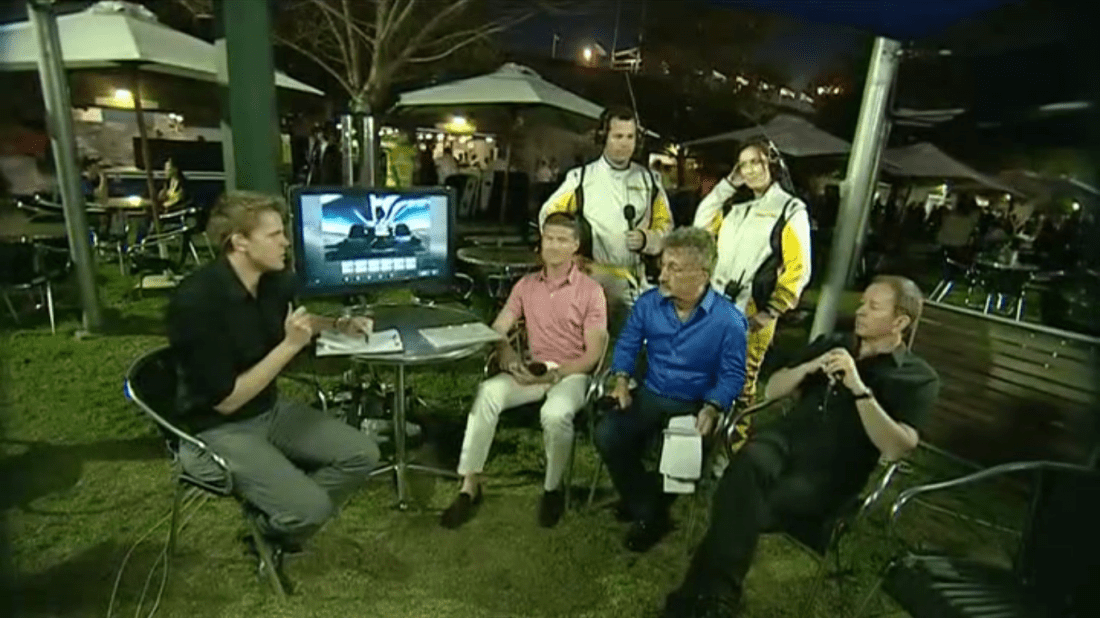
The first BBC F1 forum at the 2009 Australian Grand Prix. Jake Humphrey (l), Ted Kravitz and Lee McKenzie (top r), David Coulthard, Eddie Jordan and Martin Brundle (bottom r).
November 1st, 2009 – BBC’s first season came to a successful conclusion with the Abu Dhabi Grand Prix. From a personnel perspective, the team was well received, the exception being Legard, however the decision was made to retain him for the 2010 season.
July 11th, 2010 – The production team consolidated what they had in 2009 with more fantastic features airing during the 2010 season. Viewing figures increased, and notably the team stayed live on BBC One until 15:40 during the British Grand Prix. Over two million viewers stayed with them during the hour of post-race analysis on BBC One (excluding the forum that followed!), showing how much the audience liked and appreciated the BBC coverage. The trio of Humphrey, Coulthard and Jordan quickly built rapport with each other and it showed on air. It was clear that Formula 1 in the UK was heading into a golden age…
January 11th, 2011 – As good as BBC’s coverage was, it was clear that something was not quite right with the commentary team. The decision was made at the beginning of 2011 to remove Legard from the team, with Coulthard now co-commentating alongside Brundle. It was a marked departure from the usual set-up, with now two ex-racers commentating on the action.
June 12th, 2011 – “He’s gone wide, he’s gone wide! Button leads the Grand Prix!” Just two hours earlier, they were talking about ducks floating in the water. Of course, it could only be the Canadian Grand Prix, probably one of the best races I have watched. A peak audience of 8.5 million watched on the BBC, as the dramatic race tore up BBC’s primetime schedules. Their coverage was flying high. Sebastian Vettel may have been dominant, but viewing figures were still soaring. BBC’s F1 coverage was on top of the world. And then…
July 29th, 2011 – BBC and Sky awarded rights in new Formula 1 deal. The deal had been done. The costly error not to negotiate with Formula One Management three years earlier, plus the new licence fee settlement meant that half the races from 2012 would be aired exclusively live on pay television, an irreversible move. At the time, Barbara Slater, director of BBC Sport, said: “We are absolutely delighted that F1 will remain on the BBC. The sport has never been more popular with TV audiences at a 10-year high and the BBC has always stated its commitment to the big national sporting moments. With this new deal not only have we delivered significant savings but we have also ensured that through our live and extended highlights coverage all the action continues to be available to licence-fee payers.”
July 29th, 2011 – Martin Brundle on Twitter: “BBC/Sky/F1 2012+. Found out last night, no idea how it will work yet I’m out of contract, will calmly work through options Not impressed”
January 12th, 2012 – With Sky taking Brundle and Kravitz from BBC’s TV team, the BBC regrouped. Veteran motor sport voice Ben Edwards led the way alongside Coulthard in the commentary box, with former Jordan technical director Gary Anderson joining the team as analyst.
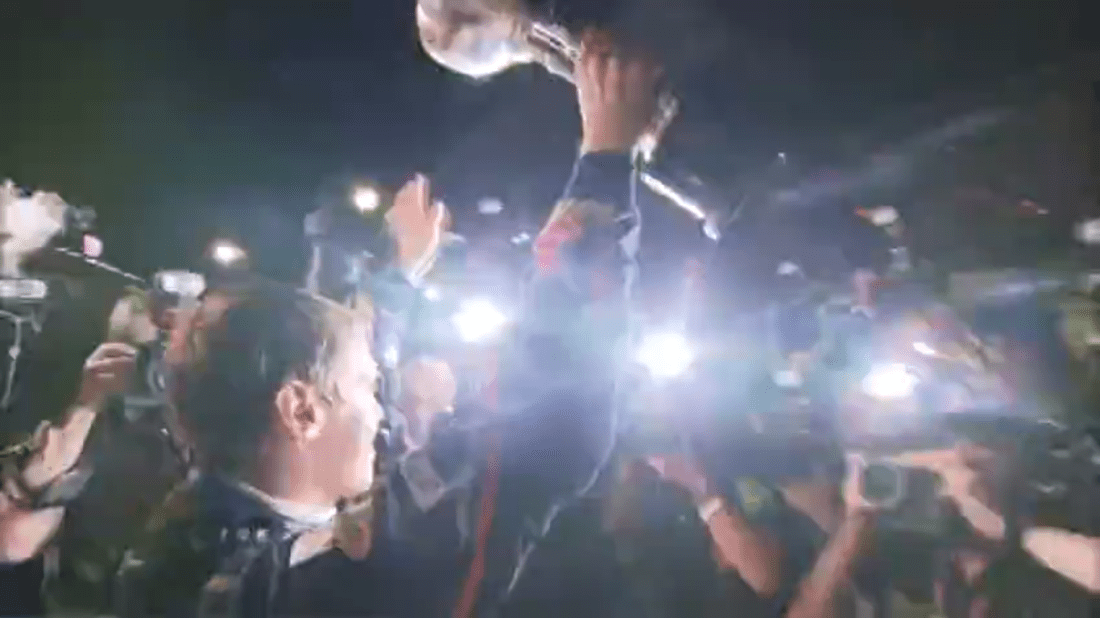
Moments to last a lifetime, beamed to millions of viewers. Sebastian Vettel’s championship celebration, during the 2011 Japanese Grand Prix post-race forum show.
March 17th and 18th, 2012 – A new era began. The 2012 Australian Grand Prix was broadcast exclusively live on Sky’s new Formula 1 channel to a peak audience of just over one million viewers. The BBC aired an extended highlights programme later that day in a two-hour timeslot. One aspect which frustrated fans to begin with was the lack of forum for non-highlight races. One of the best aspects of BBC’s programming had disappeared.
September 18th, 2012 – The highlights aspect was not for everyone. That included Jake Humphrey, who exited the BBC’s revised Formula 1 coverage after just one season, joining BT Sport’s Premier League team.
December 21st, 2012 – It was announced that Suzi Perry would become the new presenter of BBC’s Formula 1 coverage, following in the footsteps of Steve Rider, Jim Rosenthal and Humphrey. Perry said: “I am so excited to be joining the BBC. Working alongside such an eminent team and the F1 world is a huge honour and I can’t wait to get started.” The low-key addition of Tom Clarkson (a relative unknown) halfway through 2012 meant that arguably BBC’s team was stronger than ever before, despite not covering every race live.
Summer 2013 – I described the BBC team “as close to the perfect time as you would find” and that their programming is “still up there with the best.” Therefore, the very next point makes perfect sense.
January 13th, 2014 – Understanding your audience is important. In a move that baffles me to this day, the news was broken on this blog that Gary Anderson and the BBC had parted company. We found out later that, according to Anderson, the BBC thought viewers were not interested in technical analysis. Tom Clarkson filled Anderson’s role throughout 2014 and 2015. As good as Clarkson is, the move to reduce Anderson’s input was not well thought through and in the end resulted in something that no one benefited from. 72 percent of you believed that BBC’s Formula 1 coverage needs a technical expert.
November 23rd, 2014 – A peak audience of 6.5 million watched Hamilton win his second world title on BBC One. One year later…
October 25th, 2015 – A peak audience of 1.7 million watched Hamilton win his third world title exclusively live on Sky Sports F1, with an average of just over two million viewers watching on BBC One. 2015 was Formula 1’s lowest rated season in the UK since 2007, according to overnight viewing figures.
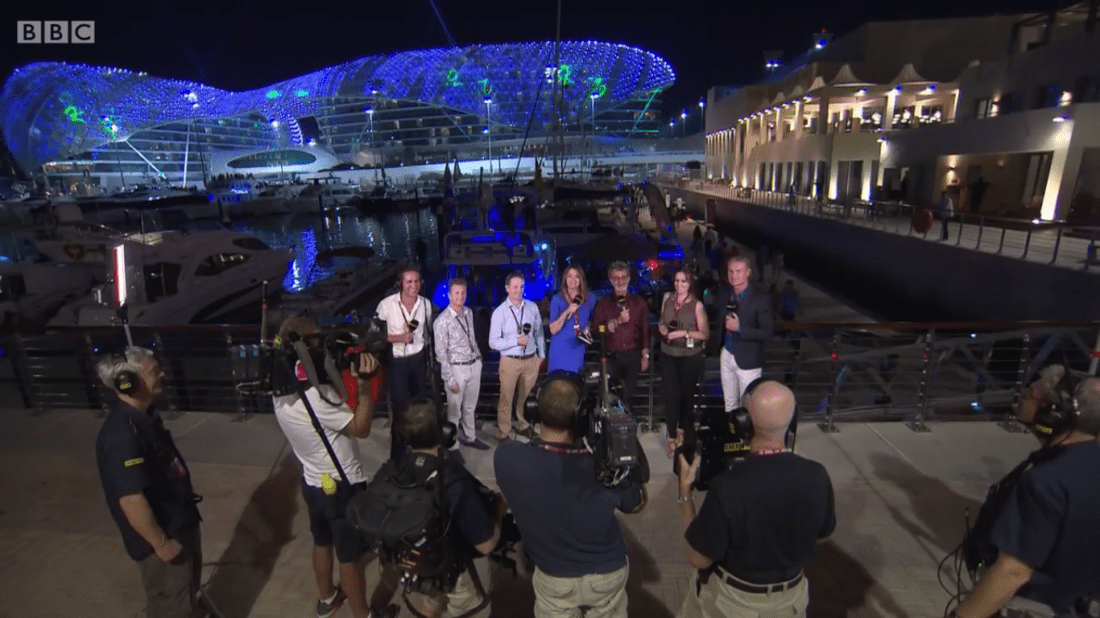
The BBC F1 team close their final ever F1 Forum at the 2015 Abu Dhabi Grand Prix.
November 18th, 2015 – Another licence fee settlement, another round of rumours. This time, the BBC were set to chop Formula 1 completely.
November 19th, 2015 – Multiple reports stated that the BBC went to Bernie Ecclestone in his Kensington office to renegotiate the financial side of their contract. It was reported that Ecclestone declined any offer the BBC made to him.
November 29th, 2015 – Unbeknown to the viewing public at the time, the Abu Dhabi Grand Prix aired for what would be the last live race under the current contract on the BBC.
December 17th, 2015 – Broadcast reported that ITV will broadcast Formula 1 from 2016.
December 21st, 2015 – A press release officially confirms BBC’s departure from Formula 1 after covering the sport for seven seasons.