In conversation with Louise Goodman (part two)

Our journey down memory lane continues with former ITV F1 pit lane reporter Louise Goodman (@LouGoodmanMedia). In part one (located here), we looked at Louise’s early career in motor sport.

In the second and final part, we chat about her ITV F1 highlights, ITV’s exit from the sport and her BTCC duties with Steve Rider.

F1B: So you were with the ITV F1 team from the start right until the very end. Unfortunately, you had some of the more; let us say ‘boring’ years with Schumacher winning.

LG: Well it was ironic actually that in our final race we finally got a British champion. Inevitably, a sport becomes more popular when you’re doing well in it, whatever the sport is. We’d gone through those years of Schumacher dominating, that’s not to take anything away from Michael; the sport became very popular in Germany those days. It was somewhat frustrating, but I don’t think that stopped us from making good programmes. We still had British drivers there to get involved with, such as Coulthard and Button.

F1B: When you found out that the BBC were taking over, just before Malaysia 2008, was it a surprise, was it a shock?

LG: It was a big surprise. We didn’t lose the rights, ITV relinquished the rights. We had just arrived for race two of that season, it came as a big shock to everybody. I remember Gerard Lane, who was our Series Editor, was a bit late arriving outside the hotel to leave for the circuit that morning. When he came down, he had a shell-shocked look on his face. He explained the situation and we was like “you’re kidding”? ITV had been renegotiating certain elements of that year’s contract whilst we were in Australia; there had been a few little bits to sort out.

F1B: So you knew things were going on behind the scenes?

LG: No, this was totally different. There were a few things that hadn’t been crossed and dotted in the new contract that needed to be ironed out. We were in the process of starting a new relationship, and then suddenly the brakes were on. None of us had any warning whatsoever. I won’t go into why, the reasons why it happened are well documented elsewhere, but it came to as a massive shock to all of us. I’m sure it wasn’t a decision that ITV took lightly and had circumstances been different I’m sure they would have kept Formula 1, the football, and various other sports as well. Suddenly, we were all out of a job.

F1B: I guess if you were to take 2008, your last interview in the pouring pit lane of Brazil, Hamilton winning the title, there’s not a better way of going out.

LG: I couldn’t dictate the outcome of the result, but we knew that we had a very good chance of ending our run with a British champion going into the weekend. If it did happen, I was determined that I was going to get the first proper interview with him. It was a memorable weekend for all sorts of reasons. It was the end of not only my ITV career but also my full-time Formula 1 career; I still go to some of the Grand Prix in other capacity. Whilst I was happy to move on and do different things, a huge chunk of my life was sort of ending. It was a big change.
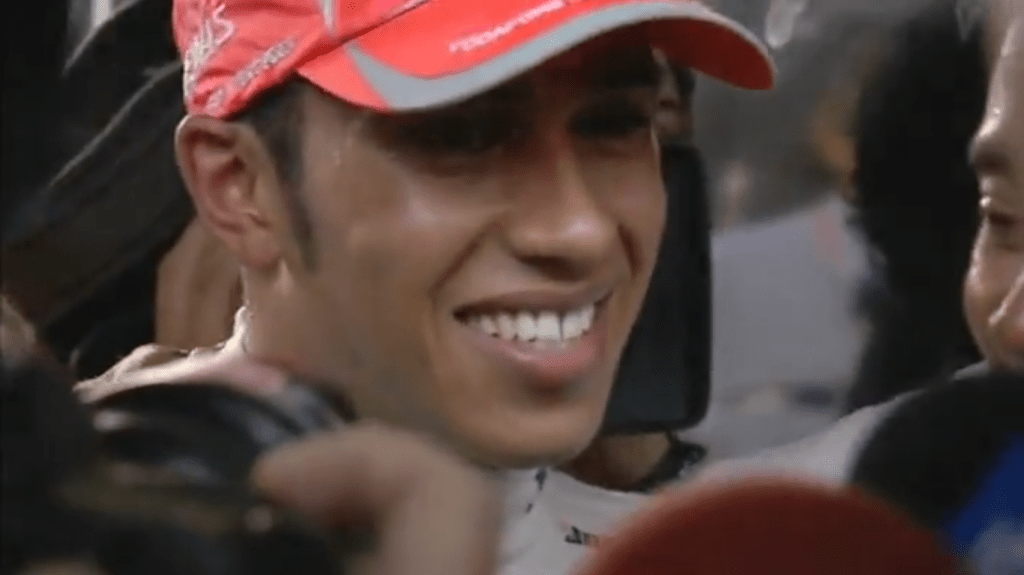
2008-brazilian-gp-hamilton
In amongst a huge media melee, Louise Goodman grabs the first words with Lewis Hamilton following the 2008 Brazilian Grand Prix.

LG: The weekend was ITV at its best. I was surrounded by other broadcasters; I remember standing in the little tunnel going through into the pit lane. I’d left the area I’d been watching the race in, and all the guys were going “such a shame Lewis hasn’t won” and I’m going “it’s not over yet!” Broadcasters all around the world were proclaiming Felipe Massa as world champion, and I could hear James [Allen] and Martin [Brundle] in my ears, absolutely spot on, correctly reading the race and the circumstances. It was a great piece of broadcasting and analysis on their part. Then the bun fight ensued to try to get hold of Lewis in the pouring rain.

F1B: The pictures told the story.

LG: Sometimes, you want an interview to be framed beautifully, but actually sometimes, the pictures do tell the story. I managed to fight my way through, door stepping McLaren with a couple of other broadcasters. A few were waiting where they assumed Lewis was going, but I couldn’t run the risk of someone else diving in. The interviews are much more a prescribed set of circumstances now, so you know that the drivers’ are going to be brought to you, you know the team are going to dictate where he goes. It was a lot more of a free-for-all back in those days. I needed to make sure that I’d got that interview. We couldn’t go off air before we had it, our audience had to have that interview. He’s our world champion, and we’re damn well having him first!

F1B: On the other end of the spectrum, you have USA 2005, which for the viewer watching at home was a shambles.

LG: Shambles, your words not mine! (laughs) A tricky event, but from a broadcasting perspective it was a blinding event to work on. It was the epitome of live television. As we went on-air, we ripped up the running order because we didn’t know what was going to happen. All of the features that we’d been carefully filming and putting together over the previous two days went out the window. The story had changed massively and we had to reflect that story, but we still didn’t know which direction the story was going to go in. We didn’t know whether there was going to be a race, how cars were going to be racing, what’s going to happen. The buzz of being involved in that was just phenomenal. If you look at the statistics for that event. Normally you get the hard-core audience turn on for the pre-show. The figures will reach a peak for the start of the race, then they’ll dip a little bit and then up again for the end of the race. But here, they just kept climbing and climbing and climbing throughout that entire broadcast. It was some story, it wasn’t exactly a good story but it was one heck of a story.

F1B: It was a story told beautifully well, and you guys did well to fill the time!

LG: Well I’d like to think that we were reflecting and telling the story from all different angles. We were out in the grandstands talking to the fans. There was nothing going on the track so Ted and I were desperately trying to come up with input to help the commentators. Had there been a dog at turn three, I think it would have got on air that day! I look back on that race as “oh my god, that dreadful race”, the sport was not showing itself in the best light, but from a live broadcast perspective and from an ITV production perspective, it was a blinding bit of telly. The feeling of being involved in that was amazing, the adrenaline rush was incredible.

F1B: Moving back to the 2009 switch to the BBC, were you tempted to switch over at all?

LG: I had conversations with the guys at the Beeb, but to be quite blunt they didn’t offer me the job. It’s inevitable; you see it every time there’s a change of broadcasters. You can’t just take the last channel’s team and flip them all over onto your new team, although if you look at the Channel 4 team there’s a lot of crossover there. BBC wanted to go down a different route. I’m not sure whether Ted was trying to be kind but he said “they’re taking me because I’m less visible than you,” that’s Ted being very sweet! From my perspective, I knew Lee. I was more concerned about the potential for having, being passionate for the cause for female sports broadcasters, someone there for the right reasons. I was very glad that the BBC employed Lee [McKenzie]. Lee had worked with us at ITV, she’d done the GP2, she knew her stuff, she was a proper broadcaster, and she wasn’t being employed because she looked right. She was a proper broadcaster being employed because a) she’s going to do a good job and b) she knew what she was talking about. I knew that I was leaving it in safe hands, that sounds a bit condescending but I was very happy to pass the microphone over to somebody who was going to pick it up and run with it.
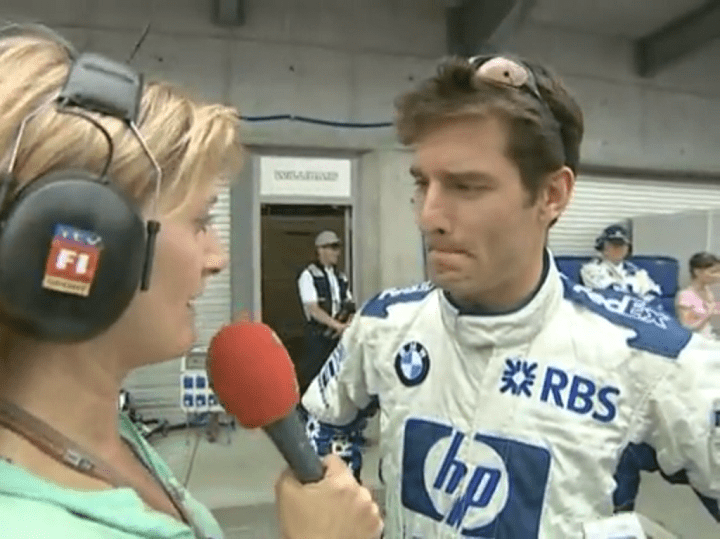
2005-usa-gp-mark-webber
Louise Goodman and Mark Webber try to make sense of the 2005 United States Grand Prix.

F1B: So, you moved onto touring cars with Steve Rider, you’ve been doing that for nearly a decade now. How’s that going?

LG: This might sound daft and people have said to me “you must miss the F1”, but I was doing it a long time. I was quite happy to have a fresh challenge in life. From a broadcasting perspective, the role I had in Formula 1 was somewhat limited. I do a lot more for the touring car programme, so externally you might think, “it’s not Formula 1” but from a personal perspective, I’d been doing that for years and been to all of those places. It’s an easier environment to work in from a broadcasting perspective; we’re a bigger fish in a much smaller pond. It’s much easier to get the drivers attention and to engage with the drivers. They have much more time to interact with us and they want to be on television. Steve is the lead presenter, but there have been occasions where I’ve presented the show when he’s been away. That’s a whole new challenge. It’s not just the duration as I’m working the same duration usually anyway, but it’s the pressure of being that lead presenter, there’s a hell of a lot going on. The likes of Steve Rider make it look so easy! There’s a lot of paddling going on, Steve glides along like a swan on top. I know what he has to contend with, live broadcasting is potentially volatile. It’s quite nerve wracking doing that job, you’re having to listen to five different people saying different things, and you have to make sure you’re spot on with timings. It’s been great to have the opportunity to do that, I now have the opportunity to do grid walks. I’m free forming for seven or eight minutes of television, that’s a long time to be talking.

F1B: Compared to the 30 seconds in Melbourne!

LG: Yeah, absolutely! Yes, that would be a quick chat to one driver. Martin was the initiator of the grid walk when Neil Duncanson said to him about doing something different for the [1997] British Grand Prix, and now there is no motor sport programme that doesn’t have a grid walk. I was a little bit concerned, Martin’s so good at this, I don’t want to be copying what Martin does, so I wanted to make sure I was doing it right, but doing it my own way. Again, it’s a volatile situation, the driver might not be there, you have to start elsewhere, you’ve suddenly got to find someone else to talk to, you might end up looking like a numpty without proper planning!

F1B: Just to finish off with then, do you have any overriding memories or thoughts of your broadcasting career.

LG: The memories that stick with me are the memorable interviews, on a personal level, speaking to Eddie Irvine when he won his first Grand Prix, speaking to Rubens Barrichello when he won his first race. I always said to EJ when I left to go to ITV that I wanted the first interview when Jordan won their first race! It was the drivers whom I had a relationship with, the drivers I knew and worked with when I was a press officer. It’s great when you manage to get information out of a driver that no one else has, such as the bad news for Damon and Arrows in Hungary, and then going out on a high with that final interview with Lewis. Funnily enough one of the interviews I do remember the most was an interview I did with Jean Alesi, again a driver I worked with in F3000, we went down to his house. It ended up being one of the longest features that ITV ever did; we ran it over two different shows at the French Grand Prix. We were in his house, he was cooking dinner, he was singing with us. I was very proud and pleased with that one; Steve Aldous brilliantly put it together.

My thanks go to Louise Goodman for spending the time with me on the above interview.

In conversation with Louise Goodman (part one)

Louise Goodman (@LouGoodmanMedia) has been a familiar figure to motor racing fans for the past twenty years through her ITV F1 commitments and more recently through her British Touring Car Championship role.

I sat down with her at the AUTOSPORT show to chat about her career in motor sport, starting with her various PR roles.

LG: I actually started out with Tony Jardine. I was Tony’s first employee when he set up his PR company Jardine PR. It’s been through about four different guises but it’s still under Jardine.

F1B: You and Tony have known each other for a long time then.

LG: Well I met Tony through powerboat racing, as I was the editor of Powerboat Racing magazine at the time. It’s thanks to Tony that I’m involved in motor sport; Tony had a history in motor sport. My first client when I was started working for him funnily enough was Derek Warwick and I say funnily enough because we come from the same town, a place called Alresford in Hampshire. As a kid, I walked past Warwick Trailers, the family business on my way to school each morning.

F1B: Did the PR thing for you then move on from there, stepping up the ladder as time moved on?

LG: Tony had motor sport clients; we launched Camel as a new sponsor when they started sponsoring the Lotus team back in the day. I worked with BP, who were very involved in the Leyton House team so I was the Leyton House team press officer. I was, briefly through Camel, press officer for Eddie Jordan in Formula 3000 with [Jean] Alesi and [Martin] Donnelly as the drivers. I was approached by Eddie to go and work with him full-time, which is when I moved up to Oxfordshire.

F1B: With Leyton House and then Jordan, what did the day-to-day activity involve?

LG: It was a bit of everything. With Jordan Grand Prix, I was employee number 47, which was the entire team! Formula 1 was very hands on in those days; Ian Phillips was the commercial department for Jordan. There was no such thing as a marketing department. During an event, I would write the press releases, I would also take the drivers to any appearances, I would do garage tours, you name it. It was a bit of everything, even sewing badges onto drivers’ overalls! The teams were much smaller; people had a much broader knowledge. The cars are much more technical these days so the knowledge has become more specialist and the areas are more delineated. Nowadays you have a communications team, a marketing team, it was almost ‘make it up as you go along’ back when I first started.

F1B: I guess it was a lot more intimate, a lot more camaraderie back in those days for the smaller teams because of the relative size.

LG: Well all the teams were smaller. The bigger teams at the time McLaren, Williams and Ferrari would have had a couple of hundred people working there whereas now you’re into the thousands. That’s just the team and then you’ve got the engine manufacture and everything alongside it. There was a lot of camaraderie. I knew next to nothing about Formula 1, I enjoyed it as a kid and I loved James Hunt. Ann Bradshaw, who was Williams press officer at the time, helped me out greatly. I have pictures at home still of all the press officers getting together and having dinner at Imola during the Grand Prix weekend. The press officer at Minardi would invite us all to his house as we all fitted in his apartment. Back in the day, all of the girls would get together every year in a motor home for dinner in Monza. It was a whole different ball game back then.

F1B: That sounds quite amazing, so much has changed since then. You were with Jordan in the early 90s and then you get a call in 1996…

LG: Various different production companies were bidding to get the contract to make the programmes for ITV. I got the approach from Mach1, which was a consortium of Meridian, Anglia and Chrysalis Television. Mach1 turned into North One Television. They were looking for a girl to put down on their bid. All the production companies had to put a bid to present to ITV to say how they’re going to produce Formula 1. It was a very theoretical thing so I said “go on, put my name down.” There were two people involved in getting me on-board. The first was James Allen. James was press officer at Brabham and he then moved onto AUTOSPORT and ESPN. James said that [I] would be a good person and that she knows her way round the paddock. The other one was a guy called Kevin Piper, who was a reporter for Anglia Television and Jordan was in the confines of the Anglia region. Kevin was a TV journalist who I had done a lot of stuff with so we had a strong relationship. Kevin also said that she’d be a good girl to have on-board. In the latter stages of the process, one of the other consortiums approached me as well. It was perceived that this other group was going to be the ones who got the contract.

LG: So, when it was announced that North One had got the contract, that’s when it became a reality, that’s when I went “oh my god!” This abstract concept quickly became very real. There was a gap between Mach1 winning the bid to officially being unveiled, as ITV had to present their proposal to Bernie Ecclestone to sanction what they wanted to do, how they were going to do it, the logistics of it all. There was a gap between me being part of the presentation team and them officially offering me the contract. By the time they offered me the job, everyone assumed that I was doing it anyway! Which I think was a good thing, because I never actually had to make the decision, it had already been made for me. I had no television experience, they didn’t employ me for that, they employed me because they thought I had the potential to be able to do that. Most importantly, I had contacts, the experience and knowledge of Formula 1, the paddock and the way the sport worked itself, I knew what to ask and how to ask it. The broadcasting bit they could teach me as we went along.

F1B: With things like football or rugby, you could have dry runs, but you can’t really dry run a proper F1 race. How did that work, were you just in front of a microphone in Melbourne and that was that?

LG: They presented me with a microphone in Melbourne and said, “We need to do a sound check so if you just wander up and down the pit lane and give us something for level, just give us some chat”; I didn’t even understand the technical terms! I thought, “What do I do?” James would give me a few tips on how to ask questions and how to phrase it, don’t ask a question in a way someone can say yes or no. I distinctly remember Damon Hill going out on the formation lap; he was my first live interview. I did a piece with Eddie Irvine on the grid, who I knew well. I remember with my squeaky voice asking Damon “what happened?” which is the worst way to ask a question and Damon explained what had happened, followed by a squeaky “thank you”! Damon was thinking, “You’re supposed to ask me a follow-up question.” The drivers were all very good with me; they all knew me, so they were all quite kind.

F1B: If you came in from the outside, it might have been different.

LG: Yeah, it would have been a different kettle of fish. I remember at the point of the British Grand Prix that year when Johnny Herbert said to me “you’re getting a bit of a hand with this now”, and I said that it’s getting better, which was a huge mistake as Johnny said that I’m in trouble now! That was when the fun started. Standing on the grid for that race, I waited for them to throw down to me for a live interview; Johnny was poking me off camera. They were all very kind to me and the guys within Mach1 were great, they helped me as much as they could. Nobody can tell you what to ask, but they can tell you how to ask it. I can remember our executive producer at the time Neil Duncanson saying to me “low… and slow… low… and slow…” When you’re excited, your voice goes up and you speak faster or you sound nervous. So, that was my big foray into broadcasting, in at the deep end.

F1B: Did you have any regrets about the first season, or did you ever think that this isn’t working?

LG: The first season was terrifying, but the biggest thing I felt is that, when you work for a team, you have a home in the paddock, that’s your motor home. There’s an unwritten rule that you don’t go into other people’s motor homes, you stick within the boundaries and it was less delineated in those days than it is now. But now I was a journalist, I didn’t feel comfortable crossing the threshold and going into the Williams or McLaren motor home, because that wasn’t my home. That was my upbringing in the paddock, within the confines of the [Jordan] team. That felt odd, and by the same token, I didn’t feel like I belonged in the TV compound because I didn’t know the technicalities. In many ways, it was great starting off in that role alongside Martin Brundle as I used to be Martin’s press officer at Jordan the previous year and we were both suddenly in the same situation that we didn’t quite have a home any more. All the teams were very welcoming and said “of course you can come in”; it just felt odd to me to just wander into another team’s motorhome. That first year was a struggle; I won’t deny it and anyone who watched it probably noticed.

They presented me with a microphone in Melbourne and said, “We need to do a sound check so if you just wander up and down the pit lane and give us something for level, just give us some chat,” I didn’t even understand the technical terms! I thought, “What do I do?”  – former ITV F1 pit lane reporter Louise Goodman

LG: Bradley Lord, who is now Head of Communications at Mercedes, reminded me, I stop him halfway through the conversation every time because I don’t want to hear it, he says “I remember watching your first…” and I say I don’t want to hear it! (laughs) By the end of the first year, I remember thinking that I’m getting to grips with it all, I’m not very good at not being very good at things and I was aware of the fact that I wasn’t a particularly good broadcaster in those days. I did have great moments, like electing to go to the Arrows garage in Hungary and being the first to deliver the not very good news that Damon wasn’t going to win that race. That was a feather in my journalistic cap, as I had the access and the foresight to go into the garage, that was where the story was going to be. Some of my grid interviews, in fact sitting down with Eddie Irvine in Melbourne. I thought “I’m not going to ask him to stand up”, so I just sat down beside him. We had a relatively cosy chat, and the guys in the studio compound said that’s exactly what we want!

F1B: From the outside, it probably looked like that the ITV team had just been ‘plucked together’, but in reality, you knew Allen beforehand, you knew Jardine beforehand.

LG: Absolutely. Mach1 were very clever I think. They knew about television, they knew about making programmes. If you look at North One as it has now become, they make all sorts of great programmes. They knew they had that side of it covered, what they didn’t know was how Formula 1 worked, access to the people. It takes time to build a relationship; they bought in people who already had that relationship.

Coming up in part two, we talk about the highs and lows of ITV’s Formula 1 coverage, the demise of ITV’s coverage in 2008 and more recently ITV’s BTCC coverage.

In conversation with Simon Lazenby

The F1 Broadcasting Blog kicked off the AUTOSPORT show weekend yesterday by chatting to a familiar face. Simon Lazenby (@SimonLazenbySky) has presented Sky’s Formula 1 coverage since its inception in 2012 having previously anchored their rugby programming.

Here, we chat to Lazenby about his tenure with Sky, including how he found the transition to Formula 1 and who within the broadcasting landscape was on hand to give him advice…

F1B: How did you start off in the media?

SL: I came straight out of University, where I was studying biochemistry and I became a commodity trader for about a year and a half. My sister, who worked in TV and still does now, works for Channel 4 funnily enough as one of their Heads of Entertainment. She was having such a great time on the initial stages of The Big Breakfast, I thought “that looks like a lot of fun”, I’d like to get into that.

F1B: This was about the mid-90s then.

SL: She got in around ‘97 and I came across from Cargill around 1998 as well. I started off doing some work experience, making the teas and coffees at Sky in rugby. And then after three months, I moved back in with my parents and got a job as a runner, and then an editorial assistant job. At that point I said “can I have a go at reporting” and that led to a bit of presenting. I remember I was in an edit suite one day and they said “go home, you’re on this evening!” After an hour’s training with autocue, they put me on Sky Sports News, I should imagine the tape exists somewhere. I’ve never been so nervous.

F1B: Would you like to see the tape again?

SL: I don’t know, it probably exists somewhere, but hopefully they’ve burnt it!

F1B: That seems like a similar way for people to get into the industry, I know your colleague Ted Kravitz came through the ITV F1 route, similar kind of thing.

SL: Yeah, he was in radio with Capital and then into ITV. He’s always been there [for me] and Ted is one of my closest friends. On the circuit, we hang around a lot together. He has a good habit of stitching me up in interviews, so if you asked me what his bad habits were, I’d probably point out a few! He got into the industry in a similar way to me. He’s an absolute nut for anything mechanical whether it flies, goes on water or as a car, if it moves, he loves it.

F1B: You became Sky’s rugby presenter in the early 2000s and you were doing that gig for a good ten years.

SL: Yeah, we were doing that for ten years. And then we got the [F1] contract, and Martin Turner who was my boss on the rugby, asked if I would be interested in it. I said “of course I’d be interested in it”, I mean who wouldn’t be interested in it! It’s an amazing sport. You know how quickly this sport changes, so you come in and think “wow, I’ve got a lot to catch up on.” When I was in on a Sunday, I’d always watch the race, half the time I was working. I got into it in the early 90s like most people did with [Nigel] Mansell. I love the way he drove in that era of so many greats. He epitomised the British spirit. He was strong, brave, everything. And then Damon [Hill] came along, he’s become a really good friend of mine now, as is Johnny [Herbert] and Martin [Brundle]. It was a good era for British sport. Williams had an extended period of success, and of course McLaren earlier, it was great to see.

F1B: During that time, you were honing your presenting skills and so on and so forth, you did a lot of studio based work. Did you think about jumping ship before the F1 offer came along?

SL: One of the frustrations of being a TV presenter is that, depending on your time slot, you might be squeezed into two hours for rugby. I might go all the way to the ground, to “hello, here’s the commentators”, to three minutes at half-time and then straight off at the end. That can be a little bit frustrating, so when I found out that we were going to have a dedicated channel [for the F1] with loads of time to talk around the issues, that was really exhilarating for me, but also one of the biggest challenges.

Everyone when we came in, you’ve done it yourself, Sky versus BBC, you get your fair share of criticism, I do understand that because people have got to get used to you and you’ve got to work on your on-screen chemistry.

SL: I remember at the time, you’ll know that the sound of the V8 is a lot different to the sound of the V6 Hybrid, that first race in Australia, the nerves were massive with the start of a new channel. Trying to hear what you were doing in the pit lane with all that going on around you was the toughest thing I’ve ever done in presenting. I still think it’s one of the toughest things in sports broadcasting because it’s such a movable feast, anything can change at any point. That’s one of the things that gives you a real high, a real adrenaline rush.

F1B: Was the transition from rugby to F1 more difficult than you expected?

SL: I think inevitably when you come in to a new sport from something else, people are used to what’s gone before. The guys at BBC and ITV did a fantastic job, and Channel 4 continue to do so. I think what we’ve always said is that we hope we offer something different to them and I think they hope to offer something different to us. We know from the information that we can gather now, from demographics and the way that TV is so digital now, you can get information on the type of viewer that you are getting. Everyone when we came in, you’ve done it yourself, Sky versus BBC, you get your fair share of criticism, I do understand that because people have got to get used to you and you’ve got to work on your on-screen chemistry. It inevitably takes time, I hope five years down the line, we’ve got it reasonably honed into a good product now. We’ve been nominated for a broadcasting award for Best Sports Programme last year, we’re against the Paralympics and the Olympics, it’ll probably be a tough category to win. It’s nice to know that people appreciate our product.

F1B: It doesn’t matter whether it is rugby in the studio or F1 in the paddock, it’ll always be the same, if you put out a bad show, people will criticise you.

SL: It’s like anything David. You’ve got to accept that not everybody is going to like what you do and that doesn’t matter who you are, whether you’re the President of the United States, or the incoming President of the United States, or your muggins like me! I consider it a great privilege to have this job and I love it. I find myself institutionalised, it’s only taken three or four years but I get to the off-season now and I think “oh god, when do we get going again?” It becomes very, very addictive, the travel, the friends you make, it’s just a great thing to be involved in.

F1B: You found out that you’re getting the presenting gig in 2012, did you go to anyone for advice, did anyone give you advice?

SL: There’s a good story here actually. It was New Year’s Day in 2012, I have to admit I was a little bit hung over. I had a text, I woke up, and I laughed out loud! It was a text from [former ITV F1 presenter] Jim Rosenthal saying congratulations on the job. I was up in Scotland with my wife and I couldn’t believe it, Jim texting me to see if I wanted any advice. We met and he said it’s a tough gig. Jake [Humphrey] said some very kind things to me and said how difficult it was, when he started and there were people gunning for him. I faced the same, Steve [Jones] faced the same. It’s about knowing that you’ve been put in that job for a reason and that you can do it. You just hope people accept that you’re trying your best and that’s all you can do.

F1B: I guess the moment doubt comes into it, is the moment it’s a slippery slope.

SL: Maybe. I try not to doubt myself. One of my producers joke about the day you get the ‘presenting yips’ i.e. you come on, camera goes on, and you forget what you need to say. If it happens, you’ve just got to laugh your way through it. You get yourself into tricky situations, but you battle your way through it.

F1B: Walking into the paddock for the first time, seeing everything around you. How was the emotion?

SL: The first time is intimidating. People think “who is this?” The one thing about the paddock is that it takes you time to earn respect. I think it was Andy Stevenson of Force India, again a really good friend now. He said it can take you three years to win the respect of people in the paddock You must remember a lot of the things that get thrown at us is because we are pay-TV, and a lot of the fans that had it for free, we understand that and we’re not arrogant about it. We just want to do a good job and hope we have a product that people want to pay for and if they don’t, fine, that’s their choice and they’ve got another option. I hope we do give you what your money’s worth.

F1B: With 2017 coming up, what sort of preparation do you do going into the season?

SL: It starts now, the AUTOSPORT show is here. It’s great to see some people again and dust off the cobwebs after Christmas. December goes like that, and all of a sudden testing is on the horizon. We’ll probably have some media days, it’s about keeping across everything that is happening and right now there’s a lot still to happen! There’s a lot to fall into place which will affect the championship. There’s new regulations to get your head around. It never stops. There are events to host and other bits and bobs to do.

Jake [Humphrey] said some very kind things to me and said how difficult it was, when he started and there were people gunning for him. I faced the same, Steve [Jones] faced the same. It’s about knowing that you’ve been put in that job for a reason and that you can do it. You just hope people accept that you’re trying your best and that’s all you can do.

F1B: How have you found it over the past few years building the relationships with both drivers’ and teams? Not every driver is the same, when interviewing them I imagine some are a bit coy.

SL: What you find is, a general rule of thumb, the more well-known they are, the more difficult it is to have a personal relationship with them. The exception is Daniel Ricciardo.

F1B: Ricciardo’s probably one of the best personalities around at the moment.

SL: Yeah, he’s great for the sport, he’s everything we want from the sport and so is Max [Verstappen]. They will all talk to you, but a lot of them only talk to you when the camera is on because they are so acutely aware that anything said out of context these days can get turned into a story because everyone is around with a microphone. I understand that as you get more famous, everyone wants a piece of you. That’s the good thing about having done it for five years, is that in some cases you’ve been there longer than they have, you’ve seen them come in from GP2. I think the respect works both ways.

F1B: Looking ahead to the future, do you see yourself in the paddock in five to ten years?

SL: I hope so! We’ve signed a contract until 2024. I’ve got two children, one’s very young, ten weeks old.

F1B: Congratulations! Abu Dhabi baby?

SL: Rosie was born in between Austin and Mexico. I went to Austin, flew back on the Monday, Rosie was born on the Wednesday and flew back out on Friday. It couldn’t be further apart. Hopefully my wife will maintain patience with me!

F1B: Any final thoughts or comments heading into 2017.

SL: I think it’s going to be a great season. Last year, you knew it was going to be Mercedes again but this year anything can happen. What if we get a double diffuser situation? We know the cars are going to look a lot cooler. Between you and me, I’ve just had a sneak preview of what the McLaren is going to look like and it looks very cool. Zak [Brown]’s really excited about what’s going on there. I hope McLaren are going to surge forward, so many British fans want McLaren to do well. I think they’ve got realistic ambitions.

F1B: It’s one of the things actually, you can deliver the best programming that you’ve ever done, but if the race isn’t good then there’s not much you can do about it.

SL: One of the things I notice from reading your blog is that when the ratings go down, you’re quick to say this is the reason why, and quite often you’re very right with it. The one thing you have to pin it on more than anything is what is happening on the grid. If that’s going well, then the figures go up. I do hope the right decisions are made by the sport going forward. I hope that Chase Carey and Liberty Media do listen to those that have gone before, but are also bold enough to take it in a new direction to make it appealing to the fans. We’ve got to have racing at the front, it’s got to be inter team rivalries rather than just intra team rivalries. We hark back to the Senna and Prost days, but they were lapping everyone, and yet they’re seen as the glory days, it’s rose tinted glasses. It’s like with icons after they’ve died, some stand the test of the time, so I’m hoping we get a little era now of really good racing between three or four teams.

My thanks go to Simon Lazenby for spending the time with me on the above interview.

In conversation with Steve Day

From former racer during his teenage years to Dorna’s World Feed commentator in their MotoGP coverage, Steve Day (@SteveDayGP) has moved up the commentary ladder in recent years.

Whilst Silverstone was getting a soaking during the fourth MotoGP practice session on Saturday, myself and Steve took cover for a quick chat, looking at how he prepares for a race weekend and how to get the best out of a commentary pairing.

F1B: Thanks for this interview Steve. To start with, just give us a brief introduction to yourself and how you got to where you are today.

SD: I actually raced myself when I was younger. I started out in the Aprilia Superteens when I was aged 15 back in 2000. I suppose you could call it unlucky really, but I was racing against the likes of Casey Stoner, Cal Crutchlow, Chaz Davies and so on. I raced for two or three seasons, went to the British championship and crashed quite a bit. Ultimately, I realised quite quickly that I wasn’t going to make it like those around me and it was costing quite a lot of money, it’s an expensive game. I decided when I was about 23 or 24 that we’d call it a day racing. And then for a few years I was working at car dealerships, Volkswagen and Toyota. My Dad was involved in a race series called Thundersport GB and they needed someone for free to come and prat around basically on a microphone! I thought I’d give it a go, so on weekends when I was free, I’d go and do that. For the first few seasons, I commentated and gave it a go. Someone said it sounded alright! I think it was in 2010, I was commentating on the Sidecar Championship for Eurosport and I spoke to Eurosport to ask if there were any openings. At the time there weren’t too many but they gave me a go [with MotoGP] and it just went from year-to-year really from strength to strength. I’ve gone from earning no money, doing it part-time for a few years to now sitting here in the Grand Prix paddock and yeah, I’m loving it.

F1B: Now that you’re a commentator, you used to race bikes so that must be a pretty big advantage in that you’ve, sort of, been there and done that.

SD: It’s a massive help because you understand the mind of a rider a little more. You can appreciate how the crashes feel, what a rider is going through on the bike. You have the general understanding of how a bike works, I’ve found it an aid to my commentary. Okay, I wasn’t racing at a world championship level, but it’s definitely been a help.

F1B: You know the basics.

SD: Yep.

F1B: Just thinking about the current season, how do you prepare for the season and for this weekend?

SD: As a commentator, you have to do a lot of research. There is paperwork around the house everywhere. I tend to start with the riders, so I’ll look at all the riders and I’ll just try to get as much research as possible. There’s a fair amount in your head, I’ve been a bike racing fan for a long time as well as a former rider, so a large quantity is already in your head because you’re sitting and watching it on your couch anyway. It’s just a matter of going through every single piece of research that you can on each rider, writing it down as it stores the information in your head a little easier when you write things down. And then researching the circuit information, the rules on the championship, the bikes. The start of the season is definitely tougher because there are normally new faces, new coloured bikes that you have to get used to, different styles of helmets. On a round-by-round basis, I have data on my iPad that I then update after each round and I’ll add to that as well in between rounds and get ourselves ready for the weekend.

F1B: How is the dynamic in the commentary box between different co-commentators, do you have a preference, what’s the protocol?

SD: I’ve always been a lead commentator, so I’ve always had what they call an expert in with me. I’ve had the chance, since working with Eurosport and now with Dorna, to work with around 15 or 16 different commentators from ex-riders to general experts. I don’t necessarily have a preference, I tend to try to have a conversation before I’m working with someone just to try and work out what their style of commentary is and then try and work within that. It’s no good constantly talking over each other, I think you have to have an out of commentary box relationship with that person as well, it works really well. Last year, I worked with Greg Haines. Me and Greg [Haines] off circuit got on like a house on fire, it worked because you can feel that. Me and Matt [Birt] this year, we get along really well, we have some common interests, we’re good mates so that works as well. Some of the ex-riders I’ve worked with, the likes of Neil Hodgson, had a great rapport with him. Julian Ryder, he’s brilliant at what he does, I’ve worked with him as well. So yeah, a mixture of different types of commentators. You have to just try and work out yourself, put the feelers out and try and find the right dynamic.

F1B: For you guys it’s important that you have the relationship, because chances are you’ll be sitting in the box next to each other for seven hours.

SD: You have. I’ve not been in a situation where I’ve necessarily worked with anybody that I don’t like which is a bonus! I’ve worked with other commentators who perhaps haven’t done the job for very long so you end up talking a little more than others. But 100 percent, if you’ve got some rapport, have a bit of a laugh, you’ve got that relationship outside the commentary box then it does come out on air.

F1B: Sepang last year, [Valentino] Rossi vs [Marc] Marquez, how was it?

SD: Believe it or not, I wasn’t actually commentating on that race, I was sitting at home watching it. In that moment, there were perhaps a few swear words from the couch! I couldn’t actually believe what I’d saw. In so many ways, it was bad for the season, in other ways it raised interest. People were then on the edge of their seats ready for the final round. It was certainly full of drama. It would have been nice if the championship had gone to the final round with them fighting all fair and square, but it didn’t happen. It was probably the most dramatic moment I’ve ever seen in MotoGP for sure.

F1B: Looking ahead to MotoGP’s future, obviously part of that future is a MotoGP without Rossi. How will it play out?

SD: It’s a question that a lot of people have asked because of the character of Rossi and his legendary status. But it takes more than one rider to make a championship. Every sport has its icons, and MotoGP will be fine. The series has never been healthier than it is right now; the crowds are record-breaking.

F1B: You would think today (Saturday) is a race day at Silverstone.

SD: Yeah, exactly, it is busy. The key at the moment is that Rossi doesn’t want to retire, he’s extended his deal and he’s still in great form. He’s in better form this year than he was last year, he’s just been unlucky in a few of the races. However, I would say post-Rossi, I don’t know. Some people think that MotoGP will go downhill when Rossi leaves. Okay, there won’t be another Valentino, he’s an amazing character but the sport will maintain the same interest. Of course this assumes he does retire, he might go until he’s 50!

F1B: Imagine us sitting here having the same conversation in ten years’ time!

SD: For me, while he keeps performing at this level, I would not be surprised in the slightest if at the end of 2018 he was to announce another deal.

F1B: Another area of course is social media. How do you find social media, of course you’re a commentator so you get reaction in when things have happened, how do you think social media will play out?

SD: I think social media is absolutely key in the modern era and I think its massive now for MotoGP. They’re understanding how important social media is. I suppose in a way I’m quite lucky, because I’m 32, I’ve come in at a time when social media has already been a big part of my life anyway. I think that for a lot of the people who have been here pre social media takeover, they’re now understanding how important it is. I think it’s the best way of reaching out to people. I’m one of those people who probably checks their Twitter feed all too often.

F1B: Just like me!

SD: Yeah, all too often! But it is the era that we’re in, there’s less paper about. People go onto Twitter and onto Facebook to find out the information. It’s in a healthy state, it has to be utilised in the right way and I think MotoGP are doing that.

F1B: Where do you see yourself in the next few years, currently you’re the MotoGP commentator, but do you want to do other sports or do you want to do other roles within the paddock?

SD: I don’t know. I’ve done other sports with Eurosport and I always like to test myself. I think there might be a point in the future where I may want to branch out and do something else, at the moment I’m happy within bike racing as a whole, not necessarily just MotoGP, but all bike racing. I’m happy doing what I’m doing, but I’m still young and I’ve got time on my side. I can’t say that one day I might take on something at the Olympics, who knows. At the moment, I’m happy with my role, I love being a commentator, and it’s nice and dry in the commentary box which is a bonus!

My thanks go to Steve Day for spending the time with me on the above interview.

In conversation with Ian Wheeler (part two)

My conversation with Ian Wheeler, who is the Marc VDS Marketing and Communications Manager, continues (part one can be found here).

In the second and final part, we talk about social media and how Dorna have increasingly helped MotoGP’s teams over the past few seasons.

IW: The other good thing about social media is that all of our partners have an active social media department as part of their marketing department. So what we do on social media is very visible to our sponsors. Not only that, but they can also see our metrics, and where they can’t see the metrics, then we supply the metrics. For them, the most important metrics we have are TV, the EAV (equivalent advertising value), which we give to our sponsors, I don’t know if any other teams do. The other thing is the social media metrics because they know that their social media accounts are also there, they want to see how our metrics compare to theirs. So, again it’s another way of measuring their return on investment in the sponsorship, it’s a very visible way of communicating.

F1B: It’s good to see the reluctance has disappeared, it really is.

IW: It sort of happened overnight. We were all invited to a social media workshop in Jerez last year, they [Dorna] brought a couple of people from Facebook, a guy from Twitter.

F1B: Were all the teams there?

IW: It was all the MotoGP teams.

F1B: Wow. I think that shows that Dorna really wanted to do something about social media.

IW: They brought in specifically Aiste Milasiute as the Social Media Manager. In the past, they’ve had a community manager, but not with the seniority to set policy. This was a change I guess quite high up at Dorna to change the policy and to bring in a Social Media Manager. She came in and the whole system changed overnight. They’ve provided the link to Facebook and Twitter, which we would have never been able to have as individual teams. All of a sudden the doors were open. Now I speak to the guy at Twitter, not frequently but if I want to know something, I sent him an e-mail and within a day I get an answer.

F1B: From what I gather, it sounds like things have changed for the positive.

IW: The biggest thing for a race team when working with sponsors is that we are limited by budget on what sort of support infrastructure we can have. The marketing department in the team is basically me. Our team principal Michael Bartolini, he’s involved in the commercial and marketing side and that’s about it. When you look at one of our sponsors, for example Estrella Galicia or Total, these are big companies with a big, active marketing department as they’re big consumer brands. For them, social media is one of their key channels of communication. For us to be able to go to them and say “okay, we have these chances now, we can promote your involvement in MotoGP through these channels.” But it’s not just us, it’s when MotoGP helps us out sharing this information, the figures are incredible. Sometimes we put things on social media and we don’t highlight it to MotoGP, we save it for something when we know the numbers are going to be good. The difference between that and something that is shared by MotoGP is huge. For us, it’s the biggest step forward in terms of providing our sponsors with ROR (return-on-relationship).

F1B: MotoGP without Valentino Rossi. How will that effect things going forward, will sponsors leave?

IW: It’s a difficult question. I don’t think sponsors will leave. Valentino Rossi is the most recognisable figure in MotoGP. Sometimes we speak to companies who have never had any involvement in motor cycle racing. You speak to them about MotoGP, you explain to them what it is and as soon as you mention the words Valentino Rossi “ah, yeah, we know him.” He is a massive part of our sport. He’s the biggest rider out there, he transcends MotoGP. He’s a little bit like what Barry Sheene was for the British in the 70s and 80s. He’s gone outside of the sporting environment and he is a real celebrity. To lose a celebrity like that, especially somebody as clever as he is. To lose his persona is always going to be difficult for the championship. But it’s not going to have a massive negative impact. Yeah, we won’t see the yellow smoke across the grandstands in Mugello. But those grandstands will still be full, they’ll just be full of people who are supporting other riders. I don’t think we are going to see a big downturn in interest, maybe we will have a small dip at the start where the fanatical Valentino Rossi fans will maybe think about whether they want to continue supporting, but I think the core following MotoGP will not dip so much and I think it will continue to grow. I think it’ll be a long time before we see another Valentino Rossi.

F1B: He’s a once in a generation.

IW: It is. Maybe once every two generations. But we have the riders, we have the close racing, it’s just this personality we will be missing. So, yeah it will have an impact on the championship but I don’t think it will have a negative impact that some of the doom-mongers would have you believe.

F1B: One last question: have you heard of virtual reality?

IW: Well it’s funny you should mention that.

F1B: It’s meant to be the next big thing.

IW: I have heard of virtual reality. One of the things that social media has done is forced MotoGP and other sports teams in general to reconsider how they deliver content. When I first started in 2001 as a press officer, you only really had one way to do it then and that was an e-mail to journalists who you’d hope would pick up what you sent and put it in their print content. Or you soft soaped the TV people and hoped they mentioned your riders, teams and so on more than anybody else. Now, it’s completely different. We don’t have to rely on the TV to speak to the fans, to promote our sponsors to our potential customers, because we have that audience ourselves. But that audience, their demand for content is different to how the journalists worked in 2001. They don’t want them to send them a press release because they already have all the information about that session, that race aggregated by websites which turn the information around so quickly. Even the teams can’t compete with that. What the teams are being forced to look at now is what content works best on social media. It’s photography, it’s short paragraphs of information, it’s video. And now teams are having to look at this and say “okay, we weren’t really set up to do this.” We were set up to communicate in a traditional manner, where we send press releases, we put them on the website and then we take the links from the website and post them onto Facebook and Twitter. And we still do that, because the press releases are our document of record and the website is our repository for that. But we’re all being forced now to come up with new ideas for content.

One of the ways we’ve changed massively over the last two years is that we put a lot of resource into new content. Short, not produced to Hollywood standard, but just to try to get a behind the scenes look. Dorna have reacted to this, their TV rights are very important, safeguarding those TV rights is critical to the future of the championship. But they also realise that the teams need to promote themselves, and by extension promote the championship. So, for example one of the things that has been relaxed in the past year is filming. Before, it was impossible for us to film, unless we organised a private test at great expense and then went and filmed there. Now, they realise that we need this opportunity to film the sponsors. We can film, we have to ask for permission and get the footage authorised by Dorna, but now we can film during MotoGP tests. This is a huge advantage to us. I think when it was allowed us, LCR Honda, who are also very progressive, and a couple of other teams were straight onto this since it benefits the sponsors.

Now, every time we go to a test (Brno and Austria before the Summer break), every team is doing it. Whether it be a professional video camera, we invested in some equipment so that we could slow-motion for MotoGP because it’s quite interesting. We’ve got Pramac with GoPro, they’re quite inventive about what they do, the content is very, very popular. The teams have changed, and it’s not just to the benefit of the teams, it’s for the benefit of the people who invest time into our race weekends, because its popular content that promotes the championship. And Dorna, quite rightly, have opened this up but also kept some control regarding the quality of the videos that goes out, which is also important to protect the championship. We’ve never had them say “no, you can’t use this.” We go and film at a test, we share it on social media and Dorna then step in and help us again by sharing the content again. So it’s win-win for us. They got a lot of criticism, but with the changing social media policy, their understanding of what the teams need to do to secure the sponsorship, to secure the racing outfit, there is a massive difference now compared to three years ago – a positive difference. I can’t fault them for that, I really can’t, it’s been a very clever thing to do.

F1B: Is there anything further you want to add that we haven’t already talked about?

IW:  The only other thing is cost cutting. We’ve seen cost cutting measures brought into the paddock and in reality, they might cut costs initially but teams will always find a way of spending money. It’s just the way it is, you cut costs there but increase costs here. It’s only going to cost us this amount of money, so we go and do it. To race at this level costs a lot of money. What I think Dorna have done well is give the teams the tools they need to bring this money. Some teams use it more effectively than others, not so much in MotoGP because you don’t get to race in MotoGP without being able to generate money. But in Moto2 and Moto3, you see that some teams are much more effective at what they can produce to secure the budget they need, and all of it helped by Dorna, and that’s probably the most profitable change.

My thanks go to Ian Wheeler for spending the time with me on the above interview.