For the first time in the modern era, Formula One Management have released footage from the FIA driver briefing to fans worldwide.
The commercial rights holder uploaded a three-minute video from the Monaco Grand Prix briefing to social media during the Canadian Grand Prix weekend. The footage shows Romain Grosjean asking the FIA’s Charlie Whiting about Lewis Hamilton’s attempted overtake on Sebastian Vettel during the Spanish Grand Prix; whilst Max Verstappen commented on the height of the kerb following the swimming pool complex.
The move has been on the cards since last October when it was first reported that the footage would be released publicly in some format, so arguably this was a decision made before Liberty came on board. You can make your own interpretation as to whether this is the first time that the driver briefing has included anything of any interest.
Having now seen the footage, the question is whether this is something we want to regularly see after each race weekend, and the pros or cons involved. One of the areas Liberty Media is trying to push is a focus on the driver personalities. The driver briefings are one place which highlights the individual characters that might not otherwise be on show elsewhere during the weekend. Showing snippets from the briefing helps fans gather an insight into the decision-making process.
On the other hand, there may be a concern that drivers will stop being themselves in the briefings if FOM choose to release footage on a regular basis. The briefings are a private forum for drivers to talk to race officials. Broadcasting the footage via any medium may result in drivers registering their grievances elsewhere, when the cameras are off.
Also, after seeing the footage a few times from different events, it will inevitably lose its raw touch. In my view, we should see the footage either on an ad-hoc basis, or potentially at the end of the season as a standalone video. The Monaco video that FOM released was an excellent behind the scenes look at the briefing, but not something I would watch every weekend.
The raft race is back!
The Canadian Grand Prix weekend also saw the return of the raft race. The raft race, organised by FOM and Red Bull, which used to be a staple of the Montreal weekend during the 1980s and 1990s, made a return on Saturday evening and was streamed live on Formula 1’s social media channels. This is not only about giving something back to the fans, but is also about making F1 fun again.
It does feel like the offering from Liberty Media this weekend has increased further with several features uploaded to social media, such as Lewis Hamilton matching Ayrton Senna’s 65 pole positions. The video presenting Hamilton with a replica of Senna’s helmet immediately following qualifying has reached 3.3 million people on Facebook and countless more across Twitter and YouTube.
For fans attending the race, Liberty are experimenting with free Wi-Fi for fans in the grandstand, allowing them it looks like to live stream the on-track action.
2017 marks twenty years since ITV’s Formula 1 coverage first hit our television screens. Their inaugural season covering the sport was a roller-coaster ride, with the championship battle between Jacques Villeneuve and Michael Schumacher going down to the wire in Jerez.
Here, we turn our attention to the 1997 Spanish Grand Prix, which marked round six of the championship. Through the early fly-away races, the season had been a very competitive affair, dominated by the tyre war between Goodyear and Bridgestone. The previous round in Monaco saw Schumacher dominate in the pouring rain. Would Villeneuve be able to bounce back in Catalunya?
At this point in proceedings, ITV’s coverage was beginning to gel together into a cohesive unit. Here is how the team lined up for the weekend:
Date: Sunday 25th May 1997
Time: 12:35 to 15:10
Presenter: Jim Rosenthal
Reporter: Louise Goodman
Reporter: James Allen
Commentator: Murray Walker
Commentator: Martin Brundle
Analyst: Tony Jardine
Analyst: Simon Taylor
In the early years, ITV’s build-up for the European rounds would typically last around 25 minutes, expanding into the early 2000s to the typical one-hour length that we currently see for live free-to-air broadcasts.
Pre-Race
After an opening interlude from Jim Rosenthal highlighting Schumacher’s Monaco success, Jamiroquai plays in ITV’s F1 coverage. We are straight into a qualifying wrap up, with Louise Goodman providing voice over. It is a quick-fire round-up, no fancy graphics or music, just Goodman narrating with Walker providing the commentary over the key bits. The grid graphics (more fancy for 1997!) follow on.
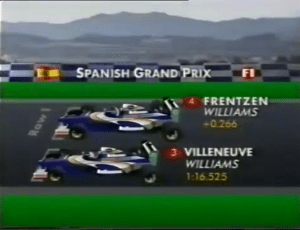
ITV’s grid graphics for the 1997 Spanish Grand Prix.
Williams driver Jacques Villeneuve gives his post-qualifying opinion to James Allen, describing his last lap as “near perfection”. All the above occurring within the first five minutes, unsurprising when there is not much build-up time to play with for ITV.
The studio atmosphere between Rosenthal, Taylor and Jardine is good (there is enough time to mention Taylor’s seasickness from Monaco, for example!). ITV strike the right tone, with discussion varying from personality driven to one of a technical nature.
A feature of ITV’s coverage from day one was an on-board lap of the circuit, but in 1997 this took the form of a virtual tour. The channel used an early version of the F1 1997 PlayStation game for the virtual lap, with Martin Brundle narrating. There are no additional features during the build-up, with the remainder of time allotted to covering grid interviews and studio chat.
Allen and Goodman provided the grid interviews, interviewing Damon Hill, Eddie Irvine, David Coulthard and Jean Alesi. Studio chatter interspersed the interviews, but this did not work well, and you can quickly see why ITV introduced a grid walk later in the season. Whilst the studio segments are good, you do not get a sense of the atmosphere building, in the same way you do in later years with the grid walk format that Brundle made popular.
Nevertheless, the studio discussion does produce some excellent technical conversation tailored to the casual fan, with Taylor dissecting why Ferrari are struggling around the Barcelona circuit.
JR: Again, for those coming to grips with the world of Formula 1, why should the Ferrari win in Monaco, which I know was a very different sort of circuit, and you say now this place just doesn’t suit them at all, with all the testing, all the money, with all the things like that.
ST: The real problem here in Barcelona is long, fast corners. And if you have a car that understeers, that’s a car that wants to go straight on in a fast corner, then you won’t get a good time. That’s Ferrari’s problem, they can’t get the grip in the long, fast corners. They can get the grip in the tight turns of Monaco. Here, it is very abrasive, they’re worried about tyre wear particularly on the front left tyre. So, it’s not looking good for Ferrari, but you can never discount them.
We see the championship standings much closer to the race start than usual instead of at the start of the broadcast, in the context of Benetton’s disappointing year so far following Alesi’s grid interview.
Race
There is no batting around the bush about what to expect for the race, with Walker calling Villeneuve the “hot favourite” for the Grand Prix. The five minutes before the race are great from the local host director, as there is a take on Formula E’s segway with the camera man focusing on each car one by one, which is a nice touch. During the segway, Walker mentions the driver change at Sauber, Gianni Morbidelli replacing Nicola Larini.
In 1997, the Barcelona circuit was one of the newer races on the calendar, then in its seventh season nevertheless the crowd, whilst smaller than other races, is still a healthy number. Ralf Schumacher stalled his Jordan car at the first start, resulting in an aborted start. At this stage, Walker and Brundle have access to team radio information from the Jordan team, with material relayed back to the viewers. An abandoned start is a good thing for viewers at this stage, as it meant that ITV could take an advert break without ‘losing’ any laps, meaning that the first 19 laps were live and uninterrupted.
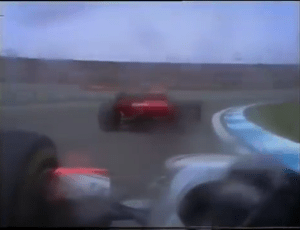
On-board with David Coulthard’s McLaren as he hunts down the Ferrari of Michael Schumacher.
Whilst the pre-race angles on the grid were good, the first lap was a mess from the local director. Multiple camera operators were far too slow to respond to the cars, resulting in cameras that panned to action half way through the field instead of the action up front. We can just about pick out, as does Walker, the “meteoric” start from Schumacher’s Ferrari, although Walker does make it sound better than it was, which Brundle points out half way round lap two! (Stating he started 9th and not 7th). The replays do make up for the host directors’ inefficiencies, with a helicopter replay, and a replay showing on-board footage of Schumacher’s start, which is amazing to watch and decipher.
The early laps are close between the front-runners, the excitement in Walker’s voice is loud and clear, even if Brundle proclaims that Villeneuve will “run and hide”. The attention is on the battle between Schumacher and Coulthard, with a queue quickly developing. Walker covers the rest of the action as best as he can at that phase in the Grand Prix, but the director is right to focus on the growing train behind the leading Ferrari.
It is a tyre dependent formula, which explains and justifies ITV’s pre-race stance to explain this element adequately to viewers. The local Formula One Management director uses helicopter shots to show the growing gap between Villeneuve and Schumacher. Coulthard finally makes the move before his first of three stops. ITV use James Allen during the pit stop sequence, pointing out a near collision between Schumacher and Benetton’s Gerhard Berger in the pit lane.
Damon Hill is in fifth position! Damon Hill in the Arrows Yamaha is higher than he has ever been this season, a terrific performance, whatever reason. Some of it of course will be due to the fact that people have been in for tyres and he hasn’t. Villeneuve leads, Alesi is in second position… and Hill stops! Ohh… as I say it. That is six races and six failures for Damon Hill. And even his patience and tolerance must be severely tested. – Murray Walker with the commentators’ curse
Villeneuve’s performance with one less stop is dominant. On return from the first break Rosenthal hands us over to Simon Taylor who covers Alesi’s first stop ‘as live’ (which occurred during the commercial break), before handing back to Walker, a neat move as he moved in front of Ferrari’s Schumacher. Through the first pit stop sequence and Villeneuve’s different strategy, Coulthard has closed in on Villeneuve with the gap down to three seconds, whilst Panis on the Bridgestone tyres in third before pitting.
Our TV director missed Alesi and Schumacher passing Hakkinen, instead cutting to Frentzen pitting despite the German driver being out of contention at this phase in the race. Walker and Brundle continue to bring into play the tyre situation, noting that blistering is a factor and that the Goodyear tyres are “too soft” for this race track. There is limited coverage of runners below sixth place, beyond the pit stop sequences, just one of ways that the feed became diluted in the late 1990s compared to the F1 Digital+ service that was starting across Europe. However, the gaps throughout the field are marginal meaning we see the likes of Johnny Herbert’s Sauber running in 4th place briefly, Walker describing it as an “interesting and exciting race.”
A lot of pit stop strategies have gone completely out of the window this afternoon. And as we look out of our commentary box window itself, there seem to be as many cars coming down the pit lane as down the pit straight! – ITV co-commentator Martin Brundle
The tyre war theme continues into the second half of the Grand Prix as Panis on Bridgestone tyres overtakes Coulthard’s McLaren on Goodyear tyres for third position (a beautiful helicopter shot at this moment showing Panis move ahead), Panis then comfortably pulling away from the McLaren! Clearly a Prost car overtaking a McLaren was previously unheard of, but made possible because of the 1997 formula, Walker notes that all the races so far in 1997 have been tyre dominated. Brundle seems in almost shock regurgitating to viewers that Coulthard may end up on a “four stop strategy” as ITV head to a further break. The differing strategies raises the prospect of Panis winning the race thanks to his lightning pace.
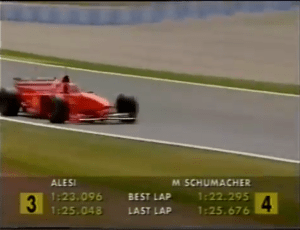
A graphic I like in the tyre dominated formula: ‘Best Lap vs Last Lap’ time comparison helps show if a drivers’ tyres have hit the cliff.
Once the leading runners pit, the order is Villeneuve, Panis, Alesi and Schumacher. ITV take their last break with 12 laps to go, and on their return the battle for first is a battle for second between Panis, Alesi and Schumacher, thanks to backmarkers failing to move over, with Alesi gesticulating repeatedly to the marshals. Panis does close in on Villeneuve again near to the end, but Brundle clearly annoyed in commentary at how long it took Panis to clear the traffic, leaving Villeneuve to win the Grand Prix.
Like at the start, the host director struggles at the end as Villeneuve tours back to the pit lane, missing Johnny Herbert overtaking Coulthard’s McLaren on the last lap. Brundle brutal in his assessment that the local director has missed “just about everything else” this weekend.
Post-Race
ITV stick with the podium without going to an advert break. The process from parc ferme to the podium itself appears to be a lot quicker than it is now. Following the Canadian and British national anthems, it is time for the obligatory champagne! An all French-speaking podium, which might be a rare occasion.
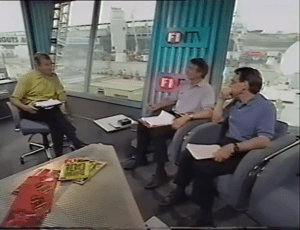
ITV’s pundits dissect the race.
We see the classifications rundown again, as Walker outlines the key achievements including a 1-3 for Renault and a strong performance for Prost. Walker also compliments Goodyear’s 350th win against the onslaught of Bridgestone (who were successful in CART), saying “heaven knows where Grand Prix racing would be if it wasn’t for Goodyear.” This is to a degree to fill time before the press conference, ITV airing it live instead of switching back to the studio for initial post-race analysis.
At the start of the analysis, Rosenthal made it clear that the three post-race interviews would be with Patrick Head, Johnny Herbert, and Michael Schumacher. The three main subjects as a result are Heinz-Harald Frentzen’s poor performance (which the consensus is that it was not his fault, but instead a result of poor set-up) and Schumacher’s brilliant start which Jardine analyses.
The last interview with a happy Herbert, describing how his tyres got better with each set, which led into a studio discussion about the scrap involving Schumacher and Coulthard during the first phase of the Grand Prix. There is not much else covered, aside from the promos for other events, all that is left is for Rosenthal to publicise the Canadian Grand Prix and to wrap up proceedings in Spain.
Fernando Alonso’s testing and rookie orientation day in preparation for the Indianapolis 500 later this month has drawn attention from far and wide. His orientation day has also reignited the debate about whether there is value in covering testing live.
From the outset, the circumstances around Alonso’s IndyCar appearance are unique, in a situation unlikely to be repeated. A peak of around 72,000 devices watched Alonso’s orientation via YouTube, with the stream provided by the IndyCar Series consistently above 40,000 devices.
Furthermore, IndyCar streamed the event via Facebook to a reach of 800,000 users. Other forms of motor racing, such as Formula E, have struggled to break through live streaming barriers on YouTube. The numbers recorded for Alonso’s orientation are staggering, especially considering that this was a weekday event.
There is a great deal motor racing can learn from this, not just Formula 1 but also other forms of the sport. Watching cars drive around a track, essentially collecting data, for hours at a time may seem like a useless activity for much of the population to watch.
The actual process of testing doesn’t have the intensity. It is much more difficult to understand because different people are doing different things. Testing highlights are really interesting, live coverage of testing is really, really boring. – MotoGP journalist David Emmett speaking to me last year.
Dorna broadcasts MotoGP testing live from Valencia post-season and Sepang pre-season via their app, combining ‘as live’ footage with studio discussion. Sky Sports F1 aired Formula 1 testing live in 2013, although this was shoe-horned around the 3D gimmick that never went any further.
The argument against live testing is that the cost is too high and the expected audience is too low. Setting up a full camera crew at say Barcelona requires a lot more people than the Indianapolis oval. For Dorna, cameras are already in Valencia following their season finale a few days earlier, so it makes logistical sense to cover the post-season test in an in-depth format.
Alonso’s Indy 500 test is the first time that testing, in any form, has aired live via outlets such as YouTube and Facebook in this live and raw form. Firstly, I absolutely applaud IndyCar and those involved from McLaren through to NBC for making this happen. The stream today allowed new fans to appreciate the demands of oval racing.
Discussions between Alonso and his mechanics were broadcast, with an openness displayed throughout. In comparison, during Formula 1 testing, the prying media have no access to drivers’ conversations with mechanics. To broadcast F1 testing in the same way as Alonso’s IndyCar test would require a significant culture change for teams up and down the pit lane.
Imagine Lewis Hamilton testing new parts on his Mercedes, and then openly giving feedback on camera in front of his mechanics instead of behind closed doors, with microphones picking up his every word. Whilst fascinating to those watching, the information provided would also be golden to his rivals.
Broadcasting testing live via social media would help viewers and fans of the sport appreciate the intrinsic nature of testing. It may bring new fans to the sport, if they stumble across live testing and become captivated by the nature of it, in the same way fans were captivated by the stream today.
Whilst I do not want to see every minute of testing live (a few hours at most each afternoon would suffice), the extremely positive reaction to IndyCar’s live stream ahead of the Indianapolis 500 may serve as a catalyst for change. How Liberty Media can implement that into Formula 1 might need a little bit of persuading from a variety of parties…
The machinery on the track might have looked the same in Bahrain, but off the track Formula 1’s leading feeder series has a new identity. Enter, the Formula Two Championship. The championship takes over that title from the now defunct GP2 Series.
Throughout its duration from 2005 to 2016, the GP2 Series maintained the same style of graphics: a combination of blue and white, with rounded ‘squircle’ like edges. Whilst Formula One Management (FOM) enhanced the graphics set when Formula 1 moved to high-definition, it retained the same look and feel as the original non-HD version.
By 2016, the graphics set had outlasted its stay compared to other championships. Formula 1, MotoGP, and IndyCar had refreshed their graphics on numerous occasions whereas GP2 and GP3 were left behind. A common GP2 complaint was the lack of a timing tower during qualifying, meaning that it was incredibly tricky to follow the action. In this respect, GP2 was a decade behind Formula 1, FOM introducing the tower when Formula 1 moved to a three-part qualifying format in 2006.
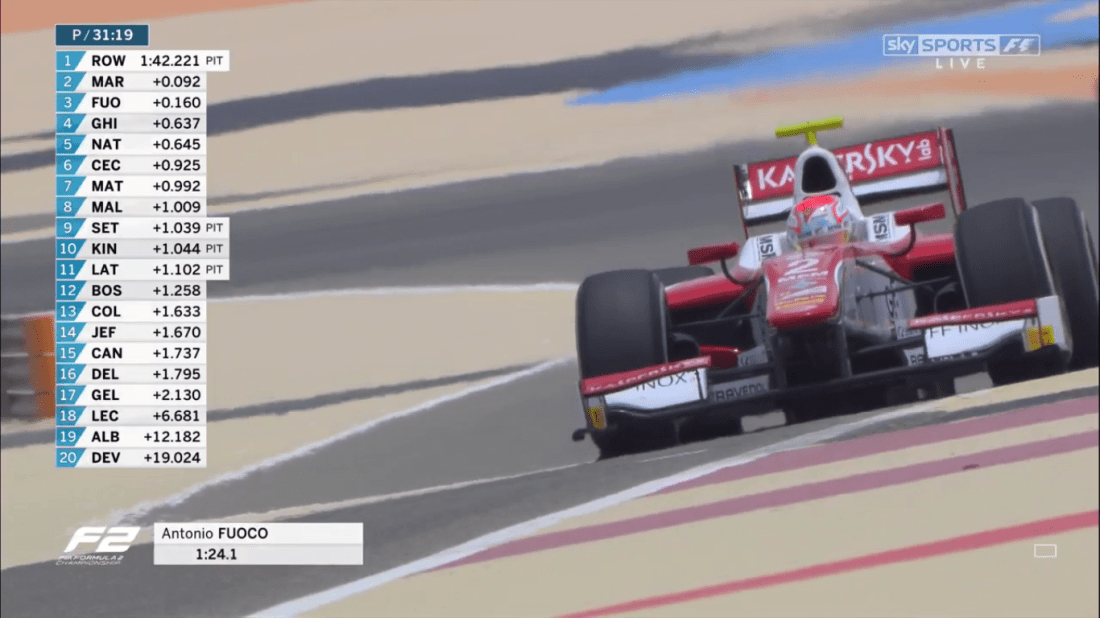
A shot of Prema’s Antonio Fuoco during the 2017 Bahrain Formula Two practice session. Note the familiar timing wall down the left hand side of the picture.
Finally, with the rebirth of Formula Two, F1’s leading feeder series is no longer treated as inferior in the production department. The new graphics set is consistent with F1, the only difference being the colour scheme, which is distinctive to Formula Two and with a call back to GP2’s colour scheme. I dare say that Formula Two’s graphics set is better than its bigger brother.
Elsewhere, there was some evidence in Bahrain that the new FOM may use Formula Two as a testing ground for new techniques. For the first time in twelve years, FOM used picture in picture during both of their live race broadcasts. The first occasion was as one of the leading drivers made a pit stop, with the second used on the formation lap of the sprint race.
I do not know if this happened in the old regime, but it would make sense to use GP3 and Formula Two as a test bed for new ideas, bringing the new features into F1 once tested. Admittedly that is difficult when the two championships run different schedules (unlike Moto2 and Moto3; Formula Two and GP3 are not present at every of their big brother’s races such as the Russian Grand Prix this weekend), but it is something that FOM should look to do now that both series are using a streamlined graphics set.
On-board with Charles Leclerc during the 2017 Bahrain Formula Two practice session.
It is not just on the graphical side, but all the way through production, the feeder series are a feeding ground in many ways. New talent should start work on directing GP3 and Formula Two, working their way to Formula 1.
Is it right to criticise Sky over lack of Formula Two promotion?
A criticism on social media over the Bahrain Grand Prix weekend was Sky Sports F1’s treatment of the series. Sky did little to promote the series opener, treating Formula Two (like they did with GP2) as a channel “add-on” rather than an integral piece of furniture. Furthermore, Sky’s scheduling was not up to scratch throughout the weekend, cutting off an excellent feature race on the slow-down lap as opposed to after the podium celebrations.
On one hand, yes, Sky should promote the series more through their supplementary programming. However, it is Liberty Media’s task to help encourage broadcasters to promote the series further, and to help embed the championship into the wider product. The new FOM needs to make Formula Two and GP3 feel important, in the same way that Dorna treat Moto2 and Moto3 with care.
Formula Two’s and GP3’s social media standing across Facebook and Twitter for an international motor racing series is alarmingly poor, whilst neither championship has a presence on YouTube. The second Formula Two race in Bahrain won by Charles Leclerc featured fantastic racing, but this was unexploited due to Formula Two’s absent YouTube presence (GP2 did not have a YouTube channel either).
A lot of drivers in Moto2 have built up sizeable fanbases due to social media, which needs to occur in Formula Two as well, given that Formula 1 will be relying on this talent in the future. It is probably no surprise that Sky have treated GP2 / Formula Two the way they do given that the Commercial Rights Holder has done little historically to help the championship. Hopefully that will change under Liberty Media’s ownership.
The Chinese Grand Prix was a notable step up from Formula One Management (FOM) on the production front following a series of issues during the season opening Australian Grand Prix last month.
Thankfully, aside from the first half of practice three, the graphics played ball for the remainder of the weekend. FOM removed the ‘mini timing loops’ from their qualifying graphics, although it is unknown at this time whether that was a deliberate move or a result of earlier issues. During the race itself, FOM presented more information within the timing tower, choosing to disregard the ticker that has been present in their coverage for the past decade.
When the race finished on Sunday morning, I tweeted stating that I believed the direction overall was “generally good.” It felt like, assuming it was not my tired blurry eyes, that the majority of action was captured in some form. The only blip was a failure to replay Valtteri Bottas’ spin during the Safety Car period, although this was uploaded to social media and played out on Sky Sports F1 during their post-race programme.
I thought it was worthwhile going back through the race and seeing how many of the 32 overtakes (source: Forix) were captured by FOM. Note that this does not include the first seven laps, which were interrupted by both a virtual and real Safety Car. FOM broadcast around two-thirds of all overtakes (21 of 32). It is easy to criticise and suggest that every overtake needs to be shown. Some overtakes are of little importance to the overall race, especially if the overtake is for slim pickings. So, what overtakes were missed, and why?
Lap 8 – Carlos Sainz on Fernando Alonso
Lap 8 – Valtteri Bottas on Felipe Massa
Lap 9 – Esteban Ocon on Felipe Massa
Lap 9 – Stoffel Vandoorne on Jolyon Palmer
Lap 9 – Nico Hulkenberg on Jolyon Palmer
Lap 10 – Valtteri Bottas on Daniil Kvyat
Lap 10 – Nico Hulkenberg on Stoffel Vandoorne
Lap 11 – Daniil Kvyat on Esteban Ocon
Lap 11 – Nico Hulkenberg on Felipe Massa
Lap 16 – Jolyon Palmer on Stoffel Vandoorne
Lap 16 – Romain Grosjean on Stoffel Vandoorne
Lap 33 – Jolyon Palmer on Marcus Ericsson
Looking at the above, it is easy to suggest that FOM’s direction was poor in the laps following the Safety Car. At this stage, the most important battle was Red Bull versus Ferrari, as both Max Verstappen and Sebastian Vettel tried to challenge Hamilton. Verstappen overtook Raikkonen quickly on lap eight and was ready to pounce on his team-mate. It would have been an error of judgment for the director to switch to battles further down the pecking order. So yes, some action was missed in the phase after the Safety Car, but for the right reasons.
In hindsight, you could say “the director should have replayed some of the key moments above” or cut to them live, but these are split second decisions that are being made. Given the tricky on-track conditions and the relative gaps between the four cars, I can understand why the director was fixated on the battle for 2nd until it was eventually resolved on lap 28.
By that point, little value would have been gained in replaying the moves from earlier in the race. It would have been nice to see them, but not a necessity. The only value we lost was not seeing Valtteri Bottas climb through the field, but apart from that, I thought the direction was fine. In the F1 Digital+ world fifteen years ago, you could imagine the Red Bull and Ferrari battle being part of the Supersignal feed, with the Bottas climb through the order being covered in the secondary track feed.
As a future enhancement, I do think that FOM should look towards picture-in-picture so that they can focus on two battles at once (maybe with an on-board camera from a secondary battle, like MotoGP currently do). It is an unlikely scenario, but it is something that they need to think about so that they can adequately cover the entire field.

 Motorsport Broadcasting