
To celebrate the fifth anniversary of The F1 Broadcasting Blog, we are looking back at five races from the archive and chewing over them. Being a broadcasting site, these races are not being analysed from a racing standpoint, but instead from a media perspective.
The five races include Grand Prix from the BBC and ITV eras, crossing over from the Americas, into Europe and Australia. Some races picked are your usual affair, whilst others have major significance in Formula 1 history. I did think about looking at five ‘major’ races, but each race has equal merit from a broadcasting standpoint, irrespective of how great the race was.
Race three takes us to North America and the 2005 United States Grand Prix! The 2005 season was a real turning point for Formula 1, with the Schumacher era of 2000 to 2004 now consigned to the history books. 2005 was the time for the likes of Fernando Alonso and Kimi Raikkonen to come to the forefront and shine. The previous weekend in Canada, Raikkonen reduced his gap to Alonso and hoped to do so again at Indianapolis.
But, if you have come this far, you know that for Formula 1, the weekend of June 17th, 18th and 19th in 2005 was no ordinary weekend… The key broadcast details can be found below:
- Date: Sunday 19th June 2005
- Channel: ITV1
- Presenter: Jim Rosenthal
- Reporter: Louise Goodman
- Reporter: Ted Kravitz
- Commentator: James Allen
- Commentator: Martin Brundle
- Analyst: Mark Blundell
Back in 2005, smartphones were not really a thing. MySpace was the major social media player in its early stages. On the TV front, live coverage of North American qualifying sessions on ITV certainly was not a thing. The first I heard of any problems in USA was by tuning in to ITV’s race broadcast. Arguably, the US Grand Prix broadcast was ITV’s finest hour.
Pre-Race
“You Ain’t Seen Nothing Yet” by Bachman–Turner Overdrive is an apt song for the opening titles, given the events that are about to unfold. “This is definitely not Formula 1’s finest hour. As it stands, I cannot tell you whether there’s going to be a Grand Prix or not,” Jim Rosenthal says during his introduction. Rosenthal outlined the key issues from the outset, hinting at the possibility of a new chicane prior to the final bend, thus preventing Michelin’s tyres from failing.
We hear from ITV’s pit lane reporters Ted Kravitz and Louise Goodman heavily throughout the build-up, more so than Rosenthal and Mark Blundell. In the first half of the programme, Kravitz updates viewers from various locations, eavesdropping on Tony George’s office. In my opinion, this build-up is the start of the on-screen Kravitz that we see today. Most of his time on-screen until this point since 2002 had been the usual interview based material, but USA 2005 was a completely new challenge for all concerned.
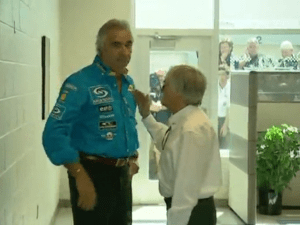
There are many hard-hitting interviews in the build-up, with the likes of Minardi team boss Paul Stoddart, Ferrari communications officer Luca Colajanni and Sir Jackie Stewart interviewed. Colajanni’s interview with Goodman does not reveal too much, but her pieces with Stoddart throughout the programme were damming. “If ever there was a time for Formula 1 to come together and leave the bloody politics behind, now is the time,” Stoddart said. Every anecdote revealed a new piece of information: Stewart in his interview mentioned potential lawsuits should the Michelin teams start the race.
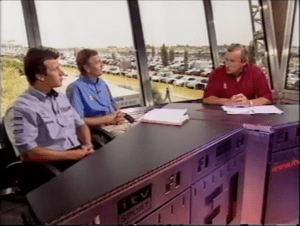
Rosenthal and Blundell hold together the programme between the various interviews, discussing Formula 1’s future in America. Their discussion is a sideshow to the pictures, which show the gravity of the situation, paddock characters in heated conversation. Furthermore, not once have ITV shown viewers the qualifying order, or any features taped before the race weekend. The running order truly ripped up. The only feature that aired was a lap of Indianapolis on-board with McLaren driver Kimi Raikkonen. Rosenthal and Blundell analyse a slower version of the lap, showing the proposed location of the chicane. If the events of 2005 occurred in 2016, I think broadcasters would have used a broader range of material to cover the tyre issues, including the use of virtual graphics to show where they was failing.
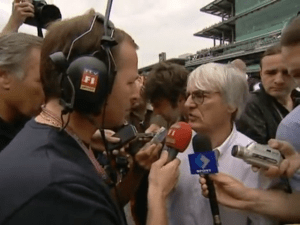
As we approach race start, you can feel the anxiety increase as people realise that the building work is not happening any time soon. Martin Brundle joined the programme towards race time, Brundle recollecting his experiences from 1994 following Ayrton Senna and Roland Ratzenberger’s deaths when the GPDA and the FIA made changes to multiple tracks. The FIA made the changes prior to the race weekend, which was not the case with USA 2005.
The grid walk with Brundle is different, who “doesn’t know whether to laugh or cry.” Brundle’s first grid interview is with Ecclestone. I wonder what Chase Carey would say in a similar situation…
MB – It looks like only four cars are going to start this race.
BE – Well there’s a lot more cars here. They’re all here [on the grid].
MB – I’m told that maybe even the Minardi’s will peel off at the end of the warm-up lap and just four cars will come down to the start line itself, they may be all here at the moment.
BE – Well, you know, so why you asking me.
MB – Well I want to know if I’m right or not.
BE – You wait and see.
MB – They can’t go round the track, they’ve been told they can’t go flat out and if they go slow, it’s more dangerous. You can’t have 14 cars effectively driving a different race track.
BE – The problem has been caused by the tyres, Michelin brought the wrong tyres. It’s as simple as that.
MB – But in the interests of Formula 1, you must have been screaming at the lot of them to say “sort yourselves out, I’m taking charge here.”
BE – Yeah, but the difference is you can’t tell people to do something when the tyre company says that you can’t race on those tyres.
MB – Did we need some more control on the paperwork that’s been flying about and the meetings, could we not bang some heads together and get this sorted out last night, why are we standing on the grid talking about this. You’re asking me and I’m asking you what’s going on!
BE – I wish I knew. The problem is simple, there’s not the tyres here where the tyre company is confident that those tyres are okay to use, especially on that banking.
MB – The future of Formula 1 in America, the future of Michelin in Formula 1?
BE – Not good.
MB – On both counts?
BE – Both counts.
MB – And what will happen this week, will they be slapped in some court?
BE – Well we’ll have to see. It’s early days, we don’t know. I feel sorry for the public, I feel sorry for the promoter here.
MB – I feel sorry for my eight million mates sitting at home, looking forward to a good Grand Prix. It’s too late now, we’ve ran out of time.
BE – We’ll see what happens now. People shouldn’t give up on Formula 1 because of this one incident. The incident is not the fault of the teams.
There is a lot more, Brundle even trying to doorstep the other Ecclestone. She has “nothing to say”; he says they need a “jolly good slapping!” On this day in history, I agree. Kravitz grabbed a final word with Michelin’s Nick Shorrock, who did the equivalent of no comment. Rosenthal and Blundell are pretty damning with their verdict, even before the formation lap gets underway.
Race
ITV did not take a break immediately before the five-minute World Feed sting, choosing to take the break later on knowing that the race would be quiet. James Allen noted that the majority of the crowd have “no idea” what is happening, which is clear as we head into the race itself. Allen recites the story so far, highlighting the key arguments from both Michelin’s and Bridgestone’s perspective. And into the formation lap we head, Brundle stating that he doesn’t want a “half-hearted start” as it would be “plain dangerous”.
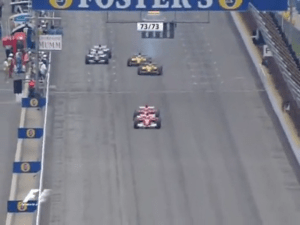
If you watched the race live, you know what happens next. “Okay mate, you know what the plan is for the start, straight into the pits please mate,” is the message for Renault driver Fernando Alonso. 14 of the 20 cars peel off into pit lane. “It’s the strangest race ever, and it gets underway, now!” Allen described the crowd as sitting in “stunned silence.” Quite clearly, the director has an easy job with not many cars to focus on. Ferrari, Ferrari, Jordan, Minardi, Jordan and Minardi are the top six, the only six.
A six-car race is not an appetising affair. Many television stations agreed and pulled the race off air. ITV disagreed, and instead used a mixture of their own cameras in paddock and the World Feed for the duration. The first in-depth conversation came as early as lap two; Goodman interviewed Coulthard who described it as a “very sad day for the sport.” In total, ITV aired 13 interviews during the race. The silence turned to audible boos at sporadic phases throughout the race, a small minority at one stage hurled bottles onto the circuit.
ITV recognised that there was a human element outside of the microcosm of the paddock, and with that, the broadcaster headed into the fan zone, fans stating that they will not watch Formula 1 at Indianapolis again, shouting “refund!” It was a rare, sublime piece of broadcasting that no doubt kept viewers watching for the majority of the programme, even though there was very little to watch on track.
I remember standing on the grid in Adelaide [1991] when it was pouring with rain. [Ayrton] Senna wanted to race, [Alain] Prost didn’t, most of the rest of us were unsure. Bernie Ecclestone walked down the grid and said “get in your car,” the race is about to start. That was pretty much how it worked in those days, but that strategy wouldn’t have worked today because of this critical problem with the tyres and liability. – ITV co-commentator Martin Brundle
Brundle and Allen discussed previous scenarios, such as the 1991 Australian Grand Prix when heavy rain stopped the race and the FISA-FOCA war in the early 1980s where Formula 1 saw a depleted running order. They also noted that the attention was not as enormous as 2005. “It’s a different world now,” says Allen. Allen’s journalistic ability shines during the race, with his ability to explain a technical matter to a casual audience, whilst adding new snippets of information to the story (for example Bridgestone’s advantage after Firestone tyres were used on the “abrasive” Indianapolis 500 surface three weeks earlier).
The commentators also bring into play the political games that are happening in the paddock, such as a proposed breakaway series. Kravitz outlined a “single tyre formula” that was mentioned in 2008 documentation circulated prior to the race weekend, a move that ended up being implemented in 2007. This kind of discussion never occurs during the race, showing how unique the race was.
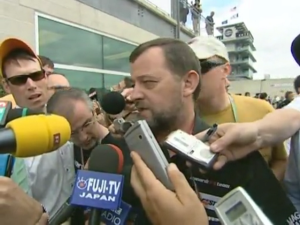
For Minardi and Jordan, the 2005 United States Grand Prix was their lucky day, with the World Feed director not having much else to focus on. Every second on-screen for them meant extra money and points. Nevertheless, Minardi boss Paul Stoddart gave a very passionate interview to ITV about the direction of Formula 1, about how the FIA are “meddling” with the regulations. Out in front, Barrichello leapfrogged Schumacher in the first round of pit stops. Despite Ferrari’s best efforts, the battle between the two drivers is not really a race, even if the two did nearly collide at one stage as Schumacher regained the lead after the second round of stops.
After 73 laps, in the strangest of circumstances, Schumacher wins the US Grand Prix!
Post-Race
Brundle remarked, “If Michael does a victory leap on the podium, I’m going to go and personally punch him.”
The usual post-race chatter begins on the warm down lap with Allen and Brundle looking forward to racing matters, starting with the French Grand Prix. Whistles and boos clearly heard in the background from the crowd as the podium ceremony starts (which ITV manage to miss, a very minor blot on their copy book).
A tricky event, but from a broadcasting perspective it was a blinding event to work on. It was the epitome of live television. As we went on-air, we ripped up the running order because we didn’t know what was going to happen. All of the features that we’d been carefully filming and putting together over the previous two days went out the window. The story had changed massively and we had to reflect that story, but we still didn’t know which direction the story was going to go in. We didn’t know whether there was going to be a race, how cars were going to be racing, what’s going to happen. The buzz of being involved in that was just phenomenal. – In conversation with Louise Goodman (Part One and Part Two)
Portuguese’s Tiago Monteiro enjoyed his moment in the sun having finished third; Schumacher and Barrichello headed straight off the podium. Blundell and Rosenthal react to what they have seen before them with some brief analysis of the Ferrari kerfuffle. The viewers hear more reaction from fans leaving the circuit with more “refund!” chants, followed by the start of the FIA press conference.
Rosenthal wrapped up the programme, stating, “We’ve seen an F1 fiasco in peak time, like David Coulthard, I feel sick and embarrassed to my stomach, circumstances beyond our control. We can only say sorry. Goodnight.”
 Motorsport Broadcasting