Archive material takes centre stage with new feature-length films

It feels like there has been a motor racing movie renaissance during the past few years, with the likes of Senna and Rush hitting the big screen to major success at the box office, both winning multiple awards.

The renaissance is continuing with more feature-length films in the works. A film surrounding the life of François Cevert is being released on Wednesday 11th May, whilst Prost will tell the story of the four-time Formula 1 world champion and is scheduled for release in 2017. Recent years could be considered a golden age for motor racing filmography. But, a great film or documentary does not need to be released at the box office to be a hit with the intended audience. The likes of Netflix and Amazon Prime have widened the net in recent years meaning that film makers have a choice on the method that they wish to distribute their movie by.

A new feature-length film has been released, telling the story of Ayrton Senna’s year-long battle in the 1983 British Formula 3 championship with Martin Brundle. If you felt that you wanted more from Senna’s early years in the Senna film, this film helps go some distance towards that goal. Senna vs. Brundle was developed from start to finish by Mario Muth and has been released on Vimeo for £5.99. The film clocks in at just over 90 minutes long, an ideal length without over saturating the subject.

There are multiple effects used throughout the film which help bring it to life. The main one is animation in the context of still images. By scaling closer to the main object in each still image, the viewer feels a ‘connection’ between themselves and the image in question. In many cases, the car is brought to life through this effect. The most dramatic image is Brundle attempting to escape his Eddie Jordan Racing car after colliding with Senna.

Archive footage is used sporadically throughout the video. Unlike today, you have to consider that the amount of footage available from a typical 1983 Formula 3 race is going to be significantly less than the footage from an equivalent event today which is understandable. I checked the BBC’s Genome service to see if the corporation aired any Formula 3 races on television, and only the final round of the 1983 season was covered. Any shortcomings in archive footage are overcome through the use of magazine extracts from AUTOSPORT and Motorsport News. Again, this is done in a ‘stylish’ manner as opposed to taking the standard flat ‘display on screen’ approach, showing that attention to detail is present throughout the film.
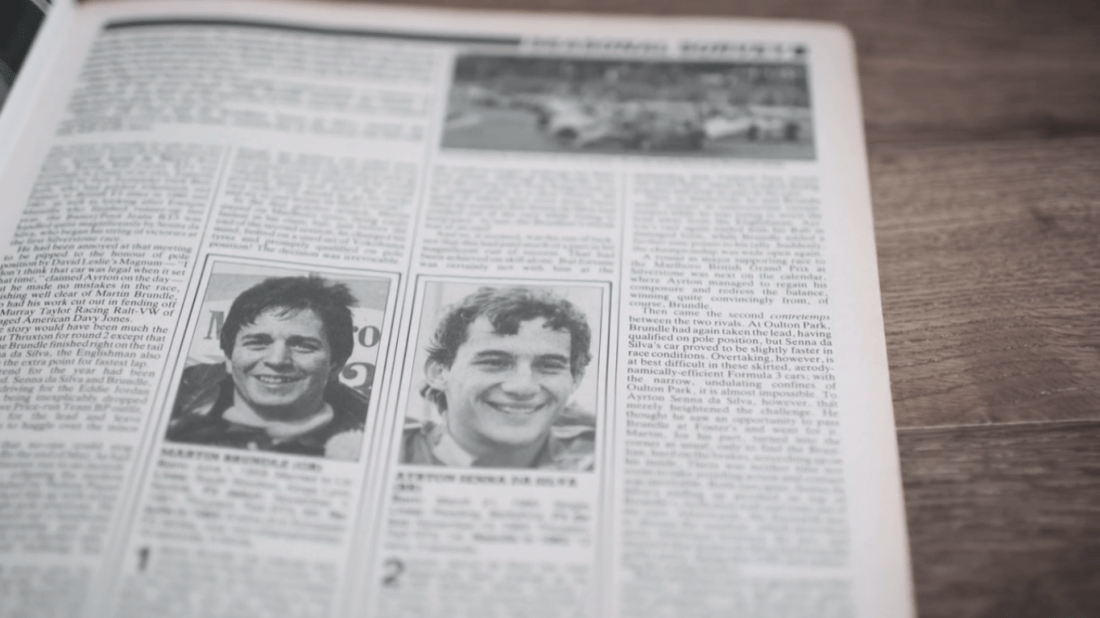
Senna vs Brundle - magazine cutting.png
Magazine snippets are used by Mario Muth throughout Senna vs Brundle, in a stylish, modern manner.

One concern I had before watching the film was that Senna’s view-point would not be captured, however any concern in this area is dispelled quickly. The viewer hears Senna through recorded audio from 1983 at various stages during the film. All of the major viewpoints were captured, including team bosses (Eddie Jordan), commentator (Murray Walker), journalists (David Tremayne) and then the drivers themselves (Senna, Brundle and Davy Jones).

The main negative concerns the flow of the film. Not necessarily the ordering, but the break points. At 90 minutes in length, it didn’t feel like there was a natural ‘breathing point’. As far as I recall, there was no ‘fade to black’ and then onto the next section. Personally, three or four ‘break points’ in the film, with a time stamp following on, for example “Silverstone, 16th July 1983” would not have gone amiss to show the context that the event took place in. We know the events occurred in 1983, but the relative time frame is unclear. In the grand scheme of things, this is a minor gripe at best.

I hope Senna vs Brundle is the springboard for more films of this nature being produced. It serves as a template for other great battles over the years in Formula 1 and beyond that could be retold in the same manner, giving a new fresh insight. Schumacher vs Villeneuve (1997), Schumacher vs Hakkinen (2000) and Hamilton vs Massa (2008) are just three possibilities in the future… as I have said before, the Formula One Management (FOM) archive is a goldmine waiting to be exploited, one day.

FOM are already making small movement on the archive front, this season it feels like that they are uploading more archive material to their YouTube channel with rare footage such as classic on-boards being made publicly available for fans to watch. I hope that trend continues as the season progresses. It is important that we remember where the sport came from, and films such as Senna vs Brundle help in that respect.
Bernie Ecclestone comments on Sky’s new UK deal

Nine days after the deal was first announced, we have our first public comments from Bernie Ecclestone on Sky’s new Formula 1 deal in the UK.

The deal, which comes into effect from the 2019 season, means that viewers will only be able to watch the British Grand Prix live on a ‘free to air’ basis, with the remaining 20 races behind a pay wall. What that exactly means with relation to the free to air aspect, as discussed previously, is unclear.

Ecclestone, the CEO of Formula One Management was speaking to AUTOSPORT’s Ian Parkes ahead of the Bahrain Grand Prix. It was the first time Ecclestone had spoken about the new deal outside of the press release issued by Sky.

“[Sky are] going to get to more people than you would believe. They’re going to get to 25 million people with the type of broadcast they are planning. Honestly, it was nothing to do with the money, it was to do with the fact this is the way we have to move forward.” – Bernie Ecclestone speaking to AUTOSPORT

I have read this quote multiple times and still do not understand what is being said. Overnight viewing figures last year showed that BBC F1 averaged 3.11 million viewers compared with Sky’s 638k for their race day programming. What Ecclestone, and a lot of other people within Formula 1 who do this deal making need to understand and digest, is that just because Sky may reach 25 million people, that does not mean you are going to get 25 million viewers. Far, far from it. One of my pet hates is seeing figures of this nature bandied around (unfortunately this kind of thing is common place, sadly), when it really could not be any further than the truth. If you’re going to throw figures around, let us have some context behind it, what does the figure represent?

The last sentence and a half of Ecclestone’s quote may lean towards something new and radical for 2019, if not earlier, such as over the top broadcasting, it may imply that FOM and Sky have already had discussions about new media ideas. As for the money, I’m sure the teams will be thrilled to hear that the deal was nothing to do with money, and more to the point why does Formula 1 need to move forward this way? Why does F1 need to move forward with pay TV deals that restrict the casual Joe, or the less financially stable fan, from watching?

Ecclestone was also asked about the future direction of the sport, following the qualifying debacle, which was ridiculed on social media during the Australian Grand Prix weekend.

“We’ll have to have a good look now and see which way we want to go. We’ve lost a television audience, like all sports have, including football. So while we’ve lost an audience one way, actually more people are viewing F1 now than ever before on their phones and tablets. So there is more interest than there was before, which is what we have to take advantage of, and which is what we are doing.” – Bernie Ecclestone speaking to AUTOSPORT

Unfortunately, the loss in television audience will not offset the increase of viewing on phones and tablets come 2019, which is a problem that needs to be addressed. I agree that F1 needs to move forward, one way they could do that is by giving drivers’ more freedom. Maybe allow the world champion to film in the paddock on Snapchat or a midfield runner to do some live videos during testing on Facebook. Oh. Wait…

Reflecting on Sky’s F1 2019 announcement

It has been nearly a week since we found out that Sky Sports would be broadcasting Formula 1 exclusively in the United Kingdom from the 2019 season.

The news itself is not a surprise. Anyone who has been tracking the rights of sporting events in the UK will know that they are rising at a pace that free to air networks cannot cater for. The value, believed to be around one billion over six years, is something that is out of the BBC’s, ITV’s and Channel 4’s price range. It is unfeasible for them to bid with those numbers. This was always going to happen, but it was the timing that caught everyone out.

This contract will not make teams at the back of the field rich overnight. As I illustrated last week, if every single penny of the Sky deal went back to each of the eleven teams, then the lower end of the field stands to gain around £3 million in prize money when comparing 2019 with 2018. However, as was pointed out in the comments section and on various other fora, the likes of CVC will take their chunk out, meaning that teams are not going to gain as much as the illustration suggested.

Sky’s Formula 1 television overnight viewing figures have stagnated since 2012. The broadcaster averaged 711,000 viewers across their race day programming in 2012, compared with 639,000 viewers in 2015. Audiences have not moved towards Sky since they started broadcasting Formula 1. Viewing figures for the likes of Sky Go and Now TV are not released publicly, however this is unlikely to exceed 200,000 viewers per race for Formula 1. We can see this by looking at the quotation below.

In their press release outlining their achievements last year, Sky said in relation to Formula 1:

Online video views surpassed 12 million, and on-demand downloads were over 700,000.

Bear in mind that these two numbers are cumulative across the entire year. Divide both numbers by 20 race weekends. Per race weekend, online video views amount to around 632,000, and on-demand downloads around 37,000. Assuming there are 15 videos per race weekend, then each video on the Sky Sports F1 website averages 42,000 views. So, whilst the total looks great, the devil is in the detail and shows why television for Formula 1 is still king.

Online is growing extremely fast, Sky tout an overall total increase (i.e. everything) of 175 percent between 2014 and 2015, so these numbers will change rapidly before 2019, although it is unknown how the F1 numbers above differ year-on-year in comparison to the rest of the Sky Sports website.

What needs to be established is what, if anything, can the free-to-air terrestrial television networks in the UK bid for. The press release last Wednesday stated:

· Free to air: The FORMULA 1 BRITISH GRAND PRIX, together with highlights of all other races and Qualifying sessions, will be shown on a ‘free-to-air’ basis.

· Sky Sports Mix: Additionally at least two other ‘prime time’ live races a season will be offered on the soon-to-be-launched Sky Sports Mix along with other F1 content.

Sky’s press release was titled: “Sky Sports to become exclusive home of F1.” My instinct is that Sky’s interpretation of free to air will mean them showing free to air content on either Sky Sports Mix (beyond the commitment above) or another Sky free to air channel, such as Pick TV. There is no legal obligation for Sky to sublet the highlights rights to a terrestrial network. This is only something we will find out a definitive answer to in time, but as with everything in F1, I wouldn’t assume anything.

As with the change from 2011 to 2012, and more recently with the change from BBC TV to Channel 4, there needs to be a strategy in place to slow down the haemorrhage of viewers. If there is not a highlights package available for terrestrial networks from 2019, Formula 1 needs alternative viewing methods implemented and running by the start of the 2018 season. By alternative, I’m referring to an over the top network. Alone, a highlights package, like now, on F1’s website is not good enough. It needs an alternative online source to entice viewers in, who cannot afford pay TV or Sky’s services, for people who are simply interested in F1. The reason I have stated 2018 is so that the transition period can begin, a phased approach (the word ‘agile’ comes to mind).

Regular readers will be familiar with the ‘over the top’ phrase given my previous comparisons with the WWE Network. If F1’s deal with Sky restricts the ability to do that, then the deal in my opinion is damaging to the overall health of F1. I find it problematical if Formula One Management’s (FOM) contracts with broadcasters worldwide are being signed for the ‘here and now’ as opposed to ‘the future’, almost as if the rights holder has neglected to realise that the future is significantly different to the ‘here and now’.

James Allen posted the following on his site:

Over the top services you refer to are very much part of the future but this deal means that F1 is going to do them with Sky, rather than in competition with them.

Reading into that comment, the suggestion appears to be that an over the top network will be a collaboration between FOM and Sky. My main worry is that the over the top network will have Sky branding on it, which I hope will not be the case. Any F1 Network needs to be a FOM branded product that can stand on its own, independent and free from any broadcaster. A ‘Sky F1 Network’ is less appealing than a ‘F1 Network’. It implies that an F1 Network needs Sky branding to be successful.

It is plausible that FOM may want to utilise Sky’s technologies for an over the top network, as opposed to a branding exercise. A potential scenario would be an F1 Network to be a standalone platform, with a discounted price for Sky or Virgin Media customers within the UK. How would this all fit in with Sky’s exclusivity? From the outside, it is not clear what FOM’s road map is, and I think that is the main concern. “In two years’ time, we want to be doing X, Y and Z.” Last Wednesday in Sky’s press release, Sky announced that ultra HD will be coming to F1 in 2017. Should this not have come directly from FOM rather than Sky announcing it on their behalf?

This is not to undermine the work that has gone into FOM’s social media channels by their digital media team, it is about wanting to know the direction that the various outlets are heading in. There is a lot of legitimate concern right now about the direction F1 is heading in, and I include social media, over the top distribution and exploitation of new media in that. If F1 is going to continue to sign exclusive pay TV deals, then they need an action plan on how they aim to reach fans that do not have pay TV. Otherwise, F1 will haemorrhage fans.

A Formula 1 only accessible behind a pay wall is not a fruitful Formula 1.

A Formula 1 that exploits social media, is available to fans at a reasonable price, and finds new, innovative ways to harness their audience, is a fruitful Formula 1.

Looking at whether F1 teams will benefit as a result of the exclusive Sky UK deal

This past Wednesday, it was announced that Sky Sports would be covering Formula 1 exclusively in the United Kingdom from the 2019 season. Their new contract will last from 2019 through to 2024.

A definitive figure of how much the rights cost has not yet been released, however, it is understood that the rights will cost Sky around £1 billion for the six seasons. Barring some change between now and 2019, Formula 1 will lose a significant portion of viewers in the UK once this new deal kicks in. Sky have splashed out on the rights to prevent BT Sport from grabbing the F1 contract.

This post is based on some assumptions, but I wanted to understand (for myself) how much teams may benefit financially between 2018 and 2019 as a result of this contract. I’ve made a few scribbles in Excel, and I thought it made sense to publish them on here for others to see and analyse. I’m not saying “this is correct”, it is merely an indicator of how teams may benefit from the new deal. Readers of this site can judge for themselves whether the financial benefit for teams will offset the loss in viewers.

Assumption 1 = Sky’s UK F1 contract from 2019 to 2024 is £1 billion.

I should note that if we find out that their contract is less than £1 billion (let’s say £900 million for sake of argument), it does not invalidate the calculations below. As we will see, the figures at the foot of this article are quite small, meaning that a difference up top will not make a huge difference further down.

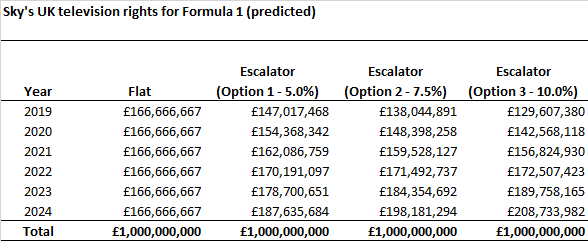
We have this figure that we need to split over the six years. Normally, we could do a straight ‘divide by six’ to present a figure per year. In broadcasting terms, contracts normally work with an escalator, meaning that they can increase in value by either 5 or 10 percent per year. This means that the cost can be back loaded through the contract as opposed to the majority of it upfront. I would expect the same to happen with Sky’s F1 contract. It is rare for the cost to be frontloaded, especially if broadcasters are in financial turmoil (see: ITV Digital and Setanta historically).

F1 2019 - Sky's rights cost.png
The predicted cost of Sky’s Formula 1 television rights within the UK from 2019 to 2024.

Above, there are four choices: your flat option along with three escalators. Option three on the escalator I think is a non-starter because it would result in the final year of Sky’s contract breaching the £200 million mark. Instead, I think option two is a more viable approach: the contract would start with £138 million in 2019, increasing to £198 million in 2024. You could flip a coin between option one and two, but even then there is £9 million difference for 2019 when you compare the two options.

Assumption 2 = Sky will pay Formula One Management (FOM) around £138 million in 2019.

I wrote a piece in 2014 looking at the rising cost of Formula 1’s television rights. In it, I placed the 2018 season roughly around £60 million. James Allen says that this is now £70 million, because Channel 4’s deal is £24 million per season instead of the £15 million that the BBC were previously paying.

To work out how much Formula 1 will benefit in 2019, we need to deduct the 2018 contract value (Channel 4 and Sky) from the 2019 total. The reason we deduct both Channel 4 and Sky is because there will not be a Channel 4 replacement in 2019. As of writing, the deal is Sky exclusive with no room for a second broadcaster to enter the fray. There is a “free-to-air” provision with relation to the British Grand Prix, but as mentioned before, this is where I anticipate Sky Sports Mix coming into play.

Based on the maths above, the difference between 2018 and 2019 is £68 million. That is the amount of money FOM will get extra as a result of the new deal. Probably the biggest assumption of the whole post is that every single penny of the £68 million will, in some shape, go back to the teams as part of their prize money.

Assumption 3 = Every penny of Sky’s Formula 1 deal will go back into the sport, and contribute to the financial health of every team.

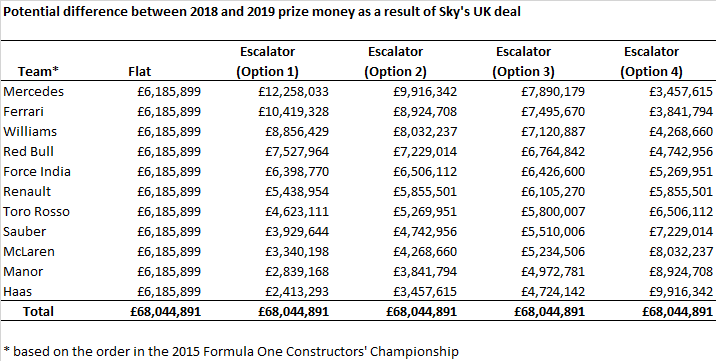
This relies on those running the sport not taking 10 or 20 percent off Sky’s contribution. The £68 million difference can be divided multiple ways. Either, an equal split between the 11 teams, or a split whereby the larger teams get a bigger proportion of funding. The escalators below take an approach, whereby, for example with option one, Ferrari get 85 percent of Mercedes, Williams get 85 percent of Ferrari and so on and so forth.

F1 2019 - Prize Money split.png
Based on the calculations presented in this post, the possible gains that teams could make financially between the 2018 and 2019 Formula One seasons.

The calculations in this article show that a team such as Force India or Renault could gain around £6 million between 2018 and 2019 as a result of Sky’s exclusive UK deal. A front running team, such as Mercedes would gain between £8 million and £12 million, whereas the likes of Haas and Manor will gain between £2 million and £4 million between 2018 and 2019. Each team would then gain a further £1 million each year until the end of 2024 as Sky’s escalator kicks in (see the first figure in this post).

Alternatively, the increase from Formula 1’s UK rights could be split equally for 2019, thereby meaning that every team would gain around £6.2 million of prize money. A third alternative is that the inverse could occur, whereby the smaller teams gain as a result of this deal, with FOM choosing to distribute more money to them than the bigger teams, resulting in a healthier Formula 1 for all concerned.

Like I said at the top of the post: I’m not saying the above is correct, or will happen. However, hopefully the above helps to show how Formula 1 teams may benefit financially as a result of Sky’s new UK deal with FOM.

Sky Sports to broadcast F1 exclusively from 2019

Sky are to broadcast F1 exclusively from 2019 in the United Kingdom, it has been confirmed. In a huge bombshell announcement on Wednesday evening, the broadcaster announced that they will show every race live from 2019 to 2024 after agreeing a new deal with Formula One Management. The announcement means that Channel 4 will only be showing their element of live Formula 1 from 2016 to 2018.

The British Grand Prix remains live and free-to-air, as will highlights of every race and qualifying session. Furthermore, at least two ‘prime time’ races will be shown live on Sky Sports Mix. Sky have also announced that from 2017, every race will be shown live in Ultra HD via SkyQ. Interestingly, there is no explicit reference of ‘Sky Sports F1’ as a channel beyond 2018.

Bernie Ecclestone said “I am delighted that we will continue to work together. Sky’s commitment to the Sport and standard of coverage is second to none.”

Barney Francis, Managing Director of Sky Sports, said “This is a brilliant deal that takes Sky’s partnership with F1 to the next level. Since 2012, we have demonstrated unrivalled commitment to F1, offering fans innovations including a dedicated channel and the very best broadcasting talent. We are delighted that we are strengthening our coverage for viewers even further, with live and exclusive F1 from 2019 and the chance to watch in Ultra High Definition for the first time from next season. We are pleased to support F1 and look forward to working with them to progress, develop and enhance coverage of the Championship during the agreement.”

Martin Brundle said “I joined Sky Sports because I wanted to be part of a dedicated F1 channel with a total and long term commitment to the sport. And we have certainly delivered on that. In a fast changing media landscape, our coverage will get even better for F1 fans.”

In response to the news this evening, a Channel 4 spokeswoman has told this blog: “This deal does not affect Channel 4’s three-year deal for 2016-2018. Channel 4 is still the terrestrial home of F1 for the next three years.”

Analysis – A huge bombshell
The idea that Formula 1 was going to move exclusively live to pay-TV at some point is not surprising. What is extremely surprising is the timing. One race into the 2016 season and the rights for 2019 onwards have been decided. In my opinion, this is Sky Sports covering themselves from a BT Sport onslaught where Formula 1 is concerned. There is no other reason for tying up the rights this early in the game when we are a long way away from 2019.

Of course, this is extremely sad and disappointing news to say the very least and means that, for the first time since its inception, Formula 1 will not be covered live (in some capacity) on BBC, ITV or Channel 4. For the latter, it is a huge blow, given that they would have been hoping to cover Formula 1 in some capacity beyond 2018. They still might: as we have seen with MotoGP, a highlights package may well be created for BBC, ITV or Channel 4 to bid on come 2019. That needs to happen if Formula 1 is going to reach the masses come 2019. There’s also the unfortunate question about whether Channel 4 will be committed to see out their current contract…

> Sky’s average F1 race day audiences (overnight viewing figures)
> 2012 > 0.71 million
> 2013 > 0.64 million
> 2014 > 0.79 million
> 2015 > 0.64 million

The sad thing is, time and time again, the price of subscription television services go up and up, above the rate of inflation. Yet, if you look at the quality of Sky’s Formula 1 programming (in totality as opposed to their race day show), that is dropping. For 2016, the scale of The F1 Show has been cut due to ‘cost cutting’ (which looks odd in the context of today’s statement). The lack of reference to Sky Sports F1 as an explicit channel implies to me that the channel will quietly disappear at the end of 2018. We will see.

Inevitably, unless a highlights package is created for 2019, viewing figures will plummet. Lewis Hamilton’s championship victory last October peaked with 1.7 million on Sky Sports F1. His second championship victory, thanks to live free-to-air television exposure, peaked with nearly eight million viewers one year earlier. Sky’s viewing figures for the Australian Grand Prix dropped 30 percent year-on-year. There is no evidence to suggest that Sky’s viewing figures are growing, and bringing in new viewers. Unless Sky’s viewing figures see a surge in the next few years, this new deal is extremely detrimental to Formula 1, in the same way Sky’s cricket deal was ten years ago. What FOM and other stakeholders do not realise is that fans are only going to pay so much. Fans, such as myself, only have limited expenditure.

Sky may have ten million customers, but their customer base is not growing fast. You can argue that the likes of Now TV have an effect, but as a combined entity, the numbers simply do not equal the pull that free-to-air television has. On a day when the GPDA released a statement concerning the future of Formula 1, the words below now take on extra meaning:

Formula 1 is currently challenged by a difficult global economic environment, a swift change in fan and consumer behaviour, and a decisive shift in the TV and media landscape. This makes it fundamental that the sport’s leaders make smart and well considered adjustments.

Formula 1 has undoubtedly established itself as the pinnacle of motorsport and as such one of the most viewed and popular sports around the world. We drivers stand united, offer our help and support for F1 to keep it as such, and further to make it fit and exciting for many years and generations to come.

Overlooked in the statement is the news that every race will be broadcast in ultra HD from 2017. Considering FOM are usually behind the ball in these things, that is great news from that perspective. I assume other countries will be able to pick up the ultra HD feeds (and additional camera angles).

Tonight, FOM may be the winners. But the losers are the drivers, who will have less eye balls on them in the future. And most importantly, once again, the fans are the ones that will be picking up the pieces.

Update on March 24th at 17:00 – Yesterday, a report from The Telegraph claimed that the cost of Sky’s contract for 2019 to 2024 will be “in excess of £300 million”, a value that seemed far too low to me. In fact, the true value appears to be significantly higher. Robin Jellis, who is the editor of TV Sports Markets, says that he has spoken to a source close to the deal and that the value is “quite a lot more than [£600m] even”, noting that “Sky have paid big bucks for complete exclusivity.”

Although not explicitly stated, it is quite clear that Sky have splashed out close to £1 billion for six seasons of Formula 1. Assuming 20 races each season, that works out at around £150 million per season, and around £7.5 million per race. That is an astronomical increase on the current value. We should have probably seen it coming: the last big rights increase would have been 2009. Since then, we have seen sports rights rise massively, notably due to the emergence of BT Sport. I said in October 2014 that, on rights negotiation would “easily head skyward of £100 million per year, probably near £200 million.” And that is what has happened…

Update on March 25th at 10:00 – James Allen is reporting that, a bidding war has been taking place between BT Sport and Sky Sports in recent weeks, which is why the rights situation has been announced now. As noted above, the value is believed to close to, or around, £1 billion for the six seasons.

A source very close to the situation told me that Sky’s team believed a few weeks ago that BT Sport would be grabbing the rights exclusively from 2019 – which I think shows that things have moved very, very fast in the past few weeks. I’m not convinced that free-to-air highlights will be sublicensed to BBC, ITV or Channel 4, and in my opinion is where their new Sky Sports Mix channel will come into play.

Also, Allen is saying that any form of online streaming will now happen in collaboration with Sky Sports as opposed to against Sky Sports.

overnights.tv-bannersF1