Flashback: 2000 French Grand Prix

To celebrate the fifth anniversary of The F1 Broadcasting Blog, we are looking back at five races from the archive and chewing over them. Being a broadcasting site, these races are not being analysed from a racing standpoint, but instead from a media perspective.

The five races include Grand Prix from the BBC and ITV eras, crossing over from the Americas, into Europe and Australia. Some races picked are your usual affair, whilst others have major significance in Formula 1 history. I did think about looking at five ‘major’ races, but each race has equal merit from a broadcasting standpoint, irrespective of how great the race was.

Race two of this series takes us back to the millennium and a time in Formula 1’s history when McLaren and Ferrari were in charge of the championship. The sporting world was dominated by the football European Championships and the Olympic Games. By the time Formula 1 moved into July, the title battle was starting to shape up between Michael Schumacher’s Ferrari and the McLaren drivers.

On that note, we head to the 2000 French Grand Prix! The key broadcast details can be found below:

  • Date: Sunday 2nd July 2000
  • Channel: ITV
  • Presenter: Jim Rosenthal
  • Reporter: Louise Goodman
  • Reporter: Kevin Piper
  • Commentator: James Allen
  • Commentator: Martin Brundle
  • Analyst: Tony Jardine
  • Analyst: Olivier Panis (pre-race)

ITV’s team of seven had an unusual look for this round of the 2000 season. Murray Walker dislocated his hip prior to the French Grand Prix following his appearance at the Goodwood Festival of Speed, meaning that James Allen moved out of pit lane and into the commentary box for his debut alongside Martin Brundle. In Allen’s place was Kevin Piper, a recognisable voice to viewers in the Anglia region at the time.

Pre-Race
Before the ITV F1 intro, quick snippets of David Coulthard’s and Michael Schumacher’s post qualifying interviews are shown, which is a cool way of introducing the show. Apollo 440’s ‘Blackbeat’ is the tune for ITV F1’s coverage, their best opener in my opinion and a tune that gets you ready for a Grand Prix.

Following the usual scenic opener, Jim Rosenthal greets us from ITV’s trackside studio alongside Tony Jardine and Olivier Panis. Panis is a guest on the show, working as McLaren test driver, adding a bit of variety to ITV’s pre-show. It is a good opportunity for Panis to explain how his McLaren role benefits the team. Panis also mentions his desire to return as full-time driver for 2001, having raced for Prost in 1999.

Jardine and Rosenthal briefly analyse the qualifying session, with various clips shown from Schumacher, Coulthard and Mika Hakkinen. Panis’ expertise is evident from early on in the programme, giving his opinion on Hakkinen’s form dip in qualifying. ITV’s grid graphics suit the era as Jardine talks through the complete grid with all teams mentioned.
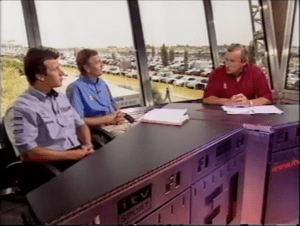
2000-french-grand-prix-studio
From left to right: Olivier Panis, Tony Jardine and Jim Rosenthal in ITV’s on-site studio.

ITV’s programme continues the French theme with its next feature, as James Allen interviews Alain Prost about the struggles that his Prost team are having. It was a serious sit down interview as Allen asked the tough questions about Prost’s future in the sport (the team went bankrupt prior to the 2002 season).

After some studio analysis on the Prost situation, Martin Brundle talked us through one of Eddie Irvine’s qualifying laps in his Jaguar! I love this on-board lap as it shows how much of a handful the Jaguar car was to control with Irvine nearly losing control at one stage. Again, kudos to ITV for picking someone different for the on-board lap instead of the usual suspects.

On the other side of a Euro 2000 advertisement is a fascinating VT voiced by Louise Goodman looking at how the communication system between the teams and race direction has improved during the 2000 season. Ferrari’s Stefano Domenicali showed the viewer what benefits the system has and how the teams interact with it. This made me ‘wow’ having never seen this feature. Goodman remarks how all the timing used to be distributed using 11,000 sheets of paper, which no longer was the case.

There is a clear trend during the build-up: all the features are relatively small in length, but they are meaty and engaging enough to keep the casual viewer interested. They are not BAFTA award winning by any stretch, but they do their job perfectly. Rosenthal hands over to Kevin Piper for a news update concerning the future of the British Grand Prix (yawn), the 2001 calendar and Juan Montoya’s status. The usual pre-race grid interviews follow next, whilst James Allen talks us through the race strategy. After that, its race time!

Race
The few minutes before the race consists of discussion between Allen and Brundle, focussing on the strategy and the qualifying performances of the leading drivers. One of the things I like, and miss in modern-day Formula 1, is the vibrant field: the red (Ferrari), green (Jaguar), yellow (Jordan), blue (Benetton) amongst others. So colourful, and Formula 1 looks so good as a result.

This is a tense time; you’re in the zone, the critical zone here where you must not make a mistake. You know that if you stall the engine, you’re going to be at the back of the grid. You’re looking in the mirror; you’re thinking that they’re taking an enormous amount of time to file in line behind me. Your temperatures are rising; you’ve got to stay very, very calm.

Your seatbelts seem a little bit too tight, your right boot seems a bit too loose, you’re moving the visor around and the lights are on… stay calm, put it in first gear, put it in 12,000 revs and just stare at those lights! (Lights off) Control the wheel spin, you’re away, see who’s doing well around you, are you on the attack or are you on the defence! – ITV co-commentator Martin Brundle calling the start of the race

Brundle called the start, which was different to your usual start sequence from the lead commentator. Frustratingly, the director held the opening shot too long meaning that we missed Rubens Barrichello’s overtake on Coulthard. The director chose not to air replays of the start either. To their credit, they did show us replays of the things we needed to see as opposed to frivolous activity: Nick Heidfeld poking his teammate Jean Alesi into a spin made the air.

Once the opening four were running in order, the director was not afraid to show viewers action further down the top ten if things were quiet up front, in this instance the battle between the younger Schumacher and the two Jordan’s. We hear from both Piper and Goodman early in the race before the first phase of pit stops, Piper reporting from Prost with Goodman reporting on Ferrari. Quickly when things are not easily noticeable on-screen, the ITV team are able to deliver the information through their pit crew on the ground, showing the instant benefit of having reporters in pit lane.
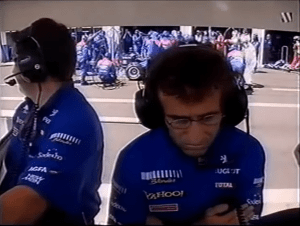
2000-french-grand-prix-prost-pit-wall
A shot from the Prost pit wall as driver Nick Heidfeld bodges a pit stop by stalling the car.

The curse of ITV’s advert breaks kicked in early during the race, the channel missing Coulthard’s overtake on Barrichello for second position. After the break, the first pit stop sequence started resulting in a flurry of activity. Without adequate graphics to explain who had made a pit stop, this sequence was not the best to follow, but Allen and Brundle do an excellent job to keep viewers on top of the strategy. The direction is okay, but the graphical side lets the product down.

One noticeable omission is on-board cameras. The F1 Digital product had exclusive access to certain angles, meaning that the World Feed was neglected. A very brief on-board is shown from Jean Alesi’s Prost as Alex Wurz attempted a “pathetic” overtake which resulted in Wurz going straight on at the final bend. The on-board shots from Alesi’s Prost and Irvine’s Jaguar are pedestrian, painting the sport in a negative light. Nevertheless, the director does manage to sneak in two in-car shots from Barrichello in the last two laps.

The director changed focus towards Coulthard and Schumacher, as the Scot hunted the German driver down for the lead. There are a few great helicopter shots showing Coulthard’s attempted moves on Schumacher at the Adelaide hairpin. The director catches the famous gesture from Coulthard to Schumacher; viewers sadly do not see on-board footage from either car though.

Allen: The biggest question marks of course after this Martin will be whether this is the point Ron Dennis and McLaren tells the team that it’s going to be David Coulthard that has to chase after Schumacher in the championship. [..] It’ll be the question that the press are asking in the morning.

Brundle: Well as the man who negotiates David Coulthard’s contract, I would like to claim the Fifth Amendment on that one, but it’s certainly a question that’s got to be asked.

Coulthard’s overtake on Schumacher is brilliantly captured from a camera on the inside of the Adelaide hairpin. The camera angles are amazing, and the sound helps show off the speed of the Formula 1 cars. Although the track is slow and cumbersome in places, the shots chosen help demonstrate the fast direction change that Formula 1 cars have.

ITV covered the battle at the front live, saving their commercial break until after the final pit stop sequence, when it was clear that the top four were unlikely to be battling again in the race. Outside of the top four, the order had not changed. Villeneuve, the two Jordan cars and the two Williams drivers completed the top nine. Both Allen and Brundle praised the performance of Jenson Button. With Schumacher out the equation, Coulthard claims victory in France!

Post-Race
Allen manages to shoehorn in a mention for the Euro 2000 final between France and Italy on the lap back to the pits, the game referenced sporadically throughout the broadcast. The World Feed director shows us the parc ferme celebrations, Brundle reminding viewers of the plane crash that Coulthard was involved in a few months previously. We get our first piece of analysis at this stage with Goodman interviewing Ferrari technical director Ross Brawn, Brawn calling the result a “disappointment”. Allen runs down the championship order as we see slow-motion clips of Coulthard winning the race.

The initial post-race replays show us snippets we had not previously seen, including a fantastic overtake from Button on Irvine at the hairpin. There is still a lack of on-board camera angles, but the new footage makes up for it as we head to the podium. After the champagne celebration, Rosenthal takes us into the first post-race ad-break.
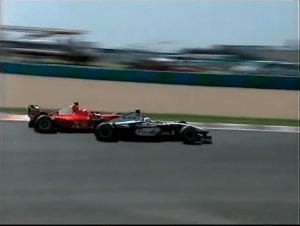
2000-french-grand-prix-lead-overtake
The key moment: David Coulthard overtaking Michael Schumacher to take the lead!

On the other side of the break, Jardine talks briefly about Schumacher’s tactics inside and outside the paddock, Schumacher refusing to talk about the title yet as Ferrari know things can change in the latter half of the season. The press conference is next with the top three drivers: Coulthard, Hakkinen and Barrichello.

Coulthard apologised for his “hand gestures” stating that his emotions were high at the time, his description of the incident making Hakkinen and journalists laugh during the unilateral, “there’s children watching so I won’t be showing it again.”

Straight from the press conference into a live link up with McLaren technical director Adrian Newey, Rosenthal asking Newey questions from the studio. The main difference between this and a present day paddock interview is that the questions and answers are far more structured and concise, rather than a discussion based format where the analyst would chip into proceedings. From Newey to Walker we head as we get an update from Walker live from his home. Walker compliments Coulthard’s victory and Allen’s commentary saying that Allen did an “absolutely superlative job.”

Back from the second post-race ad-break, Rosenthal and Jardine analyse the key overtakes and moments from the race including Coulthard’s middle finger moment and eventual overtake on Schumacher. We cut to a recorded paddock interview with Piper in the middle of a media scrum interviewing Schumacher, a lot less organised than the media pen of today. Contrast the Schumacher interview to the next interview as Louise Goodman holds a lone microphone interviewing Jacques Villeneuve without any surrounding media!

The usual promotion follows, and that is a wrap live coverage of the 2000 French Grand Prix.

In conversation with Louise Goodman (part one)

Louise Goodman (@LouGoodmanMedia) has been a familiar figure to motor racing fans for the past twenty years through her ITV F1 commitments and more recently through her British Touring Car Championship role.

I sat down with her at the AUTOSPORT show to chat about her career in motor sport, starting with her various PR roles.

LG: I actually started out with Tony Jardine. I was Tony’s first employee when he set up his PR company Jardine PR. It’s been through about four different guises but it’s still under Jardine.

F1B: You and Tony have known each other for a long time then.

LG: Well I met Tony through powerboat racing, as I was the editor of Powerboat Racing magazine at the time. It’s thanks to Tony that I’m involved in motor sport; Tony had a history in motor sport. My first client when I was started working for him funnily enough was Derek Warwick and I say funnily enough because we come from the same town, a place called Alresford in Hampshire. As a kid, I walked past Warwick Trailers, the family business on my way to school each morning.

F1B: Did the PR thing for you then move on from there, stepping up the ladder as time moved on?

LG: Tony had motor sport clients; we launched Camel as a new sponsor when they started sponsoring the Lotus team back in the day. I worked with BP, who were very involved in the Leyton House team so I was the Leyton House team press officer. I was, briefly through Camel, press officer for Eddie Jordan in Formula 3000 with [Jean] Alesi and [Martin] Donnelly as the drivers. I was approached by Eddie to go and work with him full-time, which is when I moved up to Oxfordshire.

F1B: With Leyton House and then Jordan, what did the day-to-day activity involve?

LG: It was a bit of everything. With Jordan Grand Prix, I was employee number 47, which was the entire team! Formula 1 was very hands on in those days; Ian Phillips was the commercial department for Jordan. There was no such thing as a marketing department. During an event, I would write the press releases, I would also take the drivers to any appearances, I would do garage tours, you name it. It was a bit of everything, even sewing badges onto drivers’ overalls! The teams were much smaller; people had a much broader knowledge. The cars are much more technical these days so the knowledge has become more specialist and the areas are more delineated. Nowadays you have a communications team, a marketing team, it was almost ‘make it up as you go along’ back when I first started.

F1B: I guess it was a lot more intimate, a lot more camaraderie back in those days for the smaller teams because of the relative size.

LG: Well all the teams were smaller. The bigger teams at the time McLaren, Williams and Ferrari would have had a couple of hundred people working there whereas now you’re into the thousands. That’s just the team and then you’ve got the engine manufacture and everything alongside it. There was a lot of camaraderie. I knew next to nothing about Formula 1, I enjoyed it as a kid and I loved James Hunt. Ann Bradshaw, who was Williams press officer at the time, helped me out greatly. I have pictures at home still of all the press officers getting together and having dinner at Imola during the Grand Prix weekend. The press officer at Minardi would invite us all to his house as we all fitted in his apartment. Back in the day, all of the girls would get together every year in a motor home for dinner in Monza. It was a whole different ball game back then.

F1B: That sounds quite amazing, so much has changed since then. You were with Jordan in the early 90s and then you get a call in 1996…

LG: Various different production companies were bidding to get the contract to make the programmes for ITV. I got the approach from Mach1, which was a consortium of Meridian, Anglia and Chrysalis Television. Mach1 turned into North One Television. They were looking for a girl to put down on their bid. All the production companies had to put a bid to present to ITV to say how they’re going to produce Formula 1. It was a very theoretical thing so I said “go on, put my name down.” There were two people involved in getting me on-board. The first was James Allen. James was press officer at Brabham and he then moved onto AUTOSPORT and ESPN. James said that [I] would be a good person and that she knows her way round the paddock. The other one was a guy called Kevin Piper, who was a reporter for Anglia Television and Jordan was in the confines of the Anglia region. Kevin was a TV journalist who I had done a lot of stuff with so we had a strong relationship. Kevin also said that she’d be a good girl to have on-board. In the latter stages of the process, one of the other consortiums approached me as well. It was perceived that this other group was going to be the ones who got the contract.

LG: So, when it was announced that North One had got the contract, that’s when it became a reality, that’s when I went “oh my god!” This abstract concept quickly became very real. There was a gap between Mach1 winning the bid to officially being unveiled, as ITV had to present their proposal to Bernie Ecclestone to sanction what they wanted to do, how they were going to do it, the logistics of it all. There was a gap between me being part of the presentation team and them officially offering me the contract. By the time they offered me the job, everyone assumed that I was doing it anyway! Which I think was a good thing, because I never actually had to make the decision, it had already been made for me. I had no television experience, they didn’t employ me for that, they employed me because they thought I had the potential to be able to do that. Most importantly, I had contacts, the experience and knowledge of Formula 1, the paddock and the way the sport worked itself, I knew what to ask and how to ask it. The broadcasting bit they could teach me as we went along.

F1B: With things like football or rugby, you could have dry runs, but you can’t really dry run a proper F1 race. How did that work, were you just in front of a microphone in Melbourne and that was that?

LG: They presented me with a microphone in Melbourne and said, “We need to do a sound check so if you just wander up and down the pit lane and give us something for level, just give us some chat”; I didn’t even understand the technical terms! I thought, “What do I do?” James would give me a few tips on how to ask questions and how to phrase it, don’t ask a question in a way someone can say yes or no. I distinctly remember Damon Hill going out on the formation lap; he was my first live interview. I did a piece with Eddie Irvine on the grid, who I knew well. I remember with my squeaky voice asking Damon “what happened?” which is the worst way to ask a question and Damon explained what had happened, followed by a squeaky “thank you”! Damon was thinking, “You’re supposed to ask me a follow-up question.” The drivers were all very good with me; they all knew me, so they were all quite kind.

F1B: If you came in from the outside, it might have been different.

LG: Yeah, it would have been a different kettle of fish. I remember at the point of the British Grand Prix that year when Johnny Herbert said to me “you’re getting a bit of a hand with this now”, and I said that it’s getting better, which was a huge mistake as Johnny said that I’m in trouble now! That was when the fun started. Standing on the grid for that race, I waited for them to throw down to me for a live interview; Johnny was poking me off camera. They were all very kind to me and the guys within Mach1 were great, they helped me as much as they could. Nobody can tell you what to ask, but they can tell you how to ask it. I can remember our executive producer at the time Neil Duncanson saying to me “low… and slow… low… and slow…” When you’re excited, your voice goes up and you speak faster or you sound nervous. So, that was my big foray into broadcasting, in at the deep end.

F1B: Did you have any regrets about the first season, or did you ever think that this isn’t working?

LG: The first season was terrifying, but the biggest thing I felt is that, when you work for a team, you have a home in the paddock, that’s your motor home. There’s an unwritten rule that you don’t go into other people’s motor homes, you stick within the boundaries and it was less delineated in those days than it is now. But now I was a journalist, I didn’t feel comfortable crossing the threshold and going into the Williams or McLaren motor home, because that wasn’t my home. That was my upbringing in the paddock, within the confines of the [Jordan] team. That felt odd, and by the same token, I didn’t feel like I belonged in the TV compound because I didn’t know the technicalities. In many ways, it was great starting off in that role alongside Martin Brundle as I used to be Martin’s press officer at Jordan the previous year and we were both suddenly in the same situation that we didn’t quite have a home any more. All the teams were very welcoming and said “of course you can come in”; it just felt odd to me to just wander into another team’s motorhome. That first year was a struggle; I won’t deny it and anyone who watched it probably noticed.

They presented me with a microphone in Melbourne and said, “We need to do a sound check so if you just wander up and down the pit lane and give us something for level, just give us some chat,” I didn’t even understand the technical terms! I thought, “What do I do?”  – former ITV F1 pit lane reporter Louise Goodman

LG: Bradley Lord, who is now Head of Communications at Mercedes, reminded me, I stop him halfway through the conversation every time because I don’t want to hear it, he says “I remember watching your first…” and I say I don’t want to hear it! (laughs) By the end of the first year, I remember thinking that I’m getting to grips with it all, I’m not very good at not being very good at things and I was aware of the fact that I wasn’t a particularly good broadcaster in those days. I did have great moments, like electing to go to the Arrows garage in Hungary and being the first to deliver the not very good news that Damon wasn’t going to win that race. That was a feather in my journalistic cap, as I had the access and the foresight to go into the garage, that was where the story was going to be. Some of my grid interviews, in fact sitting down with Eddie Irvine in Melbourne. I thought “I’m not going to ask him to stand up”, so I just sat down beside him. We had a relatively cosy chat, and the guys in the studio compound said that’s exactly what we want!

F1B: From the outside, it probably looked like that the ITV team had just been ‘plucked together’, but in reality, you knew Allen beforehand, you knew Jardine beforehand.

LG: Absolutely. Mach1 were very clever I think. They knew about television, they knew about making programmes. If you look at North One as it has now become, they make all sorts of great programmes. They knew they had that side of it covered, what they didn’t know was how Formula 1 worked, access to the people. It takes time to build a relationship; they bought in people who already had that relationship.

Coming up in part two, we talk about the highs and lows of ITV’s Formula 1 coverage, the demise of ITV’s coverage in 2008 and more recently ITV’s BTCC coverage.

The alternative reality

The 2016 Formula One season comes to an end this weekend in Abu Dhabi, marking the end of Channel 4’s first season of covering Formula 1. But, the outlook could have been so much different. Here, this site looks at the alternatives that might have materialised.

BBC TV stay covering Formula 1
An unlikely alternative. BBC’s television coverage of Formula 1 had always been well received and applauded, but the problem was that it cost the corporation too much money. The licence fee settlement resulted in another round of budget cuts at BBC Sport, and Formula 1 was in the firing line. On December 21st, 2015, the BBC announced their television exit from Formula 1.

Had the BBC continued to cover Formula 1, I suspect production costs would have been slashed and the quality of the show would have decreased. Yes, viewing figures would be higher on the BBC than what they are currently on Channel 4, but viewing figures matter less to the BBC. Their obligation to Formula One Management (FOM) was to cover half the races live and half in highlights form, but they were not obliged to have high-quality build-up coverage, so could have cut the extras if they so desired.

It wouldn’t have been a popular move with the viewers, but if it kept F1 on the BBC, there might have been supported. As it turned out, the BBC did the right thing. In March, it was announced that Sky would be taking the exclusive live rights from 2019 onwards.

ITV take over Formula 1 from BBC
The major surprise was that ITV did not grab Formula 1 from the BBC and instead took horse racing from Channel 4. Horse racing provides ITV and ITV4 with a lot more hours than Formula 1 and is cheaper to produce. ITV were unwilling to broadcast Formula 1 without adverts, which is what swung the deal in Channel 4’s favour.

A return to ITV would have meant a return to Formula 1 being interrupted by commercial breaks. Beyond that, it is likely ITV’s coverage would have again been produced by North One Television as it was in 2008. Remember that Whisper Films and North One were the leading two contenders for Channel 4’s production contract. As we know, Whisper won that battle but had the two been battling over at ITV, chances are that North One would have grabbed the deal.

On the personnel side, ITV would have still faced the same hurdles as Channel 4: they would still need to fill their line-up within a very short two-month period. The talent pool wouldn’t change meaning that the ITV line-up would have been quite close to what we saw at Channel 4 with ex BBC faces moving over, alongside some new faces.

Channel 5, Eurosport or BT Sport
The three broadcasters listed above are unrealistic in an alternative reality. Channel 5 could have stepped in, except taking on Formula 1 for around £20 million a year would have hurt their overall budget significantly. Demographically, it would be a fantastic fit for the channel but the price range makes this an unlikely venture.

Eurosport and BT Sport were unlikely as a shared deal between them and Sky would take Formula 1 off free-to-air television, although BT could have committed to showing Formula 1 on their BT Sport Showcase channel on Freeview. Had Liberty Media’s acquisition of Formula 1 happened a year earlier, it would have made the landscape even more interesting: would Eurosport (owned by Discovery, who are in turn owned by Liberty) have splashed the cash to take Formula 1 exclusively from 2019 onwards? We’ll never know.

Sky’s exclusivity blocked by teams
Of course, Sky wanted to step in for the BBC as early as this year. Once Sky got wind that the BBC were planning to exit their TV contract at the end of 2015, the broadcaster made moves to try to secure Formula 1 exclusively from 2016 onwards. The contract featured a clause stating that, should the BBC exit, then Sky pick up the rights exclusively. As referenced in March:

When it became apparent in the run up to the Abu Dhabi Grand Prix last November that the BBC were set to terminate their contract, Formula 1’s teams are understood to have requested that Formula 1 remains on free to air terrestrial television in the UK in some capacity until at least the end of 2018. The concern for teams was that they would have difficulty persuading sponsors to stay on board with F1 behind a pay wall in the UK. This led to the sequence of events that saw Channel 4 step in and take over BBC TV’s rights from 2016 to 2018 inclusive.

Sky’s new deal from 2019 onwards was signed early after an onslaught from BT Sport, who attempted to take the rights away from Sky.

The only way the destination would change is if Channel 4 or ITV committed to a longer time frame when the signed the contract with FOM last December. However, that would have required Sky’s involvement, and given the amount of money they were prepared to lay on the table, I think the same conclusion would have been reached.

No matter what, the destination post 2018 remains the same: a deal with Sky showing every race exclusively live.

Report: ITV to take over BBC’s F1 TV coverage from 2016

Posted on December 17th, 2015 – Broadcast are reporting this evening that the BBC are to exit broadcasting Formula 1 on television with immediate effect, with ITV taking over their coverage from 2016.

This has yet to be confirmed. As soon as we have any news, I will update this blog. My gut instinct though is that the report is true, and that ITV will confirm this officially tomorrow (Friday 18th December). That is my opinion, I’m not privvy to anything that is not currently in the public domain. If the news is true, it marks the end of BBC’s return to covering Formula 1 on television, which started back in 2009. Alongside the various news stories that have been covered recently, the news earlier this week that BBC’s Euro 2016 picks run right through the Canadian Grand Prix window mean that the BBC were not planning to pick the race live. Of course, that is the usual pick process – but now we have a clearer reason why that was probably the case.

Regarding the source: Broadcast is a reputable industry magazine, and not a website that would pluck stories out the air for ‘hits’. The fact they have published it means that it is more likely to be true than false. Tomorrow is likely to be the last day that any deal would be announced (it being the last business day before Christmas, early next week being slow down days), leads me to believe that ITV’s return will be announced tomorrow. If that happens, questions inevitably turn to the personnel. ITV should swoop in for the majority of BBC’s team… but that is a question for later rather than now (although we are only four months away from Melbourne). Another question surrounds the return of adverts during F1 races, and lastly if ITV taking Formula 1 affects their Formula E rights.

Either way, there’s little point speculating until we have official confirmation from BBC or ITV. So, for the moment, we wait patiently, but it looks like The Chain is going to be broken….

Update on December 18th at 18:05 – To my surprise, we have heard no news today. A request for comment from this blog to the BBC resulted in no comment, which is to be expected in the middle of rights negotiations. The BBC Sports Personality of the Year is being held on Sunday, so both parties may have mutually decided to hold off an announcement until Monday. Realistically, if we hear nothing either Monday or Tuesday, then it will be a wait until the New Year. Other media and motor sport outlets have since covered the story, mostly repeating Broadcast’s original story, including Motorsport.com, the Daily Mail and the Telegraph. Neither AUTOSPORT or The Guardian have yet covered the story.

In an interview with the Press Association via Motorsport.com in response to the latest story, Bernie Ecclestone said “The bottom line is that they [BBC] are cutting back on all types of sport and if we really, really, really had to, we’d say ‘you have got a contract and you better get on with it.’ They can’t leave the contract early. The Beeb have always done a very, very good job. I have no problem at all with them. It is just they can’t afford to continue with what they have done in the past.” Ecclestone concludes by saying that he does not know what will happen in 2016, which sounds worrying.

Ecclestone’s lines are again expected, he said very similar last month. The situation we are in is bizarre. Party 1 wants to exit contract and Party 2 is interested. Sport 1 wants to stay with Party 1 and appears to be distancing himself from Party 2. The more Ecclestone tries and persuades BBC to stay, the less interested ITV will become. Does Ecclestone really want an uninterested BBC to stay on-board, and potentially limit resources as much as possible? I’m not entirely sure that is the best option. In my opinion: If BBC want to get out of the contract, and ITV want to take over, then let that happen. Don’t hold it up. Yes, ITV may give you fewer viewers, but they are still free to air. They will still bring in between two and three million viewers a weekend. Annoying ITV and prolonging any negotiations will not do F1 any good in the long run.

Poll: What is your favourite ITV F1 intro?

Ahead of the return of live motor sport to ITV’s main channel this weekend in the form of the Formula E championship decider, The F1 Broadcasting Blog has decided to take a trip down memory lane, looking back at ITV’s past Formula 1 intros. Whilst ITV’s Formula E coverage this weekend will have the generic World Feed intro, ITV came up with four distinctive titles for their Formula 1 coverage from 1997 to 2008, with each iteration lasting three years.

ITV’s coverage began in 1997 with an instrumental from British jazz band Jamiroquai, who were asked to produce the intro and outro track. The band, who were approached by ITV F1 producer Neil Duncanson, were paid £100,000 to compose the theme.

The basis of the title sequence is a car unveiling, followed by a pit-stop, before the car is unleashed towards the camera, a sequence which was executed superbly and comes across well, even looking back at it nearly twenty years later. The nature of the soundtrack is reminiscent of Fleetwood Mac’s The Chain, although Jamiroquai’s version doesn’t quite build up to a climax with the same amount of energy as The Chain. Was it as good as The Chain? Of course not, but it was probably as good as what it was going to be.

Most sporting theme tunes on commercial television tend to have a life span of between three and five years, before they become old, and this was the case with ITV’s Formula 1 coverage. At the turn of the millennium, Apollo 440 provided the theme for ITV’s coverage through Blackbeat, with the car unveiling of Jamiroquai being replaced by a more upbeat, fast-paced intro that showed off Formula 1 to the maximum.

The intro showcased moments from the late 1990s alongside the latest British contenders on the grid, a narrative that would remain in ITV’s coverage until the end. This theme was the F1 theme when I first properly began getting into the sport, meaning that it is undoubtedly my favourite of the ITV era. It portrays everything that there is about Formula 1, and helps get you in the frame of mind to watch a motor race. They key words there are ‘motor race’, it has to fit that agenda. Blackbeat fulfilled that role perfectly. Of course, there’s another reason I remember the Blackbeat era fondly, and that is the Texaco break bumpers! Break bumpers like that are so much more memorable, unlike the break bumpers of 2015 (yes FairFX, I’m looking at you).

Michael Schumacher’s dominance, alongside the fall of F1 Digital+, meant that ITV’s coverage was overhauled in 2003 in an attempt to win back lapsed viewers. A remix of You Ain’t Seen Nothing Yet, originally performed by Bachman-Turner Overdrive, was on the table from 2003 through to the end of 2005. The original plan, according to The Music & Media Partnership, was to have a remix of The Who’s Baba O’Riley, but plans were dropped following the arrest of Peter Townshend.

The style of the intro is similar to Blackbeat before it, except it looks and feels more technical than before. However, I don’t think the You Ain’t Seen Nothing Yet instrumental is as hard hitting as Blackbeat, which is it’s downfall. 2003’s intro lacked any car sounds, although this was fixed for later iterations in 2004 and 2005. Don’t get me wrong, it is okay, but it never really hit the sweet spot in my opinion. Trying to incorporate technical aspects into the theme titles was not going to work, whilst the map at the end of the titles was unnecessary. The idea was good, but the execution here I don’t think was great.

You’ll probably find it easy to like or dislike either one of the three themes above, but what happened next was unexpected. Opinions on ITV’s last F1 theme, Lift Me Up from American songwriter Moby, veer from brilliant to downright awful. The intro marked a distinct change in coverage for the start of the 2006 season. Steve Rider replaced Jim Rosenthal as lead presenter, the graphics set was completely overhauled and a young Brit was entering the fray. By the time ITV’s Formula 1 coverage ended in 2008, he would be world champion.

The change of approach to their introduction was solidified in their coverage overall, with more emphasis on British drivers than ever before, this fuelled on further as Lewis Hamilton made his debut at the beginning of the 2007 season. In isolation, there is nothing wrong with Lift Me Up, but this is a case of ‘wrong song, wrong sport’. I’d love to know what the aim of this piece actually was, because some aspects of the intro clearly have nothing to do with Formula 1 and clearly were only there to try and glamour up the sport. An early version of the Lift Me Up intro exists over at Reelthing Animation, for anyone wishing to take a look. I probably look back on Lift Me Up more fondly than what I should given that it concluded ITV’s F1 coverage, but it certainly won’t top any “best sporting intro” charts any time soon.

Or… will it?

If ITV and Formula E remain partners for a second season, it will be interesting to see if ITV choose to create their own titles for the coverage, or whether they take the World Feed titles, as they have throughout Formula E’s inaugural season.