
A fascinating questions and answers session with Bernie Ecclestone was published by Campaign Asia a few days ago on their website, which received an overwhelming response on F1 media websites and by fans on social media. In it, Ecclestone made a lot of interesting comments, which I will look at further down this piece.
Some said that this is the usual Ecclestone, making controversial comments for the sake of gaining a few headlines. I disagree. This was not an interview with your usual Formula 1 journalist. As far as I can tell, Campaign Asia is an upmarket website, who have no agenda. They’re not looking to spin this story. They did not pull one or two lines out of the Q&A for a sensationalist headline. They published the entire Q&A for their readers to read, which does not happen very often, and I applaud them for that. One link between them and AUTOSPORT is that they are both owned by Haymarket, but I doubt that AUTOSPORT’s editorial stance affects Campaign Asia and vice versa.
The Q&A starts with Atifa Silk asking Ecclestone what the Formula One brand stands for. Which is a valid question. Most big brands have a roadmap of where they want to be in five years from now. Microsoft. Facebook. Two examples of brands that have roadmaps. Brands like the Premier League too will have roadmaps on how to exploit growth in certain regions (in fact, the Ecclestone interview alludes to this later, but doesn’t explain how growth is going to happen). Here is Formula E’s technical roadmap. Defining a roadmap is a key part of telling people what your brand is all about.
This was Ecclestone’s response to the branding question: “That’s a difficult question to answer. I suppose it is a major sport and most sports are in the entertainment business. Sometimes we tend to lose track of the entertainment and get caught up a bit more on the technical aspect of Formula 1, which I’m not happy about. We are very technical and we need to stay that way but I’d rather see a bit more effort on the entertainment.” Ecclestone further down the piece claims that it is “obvious” what Formula 1 does. Is it? Imagine trying to persuade a new fan to watch Formula 1, and you tell them that’s it is all obvious. That’s not a good sales pitch. What Ecclestone does not realise is that, the more indecisive he is, and the more negativity that emerges, that tarnishes the brand and removes a little bit of value from the brand. His brand, let us not forget.
Ecclestone does rightly say that there is increased competition nowadays as people have more choice than 20 or 30 years ago. His next point is about Ferrari, noting that “they’re not winning as much, and you can see that their popularity has dropped off.” With that in mind, why do they still get financial privileges in comparison to other teams? If you want to make Formula 1 a more viable proposition for teams wanting to join, the $90 million that is given to Ferrari needs to instead be re-distributed equally to every team. Ecclestone says that for teams to survive, they should not spend as much. That is all well and good, but Gerard Lopez was bang on the money with his comments in the official FIA press conference back in USA, noting “I kinda guess what [Caterham and Marussia] must have paid for the engine this year and what they have paid for developing around that engine and I guarantee that in the budgets that they have, there was not a whole lot left – so it’s not like they had a choice.” It feels like that Ecclestone believes that money grows on trees. It doesn’t. You only need to look around to see that some teams are struggling to attract sponsors.
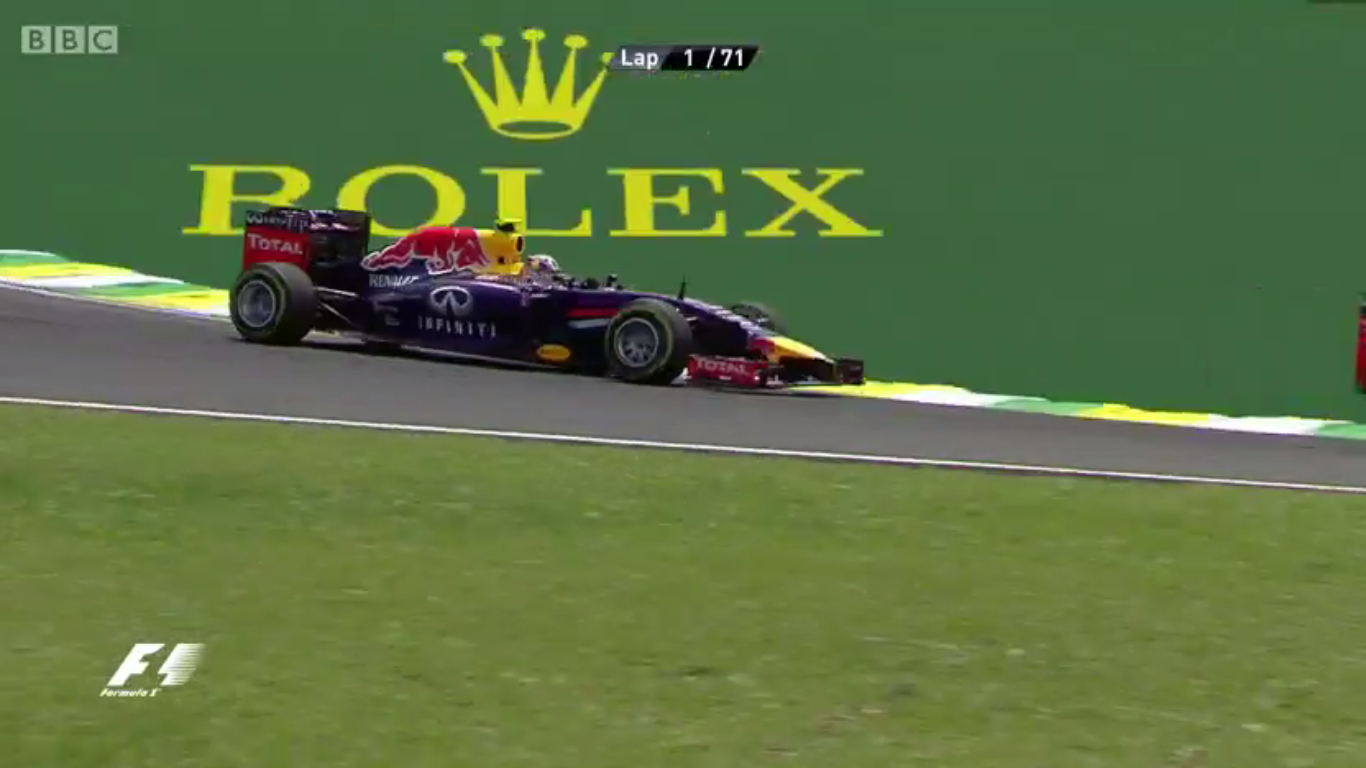
This brings me onto a point further down the article about Rolex and UBS, in that young kids can’t afford them. But I think the Rolex and UBS point is interesting in a different context. Are back end teams struggling to attract sponsors because Formula 1 presents itself as an elitist sport on screen? When I watch Formula 1, I don’t see worldwide sponsors that I can openly engage in, I see sponsors that only the rich and famous can engage in. Having a brand, such as McDonald’s or Nike to use two examples, alongside Rolex and UBS would look completely out of place. Does having only four or five sponsors presented on the World Feed at every race have a detrimental effect to those teams at the back of the field? Or does it not matter? I don’t know, but think it is an interesting point. Ecclestone does make the point about Formula 1 attracting an upmarket audience, which is a valid statement considering the sponsors. I’m not suggesting that Formula 1 should go towards a ‘chavvy’ audience or anything of the sort, but just that the choice of sponsors may make Formula 1 appear inaccessible, to some. Ecclestone himself in the interview with Campaign Asia says that the teams at the tale end require at least 70% to 80% of their budget to be from sponsors. If you fail to attract sponsors, you’re going to struggle.
Ecclestone says that they can’t “make Formula One more accessible to people”. I’m afraid I disagree: all races free-to-air worldwide where pay-TV growth has failed to take off, YouTube content (it doesn’t need to be World Feed, just some unique content produced by FOM) and the such like. In the UK, free-to-air television is still king. FOM are only starting to exploit social media with Twitter, but even so, you can argue that development is several years later than it really should have been. That probably does not matter that much, given that Ecclestone expresses no interest in tweeting.
“I’m not interested in tweeting, Facebook and whatever this nonsense is. I tried to find out but in any case I’m too old-fashioned. I couldn’t see any value in it. And, I don’t know what the so-called ‘young generation’; of today really wants. What is it? You ask a 15 or 16-year-old kid, ‘What do you want?’; and they don’t know. The challenge is getting the audience in the first place”, Ecclestone said in the piece. Ecclestone is probably one of the few old generation leaders who does not have Twitter. Rupert Murdoch, Vladimir Putin and Sepp Blatter all do. One reason that start-up companies are so successful in this generation is because of social media. Get a good following, with a bit of funding, and all of a sudden you can become the next big thing. There is a lot of possibilities with social media, which hopefully Formula E will be exploiting.
The two groups that Ecclestone alienated in the interview, women and young men (age 34 or under), accounted for 49 percent of the UK audience for the Russian Grand Prix according to overnight viewing figures, so half of his fan base. The main conclusion I sadly get from this piece is that Ecclestone is not interested in diversifying his audience. Ecclestone appears to be happy with what he have, but does not have the urge to change his audience, or to bring younger people into Formula 1. An ageing audience is not an attractive audience. An unattractive audience will not attract new, trendy sponsors. People associate Rolex and UBS with middle-aged businessman. The piece proves to me that Formula 1 needs new leadership. Not just Ecclestone, but the ‘yes men’ associated with Ecclestone. Someone to drive Formula 1 forward. Passion. Energy. Excitement. New media. Is Ecclestone really the person to drive Formula 1 forward, and continue to make it a global phenomenon?
I don’t think so.
 Motorsport Broadcasting