BBC F1’s output: The 2013 Verdict so far

Nearly half way through the Summer break which means that ‘The Verdict so far’ series is entering the half way stage too. Parts 1 and 2 focused on each member of the BBC and Sky Sports F1 teams as I analysed the strengths and weaknesses of each side. This part will look at BBC’s Formula 1 programming so far in 2013, whilst part 4 will look at Sky Sports F1’s programming – including that outside of race weekends. The final part will look at the ratings picture and compare and contrast with that in previous years.

For live races, BBC television produces 12 hours and 15 minutes of programming during a race weekend, from practice coverage on BBC Two on Friday mornings to the ever popular BBC Red Button Forum programme for an hour after the race on Sunday afternoons. Unsurprisingly, the amount of television BBC produces decreases significantly for the highlight races. BBC produces 3 hours and 15 minutes of programming for BBC One or BBC Two during a television highlights weekend.

Practice
One of the major changes in the way the BBC covered practice was that, for their live coverage, the programming is now on BBC Two instead of the BBC Red Button where possible. Since 2008, practice had been simply hooking up to Formula One Management’s World Feed from the five-minute sting until five minutes after the session. 2008 with ITV came with no commentary and no practice three online, whereas 2009 had Radio 5 Live commentary and was live on the Red Button. The coverage had worked perfectly well as it was.

The change to BBC Two meant that instead of it just being presented as another programme on the Red Button, it was now being treated as a network programme, with ‘The Chain’ opening and end titles, along with a proper introduction and outro from Suzi Perry. In some cases it meant that the slot was extended, for example, practice two in Canada had a great round-up of half an hour once the session had finished allowing Perry and Gary Anderson to round up the action. On other occasions though they were only on-air five minutes after the session, which I think renders having Perry as presenter there pointless.

I don’t really see the point of them having Perry and Anderson when there is over five minutes build-up and five minutes wrap-up, you may as well just stick to the World Feed instead of almost rushing on and off air, in my opinion. The other option would be to just extended it slightly, so the programming runs 15 minutes before and after each session for example so that Perry and Anderson are utilised more. A few weeks back, I noted how Perry, alongside Suzi Wolff were used for practice three in Canada and during a red flag period the production team chose to cut to them aimlessly filling instead of sticking with Ben Edwards in the commentary box which did not really work at all.

Inside F1
Still going strong on the BBC News Channel, Inside F1 airs during every Grand Prix weekend, typically Friday’s at 18:45 and Saturday’s an hour later, both editions presented by Lee McKenzie. The show normally recaps practice and has a guest or two on, albeit in only a fifteen minute slot. The show began alongside BBC’s Formula 1 coverage when it returned to the network in 2009, first presented in London at the BBC News room studio, before later just being done on location with Amanda Davies and later McKenzie.

I know this programme is just one that is probably there to fill a gap in the schedule without a dedicated audiences, but I do think BBC should do things with this show. Readers of this blog may well of heard of Murray and Martin’s F1 Special. Basically, what started off as a Qualifying update on ITV on Saturday evenings turned into a 15 to 30 minute show (depending on scheduling commitments) with Walker and Brundle. The show carried on for the first few years of ITV’s contract until Walker’s schedule slowed down.

Basically, my suggestion is, instead of having Inside F1 broadcast on Saturday evenings on BBC News Channel, why not have the Saturday evening edition broadcast on BBC One for 20 minutes at 17:15? I mean at the moment it seems a bit of a waste having Inside F1 going out on the BBC News Channel when most Formula 1 fans probably don’t realise it is on (after all the EPG has never specifically said ‘Inside F1’, it just says ‘Sportsday’). So for the live races, in my opinion they should put Inside F1 in the gap between Final Score and the main evening news bulletin. Maybe have Ben Edwards and David Coulthard present with A.N. Other a bit like the old ITV F1 style from fifteen years ago. Just a thought, at least that way viewers would be more inclined to watch on BBC One instead of the BBC News Channel as it currently is.

Pre-Sessions
For the live weekends, since 2009, BBC have typically had between 50 minute and an hour of build-up heading into the race. The run time that BBC had for each race build-up was broadly similar to that of ITV before 2009, except BBC of course had no commercial breaks and in general the time was better utilised than ITV had previously used it. Not to take away from the latter, as their coverage had made huge strides forward since BBC’s exploits pre 1997. One of the reasons people liked BBC’s build-ups significantly more were because of their ‘do anything’ introductions with Jake Humphrey, David Coulthard and Eddie Jordan and sporadically walking up and down pit lane to see who can find alongside scripted interviews.

The deal with Sky meant that, whilst the ten live races still had a 50 minute build-up, the highlight shows only received a 10 to 15 minute build-up in comparison. So, has the build-up been just as good with Suzi Perry presenting? I think, on the whole, it has. Whilst of course she is there to link everything together and ask Coulthard and Jordan questions, the overall package remains the same in terms of VT’s. For me, the BBC’s VT packages have, and always have been since 2009, top notch.

The thing with the pre-show is that it is largely scripted in nature, okay some of the discussion is on the spot opinion but the flow of the show is determined beforehand and all fitted in nicely beforehand, so from that perspective it is just like any other show for Perry. Sometimes it has to be said that she struggles finding the right question, but overall she is fine presenting the pre-show, whilst Coulthard and Jordan are great as always as pundits. The introductions have not been as great this year with Perry, Coulthard and Jordan, probably a step down from the past few years, but still good in their own respect and a step ahead of Sky’s.

Post-Sessions
Following the conclusion of each race, BBC One typically remains on air for about half an hour, followed by another hour on the BBC Red Button for their forum show. This has been the format since they won the rights back for the start of the 2009 season; beforehand on ITV there was no such thing as a forum show, just a wrap up on ITV1. Back in the ITV days the race weekend never felt ‘complete’, they were rushing off air occasionally to get to their next programme, whilst advert breaks disrupted the flow. The forum on BBC changed that completely. However, partially as a result of the rights deal with Sky, it is the part of the show that has become more weaker since 2012.

For some reason, it was decided half way through 2012 that there would be no forum for the highlights shows. Why? I’m not entirely sure. It appeared in Bahrain last year, but then I don’t think it appeared again. Which is a shame, as the forum was the best part of the BBC F1 race weekend for me. Like I alluded to above, the forum for me when BBC had full coverage gave ‘closure’ to a race weekend with their gentle wrapping up as everyone is packing ready for the next round. As thus, for the highlight races, there is normally twenty of so minutes of post-race with interviews from drivers up and down pit lane. In the time given on BBC One, they do a good job of wrapping up the action, although it is no substitute for the forum.

The forum has remained for the live races. It is still an extremely good hour of television, albeit in my view a step down from what we seen in 2011 and some of 2012. One of the things you can get into the habit to at times is aimlessly walking around and promote it as a forum which I felt happened one too many times so far this season. I think also Perry has struggled a bit due to the nature of the forum where it is more on the spot that the structured nature of the pre-show. Over time though, this should improve and she should get better as the season progresses. The BBC live shows would definitely be in a worser place without the forums, and it is vital that this component is not removed in years to come if BBC is to retain strong audience appreciation for Formula 1.

Other programming
Outside of race weekends, although not produced by BBC’s Formula 1 team, BBC has broadcast some supplemental Formula 1 programming this year. Over Christmas, BBC Two shown the Racing Legends series whilst BBC Four in March aired a five part series entitled Motor Racing at the BBC: That Petrol Emotion. More recently, BBC has aired a Hunt vs Lauda documentary. All of the shows, in particular the Hunt vs Lauda documentary have been top notch and worth watching.

It is important in my view that BBC continue to screen motor sport documentaries to remind viewers of Formula 1’s past and to get that out to a mainstream audience for all to see. Alongside this, whilst BBC have not recently uploaded any new Classic F1 races online, their full archive of races can be found here. Back to the present day, for me, we were extremely lucky to have BBC’s level of coverage from 2009 and 2011, and it is unlikely that we will see that matched again for a long time, especially considering those programmes were again viewed by a large audience.

Has BBC’s new deal with Sky weakened their output? Yes, but for me their programming is still up their with the best. A little lower than their 2011 levels for the reason described above, but great nevertheless, and I hope those higher up are not silly, or foolish enough to pull the plug on the F1 contract any time soon. Rumours did begin a few weeks ago, but nothing has materialised. I think, and hope, BBC will see out their current contract in the very least. Any move otherwise would put Formula 1’s free to air future in jeopardy, and would require either ITV or Channel 4 to fill the void. Let us hope that does not happen.

Programming broken down as:
– 12 hours and 15 minutes for a live weekend: 15 minutes x 2 Inside F1. 100 minutes x 2 Practice. 70 minutes x 1 Practice. 135 minutes x 1 Qualifying. 180 minutes x 1 Race. 60 minutes x 1 Forum. 60 minutes x 1 Highlights.
– 3 hours and 15 minutes for a highlights weekend: 15 minutes x 2 Inside F1. 75 minutes x 1 Qualifying. 90 minutes x 1 Race.
The Sky Sports F1 Team: The 2013 Verdict so far

Following on from my BBC F1 review looking at each team member, part two looks at each member of the Sky Sports F1 team. ‘The Verdict so far’ series will then look at BBC F1’s and Sky Sports F1’s programming throughout the year so far, whilst the fifth and final part will analyse the ratings picture and compare it to previous years.

Again for the mid-season piece, I will only be looking at the main Sky Sports F1 team members. Last year there were ten people I looked at during the Sky mid season piece, this year there is only eight, with two noticeable absentees:

– Allan McNish – defected to BBC F1
– Georgie Thompson – left before the season began, recently moved to America

The rest of the team is identical to last year. For this purpose therefore Anna Woolhouse, Craig Slater and Rachel Brookes are not included in this piece, although I may briefly mention them later on.

Anthony Davidson – @AntDavidson
Like Allan McNish on the BBC F1 team, Davidson’s main success is in endurance racing, his highest finish in the 24 Hours of Le Mans is second. His first chance in Formula 1 came in 2002 alongside Mark Webber for two races at Minardi. Unfortunately for Davidson, this did not lead to a race drive for 2003. He did have one outing for BAR, at the 2005 Malaysian Grand Prix, but it wasn’t until 2007 that he was given a permanent race seat – at tail-enders Super Aguri. Davidson’s highest finish there was 11th at the Spanish Grand Prix. He held the seat until Super Aguri’s demise in the middle of 2008.

Davidson’s first Formula 1 broadcasting exploit was in 2004 for BBC Radio 5 Live, before joining David Croft in the commentary box for every session on 5 Live several years later. It was this role which built up the Croft and Davidson partnership, and one that fans hugely enjoyed due to their relaxed style while debating viewers questions and tweets throughout the practice session. Davidson and Croft continued to commentate for 5 Live until the end of the 2011 season, when both of them defected to Sky.

Since joining Sky, Davidson has held two roles. Alongside his practice duties with Croft, he has also been on the Sky Pad alongside Georgie Thompson. I thought this worked fairly well last year, aside from the fact that they were in the middle of nowhere in a not so vibrant ‘box’ (or at least that’s what it felt to the viewer). This year, the Sky Pad has relocated outside, and minus Thompson. At first I was fearful because Davidson did not look natural on his own, but that has since changed, with Davidson now almost looking like a veteran on there. It helps I think too that the Sky Pad is integrated much more into the live shows which helps the overall product.

Damon Hill
One of the few father-son combinations to win Formula 1 championships, Hill made his Formula 1 debut at a relatively late aged 31 for Brabham in 1992. Hill moved to Williams for 1993, leading the team from 1994 onwards due to the death of Ayrton Senna. Twice he came close to winning the championship in 1994 and 1995, but 1996 would prove third time lucky as Hill won his one and only championship. In what Frank Williams described as a mistake on his behalf for not resigning Hill, Hill moved to Arrows and then Jordan to end his career in 1999. His final win came in a frantic 1998 Belgian Grand Prix which seen him lead home a Jordan one-two, with Ralf Schumacher in second.

His broadcasting career started in 2002, again with Sky as part of the F1 Digital+ service, as a pundit alongside Matthew Lorenzo and Perry McCarthy in the studio. The studio role, based at Formula One Management’s headquarters in Biggin Hill, only lasted a year with Bernie Ecclestone pulling the plug on the series. After several sporadic ITV F1 commentary appearances (the last one being the 2008 Hungarian Grand Prix), 2012 would be his next return to the paddock as part of the Sky Sports F1 team. Hill was, at the start of 2012, a bit wooden alongside Simon Lazenby but has since improved.

The introduction of Johnny Herbert alongside him loosened him up for the better, which has continued into this season. I don’t know if this is just me, but it feels like Hill has been on screen less this season. That’s not a bad thing, entirely the opposite as it shows that the load is balancing out more. There is not much more to add really as Hill has not done anything new this season, he’s just been there giving his opinions where necessary. Whether he stays with the team long term, we shall see.

David Croft – @CroftyF1
A Formula 1 commentator for the past eight season, David Croft’s broadcasting career started in 1995 with the BBC. Croft moved up the ladder, working with the BBC Radio 5 Live team covering the 2002 FIFA World Cup and the Olympics in 2004. He moved up to the Formula 1 commentary role from 2006 onwards alongside Maurice Hamilton in the commentary box. From 2009, Anthony Davidson was alongside him in the commentary box, a combination that was a hit with viewers and listeners as I described above in Davidson’s section.

Croft, like Davidson, moved to Sky Sports F1 at the end of 2011. As he did in his Radio 5 Live days, Croft commentated on every session, whilst also appearing sporadically on The F1 Show throughout the season. I’m not entirely sure his commentary has improved on Sky, though. Unfortunately, the insistence of Sky to promote their own products throughout doesn’t help (Sky Race Control) a lot to be honest. I do wonder how many people hear “You can ride with Lewis Hamilton on Sky Race Control” and actually go onto Sky Race Control? I just don’t see many doing that. I subscribe to Sky, I’ve watched them for a year and a half, I don’t really need the same viewing options at each race rammed down my throat.

As well as the above, it feels like some of his commentary at times is forced for the purpose of whatever VT package follows where you know you will hear the ‘5 lights’ line or ‘….wins the X Grand Prix’. It is painfully obvious. I do enjoy Croft as a commentator, and have done since his 5 Live days from 2009, but at Sky his commentary feels like the Sky publicity man, for some reason. It is nice though to see #AskCrofty on Twitter, although I’m not sure straight after the race is a good idea when in reality I should be engaged in the post-race coverage. However, that is probably the time when they get the most exposure, so I can see why that choose that particular time.

Johnny Herbert – @JohnnyHerbertF1
A motor sport career spanning three decades, Herbert began his Formula 1 career in 1989, nearly a year after breaking both his legs in an accident at Brands Hatch. Herbert raced with seven teams from 1989 to 2000, but it was Benetton where he would have his most successful spell. He won the 1995 British and Italian Grands Prix, on both occasions benefiting from Michael Schumacher and Damon Hill colliding. As well as his wins at Benetton, Herbert also scored a famous win for the Stewart team, winning in mixed conditions at the 1999 European Grand Prix.

Unusually, Herbert did not appear with Sky Sports F1 at the start of their coverage, instead his first race with them was round three in China. Whether that was always the plan, I don’t know. In any case, he worked fantastically alongside Damon Hill as a pundit and made the broadcast for the better as a result thanks to his lighter hearted style of pundit. Herbert has also been a regular on The F1 Show both last season and this season. My only concern is if he could turn into a parody of himself…

Let’s make it clear that I like Herbert on the Sky Sports F1 team, my only worry is if the light hearted things with him take over the show. Take Herbert’s Lemon as an example, which for some reason turned into a 15 minute standalone programme on the channel. Sometimes it can get a bit too much at times. At the moment it is mostly okay, and I hope that doesn’t change. Too much banter as I have said in the past can obviously become a bad thing. I know some people find it funny but I’m afraid it is cringey at times. As a pundit though, Herbert is good and I wouldn’t want him to leave any time soon.

Martin Brundle – @MBrundleF1
Although probably more famous for to younger audiences for his 17 years of commentary, Brundle’s Formula 1 career began in 1984 with Tyrrell. His first Formula 1 spell only lasted four years as he moved to find success in sports car racing, winning the 1990 24 Hours of Le Mans. It was 1992 when he finally broke out of the tail-enders in Formula 1, joining Benetton and racing alongside Michael Schumacher in the team. His Benetton stint reaped rewards with several podium finishes, although he was dropped at the end of 1993, moving to McLaren for the beginning of the 1994 season. His final two teams would be Ligier and Jordan, as Brundle retired at the end of the 1996 season.

Brundle, like David Coulthard did when he joined BBC, remained in the paddock, joining the newly formed ITV F1 team for the 1997 season. He would commentate alongside Murray Walker and then James Allen for the next twelve years alongside doing his now famous grid walk. Both of his roles were well received, back in 1997 you would not see many broadcasters doing the grid walk, now you see broadcasters from many different countries doing the walk before the race. When ITV lost the Formula 1 contract, Brundle moved to BBC where he remained co-commentator. This role changed in 2011 when Jonathan Legard was dropped from the team – the pairing of Legard and Brundle not blending well. Brundle was only a lead commentator for a single season alongside David Coulthard, Brundle was heading to Sky.

Last year, it felt to me that Brundle was on screen too much at nearly every opportunity possible. Thankfully, as I noted earlier in the piece, things have become balanced out so the amount of screen time Brundle gets has reduced. Brundle is still doing some fantastic features though, the feature recently with Mark Webber on the art of overtaking was a great insight which we would not normally get. Also, I’m not completely gelling with the Croft and Brundle combination, if I have a choice of Croft/Brundle vs Edwards/Coulthard, I’m more likely to go for the latter two, at the moment. Still, Brundle is a great asset to the Sky team and it would be a significant loss if he went elsewhere.

Natalie Pinkham – @NataliePinkham
Graduating from the University of Northampton, Natalie Pinkham spent the 2000’s working her way up the ladder through various roles including The Wright Stuff on Channel 5. Her previous motor sport presenting experience before Formula 1 included the Goodwood Festival of Speed with ITV alongside Steve Rider and the Isle of Man TT. Pinkham became BBC Radio 5 Live pit lane reporter from the start of the 2011 season, succeeding Holly Samos in the role. The role only lasted a year for her, as she moved to Sky Sports for 2012.

With Georgie Thompson leaving the Sky Sports team in February, it meant Pinkham was given the nod to present The F1 Show alongside Ted Kravitz for this season. I’m not a fan of Pinkham’s to be honest where Formula 1 is concerned. I have no problem with her doing driver interviews, she is fine doing that, but outside of that, she is too ‘bubbly’ for my liking. For shows like The Wright Stuff, that’s great, probably the exact sort of person you need. But in an F1 paddock? I’m not sure I particularly agree.

I’ve said many times how I prefer Rachel Brookes to Pinkham and I have seen nothing in the last few months to change that, Brookes deserves a bigger role within the team whereas I haven’t seen much from Pinkham to justify the air time she gets. Last year, I enjoyed the Thompson and Kravitz combination presenting The F1 Show, one of the best aspects of the channel, but this year I’m not liking the Pinkham and Kravitz combination, Pinkham’s style of presenting grating on me, I’m afraid. I don’t think Pinkham is well suited to Formula 1 presenting in my opinion, similar applied for that matter when Charlie Webster presented GP2 for ITV in 2008.

Simon Lazenby – @SimonLazenbySky
Joining Sky Sports in 1998, Lazenby’s first role with Sky was as part of the Sky Sports News channel. Lazenby soon moved on though, becoming presenter of their rugby coverage. It was this role which he has held for the majority of his time at Sky, remaining as presenter until the end of 2011. With Sky’s Rugby producer Martin Turner becoming Sky Sports F1 executive producer, the decision was made for Lazenby to jump over with Turner. As thus, Lazenby became the main Sky Sports F1 presenter from the beginning of 2012. It goes without saying that the two roles would be vastly different, the rugby presenting role was mainly confined to a studio whereas the Formula 1 presenting role is more sporadic in nature, and in the middle of a vibrant environment.

Throughout 2012 on this blog I was critical of Lazenby as it looked like he was struggling with the role and sometimes on the screen he came across as a little bit lost from time to time as well as courting ‘controversy’ on occasion. I said at the time that he should be kept on for 2013 and that any decision to drop him would be a knee jerk reaction. Instead, it turned out that Georgie Thompson was to leave the team, with Lazenby remaining presenter. Has Lazenby improved? I think overall, he has. Is he as good as Jake Humphrey yet in the role? No, but improving he is.

It looks to me that he appears more relaxed in the role this season than last, it helps that the line up is mostly the same around him so that there have not been any big changes. I think we will continue to see him improve as time goes on, but one thing that still needs to be toned down slightly is smugness. I was not happy with his and Pinkham’s presenting on The F1 Show Special a few weeks ago for that reason alone. However, anyone hoping (or thinking) Sky will drop him I think will have to think again, that boat has passed now and, unlike Legard on BBC in 2009 and 2010, Lazenby on Sky has got better between 2012 and 2013. Unless he wants to leave, I don’t see Sky dropping him.

Ted Kravitz – @TedKravitz
Last but not least in the Sky Sports F1 jigsaw is Ted Kravitz, who is now in his eleventh season as appearing on screen. Kravitz has been a part of the Formula 1 broadcasting world since 1997, starting off as a producer on ITV’s Formula 1 coverage. Working up from there, the shuffle as a result of Murray Walker’s retirement meant that Kravitz was promoted to the role as pit lane reporter, a role that began for him in 2002. He kept the role until ITV’s coverage ended in 2008, memorably ending with Kravitz holding the British flag against the railings in Brazil!

It wasn’t until 2009 on BBC where Kravitz grew further. Thanks to more air-time, Kravitz was seen on the BBC forum shows as well as the practice sessions on BBC Radio 5 Live. By the end of 2011, Kravitz was overwhelmingly liked by viewers, and it was no surprise that Sky picked him up for 2012 onwards. It was a good move on his behalf as it meant that his role expanded and viewers seen more of his insights. Alongside his pit lane duties, Kravitz has presented The F1 Show in both 2012 and 2013 – presenting with Georgie Thompson and Natalie Pinkham respectively. But the main highlights for me are the Notebook and Development Corner.

The former was a big part of Sky’s practice coverage back in February and something I thoroughly enjoyed on a nightly basis to get his thoughts on what had occurred. Kravitz is helped also down in pit lane by more freedom in what Sky are allowed to do, with cameras down in pit lane allowing Kravitz to get into the nitty gritty regarding technical developments. By far in my opinion Kravitz is the best member of the team, and I hope that does not change any time soon. Whilst Sky’s team is good as it is, something I alluded to in the BBC piece has to be alluded to here. BBC has a ex team boss, ex technical director and two ex drivers. Sky has four ex drivers.

Arguably, BBC’s line-up is more all rounded. I’m not saying that is a bad thing for Sky, but it just means that on BBC you may get differing opinions due to the different roles previously whereas on Sky you may get four ex drivers towing the same line. I don’t think Sky should bring in an ex technical director because they have Kravitz (although I don’t understand why they have not used Marc Priestley that much given recent experience), but there is a definite argument in my view for Sky dropping an ex driver and bringing in an ex team personnel. Sky’s viewpoint when starting out in 2012 would be to get ‘names’ on board, people will have heard of ex drivers more than former team personnel. But in my view, they should definitely get a non-driver in there so that another opinion is heard. As always, you’re thoughts and comments are welcome, should Sky drop one of their former drivers and bring in someone else?

The BBC F1 Team: The 2013 Verdict so far

The first half of the 2013 Formula One season has been exciting both on and off the circuit. On the broadcasting side of things, 2013 has seen some things remain the same, and also some new faces on both BBC and Sky Sports F1. As is now tradition on this blog, it is time for ‘The Verdict so far’. For those unfamiliar, through a series of blog posts, I will look at and analyse all things F1 Broadcasting in the United Kingdom:

– part 1 will focus on each member of the BBC F1 television and radio team
– part 2 will focus on each member of the Sky Sports F1 television team
– part 3 will focus on BBC F1’s programming
– part 4 will focus on Sky Sports F1’s programming
– part 5 will look at the ratings picture and emerging trends

The format is identical to this time last year in case you wish to compare and contrast. Unlike last year, I will look at the BBC radio team as well as the television team. I haven’t listened to a huge amount of their coverage, but have listened to enough for me to do a small piece for each person.

Allan McNish – @AllanMcNish
Despite nearly making Formula 1 several times in the late 1990s, only once did Allan McNish break into the sport with Toyota in 2002. An unreliable car meant that he failed to score any points in their debut season. McNish however is more famous for his efforts in the 24 Hours of Le Mans, having won the famous race three times. McNish failed to secure a drive for the 2003 Grand Prix season but remained a part of the Formula 1 paddock, appearing several times as a member of the ITV F1 team alongside Jim Rosenthal and Tony Jardine.

It would be another nine years before a UK broadcaster would pick him up, that being Sky Sports F1 as McNish became a regular member of the team last year from the Monaco Grand Prix onwards. He appeared at several races for the remainder of the season. Thanks to his ability to convey technical information over the microphone, McNish was the only person to surprisingly transfer from side-to-side during the off-season, heading from Sky to BBC. I’m interested to know whether Sky put any fight to keep him on board for 2013. Saying that, I don’t think he was a significant loss for the Sky side. Yes, they probably wished he was with them, but it wouldn’t have made a major difference.

What was amusing here was that BBC touted his move as some kind of big announcement, when in fact he was only scheduled to appear at six out of the nineteen races! It begged the question “who will fill his void” at the other races. Nothing against McNish, I was just surprised that BBC have not tried to get more weekends out of him. It was a coup for BBC to get McNish, but it doesn’t do much for the listeners if he is only going to be present for less than a third of the year.

Ben Edwards – @BenEdwardsTV
Now in his second season as BBC F1 lead commentator, Edwards started his commentating exploits twenty years ago. When his racing career did not get off the ground, he turned his attention to commentary. His first race was the 1994 Japanese Grand Prix, commentating alongside John Watson for Eurosport instead of Allard Kalff. The role became permanent from 1995 with Edwards and Watson soon bonding as a commentary pairing. When Eurosport (and BBC) lost the rights to screen Formula 1 at the end of 1996, Edwards turned to American racing, specifically Champ Car at the start of the millennium, still with Eurosport.

Edwards and Watson reunited for Sky’s F1 Digital+ service in 2002, but when Bernie Ecclestone pulled the plug at the end of the year, it again left Formula 1 audiences without his commentary. Still, he had yet to hit the mainstream, after all at this point Eurosport and F1 Digital+ were in front of the die hards. A1 Grand Prix followed, also on Sky Sports and alongside Watson, before a stint with ITV Sport as lead British Touring Car Championship commentator. The latter would spring him towards a bigger audience with the series being broadcast on ITV4. The question as to why ITV overlooked him in 1997 and 2002 for the F1 commentary role, and for BBC in 2009 will probably never be answered, but 2012 was to be his foray back into the Formula 1 world.

Alongside David Coulthard, Edwards has commentated on Formula 1 for the BBC since the beginning of 2012. The beauty of Edwards commentary is his pants on fire style, which is synonymous with viewers as that is the same style that Murray Walker used for his commentary. The great thing with Edwards and Coulthard is that the pairing after a year and a half feels natural which is fantastic to see. Of course, at the same point, Edwards does well to keep the viewer interested and engaged during the BBC TV live practice sessions. It is a pity therefore that BBC viewers only get to hear his full commentary at half of the races, whereas overseas viewers get the BBC live feed for every race. Sometimes, the highlights can take away from the commentary as it is all excitement, with the breathing, less exciting bits being removed. I do see a fair bit of criticism for Edwards over social media, but that unfortunately comes with the territory when you are commentating to a much bigger audience than previously. Nevertheless, I hope the Edwards and Coulthard combination continues for a few years yet.

David Coulthard – @TheRealDCF1
Born in Twynholm in 1971, Coulthard made his motor racing debut at the age of 11. Quickly, Coulthard moved up the ranks, becoming Williams test driver in 1993. His first Formula 1 race start came sooner than expected at the 1994 Spanish Grand Prix, due to the death of Ayrton Senna. Coulthard remained part-time with Williams in 1994, deputising for Nigel Mansell for a few races and becoming full time in 1995. It was there that he won for the first time in his Formula 1 career, at the 1995 Portuguese Grand Prix. The Scotsman moved to McLaren for 1996, spending nine seasons with the team and finishing runner up in the 2001 championship.

It was Red Bull where Coulthard finished his fifteen year career, joining them in 2005. He spent four years with the team, stepping aside for Sebastian Vettel at the end of the 2008 season. Coulthard remained in the paddock, joining the newly formed BBC team for the start of the 2009 season alongside Eddie Jordan and Jake Humphrey as part of the pre and post race analysis. The three were an instant hit with the viewers and made the analysis worth tuning in for, unlike the style ITV took previously where the boundaries were seemingly pushed very little with Steve Rider and Mark Blundell.

Coulthard moved up to commentary in 2011, firstly alongside Martin Brundle and then Ben Edwards. Like I said above in the Edwards section, I enjoy the combination in the box. Commentary is a tough beast if you are not used to it, but I think a season and a half in that Coulthard has settled in well into the role. He has also settled well on the grid walk, and doesn’t go for the barging in approach, instead just waiting his turn to get drivers, which probably earns their respect more than taking the first method. Of course, he is also alongside Suzi Perry during the build up and post race reaction, and again is a reliable pair of feet should things go wrong around him. Now a year and a half into the new seven year contract, I don’t see Sky poaching Coulthard and it seems Coulthard is happy where he currently is at the BBC. If anything, he would have been lost in the shuffle at Sky, so I’m glad he remained with the BBC.

Eddie Jordan
Someone who I don’t think will stay around with the BBC F1 team for many more years though is Eddie Jordan. Jordan is most famous for founding the Jordan Grand Prix team at the beginning of 1991. It was with Jordan that Michael Schumacher made his Formula 1 debut, before being poached by Benetton three races later. Jordan became a consistent mid field team, achieving their first podium thanks to Rubens Barrichello at the 1994 Pacific Grand Prix. It was the famous 1998 Belgian Grand Prix where Jordan’s team secured their first victory, Damon Hill leading a one-two with Ralf Schumacher close behind.

The team remained at the front of the mid-field pack, but soon money struggles emerged towards the end of 2001 and the team dropped down the pecking order. Giancarlo Fisichella’s win in a red flagged 2003 Brazilian Grand Prix was their final highlight before the team was sold in early 2005. Jordan disappeared from the Formula 1 paddock for a few years, returning in 2009 as part of the BBC F1 team. Jordan’s opinionated style, as I noted above has in the past four years made the build-up and forum shows must watch as a result.

Jordan is also famous for breaking big Formula 1 driver transfers, Lewis Hamilton to Mercedes to name one. The decision was made at the beginning of 2012 for Jordan not to appear on the BBC F1 highlight shows which has weakened his contribution significantly compared with 2011 and before. Whilst it has been fantastic to have Jordan’s perspective from a team owner perspective, I do wonder how many more years he will stick around for – assuming BBC see out their contract. Jordan turned 65 this past March. In March 2018 (ie, in the last year of the current contract) he will be 70. I’m not so certain about whether I see him still with the team in five years time. I don’t think he will formally leave the team, but instead the amount of races he attends will simply drop as he years pass.

Gary Anderson
A major factor in the Jordan team being moderately successful was Gary Anderson, who was technical director through Jordan’s years in the sport. Before Jordan, Anderson worked as mechanic for Tyrrell and McLaren in the 1970s and 1980s. Anderson’s Jordan stay lasted from 1991 to half way through 1998, when he joined Jackie Stewart’s Stewart Grand Prix team. With Stewart, he was part of the 1999 European Grand Prix winning team, but it was not long before Anderson was back at Jordan however, returning for 2002 and 2003.

Like Coulthard did with racing, Anderson jumped straight from technical director to broadcasting, becoming part of RTE’s Formula 1 team and later Setanta Sports in Ireland. Alongside this, he regularly writes features for AUTOSPORT. With Ted Kravitz moving to Sky Sports F1, BBC went for Anderson as their pit lane reporter from 2012 onwards. At the time, it was definitely the most logical choice, and also helps balance out the broadcast as it meant that BBC had a former team boss, former driver and a former technical director, whereas Sky is loaded with former drivers, but very little in other departments.

Anderson I felt started off slowly at the beginning of 2012, but has grown on me significantly since then. Instead of the interactivity on the iPad that Sky offers, Anderson gives his analysis using a pen and paper. It does the job perfectly at a much lower cost, so why not? As well as this, Anderson regularly gives his thoughts on strategy and predicts, mostly correctly, what he expects the teams to do in the race. Arguably, the technical analyst role is the most difficult to convey information to a casual audience without alienating them, but in my view, Anderson is doing just fine at the moment. Alongside his BBC television commitments, he is regularly alongside James Allen in the radio commentary box (hopping from the TV to radio box and vice versa), a first in UK F1 broadcasting to have a technical analyst alongside the lead commentator. It is an interesting dynamic to get the strategy side of things updated in real time. I have not had a proper chance to listen to the 5 Live commentary outside of sound bite form, but it seems to be going down well.

James Allen – @JamesAllenOnF1
One of the few people to make a return to Formula 1 broadcasting, Allen’s pit lane exploits began with ESPN in the early 1990s until the end of the 1996 Formula One season. It was in 1997 that UK viewers were introduced to Allen as ITV appeared on the radar. Allen would roam and interview drivers up and down the pit lane alongside Louise Goodman, also a new voice to the UK audience at the time. Allen continued the role until he succeeded Murray Walker as lead commentator. His first race commentary though was on the 2000 French Grand Prix which Walker missed due to recovering from a previous operation.

Allen took over full time from Walker at the beginning of the 2002 season, commentating on ITV’s coverage alongside Martin Brundle until their coverage ended in 2008. Allen’s commentary was criticised though, partially as a result of Walker’s boots being extremely tough to fill, and also because of some ‘debatable’ commentary calls. I probably don’t need to remind readers of the scream at the end of the 2006 Hungarian Grand Prix, or some of the Lewis Hamilton ‘love in’ in 2007 and 2008 (although admittedly the latter was probably a call from above rather than Allen himself in order to improve viewing figures).

At the end of 20008, Allen disappeared from the UK scene, to concentrate on running his own website whilst making sporadic appearances with Channel TEN in Australia. Allen maintained that he did not want to return to television commentary in the UK, but with radio posing a new challenge, he came back in 2012 to the 5 Live Formula 1 team. Since 2008, I think Allen’s commentary has toned down significantly, and also turned into a more relaxed style to cater for the radio audience. With ITV, his commentary at times did feel forced, whereas now with 5 Live it feels more natural.

Jennie Gow – @JennieGow
Like Suzi Perry, Gow’s first foray into the broadcasting world was on two wheels. It was 2010 when Gow replaced Perry to present the MotoGP coverage on BBC. Despite a solid first year, Gow was dropped at the end of 2010 with the coverage now being produced by Century TV and replaced by Matt Roberts. Although that was probably a cost-cutting move, at the time I didn’t really agree to Gow being dropped after just one season, but clearly other forces were at work.

Gow was not out of the motor sport spotlight for long though. Half a year after being dropped as presenter of BBC’s MotoGP coverage, she had swapped four wheels for two, as part of the BBC Radio 5 Live team at the 2011 Canadian and Hungarian Grand Prix’s, stepping in for Natalie Pinkham. It was this which led to her becoming full time pit lane reporter from 2012 onwards, a role she has continued this season. Gow also occasionally appears on BBC television’s free practice coverage in the pit lane alongside Tom Clarkson.

Alongside her usual pit lane commitments, she has presented the 5 Live Formula 1 discussion shows, such as ‘Slicks-o-Six’ after the British Grand Prix. I personally enjoyed the ‘Slicks-o-Six’ show from Silverstone, it is not often we get Formula 1 phone in shows straight after the race of that nature, so I hope we see it again. Also at some point in the future, I’d like to see Gow move up to the television team if any changes occur on that front in the future as I feel she has gelled into the 5 Live team nicely since joining them.

Lee McKenzie – @LeeMcKenzieF1
Before her BBC Formula 1 debut, viewers may have recognised her from somewhere else. Remember Speed Sunday? She was presenter of that, which was on ITV on Sunday’s in 2004. The show unfortunately did not last very long (although may not be too out of place on Sky Sports F1, if they had more rights) and was soon consigned to the dustbin. But, it was McKenzie’s foray into the motor sport world. McKenzie moved on to being the A1 Grand Prix pit lane reporter for their World Feed, a role that she held from 2005 to 2008.

It was there that she made an impression on BBC’s F1 production team, who approached her for the 2009 pit lane role, a position she accepted and has held ever since alongside presenting Inside F1 on the BBC News Channel. Whilst Jake Humphrey was presenting at Euro 2012 and the Olympics, McKenzie stepped in, presenting the Canadian, Germany and Hungary highlights rounds. It was this that made me have McKenzie down as the front runner to succeed Humphrey as lead presenter for this season onwards.

As it turned out, either McKenzie didn’t want the role or BBC chose elsewhere as Suzi Perry was announced as lead presenter last December. I was disappointed that McKenzie was overlooked, but you can see why BBC would want to go with Perry given her previous motor sport presenting experience. It will be interesting to see if McKenzie stays beyond this season, I hope she does, but at the same point if opportunities appear elsewhere, I won’t be surprised if she moves elsewhere – after all this is year five for her now in the pit lane role. She did say a little bit after Malaysia with multi-21 (I think it was on the Motorsport magazine podcast) how her role is arguably better than the presenting role as she gets to interview all the drivers’ after the race, whereas a presenter doesn’t.

Suzi Perry – @SuziPerry
Leading on nicely from the above, it was Perry that got the nod for the BBC F1 presenter role ahead of McKenzie. Perry is extremely familiar with motor sport fans, but more so for those who like two wheels, having presented BBC’s MotoGP coverage until the end of 2009. Since then, Perry has presented for The Gadget Show on Channel 5 alongside various other gigs. Jake Humphrey leaving BBC’s Formula 1 team left an opening in the presenting position gave Perry an opening, leading her to be confirmed as presenter for the 2013 season.

When Perry was announced, there were many that were saying that she “hates” Formula 1. What I don’t know is when that was said. I assume this was said around 2005 to 2007. Which, without going into a long discussion, the 2006 version of Formula 1 is significantly different to that seen this year. I would be surprised if she still hates Formula 1 considering she is currently presenting it, but stranger things have occurred. A fair comparison for Perry would be compare her first half year to Simon Lazenby’s first half year at Sky, given that both are presenting Formula 1 for the first time. I think overall the first half year has been better than Lazenby’s, but the same nervous tendencies have been displayed.

During the highlight shows, Perry is fine, with Coulthard and her generating good discussion, but things are not that way during the live shows, due to the nature of them. This was particularly noticeable last weekend in Hungary, on Saturday, BBC went live for the last two minutes of their highlights show to report on Romain Grosjean’s possible penalty, and the difference was obvious to see. It should be noted that during her MotoGP days it was 30 minutes build-up and 45 minutes post-race reaction, her Formula 1 commitments are double in both measures. Saying the above, it has been a solid start for Perry. Not as good as Jake Humphrey’s first half year, in my view, but not a disaster either. Attention for me turns to what could happen if BT Sport come knocking. I think it is within the realms of possibility that Perry could end up presenting MotoGP for them next season. Will it happen? Personally, I’d rate it as unlikely, but again, stranger things have happened….

Tom Clarkson – @TomClarksonF1
The first UK viewers heard of Tom Clarkson was during last year’s Canadian Grand Prix, who was in Lee McKenzie’s role for that race among others due to Humphrey being elsewhere. Before being introduced to UK viewers on BBC’s broadcast, Clarkson was apart of Australia’s TEN Sport broadcast and is also a writer for F1 Racing magazine.

There is not too much to say for Clarkson here as he has only been on the screen for half a year and the amount of air time then is even less. The thing with Clarkson is that he has not formally replaced anyone and is therefore sharing duties with McKenzie and Gow so at this point I’m not quite feeling his contribution to the output.

Overall, it is difficult to find any way to change the BBC team for the better, at the moment they have as close to the perfect team as you would find. The question marks lie with whether anyone is poached in the future, or if anyone decides to leave. But for the moment, I don’t see any reason why BBC should make changes to the team. In part two I will look at each member of the Sky Sports F1 team and analyse their contribution to the team, whilst parts 3 and 4 will look at each channel’s output. As always, your thoughts and comments are welcome. Do you agree or disagree with what I have wrote?

The ratings picture: The 2012 Verdict

Aside from looking at both the BBC F1 and Sky Sports F1 teams and their respective programming, a key component of this blog in 2012 has been to look at the ratings picture for every individual race. The ratings picture in 2012 has been haphazard thanks to the deal between BBC and Sky, some races have been wildly up and some have disappointed, but overall it is possible to draw some conclusions and bring together averages which I intend to do in this blog.

Before we get into figures, the main figures I use are programme averages. Why? Because they are the most widely available – especially when you are looking at historical Formula 1 figures from say ten years ago. Not every article will attach a ‘race average’ to it. However, I have done some calculations of my own using viewing figures that I have – which I will explain further later. All figures for 2012 comprise of one of the following, where appropriate:

– Sky live and BBC highlights
– Sky live, BBC live and BBC re-run (Asian based races)
– Sky and BBC live (non-Asian based races)

In August, I noted that Formula 1 in 2012 was set to be the lowest rated since on UK television since 2008. That prediction turned out to be true. Furthermore, analysis shows that there are 500,000 viewers that are not tuning into BBC highlights weekends that would otherwise tune into BBC live weekends.

Below are the season averages, based on full programme broadcasts:

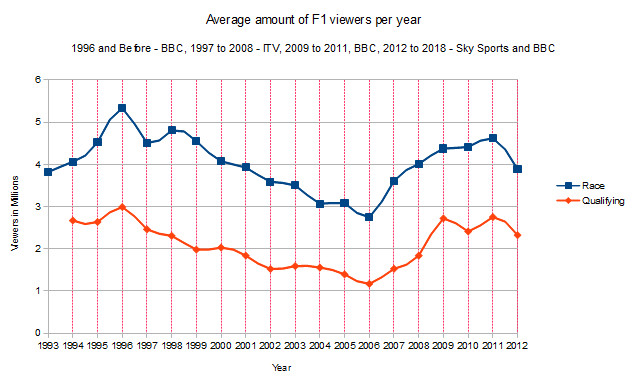
– 2006 – 2.75 million
– 2007 – 3.61 million
– 2008 – 4.01 million
– 2009 – 4.38 million
– 2010 – 4.41 million
– 2011 – 4.62 million
– 2012 – 3.89 million (or 4.10 million using the ‘35 percent theory‘)

You may note some minor differences in the viewing figures above versus the ones I published in August. The reason for this is because all the figures from 2006 to 2012 now that I use are consolidated figures (which take into account anyone who has watched within 7 days) whereas before it was a mixture of overnight ratings and consolidated ratings. You will also notice that the 3.89 million figure for 2012 is the lowest since 2007. This is where the ’35 percent theory’ that I explained in August comes back in. When comparing to previous years, the BBC F1 programme started at 12:10 and ran to about 15:15. Sky Sports F1 live programmes ran from 11:30 to 16:15 meaning that the total average for Sky Sports F1 would be artificially deflated as a result. Applying the ’35 percent theory’ on top of the Sky figures gives you the 4.10 million average above. When both BBC and Sky are live, the average for those ten races is 4.38 million viewers. When only Sky are live and when BBC are showing highlights, that figure drops to 3.88 million viewers. Only twice for those ten races has the programme average been above 4 million, Bahrain and Hungary. The remaining eight races with exclusive Sky coverage recorded a average of under 4 million viewers. I would be questioning why that is the case, a 500,000 viewer difference between the two feels significant to me and appears to prove that the majority of fans still prefer to see Formula 1 in 2012 live.

Whilst the change in Formula 1 broadcasting for 2012 is one reason for the overall drop, it is not the only reason. The Olympics is another reason, as is Euro 2012 and Wimbledon. All three sporting events have hit Formula 1’s ratings this year. Formula 1 was always going to be hit by the Summer of Sport. But would the 2012 season have faired better if every race live on the BBC? Absolutely, and I think the fact that the average when races were live on BBC is 500,000 higher than when they were exclusively live on Sky proves that. BBC have every possible way of promoting sporting events – radio, TV, interactive, online. Formula 1 would remain in the limelight and would not become a forgotten sport for the Summer. I think the average would have been down on previous years, but it would have remained well above 4 million viewers in my opinion, near to 2010 levels.

Figure 1.1.
Figure 1.1.

The drop for 2012 is disappointing. But things need to be kept in perspective, Formula 1 is still immensely popular in the UK, and we are not going back to the mid 2000’s, where Formula 1 was struggling to achieve over 3 million viewers as Figure 1.1. above shows. The ratings should rebound in 2013 – no Olympics and no European Championship’s means that Formula 1 has weaker competition next Summer. If viewing figures do not rebound, then questions must be asked whether the BBC and Sky deal was a worthwhile deal for the money-makers to enter into. It also brings up the question of BBC Sport’s Formula 1 team extremely dedicated and hard work across these past few years in increasing the popularity of Formula 1 after the Schumacher years only for those higher up at the BBC to flush over half a million viewers down the toilet.

I noted during my August blog that I hoped the the season average would increase. At the Summer break, the 2012 season was averaging 4.14 million viewers. That figure has dropped very slightly by 40,000 viewers. Not a large drop, but a slight drop for whatever reason. A worrying statistic for me is that only four races seen their figures increase versus 2011. They were Brazil (up by 1 million), Italy, China and Europe. Two races were not on the calendar in 2011, meaning that fourteen rounds seen their figures drop versus 2011. Whilst some rounds clashed with other sporting events, I am fairly certain that does not apply for every one of those fourteen rounds. Canada unsurprisingly recorded the biggest drop versus 2011, whilst Japan and India also recorded sizeable drops. 2013 should see an automatic increase in significant numbers for Canada as the race will be live on BBC One.

The 4.38 million average for the BBC and Sky live races is an average I would have expected overall if BBC was showing every race live. There is an argument – and this applies for every race – that the 520,000 viewers drop is purely due to Sky’s longer airtime as there is a higher viewership for Sky when they are live, hence more weighting on their ratings. That is a completely false assumption to make due to the fact that I have already equalised the ratings as demonstrated above. Using consolidated figures and 5-minute breakdowns, The F1 Broadcasting Blog has taken averages from seven races across the past seven years and calculated the overall averages. Those races are Monaco, Spain, Britain, Belgian, Singapore, Abu Dhabi and Europe. The average is from race start to chequered flag only. The results are as follows:

Race averages (Mon, Spa, UK, Sin, AbD, Eur)
– 2006 – 2.92 million (32.4%) (exc. Belgium, Singapore and Abu Dhabi)
– 2007 – 4.09 million (36.5%) (exc. Singapore and Abu Dhabi)
– 2008 – 4.57 million (37.9%) (exc. Abu Dhabi)
– 2009 – 4.95 million (43.9%)
– 2010 – 5.61 million (43.5%)
– 2011 – 5.58 million (43.7%)
– 2012 – 5.03 million (38.4%)

The conclusion that there has been a viewership drop is unquestionable. Those seven races were all BBC and Sky live races, and the race average is again in the lowest since 2009 – a similar story to the 4.38 million programme averages. Qualifying in 2012 has fared well, averaging 2.32 million viewers. Whilst it is down on 2009, 2010 and 2011 – it does stand in-line with 2010’s average of 2.41 million viewers which itself was affected by a Summer dominated by sport.

Focussing on Sky only to end the piece, live coverage of practice 1 has averaged 65,000 viewers; practice 2 has averaged 75,000 viewers; practice 3 has averaged 94,000 viewers. All three of those numbers have dropped off compared to the where they were at the Summer break, possibly suggesting that viewer fatigue had set in for the latter stages of the season. The F1 Show, when on location at race weekends, has averaged 45,000 viewers. I’ve covered my thoughts on those figures before and the main conclusion is that those figures are extremely low and below Sky’s own expectations. The GP2 Series and GP3 Series on Sky Sports F1 have also fared poorly, both averaging below 100,000 viewers. In my opinion that is due to the lack of advertising that Sky give to the feeder series’, neither series have had adverts promoting them on Sky so it is little wonder to see either series struggle for viewers on the channel. It is worrying that the stars of the feature are being seen by what feels like ‘one man and a dog’, GP2 and GP3 definitely need more of a prominent status here in the UK for 2013.

Several weeks on, and nearly 15,000 words later, that is my 2012 Verdict. Due to reasons already explained, I had hoped to have finished the verdict before Christmas but in any case, I hope you’ve enjoyed reading the pieces and as always, comments are welcome. Roll on 2013!

Note: All the figures quoted here are the averages for the whole race programme, not the race average unless stated. Figures are mostly official figures from BARB and Broadcast magazine. While I have made comparisons and analysis of figures, I should note that I do not have every single ratings figure. The figures for that races that I am missing are:

1992 – Australia, San Marino, France, Portugal, Japan (live and both for AUS, JPN)
1993 – France (live), Japan (highlights)
1994 – Pacific (highlights), San Marino, France, Hungary, Japan (live)
1995 – Australia, Argentina, San Marino, Spain, Japan (all live)
1996 – Canada, Japan (all live)
1997 – Japan (live)
1998 – Australia,France, Japan (all live)
2000 – Malaysia (live and re-run), Japan (live)
2001 – Japan (live)
2003 – Malaysia; Japan (both live)
2004 – China (live)

If anyone is reading and has any of them ratings, leave a comment. While this piece focusses primarily on the 2012 ratings picture, my April piece focussed on the ratings picture for the past twenty years. For anyone wishing to read that, please click here.

Sky Sports F1’s mid-week output: The 2012 Verdict

Having looked at both BBC Sport’s and Sky Sports’ Formula 1 output at race weekends this season and at how both line-ups have performed, the latter two parts will focus on two separate issues. Part 6 (this part) will look at Sky Sports F1’s output outside of race weekends while part seven will look at the ratings picture from this past season and examine whether ratings have gone up or down as a result of the BBC and Sky deal that came into effect at the beginning of 2012.

Following the decision to create a channel for Formula 1 at the end of 2011, it meant that more programming had to be created so that Sky Sports F1 felt and looked like a channel. As thus, this season after every race weekend, Sky Sports F1 has broadcast:

Fast Track – a quick-fire look back at a race weekend accompanied by a backing track (30 minutes)
Weekend in Stills – photographs from a race weekend via Sutton images with a backing track (30 minutes)
Weekend in Words – a review of the interviews done across a race weekend (60 minutes)

Since the Summer break, when I did my August review, the only programme that has been added to the schedule was a six part series entitled “Britain’s Next F1 Star“, looking at the stars coming up through the ranks into Formula 1. Apart from that, though, nothing else has been added meaning that my mid-season thoughts are largely unchanged. Whilst I can see why some would find Weekend in Stills a good programme to watch, I don’t feel the same way for either Fast Track and Weekend in Words. Neither offer a new perspective for a race weekend, and instead are there to regurgitate material that has already been released. Weekend in Words in particular smacks of lazy programming in my opinion, at the best of times Formula 1 drivers sound and feel like ‘PR bots’ so I do not know why people would want to sit through this in any way, shape or form.

Instead, Sky should look at exploiting the footage that is hidden behind the Red Button and not released publicly and turn that into a programme. In my opinion there is so much programming that could be made from the footage, yet they are doing nothing with it. Whether that is for contractual reasons or not, I do not know. I made a little list back in August and will do the same below (although I won’t go back to that post to look at those thoughts, the list below will be similar to the one back then).

The Heart of Racing – an onboard view from one driver only, intersperced with their team-radio – whether its the race winner or someone further down (30 minutes)
Going Hybrid – a better version of the World Feed, except comprising of the World Feed, plus Onboard, Pitlane feeds and exclusive team-radio (60 minutes)
A Weekend with… – a weekend with a particular member of a team or an official looking at their activities during a race weekend from Thursday to Sunday from a video diary perspective (30 minutes)
The Little Extras – the little bits of footage that was shown on Sky Race Control during a race weekend, but never made the World Feed (30 minutes)
Extended Interview – an extended interview from the race weekend with no cuts (30 minutes – similar to the one they shown with Sebastian Vettel and Ted Kravitz following India. The beauty of that 15 minute cut was that it felt much ‘rawer’ than what it came across in the shorter 5 minute cut during the Indian Grand Prix race show as you seen a different side of Vettel and the laughs and jokes that do not come across in shorter cuts. The extended cuts would also show the drivers’ as more relaxed as well as the full answers to questions posed to them rather than a cut down version)

The thing is, at the moment there is nothing to entice me to watch Sky Sports F1 outside of race weekends, aside from The F1 Show, which is one hour out of a potential 15 hours (3 hours per day, Monday to Friday). The viewing figures outside of a race weekend are terribly low because there is zero incentive for anyone to tune in. All the channel consisted off for the majority of the year was repeat after repeat. Another show I would had, which I deliberately have not mentioned above is a studio show with journalists giving their opinion on all things Formula 1. It seems like this was trialled out in the Summer with David Croft presenting and I hope this returns in 2013 as it would significantly bolster their line-up. Unlike the above shows, it would not need to be every week, maybe six or seven editions a year spread throughout the year depending on what stories crop up in Formula 1, the benefit of having them spread out means you can get different journalists on screen and therefore different viewpoints.

As well as the above, a nod to the past must be given with documentaries being shown alongside the F1 Legends series. Unfortunately, though the signs are that Sky have been rejecting documentary series’, see these two tidbits here and here. The comment in the second link is staggering: “As an aside, when I approached the Head of F1 at Sky TV with the programme, (I showed him a 5 min clip) his ONE comment was ‘The interviews are crap but the old film is good.'” The fact that a dedicated Formula 1 channel is rejecting old documentaries shows that there is something seriously wrong with the decision making process. It is a channel that should be aimed at Formula 1 fans. You are not going to find Formula 1 documentaries that will cater to the casual Formula 1 fan, that won’t happen. They should be accepting the documentary offers as it would help increase the channel reputation and it would only help the channel further in the future. As with everything, you have to start somewhere, and it is not automatically the end of the world if one ‘bad’ documentary makes it to air. Whether it is old documentaries, or just ‘Top 10 Greatest Drivers’ and ‘Top 10 Greatest Races’ for example in the pre-season, things like this will help increase the reputation of the channel. Having a sparse channel outside of the weekend makes it look like the channel is run on a shoe-string budget which is not the impression they should be giving.

There are plenty of directions Sky could go with potential documentaries in 2013 but the outlook does not appear rosy. In 2012, you could argue that they were short of time as they only won the rights in July of 2011, but in March 2013, that argument falls down like a stack of cards. The channel should be stacked of programming come March, there really is zero excuse. After all, why bother having a dedicated Formula 1 channel, yet only make a half hearted effort of it? With the pre-season, as I noted above, they could air a ton of pre-season documentaries along the lines ‘Top 10s’ and get the contributions of their own on-air team alongside Formula 1 legends. Things like that would be relatively cheap compared to a detailed Formula 1 documentary on a team’s history, but it fills airtime, it does the job and brings a feel of ‘newness’ to the channel rather than yet more repeats. Sky seem to have the attitude that nothing before 2012 matters, hence why there is a heavy weighting on 2012 programming with the programming on ‘rinse and repeat’ in the off-season currently.

Which brings us nicely to classic races. The lack of classic Formula 1 races in 2012 on Sky Sports F1 was bewildering and staggering when you consider BBC’s fantastic classic F1 series online. Yes, they screened classic races from Monaco and Britain, but that was it. Nothing in the latter half of the season. In 2013, classic Formula 1 races is a must. Not season reviews, but classic F1 races. You may say, “they may not have the rights to screen them”. If so, it is beggars belief that they would create a channel without having the core archive rights beforehand as you leave yourself falling down a hole by doing that. In my opinion, classic F1 races are absolutely essential for the channel to succeed. After all, why bother building a channel without the core rights? It does not need to be tons of classic races, otherwise they will run out fast, but two or three a week would be sufficient before a race weekend. In fact, it does not even need to be a ‘classic’. Every race has a story. Why not exploit that story and re-tell the story in a new format (like ‘Senna’, but just one race), which goes back to the documentary mentions above.

With the above in mind, I would consider the following a strong schedule after a particular race weekend, in this case after the Australian Grand Prix and before the Malaysian Grand Prix:

Monday 18th March
19:00 – Replay from the Circuit
– replay of the Australian Grand Prix

Tuesday 19th March
19:00 – Fast Track
19:30 – The Heart of Racing
20:00 – Going Hybrid
21:00 – Classic F1: 2001 Malaysian Grand Prix

Wednesday 20th March
19:30 – A Weekend With…
20:00 – The Little Extras
20:30 – Extended Interview
21:00 – Classic F1: 2002 Malaysian Grand Prix

Thursday 21st March
19:30 – Weekend in Words
20:30 – Weekend in Stills
21:00 – Classic F1: 2011 Malaysian Grand Prix

Friday 22nd March
01:30 – Live from the Circuit
04:45 – Going Hybrid (R)
05:45 – Live from the Circuit
09:45 – The F1 Show
10:45 – Classic F1: 2001 Malaysian Grand Prix (R)
12:45 – Replay from the Circuit (R)
16:00 – Replay from the Circuit (R)
20:00 – The F1 Show (R)
21:00 – F1 Legends
21:30 – A Weekend With… (R)
22:00 – The Little Extras (R)
22:30 – Extended Interview (R)
23:30 – Fast Track (R)
23:30 – The Heart of Racing (R)

Saturday 23rd March
02:45 – Live from the Circuit
06:15 – Going Hybrid (R)
07:15 – Live from the Circuit
09:45 – Classic F1: 2002 Malaysian Grand Prix (R)
11:45 – The F1 Show
12:30 – The Little Extras (R)
13:00 – Replay from the Circuit (R)
17:30 – Replay from the Circuit (R)
20:00 – The F1 Show (R)
21:00 – Classic F1: 2011 Malaysian Grand Prix (R)

Sunday 24th March
06:00 – Live from the Circuit
12:30 – documentary
13:30 – Replay from the Circuit (R)
20:00 – Malaysian Grand Prix Highlights (R)

In the very least, there needs to be more content outside of race weekends. The media and sponsorship releases last week made no mention of any new content outside of race weekends, so time will tell whether the schedules look any different come late February and early March. I will praise the fact that they have some new content on over Christmas, specifically their 2012 season review and the twelve individual team reviews as they could have took the easier option and shut the channel over the Winter. Of course, with any new programming, it needs to be advertised – not once was Britain’s Next F1 Star trailed in adverts on Sky Sports F1, a problem that was common across the channel this season.

I don’t like to criticise, but it is not often a sport is given a dedicated channel and at the moment I do not feel Sky are exploiting the channel to its full potential outside of race weekends. This part of the ‘2012 Verdict’ may sound like the most critical, but for me, this was by far the weakest part of the product. Sky are approaching this as a ‘programme’ without thinking about the remainder of the channel. If they are thinking of it as a ‘programme’ then they should axe the channel in all honesty. There is nothing on Sky Sports F1 at the moment that they could not do on another Sky Sports channel. Which is why they need to bolster the content to justify the channel’s existence. Like I say though, this past season there may have been a perfectly valid reason that there was not enough time between July 2011 and March 2012 to commission, film and air content – although they did a very good job with what they did air, such as the Legends show which is returning in 2013. Hopefully the scope for that is expanded, also with sensible scheduling as once a week as I don’t think scheduling it after races worked.

As always, your thoughts and comments are welcome. Do you think Sky’s mid-week output needs to improve? Coming up in part seven, it is my look at the 2012 ratings.