The best and worst of BBC’s F1 coverage in 2014

The ratings picture that I published a few days ago showed that BBC’s Formula 1 viewing figures have dropped 5.9 percent on 2013, despite Formula 1 crowning a British World Champion.

But, why has that happened? There are several reasons why people have tuned out of BBC’s product in my opinion. However, on the other hand, there are some areas where the BBC continue to excel in. Instead of doing a blow-by-blow review of each individual member of BBC’s F1 team, and then again with Sky, I’m going to pick out the best and worst parts of their coverage this year, mainly to keep the content fresh, but also because of time constraints on my behalf. As mentioned previously, I’d like to cover NBC’s Off the Grid and The Road to Mercedes in the next few weeks, if time allows.

Best
Suzi Perry
Yesterday, I was having a quick flick through the BBC’s 2013 F1 Preview magazine. In it was a section with Ben Gallop, BBC’s Head of F1, who explained that, when picking Jake Humphrey’s successor, they did not want a “Jake 2”, but rather someone who would bring something fresh to the table. I said that Suzi Perry’s 2013 season was mediocre, also noting that there should be big improvements in 2014.

For me, Perry has been much better on the microphone this season, and has built great rapport with David Coulthard and Eddie Jordan throughout the course of the season. I think it has helped significantly that a British driver has been in the championship race instead of having one driver dominate proceedings, as this helped bring a new spark to proceedings, which no doubt spurred the team on. With Perry recently confirming that she would be with the BBC team for 2015, things should continue to improve as next year progresses.

Commentary
As in 2012 and 2013, I have again enjoyed the commentary of Ben Edwards and David Coulthard. Edwards is still the best motor sport commentator there is out there, whilst Coulthard is a good analyst alongside Edwards. I don’t think Coulthard has had any stand out moments this year, however he is still a very valuable asset to the BBC that they cannot afford to lose. The only blot on their copy book for me is Japan, when both Edwards and Coulthard both failed to realise that Jules Bianchi had dropped down the timing screens. I think it was about 10 minutes before both realised that Bianchi was involved in the accident.

Over on 5 Live, Jack Nicholls was a revelation for the four races he did, as I noted earlier this year. I imagine that his role as Formula E lead commentator will limit what he can do – if anything – for 5 Live in 2015, but I hope we do hear him commentating on a Formula 1 race again in the near future, whether it is on TV or on radio.

VT’s
Once again, the quality of the VT’s that the BBC have produced has been top notch. From the Hamilton sky dive at Silverstone to the Jenson Button career retrospective, the VT’s produced have always delivered. There is not much more to say here, except that it is important to recognise that fact. Despite the reduction in content with the new deal, in year three, the VT’s are as good as ever.

Worst
Forum
Between 2009 and 2011, the BBC F1 forum used to be the highlight of any Formula 1 weekend. Even if the race was as dull as dishwater, you could always rely on the forum to have some great discussion with a selection of guests discussing the current issues in Formula 1. Sadly, in the past few years, the forum has fallen off the cliff, and Sky’s improvements in their post-race programming only serves to highlight this further. I understand the need and want to convey the pit lane atmosphere, especially now they only have ten forums in a year, but I also think that something needs to change.

It may be worth going back to the ‘motor home’ setting like they did in the early days of the coverage, interspersing that with Tom Clarkson and Lee McKenzie roaming the paddock. Furthermore, there really should be a short forum for the highlights shows (20/25 minutes long) to wrap things up, and to show the interviews that did not make the main show. Again, I point to the 2012 Bahrain Grand Prix forum, that being a highlights race, as one of the best, but simplest, pieces of TV in that year. When the forum is at its best, it is the best in the business by far, before that can happen again, it needs to be steered back onto track.

Lack of Gary Anderson
Normally when 95 percent of your audience agree that a mistake has been made, chances are that it means you’ve made a catastrophic error of judgement. According to Anderson, the BBC believed that their viewers were not interested in technical analysis, hence the mutual decision to part company. The void that Anderson left was filled by Tom Clarkson, although no one was brought in to directly replace Anderson.

2014 began with a barrage of criticism directed towards Formula 1 because of the new V6 power trains. The BBC needed someone like Anderson to explain to the viewers why the new power trains were brought in, and what the key technical innovations were compared with 2013. As good as Clarkson and Allan McNish are, neither of them have the technical experience and expertise that Anderson has. I maintain now, nearly a year on, that BBC made a huge mistake in parting company with Anderson. Their loss was Formula One Management’s gain.

Scheduling
I know this is not a problem that the BBC F1 team can solve, but rather a problem for the wider BBC scheduling team. If you are having to schedule a highlights programme on BBC Two, that is not good for Formula 1 as it automatically reduces the reach. Bahrain was a stunning race, but was shown in highlights form on BBC Two, as was Austria. I know that Sky probably sometimes take the self interest approach, but both broadcasters when scheduling should work together to bring the best possible product to the viewer – which means having highlights programming on BBC One and preferably with consistent timing.

In my opinion, BBC’s product went into reverse during 2014, even when considering the fact that they only screen half the races live. The forum is an easy fix with some simple tweaking. Whether they could bring Anderson in on an ad-hoc basis again, I don’t know. But I hope their product improves again during 2015 back to how it once was. Coincidentally, 2015 will mark the half way part of their current contract with Sky which runs until 2018.

UK F1 viewing figures record slight year-on-year drop

Lewis Hamilton’s championship victory may have brought joy to both BBC and Sky Sports F1’s ratings in the latter half of the season but despite this, viewing figures are down year-on-year according to unofficial overnight viewing figures. Whereas 2013’s figures dropped sharply after the Summer break, the 2014 season has seen the opposite occur.

> BBC average figures drop year-on-year
> Sky record highest figures since channel launch
> Numbers still down on 2009-11 figures

As always, for those that are new to the blog, it is best stating what figures we are comparing here. For Sky Sports F1, all the viewing figures are for the three and a half hour race day slot: one hour before the race and approximately 45 minutes after the race. I have used the equivalent slots for 2012 and 2013 to present a fair and complete picture, there would be little use in presenting a skewed picture, so all data is for the equivalent timeslots. Over on BBC, I have used their programme averages, whether it be live or highlights, irrespective of whether the highlights were shown on BBC One or BBC Two, as was the case for Bahrain and Austria this year. Repeats are taken into account for Asian-based races that the BBC showed live. As always, viewing figures are for TV only. iPlayer, Sky Go and the such like are not included.

The 2014 story
It is worth a reminder that, in my Summer post, I stated that the UK’s audience for Formula 1 had “dropped to their lowest level since 2008.” Luckily, that has not happened. Thanks to a British driver winning the championship, numbers have increased. Crucially though, have numbers increased as much as expected, and has the scheduling hit the numbers badly?

Sky Sports F1’s race day programme has averaged 790k from 12:00 to 15:30, or equivalent across 2014. That number is up a massive 23.4 percent on 2013’s figure of 640k and up 11.1 percent on 2012’s figure of 711k. Whichever way you spin that, for Sky, those are very positive numbers. Things were not looking good for Sky during 2013 with numbers falling, but this year, they have turned it around, and then some more, to record an average higher than both 2012 and 2013. Back in the Summer, I was taking about a “meagre 22k.” The numbers bandied around above are much bigger than 22k, and in my opinion is definitely something worth recognising.

So, why the increase? Better picks? Absolutely. Having both USA and Brazil exclusively during the title run in would have done the average wonders. But even then, it is more than just that. In fact, 14 out of 16 races recorded increases between 2013 and 2014 on Sky Sports F1 (the other four didn’t take place), so even the races where Sky shared coverage with BBC did the numbers increase. That suggests to me that viewers are liking the product that Sky are putting out, otherwise they would not be tuning in to their pre and post-race shows. The substantial increase correlates with feedback on this blog to suggest that people are liking Sky’s race day show more than previously. Sky’s figures are no fluke, in my opinion.

The BBC’s figures dropped year-on-year by 5.9 percent, recording an average of 3.22m versus 3.42m in 2013. Numbers are up slightly on 2012’s average of 3.21m, although those two numbers are within the margin of error to be statistically insignificant. Scheduling was not great. Bahrain and Austria were both screened on BBC Two in highlights form, USA and Brazil, two races bound to draw big audiences if shown live, were shown as highlights. Under this current agreement, I feel that there will be a yearly discussion about what things could/could not have been done differently as a result. With USA, Brazil and Mexico back to back in 2015, BBC will not be able to screen all three live, although at least one of the three will be screened live.

Still down on BBC only days
The combined average of 4.01m is up 2.3 percent on 2012’s 3.92m, but down 1.3 percent on 2013’s average of 4.06m. What is fascinating to me is the closeness of those three figures despite the complete parallels that each of those three seasons faced. 2012 had a battle between Sebastian Vettel and Fernando Alonso until the end. 2013 arguably peaked in Malaysia from a fan perspective, with figures tumbling in the latter half of the season. In contrast, 2014 started with backlash from the wider media over the sound, or lack of, developing into a rivalry between Hamilton and Nico Rosberg, inevitably helping the British figures in the final half of the year due to Hamilton’s involvement. I would suggest that it is a coincidence that the three years line up next to each other, although astonishing at the same time.

However, the 2011 season averaged 4.5m, a 10 percent drop. In fact, 2009, 2010 and 2011 all averaged higher than 2014. It will be, for me, an age old question of whether figures are really down 10 percent versus 2011, or whether more people are now watching Formula 1 via tablets, smart phones and as thus not being included in those figures. I don’t know. I’m not sure whether FOM even know the exact answer to that statement. For some people, 2009 through to 2011 will always be the barometer of Formula 1 coverage in the UK. Whether a group of fans bailed out of watching every race live at the end of 2011, I don’t know. I think it should probably be noted that a lot of shows have dropped year-on-year (the majority of ITV’s schedule is just one example), so in comparison, F1 has done well to hold onto the majority of its existing audience.

My own opinion is that viewing figures are down versus the BBC only days. That is an undeniable fact. When you include other devices, I think 2014 would close the gap in on 2011 slightly. Not significantly, as it seems clear to me that people have moved on. Sadly this is something that you cannot prove statistically, but anecdotally. If you were to grab a few people who have watched F1 at some stage in the past few years, chances are they would tell you that they are watching less F1 than when every race was live on BBC One, because it is not as readily available now as it was previously.

Heading into 2015
Whilst the overall picture is not exciting, the movement of viewers between BBC and Sky is somewhat interesting. There has been a 10 percent shift from BBC to Sky, although whether these are new viewers watching Sky’s coverage, or returning viewers to the channel from 2012, it is impossible to tell. It will be intriguing to see if Sky can continue the upwards swing heading into 2015, or whether BBC can claw back a few viewers off Sky that they have lost during 2014.

A BBC spokesperson said “In what has been a fantastic year with a wealth of sport available to watch on the BBC including the Winter Olympics, World Cup and Commonwealth Games we’re delighted with our F1 coverage this season which reached an impressive 26.1m people. This was undoubtedly helped by a brilliant season finale – Abu Dhabi was the most watched race of the season, with 6.5m people tuning in.”

overnights.tv-bannersF1

The new kids on the block

It is fair to say that the biggest news heading into 2014 was the announcement that BT Sport would be broadcasting MotoGP, along with feeder series’ Moto2 and Moto3, exclusively live, ending BBC’s and British Eurosport’s commitment to the sport. The move was controversial for several reasons, as has been discussed before on this blog.

The first half of 2014 has not been the smoothest for BT, however is filled with both positive and negatives. Starting off with the positives, I think we can all agree that BT Sport’s coverage is in general the most expansive that any broadcaster has ever provided to UK viewers. From classic MotoGP races, to Moto3 practice and onto MotoGP Tonight on the Tuesday following the race, the channel has it covered. Admittedly, the weekend coverage is not too different to what Eurosport provided before them aside from the fact that BT are providing a bit more ‘colour’ to the coverage. Strangely, the one thing that they don’t cover is the warm-ups for all three classes, but apart from that, they show every other session live. Alongside this, the channel has also produced documentaries, such as the Mike Hailwood documentary that aired a few months back, to positive praise from those in the motorcycling world.

One other positive from me has to be the commentary line-up of Keith Huewen and Julian Ryder. I did admit back in February to being sceptical to Huewen being brought back into the fold, especially as it meant that they chose not to go for Toby Moody. In a poll on this site before the start of the year, results were mixed in relation to BT’s team: only 10 percent of readers thought the line-up was good with nearly 50 percent disappointed in the line-up. However, I’ve been happy with the commentary team, and they have been a joy to listen to throughout the first half of 2014, Huewen quickly settling back in I feel. That’s not to say that they were right to make the change, but at least it has not backfired on them. I’ve enjoyed too the contributions of Matt Birt and Gavin Emmett, BT definitely made the right decision in bringing both men on board.

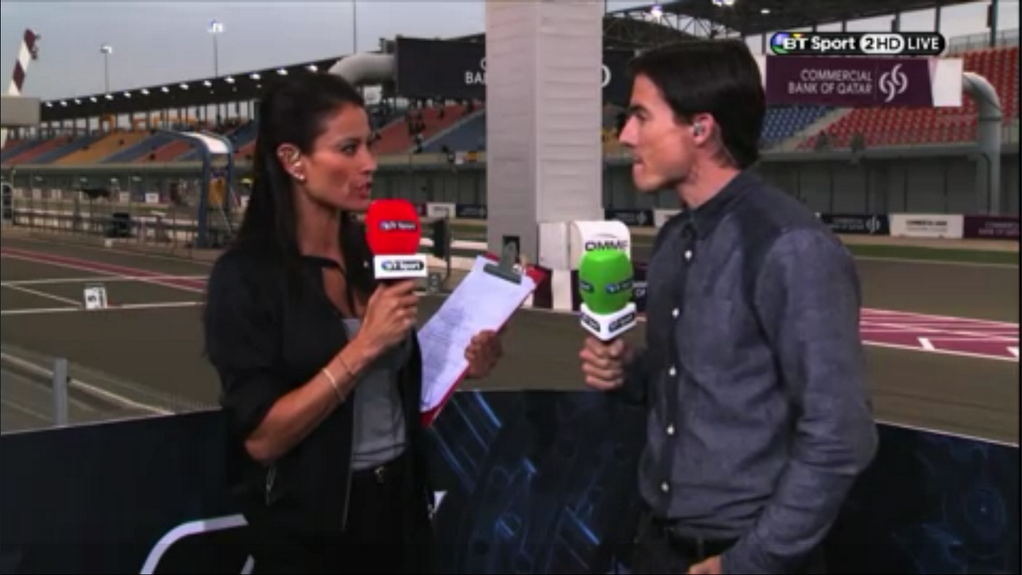
BT Sport's balcony position at the 2014 Qatar MotoGP. As of writing, never to be seen again.
BT Sport’s balcony position at the 2014 Qatar MotoGP. As of writing, never to be seen again.

Whilst there have been some aspects that BT Sport have got right, there are very well publicised negatives, which the poll before the start of the season appears to foreshadow. If I’m going to review the coverage objectively, then I cannot sweep the terrible decision making of who they appointed as presenter under the mat. On February 14th, the channel announced Melanie Sykes as their MotoGP presenter, a move which surprised many at the time. It was clear early on that Sykes was out of her depth, and not suited to presenting live sport. Why BT chose Sykes as their presenter is anyone’s guess. After four rounds, the two parties posted company. Whether it was to do with her personal issues or not, we will never know (although she has since presented several weeks worth of Let’s Do Lunch on ITV, a live daytime programme), but either way I think we can say that this was BT’s biggest mistake of the season so far. Why did they hire a presenter who had no experience presenting live sport? Apparently Sykes was supposed to bring a new audience to MotoGP, obviously that never happened.

Since then, Craig Doyle and Abi Griffiths, their rugby and Motorsport Tonight presenters respectively, have taken over presenting duties. What is unclear is whether Sykes’s departure has had any knock on effect. Qatar aside, every race has had some studio presence. Was that the intention from the get-go? If so, one has to consider if going down this route was a second mistake from BT Sport. Jake Humphrey, BT Sport’s lead football presenter and former BBC F1 presenter blogged this week, and noted that “This job is all about being at the centre of the story, which is where the real thrill lies with being a sports broadcaster. It’s why I always press to be next to the pitch, track or court when I’m working. For me, studios can’t convey an atmosphere the same.” The same applies for MotoGP.

The picture a few paragraphs up show the balcony position that BT Sport used in Qatar. It was unique. It was different. It was something that neither BBC and Sky had used before in their Formula 1 coverage. So why did it disappear after Qatar? Again, maybe it was the intention for Qatar to be the only race fully on site (along with potentially Britain and Valencia, we shall see), but it seems like a completely wasted opportunity. The balcony position could have been fantastic at showing off the atmosphere in places like Barcelona and Mugello where grandstands are rammed on race day. I assume BT Sport will be looking for a permanent MotoGP presenter for 2015 onwards, and, as they’ve done with the Premier League coverage for this season, hopefully the coverage in 2015 will be fully on-site. What they are currently doing on-site is great, it just needs a fully uniformed approach, with the studio aspects being removed from their live coverage.

As the motto goes, “you learn from your mistakes”, and I hope BT Sport learn from what has gone wrong with the MotoGP coverage so far as we head into the latter stages of the year.

Trying to justify unpopular decisions

It is fair to say that over the past few years, Formula 1 has made some strange and unpopular choices. Whether it is your odd stewards enquiry decision, or something a bit more extreme, such as double points, the poor decision making has been an undercurrent throughout. This ‘odd’ decision making has not been limited to the FIA and FOM though. Earlier this year, the BBC and Gary Anderson parted company, a move which surprised many readers at the time, and still does considering his role has never really been replaced. The only technical expert now in the UK Formula 1 broadcasting scene is Ted Kravitz on Sky Sports F1. Whilst Kravitz is great at what he does, having only one technical person across two channels is simply not good enough.

The role of technical analyst can be traced by twenty years in the UK’s Formula 1 coverage. Starting off with Jonathan Palmer on the BBC in the early 1990’s, James Allen took over the baton when ITV started screening Formula 1 in 1997. When Allen moved to the commentary box, Kravitz became the technical expert from 2002 onwards, a role he has maintained across ITV, then BBC and now Sky Sports. With the increase of air-time that the BBC’s coverage gave from 2009 onwards, the role of technical analyst has become a vital commodity. Several years later, and Kravitz is now doing his own Notebook’s over on Sky Sports. When Kravitz defected to Sky, Anderson was brought on board over on the BBC. Sadly, it didn’t last long. Less than two years later, Anderson and the BBC parted company.

There’s two ways you can look at Anderson’s departure. One is that he simply walked, and the second is that he was fired. The truth is somewhere down the middle. As Anderson noted, he was typing up a resignation e-mail, only to get a phone call about the subject! So the BBC wanted to get rid of Anderson, and Anderson, feeling he was being misused, wanted to leave. When blog readers were asked about this subject earlier this year, a whopping 5,000 people responded – and 95 percent of you thought that BBC and Anderson parting company was a bad move all around. In a request for comment from this blog, Ben Gallop, BBC’s Head of F1, said that the team had been adjusted in order to to bring the “best package for audiences across TV, radio and online”. Half a season on from Anderson’s departure, has the BBC product benefited from Anderson’s departure?

I think, if you’re going to look at what Anderson brought to the broadcasts, the answer has to be no. As mentioned above, the BBC have not replaced him. We can run around that point as much as we can, but that is the fact. Tom Clarkson and Allan McNish may bring a lot to the team, but again, neither are technical experts. They do not have the knowledge or expertise with thirty years and beyond in the field like Anderson does. You can’t replace that expertise just like that. One train of thought is that the new deal that began in 2012 meant that Anderson was more expendable. You can’t get rid of commentators, you need someone to interview drivers, you need a presenter and analyst. That leaves Anderson left for the chopping block. It almost feels like that the role of technical analyst was kept on for 2012 and 2013 as an ‘olive branch’. The BBC may also think that they cannot provide much technical analysis during a highlights show. I thoroughly disagree with that thought, as you are basically saying that you cannot provide technical analysis for a casual audience.

By not hiring a replacement for Anderson, are BBC saying that technical analysis is a dying breed? Does the general Formula 1 audience not care about the latest technical innovations? I would hate to think that the answer to those two questions is yes, although Anderson’s comments back in February certainly hinted that the BBC believe that the latter is true. If anything, the technical aspect has been even more important in 2014. Just ask Craig Scarborough or Matt Somerfield and I’m sure they would confirm this. Earlier this year, Formula 1 was facing a barrage of criticism, because apparently the ‘new formula’ was not up to scratch. A lot of that, you guessed it, concerned the technical aspects. But where was Anderson? Well he wasn’t communicating that to four million people because BBC had decided otherwise! Anderson would have been fantastic earlier this year in justifying the new technology to viewers and explaining why it is necessary for Formula 1 to move with the times.

Anderson leaving the BBC was a sign that he felt that he was being misused. Half way through 2014, do I miss Anderson’s contributions? If I’m going to be honest, the truthful answer is that the void left has not been as big as I expected it to be. Whether this is a result of them not using enough of him in 2012 and 2013, I don’t know, but I’m not left feeling that I miss his input in the coverage. Despite this, I do think it was a big mistake for them to part company. 2012 and 2013 were the same formula in essence, whereas 2014 was a complete reboot, and he would have been one of BBC’s most important assets for 2014 (or, should have been). Sadly, that didn’t happen.

Judging the current F1 Show format

Half way through the motor sport year, I tend to write several posts looking at BBC’s and Sky’s teams and programming in detail. In both 2012 and 2013, I went down this route, each member of each team was analysed one-by-one. For this year, I’m going to do things a bit differently. The main reason for this is purely because I haven’t watched as much of their broadcasts as in previous years, and also because I talk a lot about non-F1 motor sport now on this site as well.

As readers will know, back in April, I did not watch the Chinese Grand Prix live, and in addition to that, to be honest, not a lot has changed on the Formula 1 front. There are some things though, that have changed. Instead of focussing on everything, the next few posts will be limited to those points, and look at what should be changed going forward. The first two posts of the mid-season verdict I published last month, exactly half way through the Formula 1 and MotoGP seasons. The Formula 1 ratings piece can be found here, with the MotoGP article located here, both containing comments from the respective broadcasters.

The Sky Sports F1 team seen no departures over the Winter break and one addition in the form of Bruno Senna. Their programming slate has remained largely the same, the highlight no doubt being ‘Senna Week‘ from the beginning of May. Arguably, that was the channel’s best week since its inception in 2012. The main visible change for 2014 concerns The F1 Show. The show has been broadcast live from March to November on Friday’s since 2012. Previously, on non-race weeks, the show was presented from a studio, with no audience present. This was changed for 2014. After a successful trial pilot last Summer, the channel opted to switch studio’s permanently, with the studio audience a firm fixture for this season.

Every change has positives and negatives, and that is definitely the case here. Starting with the positives. The first, and I suspect there may be disagreement here, is social media. Sky promoting and actively encouraging social media involvement during the show with polls is a good thing. It is something that I have advocated in the past, and I am glad to see that Sky are doing live polls during the show. I can see the other arguments, for example “why are we wasting time on Twitter polls”, but in my opinion, the positives outweigh the negatives. Social media interaction is vital if you want the show to thrive and reach a new, bigger audience – across both Facebook and Twitter.

Another positive, in the words of Daniel Puddicombe who wrote about this in April, is that the audience brings an extra element to the show. It makes the show livelier with a studio audience, which was lacking a lot in 2013. The F1 Show in 2012 worked with Georgie Thompson and Ted Kravitz, because they bounced off each other brilliantly, however once Thompson left, the show fell off the rails. Last year, this was clearly evident, the Midweek Report with Anna Woolhouse was easily the more superior show, despite an infinitely smaller budget to play with thanks to the quality of guests and the discussion within the show. What Sky have done for this season is make the Midweek Report feel like The F1 Show of 2012, with The F1 Show becoming a lighter magazine show, rightly or wrongly with Natalie Pinkham now as one of the hosts. Pinkham works better with a studio audience, which is perhaps one reason why the format change was brought in for the first place.

Whilst there have been positives, one of the biggest negatives for me has been the quality of the guests on The F1 Show. In a few weeks time, MotoGP Tonight will be broadcasting live from BT Sport’s studios with current champion Marc Marquez as one of their guests. Unsurprisingly, tickets for that edition sold out fast. BT’s MotoGP coverage is five months old, and they’ve managed to get the world champion on. Two and a half years into The F1 Show, and I don’t think we have had one top-tier current racer in the studio. Having a studio audience is fantastic, but only if the calibre of guests live up to the standard.

Why can’t we have a member of the audience ask ‘a decision maker’, for example Christian Horner about double points? If Sky are to have a studio audience, they should exploit it. One of the biggest criticisms of Formula 1 this season is that the teams do not listen to fans; by appearing on The F1 Show, they have at least one avenue to change that perspective. The F1 Show may not be Question Time, and I wouldn’t expect it to be (after all, I’ve called it a ‘lighter magazine show’ two paragraphs above!), but guests with importance to modern day Formula 1 would be good. That way, Sky can quote the guests on the website over the weekend, which will only promote the show further. It is one thing Sky doesn’t do, promote their own shows after they have been aired, with quotes from X on relevant Y issue.

Sometimes their agenda is debatable, and focussing on the wrong areas. Again though, this is interlinked with the lighter touch and the quality of guests. The 2015 rules were a big focus at the end of June, but was treated as an afterthought on The F1 Show. One last negative concerns the scheduling, Friday nights at 20:00 does not work in my opinion, and may well hurt their ability to get top quality guests, unlike MotoGP Tonight which airs on Tuesday nights. Given that Midweek Report airs on a Wednesday, I don’t think the scheduling will change, however the Friday slot must take a chunk off its audience, and I would be surprised if many catch up with the show on the basis that the show is not ‘must see’. It should probably also be noted that the changes have not moved viewing figures, the numbers remaining below 100k, this despite the launch show in March 2012 attracting 200k to the channel.

Overall, have the changes to The F1 Show so far been for the better? I think this depends on what you are looking for. If you want just F1 discussion then you are better off watching the Midweek Report, however, if you want a bit of humour injected into it, then The F1 Show is your thing. Like I say though, Sky have to take advantage of having a studio audience for the format to work, and for that to happen, the quality of guests has to be better as we head into the latter stages of 2014.