BBC F1’s output: The 2013 Verdict

The first two parts of the 2013 verdict looked at and analysed the BBC and Sky Sports F1 teams, suggesting possible improvements in both areas. Parts three and four switches the focus from the personnel to the programming.

Part 3 will look at BBC’s Formula 1 programming. The new deal from 2012 onwards has meant a reduction in what the BBC serves up. Unsurprisingly, some parts of the programming have been affected since, both due to that but also due to personnel changes as I will look at in this piece.

Practice
The look of practice changed significantly on the BBC this year. From 2009 to 2011, BBC shown every practice session live via its Red Button service. This halved from 2012 with the revised contract, but the raw coverage was the same. The broadcaster was simply taking the Formula One Management (FOM) World Feed from the five minute sting to five minutes after the session with Radio 5 Live’s commentary. For 2013, that changed thanks in part to the significant reductions to the Red Button, which meant that practice was heading to BBC Two.

At the time, they touted this as ’40 extra hours of network output’, whilst technically true, of course the raw hours they were showing was not increasing, merely changing stations. It did make me wonder how many people were completely oblivious to them showing practice between 2009 and 2012 behind the Red Button! In any case, the change to BBC Two meant that it had to become a proper programme, start titles, end titles with proper presentation from Suzi Perry and A.N. Other (mostly Gary Anderson).

I guess this was okay for what it was, although I was somewhat wondering what the point was when sometimes they only had five minute intro and outro. I can understand having a proper programme if they had more air-time, as they did after the session in Canada, one great example where they had half an hour on BBC Three. I imagine they will continue with proper presentation in 2014, but hopefully they manage to get five or ten more minutes post-session to go with that, instead of rushing off the air.

Inside F1
One of the minor parts of BBC’s Formula 1 coverage since 2009 has been the ‘Inside F1’ show. The show has typically aired on the BBC News Channel on Friday’s and Saturday’s at 18:45 during race weekends. It has more recently been fronted by Lee McKenzie on location. Normally, every Formula 1 show has some kind of purpose. Considering its timing, you would say Inside F1 simply aims to wrap up the on-track action for Friday and Saturday respectively. Which is, fair enough, considering its fifteen minute slot. The utter confusion for me comes with one word: Why? And more importantly: Who?.

Why is BBC’s F1 team still filming this show, and secondly, who is this show actually aimed at? The main purpose appears to be that it is only there to fill air-time on the BBC News Channel. Again, it comes to the question of why Formula 1’s target audience would be watching at the time. The answer is that they simply would not be. It does follow after Sportsday, but I’m not sure what it achieves. Yeah, its a harmless show in nature, but it could be much better. BBC Three, 19:00, 30 minutes. Why not? It makes a fair bit more sense than the BBC News Channel in my view.

The BBC Three programming, instead of Inside F1, could bring a different demographic towards Formula 1, which is needed to try and reverse the difficult ratings patch as of late. In effect, I’m saying scrap Inside F1, and bring in a new show. Make it a hybrid Friday review with a different slant. The other option (for Saturday’s) is to have a BBC One tea-time show for live races, which could work in a similar way to Murray and Martin’s ITV F1 Specials in the late 1990’s. Either way, BBC need to be open to new ideas, and a new F1 show to cater to a different demographic is an interesting perspective.

Pre-Session
One of the points that has largely remained the same since 2009 is the length of both the Qualifying and the Race build-ups. For live races, this has consistently been between 50 and 60 minutes irrespective of location. I’ll begin though with the highlights, as the format is largely formulaic: a quick intro, Qualifying wrap up, maybe an interview feature, grid interviews and then onto the race. It doesn’t need to be anything more for the highlights show, and given the programme length of between 90 and 120 minutes there is not much room for manoeuvre anyway.

It’s the live programmes where all of their energy goes into. Starting with the positives, the quality of their VT’s are unmatched. From a technical standpoint, the team still produce some jaw dropping VT’s, whether it is a particular race retrospective, or throwing some old McLaren’s around Silverstone. It is great to see too that there is still a bunch of talented people behind the camera and that the BBC and Sky deal did not rip the production team apart. In front of the camera, the show has still been good.

Good, but not great. Partially, this has not really been their fault in the latter half of the season with stories drying up. Nevertheless, it hasn’t quite felt ‘must watch’ for me at several stages this season. Assuming we have a championship battle, and with Suzi Perry in her second season, I do think things will rebound. I’ll allude to this a bit in the Sky piece too, but broadcasters’ thrive with a championship battle with stories bouncing from pillar to post and possible angles to take. When that disappears, so does possible content. Hopefully 2014 is a more competitive year for all concerned.

Post-Session
The only real negative for me comes with BBC’s post-session coverage. From 2009 to 2011 we had a high quality forum, which was generally very highly regarded. Quality dipped in 2012, but appears to have plunged for 2013. This is not an issue for highlights show, but for the live races it is a major issue. For those that didn’t watch, between 2009 and 2011 the forum consisted of a hybrid of chit chat and good, solid in-depth analysis. This did vary a bit from sitting down outside with guests, or inside a motor home, or later on walking along.

Changing presenters does not help thanks to the very nature of the forum, but what has not helped at all for BBC is that this is where Sky have made the biggest strides, particularly this year. And it is one area where I feel Sky are now actually better than the BBC. BBC mastered the forum from 2009 to 2011 and it is quite sad to see it go downhill. Does it still have its good, great TV moments? Of course. But it appears to be just a few people wandering around now, meaning that the entire feel of the forum has changed for the worse since a few years ago.

Thankfully, for BBC, this is a simple fix. All they need to do is to watch a tape of a 2013 forum and compare it to a 2010 forum and analyse where things have changed, and more importantly, do they think the changes are for the better. Personally, I don’t think the changes have been for the better and Sky’s improvements in their post-race show just highlight it further for me. I hope the forum does get back on track, because when it is good, it is easily the best piece of Formula 1 television during a race weekend. Let’s get the house back in order, please.

2013 has been a year of stability for the broadcaster, although the change of presenter has been highlighted significantly. Don’t get me wrong, the BBC is still one of the best, if not the best Formula 1 broadcasters in the world. I hope 2014 sees some programming changes and tweaks in order to improve the product further. I fear that BBC risk falling into the trap of complacency and resting on the laurels. 2014 looks set to be an exciting Formula 1 season on and off track, and I hope BBC’s coverage reflects that after what has been a solid, but unspectacular 2013.
The Sky Sports F1 Team: The 2013 Verdict

Sometimes, they say that the second year is tougher than the first. In broadcasting, I think the reverse is true. The first year is for building the blocks and the second year is for expanding and cementing those blocks. Sky Sports F1’s second year was largely more successful than the first, as I will analyse in this piece and also the programming piece later on. Sky’s team was assembled at the beginning of 2012 as two presenters, one commentator, five ex-drivers and two pit lane reporters.

Whilst they did indeed build the blocks in 2012, the off-season seen two blocks disappear. Like BBC, the Sky team encountered several changes. Here is how the team changed between 2012 and 2013:

In
– Anna Woolhouse (now presents Midweek Report, although she is not a ‘formal’ part of the team)

Out
– Allan McNish (moved to 5 Live F1)
– Georgie Thompson (moved to pastures new in America)

Thompson’s departure came as a massive surprise to most considering it was only announced (on a blog, nonetheless) four weeks before the start of the season! Nothing official was ever released concerning her departure, it was all rather odd. Anyway, as it turned out, some things are for the better, and Thompson leaving ended up fitting into that category.

Anthony Davidson – @AntDavidson
– main racing activities in endurance racing
– 24 F1 races spanning eight years
– joined 5 Live F1 in 2004, before moving to Sky in 2012

One of the highlights of BBC’s Formula 1 coverage between 2009 and 2011 was the Red Button service used for practice sessions, with commentary from Anthony Davidson and David Croft. The two were universally praised by fans due to their relaxed and interactive style with viewers texting and tweeting their thoughts. Moving onto the present day, and Davidson can also be found standing at a Sky Pad, although in 2012 things were slightly…. different. In 2012, Sky had Davidson and Georgie Thompson stand at the Sky Pad, in a portacabin. The analysis was great, but the location was awful, the two may as well have been in London!

As it turns out, Thompson was not off to London, but off to America. Before the start of the season, I said Davidson would struggle going solo. How wrong was I. Combined with the Sky Pad moving outside, it is one of the biggest improvements to Sky’s coverage year-on-year. Moving it to outside allows them to do more things, which I’ll discuss more in the later pieces. As for Davidson, he has gelled in brilliantly with the team more so this year, it felt last year like he was hidden away because of the Sky Pad location. I suspect he will reduce his commitments for 2014 with good reason, as he now has a new born to take care of!

Damon Hill
– won the 1996 Formula 1 championship
– retired in 1999 after Brabham, Williams, Arrows and Jordan stints
– sole year at F1 Digital+ in 2002, returning to broadcasting in 2012 with Sky

It is not often that people go ten years without appearing in broadcasting, but in the case of Damon Hill, that happened. Of course, he has been ITV F1 commentator sporadically when Martin Brundle was on holiday, but being announced as Sky Sports F1 pundit for 2012 would be his first permanent role since 2002. At the start of last season, Hill was not great to put it lightly. Him and Simon Lazenby were wooden to watch and it was bordering on the cringeworthy. Thankfully, things did improve and with the help of Johnny Herbert, Hill loosened up as a pundit.

2013 has been better for Hill, thanks to Herbert alongside him and also the general rule that the second year tends to be better than the first. In terms of his role, it has not been that much different for him, the commitment level has remained the same. There have been some races where Hill has not travelled to, which is a good thing as Hill is better in small doses. Will he stay for 2014? I think he will, but it is worth bearing in mind that his son Josh retired from motor racing back in July, so Damon may take the opportunity to step back his commitments further for the time being.

David Croft – @CroftyF1
– began broadcasting career at BBC in 1995
– climbed up the latter to 5 Live F1 from 2006 onwards….
– …before moving with Davidson to Sky in 2012

Moving with Anthony Davidson to Sky Sports F1 from BBC Radio 5 Live was always the most logical move for Croft once BBC had reduced their coverage. I did enjoy Croft’s commentary with 5 Live as I alluded to above, his and Davidson’s practice ramblings was sometimes the highlight on an F1 weekend. Whilst I still do like Croft’s commentary, for me, he is still what puts him and Brundle below Ben Edwards and David Coulthard. The first point is with Sky self promotion, which sadly is beyond his control, but very tedious nevertheless considering most viewers know about said services, yes Sky Race Control, I’m looking at you!

There are other issues, though. I said in the BBC piece that I liked Edwards because he makes the hairs on the neck stand up, and it doesn’t feel forced. With Croft, the opposite is true. Every time the race ends, and every time an overtaking move happens (DRS assisted or not) it feels like he needs to shout for whatever reason, maybe because it sounds good in VT’s after, who knows. But to the viewer watching it live, it doesn’t come across as good, it is forced. I know Croft does a lot of fantastic things off the microphone, #AskCrofty for one, I like those, but inevitably he will be judged on his commentary. Good, but no Edwards, in my view.

Johnny Herbert – @JohnnyHerbertF1
– began his Formula 1 career in 1989 after breaking both legs
– recorded three Grand Prix victories before retiring in 2000
– first race with Sky Sports F1 at the 2012 Chinese Grand Prix

The first few races on Sky Sports F1 in 2012 from a presentation stand point were not the best. It needed a more ‘bubbly’ personality, shall we say, to enter the fray. Enter Johnny Herbert, who became part of the team from the Chinese Grand Prix. Whether that was always the intention I don’t know, but it was a much needed addition to the team which was a wooden, as I noted in Hill’s section above. It is also interesting to note that, despite retiring in 2000, his role with Sky is the first time that he has appeared on the F1 broadcasting scene, having never previously held a role with BBC or ITV.

In terms of opinions, Herbert gives the obvious opinions and doesn’t really say anything surprising, if anything he toes the ‘party line’. Another issue is if things get too light hearted, as has happened on occasion, but has not yet gone overboard, thankfully. Saying that, the Sky team would suffer without him, as he helps hold the show together in my view. I think Herbert will stay with the team for 2014, he is a safe pair of boots and there is no logical reason for them to get rid of him.

Martin Brundle – @MBrundleF1
– veteran Formula 1 career from 1984 to 1996
– part of ITV’s coverage for their entirety, commentating alongside Murray Walker and James Allen
– moved to BBC in 2009, and then hopping over to Sky for 2012

One of my criticisms of Sky in 2012 was the overuse of Martin Brundle. I can understand the reasoning behind it, as he was the face of their pre-season advertising, but throughout last season it felt like they needed to shoe horn Brundle into every segment and session possible. Brundle was present doing pieces to camera during practice in pit lane right the way through to appearing on the post-race show regularly last season. This has been reigned in somewhat during 2013, but it is still a minor issue for me.

Instead of being in pit lane during practice, Brundle now reports from a particular corner during practice. Whilst this is a great addition, it really could do with a camera man being down there with him, although I appreciate that safety is an issue when reporting from track side, which probably prevents Sky from doing this. His grid walks are still as strong as ever, although I think his commentary has dipped from when he was with the BBC. The lack of a championship battle does not help in that respect, but it was noticeable as the season progressed. Hopefully Brundle rebounds where that is concerned in 2014.

Natalie Pinkham – @NataliePinkham
– various roles on way up to F1, including The Wright Stuff
– became BBC Radio 5 Live pit lane reporter from 2011….
– …but the role was only for a season, she was soon heading to Sky

Due to Georgie Thompson choosing to leave Sky Sports at the start of the year, it meant that Natalie Pinkham’s commitments were expanded. Pinkham throughout 2013 presented The F1 Show alongside Ted Kravitz, and for me it is one reason why The F1 Show has dropped in quality compared with 2012. If I had a choice of who to keep in the team for 2013 between Thompson and Pinkham, it would have been Thompson for me purely because she is the better presenter and can be more ‘serious’ than Pinkham.

Pinkham’s role is more or less the same as Lee McKenzie’s on the BBC, except the latter is leagues ahead of the former. When Pinkham does attempt to do something serious, it is difficult to take it seriously, and feels completely out of place. I do wish that Sky chose Rachel Brookes ahead of Pinkham for The F1 Show, but sadly I think that boat has sailed. I wouldn’t mind Pinkham just as a ‘features reporter’ (even if it did mean her taking a, dare I say it, Beverley Turner style role from ITV) as long as it meant that her air-time was reduced significantly as a result. I’m not a big fan of Pinkham, I’m afraid.

Simon Lazenby – @SimonLazenbySky
– presented Sky’s Rugby coverage up to and including 2011
– moved, along with executive producer Martin Turner, to Sky Sports F1
– stayed with the team for 2013

When Sky were first announced as joint right-holders for Formula 1 from 2012, there was no logical person to give the presenting role to, and it was quite obvious early on that the hiring for the role would come from internally. If you are to talk about choices though, I guess you’d be looking at Keith Huewen and Jon Desborough from a motor sport background. Why Sky Sports never went for either of those for the F1 role, we will never know. After that it was almost a free for all, but in the end Simon Lazenby got the role. 2012 was not great for Lazenby, and I said that strong improvements had to come for 2013.

Sky kept him for 2013 (as his only likely successor decided to leave), and happily Lazenby appears more relaxed in the presenting role. It probably helps for him also that there has been a bit of movement at the BBC, with Lazenby now up against Suzi Perry, who herself has not had the strongest of years. Whilst Lazenby has improved, I don’t think he is near the level of Jake Humphrey, who I think the consensus now is that Humphrey is leagues ahead of most of the Sky presenters with his style of presenting (when not in a studio, that is!). Hopefully Lazenby improves further for 2014, should he stay.

Ted Kravitz – @TedKravitz
– began with ITV in 1997, moving in front of the camera in 2002
– jumped to the BBC in 2009, with commitments improving significantly
– moved to Sky for 2012

They always say ‘leave the best to last’. Not deliberately, but in this piece, Kravitz is the last of the main individuals on the Sky Sports F1 team. And in my view, the best. Kravitz was a main part of BBC’s output from 2009 to 2011 and with more air-time, Sky seemed the logical home for him considering his Notebook’s, which have been even better in 2013 – and expanded with testing and Saturday’s covered too. An always amusing moment is when he fails to stick inside his allotted time, on multiple occasions running 5, 10 or sometimes 15 minutes over his scheduled slot!

The Notebook has definitely the highlight of 2013 from a broadcasting standpoint for me, whether it is Kravitz wandering around Suzuka’s amusement rides or giving us a behind the scenes look at Sky’s operations as he did late in the season. Alongside the Notebook, Kravitz roves up and down pit lane, whilst also presenting The F1 Show. For reasons I’ve noted briefly above and I will note later on, it has declined in quality, although the reasons for it are out of Kravitz’s control. I’m hoping Kravitz’s Notebook’s are back in force from February with F1 testing again!

Others
If you haven’t watched much of Sky Sports F1’s coverage outside of race weekends then you will probably have not heard of Anna Woolhouse. Woolhouse is the presenter of the Midweek Report. An interesting story is that it was initially online only and filmed against a green screen, with a shoe string budget. Only a few weeks later was it noted how pointless an online only show was when you have an entire channel! So, from China, the programme had its first airing on Sky Sports F1. And since then, at times the programme has been better than The F1 Show! I’ll explain more in the next few parts, for me, the choice of guests on occasion is infinitely better. As a presenter, Woolhouse does a fine job, but there is not much more to add here.

Over on Sky Sports News (where Woolhouse also is!), is Craig Slater and Rachel Brookes. Nothing has changed here, except that Sky Sports F1 now tends to use more Sky Sports News interviews which is a good thing, as it makes complete sense for F1 and News to share resources. It made no sense to me why BBC TV and Radio were initially completely independent of one another in 2009, that soon changed where TV people started appearing in Radio’s coverage of practice. My only wish is that Brookes is more prominent on the channel, preferably replacing Pinkham, but that doesn’t appear to be happening yet.

As a unit, if I was to compare the two teams directly and ignoring the programming outside of it, the BBC for me have the edge due to their team being more all rounded than Sky. Sky throw their eggs all in one basket with former drivers whereas with BBC you have an ex team boss and an ex technical director, neither of which Sky have. I do think the Sky team is much improved on 2012, but it will always have the ‘imbalance’ problem for me until they get in another non-driver to add some balance to the programming.

The BBC F1 Team: The 2013 Verdict

2013 has passed in earnest, with Sebastian Vettel winning his fourth Formula 1 Drivers’ Championship in dominant fashion. Off the track, it has been another interesting broadcasting year, with the new Formula 1 broadcasting era in full swing, as BBC and Sky Sports now share the television rights. Now that we are firmly into December, it is time for ‘The Verdict so Far’ series to make a triumphant return!

Throughout this series of blogs, I will look back on 2013 and analyse both BBC’s and Sky Sports F1’s programming and cast an eye towards the future as F1 heads into 2014. I should note that it is unlikely that there will be a ratings analysis piece in this series of blog posts, the reasoning behind this can be found here. As always, we start the series of by looking at each member of BBC’s F1 team. Here is how the team changed between 2012 and 2013:

Who came In
Allan McNish (replaced Jaime Alguersuari as 5 Live F1 commentator; moved from Sky Sports F1)
Suzi Perry (replaced Jake Humphrey as presenter)
Tom Clarkson (expanded on 2012 commitments)

Who went Out
Jaime Alguersuari (moved to pastures new)
Jake Humphrey (moved to BT Sport)

When you look at it like that, blank piece of paper, before the start of the year and you weight it up, the in’s are stronger than the out’s. However, Jake Humphrey, was always going to be a big loss for the team. Throughout 2013, it was evident that the programming was sorely missing Humphrey’s presense…

Allan McNish – @AllanMcNish
– one and only season with Toyota in 2002
– sporadic appears with ITV F1 in 2003
– made a broadcasting return with Sky Sports F1 last season

When McNish made his return to the television screen as a sporadic member of the Sky Sports F1 team last year, I anticipated him expanding his role for 2013. What I did not expect though was for him to move sideways to BBC’s 5 Live F1 team. Nor did I expect them to announce him as commentator before the season… but only doing six races, which felt farfetched. I didn’t really have an issue with McNish only doing six races. The bizarre bit for me was that no one else was announced to do the other thirteen races. Was this a cost cutting move by 5 Live? On the suface, it definitely looked like it.

McNish’s only two appearances since the Summer were in Belgium and Italy meaning that there is not much to say here. I have not listened to 5 Live a lot this year, so I don’t know if people prefer hearing Susie Wolff or Alexander Rossi, but no permanent co-commentator for the remaining thirteen rounds does shout out cost cutting. If both parties are happy with the current arrangment then I imagine McNish will be back, although I hope the races he is at is spread out a bit more thinly rather than a big lump in the middle next year.

Ben Edwards – @BenEdwardsTV
– began F1 commentary with Eurosport in 1994
– next F1 exploits in 2002, for F1 Digital+, before A1 GP and BTCC commentary duty
– returned to F1 in 2012 with the BBC F1 team

As good as ever, in my view. Many times before, Edwards was in the wrong place, at the wrong time. For the start of ITV’s coverage in 1997, Murray Walker continued his commentary, meaning Edwards was not an option. For 2002, James Allen was chosen as ITV’s lead commentator, whilst Edwards did F1 Digital+. And in 2009, the BBC chose Jonathan Legard over Edwards. Thankfully, for 2012, BBC made the right move and Edwards was announced as lead commentator alongside David Coulthard in the box.

It was a long time in the making, and about time too in my book. Edwards has stuck to what he does best: commentating. No extra presenting, no extra interviews. Just commentate. I’ve thoroughly enjoyed his commentary throughout 2012 and 2013, and is one of the main reasons why I pick BBC over Sky Sports for the race itself. Yes, he makes mistakes, but who doesn’t. I prefer a commentator that makes the hairs on your neck stand up, and Edwards does just that. Hopefully Edwards has many years of Formula 1 commentary duty ahead of him.

David Coulthard – @TheRealDCF1
– raced for Williams, McLaren and Red Bull
– 13 wins in a 15 year F1 career
– moved to broadcasting in 2009, joining BBC following his F1 retirement

It was known within the paddock for a while before his final Formula 1 race that Coulthard would be moving into broadcasting with the BBC F1 team. At the 2008 Chinese Grand Prix, both him and Jake Humphrey were in the Red Bull garage, presumably looking at what laid ahead for 2009. Coulthard’s role in 2009 was simply being a pundit alongside Eddie Jordan. Which worked very well, both were streets ahead of the ITV product before it. Pundit turned commentator in 2011 with Jonathan Legard leaving.

Coulthard has arguably been one of the biggest beneficiaries of the BBC and Sky Sports deal, with more air time and doing more VT pieces too. One highlight of the 2013 broadcasting year has to be the McLaren piece at Silverstone with the Scot and Mika Hakkinen. Sublime, and beautiful to watch. Coulthard has also been doing the grid walks as of late, his calm approach appearing to be a winner with drivers’ and resulting in better grid walks for it. Again, I hope nothing changes here, Coulthard is great with the team, it doesn’t yet feel old or stale for me, so hopefully things continue as they are.

Eddie Jordan
– Jordan team owner from 1991 until 2005
– 4 victories as team owner in 250 races
– joined the BBC in 2009

Love him or hate him, Eddie Jordan is just one of the people that made Formula 1’s return to the BBC that much better. It was a genius move by the corporation to get him on board for the coverage, lighting up the pre-race coverage. Obviously there are others that subscribe to the theory that he always acts and is “a bit of a prat”. I don’t subscribe to that category of thinking. Jordan brings a lot to the BBC’s shows. Does he brings as much as he used to? No, due to the broadcasting rights changes, which meant that his commitments were reduced, but he is still a valuable asset.

You only have to look at his track record for exclusives to know how valuable he is to the BBC F1 product as a whole: predicting Michael Schumacher’s return and Lewis Hamilton’s move to Mercedes are two highlights. He has also sometimes this season done the grid walk, which to his credit in India went according to plan and very smoothly! Things do not work as well sometimes with just him and Perry, compared with him and Jake Humphrey, but I really do feel that BBC’s team would be worse off without Jordan, although like I said at the start: you either love him, or hate him!

Gary Anderson
– veteran technical director at Jordan and Stewart
– broadcasting exploits with Setanta Sports
– moved to BBC’s F1 team for the 2012 season

When Ted Kravitz moved to Sky Sports F1, along with a pleothra of other people, it did leave a gaping hole in BBC’s team. Enter Gary Anderson, who replaced Kravitz as BBC’s technical analyst and roving pit lane reporter during practice. Given that Anderson had been round the block many times, he was definitely the most logical person for the role. As I noted a few times last year, I felt that Anderson was out of his depth during the first half of the season as he struggled to convey technical information to a casual audience. But since then, Anderson has come on in strides.

It is a strange one actually, as you would probably logically feel that Anderson and Kravitz should be the other way around. Anderson doing more technical stuff on Sky Sports F1, with Kravitz on BBC F1. Both do fantastic things in their respective roles though and I would not want that to change. As well as being in the pit lane, Anderson is also in the commentary box for many races. Some may not realise this, but Anderson does at times form a three man commentary booth alongside Edwards and Coulthard, with Anderson dipping in from time to time. So far, the three man booth has worked definitely well, and gives them an advantage over the opposition.

James Allen – @JamesAllenOnF1
– started off as ESPN pit lane reporter in mid 1990’s
– part of ITV’s F1 team for their entire F1 stay, Allen as reporter then commentator
– joined BBC’s Radio team for the 2012 season

The announcement at the beginning of 2012 that Allen was going to join BBC Radio 5 Live was a surprising one, but as Allen noted himself, he felt that radio commentary was a new challenge compared to his previous ITV commitments. Since ITV’s coverage ended, Allen has set up a blog site which is still going to this day and has grown substantially.

There is not a lot more to add here for Allen. I have not listened to a lot of the radio coverage for 2013, but listening to little bits and Allen seems more comfortable and relaxed on the microphone than he did in the ITV days. Allen does not commentate on every race either, with Jonathan Legard commentating on some races. Sadly, whilst Allen does seem more comfortable, Legard does not with commentary and appears to have not improved that much compared with his TV days.

Jennie Gow – @JennieGow
– first appeared on the motor sport broadcasting scene in 2010 as BBC’s MotoGP presenter….
– …but was dropped at the end of that year in favour of Matt Roberts
– returned to the BBC as 5 Live’s F1 pit lane reporter from 2012

The idea of people being dropped from broadcasting roles after just one season is never a nice one. Back in 2010, I didn’t think Gow was the greatest motor sport presenter ever seen, but on the same note I thought the decision by BBC to drop her was not justified either, although admittedly this was at a time when the costs of everything was being reigned in, as the Formula 1 team found out several months later. Thankfully it was not too long before Gow got another chance, starting with the 2011 Canadian Grand Prix with BBC Radio 5 Live, not a bad race to start with!

I don’t think 2010 was too early for Gow, but may well have been in hindsight too early for the role. Nevertheless, Gow returned to the F1 paddock full time with 5 Live last season, Gow benefiting from the BBC and Sky deal. Alongside the pit lane role, Gow presents the other 5 Live F1 shows, the main contribution being ‘Slicks-O-Six’ phone in show on the station, which I have enjoyed listening to, and hope continues on a regular basis into 2014. Should there be any TV changes, then personally I hope Gow benefits from that.

Lee McKenzie – @LeeMcKenzieF1
– remember Speed Sunday? ITV? 2004? Nope? Well Lee fronted that
– part of the A1 Grand Prix team as pit lane reporter
– first Formula 1 broadcasting exploits from 2009 with the BBC

I think it is fair to say that last December, a fair few people were disappointed. Overlooked? You could say so. The BBC chose Suzi Perry over Lee McKenzie for the Formula 1 presenter role, presumably under the rationale that Perry has more experience in live motor sport presenting than McKenzie. It was disappointing for McKenzie though considering she has been part of the BBC F1 team since 2009. Nevertheless, she decided to continue with her pit lane reporting role, a role that in 2013 has brought many advantages.

Early on in the season, McKenzie highlighted the advantages of said role thanks to the controversial Malaysian Grand Prix, she being one of the first people to interview both Mark Webber and Sebastian Vettel thanks to her pen role. McKenzie has not done much more this season in comparison to other seasons aside from sporadic forum appearances and interviews, as a result probably is one of the more overlooked members of the team. She deserves to one day lead the BBC team, but given the choices made by higher up last year, I’m not sure if that will ever happen, sadly.

Suzi Perry – @SuziPerry
– part of BBC’s MotoGP team as presenter from the late 1990s through to 2009
– presented shows such as The Gadget Show amongst various other strands
– returned to live hosting as the BBC F1 presenter for 2013

McKenzie’s section leads me on very nicely to Perry. Do I understand the BBC’s logic? Of course. However, did they go with the most experienced back in 2009? Nope, and that paid off brilliantly for them. Sometimes, broadcasting is about taking risks, and taking Perry felt like the safe option. Well, it should have been, anyway. Up until this point in her career, Perry has largely been covering two wheels. And also, the air-time has been generally shorter, none of her BBC MotoGP shows were three hours in length with a one hour forum on the end.

I don’t think BBC were expecting a bumpy first season with Perry. She has been, for me, mediocre. Flashes of a potentially great F1 presenter, but nothing more. Comparisons can be made with Simon Lazenby’s 2012 season with Sky Sports F1, it has to be said. Of course, before Sky F1, Lazenby had no motor sport presenting experience. Perry did, and I think that is the difference maker. Nevertheless, I think Perry should stay for 2014 purely because I’m not a fan of rash decisions and, as we have seen with Lazenby, she should improve significantly next year. That’s assuming BT Sport don’t come calling…

Tom Clarkson – @TomClarksonF1
– a familiar face on Australian television, due to his TEN Sport F1 connections
– made his first BBC F1 appearance as interviewer in Canada 2012
– appeared full time as a member of the team this season

Last, but not least, we move onto Tom Clarkson, who, in my view is moving fairly quickly up the ranks. For the UK audience he has almost come out of no where, no formal announcement for Canada 2012, with some almost wondering “who is he?”. Clarkson was back though full time for 2013 (with a proper announcement!), roaming the pit lane during practice and conducting interviews in the paddock before and after the session.

Someone spotted Clarkson conducting an interview for TEN Sport during one of Ted Kravitz’s Notebook programmes on Sky, which suggests that he has been doing double duty for at least some of 2013, a man clearly in demand! I’ve enjoyed his contributions though throughout 2013, solid where they have been and seems confident doing pieces to camera, during practice too with him and Jennie Gow sometimes in pit lane. There is not much else to say, but I hope he remains with them into 2014.

It is fair to say that the BBC, as they always have had since 2009, still have a very strong team despite the change in broadcasting rights. 2014 for them needs to be like Sky’s 2013: stability. They’ve had two unstable years in a row, and desperately need to balance the ship. Should Perry stay, 2014 needs to build on 2013 with the team getting back to the award winning programming we seen from 2011. I know that the air-time for highlights limits what they can do, as I will talk about in a later part, but I really hope they bounce back in style for 2014.

Part two of this blog series will look at the opposition: Sky Sports F1 and their team, as I outline who has impressed me, or unimpressed as the case may be.

The ratings picture: The 2013 Verdict so far

Having looked at both the BBC and Sky Sports F1 teams along with their respective programming, part five of ‘The Verdict so far’ series brings us to the UK television ratings. Which is, quite simply, a measure of Formula 1’s popularity. Have Formula 1’s ratings dropped further since 2012, or have they rebounded? In this blog post, we shall find out the answer.

Before I start though, again it is worth reiterating figures I use. All of the figures in the blog are programme averages, unless stated otherwise. This is because these are the figures most readily available, and I do not have industry access to the viewing figures. Therefore, I am relying purely on the figures I already have and those that are reported in the public domain. I also have the Formula 1 viewing figures going back to the early 1990’s, those can be sourced from Broadcast magazine. All figures in this particular piece are official consolidated ratings from BARB, which include recordings within seven days.

For those of you that haven’t followed my ratings, we have seen since 2000 three ‘phases’. Phase 1, from 2000 to 2006 saw ratings drop from 4 million viewers to under 3 million viewers thanks to the lack of British interest and Michael Schumacher’s dominance. With Lewis Hamilton and Jenson Button on the horizon, and Formula 1 returning to BBC, meant that phase 2 from 2007 to 2011 saw ratings rise, from just over 3 million viewers to 4.6 million viewers. Phase 3 is simply 2012. Ratings dropped half a million between 2011 and 2012. Whilst the change of broadcasting rights was definitely one reason, as I outlined in my 2012 piece at the end of last year, the ‘Summer of sport’ in this country was another factor which has to be accounted for.

Official ratings from BARB show that, as it stands, 2012 was a blip. So far, Formula 1 is rating in between 2010 and 2011’s mid-season average and is back to the viewing figure levels pre-2012. As always, the figures comprise of:

– Sky live and BBC highlights
– Sky live, BBC live and BBC re-run (Asian based races)
– Sky and BBC live (non-Asian based races)

However, it is not all rosy. Further analysis shows that, versus the same races last season, BBC’s Formula 1 ratings have increased 21 percent, whilst Sky Sports F1’s ratings have dropped 9 percent.

– BBC F1 (3.18 million vs 3.83 million)
– Sky Sports F1 (699,000 vs 638,000)

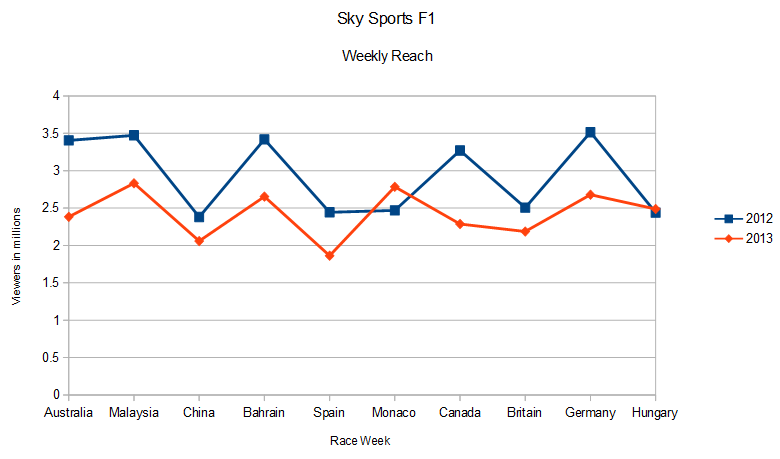
The Sky drop is further reflected in their channel reach, which has dropped half a million during live race weeks this year:

Sky Sports F1′ s weekly viewership reach at the half way point of the 2013 season. Source: BARB.

As the graph shows, only two races for them this season have increased in terms of reach, Monaco, one of their exclusive races, and Hungary due to no Olympics clash. Regarding programme averages for them, only Britain, Monaco and Hungary have increased. Unfortunately, it is difficult to find many positives for Sky as the picture is mainly decreases. Overall, the 2013 season is currently averaging 4.47 million viewers, or 4.70 million viewers when taking into account Sky’s long programming length.

– 2009 – 4.38 million
– 2010 – 4.41 million
– 2011 – 4.62 million
– 2012 – 3.89 million / 4.10 million
– 2013 – 4.47 million / 4.70 million

Typically, viewing figures drop in the second half of the season due to the run of Asian based races, whilst Belgian and Italy tend to be low too. Nevertheless, the headline figures are very, very positive. If you were to look at the first ten races of previous seasons, then you get:

Averages (Aus, Mal, Chn, Bah, Spa, Mon, Can, GB, Ger, Hun)
– 2009 – 4.30 million
– 2010 – 4.63 million
– 2011 – 4.86 million
– 2012 – 3.82 million / 4.06 million
– 2013 – 4.47 million / 4.70 million

Which places 2013 between 2010 and 2011 as I noted earlier. I expect 2013 to drop like 2010 and 2011 did, to end up with a season average of around 4.20 million / 4.50 million. The only reason 2009 increased towards the end of the year was because of Jenson Button, whilst the first half of 2012 was hurt by other sporting events as I’ve said multiple times. However, if Lewis Hamilton does put up a title fight, the figures of the season so far could be maintained.

Now, some people will rightfully say “yeah, but Germany was inflated by Wimbledon, so in reality 2013 is not up versus 2012”. Removing Germany takes the average down to 4.30 million / 4.53 million viewers. So at this stage it makes some difference, but come the end of the season, it will mean an increase of about 0.1 million to the total average, which is not a significant amount in the grand scheme of things.

If we are to compare further back, using data from 2000 onwards for Australia, Spain, Monaco, Britain and Hungary, we see the following:

Averages for the above five races
– 2000 – 4.29 million
– 2001 – 3.83 million
– 2002 – 3.49 million
– 2003 – 3.37 million
– 2004 – 2.99 million
– 2005 – 3.09 million
– 2006 – 2.58 million
– 2007 – 3.52 million
– 2008 – 4.12 million
– 2009 – 4.31 million
– 2010 – 4.54 million
– 2011 – 4.74 million
– 2012 – 3.79 million / 3.98 million
– 2013 – 3.95 million / 4.16 million

Interestingly, while that does show an increase, the increase is not as severe as the main headline figure. I think, in every season, some Formula 1 ratings have good luck and bad luck attached to them, and at the end of the year, it balances it all out. By the above measure, ratings are up versus 2012, but not as much as I said above.

A similar method would be to look at the first ten races only of the season:

Averages for the first ten races
– 2006 – 2.85 million
– 2007 – 3.66 million
– 2008 – 3.74 million
– 2009 – 4.36 million
– 2010 – 4.45 million
– 2011 – 4.66 million
– 2012 – 3.88 million / 4.12 million
– 2013 – 4.47 million / 4.70 million

At this point, no matter how many averages you take, the overriding point is that viewing figures are up versus last year. Are they near to 2011? It appears so, but the full picture will emerge as the season progresses, and more importantly if a title fight emerges. I’m pleased to see ratings increase, it is never a good sight to see ratings drop, so I’m happy to see a turn in the right direction. What is interesting is that all of the increase is due to the BBC. The move to sacrifice screening Monaco live has paid off dividends, it meant that they could pick Canada as a live race and being in primetime meant higher viewing figures for the latter.

Another brilliant move of their behalf was choosing Germany as a highlights race. It meant a combined average of 6 million viewers, which is unheard of for Formula 1 today. It is with BBC where the viewers lie, and clearly there is a section of the audience who have decided not to view Sky live this season and instead settle with the highlights. Cost? Who knows. I suspect it is one of the reasons. If everyone with the HD Pack and no Sports Pack has a nasty surprise in the off-season, then Sky’s figures could drop further. Unfortunately that is what the viewing figures show. I may be called “anti-Sky” for saying that about Sky’s figures, but the figures do not lie.

Although there is still half of the season ahead, and viewing figures could drop substantially, I think the recovery proves that the Olympics was a major factor in Formula 1’s ratings dropping. I’ve said it before and I’ll say it again – even if every Formula 1 race last year was live on BBC I think ratings would have dropped. Without stating the obvious, 2012 was a big, big year for the UK and Formula 1 just was not a part of that, nothing was going to change that fact. The only surprise for me was the severity of the drop. But, it is good to see ratings back up. How much are they up, we will know the answer at the end of the season.

Qualifying also recovered from 2012, and surprisingly an average of 2.88 million so far means that it is the most watched Qualifying ‘season’ so far since records began. That surprises me a lot. Aside from Britain, which averaged 2.36 million viewers on BBC and Sky, every Qualifying programme has recorded an average above 2.6 million viewers, which is a fantastic achievement when you consider only five years ago the average was less than 2 million. Of course, it goes without saying that some race weekends had Qualifying on the fringes of primetime, but that should not take away from the above.

Outside of the main sessions, practice remained level with last year, whilst The F1 Show increased slightly, but the averages remain below 100,000 viewers. GP2 has increased from 34,000 to 38,000 for its feature and sprint races, GP3 has remained at 21,000 viewers for its average. Unfortunately, the signs of life that the support races have shown are few and far in between. That is it for the mid-Summer verdict on the blog. I hope you’ve enjoyed reading the pieces, and as always comments are welcome.

Note: All the figures quoted here are the averages for the whole race programme, not the race average as these figures are unavailable. Figures are official figures from BARB and Broadcast magazine. While I have made comparisons and analysis of figures, I should note that I do not have every single ratings figure. The figures for that races that I am missing are:

1992 – Australia, San Marino, France, Portugal, Japan (live and both for AUS, JPN)
1993 – France (live), Japan (highlights)
1994 – Pacific (highlights), San Marino, France, Hungary, Japan (live)
1995 – Australia, Argentina, San Marino, Spain, Japan (all live)
1996 – Canada, Japan (all live)
1997 – Japan (live)
1998 – Australia,France, Japan (all live)
2000 – Malaysia (live and re-run), Japan (live)
2001 – Japan (live)
2003 – Malaysia; Japan (both live)
2004 – China (live)

If anyone is reading and has any of them ratings, leave a comment.

Sky Sports F1’s output: The 2013 Verdict so far

Part 4 of ‘The Verdict so far’ series brings me to look at Sky Sports F1’s output so far this year. The first two pieces looked at each member of the BBC and Sky Sports F1 teams as I focussed on the stronger and weaker areas of their line-ups. Part three looked at BBC F1’s output, suggesting ways that they could improve their programming further. This part looks at Sky Sports F1’s output, whilst part five will move away from analysis. Part five will look at the ratings picture and compare with 2012, to see if ratings have increased or decreased since this time last year.

Throughout a race weekend, Sky Sports F1 produces:

5 hours and 45 minutes – Practice 1, 2 and 3
2 hours and 35 minutes – Qualifying programme
4 hours and 45 minutes – Race programme
60 minutes – The F1 Show
45 minutes – Gear Up… and Ted’s Notebook

This totals 14 hours and 50 minutes of programming. It compares with 12 hours and 15 minutes of programming during a live race weekend for BBC. Note that neither GP2 or GP3, or the Press Conferences are included in the total above as Sky do not produce them programmes, they take the direct World Feed without any ‘colour’ around them.

Practice
From the beginning of 2012, Sky Sports have dedicated fifteen minutes pre-session to practice. Practice 1 and 2 have been hosted by Simon Lazenby whilst practice three on Saturday mornings has this season been hosted by Natalie Pinkham (last year Georgie Thompson). There tends to be about 15 to 20 minutes of discussion after the Friday practice sessions, however, only three to five minutes after practice three, with Sky continuing their ‘rush off the air’ technique. The latter is particularly frustrating, especially if an incident worth talking about takes place towards the end of that session.

An addition this year is Ted Kravitz’s Development Corner, which we have seen from time to time after practice one. Kravitz, on the Sky Pad, takes us through the latest technical developments as well as comparing different designs. It is definitely one of their better additions during the race weekends this year. Apart from that, there is not much to talk about, as not much has changed in terms of pre and post practice sessions for Sky, the producers choosing to keep to the same approach as 2012. I do wish, and this applies for Qualifying too, it seamlessly linked into GP2, but unfortunately for the moment it seems that particular boat has passed.

The major change comes during the actual session. Whilst it is true that Formula One Management (FOM) control the World Feed, the restrictions placed upon Sky have decreased for 2013. Last year, Sky were able to cut away from the World Feed during practice, but it had to be a full screen cut away to their own footage, they were not allowed to go picture-in-picture or anything similar to that. This season, Sky have a lot more freedom, they are allowed to go split-screen and are allowed to have their own captions over FOM’s World Feed where necessary. The captions are very useful, as it means we are treated with Mark Hughes’ predictions heading into each session which are insightful from time to time. The split-screen though is overused. In my opinion, only show us things we need to see! Cutting to split-screen every two minutes is quite annoying, especially as sometimes it doesn’t show us anything in particular. I do like the split-screen, but it can be unnecessary.

The F1 Show
The F1 Show continued this season on Friday evenings, with Ted Kravitz alongside Natalie Pinkham. I noted many times last year how for me The F1 Show was the strongest part of the line-up because of Kravitz’s presenting alongside Georgie Thompson, the two gelled together extremely well, and the show flowed nicely from the get go. It was therefore unfortunate when it was noticed that Pinkham would be taking over Thompson’s role for this season. I know some people disagree with me, but as a presenter I prefer Thompson compared to Pinkham. So far this season, I have seen nothing to change my assessment on that.

The show is still definitely worth watching, and produces some fantastic features, such as the Lost Generations mini-series, but I am not warming to Pinkham as a presenter. With Pinkham as presenter it feels too light hearted and bubbly, whereas with Thompson you could get serious discussion going as well as the light hearted bits in between. Kravitz is still great as the main presenter, and I really hope that doesn’t change any time soon. I’m not really open to the thought of Simon Lazenby taking over the role because as we seen during the audience special a few weeks back it leads to too much back slapping, whereas Kravitz does not really get involved with that, and rightfully so.

Although I enjoy it, I do think sometimes that it should be a TV version of The Racer’s Edge. The Racer’s Edge has some time constraints, but doesn’t feel rushed and lets the guest finish whatever point they are making, whereas on The F1 Show everything has to be fitted into an hour. I do wish they extended it to 90 minutes, have 70 minutes on the main features then take viewers questions from Twitter. None of this ‘send in your video clips’, just questions and answers. It worked well in the last twenty minutes each week on Ford Monday Night Football last season, so why not do it on The F1 Show? I should note: I do enjoy The F1 Show as it is, and have no problem with the current format, except I think now is the time to move it up a notch and make it more relaxed and less formulaic on a weekly basis. A move to Thursday evenings may help in that respect, as you’re more likely to get your core audience watching on Thursday evenings than Fridays.

Pre-Session
As in 2012, Sky dedicate an hours build-up to Qualifying with a 90 minute build-up for the race, both fronted by Simon Lazenby. The Qualifying build-up is largely similar to that of BBC, as the run time is similar. With that in mind, the structure as you would expect, and that hasn’t changed for 2013. The structure they use for their race programme has changed slightly, though. The first half an hour of the programme is now mostly on the track parade with Natalie Pinkham interviewing the drivers, albeit in a FOM role rather than a Sky role. It is something that has definitely been worth adding into the programme and I’m glad they chose to go down that route.

Unfortunately, the ad breaks are still a pain for the races that Sky broadcast exclusively live. In my view, they should adopt the same advert policy for every race weekend, but I don’t think that will happen any time soon. As time goes on though I guess they will become less of a nuisance in the race build-ups and viewers will accept it. The VT’s are a bit of a mis-match here and there. Some are good, whereas others I do find cringeworthy. Yes, it is good to see them trying new things but sometimes it does not come across well on screen. Some of the introduction VT’s fall into this category, I know I fall in the minority here based on the Twitter comments, but I’m not a fan of the poetry ones. As with everything here, it is personal preference and taste, so each to their own.

In terms of discussion, the fact that the line-up has settled down this year has helped a lot and has led to a more chat and less of a formulaic questions and answers style from early in 2012. Also, the Sky Pad has become significantly more integrated into the pre-show with it being moved outside. One of the highlights now is seeing the pole man taking Brundle around his lap on the Sky Pad. It is definitely good that it is the driver taking us around the lap, telling us about the moments he is having and where the time is won or lost instead of us being told that by someone else, as has been the case for many years.

Post-Session
Following each race, Sky Sports F1 is on air for about 90 minutes until between 16:00 and 16:30. The length is the same as what it was last year, but they have filled the time better this year in my opinion. Last year I felt the post show dragged and that it did not flow as well, this being down to Lazenby’s inexperience where Formula 1 was concerned. This has improved significantly for 2013, with Lazenby settling down and looking much more comfortable during the shows. It probably helps in this respect that I think BBC’s post-race coverage has got worse this year as I explained in my previous piece, Sky’s post-race is probably now equal, if not better than BBC’s.

Alongside the usual post-race interviews, Ted Kravitz’s Notebook has continued as part of the post-session wrap up on race day. His Qualifying Notebook is later on in the schedule, it would be sensible in my view to stick it on live between GP2 and GP3 instead of filler so that viewers have something to watch in between the two races. The Sky Pad has also become an integral part of the post-race show with Anthony Davidson analysing the race. Arguably, as I alluded to above, Sky’s post-race is more analytical than BBC’s and in my view digs deeper into the race than the latter.

At this point, I do not think that there are many ways for Sky to improve the way they present the post-race debrief. The only thing I would say is for Sky to get rid of the VT’s that they wrap around the breaks, this would allow them a few extra minutes of analysis or maybe to interview another driver live. The team radio pieces are good to lead into the break though, I will give them that. I’ll end this little block by talking about their Malaysian Grand Prix post-race show. That hour after the race was probably one of the best post-race shows that I have seen, and that is saying a lot. I also think that hour shown that Sky are not afraid to go off their usual approach.

Other programming
When analysing Sky’s coverage this season, what some people tend to forget is that their coverage actually began in February. At first, it seemed like Sky were going to show no testing coverage, or at least that is what their provisional schedules suggested. That soon changed, with a 15-minute round-up each day along with Ted Kravitz’s Notebook after each days proceedings being added to the schedule. More impressively though, Sky managed to twist FOM’s arm, so that they allowed Sky to film and broadcast the final test live, and in 3D. Ignoring the last bit, as 3D in my eyes is a gimmick, having testing live was very important for Sky, as it allowed them to fill the channel with content ahead of the new season. I enjoyed it to dip in and out of. Will they do it again in 2014? I hope so, as arguably that pre-season will be the teams’ most important in recent years.

It goes without saying that, as Sky Sports F1 is a channel and not a programme, you would expect to see a significant amount of programming in-between races. Thankfully, that area has improved for 2013. In 2012, the channel was missing some key features, such as Classic F1 races notably not in the schedules. For 2013 though, Sky are showing five classic races in the build-up to every race weekend. It is these classic races that help whet the appetite ahead of a race weekend. Their GP Uncovered series, ranging from the 1950 to 1970s has also featured in the build-up to the more traditional races, such as Monaco and Britain. The inclusion of these this year is definitely a plus.

The Midweek Report has began this season on Sky. Initially online, it was moved to a Wednesday slot at 19:00 on Sky Sports F1, which made sense, there is little point producing programming only for online. Presented by Anna Woolhouse, she is joined by two guests to review the previous race. It is good for what it is (clearly on a shoe-string budget against a green screen), although I admit that I have not watched every edition. Alongside the above, the F1 Legends series with Steve Rider has continued, whilst ‘Architects of F1’ has also began. I say began, it is basically the same programme, just under a different banner with different people. Saying that, the edition with Max Mosley was definitely worth a watch. Elsewhere, we have the GP2 and GP3 Series also on the channel, which Sky to their credit have been mentioning more on The F1 Show recently. I just hope that sometime in the future, it is more integrated into the weekend schedules and maybe given a presenter so it can build more of an audience.

One problem though with the majority of the other programming is promotion. It is still a problem, and a major problem. It did improve at the start of the season, but they appear to have fallen back into the trap of failing to promote. Take the Architects of F1 programme with Max Mosley. It was a fantastic programme, with some interesting quotes from Mosley. Why not run some quotes online and put them into an article, try and generate some discussion around the programme? Anything to try and get more people watching. At the moment it seems that one side is badly letting down the entire channel and depleting the ratings in the progress. Which is sad to see, as outside of race weekends the channel has produced some fantastic programming which is not being recognised sometimes.

The reality is, so far this season it has been about settling down for Sky, getting into a rhythm now that they are firmly into their contract. The main developments have been into trying to build their schedule further so it looks like a proper channel. The weekend coverage will tweak over time, but is now set in stone. In the first two parts of ‘The Verdict so far’ series, I have looked at each member of both the BBC and Sky Sports F1 teams. Parts 3 and 4 looked at their respective programming. There is only one part for me to look at. The ratings. Have they improved on 2012, or have they dropped even further? The final blog piece will be up next week.