An average audience of 4.57 million watched the Brazilian Grand Prix, overnight viewing figures show.
Race
Live coverage of the race, broadcast live on BBC One from 15:25 to 18:00, averaged 4.02m (24.9%), up significantly on 2013’s number of 3.45m (19.9%). It should be noted that 2013’s broadcast was 185 minutes long, whereas yesterday’s was 155 minutes long and yesterday would have benefited also from a strong lead-out with the BBC News at Six focussing on events in Paris. Sky Sports F1’s coverage from 15:00 to 18:30 added a further 548k (3.3%), an increase on 2013’s number of 473k (2.7%) across the same timeslot.
The combined average of 4.57 million is the highest for Interlagos since 2012, when Sebastian Vettel clinched his third championship in the final race of the year. Last year, an audience of 4.27 million watched as BBC showed highlights of the race, whilst 3.93 million watched in 2013.
Whilst yesterday’s Grand Prix was not the greatest in the world, it would have benefited from little sporting competition on pay-TV channels with no domestic top-flight football being played. Considering the championship has already been resolved, it is a good number.
The 2014 Brazilian Grand Prix ratings report can be found here.
Both titles may have been won, but there are two more races still to go as the Formula 1 paddock heads to Interlagos for the Brazilian Grand Prix. All the action for this round and Abu Dhabi will be live on both BBC and Sky Sports.
I have listed Inside F1 instead of F1 Focus because the latter is not currently scheduled on the Red Button for this upcoming week. As mentioned before, I don’t know if F1 Focus is a replacement for Inside F1 but time will tell, I’ll update the below if F1 Focus appears anywhere. With it being a BBC live weekend, expect Eddie Jordan to be back with the team. Given the way things went in USA, BBC probably wish they had Jordan with them for Austin, but that is the luck of the draw.
Over on Sky, Natalie Pinkham has not travelled to a Grand Prix since Singapore, although she has presented The F1 Show recently and has been part of a few features here and there (notably Fogglebox, filmed during the US Grand Prix). I would be surprised to see her in Brazil, but she should be back with the team in Abu Dhabi, I imagine. This also explains why Rachel Brookes and Craig Slater have been more involved recently. The edition of Architects of F1 with Flavio Briatore is back in the schedule, scheduled for straight after the Grand Prix on Sunday. It was originally scheduled for post-Mexico, but was moved to the Brazil schedule instead.
Elsewhere, BT Sport are covering MotoGP testing live this week, with Dorna’s World Feed crew staying in Valencia to film the post-season test from Valencia on Tuesday and Wednesday. The channel is also running a ‘Motorsport Weekend’ with reviews of the series that they cover, such as the aforementioned MotoGP along with IndyCar and Blancpain GT. Guests will appear throughout both live programmes, including Nick Tandy and Moto3 champion Danny Kent.
BBC F1 BBC TV – Sessions
13/11 – 11:55 to 13:45 – Practice 1 (BBC Two)
13/11 – 15:45 to 17:35 – Practice 2 (BBC Two)
14/11 – 12:55 to 14:05 – Practice 3 (BBC Two)
14/11 – 15:10 to 17:20 – Qualifying (BBC One)
15/11 – 15:20 to 18:00 – Race (BBC One)
15/11 – 18:00 to 19:00 – Forum (BBC Red Button)
BBC Radio – Sessions
14/11 – 16:00 to 17:15 – Qualifying (BBC Radio 5 Live Sports Extra)
15/11 – 16:00 to 18:06 – Race (BBC Radio 5 Live)
Supplementary Programming
12/11 – 21:00 to 22:00 – Preview (BBC Radio 5 Live)
13/11 – 18:45 to 19:00 – Inside F1 (BBC News Channel)
14/11 – 11:55 to 12:55 – F1 Rewind: Great Results (BBC Two)
14/11 – 19:45 to 20:00 – Inside F1 (BBC News Channel)
Sky Sports F1 Sessions
13/11 – 11:45 to 13:50 – Practice 1
13/11 – 15:45 to 18:00 – Practice 2
14/11 – 12:45 to 14:15 – Practice 3
14/11 – 15:00 to 17:45 – Qualifying
15/11 – 14:30 to 19:15 – Race
=> 14:30 – Track Parade
=> 15:00 – Pit Lane Live
=> 15:30 – Race
=> 18:30 – Paddock Live
Supplementary Programming
12/11 – 13:00 to 13:30 – Driver Press Conference
12/11 – 20:45 to 21:00 – Paddock Uncut: Brazil
13/11 – 18:00 to 18:45 – Team Press Conference
13/11 – 20:00 to 21:00 – The F1 Show
15/11 – 19:15 to 20:15 – Architects of F1: Flavio Briatore
18/11 – 20:30 to 21:00 – Midweek Report
MotoGP – Testing (BT Sport 1)
10/11 – 09:00 to 12:00 – Day 1: Morning
10/11 – 13:00 to 16:00 – Day 1: Afternoon
11/11 – 09:00 to 12:00 – Day 2: Morning
11/11 – 13:00 to 16:00 – Day 2: Afternoon
Motorsport Weekender (BT Sport 1)
14/11 – 16:30 to 20:00 – Part 1
15/11 – 11:30 to 14:30 – World Rally Championship
15/11 – 14:30 to 18:30 – Part 2
As always, I will update the schedule if any amendments need to be made.
Update on November 14th – BBC Radio’s Qualifying coverage will be on 5 Live Sports Extra now due to the events over the past twelve hours in Paris.
An average audience of 2.8 million watched Nico Rosberg win the the Mexican Grand Prix in the UK yesterday, overnight viewing figures show.
Race
Live coverage of the race, broadcast on Sky Sports F1 from 18:00 to 21:30, averaged 690k (3.1%), with Sky Sports 1’s simulcast from 18:30 averaging a further 227k (1.0%), bringing a combined weighted Sky Sports average of 885k (3.9%). Highlights, which aired on BBC One from 22:30 to 00:00, averaged 1.96m (20.1%).
Being a new race in the modern era, we have no historical comparisons, and you cannot compare a viewing figure from 1991 to one in 2015. The combined average across BBC and Sky of 2.85 million is unsurprising when you consider that the championship has been resolved, but low nevertheless. The best comparison I can think of is with the 2013 United States Grand Prix which was held under similar circumstances with Sebastian Vettel having claimed the championship two rounds earlier in India. That race averaged 2.42 million, which remains Formula 1’s lowest figure in many years. Mexico yesterday was at least higher than that, and higher than Japan last month.
It does mean that a Grand Prix has not recorded an overnight viewing figure average of above 3.5 million since the Italian Grand Prix in September. As always, these figures exclude viewing from BBC iPlayer, Sky Go and Now TV. How much of a difference other forms of viewing actually makes is up for debate.
Qualifying
Highlights of qualifying, broadcast on BBC Two from 22:45 to 00:00, averaged 920k (8.3%). Sky Sports F1’s live coverage, airing from 18:00 to 20:45, averaged 344k (1.7%). The number does not take into account various BBC Two opt-outs yesterday evening. With a combined average of around 1.26 million viewers, it is below the average number for qualifying of 2 million viewers. I have not looked into the qualifying numbers recently, but 1.26 million is a throwback to the ITV days in the mid 2000s, when qualifying would struggle over the one million barrier.
A theme across BBC’s and Sky Sports F1’s recent output has centered around racing cars, both single seater and rally cars. You might be thinking that the previous sentence is ‘captain obvious’ given that this sport is about fast cars. Developing a VT that actually features their own personnel racing around a track takes a bit more thought. The who, the what, the which and the why all play their part.
The first question is who. For the BBC, it is bound to be David Coulthard, with Martin Brundle part of Sky’s piece. But, to avoid sameness, could it be someone else who is part of the VT, maybe either alongside Coulthard or in place of Brundle, for example, Johnny Herbert or Damon Hill. Okay, we’ve identified who want to take part in the feature. But what about the car? If you were to conduct a piece with Hill, having Hill drive one of his old Wiliams cars would make for a fantastic feature. Next year is twenty years since Hill won his only championship, and a great feature would be him driving his championship winning Williams FW18 around Silverstone. You could then spruce that into a longer VT with insights from Sir Patrick Head and Sir Frank Williams, again focussing on the who.
That leads us into the which, specifically which circuit should filming take place at. And most importantly: why? “Because fast cars” is not a suitable explanation if there is no back story. We can have ‘fun’ pieces, but the viewer needs to be invested in the product at the same time. There is a lot more that goes into a VT, but those are your basic principles if you want to get a good feature with solid foundations off the ground. BBC and Sky struck different approaches to their most recent features.
BBC F1 Interviewee: David Coulthard
Personnel: Jenson Button
Filming Date: August 26th (1, 2)
Broadcast Date: October 10th
Link: BBC website
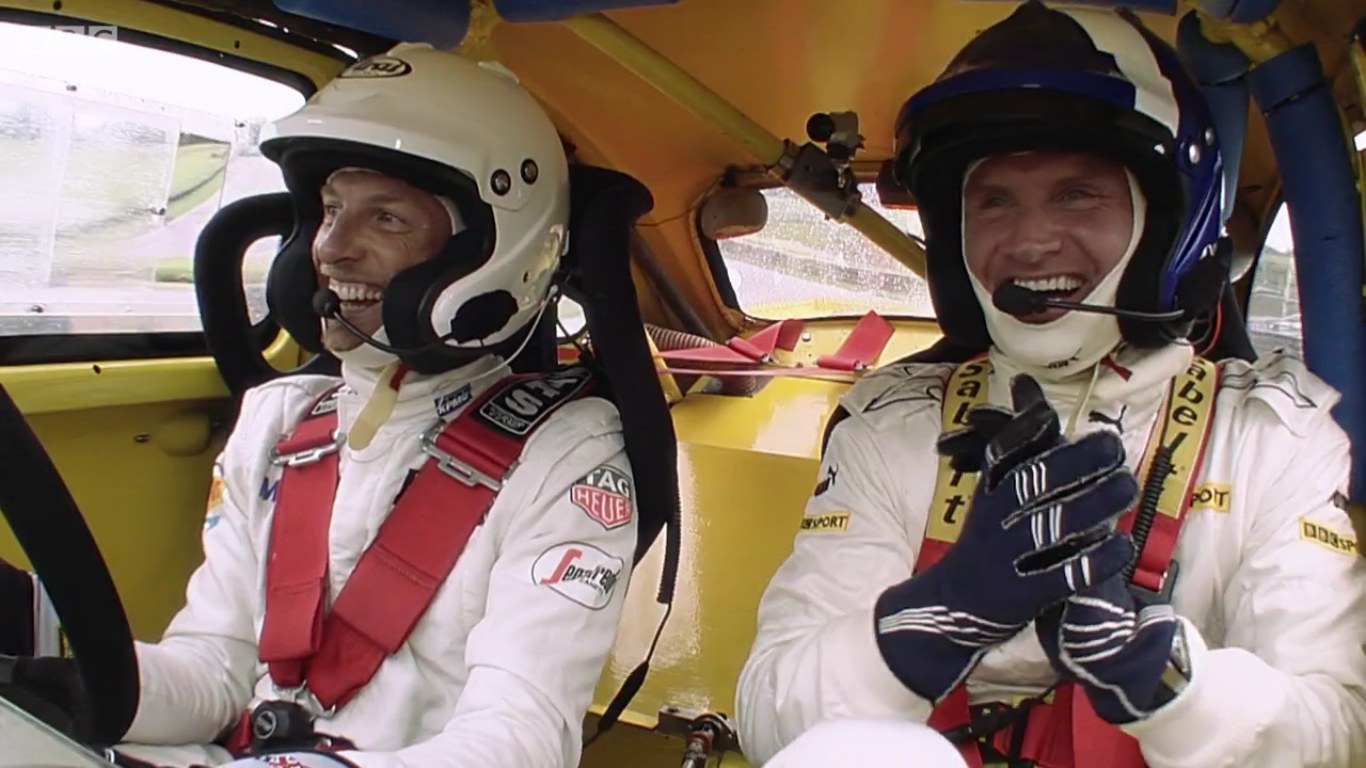
Jenson Button has a go in one of his Dad’s old rally cross cars…
Airing during the Russian Grand Prix weekend, Jenson Button’s feature with David Coulthard focussed on Jenson’s Dad John as the subject. The VT started with the two analysing John’s rally cross races from the 1970s, with commentary from Murray Walker playing. From there, Button raced round in his Dad’s rally car with Coulthard as passenger, before the two raced each other. The VT touched on the emotional aspect towards the end, with intertwining shots of present day Jenson and archive footage of John, both with Walker’s distinctive commentary in the background. Like the feature with the Verstappen’s in August, this clocked in at eight minutes. It was another high quality, superb piece from BBC’s F1 team which made the hairs on the back of your neck stand up. As you may expect during the current deal, BBC take quality over quantity. I would happily take five pieces that are eight minutes long which focus on the subject in detail than six or seven four minute pieces which may skim over the subject, but do not get the viewer emotionally invested in the piece. At eight minutes in length, it allows the piece to breathe around the sixty minute build-up.
The Button and Verstappen pieces are memorable. Viewers will look back at these pieces in time and think 'wow'. They stand out from the crowd, and that is a credit to the team that meticulously slice the feature together. Pieces like this are lifeless, they do not have an expiry date. Aside from VT's, BBC's latest output is a new 30 minute show called F1 Focus. Airing on Thursday evenings live from the paddock on the Red Button and presented by Tom Clarkson, the show looks ahead to the race weekend. To date, it has only aired for USA and Mexico, and on both occasions, it was an informative preview. I think this is a trial run for 2016, with the intention to get rid of Inside F1, but we will see. Obviously someone somewhere has decided that a Thursday night preview show is worth doing. It also helps improve Clarkson's presenting skills, which is important should anyone in the current line-up wish to move on any time soon.
Sky Sports F1 Presenter: Martin Brundle
Filming Date: October 6th (1)
Broadcast Date: October 25th
Link: Sky Sports website
…as Martin Brundle took the Mercedes W06 for a spin around Silverstone.
Over on Sky Sports, Martin Brundle hit the big 40. Not age, but the number of Grand Prix cars the commentator has driven in anger. There are not many better ways to hit number 40 than to drive this year’s championship winning car, the Mercedes W06. As always, it is fantastic to see Brundle driving these cars, irrespective of age. At the Italian Grand Prix, it was the BRM P160. Both that and the Mercedes piece, which was broadcast during the United States Grand Prix weekend, showed off some wonderful camera angles, both internal and external. In both cases, it is easy to see the beauty of the machinery, thanks to the angles used. The BRM feature was part of a wider range of segments focussing on the 1971 Italian Grand Prix story with Peter Gethin victorious for the only time. Italy was a good weekend for Sky’s F1 team, the channel opting to stay on air until 17:00 to cover Mercedes’ potential disqualification from the race, which is exactly what a dedicated service should do. The channel was endlessly filling time in Austin last weekend as well, again they should be applauded for staying on air.
Unfortunately, the inherit problem with some of Sky’s VT’s is the lack of storytelling and choosing to run shorter VT’s so that they can fit multiple trailers around it. Time should not be a limited resource, and we should not be in a scenario where the time hyping a specific feature is longer than the actual length of said feature. Whilst Brundle driving the Mercedes was a very good feature (more so considering the weather was not in their favour), I am not convinced it justified the hype that Sky gave the segment beforehand. Arguably, it is a better when a feature creeps up on you and amazes you rather than one that turns into a let-down. I’m not saying Brundle’s feature was a let-down by any means, but it is something I have noticed with Sky this season.
Looking at the dates outlined earlier in this piece, an interesting observation that Brundle’s feature was turned around in three weeks, whereas BBC’s feature went to air six weeks after being filmed. Is this simply a result of where BBC’s live races fall in the year, or is it because Sky attaching more resource to their features so that they can be turned around quicker? Following up on that line, does it mean Sky’s features are of a lesser quality than BBC’s features as a result?
A peak audience of 1.7m watched Lewis Hamilton become a triple world champion live on Sky Sports, overnight viewing figures show.
Race
Live coverage of the race, simulcast across Sky Sports 1 and F1, attracted a weighted average of 1.13m (5.0%) from 18:00 to 21:30. Sky Sports 1’s airing from 18:55 to 21:30 averaged 313k (1.3%), with Sky Sports F1 averaging 900k (4.0%) over three and a half hours. Year-on-year, Sky Sports 1’s number is up slightly due to the channel only taking the race itself rather than the pre-race aspect. Despite it being a championship decider, Sky Sports F1’s number dropped just over 100k year-on-year, a decrease of 12.4 percent. It is worth noting that the race aired live an hour later last year, the race starting at 20:00 UK time instead of 19:00, but this is unlikely to make a significant difference to the total TV viewing audience.
The race started with 1.41m (6.7%) at 19:00 across both Sky Sports channels. Despite the quality of the race being one of the best of 2015 so far, the audience failed to nudge up to 1.5 million viewers until 20:20, showing that prime time races of pay-TV struggle to bring in a casual audience. Eventually, the audience peaked with 1.70m (6.9%) at 20:50 as the race came to a conclusion, with the audience split 1.21m (5.0%) on Sky Sports F1 and a further 487k (2.0%) on Sky Sports 1.
The peak of 1.70 million is down on 2014’s peak audience of 1.93m (7.5%). 2014’s race was also simulcast live across Sky Sports 1 and F1. In comparison, yesterday’s Manchester derby, broadcast live also on Sky Sports 1, secured a 5-minute peak audience of 2.39m (18.6%). In my opinion, Sky had to have expected some kind of boost with the expectation that Hamilton was going to secure a third championship. The fact that Sky’s numbers dropped is alarming. The fact that Sky failed to bring any casual viewers to the Grand Prix is not good. In their fourth year of broadcasting Formula 1, Sky have still failed to bring a peak audience of over two million viewers to any race.
Unfortunately, BBC’s figures are no better. Sunday’s race highlights programme on BBC One averaged 2.15m (22.4%) from 22:30 to 00:00. That figure is down on both 2012 and 2014. 2014’s highlights programme averaged 2.51m (22.9%), meaning that 2015’s number is down 14.2 percent. Again, that is a very disappointing number in the context of the race. Overall, it means a combined average for BBC and Sky of just 3.28 million, down significantly on 2014’s number of 3.84 million and down slightly on 2012. For a normal race, that number is on the low end of expectations. For a potential title decider, involving a British driver, the number is disastrous.
Analysis
Disastrous may sound like an exaggeration, but last night was the first time a Drivers' Championship had been decided exclusively live on pay-TV since the current BBC and Sky deal came into effect at the beginning 2012. Compare the 3.28 million average, and a peak of just shy of 4 million with these figures. Last year's title decider the Abu Dhabi Grand Prix, which was screened live across BBC One and Sky Sports F1, peaked with 7.89m (50.9%), whilst Hamilton’s first championship victory at the 2008 Brazilian peaked with 13.1m on ITV. It is the lowest rating for a title decider since 2004. Data is available back to 2006, whilst 2005’s title clinching race was Brazil and averaged 4.3 million. It should be noted that we have been lucky in recent years with last race title deciders, whereas we have three rounds left in 2015.
How high would the US Grand Prix have peaked had it been live on free-to-air television? I think we can go back to 2009 to find an answer. Jenson Button won the championship at the 2009 Brazilian Grand Prix. The race was not the last round of the championship, yet peaked with 9.09m (40.3%). I’m not saying it would have been that high, but you just get an idea of what could have been achieved yesterday, in different circumstances. Do viewing figures really matter? It is a question I get asked regularly. The more eye-balls the better. The more popular you are, the more attractive the product is to advertisers. We don’t want Formula 1 turning into a minority sport in this country.
As always, the figures above excludes viewing on internet based services such as Sky Go, Now TV and BBC iPlayer. My opinion is that those platforms would not make up the year-on-year difference of around 600k. BBC Radio 5 Live could make up the difference, but those figures are collected separately and I believe the methodology for radio, collected through RAJAR, is significantly different. Lastly, we have illegal streaming, however we can’t begin to estimate how much they may add, plus you would argue that the streaming is not legal and therefore should not count. The opposition year-on-year was largely the same: The X Factor, Strictly Come Dancing and Downton Abbey was again the main opponents last night.
To conclude, the numbers are bad, for both channels. For BBC, because their highlights programme failed to gain any viewers whatsoever. For Sky, because they failed to peak with over two million viewers. If they couldn’t bring a two million peak audience to watch Formula 1 on their platform last night, they never will. Whether the viewing figures show anything about Lewis Hamilton’s popularity in this country remains to be seen. If Hamilton was more popular, you would think that more people would have followed the race live on Sky Sports, evidently that was not the case.
Where we go from here, I don’t know.
Update on October 27th – A repeat of BBC One’s highlights programme on Monday afternoon on BBC Two at 13:00 averaged 364k (5.2%), peaking with 484k (7.0%) at 14:10 according to overnight viewing figures.
The 2014 US Grand Prix ratings report can be found here. Peak audience figures quoted in this article are five-minute numbers.



 Motorsport Broadcasting