Survey: Your Formula 1 2014 television viewing habits

Last year, I did a poll on this blog looking at blog readers Formula 1 television viewing habits. The poll was successful, with around 200 responses. I released the results in April and did some analysis. A year on since then, and now heading into year three of the current BBC and Sky contract, I thought it would be a good idea to replicate the poll to see what has changed, and if anything has changed drastically.

For those that did this last year, the questions are largely similar, but there are a few minor differences.

Q1: Where do you currently reside?
Q2: Have your viewing habits or situation changed between 2013 and 2014?
Q3: What pay-TV platform do you subscribe to?
Q4: BSkyB subscribers: What is your status regarding Sky Sports F1?
Q5: Virgin Media subscribers: What is your status regarding Sky Sports F1?
Q6: What shows on Sky Sports F1 have you watched?
Q7: How did you consume Formula 1 in 2013? [Sky live races]
Q8: How do you plan to consume Formula 1 in 2014? [Sky live races]
Q9: How did you consume Formula 1 in 2013? [BBC and Sky live races]
Q10: How do you plan to consume Formula 1 in 2014? [BBC and Sky live races]
Q11: BBC F1 – 2013 vs 2014
Q12: Sky Sports F1 – 2013 vs 2014
Q13: Have the changes to the BBC team made you…
Q14: Have the changes to the Sky Sports F1 team made you…
Q15: Sky Sports F1 as a standalone channel: the price per month?
Q16: Further comments

Questions 1 through to 3 are overview questions, whilst questions 4 to 10 drill down into your individual consumption of Formula 1. After that are the BBC and Sky Sports F1 year-on-year comparisons for questions 11 to 14. A new addition concerns the possibility of having Sky Sports F1 as a standalone channel. I personally would be interested in such an option, but I’m interested in seeing how much blog readers would be willing to pay for it realistically.

Note that if you live outside of the United Kingdom, you will be taken straight to Question 16, where you are welcome to write some comments on the broadcasting situation in your country. There are also branches throughout, no one should see both questions 4 and 5. If anyone does spot any issues, do let me know. And as noted, comments made there may be used when analysing the results in a future blog post. If there are many comments from international readers, then I may do a future post around that subject.

The survey can be found here. The results will be published in mid-April 2014.

New FOM graphics for 2014 and Coulthard gets a tablet

The BBC F1 magazine was released yesterday, and in it contains a few interesting tidbits from BBC F1’s editor, Mark Wilkin.

The first is that, according to Wilkin, we will be getting a complete overhaul of the World Feed, with a new graphics set. Wilkin, speaking to the magazine, said “Together with our Host Broadcast partners, FOM, we have been developing a new graphics package, with much more information. This will enable commentators Ben Edwards and David Coulthard to be aware of what is happening on the track and in the pitlane and to be able to interpret it for the audience.” Given that specific reference is made to Edwards and Coulthard, it is clear to me that Wilkin is referring to the World Feed, although I imagine BBC’s own graphics have been tweaked slightly too.

A new graphics package is not a surprise, 2014 is a ‘new formula’, and it makes sense to overhaul everything from the bare bones upwards from a graphics perspective. It would be the third major iteration in graphics since 2004, the first from 2004 to 2009 was in the form of ‘squares’, with the second, more ‘swoosh’ style from 2010 to 2013. It is not too surprising to see BBC working with FOM on that, and they would not have been the only broadcaster to get involved, Sky would have been involved to along with a host of other foreign broadcasters. Obviously FOM never officially confirm graphic set changes, so I think we will have to wait and see until Australia to see what exactly has changed regarding the graphics, but there will be at least some change anyway.

Meanwhile, BBC have invested in a tablet for David Coulthard to use in the paddock. Wilkin notes that Coulthard “will be able to review footage and control the pictures”, and that the addition will be “a new dimension for the post-qualifying and post-race analysis which promises to be an exciting part of the coverage.” Whilst I am happy that it is in the paddock, and not in a cupboard like Martin Brundle had to suffer in the early part of 2011, this appears to be a rip-off of the Sky Pad. Of course, Sky have ripped off BBC ideas in the past (from the basics back in 2012 vs BBC in 2011) but it doesn’t make it any better. It’ll be interesting to see it on screen though, but whether it is actually a necessity, I don’t know. The last thing we want is for both shows to look and feel identical aside from the talking heads.

Lastly, highlights of the Brazilian Grand Prix appear to be getting a primetime slot. The magazine has a start time of 20:00, presumably both BBC Two, for both days. I expect that this hinges on whether it is a title decider or not, a title decider involving a British driver could see a very late move to BBC One (although this is unlikely), but on the other hand if the title has already been decided then it could well be 22:30. In other words I don’t think this tells us much.

Update on March 14th – Now that practice is taking place, we can see that there is some change, but only minor tweaks. I’ve seen a few people suggest that what I reported was incorrect, I quoted Wilkin who is clearly very high up in the BBC F1 chain! I did add a disclaimer above too “I think we will have to wait and see until Australia to see what exactly has changed regarding the graphics, but there will be at least some change anyway”. It would have been nice to get a complete overhaul, but that is not the case.

Scheduling: The 2014 Australian Grand Prix

It has been over one hundred days since Sebastian Vettel crossed the line to win the 2013 Brazilian Grand Prix to close off what was a dominant end of the season for him. Every year, it feels like the Winter is longer than the previous one, despite it being statistically quite the opposite with the Grand Prix season finishing later as the years progress. The rule makers can change things all they want, but one thing remains the same: the excitement that most fans feel when March comes around every year. Formula 1 is back!

If you want to jump straight to the schedule, click the links below…

Thursday 6th March
Friday 7th March
Saturday 8th March
Monday 10th March
Tuesday 11th March
Thursday 13th March
Friday 14th March
Saturday 15th March
Sunday 16th March
Wednesday 19th March
Classic F1

The Australian Grand Prix as always is the traditional curtain opener, as they say, there simply is not a better place for a race. So, what has changed on the broadcasting side of things in the off-season? If you watch Sky Sports F1 throughout the season, you will be glad to know that no one has left, and only one addition in Bruno Senna. Simon Lazenby is back as presenter for a third season, alongside Damon Hill, Johnny Herbert and Anthony Davidson. Senna will be there for seven races, so used in rotation with the three already mentioned. Martin Brundle (entering year 18!) and David Croft remain as commentators, with Natalie Pinkham and Ted Kravitz roving the pit-lane. Steve Rider is also back presenting F1 Legends, and whilst Juan Pablo Montoya may not exactly be deserving of the title ‘F1 Legend’, I am definitely looking forward to that edition, airing in the post-Melbourne slot. I’ve moved all the classic F1 details down the page, for anyone looking for that.

Whilst Sky’s line-up is largely the same, it is made stronger by the fact that BBC have made their line-up, in my opinion, weaker. The trio of Suzi Perry, Eddie Jordan and David Coulthard return, Coulthard also joining Ben Edwards again in the commentary box. This is Jordan and Coulthard’s sixth season as pundits, both having been members of the BBC team since they regained the coverage in 2009. It is also Lee McKenzie’s sixth season with the broadcaster, Tom Clarkson joining her in the pit lane. Mark Webber will also be part of the team, but it is unclear whether he will be at any races with the team as it was not mentioned in the press release. However, Gary Anderson has been axed. For those out of the loop, I direct you to the original announcement, his view point on it all, and Ben Gallop’s statement on the matter.

Over on BBC Radio 5 Live, Allan McNish’s role extends so it covers all platforms (although I am not entirely sure how he will factor into BBC TV’s coverage) and more races. Meanwhile James Allen and Jennie Gow return for a third full season. Jack Nicholls will be lead commentator for four races, the first being China. BBC’s TV coverage of Qualifying is on BBC Two due to the Six Nations coverage involving England over on BBC One. For some confusing reason though, repeats bump it out of its 13:00 slot and into a slot that is two hours later. I assume the rationale behind it is so it doesn’t clash with Italy vs England. Instead, it will clash with Wales vs Scotland, and talking of Scotland, viewers up there will get the race one hour later than the other nations and on BBC Two. The final note to make is that Sky have split their shows into three, which first happened in India last year. Of course, whilst there may well be some spinning where ratings are concerned as a result, The F1 Broadcasting Blog promises to lay all things out black and white regarding viewing figures. Hopefully…. here’s the schedule!

Thursday 6th March
21:00 to 22:00 – F1: Season Preview (BBC Radio 5 Live)

Friday 7th March
20:00 to 21:00 – The F1 Show (Sky Sports F1)

Saturday 8th March
21:00 to 22:00 – Horse Power (Sky2)
– repeated on Friday 14th March at 10:30 on Sky Sports F1
– behind the scenes documentary at Ferrari, produced by Whisper Films

Monday 10th March
21:45 to 22:00 – Pinkham’s F1: Part 1 (Sky Sports F1)
– the basics about Formula 1 for novices

Tuesday 11th March
19:00 to 20:00 – F1: Season Preview (BBC Red Button)
– also available on the BBC F1 website
21:45 to 22:00 – Pinkham’s F1: Part 2 (Sky Sports F1)
– the basics about Formula 1 for novices

Thursday 13th March
04:00 to 04:45 – F1: Driver Press Conference (Sky Sports F1)
20:45 to 21:00 – F1: Gear Up for Australia (Sky Sports F1)
21:30 to 22:00 – F1: Preview (BBC Radio 5 Live)

Friday 14th March
01:00 to 03:20 – F1: Practice 1 (Sky Sports F1)
01:25 to 03:05 – F1: Practice 1 (BBC Radio 5 Live Sports Extra)
03:20 to 03:35 – Inside Track: All Change for 2014 (Sky Sports F1)
05:15 to 07:30 – F1: Practice 2 (Sky Sports F1)
05:25 to 07:05 – F1: Practice 2 (BBC Radio 5 Live Sports Extra)
07:30 to 08:15 – F1: Team Press Conference (Sky Sports F1)
09:30 to 10:30 – The F1 Show (Sky Sports F1)
– simulcast live on Sky Sports 1
18:45 to 19:00 – Inside F1 (BBC News Channel)

Saturday 15th March
02:45 to 04:15 – F1: Practice 3 (Sky Sports F1)
02:55 to 04:05 – F1: Practice 3 (BBC Radio 5 Live Sports Extra)
05:00 to 07:45 – F1: Qualifying (Sky Sports F1)
– simulcast live on Sky1
05:55 to 07:05 – F1: Qualifying (BBC Radio 5 Live Sports Extra)
06:00 to 08:45 – F1: Qualifying (Sky1 + 1)
14:55 to 16:25 – F1: Qualifying Highlights (BBC Two)
19:45 to 20:00 – Inside F1 (BBC News Channel)

Sunday 16th March
04:30 to 09:15 – F1: Race (Sky Sports F1)
=> 04:30 – Track Parade
=> 05:00 – Race
=> 08:30 – Paddock Live
05:30 to 08:00 – F1: Race (BBC Radio 5 Live)
09:15 to 10:15 – Legends: Juan Pablo Montoya (Sky Sports F1)
11:15 to 12:00 – Desert Island Discs (BBC Radio 4)
– featuring Murray Walker
14:00 to 16:00 – F1: Race Highlights (BBC One)
– note: For Scotland viewers, the race is on BBC Two at 15:00

Wednesday 19th March
20:30 to 21:00 – Midweek Report (Sky Sports F1)

Classic F1 on Sky Sports F1
For this season, I’ve made the move to separate the classics out of the main body, primarily because Sky are not repeating races straight after the first airing in that block. Whilst they are still airing about 100 classic races this season, the two repeats are being finely spread throughout the year, meaning that the Australian repeats will not turn back up until say August at a guess. The idea that Sky are broadcasting more classic races though is incorrect I believe, they are not, the difference this year is that the scheduling is consistent, even though it does mean that the race weekends themselves are a bit more bare.

07/03 – 21:00 to 00:15 – Race of the Century Winner (2011 Canadian Grand Prix)
08/03 – 21:00 to 23:15 – Race of the Century Second (2008 Brazilian Grand Prix)
09/03 – 21:00 to 23:00 – Race of the Century Third (2005 Japanese Grand Prix)
10/03 – 21:00 to 21:45 – 1985 Australian Grand Prix Highlights
11/03 – 21:00 to 21:45 – 1986 Australian Grand Prix Highlights
12/03 – 21:00 to 21:30 – 1987 Australian Grand Prix Highlights
13/03 – 21:00 to 22:30 – 1989 Australian Grand Prix
14/03 – 21:00 to 21:45 – 1996 Australian Grand Prix Highlights
15/03 – 21:00 to 22:00 – 1994 Australian Grand Prix Highlights
16/03 – 21:00 to 21:30 – 1990 Australian Grand Prix Highlights
17/03 – 21:00 to 23:45 – 1998 Japanese Grand Prix
18/03 – 21:00 to 23:15 – 1981 Caesars Palace Grand Prix
19/03 – 21:00 to 23:30 – 2010 Abu Dhabi Grand Prix
20/03 – 21:00 to 21:35 – 1988 Japanese Grand Prix Highlights
21/03 – 21:00 to 23:15 – 2003 Brazilian Grand Prix
22/03 – 21:00 to 23:15 – 1998 Hungarian Grand Prix
23/03 – 21:00 to 21:30 – 1989 Italian Grand Prix Highlights
24/03 – 21:00 to 23:00 – 2000 Belgian Grand Prix
25/03 – 21:00 to 21:45 – 1984 Brazilian Grand Prix Highlights
26/03 – 21:00 to 23:00 – 2000 German Grand Prix

As always, if anything changes I shall update this blog if necessary.

Update on March 8th – Very interesting to see that Qualifying is being simulcast on Sky1 (thanks Withito in the comments), which makes it available to many more people. Hopefully Sky promote this.

Update on March 10th – A few minor Classic F1 alterations, along with an Inside Track addition in the main schedule. I’ve also added the BBC F1’s TV season preview.

Mark Webber joins BBC’s F1 team

Mark Webber will join BBC’s F1 team for a few races this year and participate in some films with them, it has been confirmed. Given Webber’s high praise of the BBC, most notably on the track parade before last year’s British Grand Prix, this shouldn’t be too surprising. Great news nevertheless, in my view.

Also joining the BBC team is Jack Nicholls, who will commentate on four race weekends for Radio 5 Live. Nicholls announcement is significant: at the age of 24, he becomes the youngest lead commentator to commentate on Formula 1 in this country! Ages based on their birth year, so may be slightly out.

– Jack Nicholls (age 23 – at time of 2014 Chinese Grand Prix)
– Ben Edwards (age 28 at time of 1994 debut)
– Allard Kalff (age 26 to 30 at time of late 1980s debut)
– Murray Walker (~age 30’s – exact age unclear)
– James Allen (age 35 at time of 2001 debut)
– David Croft (age 36 at time of 2006 debut)
– Martin Brundle (age 50 at time of 2011 debut as lead commentator)

I’ve got to say that is an impressive statistic, at a time when the age of commentators is getting older, so kudos to the BBC for putting faith in someone significantly younger than the rest. Apart from those two pieces of news, the rest of the line-up is as expected, having already been announced in January. In terms of coverage details, I cannot see any differences with how things are covered: practice is again live on BBC Two for their live weekends with the F1 Forum back after the race. One minor difference spotted by Ashley is that the length of the US Grand Prix highlights programme has been shortened to 90 minutes, but I think it is best to wait until the preview magazine before reading too much into that, the same applies for Bahrain and Brazil.

Disappointingly, but not surprisingly, no replacement for Gary Anderson has been announced, I maintain that is a huge loss for the team which I believe they will feel greatly as the season progresses. Ben Gallop, BBC’s Head of F1, said: “We are all excited about the new F1 season on the BBC. 2014 sees new faces to complete our first-rate team and a stronger digital offering to our output than ever before, which really puts users in control of the action. This season has already got everyone talking, with intriguing technical changes and team line-ups, and we’re looking forward to bringing that in all its glory to our audiences.”

The rising cost of Formula 1’s UK television rights

One of the biggest talking points in the broadcasting scene in recent years has been the sky-rocketing cost of television rights to broadcast sporting events. Whilst Formula 1’s deals have indeed risen in the last ten to fifteen years, the cost of Formula 1’s rights pales in comparison to the Premier League television deal which now runs into the billions. Formula 1’s rights in comparison, are less than a tenth of that. One Premier League season, for Sky Sports or BT Sport could buy the equivalent of about seventeen Formula 1 seasons. Yes, I agree, that is completely bonkers.

But where did the rights picture start for Formula 1 in the UK? Back in the early 1990’s, the BBC signed a deal to cover Formula 1 for three years from 1994 to 1996, for just under £7 million (or £2.3 million a season – source: The Guardian, December 14th, 1995), a paltry amount compared to today. In other words, for the BBC, Formula 1 in 1994 and MotoGP in 2013 were probably close to one of the same, except the former’s viewing figures were much higher than the latter. Back then, ITV were fed up of losing in the Sunday afternoon ratings battle. And who could blame them, this being a time where there were fewer channels so the audience was more pointed towards terrestrial, except ITV was losing hands over first while BBC was consistently bringing in five to six million viewers for each Formula 1 race. That changed in December 1995, when it was announced that ITV had bid six times the amount of BBC previously, with a new deal from 1997 to 2001. Turn £2.3 million to £14 million per season, a substantial rise. A nice profit if your name is Bernie Ecclestone.

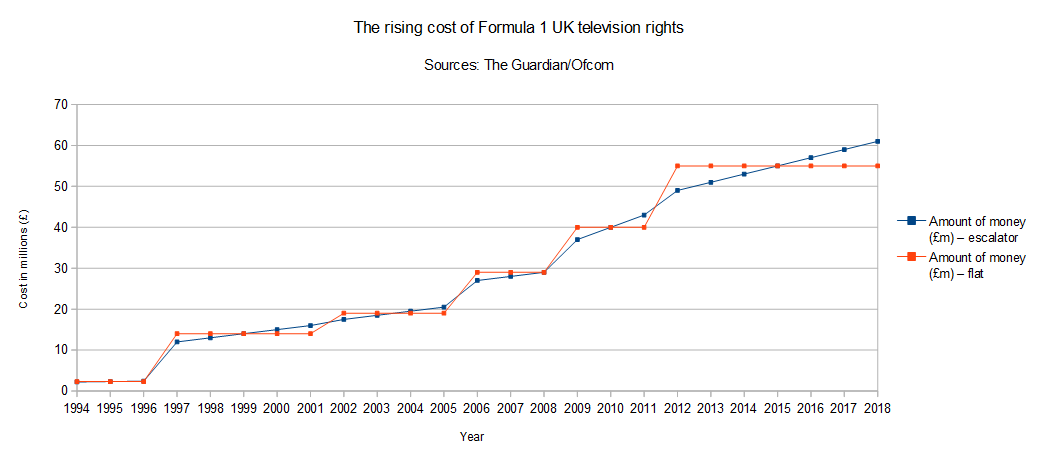
Away from the cost implications, ITV appeased the Formula 1 fan by having longer pre-race and post-race broadcasts which were largely successful and definitely paved the way to what we know now. In an Ofcom consultation back in 2007, details on all of ITV’s contractual costs were published by the regulator (page 79). We can see that the cost rose again in 2001 despite Michael Schumacher’s dominance from £14 million a year to £19 million a year for the 2001 to 2005 contract. However, it must be remembered that some broadcasting contracts work on an ‘escalator’ approach, meaning that the amount a broadcaster pays increases throughout the contract (the graph below gives an idea of the amounts involved). This means that the £19 million a year would not be too much higher for ITV – they would be paying essentially £16 million at the end of the previous contract and possibly £17 million at the beginning of the next contract.

A graph showing the amount that Formula 1's UK television rights have rose in the past two decades.
A graph showing the amount that Formula 1’s UK television rights have rose in the past two decades.

For ITV, the death knell came when they overpaid on Formula 1’s television rights from 2006. They overpaid badly, and the viewing figures at the time definitely did not justify that. With no other broadcasters bidding, ITV’s rights increased immediately by about £7 million, a near 33 percent increase. In hindsight it was a frankly stupid decision made by those who were not thinking long term, however an unsurprising one when you consider that they also overbid on The FA Cup the following year. ITV did not foresee the advertising recession that would follow leaving those in charge needing to save money, and fast. Sadly, with a choice between the Champions League and Formula 1, ITV went for the former, activating a get-out clause. Formula 1 was heading back home. Which was another chance for Ecclestone to get more money out of a broadcaster. Seizing the opportunity, Ecclestone signed a contract with the BBC, estimated to be around £200 million for the five years, or £40 million per year for Formula 1. I’ve spoke before about how this was a disastrous mistake for the BBC that would have major consequences. I feel sometimes that broadcasters ‘play’ with money, going back to the ITV bit above, just why did they need to increase the rights by that much, I don’t know. It doesn’t make any financial sense whenever I see any sporting contract go up significantly, but it is a repeating pattern over and over again. The bubble will burst, especially where the Premier League rights are concerned. It is a matter of ‘when’, not ‘if’.

BBC’s financial problems soon hit Formula 1, in 2011. A reduction of the BBC Sport budget meant that BBC went to Sky and agreed a deal that would only see half of the races live on terrestrial television, an irreversible move. In terms of cost, it is believed to be in the region of £40 million per year for Sky and £15 million per year for BBC, again on an escalator approach. As always, broadcasters always use the word ‘undisclosed’ whenever announcing new deals, so a degree of caution must always be taken, especially when different websites can report different figures. At the moment, it is difficult to say whether the BBC will see out the remainder of their contract. I expect they will, but nothing is guaranteed. It was reported this past Wednesday that the BBC are about to make another round of £100 million cuts, the full details of which will be announced at the end of this month. It should be noted though that Tony Hall said that further “salami-slicing” cuts would not happen. But, at the end of the day, if any cuts to BBC Sport are announced at the end of this month, then alarm bells have to start ringing where BBC’s Formula 1 television coverage are concerned. An interesting question to be asked is whether the BBC and Sky contracts are treated ‘independently’ of each other, or if they are treated as ‘one’. I assume that they are independent, i.e. any future BBC actions regarding Formula 1 do not affect the current Sky contract, but I don’t know for sure.

So, what can £55 million a year get you?

– ten Premier League games
– the group stages of a Champions League season
– one and a third Six Nations championships
– four and a half MotoGP seasons

Formula 1’s television rights have not yet descended into silly money, like the football rights have for both the Premier League and the Champions League rights have, for which I personally am thankful for, as we still have Formula 1 live on free to air television in some capacity. If the current contract is seen through to the end, then the silly money will not begin for quite some time yet, but as always in this game, things can change with the flick of a coin. There is a long, long way before the finishing line in this contract.