As you may have seen on my Twitter, I am on holiday from now until Saturday 4th August, so I’m keeping this post short.
Unfortunately, there is not a lot of data available, but what is available shows that the F1 was hit by the warm weather and the other sporting competition. ITV Media reported earlier that BBC Two’s highlights programme had 1.9 million (12%), although that has been since pulled along with a whole host of other ratings information. That is almost certainly true, as the programme is not in the top 10, and therefore below 1.853 million to 3.d.p. I am also unsure if that rating includes BBC HD. If it doesn’t, then we can add another 400,000 viewers to the 1.9 million.
Sky Sports F1 had 901,000 viewers (9.3%). If we are to compare that to Bahrain, the last European race which was Sky exclusive, they had 738,000 viewers (6.2%) in the overnight ratings. Malaysia had slightly higher viewing figures, but I do not believe that is a vaild comparison due to the red flag period inflating the average.
So overall, how much of an effect did the ‘free weekend’ have on the race viewership? Difficult to tell, but I think we are looking at a 20 percent figure for those that do not subscribe to Sky Sports F1, but watched last Sunday. What I shall do in the officials is do a full comparison between Germany and Bahrain – in theory, despite the warmer weather every session should see an increase due to the increased reach potential.
Onto the negatives, however. 1.9 million for the BBC highlights (with or without HD) is the lowest race highlights figure yet. Combined, the BBC and Sky figure will be the lowest since 2006, although it will be very nip-and-tuck with the 3.28 million average that ITV had in 2008.
With regards sporting competition, the Tour de France peaked with 3.55m (28.2%) on ITV1 and ITV4 while the Open Golf averaged 2.36m (20%) across six and a half hours on BBC One.
Sky have not long gone off the air, completing their weekend of free coverage. If you are a Virgin Media or Sky customer, I want to know if you are planning as a result to upgrade packages to watch F1.
To allow me to create an analysis, the poll is split into four sections.
Section 1 asks for how you watch. Section 2 concerns Sky customers only. Section 3 concerns Virgin Media customers only. Section 4 asks what you thought of Sky’s German Grand Prix coverage. Section 5 asks what you thought of Sky’s German Grand Prix coverage in comparison with BBC’s overall coverage.
Everyone can answer sections 1 and 4, only Sky and Virgin Media customers can answer sections 2 and 3 respectively.
Comment below saying what you put and also extra opinions. I shall publish the results here next week if there is enough of a consensus.
One thing you may have noticed over the past few months on this blog is how I have written more blog posts about Sky Sports F1 compared with BBC’s Formula 1 coverage. The simple reason for that is that there is more scope to cover with Sky Sports compared with BBC as they have a channel rather than a programme so there are more areas to talk about both within a race weekend and outside of the race weekend.
Admittedly, I have watched a lot more Sky Sports F1 programming compared with BBC F1 programming this year, hence why I have not covered BBC a massive amount on this blog yet, in fact there are 29 posts in my BBC F1 category compared with 61 posts for Sky Sports F1. With that in mind, I thought that I would use this post to look at BBC’s coverage a bit more, in particular, their Qualifying highlights programme for this weekend’s German Grand Prix. While watching I will also take the opportunity to make general comments about BBC’s coverage. As well as today’s programme, I also watched the latter stages of the British Grand Prix on BBC Two as well as the F1 Forum for that race. Of course, BBC’s coverage began in 2009 and like many of you I also watched every race on the BBC from then to 2011.
The first thing you hear in any F1 programme on BBC television is The Chain. The famous riff as the pace speeds up, for me, nothing beats The Chain when it comes to Formula 1. As good as Just Drive by Alistair Griffin is (and yes, I very much enjoy hearing it), it will never beat The Chain for me. There is something about The Chain that for me sends a shiver down the spine. You know hearing that theme that you are not long away from seeing the famous red lights going off. The Chain, in my opinion, is the definitive Formula 1 theme. The visuals however? If I am to be brutally honest, I’m really not a fan of the intro visuals. The Chain makes up for it somewhat, but the visuals just shout out “tacky” and lacks class. In a dream world, we should combine the Sky Sports intro visuals with The Chain. Now that would be perfection. One day, maybe.
(For clarity, the above paragraph only refers to one minute onwards in this video. The first minute before that is, again, perfect)
The VT intro focussed on Michael Schumacher’s quest to get back to the top podium, as well as looking at Sebastian Vettel’s rise to the top with Schumacher’s thoughts in the background. The VT made super use of the archive footage which I thoroughly enjoyed. It probably helped that I am a Schumacher fan, so I may be slightly biased in this respect, but I would take archive footage over computer generated footage any day of the week. From there, Lee McKenzie and David Coulthard discussed the possibilities for Schumacher this weekend, before a look at the drivers’ standings. Some people at home may have been wondering this season why BBC do not just go straight into the race. There are several reasons for this. The first one is that the BBC team wanted to keep the best of the live shows and build a more ‘concise’ highlights show, this was something Jake Humphrey heavily emphasised in the BBC F1 preview magazine and something that they have aimed to do. The second reason is almost certainly a contractual obligation, in that they are not allowed to broadcast an entire Qualifying session without truncating it, so I suspect there are clauses saying “World Feed footage must not exceed X minutes for Qualifying and Y minutes for the Race.” It would also make the contract a bit worthless for Sky if BBC were allowed to go and broadcast the Qualifying and Race sessions in full, hence why there are likely to be clauses in place to prevent them from doing that.
Following that, we had an interview with Pastor Maldonaldo from Tom Clarkson, Ben Edwards with the news and Gary Anderson looking over the technical features. The thing that I liked here is that each team member had their own little feature so the pre-show was balanced out in that respect. Also, and a side effect of the above paragraph, it has to be said, by having less World Feed footage it means that you can have a longer pre-show and post-race show to cover the latest stories and events. Comparing Anderson’s technical analysis with Ted Kravitz’s Sky Pad analysis makes for interesting reading. I remember back at the start of the season when you had Kravitz on the Sky Pad and Anderson, quite literally, using a pen and pencil, in terms of technology, worlds’ apart from one another.
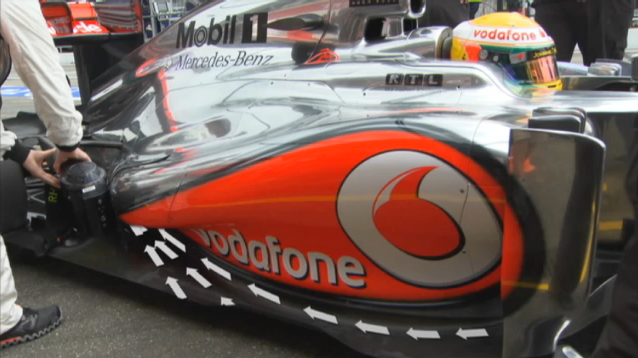
BBC’s graphics used during the 2012 German Grand Prix Qualifying session to help explain McLaren’s upgrades.
Does it make for better analysis though? The above is Anderson talking over a shot of a few arrows going from one part of the car to another. Simple, but it shows beautifully what the latest McLaren upgrades are intended to do. It depends what exactly the upgrade is and where about on the car it is, sometimes having the Sky Pad shows it better, sometimes it doesn’t. As a technical expert doing pieces to camera, though, Anderson has improved a lot compared with the start of this season in my opinion from when I remember watching him in Australia.
I won’t comment too much on the commentary, purely because both sets of commentary teams are as good as each other. At the end of the day it comes down to personal preference. Me, personally, I value Martin Brundle’s opinion a lot, and therefore I prefer him and David Croft, but that does not mean Coulthard and Edwards are bad. It is personal preference, plain and simple.
While the pre-Qualifying show has to be recorded before Qualifying, the post-Qualifying show can be done anytime after Qualifying. So today, the post-Qualifying show could be filmed anytime from 14:00 to 16:30, to allow adequate editing time before that portion of the show makes the air at about 17:50 on BBC Two. Those that watched the Bahrain Grand Prix forum will know that BBC were filming that after Sky Sports had gone off-air, about 16:50 UK time, allowing them to get the opinions of people you normally would not hear from (ie Jo Ramirez in that particular forum), leading to a much better and enjoyable show. The same applies for post-Qualifying, and also for between the sessions. While of course the interviews would have been done in one ‘take’, the programme is not live and therefore there is no urgency to get the driver who they want to interview as soon as possible, allowing the editor to wait a short time before getting the person who they want to get, hence why McKenzie and Coulthard interviewed Mark Webber during the GP2 race, a long time after Sky went off the air. After the session, you also had Anderson outline the relative strategy options, which presents an interesting take on things, notwithstanding the accuracy of it come the Sunday race. I do recall seeing this back in Australia, so I assume this has been around for the majority of the races. For both the hardcore and casual viewer, by showing the differing strategies, it helps the viewer know what to look out for in the race and what sort of race to expect, whether it will be a ‘pit stop fest’ or a ‘overtaking fest’. Or neither.
Unrelated to the structure of the show but, for future reference, it is me worth noting that I spotted Clarkson holding two microphones, a TEN Sport microphone and a BBC Sport microphone, meaning that he is more than likely working with both broadcasters’ this weekend.
The highlights programme produced by BBC, as you would expect, is an extremely well-produced programme, and while it is always better to be live (to give it the ‘raw’ feel), the programme that BBC produces definitely brings out the good for everyone involved. As noted above, the show also brings with it certain benefits which enhances the quality of the BBC programme. As always your thoughts and comments are welcome.
From Germany, it is a frantic rush as the teams’ pack up quickly ready to hop over to Hungary for the Hungarian Grand Prix, part of the third double header so far this season.
In terms of the BBC and Sky personnel, I believe it is status quo compared to Germany, the only difference being that Natalie Pinkham is back after her wedding. The schedule as always, is below, although I’m unsure if Inside F1 will actually air on Friday 27th July due to build-up to the Olympics Opening Ceremony. Qualifying is on BBC Two, with the Race on BBC One, both highlights of course.
All of the radio coverage is on 5 Live Sports Extra, again, due to the Olympics coverage. Ben Edwards is the commentator for Friday, with James Allen back for Saturday and Sunday.
Thursday 26th July
14:00 to 14:45 – F1: Driver Press Conference (Sky Sports F1)
Friday 27th July
08:45 to 10:50 – F1: Practice 1 (Sky Sports F1) 08:55 to 10:35 – F1: Practice 1 (BBC Radio 5 Live Sports Extra)
10:50 to 11:30 – GP2: Practice (Sky Sports F1)
12:45 to 14:55 – F1: Practice 2 (Sky Sports F1) 12:55 to 14:35 – F1: Practice 2 (BBC Radio 5 Live Sports Extra)
14:55 to 15:35 – GP2: Qualifying (Sky Sports F1)
16:00 to 16:45 – F1: Team Press Conference (Sky Sports F1)
17:00 to 18:00 – The F1 Show (Sky Sports F1)
18:45 to 19:00 – Inside F1 (BBC News Channel)
Saturday 28th July
08:40 to 09:20 – GP3: Qualifying (Sky Sports F1)
09:45 to 11:10 – F1: Practice 3 (Sky Sports F1) 09:55 to 11:05 – F1: Practice 3 (BBC Radio 5 Live Sports Extra)
12:00 to 14:35 – F1: Qualifying (Sky Sports F1) 12:55 to 14:05 – F1: Qualifying (BBC Radio 5 Live Sports Extra)
14:35 to 16:05 – GP2: Race 1 (Sky Sports F1)
16:15 to 17:10 – GP3: Race 1 (Sky Sports F1)
17:15 to 18:30 – F1: Qualifying Highlights (BBC Two and BBC HD)
Sunday 29th July
08:20 to 09:10 – GP3: Race 2 (Sky Sports F1)
09:30 to 10:35 – GP2: Race 2 (Sky Sports F1)
11:30 to 16:15 – F1: Race (Sky Sports F1) 12:45 to 15:00 – F1: Race (BBC Radio 5 Live Sports Extra)
17:00 to 18:30 – F1: Race Highlights (BBC One)
18:30 to 19:30 – F1: Forum (BBC Red Button)
As always, the timings are subject to slight alterations, so I shall update this blog if and when that happens.
The Daily Telegraph have this morning published an article written by Christian Sylt and Caroline Reid with the headline, and I quote “BBC saves £150m in Formula 1 deal with Sky”. How accurate is that? The answer is, not very much.
As I did with the Daily Mail article concerning Simon Lazenby here, and as I did with The Guardian article here, I will dissect the article. As always, there are some parts of the article which are true, and there are some which appears to prove that the writers have not done their research.
The first bug-bear for me is when the article claims that Sky Sports are paying £25 million for Formula 1 and BBC are paying £7 million. Both figures look low, especially when you consider that the figure totals £32 million. Let us go back to 2008. According to Ofcom, between 1997 and 2001, ITV paid £14 million per year for Formula 1. That increased to £19 million between 2002 and 2005, before increasing again (this time by £10 million) to £29 million between 2006 and 2010. Of course, they pulled out during 2008, with BBC taking over for 2009. Now, if you are suggesting that BBC did not pay substantially more than £29 million between 2009 and 2011, then I would be extremely shocked. £40 million was the amount I believed BBC to be paying, which is supported by a Google search with multiple level sources reporting the same amount.
So to suggest that BBC and Sky combined are paying £8 million less per year, is a bit optimistic. If anything, the £40 million amount would have risen somewhat, we all know how Bernie Ecclestone likes to increase the contract value at any given opportunity, hence why ITV’s Formula 1 contract went up by £10 million per year despite zero competition. I would have a stab and say Sky Sports are paying £40 million, with BBC paying £10 million. That saving, instead of it being £150 million, comes in at £210 million, a far bigger sum than that in the Daily Telegraph article. If BBC are paying £15 million, for sake of argument, then the saving is £175 million over seven years.
On the other side of the spectrum, the article claims that their was a “£480 annual cost of subscribing to Sky’s sports package”. That is an interesting way of putting things, which works out at £40 per month. The article makes out that £40 is the cheapest way to see Formula 1 on Sky. It is not. Keith Collantine of F1 Fanatic worked out that the cheapest annual cost is £363, while another member on that particular website worked out that if you just wanted to watch the ten Sky exclusive live races it via Sky Go on the computer, it would cost you £175. I would not class the £480 figure as an exaggeration, because it is true, but there are much cheaper ways of watching F1 on Sky than that sum.
“Across the eight Grands Prix which have taken place so far this year, the BBC’s total audience of viewers watching at least 15 minutes has fallen 20.5% to 20.2m which is understandable given that it lost half of the live races. In contrast, F1 has gained as it is understood that 5.5m watched at least 15 minutes of Sky’s broadcasts of the first eight races and this offset the BBC’s drop. In fact, the total audience for the race in Valencia was 8% up on 2011.”
I’m afraid that can only be described as spin. The figures quoted there as reach figures, and it is impossible for the reader to know how many of the 5.5 million are bundled into the 20.2 million figure. I’ve watched the majority of Sky’s programming, but also watched the British Grand Prix on BBC. Does that mean I am two people and therefore bundled into both sets of figures? With regards Valencia, the total audience was up, yes, but on the other hand Australia, Malaysia, Bahrain, Spain, Monaco, Canada and Britain were down. Only Valencia and China have recorded increases.
Finally, I’m afraid I do not believe the following is true:
“The deal suits F1 particularly since only a core of die-hard fans watch every race live in full.”
BBC’s viewing figures last year were the highest since 1999, both seasons averaging 4.55 million, which shows that not only die-hard fans were getting into watching every race live, but it was also drawing in a large proportion of casual fans. The lowest rated race last season was Belgium, which had 3.76 million viewers. This year, already four races have had under 3.76 million viewers, and this year looks set to be the lowest rated season since 2008…

 Motorsport Broadcasting