Alex Jacques on the joy of F1 commentary and the ‘unwinnable’ battle it presents

Alex Jacques has been the one of the leading voices in motor sport for the past decade.

Despite being relatively young compared to some of his compatriots, Jacques has risen rapidly up the ranks, having already covered prestigious events such as the 24 Hours of Le Mans and Indianapolis 500.

Currently, Jacques is Formula 1’s lead commentator for Channel 4 and F1 TV, combining the responsibility with his Formula 2 duties, 2024 his tenth season holding the Formula 2 microphone.

I caught up with Jacques at the Black Book Motorsport Forum on his journey so far and where he is heading next…

The road to Formula 1

Like many before him, Jacques worked with various BBC local radio stations on his way up alongside working for The Times newspaper, covering anything and everything the stations threw at him. Helping Jacques during his early broadcasting career was BBC Radio Suffolk’s sports editor Graham Mack.

“All the time, I was building a demo that I could send to producers if the right opportunity arose, and Mack was such a big help with all of that,” Jacques tells me.

“He lent me Radio Suffolk’s spare ISDN box, which was useful because I didn’t have the money for that equipment. I would get the box, go to anywhere that would have me and plug it in.”

“I did any local radio station that would take me for any sport. So, BBC Radio Suffolk, BBC Radio Leeds, BBC Radio Norfolk, BBC Radio Manchester, it didn’t matter if it was football, cricket, handball.”

While travelling around the country on a limited budget ‘couldn’t last forever’ in Alex’s own words, what it did give him was a range of opportunities that wouldn’t have otherwise presented themselves.

“I covered non-league football all the way up through to Premier League football, encountering every type of scenario,” he says.

“I was in press conferences with Premier League winning managers when just four years previously I was trembling holding the microphone outside non-league football waiting, hearing the manager shouting at players in the dressing room and knowing I’ve got to ask him three questions otherwise I’m in trouble. I loved doing all of that.”

The early days

Jacques’ breakthrough came in 2015, when Will Buxton announced his surprise departure from the GP2 commentary box (since rebranded Formula 2), in a decision Buxton called ’one of the hardest of my professional career to make.’

“It’s so odd when you recount it,” Jacques says. “It was an extreme slice of luck that I saw there was an opening because of his blog. I’ve been obsessed with motor racing my entire life, and I thought I could take my passion as a fan and distil it into commentary.”

His pitch to F1’s TV producers was simple: treat Formula 2 and Formula 3 as if the two were on an equal footing to Formula 1.

“The number one thing I said was that I will treat Formula 3 and Formula 2 like Formula 1. You fuel up the helicopter to do the start, now I know that’s a practice for Formula 1, but you still put fuel in the helicopter. You’ve still got some of the best operators in the world in that gallery, they’re not on lunch break, they’re doing Formula 2.”

“It needs to feel as vital and important [as F1], and it needs to tell the story of the people that you will eventually hear about in Formula 1 in the same way. And I think that pitch got me the job.”

The early races were challenging for Jacques, as he was subject to social media criticism following Buxton’s departure. Nevertheless, F1 stuck with Jacques and fans began to warm to his commentary alongside the likes of Jolyon Palmer and Davide Valsecchi.

“The first few races weren’t what I wanted them to sound like, but everyone, both the audience and the people behind the scenes, were very patient with me,” Jacques says, talking to me nearly 10 years on and over 500 races in the bag.

“It’s natural when you start [to overthink]. You always look back on the early days of a job and they feel like months because you’re sweating every minute of it.”
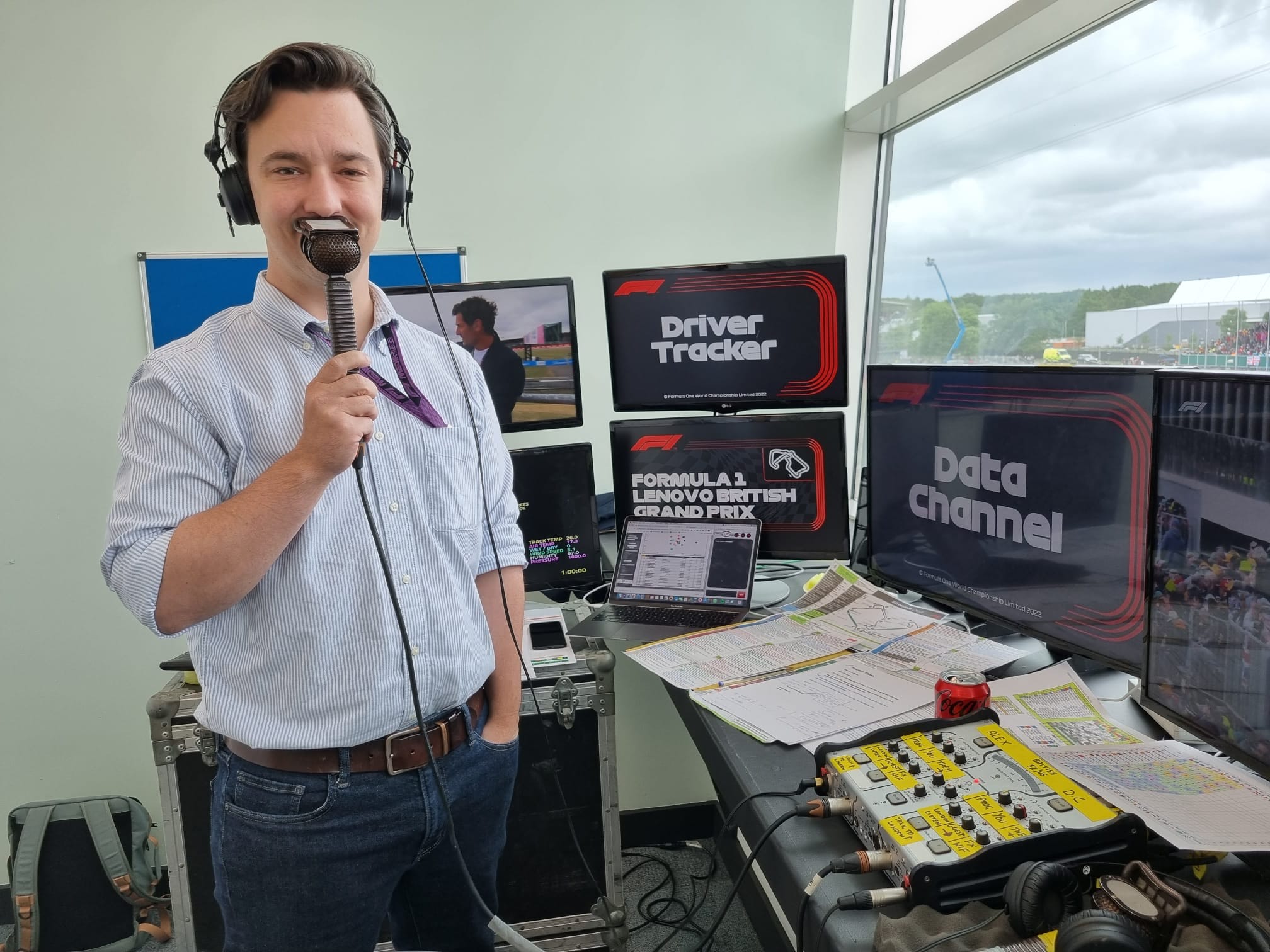
Alex Jacques in the commentary booth during the British Grand Prix weekend.

“The advice I’d give anyone at the start of their career, whether it be broadcasting, whether it be print journalism, is not to sweat it. The good days are never as good as you think they are and the bad days are never as bad as you think they are.”

“And the more reps you get, the more you get into a rhythm of it. The wonderful thing about Formula 2 is that the championship provides so much drama that you go through every conceivable circumstance.”

Talking through the highs and lows

“You cannot do unforgettable commentary unless there is a compelling story at the centre of it,” Jacques says. Luckily for Jacques and Valsecchi in the Formula 2 commentary box, that compelling story came in 2017 when Charles Leclerc took the championship by storm.

In the Bahrain sprint race, Leclerc made an unexpected pit stop, before overtaking 13 cars on his way to victory, a sign of things to come.

“Valsecchi’s next to me, saying, ‘what’s he doing, it can’t be done!’ We’re like, of course, it can’t be done, and then Charles just starts carving it up like it’s a PlayStation game!”

“You desperately want that narrative; you want the drama. People talk a lot about bias, the only thing any sports broadcaster is biased towards is it being good.”

Since the early years, Jacques’ commentary has received plaudits and colleagues alike, the most recent example being Jacques’ call at the end of the Monaco Grand Prix as Leclerc won in Formula 1 for the first time on home soil.

While Jacques is now in his element, it wasn’t until mid-2016 that Jacques began to felt more comfortable in the booth, aided by classic moments such as Leclerc’s Bahrain drive, and a drag race to the line between Pierre Gasly and Raffaele Marciello.

“It was one of those wonderful moments that didn’t matter in the grand scheme of things, but it was there where I was beginning to sound like how I wanted it,” Jacques recalls.

As lead commentator for Formula 2, Jacques has watched the future stars go wheel-to-wheel, waxing lyrical at their every move. On the other end of the spectrum, Jacques led Formula 2’s on-air tribute to Anthoine Hubert, who was tragically killed during the 2019 Belgian Grand Prix weekend.

“Anthoine was a terrific guy on and off track and it was such a cruel set of circumstances,” Jacques tells me. “I knew instantly it would be serious and then I felt an immense responsibility to the championship and my broadcast team. At that point you push all the emotion out and just deal in the facts that you have available.”

“Afterwards it was very tough when the news came through. It was difficult to comprehend that it had happened on a modern Grand Prix weekend and that someone you’d spoken to two hours ago was gone. It was just appalling for his team, friends, and family.”

At the start of Formula 2’s Italian Grand Prix broadcast the following weekend; Jacques gave a heartfelt speech.

When the sport that brings you joy suddenly brings you heartbreak, you are confronted with a choice. Stop and despair, or endure and continue. The drivers of Formula 2 reject despair, not because they do not grieve, but because they are determined in their defiance. Know this with certainty. Anthoine Hubert will never be forgotten. He was special, on and off the track, and the 17 on the grid today choose to honour him. They choose to race.

Alex Jacques, speaking at the start of Formula 2’s 2019 Italian Grand Prix broadcast.

“Those were my words and thoughts,” he says. “The thing about the production team is they have always put huge trust in me. In Italy there wasn’t even a discussion beyond checking I was okay. It will always be that way with my commentary.”

“It was seeing the determined defiance from the drivers in the paddock which inspired it. It’s the most honest and direct piece of broadcasting I’ve done and hopefully I’ll never have to do anything remotely like it again.”

Jumping to F1

Jacques moved up to covering F1 for their direct-to-consumer platform F1 TV, later becoming Channel 4’s F1 lead commentator from 2021 onwards.

“We’re all taught by the late great Murray Walker, there’s no such thing as a dull Grand Prix,” Jacques says. “And if you want to hold the microphone, you’ve got to try and make that true.”

Luckily, Jacques did not have much difficulty with that in 2021, as Lewis Hamilton and Max Verstappen raced towards a dramatic finale in Abu Dhabi.

One of their flashpoints at Silverstone was Jacques’ first live commentary on free-to-air television in the UK, joining an elite few to hold the honour of doing so, Jacques succeeding Ben Edwards in the position.

“I was talking to Ben about it in the week afterwards, it means a lot to be part of that group. There’s very few people who have had the honour of doing one of the great fixtures of the British sporting summer for a free-to-air audience.”

“That meant a lot as a 10-year-old who loved the commentary of Murray Walker and Martin Brundle. The idea then that I would be doing that, that was a very strange situation to try and wrap my head around.”

“If you tell everyone from a very young age that you want to be a Formula 1 commentator and they let you do it on Channel 4 live, you better be good! I’ve never felt pressure like that in my life and then to be rewarded with what happened.”

“It was one of the greatest distillations of what makes Formula 1 great that I’ve ever seen.” Hamilton and Verstappen raced towards Copse, but only Hamilton would continue beyond Copse, the two colliding as Verstappen slid off into the gravel.

“You just wanted it to carry on and on and on, but unfortunately it didn’t. Off the back of COVID, that felt like the first race that Formula 1 was back: it suddenly felt like it was vivid again.”

For Jacques, Silverstone 2021 was his favourite race to commentate on “by a mile, not because of who won, not because of what happened, just because of the occasion.”

Alex Jacques presenting alongside Billy Monger in the paddock for Channel 4.

Jacques is complementary of both of his co-commentators during that Silverstone race, David Coulthard, and Mark Webber.

“I was always so grateful for him [DC] for not pulling rank, understanding how I would do it differently, working with me [after Ben left]. He could not have been more accommodating, and I massively appreciated that when I switched to Channel 4”, Jacques says.

“I don’t there’s anybody else in broadcasting who will talk about the under rotation of an axle in the first part of a sentence and then give you pop lyrics in the second. He’s the same guy who has beaten Alonso, Schumacher, Hakkinen on his day suddenly then going, ‘what’s that pop song from 1980’ and then going ‘that might be because of d-rating!’”

“And with Mark [Webber], you just leave the commentary box with a smile on your face.”

As for his other co-commentators? Jacques has had just a few over the past decade and has compliments for them all, whether its Alex Brundle’s “brilliant one liners” or Jolyon Palmer’s “superb” analysis of the race.

“I think that is probably where I have been the most fortunate. Because of the range of brilliant co-commentators I’ve had, it’s given me the ability to work with so many different broadcasters with different skills.”

Jacques evolved his commentary style upon getting the Formula 1 gig, noting that the sport’s audience has radically changed over the past decade, with the sport attracting a younger audience every weekend.

“Commentary should always feel warm, and as broad as possible, especially in this era of Formula 1,” he believes. “We’ve got a large percentage of the Formula 1 audience who don’t know who Sebastian Vettel is, and he’s a four-time champion! Every time we commentate, we’re having to recap the basics.”

“I had a fan come up to me recently and say ‘why is there a safety car?’ It makes you re-examine everything. It’s wonderful that we’ve got so many more people interested in it, and that Formula 1 is pushing that into different places because it’s not rocket science. It’s prototype technology with brilliant athletes racing.”

“You do have to drive the commentary yourself, and you have to have that editorial judgement of what the commentary should sound like in someone’s living room to keep moving forward.”

Final thoughts

Jacques joined Discovery+ last year to cover the 24 Hours of Le Mans for the first time. The famous race presented him with a new, unique challenge, giving him the opportunity to start ‘from scratch.’

“You’ve got to know absolutely everything. You’re on that microphone at five in the morning with a team of experts, and you need to know everything inside out.”

“I loved going back to the start and going right, I’ve been a fan of this, now I’m going to try and wrap my head around the spectacle of the race. It was just wonderful that we got a race that matched the occasion [in 2023].”

“It was great [doing something brand new] because there are things that I learnt from that week that I then took to Formula 1. Ultimately, I just love broadcasting motor racing and I’m a commentary fan as well. It’s a consistently moving target.”

Nearly, a decade on from his opening act in 2015, Jacques does not see himself moving away from the commentary booth any time soon, openly admitting that he’s yet to have a ‘perfect’ race from a broadcasting perspective!

“Every single time I go into a pit lane or a commentary box, that moment hits. ‘Yes, this is cool!’ It never gets old and the moment it gets old you should be out of that commentary box. It should never be a job; it should mean more.”

“With broadcasting, there is nothing I enjoy more. Commentary for me is this unwinnable battle. The highest percentage you can ever get to is 99%.”

“There’s a race, and I won’t tell you which one, I got close, but I still know the thing I didn’t get quite right. It wasn’t wrong, it wasn’t a mistake. I thought I had a good race and then the next day I was like, ‘oh, you could have explained that a different way!’”

“Commentary is this wonderful thing that keeps me coming back, and long may it continue.”

If you enjoyed this article, consider contributing to the running costs of Motorsport Broadcasting by donating via PayPal. If you wish to reproduce the contents of this article in any form, please contact Motorsport Broadcasting in the first instance.

F1 TV or Sky Sports: who wins the pre-race battle?

In recent years, Formula 1 has evolved its direct-to-consumer product, F1 TV. The platform has grown since launch in 2018, with the championship now providing fans with a rich in-house offering during a race weekend.

As well as their non-live YouTube offering, the series also presents live pre- and post-race content on YouTube and through their DTC platform, meaning the F1 now stands directly alongside the broadcasters that air the sport.

F1 TV caters to international fans, similar to how Sky Sports serves fans in the UK. But how to the services compare from a pre-race build-up perspective?

Motorsport Broadcasting has analysed F1 TV’s and Sky’s build-up to last weekend’s Sao Paulo Grand Prix to see where the similarities and differences lie in their offering. With both Drivers’ and Constructors’ Championships well wrapped up, it is challenging for F1 and its stakeholders to create engaging content as the 2023 season concludes.

How did F1’s in-house team fare with 60 minutes to play with, and how did Sky fill 70 minutes of content (excluding commercials)? And are UK fans missing out by being unable to access F1 TV’s premium live content?

Where F1 TV takes the lead

Laura Winter and James Hinchcliffe led F1 TV’s output that included former Lotus and Renault race engineer Julien Simon-Chautemps on-site. Technical expert Sam Collins and commentators Alex Jacques and Jolyon Palmer provided additional build-up analysis from F1’s UK base.

The pre-race broadcast focused on the thing that mattered the most: the racing, dissecting the fortunes of all 10 teams and 20 drivers, each part given time to breathe, without the need to rush into an ad-break or onto the next segment.

F1 TV’s ‘all drivers covered’ mantra was evident during their grid walk, where Hinchcliffe walked from the rear to the front of the field. The format reminded me of NBC’s IndyCar build-up (a team that Hinchcliffe is also part of), serving to bring fans up to speed with the storylines in a digestible manner.

Whether it was Red Bull or Alfa Romeo, F1 TV had it covered. ‘Hinch’ was brilliant throughout the build-up. Like Sky’s Karun Chandhok, Hinchcliffe is a walking F1 encyclopaedia!

By way of comparison, Sky’s broadcast predominantly focused on the top contenders (similar to their 2022 output) in a circular and sometimes disjointed fashion, with the tailenders receiving minimal coverage from the pay TV broadcaster.

F1 TV’s broadcast felt accessible to fans of all generations, introducing everyone to the race as if it was their first time watching during the weekend, irrespective of their viewing habits. The broadcast never ‘assumed knowledge’, which I really liked. Features aired to recap both Friday’s qualifying and Saturday’s Sprint race, reminiscent of the BBC’s and ITV’s old F1 broadcasts.

James Hinchcliffe and Laura Winter presented F1 TV’s broadcast from the grid.

As expected, the show utilised F1’s Biggin Hill archive and the terabytes of data that they receive during a race weekend. However, while both features in question were good, I was left wanting more in both areas.

Will Buxton narrated a piece looking back at Brazil 2003, showcasing F1’s history, but never gave fans a new take on events. It felt like a piece I could watch on YouTube with no ‘added value’ like previous segments on Sky have had.

Later in the broadcast, Collins compared the tyre degradation of Mercedes’ George Russell and Red Bull’s Max Verstappen, showing where Russell lost out to Verstappen over the course of the Sprint. This was a superb piece of analysis and really showed where Verstappen is a class ahead of his rivals.

An issue I had with both Sky’s and F1 TV’s broadcasts though, is that neither broadcaster explained the tyre degradation situation is simple terms.

There was lots of chat, and helpful analysis from Collins on F1 TV, but neither aired a graphic comparing the amount of tyre compounds (Soft, Medium and Hard) each driver had left, which felt like a major oversight considering how much chatter there was on the subject.

Nevertheless, there is only so much data-driven and technical content you can create for the build-up without overwhelming (or alienating) the audience.

Each weekend, F1 creates Tech Talk, a segment fronted by Collins for their social channels, highlighting the technical updates across the whole of the grid.

While Sky adopts a personality-led approach to attract the Drive to Survive convert, F1 is streets ahead of the competition when it comes to data and technical content creation.

…and where Sky hit the DRS

If you want a show that brings you closer to the personalities involved with F1 as well as the wider storylines beyond the race, Sky Sports is the place for you.

Fronted by Simon Lazenby, Naomi Schiff and Karun Chandhok, Sky’s build-up as always aired interviews with the key drivers in their 90-minute broadcast before lights out. David Croft gave a brief summary from the commentary box, with Rachel Brookes and Ted Kravitz down in pit lane and the paddock.

There were two standout features in Sky’s expansive pre-show: a behind the scenes look at Ferrari, and Martin Brundle’s grid walk.

Filmed during the Mexican Grand Prix weekend, a camera crew followed the Ferrari team around, giving fans a new perspective on the Scuderia. In the week following the race, Sky’s production team turned around a 15-minute edit, which aired in two segments during the Brazil weekend.

Arguably, it is one of the best behind the scenes pieces you will see any F1 TV broadcaster air this season, even more impressive considering the turnaround to get the piece on-air.

In comparison, Netflix’s Drive to Survive airs months after footage is shot. That is not to do Drive to Survive a disservice, merely to highlight the effort involved from Sky on this front.

As amazing as features like these are, the logistics of organising the pieces mean that they are few and far between. Sky’s other build-up features on George Russell’s firsts and Daniel Ricciardo were likely much quicker to turn around that the Ferrari segment.

Brundle’s grid walk was its usual chaotic self, with a mix of driver and celebrity interviews, and clearly different to the style offered up by F1 TV. ‘Inform, educate and entertain’ may be the BBC’s mission, but it is also a statement that is pertinent across the whole of the broadcasting landscape.

Sky’s iteration of the grid walk (and its predecessors) serves to inform and educate, by bringing fans the latest news from the grid, intertwined with interviews from stars past and present.

In Brazil, this included a brief catch up with Safety Car driver Bernd Maylander, ex-Brazilian star Rubens Barrichello (informing), and explaining what has changed on the Ferrari since Friday qualifying (educating).

But there is the third branch: entertaining, and Brundle’s grid walk fulfils that mantra. Whether it is hearing him say “Balloons out and away we go!” or him trying to get some sense out of Machine Gun Kelly, it is entertaining television. Sometimes the grid walks miss wildly, but that is live television for you.

While the F1 TV version of the grid walk was informative and entertaining, the format was dry and unsuitable for a broadcaster like Sky who are trying to attract new fans to F1.

Brundle’s grid walk lasted almost twice the length of Hinchcliffe’s, but had a ‘Fast and Furious’ style to it, rather than wandering from back to front. Both grid walks were good, but the target audience for both parties is different and that is the key here.

Elsewhere, Sky’s broadcast featured 3D analysis on the Sky Pad, overlaying Verstappen’s and Leclerc’s qualifying laps, the graphic and Chandhok’s usually excellent description giving fans an idea of where the differences were between the two drivers during Q3.

Chandhok’s knowledge came into play throughout the build-up, linking Lance Stroll’s qualifying performance to engineer Tom McCullough, who was also Nico Hulkenberg’s engineer when he took pole at Brazil in 2010.

Looking ahead to 2024

Whether you like F1 TV’s or Sky’s build-up more really depends on what you want out of your pre-race content.

If you are an F1 fanatic who does not care so much about the glitz and glamour that surrounds the sport, F1 TV is likely the place for you, the in-house broadcaster continuing to enhance its product.

F1 TVSky Sports F1
+ Archive+ Behind the scenes
+ All rounded+ Grid walk
+ Data usage+ Leading contenders
+ Line-up+ Sky Pad
Quick comparison of the pros of F1 TV’s and Sky’s Sao Paulo Grand Prix build-up

On the other hand, if you are newer to F1, or like to see the personalities that F1 has on offer, then Sky has this in abundance. The recent changes to their broadcast team, with the additions of Bernie Collins and Naomi Schiff, in place of Johnny Herbert and Paul di Resta, have helped their broadcast.

Having a former Strategy Engineer as part of Sky’s team has benefited them this season, however Collins’ absence has been felt during some race weekends, when she either has not been there or she has been with…. F1 TV.

Arguably, having two separate English speaking presentation teams presenting live F1 dilutes the talent pool, at a time when broadcasters are trying to save costs. Sky likes to put their own mark on their premium events, which makes the idea of them sharing a broadcast with F1 TV unpalatable.

However, the next six months may be tough for F1 at the pay TV broadcaster as inflation bites across the broadcasting world.

F1 has yet to face the brunt of Sky’s cost cuts in the same vein as Sky’s Premier League offering, which saw veteran faces Geoff Shreeves, Martin Tyler and Jeff Stelling leave at the end of the 2022-23 season.

Sources have indicated to Motorsport Broadcasting in recent months that Sky’s F1 budget will be cut for the 2024 season. As F1 TV continues to grow their offering, Sky F1 may well be changing theirs, which will change the dynamic again heading into 2024.

UK fans can access F1 TV’s Sao Paulo Grand Prix build-up via F1 TV Access here.

If you enjoyed this article, consider contributing to the running costs of Motorsport Broadcasting by donating via PayPal. If you wish to reproduce the contents of this article in any form, please contact Motorsport Broadcasting in the first instance.

Inside F1’s Media and Technology Centre: going remote

Covering the world’s fastest motor sport across 24 race weekends is no easy feat. The twists and turns, come rain or shine, are covered meticulously by Formula 1’s production team week in, week out.

At the start of July, Motorsport Broadcasting was invited to F1’s revamped Media and Technology Centre as part of an F1 media day, giving us a glimpse behind the curtain. In the third and final part of our series, we look at the need for change and shine a light on the aspects which are covered remotely (to read parts 1 and 2 click here and here).

Sunday 20th November 2022. 13:00. The lights go down on another Formula 1 season, with Max Verstappen winning what, little did we know then, would turn into a period of Red Bull dominance.

As F1 bid farewell to Abu Dhabi and the 2022 season, and as the world turned its attention to Qatar for the men’s football World Cup, back home, the work was just beginning at F1’s Media and Technology Centre on the outskirts of London.

The new build

The building was revamped over the winter, beginning immediately after Abu Dhabi and finishing a few days before Bahrain testing. The changes support F1 in its sustainability aspirations, as well as enabling the organisation to be more flexible.

Speaking to F1’s Director of Broadcast and Media Dean Locke, he explained that the building in its previous state was no longer fit for purpose for the sport’s new way of working, with most of its production now remote at Biggin Hill, accelerated partly due to the pandemic.

“It was fit for purpose for how we did things before,” explains Locke. “We had a longer off season, so we did all our winter builds here, at that time we were travelling 60 containers around the world.”

“It was always on our roadmap to build something fit for purpose for remote, but COVID accelerated it like you wouldn’t believe. We were really keen to be the first international sport event up and running [post shutdown], and we built the remote operation in seven weeks [for Austria].”

Although COVID meant that the production went remote, the containers still travelled to the race track, something that has changed with the rebuild over the winter break.

“A lot of our technical roadmap is included in that so whether it’s new cameras, new replay systems, new team radio systems, new data collection, you’re still doing that but now you’re doing it in line with what we’ve done here with remote.”

The revamp aims to reduce internal silo working within F1, with “more cross conversations going on” between different teams now within the new building structure.

The building contains F1’s broadcast, media and digital teams, as well as engineering and commercial divisions, the teams working on a variety of areas, with over 30 edit stations active during a race weekend.

The facts and figures

  • 500TB of data transferred each race
  • 140 people working at M&TC
  • 74 broadcasters across 180 territories
  • 8 free-roaming camera operators on and off track
Source: F1

Locke’s team saw an immediate benefit of going remote. The team brought in two additional team radio stations between Saudi Arabia and Abu Dhabi in 2021, allowing them to capture the on-track drama that was unfolding between Lewis Hamilton and Max Verstappen from all perspectives.

“We wanted to tell a better story, and it was all being told over team radio,” Locke says.

“We added the stations between Saudi and Abu Dhabi, which we couldn’t have done on the road because you’d need to get visas, get producers in.”

“But we brought that in between back-to-back races, which then paid dividends for the broadcast in Abu Dhabi. Trying to do that kind of thing while you’re on the road is very difficult but it was an easy thing to do [remotely].”

In-line with its outreach strategy, F1 has also opened up the building to stakeholders from the local community. “We’ve had three local schools in, and they were just blown away by the whole experience, and we got loads from it as well.”

From track to base

But how do the pictures, and the data, get from the circuit into people’s living rooms in over 180 countries?

F1’s front desk at their Biggin Hill HQ. Image Credit: Jacob Niblett/Shutterstock Studios.

From the perspective of the car, meet what F1’s head of on-board systems Steve Smith calls the “on-car computer,” weighing just over 1kg.

Housed on the roll hoop alongside the rear and forward-facing cameras, the device transmits the on-board pictures back to F1’s UK HQ. The device plays a sporting role too: it controls the DRS, it operates the cockpit lights (e.g., for when a yellow flag is waved), as well as supplying the car telemetry back to base!

F1 supplies the car performance data “as a service direct to the teams, its encrypted,” Locke emphasises, meaning that each team is not rigging up their own individual systems as was the case in yesteryear.

“We get an element of it that we can use in our TV graphics, for example on the heads-up display, which shows speed and g-force.”

Likewise, team radio feeds (including garage links) are supplied back to F1 and the teams from the same on-car device.

The way F1 receives the pictures from the cars racing around at up to 230mph has changed radically over the decades. “We used to transmit pictures directly from the car up to a helicopter that hovered 3,000 feet above the track,” Smith explains.

“It was then relayed back down to the broadcast centre [on-site]. That gave you a few problems with microwave link, when you’re going under trees or bridges. The iconic lap of Senna going around Monaco, most of the time the pictures are breaking up because it’s lost signal.”

Smith’s team changed the system in 2001, moving to a ground-based system where the “signal strength works like a mobile phone”, with up to 38 antennas around the circuit, allowing for two-way transfer with the cars.

“As signal strength drops out of one signal at one area to another, the picture moves, and this is why you can get pictures inside the tunnel at Monaco.” The pictures on the on-board cameras are transmitted by the antenna on the car to the sites around the circuit.

Smith acknowledges that there are still a few spots on the F1 calendar where the picture can disappear, notably on street circuits such as Baku due to the right-angled nature of the circuit with tall buildings.

Also coming back from the on-car computer is the audio, which F1 has been working to improve during the hybrid era. As revealed previously, F1 are exploring increasing the number of audio inputs to five in the future from the two that they have at present, building on the improvements they have already made.

“We mounted one of the microphones as close as we could get it to the exhaust, to try and make the sound more attractive,” Smith says.

“That poses a few problems in its own right. It lived in the bodywork before and now it lives outside suspectable to water, and putting it in the exhaust, it generates a lot of heat.”

To overcome the issues with using synthetic material near to the exhaust, F1 designed and built a new housing using Kevlar material.

As well as the on-board footage, there is the small matter of F1’s trackside camera angles and roaming cameras.

Although the cameras are on location around the world, whether at Spoon in Japan, or Copse at Silverstone, the engineering settings are all controlled from Biggin Hill, which Locke believes is a “really good” example of F1’s remote capability.

“We have a cameraman potentially in a different content in a different time zone. He’s zooming, panning, focusing the camera,” explains Locke.

“All the engineering for that camera, whether that’s the shading, the tracking, the colour contrast, that’s all done from here. I feel it’s a really good example that demonstrates that remote side.”

“They can’t step out to see if it’s raining, but they’re trying to match all those pictures [together] around the track.”

Aiding the cameramen is the fact that they can see the track feed with and without graphics, as well as textual information that can be put in the viewfinder.

“The Track Director PA can say we’re following this car,” says Locke. “First lap in Baku, they can’t hear the director very well, so we put text information in there, such as the driver, the team and the camera number they’re on at the moment.”

“Quite often the cameraman will sit on track mix, so he’s seeing the cut and then he’ll spot the two cameras in front of him, and he comes off it.”

A wide shot of F1’s gallery. F1’s main gallery area. Image Credit: Jacob Niblett/Shutterstock Studios.

In addition, the health of the devices, ensuring that they are working as expected is also controlled from F1’s Biggin Hill base.

Despite the move to remote on the engineering front, Locke does not foresee a future where cameramen are rendered redundant, arguing that the human element is still “dramatically important” to F1’s broadcasts.

“In my experience, the cameraman calls it best,” Locke believes. “They’re looking at that corner eight hours a day, they know exactly what they’re doing. Their instincts and reactions are incredible.”

“We only put remote cameras in where it’s too dangerous for a person to be. But we still have a person out there so they can clean the lens, they are part of that environment.”

“We could build a system that has a camera pan with the car, but I still don’t think you’d get that human touch of everything that happens within a Grand Prix. The human element of cameramen is dramatically important in our sports story.”

Locke cited the dramatic accident involving Romain Grosjean at the 2020 Bahrain Grand Prix as an example of the cameramen on the ground playing an important role in proceedings, more than what fans watching at home may envisage.

“The cameraman can call that through [accidents] very effectively to say, ‘you need to stay wide here’. Normally we cut away, we talk to race control and we only run the replay when we’re both happy that we’re able to run the replay.”

“We had the pictures of Grosjean jumping out of those flames, but we were checking for marshals, we were checking for our own crew, because it’s one thing Grosjean gets out, but what about other people as well.”

The critical role of the Event Technology Centre

To enable the data to travel to and from the circuit, there are two “geographically diverse” fibre links. All of the data travels down the two links, which can hold up to 10GB of data.

Everything you could think of from both a sporting and a broadcast perspective travel down the pipelines, which is why there are two fibre links, in case one of them goes offline for any reason.

“To get everything down those two lines is pretty impressive. We do a lot of compression, to make sure that we can get everything back here, while also keeping the latency down,” Locke says.

However, there is the rare occasion where both of those lines go down, which is partly why F1 still has an on-site production set up at each of the 24 race weekends.

Meet the Event Technology Centre (ETC). F1’s on-site home, which can take 5 days to construct from start to finish, plays a crucial role during a race weekend, ensuring that the footage transfers correctly to F1’s Biggin Hill base, as well as hosting F1’s Track Mix feed, which the director switches to if disaster recovery is activated.

“We’re able to distribute from the track and can switch within 30 seconds if we need to. That’s why we keep the Track Mix, which is the core of the platform, at the track because that’s still our disaster recovery,” explains Locke.

“The only things you’re going to miss at the moment are team radios, on-boards and limited replays.” In recent years, F1 has activated disaster recovery successfully on multiple occasions, showing why the system, and the ETC is a crucial role of F1’s broadcasts.

Up to 120 concurrent streams are sent to and from the event within the bink of a second. While the audio and video are in sync, the data relayed back from the car is not, however it is time stamped, allowing the team “to bring everything back in line.”

Once the production team has made the critical editorial decisions that they need to make for the World Feed and other downstream products within the gallery, the Master Control Room plays host to all of the feeds leaving, including the World Feed, on-board feeds and the different data channels.

Those feeds are then distributed to third parties, including Fire TV, Roku, the F1 TV app and broadcasters worldwide within 30 seconds depending on platforms for fans to watch worldwide.

What next for F1? This weekend, it is the Dutch Grand Prix, with another ten race weekends across four continents to go before the 2023 season draws to a close.

What was clear walking round Biggin Hill and speaking to everyone is that they all share one thing in common: their passion for Formula 1, and for producing the best content possible.

From my perspective, seeing it from the inside, has given me a new appreciation of the broadcasting side of F1, knowing the effort that goes into helping make it happen. So, to F1: thank you.

If you enjoyed this article, consider contributing to the running costs of Motorsport Broadcasting by donating via PayPal. If you wish to reproduce the contents of this article in any form, please contact Motorsport Broadcasting in the first instance.

Inside F1’s Media and Technology Centre: looking to the future

Covering the world’s fastest motor sport across 24 race weekends is no easy feat. The twists and turns, come rain or shine, are covered meticulously by Formula 1’s production team week in, week out.

At the start of July, Motorsport Broadcasting was invited to F1’s revamped Media and Technology Centre as part of an F1 media day, giving us a glimpse behind the curtain. In the second part of our series, we look to the future as well as exploring the challenges F1 has faced in 2023 (to read part 1, head here).

Around the world, Formula 1’s production team is presented with new challenges every year, and 2023 is no different.

Changing circuits

Two new circuits are on the 2023 calendar: Las Vegas and Monaco. A confusing statement perhaps, given how Monte Carlo has been a staple of the Grand Prix calendar since its inception.

However, F1 has never controlled the World Feed broadcast for Monaco. That was until this year when F1 took over the responsibilities previously held by the local host.

Monaco was the last race to fall out of local control, a process that started nearly two decades ago, although as F1’s Director of Broadcast and Media Dean Locke highlighted, F1 were still supporting the hosts by “doing graphics, on-board cameras, and event management.”

Locke expressed his satisfaction with the coverage that the team produced for Monaco, the team relying on their experience over the past two decades. “I’m proud of the team for being aggressive with the coverage,” Locke tells selected media.

“It would have been very easy to copy the existing positions that people love, and just do them slightly better. Instead, we looked at Monaco differently and highlighted different areas.”

“When I saw the camera plan, I was nervous, but we showed it in a very different light. We kept some traditional cameras but moved others so you saw it in a different way. It still felt like a race, and it was a big deal, given the historic and traditional nature of the event. We wanted to do it justice.”

Negotiations on the broadcasting front went down to the wire, with final decisions around the usage of F1’s helicopter at Monaco agreed at the eleventh hour.

Unlike Monaco, whereby F1 already had a template to work with, the series heads to Las Vegas later this year with a blank canvas, a project that is posing many logistical challenges for Locke and his team.

“They are opening 13 parts of the track, making our cable infrastructure very difficult,” Locke says.

“It’s a night race on a Saturday, coming back off a back-to-back as well. No support races to practice on, the LEDs, and the partnership arrangements around there are quite tricky. I think all of Vegas will be very difficult.”

Locke and the team are heading back out to Vegas prior to the event in November to finalise key details, however the brief that his team has is clear.

“We’ve had a race there [in Vegas before], and it looked like a car park. There’s a good reason we’re going there, and that is to make it look fantastic. There’s a lot of pressure to make it look like what people think it should be.”

“How we position those cameras and show the extreme nature of Vegas is very challenging,” he believes.

“I remember looking at the original camera plan and I said ‘No, we’ve got to get higher.’ I remember doing recces in New Jersey, and everything was the backdrop to New York.”

“If you go to Monaco, there are certain buildings you want to show. In Singapore, we work closely with the tourist board. There are elements we want to highlight [in Vegas], whether they’re spectacular or part of the operation.”

Diversifying the audience

The inclusion of Las Vegas on the F1 calendar may attract attention from a new audience, Vegas one of many projects that F1’s broadcasting team is actively involved in.

The team has been supporting production of the new Apple film, with Brad Pitt one of the leading stars. The Apple squad filmed content during the British and Hungarian race weekends, before filming on some elements was halted due to the SAG-AFTRA strike.

One of F1’s workstations at their Biggin Hill HQ. Image Credit: Jacob Niblett/Shutterstock Studios.

F1’s on-board team has offered technical advice around the shots that the film will offer. Locke is clear though that filming of the new movie must not interfere with F1’s day-to-day broadcast operations, a brief that has come from the top.

“Stefano [Domenicali] was very strict in what my brief was. There’s two things: there’s the World Feed, and then there’s the movie,” he says.

“We’re using our facilities to help them out, but they are still very separate and we’re briefing our broadcasters the same way. They’ve got their garage and things like that, but that’s not the story. The story is the race.”

Nevertheless, Locke is happy for his team to support the project, believing that the collaboration between the two parties will only help the movie.

“I think what is fantastic about the movie experience is that it’s using our footage. In theory, it will be the most authentic racing movie ever because of that,” he believes.

“Our 4K footage holds up so well that they’re interested in taking more from us rather than filming it themselves. Of course, it’s going to be complicated. Whilst it’s good they’re using our cameras now; we’re doing extra sessions now in between F2 and Porsche and things like that.”

“It’s still a very exciting project and we were very happy when we did some testing with our footage in Austin last year. They’re very interested in our graphics as well, because they want to make it look authentic.”

The film will help bring more eyeballs into the sport, building on the success of Netflix’s Drive to Survive. F1’s audience has skewed younger and more female since Liberty Media took control of the sport in 2017.

As part of the diversification effort, F1 piloted an alternative feed during the Hungarian Grand Prix weekend aimed at kids.

Called F1 Juniors, the feed was a collaboration between Sky and F1, with young stars commentating on the Grand Prix. It utilised the same pictures as the adult broadcast, with bespoke graphics tailored towards a younger demographic.

Also making its debut during 2023 is the all-female F1 Academy series. The series fills the void that the W Series left behind, with the aim ultimately to increase female participation in the sport.

Series organisers faced criticism initially when it became clear that the 2023 season would not air live. Moving forward, races will air live as the series joins up with F1 from Austin onwards and into 2024.

Speaking to Motorsport Broadcasting, Locke said “We’re focusing now on the pre and post rather than the live race as much, and we’ve been taking those feeds from local suppliers.”

“Right now, it is about building the academy, building the individuals around that academy and telling that story, and then bringing that into the live feed when we take it over in Austin.”

“We’re building our own commentary and presentation team for it. It’ll be done by the people that produce Formula 1 as well, then rolling in next year, they’re going to be support to F1, so they will get all the bells and whistles they get from broadcasting with us.”

While F1 continues to move forward and produce exciting content, there is the small matter of what to do with all that content once it moves into F1’s vast archive, which also falls into the remit of the Biggin Hill team.

Some of the content, which has been digitised into 4K, is available for fans to watch via F1 TV, however the team is now getting into the “murky” world of support categories. “Do you spend the money digitising it? Do you get rid of it? It’s a whole different world,” Locke says.

Improving F1’s visceral sound

Since F1 moved to hybrid engines in 2014, the team at Biggin Hill have been working constantly to improve F1’s visceral sound, with the sport itself making changes to the exhaust over the years to aid this effort in response to criticism from fans and those inside the sport.

The F1 Junior graphics set from the 2023 Hungarian Grand Prix: here is the leader board and a battle graphic.

Each car has two audio inputs at present, however F1 are exploring increasing the number of audio inputs to five in the future.

“It is our intention on our next generation of camera to have five audio inputs,” explains Steve Smith, F1’s on-board team lead.

“Ideally, what we want to do is retain the Dolby surround sound indoors. You’d have a microphone inside the car to capture your true stereophonic sound, then you’d have two microphones at the front of the car.”

“So, when there’s an incident or when they heavily brake, you get that audio [from the two new microphones],” Smith adds.

The team are constantly experimenting and trying to push the boundaries of what is possible. The latest addition to F1’s World Feed, albeit in Formula Two has been biometric data, with the heart rates of drivers such as Theo Pourchaire and Frederik Vesti occasionally on display during races.

The biometric trials are set to continue in Formula Two after the Summer break, with the intention of rolling it out to F1 in the future.

One other aspect of F1 that has changed for 2023 underneath the hood is the way advertising and sponsorship boards are generated. Over the past decade, F1 has enhanced the boards through the use of ‘virtual advertising’: that is replacing or supplementing the real on-site sponsorship with their virtual counterparts.

For 2023, the team have brought in a new system using modern technology at base rather than flying kit worldwide, in-line with F1’s sustainability message as well. “It was a very good system [previously], but it was a lot of kit we were flying around the world,” Locke explains.

“It took feedback from the lens, from the head, from zoom and then plotting the graphics. We’ve moved forward to a new system, which uses image recognition and AI. It means we can put signage where we can’t put signage for various reasons, but also, we’re not painting a corner and then having to clean it up afterwards.”

Locke praised the versatility of the new system, stating that the Monaco tunnel “was a really good example” of a position where the team wants to highlight the speed, while also showing virtual advertising.

Having virtual adverts allows F1 to tailor the output depending on the region that the viewer is in, and also to change which partner is displayed in specific positions throughout a race weekend if necessary.

8K and drones remain question marks in F1’s road map

There are two areas where F1 remains cautious moving forward: 8K and the usage of drones.

Picture quality was one of the many subjects up for discussion as the F1 media fraternity descended on Biggin Hill. F1 moved to high definition in 2011, later than most other international sports, and recently moved to 4K and HDR (high dynamic range).

The next logical step would be 8K, which the Olympics explored in Tokyo 2021, but Locke believes that the future lies instead with content creation and personalisation.

“We sit down with a lot of the key broadcasters and say ‘what’s your technical roadmap for five years.’ We’re not hearing much about 8K,” Locke reveals.

“Our SD was really good, so it wasn’t a massive jump to HD for us. The jumps to both 4K and HDR though were impactful, both have been brilliant for F1. We hear a lot about Olympics being in 8K. You’re just being in a whole new world, if you start going to 8k.”

“I think it’s about content moving forward, about choosing and personalising your viewing experience. I think it’s something that we’re looking at and taking on a bit further.”

Other experiments by F1 have included the usage of drones in their live broadcasts, notably during the slower final sector in last year’s Spanish Grand Prix, although Locke was cautious about seeing them regularly during live F1 racing.

“There’s lots of rules around drone use generally. They’re slow, whereas our sport is too fast. They can only do 120 kilometres an hour,” Locke says. “Drones are fantastic for post-produced content, for example Motocross.”

“We’re a 4K broadcaster, so the picture quality [from the drone] has to match ours. Our events have too many people [on-site]. RF wise, it is a crowded area during a race weekend. All of that goes against us using drones. We’ve tried it and we trialled it and I think we’re just trying to keep up with technology.”

Certain scenarios may lean towards the usage of drones, including the drivers’ parade and formation laps “where the cars are slower,” Locke also citing one-lap qualifying as a potential use case for drones should the format return in the future.

Coming up on Motorsport Broadcasting: Going remote, the on-car computer and what is (and isn’t) controlled from Biggin Hill…

If you enjoyed this article, consider contributing to the running costs of Motorsport Broadcasting by donating via PayPal. If you wish to reproduce the contents of this article in any form, please contact Motorsport Broadcasting in the first instance.

F1 to produce Monaco Grand Prix broadcast for first time

Formula 1 will produce television coverage of the Monaco Grand Prix for the first time this year, ending the local hosts’ control over the race, Motorsport Broadcasting has learnt.

Previously, the local station Tele Monte Carlo produced coverage of the blue-ribbon event, but now F1 will control the broadcasting aspects of the event, including the World Feed.

This change means that F1 will produce the World Feed for every race during a given season, which is the first time this has happened.

2023 marks the first year of a three-year deal between Formula 1 and the Automobile Club of Monaco (ACM) for the championship to race around the principality.

End of an era for local hosts

In the 1990s, local broadcasters produced Grand Prix events. For example, free-to-air broadcasters ITV, RTL, and Rai produced the British, German, and Italian rounds respectively, with the local hosts placing emphasis on the home drivers.

The quality of the broadcasts varied from week to week. While broadcasters like ITV produced coverage that would fit well with today’s standards, other broadcasters offered inferior coverage.

Simultaneously, F1 developed its in-house capability at Biggin Hill, introducing the F1 Digital+ service in 1996.

The operation provided an enhanced multi-view service, with F1 producing the action during every race weekend, while their free-to-air counterparts offered a limited number of on-board cameras and subpar camera angles in comparison.

Although F1 ended its pay-TV operation after the 2002 season, they learned valuable lessons from the experiment. Recognising the benefits that the pay-TV product brought, the series began to centralise the World Feed production in-house and remove local control.

Viewers at home saw the benefits of the change: the quality of F1’s broadcasts improved across the calendar, ensuring fans received a consistent product regardless of the race weekend.

The transition from local hosts to in-house production took place throughout the 2000s, with the Japanese Grand Prix being the penultimate race to relinquish the local control in 2011, after the arrangement with Fuji Television ended.

However, Monaco has remained the exception over the past decade.

The benefits of F1 taking control of Monaco

In recent years, fans have criticised the broadcast feed produced by Tele Monte Carlo for the Grand Prix.

One notable incident occurred during the 2021 Monaco Grand Prix, when a replay of Lance Stroll running wide at the Swimming Pool complex interrupted a side-by-side battle between Sebastian Vettel and Pierre Gasly up Beau Rivage to Massenet.

While the overall broadcasting quality of Formula 1 has generally improved over the past decade, the quality of the Monaco broadcast has remained stagnant.

An in-depth piece on this site in 2018 highlighted the issues with TMC’s Monaco Grand Prix broadcasts, which continued to persist even in their post-COVID productions.

Fans can expect new and revised angles that will showcase the speed of the cars, in addition to the existing angles that have become a hallmark of the Monaco offering.

If you enjoyed this article, consider contributing to the running costs of Motorsport Broadcasting by donating via PayPal. If you wish to reproduce the contents of this article in any form, please contact Motorsport Broadcasting in the first instance.