The award winning documentary Senna is to make its terrestrial première on ITV this month, it has been confirmed today. The film, directed by Asif Kapadia, will air on ITV on Sunday 13th October at 22:20.
The slot is fairly good, but it does mean that it will run past mid night and be littered with adverts. Unfortunately, I couldn’t imagine a Formula 1 film being given a 21:00 slot, so I think this was the best slot possible.
Having looked at both the BBC and Sky Sports F1 teams along with their respective programming, part five of ‘The Verdict so far’ series brings us to the UK television ratings. Which is, quite simply, a measure of Formula 1’s popularity. Have Formula 1’s ratings dropped further since 2012, or have they rebounded? In this blog post, we shall find out the answer.
Before I start though, again it is worth reiterating figures I use. All of the figures in the blog are programme averages, unless stated otherwise. This is because these are the figures most readily available, and I do not have industry access to the viewing figures. Therefore, I am relying purely on the figures I already have and those that are reported in the public domain. I also have the Formula 1 viewing figures going back to the early 1990’s, those can be sourced from Broadcast magazine. All figures in this particular piece are official consolidated ratings from BARB, which include recordings within seven days.
For those of you that haven’t followed my ratings, we have seen since 2000 three ‘phases’. Phase 1, from 2000 to 2006 saw ratings drop from 4 million viewers to under 3 million viewers thanks to the lack of British interest and Michael Schumacher’s dominance. With Lewis Hamilton and Jenson Button on the horizon, and Formula 1 returning to BBC, meant that phase 2 from 2007 to 2011 saw ratings rise, from just over 3 million viewers to 4.6 million viewers. Phase 3 is simply 2012. Ratings dropped half a million between 2011 and 2012. Whilst the change of broadcasting rights was definitely one reason, as I outlined in my 2012 piece at the end of last year, the ‘Summer of sport’ in this country was another factor which has to be accounted for.
Official ratings from BARB show that, as it stands, 2012 was a blip. So far, Formula 1 is rating in between 2010 and 2011’s mid-season average and is back to the viewing figure levels pre-2012. As always, the figures comprise of:
– Sky live and BBC highlights
– Sky live, BBC live and BBC re-run (Asian based races)
– Sky and BBC live (non-Asian based races)
However, it is not all rosy. Further analysis shows that, versus the same races last season, BBC’s Formula 1 ratings have increased 21 percent, whilst Sky Sports F1’s ratings have dropped 9 percent.
– BBC F1 (3.18 million vs 3.83 million)
– Sky Sports F1 (699,000 vs 638,000)
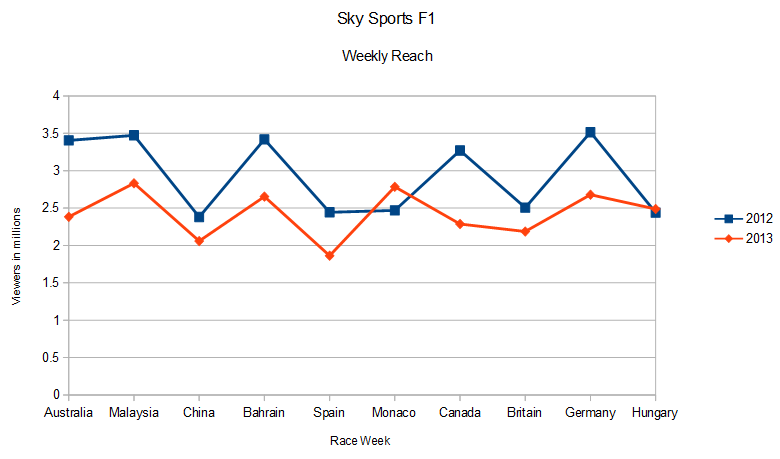
The Sky drop is further reflected in their channel reach, which has dropped half a million during live race weeks this year:
Sky Sports F1′ s weekly viewership reach at the half way point of the 2013 season. Source: BARB.
As the graph shows, only two races for them this season have increased in terms of reach, Monaco, one of their exclusive races, and Hungary due to no Olympics clash. Regarding programme averages for them, only Britain, Monaco and Hungary have increased. Unfortunately, it is difficult to find many positives for Sky as the picture is mainly decreases. Overall, the 2013 season is currently averaging 4.47 million viewers, or 4.70 million viewers when taking into account Sky’s long programming length.
– 2009 – 4.38 million
– 2010 – 4.41 million
– 2011 – 4.62 million
– 2012 – 3.89 million / 4.10 million
– 2013 – 4.47 million / 4.70 million
Typically, viewing figures drop in the second half of the season due to the run of Asian based races, whilst Belgian and Italy tend to be low too. Nevertheless, the headline figures are very, very positive. If you were to look at the first ten races of previous seasons, then you get:
Averages (Aus, Mal, Chn, Bah, Spa, Mon, Can, GB, Ger, Hun)
– 2009 – 4.30 million
– 2010 – 4.63 million
– 2011 – 4.86 million
– 2012 – 3.82 million / 4.06 million
– 2013 – 4.47 million / 4.70 million
Which places 2013 between 2010 and 2011 as I noted earlier. I expect 2013 to drop like 2010 and 2011 did, to end up with a season average of around 4.20 million / 4.50 million. The only reason 2009 increased towards the end of the year was because of Jenson Button, whilst the first half of 2012 was hurt by other sporting events as I’ve said multiple times. However, if Lewis Hamilton does put up a title fight, the figures of the season so far could be maintained.
Now, some people will rightfully say “yeah, but Germany was inflated by Wimbledon, so in reality 2013 is not up versus 2012”. Removing Germany takes the average down to 4.30 million / 4.53 million viewers. So at this stage it makes some difference, but come the end of the season, it will mean an increase of about 0.1 million to the total average, which is not a significant amount in the grand scheme of things.
If we are to compare further back, using data from 2000 onwards for Australia, Spain, Monaco, Britain and Hungary, we see the following:
Averages for the above five races
– 2000 – 4.29 million
– 2001 – 3.83 million
– 2002 – 3.49 million
– 2003 – 3.37 million
– 2004 – 2.99 million
– 2005 – 3.09 million
– 2006 – 2.58 million
– 2007 – 3.52 million
– 2008 – 4.12 million
– 2009 – 4.31 million
– 2010 – 4.54 million
– 2011 – 4.74 million
– 2012 – 3.79 million / 3.98 million
– 2013 – 3.95 million / 4.16 million
Interestingly, while that does show an increase, the increase is not as severe as the main headline figure. I think, in every season, some Formula 1 ratings have good luck and bad luck attached to them, and at the end of the year, it balances it all out. By the above measure, ratings are up versus 2012, but not as much as I said above.
A similar method would be to look at the first ten races only of the season:
Averages for the first ten races
– 2006 – 2.85 million
– 2007 – 3.66 million
– 2008 – 3.74 million
– 2009 – 4.36 million
– 2010 – 4.45 million
– 2011 – 4.66 million
– 2012 – 3.88 million / 4.12 million
– 2013 – 4.47 million / 4.70 million
At this point, no matter how many averages you take, the overriding point is that viewing figures are up versus last year. Are they near to 2011? It appears so, but the full picture will emerge as the season progresses, and more importantly if a title fight emerges. I’m pleased to see ratings increase, it is never a good sight to see ratings drop, so I’m happy to see a turn in the right direction. What is interesting is that all of the increase is due to the BBC. The move to sacrifice screening Monaco live has paid off dividends, it meant that they could pick Canada as a live race and being in primetime meant higher viewing figures for the latter.
Another brilliant move of their behalf was choosing Germany as a highlights race. It meant a combined average of 6 million viewers, which is unheard of for Formula 1 today. It is with BBC where the viewers lie, and clearly there is a section of the audience who have decided not to view Sky live this season and instead settle with the highlights. Cost? Who knows. I suspect it is one of the reasons. If everyone with the HD Pack and no Sports Pack has a nasty surprise in the off-season, then Sky’s figures could drop further. Unfortunately that is what the viewing figures show. I may be called “anti-Sky” for saying that about Sky’s figures, but the figures do not lie.
Although there is still half of the season ahead, and viewing figures could drop substantially, I think the recovery proves that the Olympics was a major factor in Formula 1’s ratings dropping. I’ve said it before and I’ll say it again – even if every Formula 1 race last year was live on BBC I think ratings would have dropped. Without stating the obvious, 2012 was a big, big year for the UK and Formula 1 just was not a part of that, nothing was going to change that fact. The only surprise for me was the severity of the drop. But, it is good to see ratings back up. How much are they up, we will know the answer at the end of the season.
Qualifying also recovered from 2012, and surprisingly an average of 2.88 million so far means that it is the most watched Qualifying ‘season’ so far since records began. That surprises me a lot. Aside from Britain, which averaged 2.36 million viewers on BBC and Sky, every Qualifying programme has recorded an average above 2.6 million viewers, which is a fantastic achievement when you consider only five years ago the average was less than 2 million. Of course, it goes without saying that some race weekends had Qualifying on the fringes of primetime, but that should not take away from the above.
Outside of the main sessions, practice remained level with last year, whilst The F1 Show increased slightly, but the averages remain below 100,000 viewers. GP2 has increased from 34,000 to 38,000 for its feature and sprint races, GP3 has remained at 21,000 viewers for its average. Unfortunately, the signs of life that the support races have shown are few and far in between. That is it for the mid-Summer verdict on the blog. I hope you’ve enjoyed reading the pieces, and as always comments are welcome.
Note: All the figures quoted here are the averages for the whole race programme, not the race average as these figures are unavailable. Figures are official figures from BARB and Broadcast magazine. While I have made comparisons and analysis of figures, I should note that I do not have every single ratings figure. The figures for that races that I am missing are:
1992 – Australia, San Marino, France, Portugal, Japan (live and both for AUS, JPN)
1993 – France (live), Japan (highlights)
1994 – Pacific (highlights), San Marino, France, Hungary, Japan (live)
1995 – Australia, Argentina, San Marino, Spain, Japan (all live)
1996 – Canada, Japan (all live)
1997 – Japan (live)
1998 – Australia,France, Japan (all live)
2000 – Malaysia (live and re-run), Japan (live)
2001 – Japan (live)
2003 – Malaysia; Japan (both live)
2004 – China (live)
If anyone is reading and has any of them ratings, leave a comment.
March 20th, 2008. The Formula 1 teams and personnel were gearing up for the Malaysian Grand Prix. The previous weekend, the Australian Grand Prix saw ITV celebrating their best season opening ratings for nearly a century. Morale was high within the team. After years of low ratings, a new Brit was on the scene and with it, Formula 1’s popularity in the United Kingdom was on the rise.
All was going well within the ITV F1 team. Higher up at ITV though, they had other ideas. ITV were going through an advertising downturn and, although the situation was improving by the end of 2007, it meant that the broadcaster had to cut costs across the board. In early 2007, ITV swooped for the FA Cup rights. Although it was a huge boost to ITV’s portfolio, in the process, the broadcaster had paid over the odds for them. And what it meant, one year later, is that the sums did not add up. Something had to give.
There were essentially two options. ITV could either bid extremely low for the UEFA Champions League Football, in the hope that they would retain, or they activate a get-out clause in their Formula 1 contract. On March 20th, 2008, it was revealed that they had done just that. Formula 1 was heading back to the BBC. At the time, fans were extremely happy with the move. ITV’s coverage was improving, with the addition of live streaming of practice on the internet, but the move to BBC promised a lot in terms of scope that the coverage would take. Just as a brief aside, a get-out clause is a clause that a party can activate at a particular time as specified if they no longer wish to continue with said contract, sometimes at a price, or sometimes with no price to pay (this particular point will become important later on).
But why did ITV take the UEFA Champions League instead of Formula 1? The answer, for ITV, was pretty simple. Taking the football would for ITV fill a lot of primetime hours around the year and more importantly for them, bring the male audience to the channel that other programs in their schedule then – and now – cannot achieve. Also, in terms of raw total audience figures, the football in primetime was an easy winner against the Formula 1 which goes out on Sunday mornings and afternoons. Currently, three out of the 19 races are in the lucrative European primetime slot. Nevertheless, for some, it seemed like an odd move, when Formula 1’s popularity was rising thanks to Lewis Hamilton and, a year later, Jenson Button. At the same point, we have to ask: why did ITV not renegotiate their contract with FOM? If the Formula 1 product was profitable to them, then it should have been in their interests to renegotiate to a lower deal, unless money was that tight at ITV, which prevented them from doing so.
So from their perspective, it was a fairly simple decision. Okay, it may have gave them a lot of headache, especially from the ITV F1 team who had worked fantastically for the decade before the announcement, but it was in the BBC’s hands to make Formula 1 broadcasting even more enticing to watch. The BBC won the contract for a reported £40 million per year. Already, the first mistake in their tenure had been made. £40 million per year, for the rights. Nothing else. At this point, I will quote from Steve Rider’s book. Page 223:
“Meanwhile, within a few weeks the initial euphoria seemed to have disappeared at the BBC as well. We received a call from a very senior producer at the BBC asking if we would mind giving them a rough ballpark figure on what our production costs had been (aside from the rights costs) for putting a full season of Formula One on the screen. Such a friendly informal exchange of information was commonplace, despite the public posturing. When he was told there would not be much change out of £8 or £9 million there was silence, then ‘Oh shit…’, and the line went dead.”
The last paragraph shows for me, that no negotiation took place between BBC and Formula One Management (FOM) in 2008. They took the first offer in place, without trying to reduce it or seeing where it would fit within their existing budget. Obviously production costs and rights costs are separate, but the point remains that no discussion took place about how much things would cost before entering the contract. If they realised the production costs beforehand, then they could have negotiated to reduce the rights costs. Failing to do so would turn out to be a grave mistake. With nearly £50 million being spent by BBC on Formula 1 each year, that works out at roughly £145 million the cost that the corporation spent on Formula 1 between 2009 and 2011, possibly more. Had BBC tried to negotiate the contract with Formula One Management, they could have tried to reduce the contract from £40 million to £35 million or £30 million, reducing their spending each year by a few million – and over the 3 years by between £15 million and £30 million. I guess, though had BBC stalled straight away on the first offer, Formula One Management would have been well in their right to walk to Channel 4 or even BSkyB and ask them if they want the contract.
On October 19th, 2010, it was announced that the licence fee had been frozen for seven years, which in real terms is a drop in income of 16 percent. The BBC had to save, and in some cases reduce services. Formula 1 was under threat. Immediately, their failure to negotiate with FOM in 2008 hit them. Because had they managed to negotiate a lower deal with FOM, they would have chopped potentially between 10 percent and 20 percent off their total Formula 1 expenses. Which could have been enough to save Formula 1’s full free-to-air profile. Could, have, would. It didn’t.
Fast forward to early 2011, where rumours began of potential Sky and News Corporation involvement in Formula 1. The Summer began, though, with the rumours having moved away very briefly. Again, like with the ITV deal and their people, people higher up in BBC began negotiating. Not with FOM for a lower deal. Instead they went straight to Sky Sports. At this point, you may be wondering why BBC did not activate a get-out clause. Firstly, it would have cost them a substantial amount of money, and secondly, they did not want to get rid of Formula 1 altogether. Those higher up within the corporation were prepared to do a deal with Sky, despite Formula 1 achieving its highest ratings since the late 1990’s. BBC and Sky agreed a deal, BBC went to FOM, and the contract was signed. Neither ITV or Channel 4 could agree to 2012. ITV were tied already due to Euro 2012, whilst Channel 4’s budget was covered by the Paralympics. They could have done 2013, but, as noted above, BBC opting out then would have left them with a financial penalty – they would be paying FOM for essentially screening no Formula 1 for one year. A lot of people call Sky ‘the enemy’ for taking Formula 1 on board, when in fact BBC went to Sky for the deal. I don’t particularly agree with that, but whether Sky used News Corporation newspapers as a ‘pressure movement’ to BBC management to try and get them to budge, we will never know.
At several stages here, there is a distinct lack of thought from all concerned. The first: ITV failed to renegotiate with FOM back in 2008. Had they have done that, I think it is highly likely that ITV would still have the rights today and more importantly every race would be live on free to air television. Would the coverage and air-time be as good as what BBC provide today? I don’t know, it is impossible to know what ITV would – or would not – have done had their ratings continued to increase in the same style BBC’s did. Secondly: BBC failed to negotiate the original contract presented to them by FOM. Again, had they have done that, they would have saved on the deal they actually proceeded it. Would it have been 17 percent? Possibly not, but it may have meant that Formula 1 would not have been in the firing line. Thirdly: BBC failed to renegotiate the original contract once the licence fee reduction was put in place. Would FOM and Bernie Ecclestone have granted it? We don’t know.
Five years ago, Formula 1 was live, every race on ITV. Now, half the races are live on BBC, with every race live on Sky Sports. The landscape has changed quicker than anyone predicted.
From Rider to Rosenthal, back to Rider and onto Humphrey to front Formula 1 on terrestrial television. In came Lazenby for Sky. And now from Humphrey to Perry. In comes Suzi Perry, the new face of Formula 1. Perry will, on Saturday, become the new face of BBC’s Formula 1 programming. But will she be as successful as those before her?
Steve Rider fronted Formula 1 for both BBC and ITV. Rider was the host of BBC’s coverage from the early 1980s to 1996. Back then, there was no laborious travelling around the world to present the sport as the majority of Rider’s presenting was part of BBC’s Grandstand strand, coming from their London studio at Television Centre. Staying in the UK was part of the reason why Rider held the role for so long. Towards the end of BBC’s contract, the team did travel to European races more, Rider still hosting alongside Tony Jardine in the pit-lane and on the grid.
When ITV picked up the rights to Formula 1, the production rights went out to tender. Chrysalis initially had Steve Rider as part of their bid to produce ITV’s coverage, but in the late stages, the two went in different directions. After considering Philip Schofield and John Leslie for the presenter’s role, Rider suggested to Jim Rosenthal that he should put himself forward to present. Chrysalis won the bid, and produced Formula 1 for ITV from 1997 to 2008, later becoming North One Television. Rosenthal held the presenting role from 1997 to 2005 before stepping aside at the end of that season. His tenure at ITV F1 began with him, Jardine and Simon Taylor presenting the show from an on-site studio, before moving into the paddock at the start of the 2004 season in an effort to bring viewers closer to the action. Rosenthal for ITV was a safe pair of hands, and was the right choice for them as he steered them through difficult years whilst Michael Schumacher dominated proceedings.
Rosenthal was succeeded by a familiar face though as Rider returned to the fray for three seasons. Unlike his first stint, Rider presented the action alongside Mark Blundell from the pit-lane. Whilst Rider was, again, a safe pair of hands, the pairing of him and Blundell was not the most riveting pair ever and soon the build-up discussion between the two became a bit ‘dull’. That would be no fault of Rider’s, but probably of the production team who did not seem to push the boundaries at this point, with Rider and Blundell seemingly situated in the same place in pit-lane for the entire pre race build-up.
Rider’s second spell ended in 2008 as BBC won the rights back from ITV. Instead of going with experience like ITV, BBC went for youth in 2009 as they made Jake Humphrey their new face of Formula 1. On the face of it, it was a potentially risky move going for youth instead of a veteran who held years of experience. But you can also see the logic in it, a younger presenter can help bring a new generation of viewers with him, in turn increasing viewing figures. The product, partly thanks to Humphrey’s presenting style, was a hit with viewers with the BBC programme well received. Humphrey was also helped by two fantastic pundits in David Coulthard and Eddie Jordan. Had you replaced Humphrey in Steve Rider, the results may have been similar in nature, although having a new, fresh look helped them.
Thanks to the broadcasting changes in 2011, Simon Lazenby was next to join the vast array of Formula 1 presenting talent for Sky last year. This year, he is joined by Suzi Perry, as the two will be presenting Formula 1 for Sky and BBC respectively. To her advantage, Perry has a significant amount of motor sport presenting experience having presented MotoGP for BBC for over ten years. Personally, I think Perry will do well as BBC presenter. It helps for her as well that the first two races are not live so that she can gel with the remainder of the team. At the end of the 2012, there was a question of whether the BBC team would be weaker without Humphrey. If anything, with the introductions of Perry and Tom Clarkson, their television production should be stronger than ever before.
Next weekend, the 2012 GP2 Series season comes to a conclusion in Singapore, with Davide Valsecchi and Luiz Razia aiming to win the championship. The series runs alongside the GP3 Series as Formula 1’s support package during race weekends, that particular championship concluding with a fantastic series finale last Sunday as Mitch Evans clinched the championship in the final laps.
While both championships have, for the most part, provided fantastic racing this season, there is a sad reality here in the UK. The reality is, that despite having three British drivers in GP2 and a further three drivers in GP3, the viewing figures on Sky Sports F1 have been embarrassingly low. Practice and Qualifying figures, understandably, are very low because I would not expect casual fans to watch that, but the race figures have been nothing to shout about. Here are the race figures that I have to hand for the season so far:
Bahrain
– 21/04/12 – GP2 Race 1: 56,000 (0.58%) average from 13:40 to 15:05; peak: 91,000 (0.98%) at 13:40
– 22/04/12 – GP2 Race 2: 46,000 (0.57%) average from 08:45 to 09:50; peak: 68,000 (0.86%) at 09:05
Spain
– 12/05/12 – GP2 Race 1: 62,000 (0.74%) average from 14:35 to 16:00; peak: 106,000 (1.30%) at 14:35
– 12/05/12 – GP3 Race 1: 42,000 (0.39%) average from 16:15 to 17:10; peak: 57,000 (0.57%) at 16:20
– 13/05/12 – GP3 Race 2: 32,000 (0.53%) average from 08:20 to 09:15; peak: 51,000 (0.84%) at 08:40
– 13/05/12 – GP2 Race 2: 35,000 (0.45%) average from 09:30 to 10:35; peak: 46,000 (0.59%) at 09:45
Monaco – all support race figures under 55,000
Europe – all support race figures under 42,000
Britain
– 08/07/12 – GP2 Race 2: 54,000 average from 09:35 to 10:40
– all other figures under 54,000
Germany
– 21/07/12 – GP2 Race 1: 100,000 average from 14:35 to 16:00
– all other figures under 72,000
Hungary – all support race figures under 24,000
Belgium
– 01/09/12 – GP2 Race 1: 29,000 average from 14:35 to 16:00
Only once this season has the GP2 Series hit 100,000 viewers. When you consider that Formula 1 regularly attracts audiences of over 4 million viewers, surely it is not right that the series’ one tier down attracts only 2.5 percent of the Formula 1 viewership?
If you look at any other sport, the gap between two tiers is not as large as that, where one attracts 4 million viewers, and the others only attract 100,000 viewers. The first problem has to be the lack of promotion given to it by Sky Sports. Throughout the months of promotion it gave to Formula 1, the only promotion they gave to GP2 and GP3 was a thirty second trailer to put on their website before the start of the season. No on-air trailers with dates and times to alert people, nothing of that sort has aired once this season on any Sky Sports channel promoting GP2. And I think that’s pretty poor myself. I have only ever seen GP2 and GP3 mentioned on Sky Sports News once, and that was when Conor Daly had his horrific accident at Monaco. They’ve never had a brief summary of the results with one or two clips summarising events and a quick interview with the winner, after all I lose count of how many times goals from the second and third tiers of English football are replayed constantly on Sky Sports News.
The fact here is that GP2 and GP3 deserve to have viewing figures so much higher than what they currently are getting and it is a sad indictment that not many people will be watching the GP2 Series conclude next weekend. Had James Calado had a good weekend in Italy, he would have been in the championship name, but how many people know of the name “James Calado”? Not many. Someone on another blog post of mine said “James who? Max who? Oh, I’m sorry. You can only see them at work behind a paywall. Disgraceful.” It is hard to disagree with him.
But is it all Sky Sports’ fault that GP2 and GP3 are doing badly? Some of it is, I’ve outlined promotion issues above. In my opinion though, no it isn’t. In fact, I would argue that the BBC have some proportion of blame here as well. Let us go back to 2007. ITV were screening International Motor Sport, which summarised the events of GP2 (and before that Formula 3000), with commentary from James Allen (previously Simon Taylor). From 1997 to 2007, ITV had that commitment to screening a half an hour highlights show on ITV1 on Saturday afternoons irrespective of viewing figures, the will to screen it always existed so viewers recognised future talent. It is where I watched on occasions Lewis Hamilton’s GP2 races in 2006 alongside Eurosport’s live coverage. Whilst the ITV1 ratings may have been low for the slot, they were multiple times higher than the 100,000 viewers that the live races attract at their peak on Sky Sports F1. In 2008, the coverage extended so that races were covered live on ITV4 with Charlie Webster presenting, which re-affirmed their commitment to showing GP2. It turned out to be their last year covering Formula 1 and GP2 as they gave up the rights to concentrate on the UEFA Champions League.
From 2009, Formula 1 coverage moved to the BBC. Whilst Formula 1 coverage got better on the BBC, what happened with the GP2 Series? The terrestrial commitment stopped. The BBC passed on showing the GP2 Series in any form, and instead Setanta Sports were left to pick up the live rights. As it turns out, that only lasted for half a year, Setanta went bust, and the live rights reverted to Eurosport, until Sky Sports won the F1 rights, taking with it GP2 and GP3. My point here is that had BBC decided “you know what, we will screen highlights in some form”, the conclusion may well be very different. It may not have been a ratings hit, it may have been under their slot average, but it would show their commitment to future Formula 1 stars. Place it neatly in the schedules, maybe directly after F1 Qualifying at 14:30. Unfortunately, for whatever reason, they did not take GP2 up.
I’ll finish this piece by linking to a video. It is an interview Steve Rider did at this year’s AUTOSPORT International show.
I know that the GP2 Series is worldwide rather than British based, but in my opinion, the point still remains. It is in GP2 and GP3 where the first glimpses of future world champions can be seen, where the next Schumacher, Raikkonen and Alonso can be found.
And how much coverage can terrestrial television viewers see? Nothing. And that, for me, is sad.

 Motorsport Broadcasting