The ratings picture: The Verdict so Far

The final part of my mid-season Verdict so far Series focusses on the ratings picture for this year’s Formula One season. Due to the change in broadcasting rights, with Sky Sports taking over exclusive live coverage for ten races, a change in the television ratings was anticipated. But have the ratings gone down, or have they gone up?

Before I start though, complete clarity on the figures I use. All of the figures in the blog are programme averages, unless stated otherwise. This is because these are the figures most readily available, and I do not have industry access to the viewing figures. Therefore, I am relying purely on the figures I already have and those that are reported in the public domain. I also have the Formula 1 viewing figures going back to the early 1990’s, those can be sourced from Broadcast magazine.

Unfortunately, the viewing figures for this season reveal that Formula 1 viewing has decreased to a four year low, with an average of 3.91 million viewers across the first eleven races of this season. The figure consists of:

– Sky live and BBC highlights for Australia, Malaysia, Bahrain, Canada, Germany and Hungary
– Sky live, BBC live and BBC re-run for China
– Sky and BBC live for Spain, Monaco, Europe, Britain

With the exception of the Chinese Grand Prix earlier this year, every race has been down year-on-year. At this point I want to dispel a myth that this is due to Sky Sports F1’s longer build-up and post-race, thus distorting the figures year-on-year. That is false. Let us take the Spanish Grand Prix.

BBC had 3.49 million viewers for its broadcast. From 11:30 to 16:15*, Sky Sports F1 had 551,000 viewers, a 4.62 percent viewing share. With the 5-minute breakdown in hand, from 12:10 to 15:15, the typical BBC F1 broadcast length from last year, Sky Sports F1 had 744,000 viewers, a 6.09 percent viewing share. That’s a difference of 232,000 viewers, or 35.1 percent. Keep that number in mind.

* note: Sky’s programme went on until 16:45 due to the Williams fire incident, as I note above, I have access to that particular breakdown so have taken the 11:30 to 16:15 chunk only. Most of Sky’s broadcasts now end at 16:15, hence the 16:15 cut-off to give the most accurate figure.

Sky Sports F1’s live race day broadcasts have average 669,000 viewers this season. Extrapolate that up 35.1 percent, and you get 904,000 viewers. That is an increase of 235,000 viewers.

Add that to the 3.91 million viewers and you get 4.14 million viewers. Which is down on 2009, 2010 and 2011:

– 2009: 4.32 million
– 2010: 4.29 million
– 2011: 4.55 million
– 2012: 4.14 million

The figures are still down, but not as much as it appears. If you were to look at the first eleven races excluding Bahrain as that was not part of last years calendar, then you get:

Averages (Aus, Mal, Chn, Spa, Mon, Can, Eur, GB, Ger, Hun)
– 2009 – 4.29 million
– 2010 – 4.30 million
– 2011 – 4.54 million
– 2012 – 4.09 million

Again, there is a drop, a substantial drop on last year, but not much of a drop on 2009 and 2010. The consensus there seems to be that there is a drop of 2009, 2010 and 2011, albeit not as much as is touted around in the media.

If we are to compare further back, using data from 2000 onwards for Australia, Spain, Monaco, Britain, Germany and Hungary, we see the following:

Averages for the above six races
– 2000 – 4.30 million
– 2001 – 3.61 million
– 2002 – 3.32 million
– 2003 – 3.22 million
– 2004 – 2.95 million
– 2005 – 3.00 million
– 2006 – 2.73 million
– 2007 – 3.35 million
– 2008 – 3.68 million
– 2009 – 4.22 million
– 2010 – 4.28 million
– 2011 – 4.52 million
– 2012 – 3.83 million (or 4.06 million using the ‘35.1 percent’ above)

A similar method would be to look at the first elevent races only:

Averages for the first eleven races
– 2006 – 2.87 million
– 2007 – 3.58 million
– 2008 – 3.62 million
– 2009 – 4.29 million
– 2010 – 4.36 million
– 2011 – 4.62 million
– 2012 – 3.91 million (or 4.14 million using the ‘35.1 percent’ above)

The problem that I have is that after years of increases since 2006 is that ratings have dropped by at least 400,000 irrespective of which comparison you use. It does not matter which ratings comparisons you use or how you choose to interpret them or spin them, but the fact of the matter is that this season will be the lowest rated season since 2008, unless there is a big increase in the next three months.

Why? Being a broadcasting blog, the first reason you could argue is that the BBC and Sky deal is sending viewers away from the sport. It is quite possible that this is happening, with the casual fans not knowing which races are live and which are highlights, therefore not bothering to tune in. It may be a lack of promotion on the BBC side of things. Take next weekend’s Belgian Grand Prix, there have been dozens of adverts on Sky, yet I have only seen one advert on BBC. If you don’t promote things, then viewers may not be aware that it is on, therefore won’t tune in. Outside of the ramifications of the BBC and Sky deal, the Olympics and Euro 2012 argument could be brought in.

Historically, the Olympics has dented things badly. In 2008, the European Grand Prix had only 2.64 million viewers compared with 3.24 million viewers the previous year, while in 2004, the Hungarian Grand Prix recorded a programme average of 2.11 million viewers compared with 2.73 million viewers in 2003. So the olympics definitely does have a negative effect on Formula 1 ratings. As I have said multiple times in this blog, it is madness that FOM and FIA schedule races against major sporting events. They won’t win viewers, they will only lose them, so why do it? It confuses me. Back to this year, however, and Canada may have had its viewership slashed because of Sky exclusivity (an example of a race that needed terrestrial coverage), but on the other hand the European Grand Prix had its highest rating since 2000, while the British and Hungarian Grand Prix’s were down, but not by as much as I anticipated. Aside from that, Australia, Malaysia, Spain and Monaco were down versus 2011, and none of those races were influenced at all by the Olympics or Euro 2012.

Qualifying has not done too badly, in fact while the 2.38 million viewers average may be down on 2009 and 2011, it is in line with 2010, coincidentally another sporting year with the World Cup playing a part. There has been a major fluctuation though between events, Australia was 1.2 million viewers down on 2011, yet Bahrain had an average of 3.45 million viewers, benefiting from a primetime slot on BBC One. So the deal does have swings and roundabouts regarding viewership.

I suspect there are multiple causes to the race drop outside of broadcasting. Maybe viewers are finding the ‘random’ Formula 1 this season with Pirelli a turn-off? It is possible, I guess, along with DRS and KERS hurting the viewership as fans and casuals want to see more ‘pure’ racing. I don’t know, the pattern of low ratings may not be repeated across Europe, it may just be a UK thing, because of the new deal.

Moving onto practice, and for the European based races, Practice 1 has averaged 83,000 on Sky Sports F1, Practice 2 has averaged 82,000 and Practice 3 has averaged 130,000. Interestingly there is very little difference between the programme averages for practice in Sky exclusive weekends versus the joint BBC and Sky races (74k/85k/128k vs 82k/69k/120k) which suggests that either not many people watch BBC Red Button, or that very few people that watch the Red Button for practice choose to watch the Sky exclusive practice sessions as well. I know the “it’s only practice” argument can be bandied around, but I do think Sky would have been hoping for higher figures for their exclusive practice sessions.

I hope that the ratings in general increase back to 2011 levels for the final haul of the season now that the Olympics and Euro 2012 are over. There is no reason, really, why the ratings should not increase as the championship reaches its climax, and looks set to be resolved at a later stage compared to last season. It would look odd if the highest rated season in the UK since 1999 would be a season where it was actually a German that won the title…

To end the blog post, I thought it would be a good idea to look at the GP2 and GP3 Series ratings. While I do not have averages for the series’ so far, the series is not benefiting one bit from being on Sky Sports F1, take this from the Spanish Grand Prix Qualifying day:

12:00 – F1 Qualifying: 342k (4.0%)
* peak: 632k (6.7%) at 13:55
14:35 – GP2 Race 1: 62k (0.7%)
* peak: 106k (1.3%) at 14:35
16:15 – GP3 Race 1: 42k (0.4%)
* peak: 57k (0.6%) at 16:25

As someone pointed out to me on my blog a few weeks ago: Who’s James? Who’s Max? That is referring to James Calado and Max Chilton, of course. The GP2 and GP3 figures are not spectacular, and is not bringing in any extra viewers than what it would usually on British Eurosport 2, or ITV4 in the case of GP2 in 2008. GP2 races in 2008 on ITV4 typically had between 80,000 and 100,000 viewers, so the Sky viewership is slightly down on that.

That is it for the mid-Summer verdict on the blog. I hope you’ve enjoyed reading the pieces, and as always comments are welcome.

Note: All the figures quoted here are the averages for the whole race programme, not the race average as these figures are unavailable. Figures are mostly official figures from BARB and Broadcast magazine. While I have made comparisons and analysis of figures, I should note that I do not have every single ratings figure. The figures for that races that I am missing are:

1992 – Australia, San Marino, France, Portugal, Japan (live and both for AUS, JPN)
1993 – France (live), Japan (highlights)
1994 – Pacific (highlights), San Marino, France, Hungary, Japan (live)
1995 – Australia, Argentina, San Marino, Spain, Japan (all live)
1996 – Canada, Japan (all live)
1997 – Japan (live)
1998 – Australia,France, Japan (all live)
2000 – Malaysia (live and re-run), Japan (live)
2001 – Japan (live)
2003 – Malaysia; Japan (both live)
2004 – China (live)
2006 – China (live)

If anyone is reading and has any of them ratings, leave a comment. While this piece focusses primarily on the 2012 ratings picture, my April piece focussed on the ratings picture for the past twenty years. For anyone wishing to read that, please click here.

A decade since the runaway Schumacher in 2002

Ten years ago today, at the 2002 French Grand Prix, Michael Schumacher clinched his fifth Formula One Drivers’ Championship. Aside from the fact that his championship winning drive helped him equal Juan Manuel Fangio’s record of five championship titles, his win was in Round 11 of 17 of the 2002 season. Or, to put it another way, there was still a third of the season left and there was six races left to win.

The people in Italy and Germany may have been very happy, but television bosses around the world were not, as all they seen was slumping ratings. And that too was evident here in the UK. During that season, a British driver only won a race once, that being David Coulthard in the Monaco Grand Prix where Schumacher finished second.

All but three race in the 2002 season recorded a ratings decline compared with the 2001 season, the only three races to record an improvement were Spain, Monaco and Europe. Starting off in Australia, the season opener had 3.41 million viewers, shedding over 1 million viewers compared with 2001. Even more surprising for me was that both the live showing and repeat showings were down, despite the multiple car collision that began that Grand Prix. I do remember the newspapers the next day having a five or six page spread with just full page spreads of pictures of the carnage that occurred from the first corner crash.

Moving onto Malaysia, and the ratings were steady year-on-year thanks to Jenson Button’s near podium and Michael Schumacher’s clash with Juan Pablo Montoya. Only a 30,000 viewer dip was recorded for Malaysia, which in the grand scheme of things is fairly negligible. The Brazilian Grand Prix did fairly well thanks to a battle to the end between the Schumacher brothers, recording a dip of 260,000, but still with a primetime viewership of nearly 6 million viewers.

San Marino, however, recorded the first big dip of the European season though, shedding 750,000 viewers on the previous year, with a rating of 3.43 million viewers. Despite Spain being a Schumacher walkover, that race recorded a slight rise, the first of the season, with a rise of 30,000 viewers. And then, we come onto Austria. If you are a Formula One fan, you know what happened here. Unsurprisingly, Austria seen a decline of 170,000 viewers compared with 2001.

Heading into the early part of the Summer though, the ratings seemed to zig-zag somewhat, Monaco and Europe actually increased despite the Austria fiasco, while Canada and Britain decreased. The block of four altogether had a decrease of 110,000 viewers, in line with the decrease for the France Grand Prix. Which, as I outlined above, is when viewers began to tune out in the droves. If you are a TV boss, how can you promote six races where there is nothing to fight for? You can’t. You could focus on the Constructors’ Championship battle, but fact of the matter is that the casual viewers do not really care about that, and therefore concentrating on that will do nothing for your viewership. It was damage limitation.

From that point onwards, every race recorded a decline compared with 2001. Both the Belgian and United States Grand Prix’s recorded declines of over 1 million viewers while the Hungarian and German Grand Prix’s recorded hefty declines as well. In order:

Top 6 declines – 2001 vs 2002
– 1.25 million – Belgian
– 1.16 million – United States
– 1.01 million – Australia
– 0.75 million – San Marino
– 0.61 million – Hungary
– 0.47 million – Germany

The US Grand Prix decline was particularly damaging, with it being one of only three races in primetime on ITV1, so you can imagine their reaction when they noticed they had a ‘dud’ race in primetime. Nowadays TV bosses are glad when the championship race goes to the final few races. Because tight championship battles makes people change the channel and watch Formula 1. And that’s what they want. They don’t want things like 2002 every year. Because it is a turn off. Plain and simple.

Did you watch every race in 2002? I did. Somehow. As always, comments and thoughts are welcome.

The lowest ten UK F1 ratings in the 21st century

One of the things that is interesting about looking over ratings data is seeing which races did very well and brought in the viewers… and which races, for whatever reason, didn’t do so well. There’s been a fair share of fantastic ratings since 2000 – such as the 8.8 million average recorded for the 2008 Brazilian Grand Prix – but on the other hand there have been ratings on the opposite of that spectrum as outlined below:

01 – 1.80 million – 2006 French Grand Prix
02 – 1.90 million – 2006 Italian Grand Prix
03 – 2.00 million – 2006 Turkish Grand Prix
04 – 2.10 million – 2005 Belgian Grand Prix
05 – 2.11 million – 2004 Hungarian Grand Prix
06 – 2.20 million – 2006 Spanish Grand Prix
07 – 2.21 million – 2005 Italian Grand Prix
08 – 2.23 million – 2006 German Grand Prix
09 – 2.37 million – 2005 French Grand Prix
10 – 2.39 million – 2002 Belgian Grand Prix

All of the ratings above are for the full ITV F1 programme, which was about three hours even back then, similar to the preceding years and similar to the years following those above, both of which had higher ratings. Eight out of the ten ratings above are from 2005 and 2006. To put the above ratings into context, the 2000 French Grand Prix Qualifying programme had 1.91 million viewers, which shows how low some of the above races plunged.

Unfortunately for ITV, it seems that a Spaniard and German fighting it out for the Drivers’ Championship was actually worse than seeing a German run-away with the championship. All but one race in the list above had something where there was still the Drivers’ Championship up for grabs, it was only the 2002 Belgian Grand Prix in the above which was a ‘dead rubber’ race with Michael Schumacher having claimed the Drivers’ Championship many races earlier. So that very low rating, on an August Bank Holiday weekend as well, may not be too surprising.

Italy and Hungary’s UK TV ratings from 2000 to 2011.

The fact that five out of the ten races in that list are from 2006 interests me though. Was no battle really better than a Spanish versus German battle? I guess one thing worth considering is the lack of British drivers’ fighting it out at the front in 2005 and 2006. David Coulthard had moved to Red Bull and out of a championship winning team, while Jenson Button was collecting good results, but never really threatening for a win, aside from his win at the 2006 Hungarian Grand Prix (even that failed to deliver ratings wise, an average of 2.50 million was all it could muster – probably showing how much the sport had declined in popularity in the country).

Aside from what I’ve mentioned above, there is the 2004 Hungarian Grand Prix on the list with 2.11 million. Which is of little surprise to me, it was held in the middle of Summer and it was by far one of the most boring races I have ever sat through. Looking at the ratings above, it’s not difficult to see why Formula 1’s popularity was at an all time low in the UK in the mid 2000’s.

Around this time period, Qualifying sessions hovered around the 1 million mark. The lowest live European-zone Qualifying session that I have is the 2005 Bahrain Grand Prix which had a very low 900k.

A look back at ITV’s first live Formula 1 broadcast in 1997 – the VT count

While my main post on Tuesday looked back at the 1997 Australian Grand Prix Qualifying broadcast on ITV, this post will simply note the lengths of VT’s and the time that they were actually live for. Basically, the length of everything.

01: Intro
– 00:00 to 00:35 (35 seconds)

02: VT
– 00:35 to 02:35 (2 minutes)
– Jim introduces programme from the lakeside
– a look at the Melbourne scenary
– an introduction to the ITV F1 team

03: VT
– 02:35 to 02:42 (7 seconds)
– Jim linking from previous piece to the next piece
– not live as it probably took him more than three minutes to get to the studio

04: VT
– 02:42 to 05:23 (2 minutes, 41 seconds)
– driver line-up

05: Live
– 05:23 to 07:07 (2 minutes, 44 seconds)
– in studio with Jim, Tony and Simon outlining key discussion points

06: VT
– 07:07 to 07:51 (44 seconds)
– Martin and Murray do a discussion piece to camera

07: Live
– 07:51 to 08:16 (25 seconds)
– in studio with Jim linking to an Inside F1 piece

08: VT
– 08:16 to 09:17 (1 minute, 1 second)
– David Coulthard explains all the buttons on the steering wheel

09: Live
– 09:17 to 09:50 (33 seconds)
– in studio with Jim linking to a piece about anti-F1 in Melbourne

10: VT
– 09:50 to 11:06 (1 minute, 16 seconds)
– News (focus on anti-F1, tyre war, Coulthard, Peter Phillips, tram strike)

11: Live
– 11:06 to 11:38 (32 seconds)
– in studio with Jim linking to a live Damon Hill interview

12: Live
– 11:38 to 12:52 (1 minute, 14 seconds)
– James Allen interviewing Damon Hill in pit-lane

13: Live
– 12:52 to 13:39 (47 seconds)
– discussion about Damon Hill’s weekend so far and expectations

Commercial Break.

14: Live
– 00:00 to 01:00 (1 minute)
– discussion about title championship predictions

15: Live
– 01:00 to 02:35 (1 minute, 35 seconds)
– Louise Goodman interviewing Jacques Villeneuve in pit-lane

16: Live
– 02:35 to 02:51 (16 seconds)
– in studio with Jim linking to track guide

17: VT
– 02:51 to 04:46 (1 minute, 55 seconds)
– Martin Brundle track guide using the F1 1997 video game

18: Live
– 04:46 to 05:47 (59 seconds)
– discussion about Schumacher’s track complaints
– Jim hands over to Murray and Martin

Totals
VT – 10 minutes, 19 seconds (50.6%)
Live – 10 minutes, 05 seconds (49.4%)

VT includes the opening titles.

A look back at ITV’s first live Formula 1 broadcast in 1997

So originally I had penned in for today to upload a comparison of VT’s between BBC and Sky Sports for the Monaco Grand Prix. But then, it sort of clicked. Would it be better doing that on its own, without any comparison to previous eras, or should I take a trip down memory lane and look at how ITV laid out their first Formula 1 live show?

The purpose, of course, of heading down memory lane is to see whether the quality of the shows has really improved, or whether in fact we are given more airtime, which means we are given more ‘fluff’ (ie more irrelevant pieces that mean little), and therefore, nothing has really improved? That’s an interesting question in itself. I’m sure come next week I will start staying “is this VT necessary?”. Maybe.

You may wonder why I have picked ITV’s first live broadcast, the Qualifying session of the Australian Grand Prix. First and foremost, when I do my blog post next week for the present day, I will be using the Qualifying session for Monaco, so it is important to compare side-by-side. Thirdly, I wanted to use the starting point for ITV, as Sky are in a similar position with their presentation just starting out. Obviously it’s a lot more different, and I want to use this to show how much things have moved on in some areas.

Texaco were ITV’s Formula 1 sponsor from 1997 to 2001.

As a viewer back in 1997, I imagine you were interested to see how the changes in broadcasting rights turned out on TV, while also annoyed that BBC had lost the rights. Out goes The Chain, and in comes Jamiroquai. Of course, it was actually a very good introduction and theme music. It’s just that it was not The Chain and therefore was not as well received. Same applies for Just Drive today. Both are very good introductions for the programme. Unlike Lift Me Up by Moby. The song is fine, the imagery… not so. Lets not go there. Anyway. Also coming in were adverts. Which, very obviously, was the major bugbear for any viewer. There was the suggestion of pausing the race while going to adverts. It did not occur in 1997, so I’m pretty certain in 2012, it would be extremely inconceivable to do such a thing. At the moment, in 2012, we are one of the few countries to have our races advert free, so we should count ourselves lucky.

Back to 1997, and at approximately 01:30 on Saturday 8th March, the Texaco sponsor and Jamiroquai played over to the nation for the very first time. While Jamiroquai was not The Chain, the Texaco spots were definitely the best sponsorship for ITV in their 12 years covering Formula 1.

Once the opening titles finished rolling, Jim Rosenthal gave us an introduction from the river beside Albert Park, followed by a VT previewing the new season. Two minutes and 41 seconds was the time needed to convey the information about the 12 teams and 24 drivers to screen. No flashy logos or anything, just video of drivers interspersed with the ITV F1 logo when the subject changed to another team. Afterwards, we were greeted to our first shot of the ITV F1 studio with Rosenthal alongside analysts Tony Jardine and Simon Taylor. Presenting Formula 1 from a studio on-site was a new thing back 15 years ago. Of course, F1 had been presented from a studio before. Just that the studio was in London and not track side.

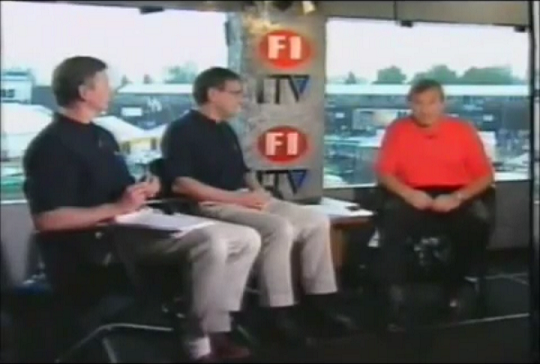
ITV’s F1 studio in 1997. Tony Jardine (l), Simon Taylor (c) and Jim Rosenthal (r).

In 1996, BBC’s last season consisted of Steve Rider either in London or presenting from the grid (depending on the race) with Tony Jardine in the pit-lane, and Jonathan Palmer alongside Murray Walker in the commentary box. ITV’s new studio helped them expand the on-air team with four people being expanded to seven people. Rider was replaced by Rosenthal, Jardine moved to the new studio, which would be transported all over the world, while Louise Goodman and James Allen presided over the latest pit-lane activity. If we are to forget about the adverts issue for a minute, having an on-site presence was already a step forward from the BBC’s offering the previous season. The studio also gave them a ‘safe haven’ I feel in a way in that it felt more rehearsed, but at the same point gave the coverage a laid back approach. Rosenthal was a safe pair of hands to steer the ITV F1 ship as well with over 15 years of sport experience covering sports such as boxing and football before joining the Formula 1 circus.

After a minute or so introducing the key topics with Jardine and Taylor, we got our first glimpse of Walker and Brundle together, the two presenting a short piece from the commentary box balcony.

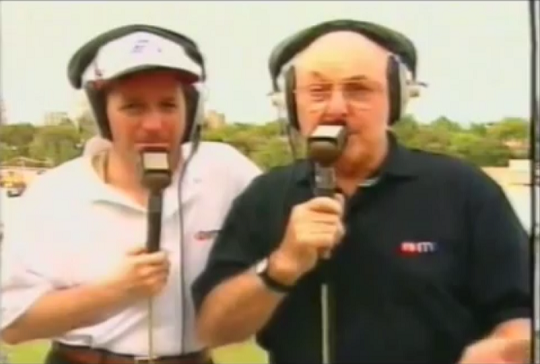
Martin Brundle and Murray Walker on the balcony.

From that, we then went to a VT, which for their first show seemed a bit out of place I would say, the first of many ‘Inside F1’ pieces, the first piece looking at the steering wheel with David Coulthard. Looked a bit out of place just eight minutes into the coverage. You could argue it was dumbing down with features like this, but if we look into the future from 1997, BBC did something similar in 2009 with ‘The Formula‘ whereas Sky do things with their virtual car. Although I’m not particularly sure why people would have their understanding ‘enhanced’ at 01:40 in the morning when the majority of them are hardcore fans! The feature would have been better saved for when more casual fans are watching starting from the European rounds. Rosenthal linked us from that to another VT, which was basically the news. Interestingly, the VT did not actually have any soundbites from the drivers’. Normally the news pieces nowadays tend to have a soundbite from the driver from the pre-weekend Thursday media interviews, but none were featured here. Instead the focus was on possible protests for the weekend’s race.

One thing we did get though was live interviews with Damon Hill and Jacques Villeneuve, although before the interview with Hill we did get a case of Rosenthal fluffling his lines, even referring to James Allen as Louise Goodman. Once the first commercial was out of the way we got Villeneuve live, with Goodman the interviewer. Not as polished as Allen at first, although Allen had previous broadcasting experience as ESPN pit-lane reporter whereas Goodman was a press officer for Jordan Grand Prix. After the interview we got evidence of just how much the track guide has moved on in the 15 years since 1997. For the 1997 season, we were greeted to a retro track guide from the F1 1997 video produced by Psygnosis. A great game it was as well for the time period, although it shows how basic the track guide was back then whereas nowadays you would have some corners analysed in the most finite of details to see where the extra hundredth of a second comes from.

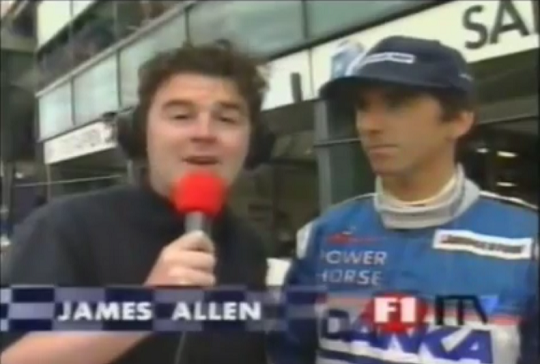
James Allen interviewing Damon Hill live.

And that was just about it for the build-up before Rosenthal handed over to Walker and Brundle for the first time. No five minute sting back then for Qualifying so Rosenthal handed over two minutes before the beginning of the session. A full summary of VT’s and live action will go up on this blog in the next few days, but for the 20 minute build-up excluding commercials, VT’s clocked up a total of 10 minutes, 19 seconds whereas live action, for instance studio discussion and interviews from the pit-lane hit just over 10 minutes with 10 minutes, 05 seconds. How does that compare with the present day? I will discuss in full in a few weeks, but BBC’s Qualifying programme for Monaco had over double the VT’s and over double the live action. ITV’s longest VT, 2 minutes and 41 seconds was shorter than three of BBC F1’s VT’s.

After the session, although I have not done any counts, the lengths are fairly similar, both with ten minutes each. The qualifying formats are different though, with the action today being analysed in between every session, so it is probably not a particularly fair comparison. One thing that I again noted was no driver interviews after the session, and nothing of the post-qualifying press conference shown. The post-qualifying coverage simply consisted of Rosenthal, Taylor and Jardine discussing the one-hour session until the end of the programme, which worked well with it being a relaxed discussion going over the key points.. It may be that they saved the interviews for the Qualifying Update show (turned into F1 Special’s when the European season came into full swing) on Saturday evening. On that note, here was the schedule for the remainder of the weekend:

Saturday 8th March 1997
17:15 – Qualifying Update
21:55 – Grand Prix Night
– The Clive James Formula 1 Show at 22:00
– FILM: Grand Prix at 22:00
– Australian Grand Prix Live at 02:05
–– 55 minutes build-up

Sunday 9th March 1997
14:00 – Australian Grand Prix Re-Run

As always, comments and thoughts are welcome. Did you watch ITV’s F1 coverage in 1997? Did you mind adverts? How did you rate it?

Images in this article are copyright of ITV Sport.