I thought, having watched both practice sessions today as I have done throughout the year, write some brief thoughts on Sky’s Practice coverage. It won’t be a really long blog, just a few pointers on where they could improve. For the most part, it is good, but there are a few areas where things do grind.
Firstly, there is the constant cutting away to their own cameras. There needs to be a balance, and I don’t feel that Sky have the correct balance at the moment. They normally cut away from the Formula One Management feed when David Croft hands over to Ted Kravitz or Natalie Pinkham, but I really don’t get why they cut away. They should only cut away if Kravitz has something to show us, as it adds to the coverage. But cutting away to show Martin Brundle interviewing Martin Whitmarsh is unnecessary, we know what both men look like so there is no need to cut away from the World Feed when there may be action on the track. In one example, they cut away to show Jacques Villeneuve walking through the paddock. Yes, he may be part of your coverage this weekend, but the cut away was not necessary, and did not enhance the coverage apart from say “ooh, we have a camera in the paddock!”. As I say, they should only cut away when Kravitz is showing us something, we know what people look like so we don’t need to cut away at any other time, especially if cars are on track, as that grates a lot.
The next point concerns Jerome d’Ambrosio. I’m not sure how many more Friday’s Anthony Davidson is away for, but d’Ambrosio does not really add to the coverage for me, and they would be much better rotating the co-commentary position, or have a guest commentator like BBC Radio 5 Live used to do when Davidson was unavailable. We had d’Ambrosio in Monaco, and as a practice commentator he doesn’t do much because he has not been high up the grid, so does not have the expertise that another potential co-commentator would have, take Johnny Herbert for instance for the sake of an example. At times it felt like Croft and d’Ambrosio were having trouble filling the time with awkward pauses, whereas someone like Herbert, who has a lot of past F1 experience, would be able to fill the time easily and tell ‘stories’ to relate to a current drivers’ situation. d’Ambrosio’s a fine commentator in GP2 and GP3, because he’s commentating on the action in front of him, but is not really suited to practice where they are in ‘discussion mode’, in my opinion.
Seven minutes off-air, that is still in force, and it grinds a bit when they could get a extra interview or two in. It is most noticeable though for practice three, as we witnessed in Monaco when they hurried off air a mere three minutes after the session had ended, despite incidents at the end of the session.
Anyway, I thought I’d write this blog, seeing as I had a few pointers in my head, but as always, your comments are welcome as well. Agree or disagree with the above?
Yesterday, The Guardian published an article, written by Christian Sylt with the headline “Bernie Ecclestone suggests free-to-air Formula One could end on BBC”.
Interesting headline, I’m sure you will think. Any substance to the article? Not really, if I’m to be brutally honest. The only quotes that come from Ecclestone are as follows:
– “We will never move all countries to pay‑per‑view only though it wouldn’t make any difference here in the UK”
– “Sky reaches over 10m. We don’t get 10m on the BBC, normally about 6m or 7m.”
– “The thing that TV stations want to buy most is live sport. People don’t want to watch delayed stuff because nowadays it’s hard not to know the result if you don’t want to.”
– “Sky have done a super job. The Beeb were sure we wouldn’t be able to go anywhere else”
The first point, Sky is not pay-per-view. It is not like with movies, where you have to buy each one individually. You could call Sky pay-per-month but not pay-per-view. A PPV service model would be F1 Digital+ from back in 2002. Moving onto the second point, and I wonder if that is like for like. Does the Sky Sports F1 channel reach over 10 million, or does the race show reach over 10 million? Looking on BARB, the channel has not reached over 10 million viewers once. If you’re to say “Well, Sky reaches 10 million” then you may as well respond by saying BBC reaches five times that number with a reach of over 50 million.
“People don’t want to watch delayed stuff…”, I don’t know about the don’t want part, but if we’re to look at the viewing figures, 3.65 million viewers (or a 20.2% share) watched highlights of the Bahrain Grand Prix on BBC One, whereas only a peak of 1.6 million viewers watched that race on Sky Sports F1. So people not watching delayed stuff as Ecclestone puts it is a factually inaccurate statement. The last statement is odd, because as far as I know, and as far as what was discussed around the time of the announcement, BBC wanted out of the deal because they could not afford to screen all of the races live, therefore went to Sky to get the deal we currently have now (as Channel 4 and ITV1 were tied up with 2012 commitments already). In other words, the four quotes from Ecclestone have either been spun, or are inaccurate.
Looking outside of the Ecclestone quotes, there are several other factual inaccuracies.
“At an estimated cost of £25m annually Sky is broadcasting all races, qualifying and practice sessions live while the BBC is paying around £15m to show half of the races live with delayed highlights of the others.”
If that is true, it means that Formula One Management have not benefited financially from the deal, when you consider that the previous BBC deal from 2009 to 2011 was also in the region of £40 million. The Guardian themselves reported on the day of the deal that the rights were believed to be worth £65 million now, £40 million being paid by Sky with £25 million being paid by BBC. The amounts above are significantly lower than I expected.
Finally, we’re into month six of a seven year deal, so why have we got headlines like this already? I would expect better from The Guardian rather than trying to twist the story. This reminds me of some kind of tabloid sensationalism, something I don’t really associate The Guardian with. As far as I can see, this is a blatant anti-BBC article with little substance, and as thus the article I’m afraid is cobblers.
Italian pay TV station Sky Italia are to screen all twenty races of the Formula 1 season from 2013 live, it has been announced. Eleven of these races will be broadcast exclusively live on their channel, with the remaining nine races (including the Italian Grand Prix) broadcast by a free to air station yet to be announced. That broadcaster will also screen the eleven races that Sky have exclusively in highlights form. In summary:
– 11 races: Sky Italia exclusively, FTA broadcaster highlights
– 09 races: Sky Italia and FTA live
This announcement appears to signal a reduction, or even possibly the end of Formula 1 involvement, for free to air broadcaster RAI. It is the latest blow for them, who recently lost the rights to the UEFA Champions League and MotoGP. In a statement of intent that they intend to expand their motor sports portfolio, the MotoGP rights went to Sky Italia exclusively last month, with the broadcaster to screen the races from 2014 onwards.
Sky Italia’s coverage will feature across all platforms, “web, tablet Smartphones and IPTV”. In their press release, Bernie Ecclestone notes that “we have a similar arrangement [in the UK] that is working very well, increasing the quality and breadth of coverage”. While true, I cannot help but feel that this is another irreversible step towards Formula 1 being exclusively broadcast on a pay TV station, leading to a dip in ratings. The initial effects of the UK deal after the first four rounds showed a drop in ratings, although the amount that the ratings have dipped by was unclear taking everything into account.
The situation, though, in both countries is different. Before the new deal in the UK, BBC screened every Formula 1 session, from the first Friday practice session to the race on Sunday. Whereas, in comparison, RAI in Italy only screen Qualifying and the Race live with no coverage of practice sessions. So, from that perspective, the fans in Italy may well be happy – or more welcome – to the prospect of Formula 1 being on Sky Italia, compared to the reaction when the similar deal was announced in the UK. Looking at Sky Sport’s Facebook page, specifically this post, it looks like they are more receptive to the move, although there are a few negative comments in there, as you would probably expect.
I would be interested to hear from Italian Formula 1 fans, if any are reading this blog. How do you feel about this deal? Do you welcome it, or do you want all races to remain live on RAI?
From BARB, two days late due to a few celebrations of national importance:
1 – 565k – Live Monaco Grand Prix (Sunday, 11:30)
2 – 388k – Live Monaco Grand Prix: Qualifying (Saturday, 12:00)
3 – 148k – Live Monaco Grand Prix: Practice 3 (Saturday, 08:45)
4 – 89k – Live Monaco Grand Prix: Practice 2 (Thursday, 12:45)
5 – 80k – Live Monaco Grand Prix: Practice 1 (Thursday, 08:45)
6 – 77k – The F1 Show (Friday, 17:02)
7 – 64k – Brundle Drives a Ferrari (Saturday, 14:45)
8 – 57k – F1 Legends (Saturday, 11:30)
9 – 55k – Bahrain Grand Prix: Porsche Supercup (Saturday, 11:10)
10 – 55k – The F1 Show (Friday, 20:06)
The Indianapolis 500 only just made Sky Sports 4’s Top 10 with 29 thousand viewers. The channel reached 2.469 million viewers for the week, the highest for a non-Sky exclusive race yet.
Neither of BBC F1’s programmes entered BBC One’s Top 30.
So originally I had penned in for today to upload a comparison of VT’s between BBC and Sky Sports for the Monaco Grand Prix. But then, it sort of clicked. Would it be better doing that on its own, without any comparison to previous eras, or should I take a trip down memory lane and look at how ITV laid out their first Formula 1 live show?
The purpose, of course, of heading down memory lane is to see whether the quality of the shows has really improved, or whether in fact we are given more airtime, which means we are given more ‘fluff’ (ie more irrelevant pieces that mean little), and therefore, nothing has really improved? That’s an interesting question in itself. I’m sure come next week I will start staying “is this VT necessary?”. Maybe.
You may wonder why I have picked ITV’s first live broadcast, the Qualifying session of the Australian Grand Prix. First and foremost, when I do my blog post next week for the present day, I will be using the Qualifying session for Monaco, so it is important to compare side-by-side. Thirdly, I wanted to use the starting point for ITV, as Sky are in a similar position with their presentation just starting out. Obviously it’s a lot more different, and I want to use this to show how much things have moved on in some areas. Texaco were ITV’s Formula 1 sponsor from 1997 to 2001.
As a viewer back in 1997, I imagine you were interested to see how the changes in broadcasting rights turned out on TV, while also annoyed that BBC had lost the rights. Out goes The Chain, and in comes Jamiroquai. Of course, it was actually a very good introduction and theme music. It’s just that it was not The Chain and therefore was not as well received. Same applies for Just Drive today. Both are very good introductions for the programme. Unlike Lift Me Up by Moby. The song is fine, the imagery… not so. Lets not go there. Anyway. Also coming in were adverts. Which, very obviously, was the major bugbear for any viewer. There was the suggestion of pausing the race while going to adverts. It did not occur in 1997, so I’m pretty certain in 2012, it would be extremely inconceivable to do such a thing. At the moment, in 2012, we are one of the few countries to have our races advert free, so we should count ourselves lucky.
Back to 1997, and at approximately 01:30 on Saturday 8th March, the Texaco sponsor and Jamiroquai played over to the nation for the very first time. While Jamiroquai was not The Chain, the Texaco spots were definitely the best sponsorship for ITV in their 12 years covering Formula 1.
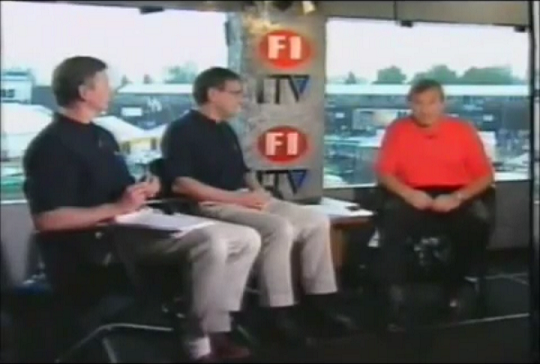
Once the opening titles finished rolling, Jim Rosenthal gave us an introduction from the river beside Albert Park, followed by a VT previewing the new season. Two minutes and 41 seconds was the time needed to convey the information about the 12 teams and 24 drivers to screen. No flashy logos or anything, just video of drivers interspersed with the ITV F1 logo when the subject changed to another team. Afterwards, we were greeted to our first shot of the ITV F1 studio with Rosenthal alongside analysts Tony Jardine and Simon Taylor. Presenting Formula 1 from a studio on-site was a new thing back 15 years ago. Of course, F1 had been presented from a studio before. Just that the studio was in London and not track side. ITV’s F1 studio in 1997. Tony Jardine (l), Simon Taylor (c) and Jim Rosenthal (r).
In 1996, BBC’s last season consisted of Steve Rider either in London or presenting from the grid (depending on the race) with Tony Jardine in the pit-lane, and Jonathan Palmer alongside Murray Walker in the commentary box. ITV’s new studio helped them expand the on-air team with four people being expanded to seven people. Rider was replaced by Rosenthal, Jardine moved to the new studio, which would be transported all over the world, while Louise Goodman and James Allen presided over the latest pit-lane activity. If we are to forget about the adverts issue for a minute, having an on-site presence was already a step forward from the BBC’s offering the previous season. The studio also gave them a ‘safe haven’ I feel in a way in that it felt more rehearsed, but at the same point gave the coverage a laid back approach. Rosenthal was a safe pair of hands to steer the ITV F1 ship as well with over 15 years of sport experience covering sports such as boxing and football before joining the Formula 1 circus.
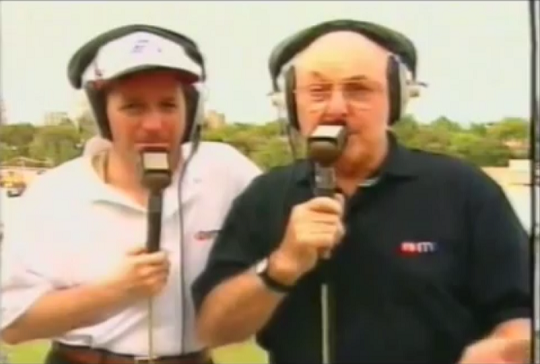
After a minute or so introducing the key topics with Jardine and Taylor, we got our first glimpse of Walker and Brundle together, the two presenting a short piece from the commentary box balcony. Martin Brundle and Murray Walker on the balcony.
From that, we then went to a VT, which for their first show seemed a bit out of place I would say, the first of many ‘Inside F1’ pieces, the first piece looking at the steering wheel with David Coulthard. Looked a bit out of place just eight minutes into the coverage. You could argue it was dumbing down with features like this, but if we look into the future from 1997, BBC did something similar in 2009 with ‘The Formula‘ whereas Sky do things with their virtual car. Although I’m not particularly sure why people would have their understanding ‘enhanced’ at 01:40 in the morning when the majority of them are hardcore fans! The feature would have been better saved for when more casual fans are watching starting from the European rounds. Rosenthal linked us from that to another VT, which was basically the news. Interestingly, the VT did not actually have any soundbites from the drivers’. Normally the news pieces nowadays tend to have a soundbite from the driver from the pre-weekend Thursday media interviews, but none were featured here. Instead the focus was on possible protests for the weekend’s race.
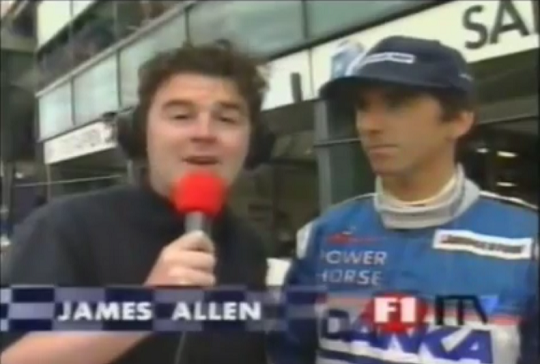
One thing we did get though was live interviews with Damon Hill and Jacques Villeneuve, although before the interview with Hill we did get a case of Rosenthal fluffling his lines, even referring to James Allen as Louise Goodman. Once the first commercial was out of the way we got Villeneuve live, with Goodman the interviewer. Not as polished as Allen at first, although Allen had previous broadcasting experience as ESPN pit-lane reporter whereas Goodman was a press officer for Jordan Grand Prix. After the interview we got evidence of just how much the track guide has moved on in the 15 years since 1997. For the 1997 season, we were greeted to a retro track guide from the F1 1997 video produced by Psygnosis. A great game it was as well for the time period, although it shows how basic the track guide was back then whereas nowadays you would have some corners analysed in the most finite of details to see where the extra hundredth of a second comes from. James Allen interviewing Damon Hill live.
And that was just about it for the build-up before Rosenthal handed over to Walker and Brundle for the first time. No five minute sting back then for Qualifying so Rosenthal handed over two minutes before the beginning of the session. A full summary of VT’s and live action will go up on this blog in the next few days, but for the 20 minute build-up excluding commercials, VT’s clocked up a total of 10 minutes, 19 seconds whereas live action, for instance studio discussion and interviews from the pit-lane hit just over 10 minutes with 10 minutes, 05 seconds. How does that compare with the present day? I will discuss in full in a few weeks, but BBC’s Qualifying programme for Monaco had over double the VT’s and over double the live action. ITV’s longest VT, 2 minutes and 41 seconds was shorter than three of BBC F1’s VT’s.
After the session, although I have not done any counts, the lengths are fairly similar, both with ten minutes each. The qualifying formats are different though, with the action today being analysed in between every session, so it is probably not a particularly fair comparison. One thing that I again noted was no driver interviews after the session, and nothing of the post-qualifying press conference shown. The post-qualifying coverage simply consisted of Rosenthal, Taylor and Jardine discussing the one-hour session until the end of the programme, which worked well with it being a relaxed discussion going over the key points.. It may be that they saved the interviews for the Qualifying Update show (turned into F1 Special’s when the European season came into full swing) on Saturday evening. On that note, here was the schedule for the remainder of the weekend:
Saturday 8th March 1997
17:15 – Qualifying Update
21:55 – Grand Prix Night
– The Clive James Formula 1 Show at 22:00
– FILM: Grand Prix at 22:00
– Australian Grand Prix Live at 02:05
–– 55 minutes build-up
Sunday 9th March 1997
14:00 – Australian Grand Prix Re-Run
As always, comments and thoughts are welcome. Did you watch ITV’s F1 coverage in 1997? Did you mind adverts? How did you rate it?
Images in this article are copyright of ITV Sport.


 Motorsport Broadcasting