Last night I wrote my 99th post for this blog, which means that this is post number 100.
I started the blog off in April, but I was never sure whether it would continue, or whether people would read. I am extremely pleased that even three months on, the blog is still going and getting stronger. Since April, the blog has received over 5,000 hits, which, for a F1 Broadcasting blog, is definitely a big achievement.
Here are the top 10 posts that have received the most views:
Another set of posts worth posting is what began this blog back in April, ‘The Verdict so Far’ posts, which apply just as much now as they did back then.
I also should thank everyone that has read the blog so far, and I hope the blog grows further into the future!
One thing you may have noticed over the past few months on this blog is how I have written more blog posts about Sky Sports F1 compared with BBC’s Formula 1 coverage. The simple reason for that is that there is more scope to cover with Sky Sports compared with BBC as they have a channel rather than a programme so there are more areas to talk about both within a race weekend and outside of the race weekend.
Admittedly, I have watched a lot more Sky Sports F1 programming compared with BBC F1 programming this year, hence why I have not covered BBC a massive amount on this blog yet, in fact there are 29 posts in my BBC F1 category compared with 61 posts for Sky Sports F1. With that in mind, I thought that I would use this post to look at BBC’s coverage a bit more, in particular, their Qualifying highlights programme for this weekend’s German Grand Prix. While watching I will also take the opportunity to make general comments about BBC’s coverage. As well as today’s programme, I also watched the latter stages of the British Grand Prix on BBC Two as well as the F1 Forum for that race. Of course, BBC’s coverage began in 2009 and like many of you I also watched every race on the BBC from then to 2011.
The first thing you hear in any F1 programme on BBC television is The Chain. The famous riff as the pace speeds up, for me, nothing beats The Chain when it comes to Formula 1. As good as Just Drive by Alistair Griffin is (and yes, I very much enjoy hearing it), it will never beat The Chain for me. There is something about The Chain that for me sends a shiver down the spine. You know hearing that theme that you are not long away from seeing the famous red lights going off. The Chain, in my opinion, is the definitive Formula 1 theme. The visuals however? If I am to be brutally honest, I’m really not a fan of the intro visuals. The Chain makes up for it somewhat, but the visuals just shout out “tacky” and lacks class. In a dream world, we should combine the Sky Sports intro visuals with The Chain. Now that would be perfection. One day, maybe.
(For clarity, the above paragraph only refers to one minute onwards in this video. The first minute before that is, again, perfect)
The VT intro focussed on Michael Schumacher’s quest to get back to the top podium, as well as looking at Sebastian Vettel’s rise to the top with Schumacher’s thoughts in the background. The VT made super use of the archive footage which I thoroughly enjoyed. It probably helped that I am a Schumacher fan, so I may be slightly biased in this respect, but I would take archive footage over computer generated footage any day of the week. From there, Lee McKenzie and David Coulthard discussed the possibilities for Schumacher this weekend, before a look at the drivers’ standings. Some people at home may have been wondering this season why BBC do not just go straight into the race. There are several reasons for this. The first one is that the BBC team wanted to keep the best of the live shows and build a more ‘concise’ highlights show, this was something Jake Humphrey heavily emphasised in the BBC F1 preview magazine and something that they have aimed to do. The second reason is almost certainly a contractual obligation, in that they are not allowed to broadcast an entire Qualifying session without truncating it, so I suspect there are clauses saying “World Feed footage must not exceed X minutes for Qualifying and Y minutes for the Race.” It would also make the contract a bit worthless for Sky if BBC were allowed to go and broadcast the Qualifying and Race sessions in full, hence why there are likely to be clauses in place to prevent them from doing that.
Following that, we had an interview with Pastor Maldonaldo from Tom Clarkson, Ben Edwards with the news and Gary Anderson looking over the technical features. The thing that I liked here is that each team member had their own little feature so the pre-show was balanced out in that respect. Also, and a side effect of the above paragraph, it has to be said, by having less World Feed footage it means that you can have a longer pre-show and post-race show to cover the latest stories and events. Comparing Anderson’s technical analysis with Ted Kravitz’s Sky Pad analysis makes for interesting reading. I remember back at the start of the season when you had Kravitz on the Sky Pad and Anderson, quite literally, using a pen and pencil, in terms of technology, worlds’ apart from one another.
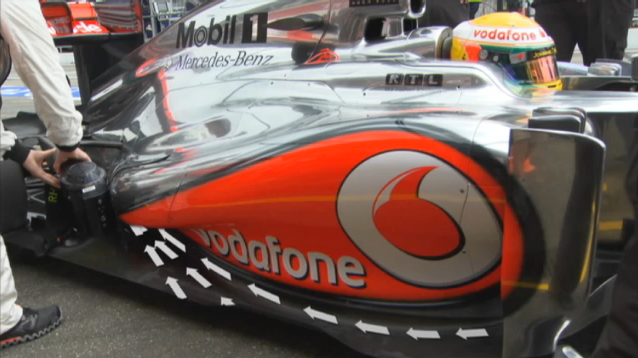
BBC’s graphics used during the 2012 German Grand Prix Qualifying session to help explain McLaren’s upgrades.
Does it make for better analysis though? The above is Anderson talking over a shot of a few arrows going from one part of the car to another. Simple, but it shows beautifully what the latest McLaren upgrades are intended to do. It depends what exactly the upgrade is and where about on the car it is, sometimes having the Sky Pad shows it better, sometimes it doesn’t. As a technical expert doing pieces to camera, though, Anderson has improved a lot compared with the start of this season in my opinion from when I remember watching him in Australia.
I won’t comment too much on the commentary, purely because both sets of commentary teams are as good as each other. At the end of the day it comes down to personal preference. Me, personally, I value Martin Brundle’s opinion a lot, and therefore I prefer him and David Croft, but that does not mean Coulthard and Edwards are bad. It is personal preference, plain and simple.
While the pre-Qualifying show has to be recorded before Qualifying, the post-Qualifying show can be done anytime after Qualifying. So today, the post-Qualifying show could be filmed anytime from 14:00 to 16:30, to allow adequate editing time before that portion of the show makes the air at about 17:50 on BBC Two. Those that watched the Bahrain Grand Prix forum will know that BBC were filming that after Sky Sports had gone off-air, about 16:50 UK time, allowing them to get the opinions of people you normally would not hear from (ie Jo Ramirez in that particular forum), leading to a much better and enjoyable show. The same applies for post-Qualifying, and also for between the sessions. While of course the interviews would have been done in one ‘take’, the programme is not live and therefore there is no urgency to get the driver who they want to interview as soon as possible, allowing the editor to wait a short time before getting the person who they want to get, hence why McKenzie and Coulthard interviewed Mark Webber during the GP2 race, a long time after Sky went off the air. After the session, you also had Anderson outline the relative strategy options, which presents an interesting take on things, notwithstanding the accuracy of it come the Sunday race. I do recall seeing this back in Australia, so I assume this has been around for the majority of the races. For both the hardcore and casual viewer, by showing the differing strategies, it helps the viewer know what to look out for in the race and what sort of race to expect, whether it will be a ‘pit stop fest’ or a ‘overtaking fest’. Or neither.
Unrelated to the structure of the show but, for future reference, it is me worth noting that I spotted Clarkson holding two microphones, a TEN Sport microphone and a BBC Sport microphone, meaning that he is more than likely working with both broadcasters’ this weekend.
The highlights programme produced by BBC, as you would expect, is an extremely well-produced programme, and while it is always better to be live (to give it the ‘raw’ feel), the programme that BBC produces definitely brings out the good for everyone involved. As noted above, the show also brings with it certain benefits which enhances the quality of the BBC programme. As always your thoughts and comments are welcome.
Ten years ago today, at the 2002 French Grand Prix, Michael Schumacher clinched his fifth Formula One Drivers’ Championship. Aside from the fact that his championship winning drive helped him equal Juan Manuel Fangio’s record of five championship titles, his win was in Round 11 of 17 of the 2002 season. Or, to put it another way, there was still a third of the season left and there was six races left to win.
The people in Italy and Germany may have been very happy, but television bosses around the world were not, as all they seen was slumping ratings. And that too was evident here in the UK. During that season, a British driver only won a race once, that being David Coulthard in the Monaco Grand Prix where Schumacher finished second.
All but three race in the 2002 season recorded a ratings decline compared with the 2001 season, the only three races to record an improvement were Spain, Monaco and Europe. Starting off in Australia, the season opener had 3.41 million viewers, shedding over 1 million viewers compared with 2001. Even more surprising for me was that both the live showing and repeat showings were down, despite the multiple car collision that began that Grand Prix. I do remember the newspapers the next day having a five or six page spread with just full page spreads of pictures of the carnage that occurred from the first corner crash.
Moving onto Malaysia, and the ratings were steady year-on-year thanks to Jenson Button’s near podium and Michael Schumacher’s clash with Juan Pablo Montoya. Only a 30,000 viewer dip was recorded for Malaysia, which in the grand scheme of things is fairly negligible. The Brazilian Grand Prix did fairly well thanks to a battle to the end between the Schumacher brothers, recording a dip of 260,000, but still with a primetime viewership of nearly 6 million viewers.
San Marino, however, recorded the first big dip of the European season though, shedding 750,000 viewers on the previous year, with a rating of 3.43 million viewers. Despite Spain being a Schumacher walkover, that race recorded a slight rise, the first of the season, with a rise of 30,000 viewers. And then, we come onto Austria. If you are a Formula One fan, you know what happened here. Unsurprisingly, Austria seen a decline of 170,000 viewers compared with 2001.
Heading into the early part of the Summer though, the ratings seemed to zig-zag somewhat, Monaco and Europe actually increased despite the Austria fiasco, while Canada and Britain decreased. The block of four altogether had a decrease of 110,000 viewers, in line with the decrease for the France Grand Prix. Which, as I outlined above, is when viewers began to tune out in the droves. If you are a TV boss, how can you promote six races where there is nothing to fight for? You can’t. You could focus on the Constructors’ Championship battle, but fact of the matter is that the casual viewers do not really care about that, and therefore concentrating on that will do nothing for your viewership. It was damage limitation.
From that point onwards, every race recorded a decline compared with 2001. Both the Belgian and United States Grand Prix’s recorded declines of over 1 million viewers while the Hungarian and German Grand Prix’s recorded hefty declines as well. In order:
Top 6 declines – 2001 vs 2002
– 1.25 million – Belgian
– 1.16 million – United States
– 1.01 million – Australia
– 0.75 million – San Marino
– 0.61 million – Hungary
– 0.47 million – Germany
The US Grand Prix decline was particularly damaging, with it being one of only three races in primetime on ITV1, so you can imagine their reaction when they noticed they had a ‘dud’ race in primetime. Nowadays TV bosses are glad when the championship race goes to the final few races. Because tight championship battles makes people change the channel and watch Formula 1. And that’s what they want. They don’t want things like 2002 every year. Because it is a turn off. Plain and simple.
Did you watch every race in 2002? I did. Somehow. As always, comments and thoughts are welcome.
From Germany, it is a frantic rush as the teams’ pack up quickly ready to hop over to Hungary for the Hungarian Grand Prix, part of the third double header so far this season.
In terms of the BBC and Sky personnel, I believe it is status quo compared to Germany, the only difference being that Natalie Pinkham is back after her wedding. The schedule as always, is below, although I’m unsure if Inside F1 will actually air on Friday 27th July due to build-up to the Olympics Opening Ceremony. Qualifying is on BBC Two, with the Race on BBC One, both highlights of course.
All of the radio coverage is on 5 Live Sports Extra, again, due to the Olympics coverage. Ben Edwards is the commentator for Friday, with James Allen back for Saturday and Sunday.
Thursday 26th July
14:00 to 14:45 – F1: Driver Press Conference (Sky Sports F1)
Friday 27th July
08:45 to 10:50 – F1: Practice 1 (Sky Sports F1) 08:55 to 10:35 – F1: Practice 1 (BBC Radio 5 Live Sports Extra)
10:50 to 11:30 – GP2: Practice (Sky Sports F1)
12:45 to 14:55 – F1: Practice 2 (Sky Sports F1) 12:55 to 14:35 – F1: Practice 2 (BBC Radio 5 Live Sports Extra)
14:55 to 15:35 – GP2: Qualifying (Sky Sports F1)
16:00 to 16:45 – F1: Team Press Conference (Sky Sports F1)
17:00 to 18:00 – The F1 Show (Sky Sports F1)
18:45 to 19:00 – Inside F1 (BBC News Channel)
Saturday 28th July
08:40 to 09:20 – GP3: Qualifying (Sky Sports F1)
09:45 to 11:10 – F1: Practice 3 (Sky Sports F1) 09:55 to 11:05 – F1: Practice 3 (BBC Radio 5 Live Sports Extra)
12:00 to 14:35 – F1: Qualifying (Sky Sports F1) 12:55 to 14:05 – F1: Qualifying (BBC Radio 5 Live Sports Extra)
14:35 to 16:05 – GP2: Race 1 (Sky Sports F1)
16:15 to 17:10 – GP3: Race 1 (Sky Sports F1)
17:15 to 18:30 – F1: Qualifying Highlights (BBC Two and BBC HD)
Sunday 29th July
08:20 to 09:10 – GP3: Race 2 (Sky Sports F1)
09:30 to 10:35 – GP2: Race 2 (Sky Sports F1)
11:30 to 16:15 – F1: Race (Sky Sports F1) 12:45 to 15:00 – F1: Race (BBC Radio 5 Live Sports Extra)
17:00 to 18:30 – F1: Race Highlights (BBC One)
18:30 to 19:30 – F1: Forum (BBC Red Button)
As always, the timings are subject to slight alterations, so I shall update this blog if and when that happens.
The first thing I need to note for this week’s edition of the Twitter outlook is that the counters were done yesterday morning around about 09:00. There’s no real reason for this, apart from the fact that I completely forgot to do it on Monday! Now that I’ve got that disclaimer out of the way, here is this weeks’ figures:
Thanks to another 10,000 follower gain, Lewis Hamilton has broken the 900,000 follower barrier, only the second current Formula 1 driver to do so, the other being Jenson Button. Elsewhere, Sergio Perez has moved further ahead of Pastor Maldonaldo, while Charles Pic moves back to top of the smallest increase chart.
Teams – Biggest Increases
02 – 2,530 – Red Bull
01 – 2,389 – Ferrari
03 – 2,130 – McLaren
Teams – Smallest Increases
01 – 154 – Force India
02 – 602 – Toro Rosso
03 – 635 – HRT
The most interesting statistic this week comes down here, as Red Bull for the first time since I started tracking the outlook had the biggest increase of all the teams, with Ferrari in second place. This is the second week in a row that they have shown big gains, as last week they recorded a bigger gain than McLaren. As a team, though, they are still some way from overtaking McLaren in the main chart.
At the bottom of the chart, I have a feeling I made a mistake or a typo with Force India’s number last week, almost certainly their gain last week of 1,691 was a bit higher than what it should have been. However, if you look at the total gain for the past two weeks, the gain is still the second lowest, with only Toro Rosso recording lower.
Driver and Team statistics as of Tuesday 17th July 2012.

 Motorsport Broadcasting