As anticipated, and reported last week, NBC have won the rights to screen Formula 1 in America from 2013.
The press release from Monday can be found here via NBC Sports Group’s website. NBC will screen the Canadian, Abu Dhabi, Austin and Brazilian races with the NBC Sports Network screening the remaining races.
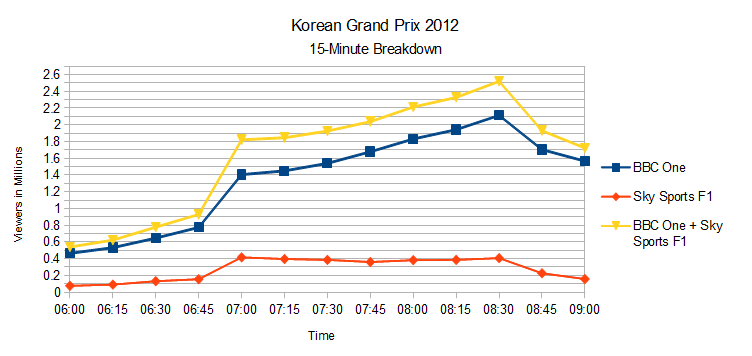
The Korean Grand Prix yesterday on BBC One and Sky Sports F1 had a 15-minute peak of 2.52 million viewers, overnight viewing figures show. Between 08:30 and 08:45, an average of 2.11 million viewers were watching on BBC One, with a further 407,000 viewers watching on Sky Sports F1. Whilst the peak, on paper looks good it is marginally down on 2010’s rain-affected race and nearly a million viewers down on the 3.39 million peak recorded at 08:30 last year.
Between 06:00 and 09:15, 1.35 million watched Formula 1 on BBC One and 274,000 watched on Sky Sports F1. I should note Sky’s programme average will be lower as the 274,000 excludes the first half an hour and the last 75 minutes. Here is a comparison between the three years:
2010 – 3.39 million (1.39 million live and 2.00 million repeat – live peak of 2.6 million at 09:00)
2011 – 4.09 million (2.17 million live and 1.92 million repeat – live peak of 3.4 million at 08:30)
2012 – 3.18 million (1.62 million live [see above] and 1.56 million repeat on BBC One – live combined peak of 2.5 million at 08:30)
Although it is a record low, using it in the title as a headline is a useless statistic in my opinion given that the event has only been running for three years, so for me even though the statement is true, it is not a headline figure. With only three sets of data available, there is little point of comparing with 2010 and 2011, in my opinion.
One thing I do want to look at though is the respective BBC and Sky breakdowns from yesterday, because it makes for interesting reading.
A 15-minute breakdown of the Korean Grand Prix 2012 viewing figures on BBC One and Sky Sports F1.
The first thing that caught my eye was the different trajectory for BBC One and Sky Sports F1 after 07:00. BBC’s viewership increases constantly until the peak at 08:30, partly thanks to people waking up while the race is progressing and turning straight to BBC One, whilst Sky Sports F1’s viewership actually goes slightly down. Which I do find odd. It’s not the first time I’ve seen that happen. Considering Sky Sports F1 is a dedicated channel, the fact that the audience declined slightly after the race started is worrying.
It also, for me, shows why Formula 1 has to stay on terrestrial television in some form, because sporting events catch the interest and can rise to a big peak on terrestrial, which very rarely happens on multichannel television. It looks like no one tuning in bothers to tune to Sky Sports F1 during the race. Between 07:00 and 07:15, 416,000 viewers were watching Sky Sports F1. Between 08:30 and 08:45, 406,000 viewers were watching the channel, a 10,000 viewer drop. BBC One in the same period increased 700,000 viewers.
Another thing is that under 100,000 viewers were watching Sky Sports F1 between 06:00 and 06:30. That, and all the figures above, include viewers that timeshifted that exact block of programming up until 02:00 on Monday morning (which may also explain why BBC One suddenly jumped 700,000 at 07:00, which may be a few hundred thousand watching it later but not bothering with the build-up). A final graph, this time, the percentage difference:
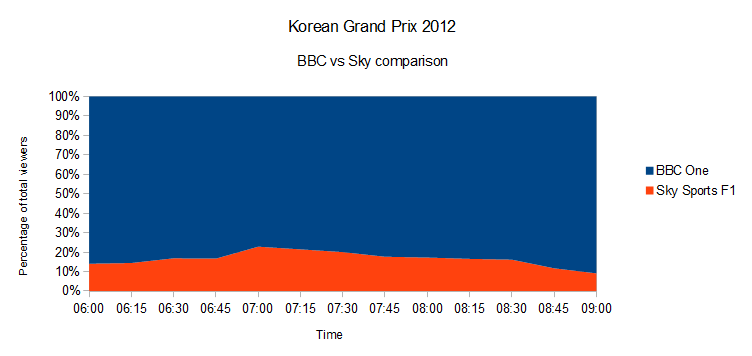
A percentage comparison between BBC One and Sky Sports F1 during the Korean Grand Prix broadcast. (for some reason the quality of the image appears to be blurry, clicking on the image will solve that)
The smallest percentage gap between the two was in the 15-minutes from 07:00 when 77.2 percent were watching BBC One and the other 22.8 percent were watching Sky Sports F1. The gap grew again, however, by 08:00 it was 82.7 percent vs 17.3 percent and by 08:45 it was 88.3 percent versus 11.7 percent. For a early morning race, I would have expected the gap to be closer between the two, I would have expected the gap to be closer, but it turns out that has not been the case.
Thanks to gslam2 for kindly posting the 2012 breakdown on Digital Spy Forums.
1 – 390k – Live Japanese Grand Prix (Sunday, 06:00)
2 – 213k – Live Japanese Grand Prix: Qualifying (Saturday, 06:00)
3 – 121k – Japanese Grand Prix Replay (Sunday, 11:30)
4 – 113k – Live Japanese Grand Prix (Saturday, 29:30)
5 – 105k – Live Japanese Grand Prix: Qualifying (Friday, 29:00)
6 – 69k – Japanese Grand Prix Qualifying Replay (Saturday, 10:00)
7 – 64k – Japanese Grand Prix Qualifying Replay (Saturday, 14:00)
8 – 61k – The F1 Show (Friday, 10:00)
9 – 55k – Live Japanese Grand Prix: Practice 2 (Friday, 06:00)
10 – 47k – Live Japanese Grand Prix: Practice 1 (Thursday, 25:45)
Due to the way “TV days” work, TV operates from 06:00 to 06:00. Which is why there are some odd numbers above 24:00 in the above. To make things simple:
– 24:00 is midnight
– 25:00 is 01:00
– 26:00 is 02:00
– 27:00 is 03:00
– 28:00 is 04:00
– 29:00 is 05:00
The next thing is that any programmes in the above that go across 06:00 are split into two. Which is frustrating when trying to analyse things. To make things simple:
– Sky’s live Qualifying show from 05:00 to 07:45 averaged 174k.
– Sky’s live Race show from 05:30 to 10:15 averaged 360k.
Alarmingly, the numbers will be the lowest for Japan in nearly ten years. Even if you cut some of the build-up and post-race reaction from Sky, I could not see the live race getting above the 640,000 needed to break 3 million (combined with their only replay or not).
Apart from that, the only other valid comparison for Sky could be made with Australia which was a Sky exclusive race also and averaged 582,000 from 04:30 to 09:00. You could argue that the Australia race was the season opener, but even so, it doesn’t automatically mean that particular number should be ignored from comparison, especially when you also consider that Australia was an hour earlier! The channel also reached 1.92 million people, which compares with 3.41 million people for the Australia weekend. I haven’t had time to look at the reaches across the season, but 1.92 million might be the lowest yet for an exclusive Sky race.
Whichever way you spin it, the numbers don’t make for great reading.
Or alternatively, none of the above takes place and you miss the alarm. It doesn’t go off. You don’t go downstairs. – October 3rd, 2012 as I preview the Japanese Grand Prix
Ten days later, it turns out that did happen. The alarm, for the Korean Grand Prix Qualifying session was on for 04:45. I went to bed last night at 22:15 last night. The alarm came and went, and I slept straight through it. As I said in the Japanese Grand Prix blog, I have been doing this “getting up early business” for many years with Formula 1 purely because I love it and there is nothing better than seeing Formula 1 live. I ended up waking up at 06:55. So not only did I miss the build-up’s, but I also missed the session itself, the first time that has happened. Near misses have happened before, in 2008, I missed the opening laps of the Japanese Grand Prix and I think a few years ago I missed the majority of BBC’s build-up for the Chinese Grand Prix.
So it was 06:55, pretty quickly it became apparent that I had missed the session, probably as a result of not having a lie-in since September 30th due to University and Formula 1. I was wondering then when to watch. Ten years ago it would be a simple answer, either just wait until the ITV1 re-run or read the results on Ceefax via P360. Which I did back then as I never really got up for Qualifying early back then. I wanted to avoid spoilers, nowadays with the amount of technologies available, I find avoiding spoilers near impossible and very rarely do I, in 2012, watch Formula 1 “as live” seven hours later. It does not appeal to me.
The BBC F1 re-run at 13:00? That means killing the morning hours and trying to avoid just about every website I visit, including AUTOSPORT, BBC, Sky, Facebook and Twitter. Hmmm. This is 2012, and that is not happening. The Sky Sports F1 re-run at 09:45? Possibly. Go back to sleep for a few hours and then get up, ready and watch it? Realistic. But then I thought and said to myself “Doesn’t BBC iPlayer have a feature where you can rewind live television by two hours?” I don’t think I’ve leapt out of bed faster in recent times. Turned on the PC, went direct to iPlayer, loaded up the live BBC One page, put a book over the screen so I did not have the result spoiled and then scrolled from about 07:05 to 05:05, ie. a full two hours.
Genius. A frustrating situation turned very quickly a full 180 degrees. I was watching Qualifying as soon as I woke up, watched the entire BBC programme (bar the first 10 minutes) and finished it about 09:20. But what if this was a Sky exclusive weekend? Sky Go does not have that capability and in my opinion is a much inferior product to that of iPlayer. If this was last weekend, I would not have been able to get up, rewind Sky Go on the PC and watch it because it does not have the facility. I guess I was just… lucky that I slept through the alarm on a BBC live weekend.
And seeing as I have got to this point, I may as well comment on the programme itself. There was not too many VT’s in the build-up, it was mainly a ‘talk and chalk’ style I thought. But there is no real need in my opinion to stack all the VT’s into a programme airing at 05:00. Save the award winning VT pieces for a day when there is a higher audience watching. The ‘talk and chalk’ style worked, I liked it. Jake Humphrey, David Coulthard and Eddie Jordan looked at the bottom three teams fortunes and their potential line-ups for 2013 before being joined at Gary Anderson to look at the technical developments for the top half of the field. I really enjoyed Anderson joining them for 15 minutes, because it is not often you see that, and it is not often you get the technical developments analysed of the top four teams in a row. At times it was slightly difficult to see what the focus was on, but that may be down to the iPlayer stream rather than not looking at the right thing.
The session itself I thought was well directed by Formula One Management, and the commentary on the whole was good, although I did think Coulthard and Ben Edwards were very late on picking up that Lewis Hamilton could have been eliminated from Q1, and at the same point did not really spot that Bruno Senna had aborted his last effort. But apart from that, they were fine. Post-Qualifying was enjoyable as well, Jordan trying to chase Romain Grosjean and Anderson’s pit-stop strategies was interesting, I shall be looking to see if it is as accurate as his perfect prediction at the Q3 time!
So overall, yeah, I was a bit annoyed at sleeping through the alarm, but in the end I watched Qualifying when I got up, avoided spoilers and had it all done by 09:35. And that includes this blog. A win, win for me, then.
Speed TV have today confirmed that they have lost the rights to screen Formula 1 in America, ending a 17 year association between them and Formula One Management.
In a statement to the Association Press, a Fox Sports Media Group spokesman (who own Speed TV), said “It’s disappointing to learn that F1 has elected to move forward with a different media partner. Speed has been the U.S. voice of F1 since the mid ’90s, and it is a passion for many people at the network. Fox Sports Media Group made what we believed to be a fiscally responsible bid based on the sport’s current viewership levels, but F1 has elected to go in another direction. We wish them well.”
The news comes at an unsurprising time, and supports earlier reports that Speed were set to drop their entire Formula 1 team for 2013, something noted by Will Buxton, who said on Twitter that he had no contract with anyone in place for 2013. Now, it turns out that Speed have gone the full stretch and dropped Formula 1 altogether. One has to question now, whether the Speed channel will even exist in 2013…
A new rights holder for 2013 and beyond will be announced in due course, although if the Association Press are to be believed, then the NBC Sports Group are a contender.
Update at 19:03 UK time – Peter Windsor on Twitter is saying that NBC Sports have won the rights. Will Buxton has also posted “Just read the news via twitter. Can’t help but feel a pit on my stomach had to learn this way. But that’s life. Onwards my friends. Love you all. I want to say that the last 3 years with Bob, Steve and David have been the most enjoyable of my career. More than colleagues. Friends.” I do hope Buxton stays in the Formula 1 paddock in some capacity. Having listened to his GP2 and GP3 commentary via Sky Sports F1, it would be a shame to lose his contributions.

 Motorsport Broadcasting