As noted during one of Ted Kravitz’s Notebook’s through the weekend, Kravitz asked Sky Sports F1’s Executive Producer Martin Turner a series of questions. The key bits I have posted below whilst the video can be found here.
When asked why testing is not being covered live on Sky F1, Turner said: “Well first of all, we have been live at every test, we have Craig [Slater] and Rachel [Brookes] doing their live throws all throughout the day and we feel that is the best way of telling the story. We’re also telling the story on mobile, on app, on live blog commentary and we think they’ve gone down really well. [..] It is a great way of bringing it to a new audience as well [through Sky Sports News]. [..] Sometimes during testing, there are no cars on the track and that is quite a difficult story to tell live, but we hope the story we’re telling, and the variety of ways that we are telling it are going down particularly well.”
His line later on, noting that “live is always better than recorded” amused me considering Sky Sports F1 has been showing recorded content for months, and have not had one live programme yet in 2014 despite having the opportunity to do so. Even if testing was not live, The F1 Show for some reason is starting several weeks later than last year. Turner confirms that Natalie Pinkham will present every F1 Show, with the co-presenter rotating between Kravitz, David Croft and Simon Lazenby. There will again be two F1 Show’s in Monaco and Britain as usual, and Pit Wall Live is back. Regarding adverts in races, Turner said: “There never have been ad-breaks in races [on Sky], and there never will be.”
There’s a few more interesting bits in there, and it is worth a watch but those are the few bits I have picked out.
Mark Webber will join BBC’s F1 team for a few races this year and participate in some films with them, it has been confirmed. Given Webber’s high praise of the BBC, most notably on the track parade before last year’s British Grand Prix, this shouldn’t be too surprising. Great news nevertheless, in my view.
Also joining the BBC team is Jack Nicholls, who will commentate on four race weekends for Radio 5 Live. Nicholls announcement is significant: at the age of 24, he becomes the youngest lead commentator to commentate on Formula 1 in this country! Ages based on their birth year, so may be slightly out.
– Jack Nicholls (age 23 – at time of 2014 Chinese Grand Prix)
– Ben Edwards (age 28 at time of 1994 debut)
– Allard Kalff (age 26 to 30 at time of late 1980s debut)
– Murray Walker (~age 30’s – exact age unclear)
– James Allen (age 35 at time of 2001 debut)
– David Croft (age 36 at time of 2006 debut)
– Martin Brundle (age 50 at time of 2011 debut as lead commentator)
I’ve got to say that is an impressive statistic, at a time when the age of commentators is getting older, so kudos to the BBC for putting faith in someone significantly younger than the rest. Apart from those two pieces of news, the rest of the line-up is as expected, having already been announced in January. In terms of coverage details, I cannot see any differences with how things are covered: practice is again live on BBC Two for their live weekends with the F1 Forum back after the race. One minor difference spotted by Ashley is that the length of the US Grand Prix highlights programme has been shortened to 90 minutes, but I think it is best to wait until the preview magazine before reading too much into that, the same applies for Bahrain and Brazil.
Disappointingly, but not surprisingly, no replacement for Gary Anderson has been announced, I maintain that is a huge loss for the team which I believe they will feel greatly as the season progresses. Ben Gallop, BBC’s Head of F1, said: “We are all excited about the new F1 season on the BBC. 2014 sees new faces to complete our first-rate team and a stronger digital offering to our output than ever before, which really puts users in control of the action. This season has already got everyone talking, with intriguing technical changes and team line-ups, and we’re looking forward to bringing that in all its glory to our audiences.”
Ratings for the final pre-season test from the Bahrain International Circuit were level year-on-year with Sky Sports F1’s live coverage from last year, unofficial overnight viewing figures show. If you are to do a best like-for-like comparison, live airings of testing versus the first round-up/Notebook airings from this week then it is a dead heat. The repeats I don’t think would make much difference, although if you were to do a peak figure comparison, then there would be a significant difference, as the live testing coverage from last year was longer than this year’s round-ups.
Coverage began on Thursday with 44k (0.2%) watching Sky’s coverage, this dipping to 29k (0.1%) for Friday’s round-up, both ratings up on live testing in 2013. 40k (0.2%) tuned in on Saturday, whilst 30k (0.1%) watched on Sunday, figures for the weekend down in both raw numbers and share on 2013. I really do think Sky should have made every effort possible to screen testing live on Saturday and Sunday. I would have agreed with ditching Thursday and Friday’s live coverage given that they are weekdays, but I personally would not have been opposed to something like this for the weekend:
12:00 – Live Testing
15:00 – Testing round-up/Notebook repeats
18:00 – Testing (repeat of earlier)
21:00 – Ted’s Notebook
I wouldn’t be surprised if the location played a hand in the decision to not pursue testing live. Of course, we mustn’t forget that, according to Sky Sports F1’s channel scheduler, “live testing is pointless”. One thing I want to mention, I have seen some people saying that allegedly ‘nobody cares’ about testing, yet the testing figures (as I have said before) beat the GP2 and GP3 figures from previous years and multiple episodes of The F1 Show. Using the same logic, the aforementioned items are pointless, too.
Note that I believe that Ted’s Notebook overran on the Saturday and Sunday, however I do not know the exact times that it finished so, for the purposes of this blog post I have kept the original timings.
One of the biggest talking points in the broadcasting scene in recent years has been the sky-rocketing cost of television rights to broadcast sporting events. Whilst Formula 1’s deals have indeed risen in the last ten to fifteen years, the cost of Formula 1’s rights pales in comparison to the Premier League television deal which now runs into the billions. Formula 1’s rights in comparison, are less than a tenth of that. One Premier League season, for Sky Sports or BT Sport could buy the equivalent of about seventeen Formula 1 seasons. Yes, I agree, that is completely bonkers.
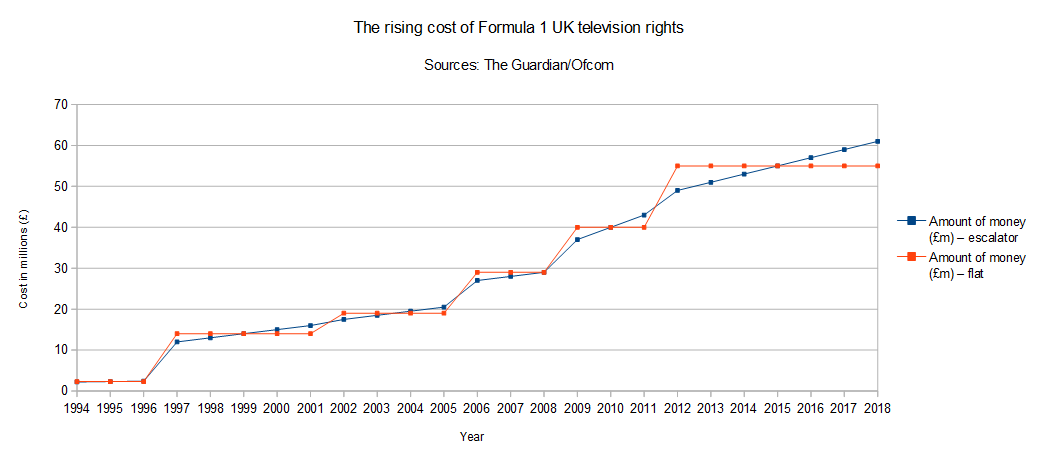
But where did the rights picture start for Formula 1 in the UK? Back in the early 1990’s, the BBC signed a deal to cover Formula 1 for three years from 1994 to 1996, for just under £7 million (or £2.3 million a season – source: The Guardian, December 14th, 1995), a paltry amount compared to today. In other words, for the BBC, Formula 1 in 1994 and MotoGP in 2013 were probably close to one of the same, except the former’s viewing figures were much higher than the latter. Back then, ITV were fed up of losing in the Sunday afternoon ratings battle. And who could blame them, this being a time where there were fewer channels so the audience was more pointed towards terrestrial, except ITV was losing hands over first while BBC was consistently bringing in five to six million viewers for each Formula 1 race. That changed in December 1995, when it was announced that ITV had bid six times the amount of BBC previously, with a new deal from 1997 to 2001. Turn £2.3 million to £14 million per season, a substantial rise. A nice profit if your name is Bernie Ecclestone.
Away from the cost implications, ITV appeased the Formula 1 fan by having longer pre-race and post-race broadcasts which were largely successful and definitely paved the way to what we know now. In an Ofcom consultation back in 2007, details on all of ITV’s contractual costs were published by the regulator (page 79). We can see that the cost rose again in 2001 despite Michael Schumacher’s dominance from £14 million a year to £19 million a year for the 2001 to 2005 contract. However, it must be remembered that some broadcasting contracts work on an ‘escalator’ approach, meaning that the amount a broadcaster pays increases throughout the contract (the graph below gives an idea of the amounts involved). This means that the £19 million a year would not be too much higher for ITV – they would be paying essentially £16 million at the end of the previous contract and possibly £17 million at the beginning of the next contract.
A graph showing the amount that Formula 1’s UK television rights have rose in the past two decades.
For ITV, the death knell came when they overpaid on Formula 1’s television rights from 2006. They overpaid badly, and the viewing figures at the time definitely did not justify that. With no other broadcasters bidding, ITV’s rights increased immediately by about £7 million, a near 33 percent increase. In hindsight it was a frankly stupid decision made by those who were not thinking long term, however an unsurprising one when you consider that they also overbid on The FA Cup the following year. ITV did not foresee the advertising recession that would follow leaving those in charge needing to save money, and fast. Sadly, with a choice between the Champions League and Formula 1, ITV went for the former, activating a get-out clause. Formula 1 was heading back home. Which was another chance for Ecclestone to get more money out of a broadcaster. Seizing the opportunity, Ecclestone signed a contract with the BBC, estimated to be around £200 million for the five years, or £40 million per year for Formula 1. I’ve spoke before about how this was a disastrous mistake for the BBC that would have major consequences. I feel sometimes that broadcasters ‘play’ with money, going back to the ITV bit above, just why did they need to increase the rights by that much, I don’t know. It doesn’t make any financial sense whenever I see any sporting contract go up significantly, but it is a repeating pattern over and over again. The bubble will burst, especially where the Premier League rights are concerned. It is a matter of ‘when’, not ‘if’.
BBC’s financial problems soon hit Formula 1, in 2011. A reduction of the BBC Sport budget meant that BBC went to Sky and agreed a deal that would only see half of the races live on terrestrial television, an irreversible move. In terms of cost, it is believed to be in the region of £40 million per year for Sky and £15 million per year for BBC, again on an escalator approach. As always, broadcasters always use the word ‘undisclosed’ whenever announcing new deals, so a degree of caution must always be taken, especially when different websites can report different figures. At the moment, it is difficult to say whether the BBC will see out the remainder of their contract. I expect they will, but nothing is guaranteed. It was reported this past Wednesday that the BBC are about to make another round of £100 million cuts, the full details of which will be announced at the end of this month. It should be noted though that Tony Hall said that further “salami-slicing” cuts would not happen. But, at the end of the day, if any cuts to BBC Sport are announced at the end of this month, then alarm bells have to start ringing where BBC’s Formula 1 television coverage are concerned. An interesting question to be asked is whether the BBC and Sky contracts are treated ‘independently’ of each other, or if they are treated as ‘one’. I assume that they are independent, i.e. any future BBC actions regarding Formula 1 do not affect the current Sky contract, but I don’t know for sure.
So, what can £55 million a year get you?
– ten Premier League games
– the group stages of a Champions League season
– one and a third Six Nations championships
– four and a half MotoGP seasons
Formula 1’s television rights have not yet descended into silly money, like the football rights have for both the Premier League and the Champions League rights have, for which I personally am thankful for, as we still have Formula 1 live on free to air television in some capacity. If the current contract is seen through to the end, then the silly money will not begin for quite some time yet, but as always in this game, things can change with the flick of a coin. There is a long, long way before the finishing line in this contract.


 Motorsport Broadcasting