Scheduling: The 2014 Austrian Grand Prix

After an eleven year break, Formula 1 heads to Spielberg for the Austrian Grand Prix! What was known as the A1-Ring during Formula 1’s visits between 1997 and 2003 is now known as the Red Bull Ring. As thus, it is also the first visit for the GP2 and GP3 Series’ to the track – GP2 replaced Formula 3000 for 2005, whilst GP3 only began in 2010. It will also be one of the shorter races of the season, with lap times around 1 minutes 10 seconds, the race should be over in under 90 minutes.

For those who want to jump to the schedule, click the links below:

Thursday 19th June
Friday 20th June
Saturday 21st June
Sunday 22nd June
Wednesday 25th June
Classic F1

There are no surprises in Sky’s schedule, however some of BBC’s schedule is worth mentioning. Practice on Friday is not on BBC Radio 5 Live Sports Extra due to cricket. Qualifying highlights on BBC One are on unusually early at 16:45 on the Saturday, which is completely the opposite to Sunday, where highlights of the race are on BBC Two, and on at 19:30! I assume the reason that they’ve decided to schedule the highlights there are so that it doesn’t clash with their own World Cup game on BBC One.

I do wonder though if there should be a clause in the contract that says that the race highlights must be on BBC One. It’s a big issue for the early evening races, and easily knocks a good million or so off the figures by scheduling the highlights on BBC Two instead of BBC One. It’ll be another difficult Summer I feel for the F1: the British Grand Prix again clashes with the Wimbledon final, whilst the Hungarian Grand Prix clashes with the Commonwealth Games, and no doubt the World Cup will deflect attention away from the F1.

Thursday 19th June
14:00 to 14:45 – F1: Driver Press Conference (Sky Sports F1)
20:45 to 21:00 – F1: Gear Up for Austria (Sky Sports F1)

Friday 20th June
08:45 to 11:00 – F1: Practice 1 (Sky Sports F1)
11:00 to 11:50 – GP2: Practice (Sky Sports F1)
12:45 to 14:50 – F1: Practice 2 (Sky Sports F1)
14:50 to 15:30 – GP2: Qualifying (Sky Sports F1)
16:00 to 16:45 – F1: Team Press Conference (Sky Sports F1)
17:00 to 18:00 – The F1 Show (Sky Sports F1)
18:00 to 19:00 – GP Heroes: Ronnie Peterson (Sky Sports F1)
18:45 to 19:00 – Inside F1 (BBC News Channel)

Saturday 21st June
08:45 to 09:20 – GP3: Qualifying (Sky Sports F1)
09:45 to 11:15 – F1: Practice 3 (Sky Sports F1)
12:00 to 14:35 – F1: Qualifying (Sky Sports F1)
13:00 to 14:05 – F1: Qualifying (BBC Radio 5 Live)
14:35 to 16:05 – GP2: Race 1 (Sky Sports F1)
16:20 to 17:20 – GP3: Race 1 (Sky Sports F1)
16:45 to 18:00 – F1: Qualifying Highlights (BBC One)

Sunday 22nd June
08:25 to 09:25 – GP3: Race 2 (Sky Sports F1)
09:30 to 10:45 – GP2: Race 2 (Sky Sports F1)
11:30 to 16:15 – F1: Race (Sky Sports F1)
=> 11:30 – Track Parade
=> 12:00 – Race
=> 15:30 – Paddock Live
12:30 to 15:00 – F1: Race (BBC Radio 5 Live)
19:30 to 21:00 – F1: Race Highlights (BBC Two)

Wednesday 25th June
20:30 to 21:00 – Midweek Report (Sky Sports F1)

Classic F1 on Sky Sports F1
In the same way how Canada 1998 was originally listed two weeks ago, but never actually aired, I don’t expect Austria 1999 to air either on June 22nd, but hopefully I’m proven wrong. EDIT on June 19th: The Austria 1999 slot has been extended to a two hour slot, so it will be the full race!

14/06 – 21:00 to 21:45 – 1993 Italian Grand Prix Highlights
15/06 – 21:00 to 21:45 – 1986 Australian Grand Prix Highlights
16/06 – 21:00 to 00:15 – 2012 Singapore Grand Prix (Sky commentary)
17/06 – 21:00 to 22:00 – 1994 Japanese Grand Prix Highlights
18/06 – 21:00 to 22:00 – 1985 Australian Grand Prix Highlights
19/06 – 21:00 to 21:45 – 1982 Austrian Grand Prix Highlights
20/06 – 19:15 to 20:00 – 1984 Austrian Grand Prix Highlights
21/06 – 21:25 to 22:10 – 1987 Austrian Grand Prix Highlights
22/06 – 16:15 to 17:15 – 1979 Season Review
22/06 – 21:00 to 23:00 – 1999 Austrian Grand Prix
23/06 – 21:00 to 23:30 – 2003 Brazilian Grand Prix
24/06 – 21:00 to 23:45 – 2012 Abu Dhabi Grand Prix (Sky commentary)
25/06 – 21:00 to 23:00 – 2002 Malaysian Grand Prix
26/06 – 21:00 to 21:45 – 1994 Australian Grand Prix Highlights
27/06 – 21:00 to 22:00 – 1991 British Grand Prix Highlights

As always, the timings are subject to slight alterations, so I shall update this blog if and when that happens.
Should broadcasters’ lobby to take over the FOM World Feed?

There’s two things I could use this blog post to complain about, both of which reared their ugly head in Canada. The first concerns Sky Sports’s Formula 1 coverage very quickly turning into ‘The Lewis Hamilton show’ with some worrying traits, the latter is regarding the incompetent direction of Formula One Management (FOM). I’ll use this post for the latter. Whilst the Canadian Grand Prix was thrilling from start to finish, with Daniel Ricciardo eventually winning, it was not FOM’s brightest hour. Seemingly, constant zoom ins and an ever growing reliance on virtual advertising means that their priorities are changing from what they once were. No longer is the car the sole focus of the picture, meaning the sometimes the raw speed does not come across to the viewer as well as it once did. One might ask: is it time for change?

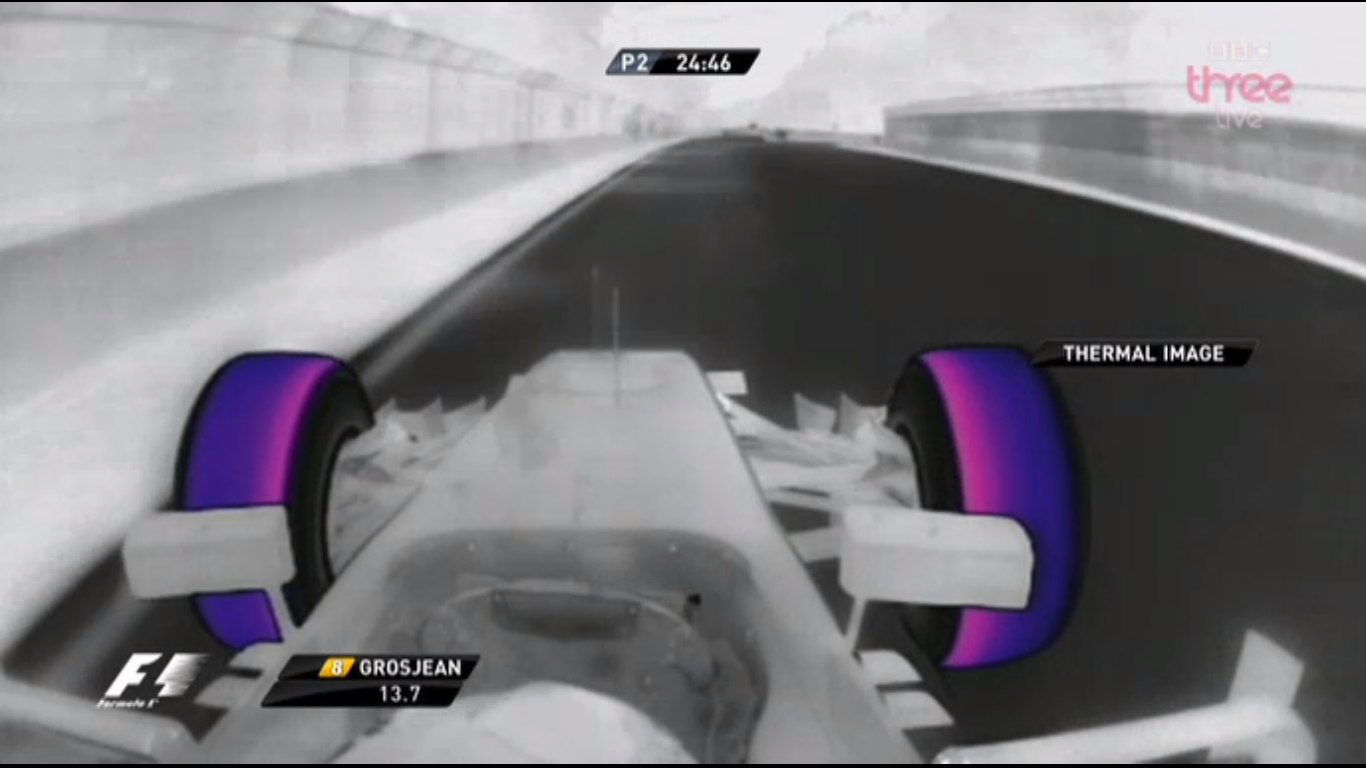
If I’m going to criticise FOM, then I think it is only fair to begin by focussing on the positives. Of which there are several, don’t get me wrong. The thermal image shots lead the way on the innovation front, it is probably FOM’s best innovation by far. With both rear-view and front-view shots, it gives the viewer a good idea of how hot the tyres get under braking, and also in last Sunday’s case how warm the brakes on Lewis Hamilton’s Mercedes were getting shortly before retirement. It’s a very effective innovation, and one that many fans like seeing. Rotating cameras is another innovation, however if you watch the IndyCar Series you will know that rotating cameras have been around for many, many years. Nevertheless, from an F1 coverage point of view, it is a step forward in the very least. A final innovation is line comparison, which sadly is used nowhere near as much as it should. Despite first appearing back in 2009, it has only been sporadically used by FOM since. It should be used more, but for some reason isn’t. A line comparison feature, for example, would have been fantastic to see for Nico Rosberg’s Qualifying excursion in Monaco.

One of Formula One Management's best innovations: the thermal image, here seen on Romain Grosjean's Lotus during FP2 for the 2014 Canadian Grand Prix.
One of Formula One Management’s best innovations: the thermal image, here seen on Romain Grosjean’s Lotus during FP2 for the 2014 Canadian Grand Prix.

I feel it’s important for me to highlight that FOM has done some great innovations, and for that we should applaud them for. However, more recently, they have been let down by two things: virtual advertising and poor direction. I made a point last year about virtual advertising, when it was starting to appear. “The virtual advertisements that are subtle are the best,” a point which I still maintain. When virtual advertisements work, and blend in with the image, I have no issue with them. You know what, it’s cost effective and I can see the logic in using them. The issue I’m having is that the advertising is creeping into Formula 1 coverage more and more, to a degree where it is taking over certain shots, and in some cases is blatantly obvious. I’m not against FOM using virtual advertising, however, they need to rethink a) how and b) where they use them. If it is going to disturb the piece of track that the camera is focusing on, or become an unintended distraction to the viewer because of its size, don’t place it there.

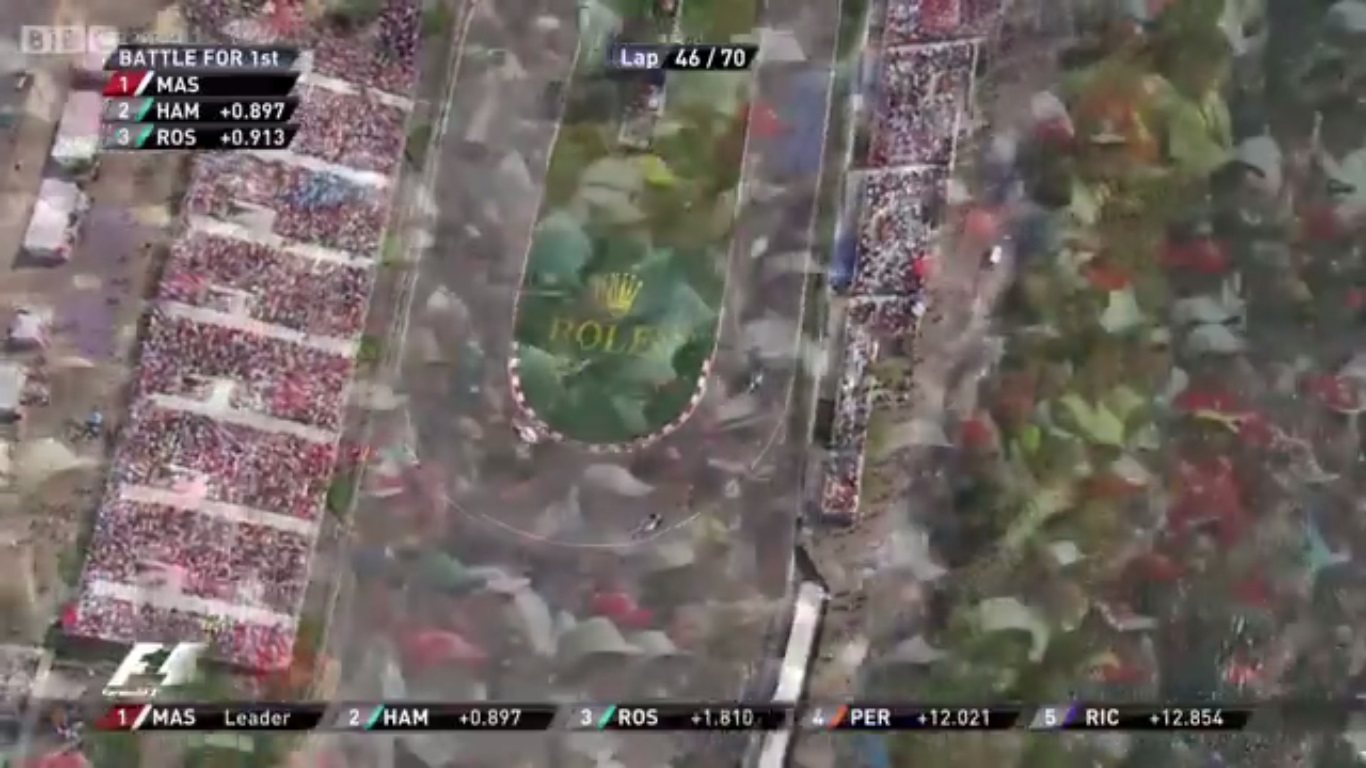
The second part concerns the poor direction as of late which for me, and many other Formula 1 fans came to a head in Canada. Constant zoom in to the crowd, cutting away from Lewis Hamilton running wide at the hairpin and very nearly missing Daniel Ricciardo overtake Nico Rosberg for the lead. I’m a motor racing fan. I watch to see that move, that moment. I don’t expect someone up in production to then determine that a crowd shot is more important than seeing the on-track action. This is similar to the virtual advertising issue above. I can live with one or two crowd shots if the track action is quiet, but in Canada things were teetering on the edge. Obviously cameramen do not decide to pan to the crowd out of their own accord, so calling the cameramen ‘stupid’ for doing their job won’t get anyone anywhere. They would have been directed to pan into the crowd every so often by whoever was leading FOM’s production team on Sunday. Just after Ricciardo overtook Rosberg we had a pan to the crowd. This was mildly amusing because the crowd didn’t appear to be reacting at all, which led Ben Edwards covering up that fact moments later.

The 2014 Canadian Grand Prix: Lewis Hamilton gives the lead away to Nico Rosberg as the camera cuts away to a crowd shot.

As an aside, when all the sound kerfuffle was going on earlier this year, one angle of it concerned FOM. The camera angles currently do not present Formula 1 in the best light and are instead used to get maximum exposure for the sponsors in the background. What the live camera angles should be showing is this sport that makes the hairs on the back of your neck stand up at 200mph. The secretive structure at FOM means that it is difficult to know where the buck stops, and it goes without saying that those who direct the F1 also direct other events. To put it simply, whoever at the top is making the calls at the moment is making the wrong calls. Whilst the innovations are largely fantastic, I hate to say this, but Formula 1’s television coverage is heading into reverse. I don’t want to blame one person, or one director, because they do this for a living, and for the large part do a great job at it. I’d like to think that they do Formula 1 directing because they’re the best in the business. Canada wasn’t their finest day, however, some of the decisions that are made during races need a serious re-think. Formula 1 fans deserve the best World Feed possible, akin to what F1 Digital+ provided across Europe between 1997 and 2002. Do I think we’re currently getting that? No.

Another perspective is that the World Feed needs some new blood. In November 2012, speculation began to mount about Sky Sports taking over the World Feed following this comment from Barney Francis, who is the managing director of Sky Sports. Three months later, and Sky would cover testing live and in 3D, a Formula 1 first. Nothing ever happened after that, Sky didn’t broadcast testing live this year. Given FOM’s current direction, I’d love to see Sky Sports get their hands on the British Grand Prix weekend and take over the World Feed. Given that this is year three of their contract, I’m surprised that it hasn’t happened already, as it gives them much more control in terms of the camera angles and the editorial aspect that they want to present to the viewer. Once Sky have done it, assuming it was universally liked, then they can get other broadcasters on-board in order to try and have more influence on the World Feed – or perhaps have Sky as the World Feed ‘leaders’ (given their potential pan-European status in the future, this could have a lot of weight), with other broadcasters playing a supporting role.

I’m not saying Sky controlling the World Feed would be better, however from a curiosity point of view, I want to see it happen. And given FOM’s lack of direction last weekend, who can blame me. I’ll finish off by linking to the below, which was all filmed, produced and edited by Sky Sports in the latter stages of the 2011 Formula One season.

Canadian Grand Prix marginally up year-on-year

The Canadian Grand Prix pulled in solid numbers across the weekend, and was marginally up year-on-year, unofficial overnight viewing figures show.

Race
Live coverage of the race, screened live on BBC One averaged 4.59m (23.3%) from 18:20 to 21:00. It is down slightly on last year’s number of 4.61m (23.8%) despite a smaller timeslot, which may be considered a tad disappointing, but no doubt Soccer Aid took one or two viewers away. For the third race in a row, and what is now turning into a trend, Sky Sports F1’s coverage was up compared with 2013. The race show from 18:00 to 21:30 averaged 818k (4.2%), compared with 743k (3.8%) for the identical slot last year.

With both numbers not a million miles away from last year, the combined numbers are in the same ballpark: 2014’s combined average of 5.40m is 50k up on 5.35m from 2013. It will end up being the second most watched Canadian Grand Prix in the past decade and a bit, only behind the 2011 race which averaged a massive 6.12m across five and a half hours. Part of me wishes yesterday’s race did a little better, but it is still a very good rating.

Elsewhere, Paddock Live from 21:30 averaged 166k (0.8%), whilst the Track Parade brought 221k (1.6%) from 17:30 to 18:00.

Practice and Qualifying
Live coverage of Qualifying on BBC One from 17:00 to 19:20 averaged a solid 2.43m (16.6%), which is virtually identical to last year’s 2.41m. Sky Sports F1’s coverage brought in a further 435k (2.8%), up nearly 100k on last year’s number of 351k (2.6%). The combined figure of 2.87m will be the second highest in the past decade, only behind 2011 which had an extremely high number of above 3.5m.

It is worth mentioning Practice 3 which did very well on Saturday afternoon. BBC Two’s coverage averaged 850k (8.8%), with Sky Sports F1 adding 142k (1.5%) – so almost 1 million viewers watching practice which is a brilliant stat. Overall it has to be said another that on the ratings front, things are starting to come together and is really a complete 180 from the first four races, which is great to see. We’re also setting some fascinating trends: BBC’s numbers have largely stagnated whilst Sky is increasing its numbers every so slightly. Next up is Austria, meaning that there is nothing for me to compare against. The only potential comparison is with the European Grand Prix’s that were held in late June when it was held in Valencia, but I’ll pull together a ratings article for Austria nevertheless. Frustratingly, the race highlights are on BBC Two, which is going to hurt numbers.

The 2013 Canadian Grand Prix ratings report can be found here.

overnights.tv-bannersF1

Scheduling: The 2014 24 Hours of Le Mans

The greatest motor race of the year, some say. It is the middle of June which means that it can only be time for the 24 Hours of Le Mans! Expect a battle up front between the Audi’s and Toyota’s as Audi attempt to claw back some ground on Toyota following the first two rounds of the FIA World Endurance Championship. Having been in attendance at Silverstone in April, I’m looking forward to see how this battle plays out, and also to see whether the Porsche’s can spoil Audi and Toyota’s fun.

As is the usual tradition, the 24 Hours will be screened in full, live and exclusively on British Eurosport across Saturday and Sunday with build-up taking place across the entire week. Tom Gaymor will be voicing the 24 Minutes shows, whilst the usual team led by Martin Haven and Liz Halliday will be on commentary. The race starts at 14:00 UK time on Saturday 14th June. The full schedule can be found below:

Sunday 8th June
21:00 to 22:00 – Sports Insiders: 24 Hours of Le Mans (Eurosport)

Monday 9th June
21:30 to 22:00 – 24 Minutes (Eurosport)

Tuesday 10th June
20:55 to 21:25 – 24 Minutes (Eurosport)

Wednesday 11th June
14:50 to 19:00 – Live Practice (Eurosport 2)
20:35 to 21:00 – Live 24 Minutes (Eurosport)
21:00 to 23:00 – Live Qualifying (Eurosport)

Thursday 12th June
18:00 to 20:00 – Live Qualifying (Eurosport 2)
20:30 to 21:00 – Live 24 Minutes (Eurosport)
21:00 to 23:00 – Live Qualifying (Eurosport)

Friday 13th June
20:00 to 20:30 – 24 Minutes (Eurosport)

Saturday 14th June
07:45 to 08:45 – Live Warm Up (Eurosport)
08:45 to 09:45 – Live Legends Race (Eurosport)
13:15 to 13:45 – Live 24 Minutes (Eurosport)
23:00 to 23:30 – Live 24 Minutes (Eurosport)
– for details of the race itself, see below

Sunday 15th June
07:45 to 08:15 – Live 24 Minutes (Eurosport)
14:15 to 14:30 – Live 24 Minutes (Eurosport)

The race itself beginning on the Saturday…
13:45 to 22:30 – Eurosport
22:30 to 23:30 – Eurosport 2
23:30 to 07:30 – Eurosport
07:30 to 08:15 – Eurosport 2
08:15 to 14:15 – Eurosport

It doesn’t look like BBC Radio are doing a one hour special this year, however if anything changes, I’ll update the schedule.

Why F1 is still experiencing a viewer decline – even with VOD included

Yesterday, AUTOSPORT published an article noting that BBC’s iPlayer figures for Formula 1 have increased 33 percent, whilst their Radio 5 Live figures have increased 53 percent. The paragraph concludes by noting that “there is a growing view that the way people consume F1 is changing dramatically”. Whilst I agree that habits are changing, I’m not entirely convinced by the validity of that sentence.

Let’s come back to that later, and instead look at some other statistics. Compared with the first six races last year, BBC’s Formula 1 coverage has dropped by 12 percent, whilst Sky Sports F1’s live race coverage has increased by 11 percent according to unofficial overnight viewing figures from Overnights.tv. If you knew absolutely nothing about viewing figures, you might be led to believe that Sky’s ratings are beginning to move mountains and are taking viewers off BBC hand over fist. Well…. not quite.

In fact, whilst BBC’s figures have dropped 426k for a variety of factors already covered in detail on this blog, Sky’s viewing figures have increased only 79k. See how things now look different? Because Sky Sports F1’s viewing figures are coming from a low base, it means that any increase it makes will seem massive percentage wise. The combined figures for the UK are down 8 percent or 350k. The point I’m making is that percentages do not always tell the full story, and they certainly don’t here.

All the percentages we have are listed below:

+ 53 percent = BBC Radio
+ 33 percent = BBC iPlayer
+ 11 percent = Sky TV (+79k)
– 8 percent = BBC TV + Sky TV (-350k)
– 12 percent = BBC TV (-426k)

Thanks to BBC’s monthly iPlayer reports, we have some Formula 1 figures dating back a few years, which are as follows:

2011
– 254k – Australia
– 297k – China
– 286k – Canada
– 277k – Germany
– 262k – Singapore

2012
– 417k – Australia highlights
– 316k – China live

2013
– 484k – Australia highlights

2014
– 521k – Bahrain highlights

From a percentage point of view, 33 percent seems like a huge increase. It’s worth noting that AUTOSPORT probably would not have been given the raw figures from BBC’s Media Centre team, I imagine that the only figures they were given were percentage increases. But what about from a raw figures perspective? The 33 percent increase is about 100k, which definitely does not cover the entirety of BBC TV’s drop this season, nor does it account for 350k drop overall. Or, for that matter, why Formula 1’s UK viewing figures have dropped over half a million viewers between 2011 and 2014. And if BBC iPlayer is ‘only’ averaging 500k for Formula 1, one assumes the Sky Go/On Demand effect is negligible. I’d also argue that the reason Bahrain is showing above is because of the TV timeslot it was in – had that race been broadcast live on free-to-air television, it definitely would not have had 521k via iPlayer.

Whilst there is changing viewing habits, you cannot escape the fact that there are fans no longer watching the sport and are not being replaced by new fans at the same rate, whether it is due to the on-track action changing (DRS, Pirelli’s, turbo’s), those in charge of the sport running into a power-trip with no direction thanks to rules nobody wishes to see (double points), fans feeling distant from the sport (expensive ticket prices) or because Formula 1 is moving to a pay TV model, thus pricing people out of the sportMotoGP fans know what that feels like. I’ll let you decide…