Scheduling: The 2016 Spanish Grand Prix

Round five of the 2016 Formula One season marks a return to more familiar territory with the Spanish Grand Prix from the Circuit de Barcelona-Catalunya. With it, the support races return during the weekend: GP2, GP3 and the Porsche Supercup.

Spain marks Channel 4’s second live Grand Prix and as part of their rotating punditry line-up, the weekend sees the debut of four-time world champion Alain Prost. Prost will be alongside Susie Wolff who makes her second appearance this season.

Elsewhere, I would expect Alex Jacques to return as GP2 and GP3 commentator for his second season. This has not yet been officially confirmed, but I have not seen any information to the contrary making the rounds. I will update this post if I hear anything (the same applies for co-commentator).

Outside of Formula 1, it is the Historic Grand Prix in Monaco, which is being covered live on Motors TV. The only two races that are not being covered are the post-1966 Formula 1 cars in action, because Motors TV is showing the Blancpain Endurance Series instead. In previous years, Sky Sports F1 has aired highlights from the historic weekend, but there is nothing currently in their schedules for the forthcoming weeks.

Also of interest is the World Superbikes from Sepang. The weekend is the first major event that is utilising the revised final corner, which will be used later this year in Formula 1. Below are all the scheduling details you need.

Channel 4 F1
Sessions
13/05 – 08:55 to 10:35 – Practice 1
13/05 – 12:55 to 14:35 – Practice 2
14/05 – 09:55 to 11:05 – Practice 3
14/05 – 12:00 to 14:30 – Qualifying
15/05 – 12:00 to 15:35 – Race
15/05 – 23:00 to 00:10 – Highlights

Sky Sports F1
Sessions
13/05 – 08:45 to 11:00 – Practice 1
13/05 – 12:45 to 14:50 – Practice 2
14/05 – 09:45 to 11:15 – Practice 3
14/05 – 12:00 to 14:35 – Qualifying
15/05 – 11:30 to 16:15 – Race
=> 11:30 – Track Parade
=> 12:00 – Pit Lane Live
=> 12:30 – Race
=> 15:30 – Paddock Live

Supplementary Programming
11/05 – 20:30 to 21:00 – F1 Report: Preview
12/05 – 14:00 to 14:30 – Driver Press Conference
12/05 – 20:45 to 21:00 – Paddock Uncut
13/05 – 15:30 to 16:00 – Team Press Conference
13/05 – 16:00 to 16:30 – The F1 Show
18/05 – 20:30 to 21:00 – F1 Report: Review

BBC Radio F1
13/05 – 08:55 to 10:35 – Practice 1 (BBC Radio 5 Live Sports Extra)
14/05 – 09:55 to 11:05 – Practice 3 (BBC Radio 5 Live Sports Extra)
14/05 – 12:55 to 14:05 – Qualifying (BBC Radio 5 Live Sports Extra)
15/05 – 13:00 to 15:00 – Race (BBC Radio 5 Live)

Blancpain Endurance Series – Silverstone (Motors TV)
15/05 – 14:30 to 18:30 – Race

Formula 3 Europe – Pau (BT Sport Europe)
14/05 – 10:00 to 11:00 – Race 1
14/05 – 14:30 to 15:45 – Race 2
15/05 – 14:00 to 15:15 – Race 3

GP2 Series – Spain (Sky Sports F1)
13/05 – 11:00 to 11:50 – Practice
13/05 – 14:50 to 15:30 – Qualifying
14/05 – 14:35 to 16:05 – Race 1
15/05 – 09:30 to 10:45 – Race 2

GP3 Series – Spain (Sky Sports F1)
14/05 – 08:45 to 09:20 – Qualifying
14/05 – 16:15 to 17:15 – Race 1
15/05 – 08:20 to 09:20 – Race 2

Historic Grand Prix of Monaco (Motors TV)
14/05 – 07:25 to 10:35 – Qualifying
=> 07:25 – 1966 to 1972 Formula 1
=> 08:05 – 1973 to 1976 Formula 1
=> 08:55 – 1958 to 1960 Formula Junior
=> 09:45 – Parade for Pre-War
14/05 – 13:25 to 17:20 – Qualifying
=> 13:25 – Pre-1961 Formula 1 and Formula 2
=> 14:05 – 1961 to 1965 Formula 1 (1500cc)
=> 14:55 – 1952 to 1955 Sports Racing
=> 15:45 – 1966 to 1972 Formula 1
=> 16:35 – 1973 to 1976 Formula 1
15/05 – 07:50 to 12:05 – Races
=> 07:50 – 1958 to 1960 Formula Junior
=> 08:50 – Pre-1961 Formula 1 and Formula 2
=> 09:55 – 1961 to 1965 Formula 1 (1500cc)
=> 11:05 – Parade for Pre-War
15/05 – 12:50 to 13:50 – Race – 1952 to 1955 Sports Racing

IndyCar Series – Indianapolis (BT Sport//ESPN)
14/05 – 20:30 to 23:00 – Race

Porsche Supercup – Spain (British Eurosport 2)
15/05 – 10:30 to 11:30 – Race

Speedway Grand Prix – Poland (BT Sport 1)
14/05 – 17:45 to 21:15 – Races

World Superbikes – Malaysia (British Eurosport 2)
14/05 – 06:15 to 10:15 – Qualifying and Race 1
15/05 – 07:00 to 10:30 – Support Races and Race 2

As always, if anything changes, I’ll update the schedule.

Updated on May 7th.
Motor racing prepares for the future with technical enhancements

As the 2017 Formula One season starts to take shape with the sport’s stakeholders thrashing out the technical regulations, on the broadcasting side movement continues to be made in both Formula 1 and beyond.

Changes are coming…
There will be two significant changes in 2017 for viewers watching Formula 1. For the first time ever, Formula 1 will be broadcast in 4k resolution (Ultra HD) from 2017. The news was announced at the time of Sky’s new rights deal back in March. It is not the first time a motor sport event has been broadcast in 4k: BT Sport aired the British MotoGP last season in ultra HD. The 2017 announcement with relation to Formula 1 has not yet been mentioned via any of Formula One Management’s (FOM) outlets, namely their website or social media channels.

Despite this, as the Sky press release mentioned every race will air live in 4K next year. It will be interesting to see how much demand there is for 4K content. FOM’s current circuit cameras are configured for 4K, meaning that there will be only World Feed. In comparison, BT Sport usually have two commentary teams for the events they air in ultra HD, the British MotoGP was one example of this last year.

2016 Russian GP - Magnussen on-board
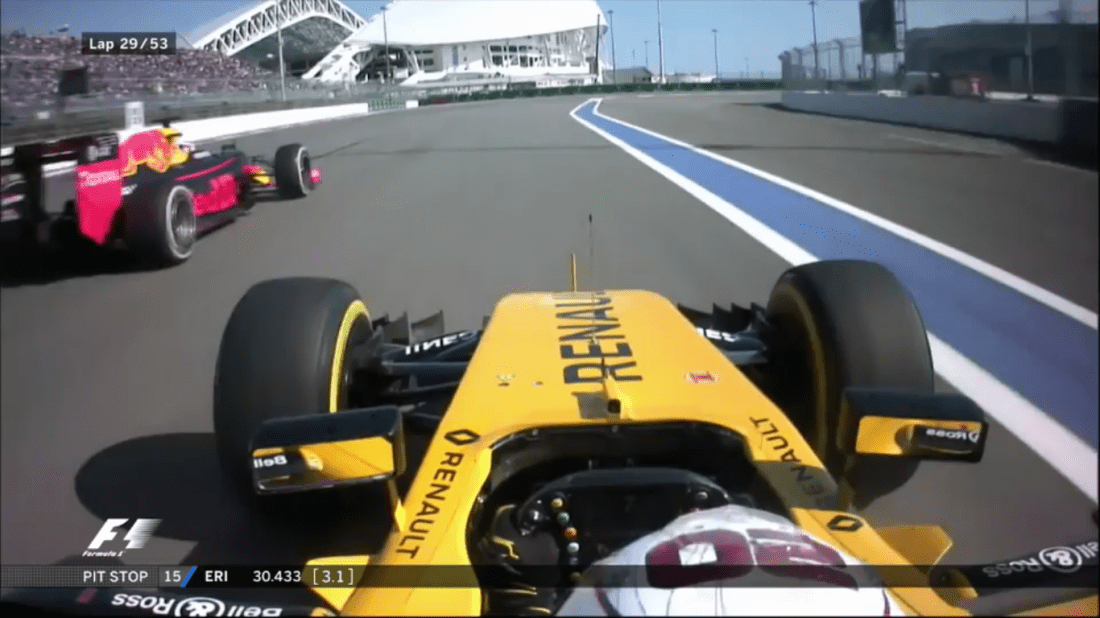
On-board with Renault’s Kevin Magnussen at the 2016 Russian Grand Prix. Just how different may the t-cam angle look in 2017?

The second major change that will be noticed worldwide is the change to the T-camera. Probably the most well-known and used on-board camera, the introduction of a cockpit protection system (Halo, Aeroscreen or something else) means that the perspective this camera gives will be radically different. Unfortunately, we did not see any on-board cameras from Daniel Ricciardo’s car during his Aeroscreen demonstration during practice one at the Russian Grand Prix, but I’m hopeful we will see on-board shots in forthcoming races.

An Aeroscreen like solution does provide opportunities to bring in new camera angles. The most logical one is a camera looking back towards the driver, which should be closer than ever before. If you wanted to be clever, you could have a camera embedded within the Aeroscreen that rotates around the top rim. I’m sure there’s many more, but if Aeroscreen was made mandatory, there certainly are a lot of ways that FOM could try to use the system to get closer to the driver in the future.

…say hello to drones and virtual reality…
Before the 2017 season gets underway though, there is at least one new innovation we will see in Formula 1 this year. According to Joe Saward, the Italian Grand Prix will play host to drones, with the hope that it will “create better coverage”. I’m intrigued to see how this goes, although there are some very obvious safety aspects to take into account, as Saward himself mentions in the link above.

Elsewhere, 360 degree videos and virtual reality is the thing doing the rounds at the moment, in both Formula 1 and Formula E. 360 degree videos are not new though, and in fact have been around for several years, dating back to at least 2012. Nevertheless, Formula E has managed to get the jump on Formula 1 by offering 360 degree highlights of races from a selection of on-board camera angles. To my knowledge, we have not yet had 360 degree videos during an F1 race weekend, the closest we have come so far is this video from Sky’s virtual reality studio that was released in March.

Alongside Formula E’s 360-degree movement is the announcement that was made in March that the series has teamed up with Virtually Live, with the intention to broadcast races live in virtual reality in the near future. Virtually Live’s CEO Tom Impallomeni said: “Formula E aims to represent a vision for the future of the motor industry, serving as a framework for R&D around the electric vehicle, while Virtually Live is building a revolutionary, immersive virtual reality technology allowing everyone to experience the magic of live sports and events from anywhere in the world.”

…FOM and Dorna roll out new graphics
There have been some subtle graphical changes rolled out this season so far from FOM. Ignoring the elimination qualifying ‘countdown’ graphic that we will hopefully never see again, the main changes are around pit stops and tyre choices. The pit stop graphic is the most effective change, with added detail compared with 2015. There is more emphasis on tyre choices, which are embedded within the pit stop strip, as well as the stint length that the tyre lasted.

2015 vs 2016 F1 pit graphics.png
A comparison of Formula One Management’s 2015 (top) and 2016 (bottom) pit stops graphics.

The tyre graphics as a whole have been tweaked out of necessity for the new tyre rules for the 2016 Formula One season. With three tyre compounds available, it means six possible options are available (new and used). FOM use a filled-in tyre to show that it is a new tyre at the start of the stint. An unfilled tyre, like the graphic above shows, means that some laps had already been completed on that tyre before the current stint started – in the case above with Hamilton, this would have been during qualifying.

I understand why FOM may have wanted to add the new and used aspect to the graphics, but, is the graphic useful if it has to be explained to casual viewers at every race? I’m not so certain. After a few laps a tyre is no longer new. This feels like over complexity to a degree. I like the graphic, I just wonder whether it was necessary though in the first place.

ESPN have taken a page out of FOM’s book with their new IndyCar graphics for the 2016 season. The graphics, only available to domestic viewers when ESPN are covering the action live, can be seen here. The graphic set uses a similar layout to historical IndyCar graphics but with a modern, flat look, bearing similarities to the graphics Formula 1 introduced at the beginning of 2015.

Brundle to miss European Grand Prix weekend

For the first time since they entered the sport in 2012, Sky Sports F1 will be without Martin Brundle for a race weekend.

Brundle has confirmed that he will be racing in the new LMP3 support race during the 24 Hours of Le Mans weekend. The race takes place on Saturday 18th June, the same day as qualifying for the 2016 European (Baku) Grand Prix. Sky have confirmed to this site that Brundle will be missing the whole weekend.

It is the first race he has missed since the 2008 Hungarian Grand Prix when James Allen and Anthony Davidson voiced the race for ITV. Sky have also said to this site that their European Grand Prix co-commentator will come from their existing range of talent, meaning that it is likely to be one of either Damon Hill, Paul di Resta or Johnny Herbert alongside David Croft.

Don’t expect the co-commentator to be confirmed in the form of a press release before the race weekend. One thing is for certain: Sky’s team will be significantly weaker without Brundle during the Baku weekend.

2.4 million watch Russian Grand Prix in UK

An average audience of just over 2.4 million watched the Russian Grand Prix on television in the United Kingdom yesterday, overnight viewing figures show.

Before we go into the in-depth detail, it is worth pointing out two things that would have adversely affected viewing figures. The first is the change of slot in the calendar. In both 2014 and 2015, Russia was at the latter end of the calendar when there was a championship battle ongoing, which may have increased audiences.

Secondly, Bank Holiday weekend in the United Kingdom means slightly reduced audiences across the board as people head away for long weekend.

Race
Live coverage of the race, which aired live on Sky Sports F1 from 12:00 to 15:30, averaged 470k (4.9%). In comparison, last year’s programme on Sky, which was shared with BBC One, averaged 497k (5.1%). So, despite the added exclusivity aspect this year, Sky’s number was slightly down year-on-year.

Highlights of the race were broadcast on Channel 4 from 18:00 to 20:00 and averaged 1.94m (10.8%). The combined audience of 2.41 million viewers is down 26.7 percent on 2015’s average audience of 3.29 million viewers. Unfortunately, the Russian Grand Prix now holds the accolade of being the lowest rated ‘European time zone’ race since the mid 2000s, taking away the feat that the 2015 Abu Dhabi Grand Prix previously held. The audience yesterday of 2.41 million viewers is the lowest for a ‘European time zone’ race since the 2006 Italian Grand Prix.

Qualifying
Live coverage of qualifying, broadcast exclusively on Sky Sports F1 from 12:00 to 14:45, averaged 275k (3.6%).  Last year, Sky’s shared live coverage with the BBC averaged 351k (4.3%) over a shorter slot from 12:15 to 14:35. Nevertheless, for an exclusive live broadcast, that is a very poor number, especially considering the lack of Premier League competition from BT Sport.

Channel 4’s highlights programme, which aired from 17:30 to 19:00, averaged 1.16m (8.2%). Although it was Channel 4’s only programme over one million viewers on Saturday, the raw number and share is arguably lower than they would have expected. The combined audience of 1.44 million viewers is down 39.3 percent on 2015’s combined audience of 2.37 million viewers. It looks to be the lowest audience for a qualifying session since the 2008 European Grand Prix.

The 2015 Russian Grand Prix ratings report can be found here.

overnights.tv-bannersF1

Archive material takes centre stage with new feature-length films

It feels like there has been a motor racing movie renaissance during the past few years, with the likes of Senna and Rush hitting the big screen to major success at the box office, both winning multiple awards.

The renaissance is continuing with more feature-length films in the works. A film surrounding the life of François Cevert is being released on Wednesday 11th May, whilst Prost will tell the story of the four-time Formula 1 world champion and is scheduled for release in 2017. Recent years could be considered a golden age for motor racing filmography. But, a great film or documentary does not need to be released at the box office to be a hit with the intended audience. The likes of Netflix and Amazon Prime have widened the net in recent years meaning that film makers have a choice on the method that they wish to distribute their movie by.

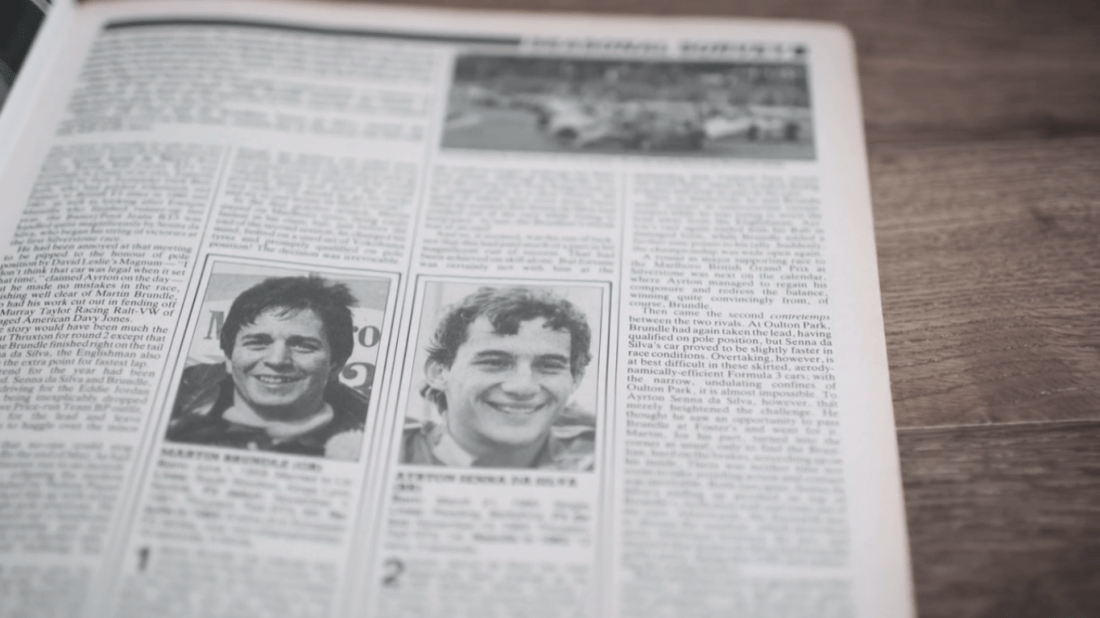
A new feature-length film has been released, telling the story of Ayrton Senna’s year-long battle in the 1983 British Formula 3 championship with Martin Brundle. If you felt that you wanted more from Senna’s early years in the Senna film, this film helps go some distance towards that goal. Senna vs. Brundle was developed from start to finish by Mario Muth and has been released on Vimeo for £5.99. The film clocks in at just over 90 minutes long, an ideal length without over saturating the subject.

There are multiple effects used throughout the film which help bring it to life. The main one is animation in the context of still images. By scaling closer to the main object in each still image, the viewer feels a ‘connection’ between themselves and the image in question. In many cases, the car is brought to life through this effect. The most dramatic image is Brundle attempting to escape his Eddie Jordan Racing car after colliding with Senna.

Archive footage is used sporadically throughout the video. Unlike today, you have to consider that the amount of footage available from a typical 1983 Formula 3 race is going to be significantly less than the footage from an equivalent event today which is understandable. I checked the BBC’s Genome service to see if the corporation aired any Formula 3 races on television, and only the final round of the 1983 season was covered. Any shortcomings in archive footage are overcome through the use of magazine extracts from AUTOSPORT and Motorsport News. Again, this is done in a ‘stylish’ manner as opposed to taking the standard flat ‘display on screen’ approach, showing that attention to detail is present throughout the film.

Senna vs Brundle - magazine cutting.png
Magazine snippets are used by Mario Muth throughout Senna vs Brundle, in a stylish, modern manner.

One concern I had before watching the film was that Senna’s view-point would not be captured, however any concern in this area is dispelled quickly. The viewer hears Senna through recorded audio from 1983 at various stages during the film. All of the major viewpoints were captured, including team bosses (Eddie Jordan), commentator (Murray Walker), journalists (David Tremayne) and then the drivers themselves (Senna, Brundle and Davy Jones).

The main negative concerns the flow of the film. Not necessarily the ordering, but the break points. At 90 minutes in length, it didn’t feel like there was a natural ‘breathing point’. As far as I recall, there was no ‘fade to black’ and then onto the next section. Personally, three or four ‘break points’ in the film, with a time stamp following on, for example “Silverstone, 16th July 1983” would not have gone amiss to show the context that the event took place in. We know the events occurred in 1983, but the relative time frame is unclear. In the grand scheme of things, this is a minor gripe at best.

I hope Senna vs Brundle is the springboard for more films of this nature being produced. It serves as a template for other great battles over the years in Formula 1 and beyond that could be retold in the same manner, giving a new fresh insight. Schumacher vs Villeneuve (1997), Schumacher vs Hakkinen (2000) and Hamilton vs Massa (2008) are just three possibilities in the future… as I have said before, the Formula One Management (FOM) archive is a goldmine waiting to be exploited, one day.

FOM are already making small movement on the archive front, this season it feels like that they are uploading more archive material to their YouTube channel with rare footage such as classic on-boards being made publicly available for fans to watch. I hope that trend continues as the season progresses. It is important that we remember where the sport came from, and films such as Senna vs Brundle help in that respect.