Putting £5 billion into context – and what it means for F1

I find that it’s incredibly difficult trying to quantify how much £5 million really is. So, what happens when a figure of over £5 billion comes along? You’re left thinking “woah”. And quite rightly so. Over three seasons, from the 2016-17 season through to the 2018-19 season, BT Sport and Sky Sports will be paying the Premier League £5,136,000,000.00 (or £5.136 billion), a frankly ridiculous amount of money.

Across each season, that works out to £1.712 billion. It’s difficult to comprehend just how big that number is. But, eventually you can break it down.

– £5.136 billion across three seasons
– £1.712 billion across one season
– £10.19 million per game

In comparison, the Formula 1 numbers pale into comparison. Numbers have never been officially released into the public domain, but the best guesstimates for BBC and Sky combined put the number around £55 million.

£55.0 million approx across one season
– £2.75 million approx per race weekend

Formula 1 is pocket money compared to the Premier League, which may be seen as somewhat surprising considering the Premier League does not bring Sky Sports four times the audience of Formula 1. However, the reach for the Premier League is significantly greater than your typical Formula 1 season on Sky. Whether we like it or not, the Premier League is such a subscription driver for both BT and Sky that both parties are willing to break the bank to get what they want to ridiculous proportions. Sadly, that means that customers suffer as a result, with higher costs, and not necessarily better quality.
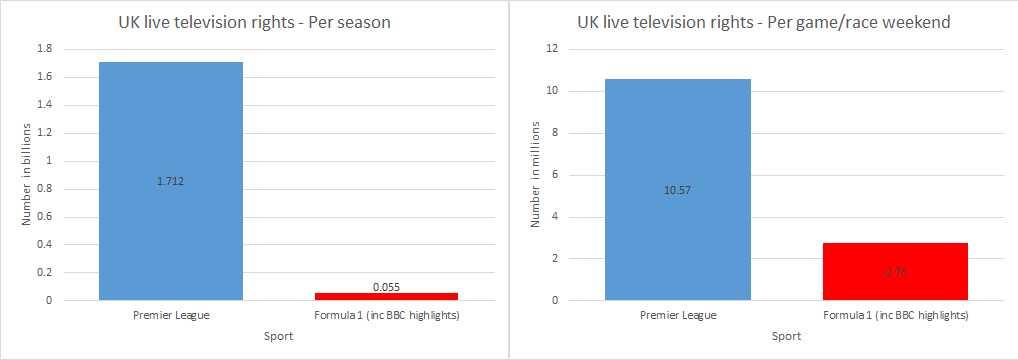
Comparing the Premier League live TV rights (2016-17 to 2018-19) to the current Formula 1 rights (2012-18).

It will be another two years before either Sky and BT Sport even begin thinking about the Formula 1 rights. Given that they mention it in every press release, it is pretty clear to me that the BBC are going to fulfil their contract until the end of 2018. I do wonder how much have money Formula One Management have lost as a result of the seven year deal between BBC and Sky. We say that Bernie Ecclestone is good at making deals, but if you’re looking at it from a money perspective, then he lost a massive amount of money by giving in to BBC’s and Sky’s demands in 2011. Seven year contracts are very unusual, the Premier League rights run on three year cycles, for example. Since the middle of 2011, we’ve had BT Sport enter the scene.

I am convinced that, if the Formula 1 rights had been on the market on the past twelve months, then live coverage would have disappeared from free-to-air television, and the value of the rights would have soared. How high would the rights have gone, I don’t know, but you can guarantee that there would have been a tug of war between Sky and BT to get live Formula 1 rights. Assuming that there are no fundamental changes to Formula 1, as we know it before 2018, then I think the next set of Formula 1 rights will be north of £100 million per year.

The main thing though, beyond anything else, is that the money generated goes back into the sport. It cannot go to those outside the sport. If it does stay inside the sport, with a more equal prize structure, then the sport should flourish.

PL 100 – F1 style

Yesterday before The FA Cup action began, I was watching an episode of PL 100 Club on Sky Sports.

The idea behind PL 100 Club is simple. It is “a celebration of some of the finest goalscorers in Barclays Premier League history”, those that have scored over one hundred goals have an episode dedicated to them, hence the programme title. The episode that I watched featured Robbie Keane. At thirty minutes in length, it showed some of his best goals from his time in the Premier League. I did not count the number of goals, but I’d estimate that about 25 to 30 goals were shown, this was interspersed with mini VT’s as Keane moved between clubs.

As I say, its an incredibly simple programme, making great use of the Premier League archive. You don’t need to know a lot about Keane to watch the programme, it can be background viewing at times. I also think that you can apply programming of this nature to Formula 1. I’ve suggested before about how Sky could utilise the Summer break where Classic F1 races are concerned so that viewers can follow a single season, or potentially create retrospective documentaries of a race weekend.

I suggest a programme called F1 20 Overtakes if you’re to use the same style as the Premier League programme. To continue along those lines, the programme would be a celebration of some of the finest overtakers in Formula 1 history. Making sure that a programme like that would actually be possible, I went on YouTube, typed in “schumacher overtake” and listed the first twenty below.

Schumacher overtakes
1. Alain Prost (1993 Belgium Grand Prix)
2. Jean Alesi (1995 European Grand Prix)
3. Jean Alesi (1996 Spanish Grand Prix)
4. Jacques Villeneuve (1996 Spanish Grand Prix)
5. Alex Wurz (1998 Monaco Grand Prix)
6. Damon Hill (1998 Canadian Grand Prix)
7. Mika Hakkinen (1998 British Grand Prix)
8. Mika Hakkinen (1998 Italian Grand Prix)
9. Jenson Button and Jarno Trulli (2000 Belgium Grand Prix)
10. David Coulthard (2000 US Grand Prix)
11. Kimi Raikkonen (2003 Austrian Grand Prix)
12. Jarno Trulli (2003 German Grand Prix)
13. Fernando Alonso (2006 Chinese Grand Prix)
14. Kimi Raikkonen (2006 Canadian Grand Prix)
15. Giancarlo Fisichella (2006 Brazilian Grand Prix)
16. Nick Heidfeld (2006 Brazilian Grand Prix)
17. Kimi Raikkonen (2006 Brazilian Grand Prix)
18. Fernando Alonso (2010 Monaco Grand Prix)
– the illegal overtake
19. Kamui Kobayashi and Felipe Massa (2011 Canadian Grand Prix)
20. Kamui Kobayashi (2012 Italian Grand Prix)

Whilst it is great to have Classic F1 races and Legends shows on the channel, you have to appreciate that there is a portion of the audience who want something to ‘dip in and out’ of during non-race weekends, I question whether any of Sky F1’s programming achieved that during 2014. Plus, many can put 30 minutes aside to watch a programme of the nature described, whereas two hours for classic races is more difficult. You could have a lot of different episodes in an overtaking strand: Schumacher as mentioned, Lewis Hamilton, Fernando Alonso, Juan Montoya and Ayrton Senna to name a few. In the case of the latter two, it would be a nice companion programme to their respective Legends of F1 programming already aired.

As always, the issue is getting access to the footage. Sky have been broadcasting the Premier League since its inception, but only Formula 1 since 2012. This means that Sky would need to get the footage for the races mentioned from Formula One Management (FOM), BBC or ITV if they wanted to screen programmes of that nature. Or better still, FOM could produce programmes such as F1 20 themselves, and distribute it to broadcasters.

Looking ahead to 2015

2014 has been a fascinating year in the world of motor sport broadcasting, from the launch of BT Sport’s MotoGP series to the launch of the Formula E series. 2015 looks like it will be another intriguing year with plenty of news lines heading into the New Year and beyond.

Something I was expecting to be announced last week did not happen. Normally, the BBC and Sky 2015 picks are revealed before Christmas, as has been the case previously. Presumably, the reason for the delay is because neither broadcaster expects Korea to appear in the finalised calendar. I would be surprised if there was a separate reason, but we shall see. The picks will need to be confirmed in the first few weeks of January, so that both sides can start publicity, in particular Sky where their exclusive races are concerned.

Another story that will be followed throughout the first few months of 2015 are the Premier League highlights rights, which went out to tender recently. The Guardian reported in November that ITV are going to bid for the highlights contract. It goes without saying that the Premier League highlights, through their Match of the Day brand, is the most important contract that BBC Sport currently hold. Any attempt to destabilise BBC Sport’s portfolio could have major consequences. The early rumour was that Wimbledon could be split between BBC and BT Sport, although this has been denied. Let us hope that any change does not effect the current BBC F1 package…

Formula One Management’s social media expansion is set to continue into 2015, with the relaunch of Formula1.com. What exactly will the new website bring? Furthermore, based on Marissa Pace’s recent comments, we may well see an official Formula 1 channel on YouTube in 2015. Elsewhere, BT Sport’s MotoGP coverage enters year two, and Formula E will be entering year two in September. From a UK perspective, I hope year two remains live on ITV, but we won’t know the answer to that question for many months yet. 2015 looks set to be another intriguing year on and off the track as Formula 1 heads into its second season with the V6 power units.

Official F1 feeds heading to YouTube and Facebook

The latest news in the ongoing Formula One Management social media cycle was revealed today, as it emerged that FOM will be creating official F1 channels on both YouTube and Facebook in the near future.

As noted in a detailed Q&A session with Bernie Ecclestone and Marissa Pace (FOM’s Digital Media Manager) on the Forbes website, Pace noted that the plan for FOM is to begin with Twitter, as happened back in Singapore, moving onto YouTube and eventually Facebook. “We are rebuilding Formula1.com and from Singapore onwards you may have noticed we have taken a more active role in social media so, starting with Twitter, we started in Singapore carrying on through to Youtube in the future and eventually Facebook when we get it past the legal team”, Pace said.

Pace, who was part of Kangaroo TV, noted that the “impressions were over 80 million from Singapore until the end of the season. Impressions is anybody who has seen the @F1 content that we pushed out”, whilst lastly confirming the news that James Allen revealed last month, stating that the official Formula 1 website is being rebuilt from the ground up. The new website will contain a membership area, Pace did not specify whether the membership area would be free or pay to use. If it was pay, I can’t say I would be enticed to sign up unless there were some valuable extras, for example access to (present or past) some of FOM’s archive which has been hyped up a bit given that it was part of the F1 Connectivity Innovation Prize, the winners of which were announced today.

The YouTube content, according to Pace, will be similar to the content currently on the app, something that Ecclestone agreed with, Ecclestone himself noting that content such as the driver pen interviews would not “hurt anybody and it’s good and interesting because it’s instant.” Ecclestone rejected the notion that their YouTube channel would contain any race action, which should not be too much of a surprise given the nature of the current broadcasting contracts. It is difficult to know when the YouTube and Facebook will happen, I hope FOM has presence on both platforms in time for the 2015 season.

It is clear, as has been the case before, that Ecclestone himself does not understand social media. “People in here tell me that we need social media because it is good for us. It’s better than Aspirin. Since people have been breaking my balls about social media I have been looking at this Twitter thing and I can’t see anything on there except [Mercedes motorsport boss] Toto Wolff and one of my daughters and I thought people put things on there, how does that help Formula One?”, Ecclestone says in the Q&A.

Commenting further on social media, Ecclestone said “If it works, the whole point about this I believe, is to encourage people to watch television. I’m not sure, and I have always thought ‘does it actually do that’ and I don’t know. So probably in a year’s time I shall be looking for figures to see what has happened. The only trouble about that is that if there are more people watching television is it because of this or because there are more people watching television?”

An interesting line from the piece is that their social media team only has eight people. I would assume that does not include the people developing the app and the website, otherwise that would be an extremely small group of people. As I’ve said before, it is good again to see FOM heading in the right direction with social media, and this is just further evidence. Whether they are moving as quickly as some people would like, that is up for debate…

How F1 2014’s timings would have changed – Bianchi report

The findings of the Accident Panel have been published today surrounding Jules Bianchi’s accident at the Japanese Grand Prix.

The panel came to 11 conclusions and seven recommendations. One recommendation states that “it is proposed that a regulation or guideline be established such that the Start time of an event shall not be less than 4 hours before either sunset or dusk, except in the case of night races.”

How would such a rule affect the timings on race day where the calendar is concerned? If we’re to look at the 2014 calendar, a total of six races would have been affected. In most cases though, this is a movement on one hour rather than anything significant. However, Australia and Japan would have been brought forward by two hours, Australia would have a start time of 04:00 UK time, with Japan at 05:00 UK time. Let’s not forget, the reason Australia was pushed later in the first place was to boost European viewing figures and at broadcasters demand, so it will be interesting to see if any change comes in for 2015.

Anyway, here is what would have changed for 2014…

Australian Grand Prix – 16 March
=> actual: 17:00 / 06:00
=> proposed: 15:00 / 04:00
=> sunset is 19:38 – http://www.timeanddate.com/sun/australia/melbourne?month=3&year=2014
Malaysian Grand Prix – 30 March
=> actual: 16:00 / 09:00
=> proposed: 15:00 / 08:00
=> sunset is 19:22 – http://www.timeanddate.com/sun/malaysia/kuala-lumpur?month=3&year=2014
Chinese Grand Prix – 20 April
=> actual: 15:00 / 08:00
=> proposed: 14:00 / 07:00
=> sunset is 18:26 – http://www.timeanddate.com/sun/china/shanghai?month=4&year=2014
Japanese Grand Prix – 5 October
=> actual: 15:00 / 07:00
=> proposed: 13:00 / 05:00
=> sunset is 17:33 – http://www.timeanddate.com/sun/japan/suzuka?month=10&year=2014
Russian Grand Prix – 12 October
=> actual: 15:00 / 12:00
=> proposed: 14:00 / 11:00
=> sunset is 18:43 – http://www.timeanddate.com/sun/russia/sochi?month=10&year=2014
US Grand Prix – 2 November
=> actual: 14:00 / 20:00
=> proposed: 13:00 / 19:00
=> sunset is 17:43 – http://www.timeanddate.com/sun/usa/austin?month=11&year=2014

Alternatively, if you’re looking at ways of boosting viewing figures without hindering driver safety, you could push all European races to a start time of 16:00 or 17:00 local time. Based on this year’s calendar, Monaco has sunset at 20:59, Budapest is 20:25, Spa is 20:45 and Silverstone is 21:19, so a start time of 16:00 or 17:00 local time would be reasonable. In fact, I’m surprised that has not already happened.