Should broadcasters’ lobby to take over the FOM World Feed?

There’s two things I could use this blog post to complain about, both of which reared their ugly head in Canada. The first concerns Sky Sports’s Formula 1 coverage very quickly turning into ‘The Lewis Hamilton show’ with some worrying traits, the latter is regarding the incompetent direction of Formula One Management (FOM). I’ll use this post for the latter. Whilst the Canadian Grand Prix was thrilling from start to finish, with Daniel Ricciardo eventually winning, it was not FOM’s brightest hour. Seemingly, constant zoom ins and an ever growing reliance on virtual advertising means that their priorities are changing from what they once were. No longer is the car the sole focus of the picture, meaning the sometimes the raw speed does not come across to the viewer as well as it once did. One might ask: is it time for change?

If I’m going to criticise FOM, then I think it is only fair to begin by focussing on the positives. Of which there are several, don’t get me wrong. The thermal image shots lead the way on the innovation front, it is probably FOM’s best innovation by far. With both rear-view and front-view shots, it gives the viewer a good idea of how hot the tyres get under braking, and also in last Sunday’s case how warm the brakes on Lewis Hamilton’s Mercedes were getting shortly before retirement. It’s a very effective innovation, and one that many fans like seeing. Rotating cameras is another innovation, however if you watch the IndyCar Series you will know that rotating cameras have been around for many, many years. Nevertheless, from an F1 coverage point of view, it is a step forward in the very least. A final innovation is line comparison, which sadly is used nowhere near as much as it should. Despite first appearing back in 2009, it has only been sporadically used by FOM since. It should be used more, but for some reason isn’t. A line comparison feature, for example, would have been fantastic to see for Nico Rosberg’s Qualifying excursion in Monaco.
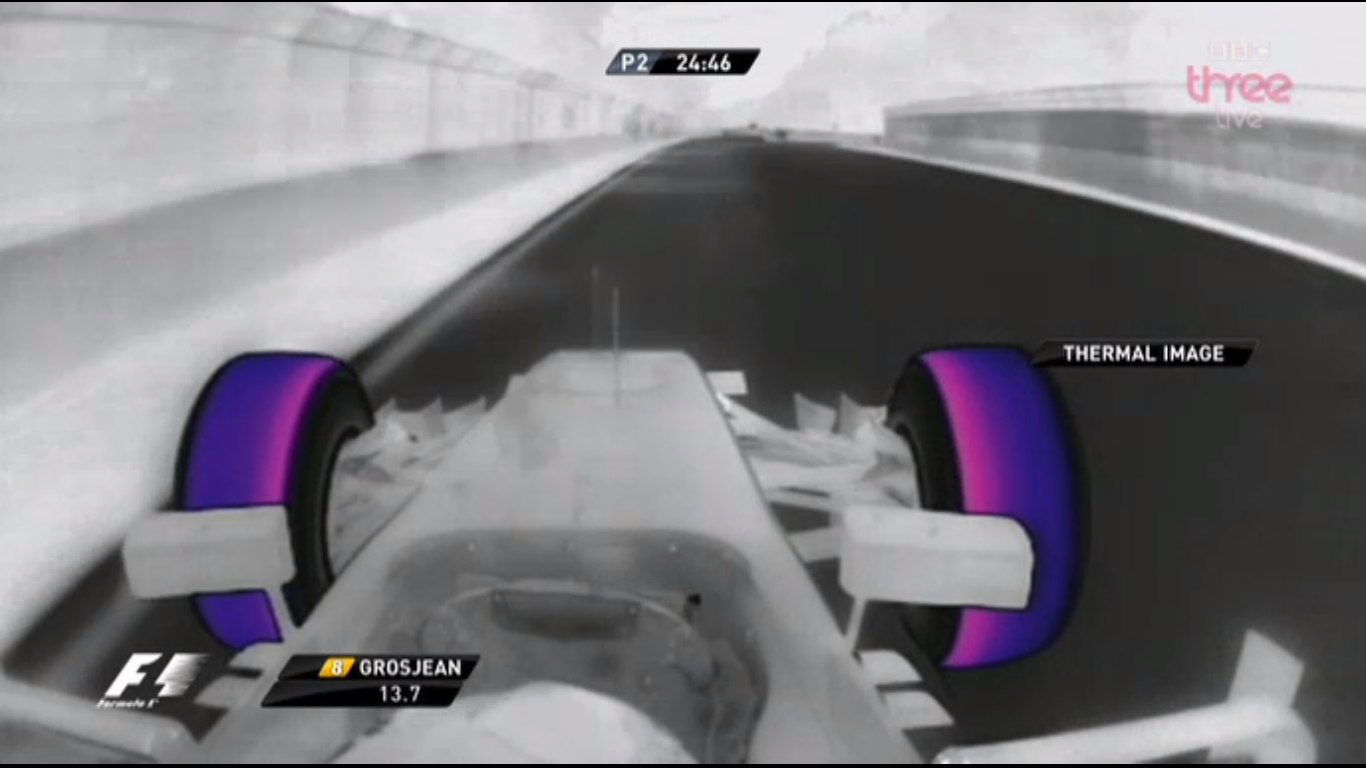
One of Formula One Management's best innovations: the thermal image, here seen on Romain Grosjean's Lotus during FP2 for the 2014 Canadian Grand Prix.
One of Formula One Management’s best innovations: the thermal image, here seen on Romain Grosjean’s Lotus during FP2 for the 2014 Canadian Grand Prix.

I feel it’s important for me to highlight that FOM has done some great innovations, and for that we should applaud them for. However, more recently, they have been let down by two things: virtual advertising and poor direction. I made a point last year about virtual advertising, when it was starting to appear. “The virtual advertisements that are subtle are the best,” a point which I still maintain. When virtual advertisements work, and blend in with the image, I have no issue with them. You know what, it’s cost effective and I can see the logic in using them. The issue I’m having is that the advertising is creeping into Formula 1 coverage more and more, to a degree where it is taking over certain shots, and in some cases is blatantly obvious. I’m not against FOM using virtual advertising, however, they need to rethink a) how and b) where they use them. If it is going to disturb the piece of track that the camera is focusing on, or become an unintended distraction to the viewer because of its size, don’t place it there.

The second part concerns the poor direction as of late which for me, and many other Formula 1 fans came to a head in Canada. Constant zoom in to the crowd, cutting away from Lewis Hamilton running wide at the hairpin and very nearly missing Daniel Ricciardo overtake Nico Rosberg for the lead. I’m a motor racing fan. I watch to see that move, that moment. I don’t expect someone up in production to then determine that a crowd shot is more important than seeing the on-track action. This is similar to the virtual advertising issue above. I can live with one or two crowd shots if the track action is quiet, but in Canada things were teetering on the edge. Obviously cameramen do not decide to pan to the crowd out of their own accord, so calling the cameramen ‘stupid’ for doing their job won’t get anyone anywhere. They would have been directed to pan into the crowd every so often by whoever was leading FOM’s production team on Sunday. Just after Ricciardo overtook Rosberg we had a pan to the crowd. This was mildly amusing because the crowd didn’t appear to be reacting at all, which led Ben Edwards covering up that fact moments later.
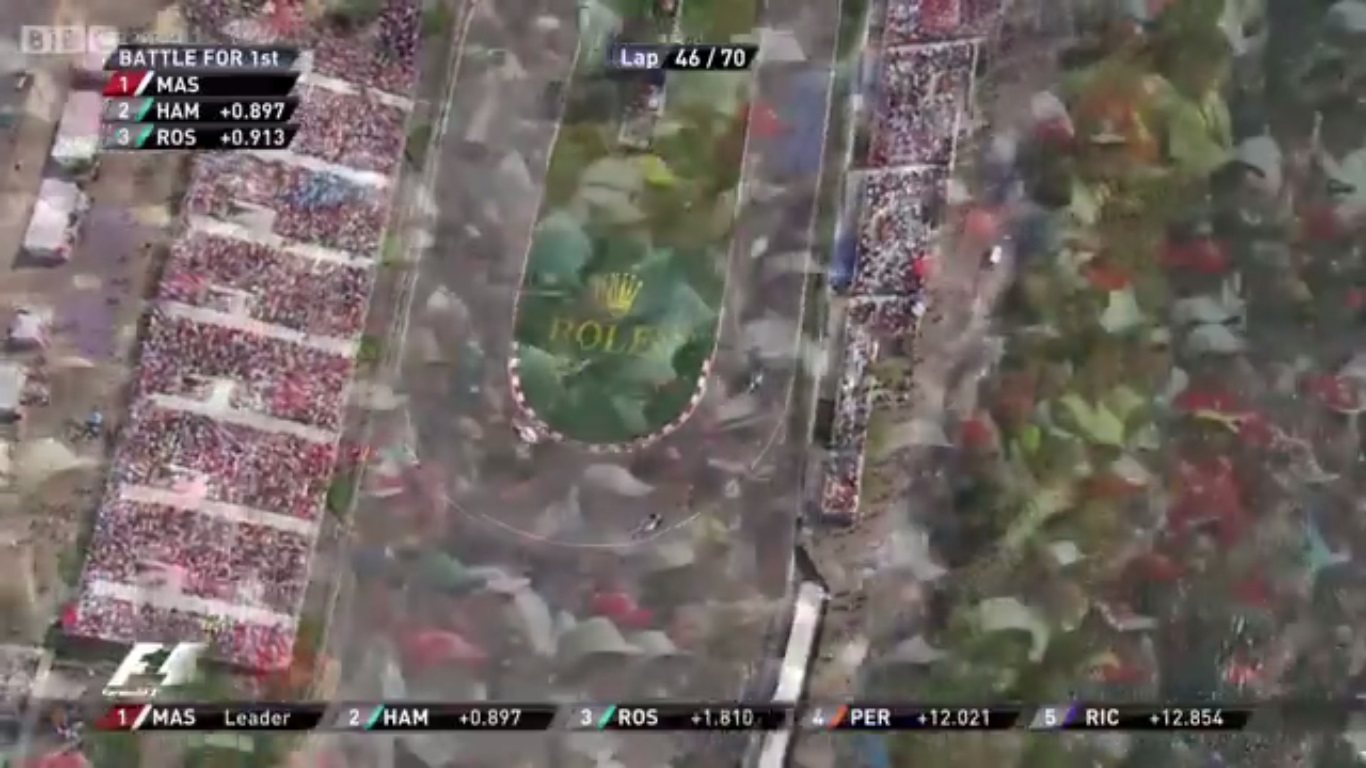
The 2014 Canadian Grand Prix: Lewis Hamilton gives the lead away to Nico Rosberg as the camera cuts away to a crowd shot.

As an aside, when all the sound kerfuffle was going on earlier this year, one angle of it concerned FOM. The camera angles currently do not present Formula 1 in the best light and are instead used to get maximum exposure for the sponsors in the background. What the live camera angles should be showing is this sport that makes the hairs on the back of your neck stand up at 200mph. The secretive structure at FOM means that it is difficult to know where the buck stops, and it goes without saying that those who direct the F1 also direct other events. To put it simply, whoever at the top is making the calls at the moment is making the wrong calls. Whilst the innovations are largely fantastic, I hate to say this, but Formula 1’s television coverage is heading into reverse. I don’t want to blame one person, or one director, because they do this for a living, and for the large part do a great job at it. I’d like to think that they do Formula 1 directing because they’re the best in the business. Canada wasn’t their finest day, however, some of the decisions that are made during races need a serious re-think. Formula 1 fans deserve the best World Feed possible, akin to what F1 Digital+ provided across Europe between 1997 and 2002. Do I think we’re currently getting that? No.

Another perspective is that the World Feed needs some new blood. In November 2012, speculation began to mount about Sky Sports taking over the World Feed following this comment from Barney Francis, who is the managing director of Sky Sports. Three months later, and Sky would cover testing live and in 3D, a Formula 1 first. Nothing ever happened after that, Sky didn’t broadcast testing live this year. Given FOM’s current direction, I’d love to see Sky Sports get their hands on the British Grand Prix weekend and take over the World Feed. Given that this is year three of their contract, I’m surprised that it hasn’t happened already, as it gives them much more control in terms of the camera angles and the editorial aspect that they want to present to the viewer. Once Sky have done it, assuming it was universally liked, then they can get other broadcasters on-board in order to try and have more influence on the World Feed – or perhaps have Sky as the World Feed ‘leaders’ (given their potential pan-European status in the future, this could have a lot of weight), with other broadcasters playing a supporting role.

I’m not saying Sky controlling the World Feed would be better, however from a curiosity point of view, I want to see it happen. And given FOM’s lack of direction last weekend, who can blame me. I’ll finish off by linking to the below, which was all filmed, produced and edited by Sky Sports in the latter stages of the 2011 Formula One season.

New show with unseen FOM footage coming to Sky F1

A new show with never before seen footage from Formula One Management’s archive is coming to Sky Sports F1, it has been confirmed. ‘Tales from the Vault‘ will be presented by Steve Rider with the first show based around ‘team mates’. In front of a studio audience, Christian Horner and John Watson will be guests in episode one, which will be recorded on Thursday 26th June.

This seems like an interesting concept, especially with it all being new footage, I’m all for unseen footage being used considering the rich archive that FOM has which is frustratingly being unused. Biggin Hill is basically a goldmine for Formula 1 fans, so I’m fascinated to see what footage is in the Sky show, hopefully it doesn’t disappoint. I assume that this will be a half an hour show, I can’t see it being an hour long, however, that depends on what footage they have found in the FOM archive. Which brings us to the next point: has FOM sent unseen footage to Sky, or has someone had Sky had the ability to roam around Biggin Hill looking for footage?

One thing I’m wondering too is the type of footage that will be aired. Are we talking unseen camera angles from out on the race track, or off the record conversations in FOM’s archive that have not been released before? If someone at Sky has common sense, and one assumes the footage is interesting otherwise it simply would not make it to it, before episode one airs, they’d be hyping whatever footage goes to air through online and social media. I’m not convinced either that we need a studio audience personally, I’d have thought that the footage is the draw to the show rather than having an audience. Either way, I’m very pleased to see that this is happening and I will update this post with more details when the scheduling is confirmed…

Update on June 13th – Whilst no scheduling details have officially been confirmed, Sky have confirmed that the first ‘episode’ will be taped from 11:30 to 18:00, six and a half hours. Now obviously they won’t be taping for that entire time. If I had to guess, the first ‘episode’ will actually be split into two, taping from 12:30 to 14:30 and then from 15:30 to 17:30, which would be two hours each. Conveniently, there are two blank two hour slots on Tuesday 1st July and Wednesday 2nd July at 21:00 in the build-up to the British Grand Prix, so let’s see if it ends up in there…

Update on July 25th – Confirmed on The F1 Show that it will première on Sunday 24th August at 16:15, after the Belgian Grand Prix.

Update on August 6th – Sky have confirmed that each episode will be an hour long, the first two focussing on team-mates and underdogs respectively.

Why the F1 championship trophies should be presented straight after the final race

Today, in football, Manchester City won the English Premier League title after beating West Ham 2-0. Afterwards, the team were presented with the Premier League trophy in front of 45,000 people at the Etihad Stadium. It is tradition in many different sports for the winners to be presented with their trophy straight after the final event. The purpose of this, of course, is so that the fans in attendance can witness the moment taking place, but also for the viewing audience watching at home: for them to be part of it. You may wonder what relevance at all this has to Formula 1.

Let’s take 2012 as a good example. The championship battle went down to the final race at the Brazilian Grand Prix with Sebastian Vettel and Fernando Alonso fighting for the title. In the end, Vettel won the title after battling through the field following a spin on the first lap. Whilst Vettel did have a visit to the podium following the end of normal proceedings, he was presented the official Formula One World Drivers’ Championship trophy at the FIA Gala a few weeks later, out of the public spotlight in front of only those directly involved with the sport. The same applies to the Constructors’ Championship trophy. The reason for this is because there is the possibility that cars could be found illegal, thus potentially changing the championship order, this very nearly happened in 2007. To date, the championship winner has never been excluded from the standings following the conclusion of the final race.

The issue I have with the trophies being presented long after the final is that it feels too old-fashioned, and too bureaucratic. I understand that post-race checks need to be done after the race in order to make sure that every participant is running with a legal car, and also that the teams need to pack up and head home. But, I also feel that more could be done in order to bring the atmosphere of the final race ‘home’ to the viewer. It is bizarre that we see the teams celebrating after each race weekend with the individual race winning trophies, yet when it comes to the championship winning trophies, this is not the case. If you asked anyone what the Formula One championship trophies looked like, they probably wouldn’t be able to tell you, because neither trophy is showcased anywhere near as enough as they should be. Why not have the trophy on the grid next to the safety car before every race, or a select few races? Both trophies should be made to ‘feel’ important.

If it was me running the sport for the final race, after the podium procedure, I would like to see a separate presentation done on the start-finish straight. Have the winning driver presented with the World Drivers’ Championship trophy and the winning team presented with the World Constructors’ Championship trophy. It would bring a bit more ‘aura’ to the final race weekend, in the same way that the final day of the Premier League season does. In Brazil, this would be great to see, and even in Abu Dhabi this year, irrespective of how much I loathe double points, it would be a spectacle to see something of that nature to happen. Those watching at home would keep watching as the would want to watch the presentations. It could well be a ‘replica’ trophy (today there would have been two Premier League trophies at Liverpool and Man City, so it would make no difference to the viewing public), with the driver and team getting the real version of it at the FIA Gala. Only a select few know about the FIA Gala, whereas many millions around the globe watch the final race each year, it is the latter who should be catered to in this case and not the former.

In my view, it is one of them obvious and simple things that should be considered and discussed, and would make the fans feel closer to the sport. Which probably means that it has never been considered as a realistic option by those that matter.

Imola 1994: The reflections of a commentator

The 1994 San Marino Grand Prix weekend is one that will be remembered for generations to come. The weekend that Formula 1 lost, not only a rookie living his dream, but also a legend. I never watched Formula 1 in 1994, I was too young back then to watch it. My first experience of watching Formula 1 on the television came five years later. Having not watched that weekend ‘as live’, it is difficult for me to put into words the events that surrounded that weekend. I couldn’t imagine being a Formula 1 fan on that weekend, I just couldn’t.

Watching ‘Senna‘ helped bring it home to those that were not around to watch Imola 1994 live at the time. No matter how many times you watch it, you just wish there was an alternative ending. Roland Ratzenberger going around Tosa on another lap, or Ayrton Senna escaping free from Tamburello. Sadly, both of them thoughts are images we will never see. Every time I watch the entire Imola sequence, I can feel shivers go down my body knowing that the inevitable is about to transpire. The closest emotions that I can think of would be Felipe Massa’s crash during the 2009 Hungarian Grand Prix Qualifying session, or Dan Wheldon’s fatal accident during the final round of the 2011 IndyCar Series season. Both of them moments instantly shook me up. The former felt like watching a clock tick by, minute by minute, hoping for good news to come out of Hungary, hoping for a flicker of positivity.

And, for every Formula 1 fan worldwide currently, we have the same each and every day for the past four months with Michael Schumacher, albeit in an accident outside of the confines of a race track. One aspect that I can appreciate about Imola 1994 is that amount of work that has gone in by Professor Sid Watkins, the FIA and many, many more names to improving the safety of the sport that we love, year-in year-out. I spoke to Allard Kalff, who was Eurosport’s lead commentator for the San Marino Grand Prix weekend, commentating alongside John Watson. Kalff was a close friend of Ratzenberger’s. “The weird thing was that on Saturday, I had a really shitty feeling as I knew Roland pretty well. He used to stay at my place, first in Holland and later also sometime in England. So Roland dying during qualifying was a huge shock”, Kalff recalls.

“We all understand the risk of motor racing and realise these things can happen, even in 2014, so you accept the fact that something terrible has happened.” Nowadays, inaccurate rumours can spread via social media time and time again. Despite the lack of social media back then, the rumours spread from people walking into the various commentary boxes. “We did our best not to follow the many rumours that people were spreading around by walking into our commentary booth. The rumours went from ‘he died on the spot’ to “he only has a broken finger’. I am sure the people in Paris [at Eurosport’s headquarters] wanted to stay or move away from the pictures coming from the circuit but it was a case of, just keep going. I still believe John Watson was great keeping himself, and probably me, together”, Kalff noted.

As Kalff alluded to above, the weekend at Imola seen some harrowing images beamed around the world, both during the initial accidents, and also in the aftermath that followed. Those that watched the Senna movie will recall the overhead shots that were shown. Back in 1994, the control of the World Feed was in the hands of the local broadcasters’, whether that was the BBC for the British Grand Prix, or RAI for the San Marino Grand Prix. RAI took the decision to broadcast close-ups of Senna’s lifeless body in the car. BBC had their own camera in pit lane and so were able to cut away from the World Feed during the red flag stoppage. Other broadcasters, such as Eurosport did not have cameras readily available in the pit lane, and so stuck with the World Feed. “We didn’t have a protocol other than ask the people in Paris to go to a commercial break. The thing is that we didn’t have any communication with anybody really, so we were in the dark on what was happening”, explained Kalff.

Like I said at the start of the piece: I never watched Formula 1 in 1994, and was only introduced to the sport five years later. However, I wanted to write a small piece on the weekend, with the thoughts of one of those, who was there on the day and witnessed Formula 1’s blackest weekend. I’ll end with this quote from Kalff, as he summed up the weekend: “You try to work as good as you can and cry when back in the hotel room, or even a little bit before that.”

The F1 App ramps up video content

Since launching a few weeks ago, the F1 App is already growing, and adding new content. For 2014, there are two versions of the app: a free (lite) version and a premium version for £7.49, the latter of which contains exclusive team radio, live timing amongst other things. The app also comes with BBC Radio 5 Live commentary for the entire race weekend. The app has been brought in house by Formula One Management (FOM) over the Winter break. Having been developed by Softpauer for 2013, this year, a company called ‘Formula One Digital Media Limited‘ (FODM), under the FOM umbrella has taken over the app.

So, what does this mean? To put it simply: FOM can do a lot more with the app, they have more control. And by creating a new company, it means that anything concerning the app can fall under this company. An aspect FOM also promoted was ‘video’, but they never specified what video. Why is this a point of interest? Because already one and a half race weekends into the year, FOM are already increasing what they are offering on the app. The first sign of video content popped up on the official Formula 1 website a few days prior to Australia, with an eleven minute insight into the regulation changes for 2014. That video is also notable for archive footage being featured, the first occurrence of that happening on the website. Video content continued into Australia: a pit lane insight with Gary Anderson, following him parting company with BBC and also an eight minute interview with Felipe Massa and his race engineer.

We’re not even half way through the Malaysian Grand Prix weekend and already there is more video content than Australia. There was a video with James Allen talking about the heat added, whilst a video was uploaded from Thursday with Caterham’s Alexander Rossi doing the track walk accompanied by Bob Constanduros, finishing off with Anderson interviewing a member of the Caterham team. At eleven minutes in length, the amount of detail it has to be said was more than your typical BBC or Sky feature which is normally snipped down to three or four minutes for TV, whereas an app doesn’t have any such restrictions. The best thing about the videos already mentioned is that FOM are utilising Anderson! If a technical row breaks out at all this year, you may find that the best analysis is not on BBC or Sky… but in fact on the official F1 App, which would be quite a turn around considering this is completely new territory for FOM.

The most interesting thing is that a round-up of practice two was uploaded, and not geo-blocked. I’m not sure whether that is surprising or not. At the end of the day though, it is FOM’s footage so they are free to do what they want with it. I don’t think the broadcasters will be too happy if FOM start throwing a lot of World Feed footage onto the app, however it is a very clever move by FOM where the app is concerned, start from the ground up, and then gradually add more videos each race weekend. Arguably this is better than doing everything all at once: see what the customer likes and work from that base point onwards and upwards. I don’t know whether this is the plan for the entire season, but it seems like smart marketing to me.

I’m going to be fascinated to see where we end up with the app come Abu Dhabi, whether they stick to a certain amount of videos per weekend, or whether it will be a constant work in progress. I’ve criticised FOM a lot for failing to see the digital age for what it really is. But this is a brilliant step in the right direction. Yes, social media, Twitter, Facebook needs to be worked on significantly (@F1 has only retweeted once, and it is clearly not fully human yet), as always though you need to start somewhere. And who knows, maybe live streaming via the official Formula 1 website and app could happen sooner than you might expect…