2014 Austrian Grand Prix Qualifying: How F1 interacted with Twitter

A few hours ago on Twitter, I posted an image looking at how Formula 1’s eleven teams along with the UK broadcasters interacted with followers across the 2014 Austrian Grand Prix Qualifying period, alongside post-session reaction. The tweet has so far between retweeted by 22 accounts and favourited by 11 accounts. I thought it would be a good idea to repost the image on here and highlight some important things that pop out when looking at this.
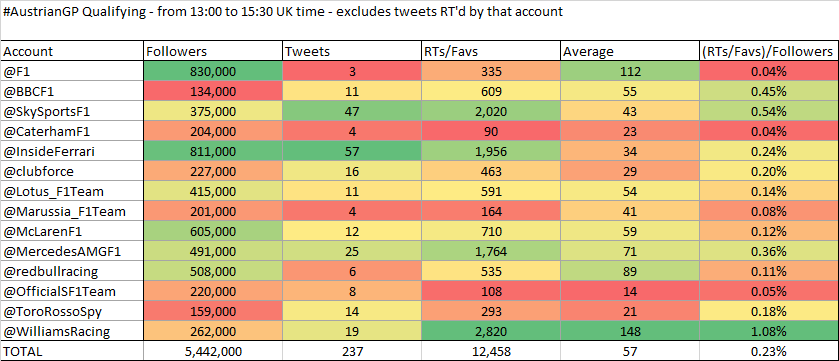
How Formula 1 interacted with Twitter during Qualifying for the 2014 Austrian Grand Prix.

For the purposes of this post, and as noted above, I have used the time period 13:00 to 15:30, so from the start of Qualifying to an hour and a half after the session. The image is fairly self explanatory, just two points to make: the average is the amount of retweets (RT) or favourites divided by the number of tweets made within that time period, whilst the latter column is the number of RT’s or favourites divided by the number of followers, as a percentage. Of course, people can RT and favourite accounts that they don’t follow, but there is no way to know exact numbers where that is concerned. It’s the first time I’ve tried to bundle a lot of statistics into one image, and no doubt there may be other ways to look at this, but thought it would be worth doing considering how social media where Formula 1 is concerned is a very popular subject at the moment! I’ve added some conditional formatting as well to give a clearer view of the situation.

Whilst Formula One Management’s (FOM) social media strategy has been under intense scrutiny as of late, their tweets can reach many people, however that requires them to actively tweet. An average of 112 accounts retweeted or shared their three tweets, the second highest of the list, and only behind @WilliamsRacing. Despite this, the percentage is the lowest of the 14 accounts listed, 335 interactions in total from nearly 1 million accounts is only 0.04% of their overall total. If @F1 chose to actively engage with their followers throughout an F1 session, then I would be painting a different picture. What is odd is that @F1TimingApp is clearly humanely ran. So why does one company operate two completely separate social media policies? They don’t need to accelerate @F1 fast, but why they are not interacting with their followers, I simply don’t know. What is there to lose?

Where there is a void from FOM, there isn’t from @BBCF1 and @SkySportsF1. The BBC story is interesting, as it started out as a BBC Radio 5 Live account before turning into a corporate BBC Sport account earlier this year. I’m personally not a fan of the style that the BBC F1 account uses now, but when you look at the numbers above, you cannot complain too much. I suspect the difference in the amount of tweets between them and Sky is because this weekend is a highlights weekend for them, so kept tweeting fairly low-key in comparison. On Sky’s side of things, I did in the past complain about their lack of interaction, however that has improved significantly since then, and the statistics show that their followers like what they are seeing – #AskCrofty is one particular feature after each Qualifying and Race session. I personally would like to see more of GP2 and GP3 on there, but from a F1 perspective, I think Sky have got it right. @SkyF1Insider on the other hand is a different kettle of fish for debate in another blog post…

Given that this is a look at Qualifying, unsurprisingly the tail-ender teams do not register significantly in this analysis, @Marussia_F1Team, @OfficialSF1Team and @CaterhamF1 the victims. Up front, all the credit goes to @InsideFerrari – 54 tweets during the two and a half hour time period! Okay, some of them are duplicates as there will be tweets in English and Italian, but it shows to me how they are desperately trying to push social media within Formula 1, more so than perhaps other teams. @RedBullRacing may have half a million followers, but with only six tweets during Qualifying today, its potential is not being maximised as much as it should be. Their sister team @ToroRossoSpy made more than double the amount of tweets as them despite having a much lower social media profile.

The @WilliamsRacing numbers really shows what happens when a team or driver claims victory, their pole position tweet as of writing has been retweeted over 1,000 times! Anyway, I thought this would be an interesting comparison to do. Okay, it is a very small sample of data, and only one session, but it is fascinating to see who is embracing social media and which parties need to improve – or in one case create – a social media strategy. All it requires is a few tweets to tap into the next generation of Formula 1 fans. They are ready and waiting. With over 830,000 followers for the official F1 account on Twitter, all the Commercial Rights Holder needs to do is reach them. And why wait?

Update on June 22nd at 17:50 – I’ve done a comparison between the statistics for Qualifying and the Race, which can be found here, and a race day chart including NBC Sports is here.

Stirring the pot

For reasons discussed elsewhere, the Monaco Grand Prix weekend was interesting, and provided us with some fascinating sound bites. The first is from after the race, as Lewis Hamilton was interviewed by Sky Sports F1’s Natalie Pinkham, who it has to be said did a fantastic job in both post-session interviews with him and Nico Rosberg over the weekend. This is how it went down:

NP: “[Montreal] is going to be a good opportunity for you guys, but what about mending bridges with your friend?”
LH: “We’re not friends. We’re colleagues and we’ll work to get the team as many points as we can.”

And this is how Pinkham’s interview with Rosberg went:

NP: “Do you consider yourself to still be friends with Lewis?”
NR: “We’re always friends, we’ve always been friends. Friends is a big word. What is friends? We have a good relationship.”

Both interviews were broadcast live, or as close to live as possible, on Sky Sports F1. I don’t think Pinkham in the Sky piece was phishing for that comment from Hamilton, instead in typical Hamilton style he perhaps said a little too much in front of the cameras. Similarly, on Saturday, Hamilton made a comment to BBC Radio 5 Live’s Jennie Gow, saying that he will “take a page out of Senna’s book” during the race, implying that he could deliberately crash into Rosberg. Nowadays, as soon as any quotes like that are broadcast live, it goes straight onto social media and whipped into a frenzy from UK journalists to German journalists to journalists over the pond. It is the nature of the beast. As thus, the quotes above, along with the initial Rosberg incident were being discussed, and are still be discussed, across social media outlets and internet forums.

Sky Sports F1, along with any other broadcasters immediately discussed the Rosberg incident as soon as it happened on Saturday, getting opinions from others. Every opinion supposedly meant something, although Sky made the frankly pathetic decision of getting Flavio Briatore’s opinion, who himself is a known cheat for Singapore 2008. Apart from that, I can’t say I necessarily blame them for dedicating the majority of their hour post-Qualifying show to the incident. If I was making the editorial decisions that day, I’d have probably made the same choice. The viewing figures show that the right choice was made.

I’ve demonstrated in the past how the amount of air-time Formula 1 gets in the United Kingdom has significantly increased in the past decade, a picture that no doubt repeats itself across Europe. Which means that instead of just getting isolated interviews, you perhaps now even get analysis of said interviews during the live shows, i.e. “what did driver X mean when he said that”, despite the fact that the viewer has just watched with their own eyes and can interpret it for themselves! Given that there have already been many comparisons between Rosberg and Hamilton/Prost and Senna, I thought it’d be interesting to jump back to the 1989 San Marino Grand Prix in an era where Formula 1 had limited television coverage. On that day, Ayrton Senna ignored a pre-race agreement that said that whoever led into turn one between himself and McLaren team-mate Alain Prost would stay there. I’ll quote from The Life of Senna by Tom Rubython:

Journalists and the team, unaware of the accord, were bemused. He told them an accord had been breached. The hacks had no idea what he was talking about. [..] Senna explained to journalists afterwards: “He got the jump early, then I got the slipstream immediately, and I was in the slipstream all the way until the first corner and I got much more speed than him. So that is the truth.”

You can probably imagine what social media would have been like after that particular event had it been around in 1989, and with the extensive coverage like we have today! Very quickly, the news would have got out. Coverage of the Grand Prix in the UK in 1989 would have been live on BBC Two during Grandstand as most races during that time period were. Because of that, there was not much pre-race and post-race analysis. In fact, coverage may well have disappeared straight after the podium, with a few interviews being clipped onto the end of the highlights show. Either way, I don’t think that there would have been much external scrutiny from fans regarding any quotes Prost and Senna made during the broadcast, instead it would probably be one or two lines from Murray Walker noting what had happened, with AUTOSPORT magazine doing an analysis piece the following Thursday.

In 1989, there would not have been instant reporting where viewers get to know everything on a minute-by-minute basis. In any season where team-mates are battling and level pegging, the media will always look to see if they can find a story, it is their job to do that. The Prost and Senna story started at Imola, as noted above. The pot I think is stirred more nowadays, however I don’t think it has any effect whatsoever other than to fill internet pages. This is coming from someone though who was not around in the 1980s and did not start watching Formula 1 until 1999. What I do know, with the help of a scrapbook from the loft, is that tabloid style reporting has always been around. The scrapbook in question features pages and pages of quotes from newspapers from the 1976 season featuring James Hunt. From the outside, things may appear different because of social media. Fans have more access to Formula 1 journalists than ever before, but inside the paddock, I imagine nothing is fundamentally different when doing business.

The way fans consume Formula 1 has changed considerably as there are many more mediums available in 2014 compared with 25 years earlier meaning that fans are connected better than ever before, which, in my opinion is largely a brilliant thing. You just need to learn which journalists are actually being journalists, and which ones are there, but serving no real purpose. Or, as a third argument, you could say that they’re all as bad as each other, an argument I don’t subscribe to, but an interesting point of view nevertheless.

The F1 App ramps up video content

Since launching a few weeks ago, the F1 App is already growing, and adding new content. For 2014, there are two versions of the app: a free (lite) version and a premium version for £7.49, the latter of which contains exclusive team radio, live timing amongst other things. The app also comes with BBC Radio 5 Live commentary for the entire race weekend. The app has been brought in house by Formula One Management (FOM) over the Winter break. Having been developed by Softpauer for 2013, this year, a company called ‘Formula One Digital Media Limited‘ (FODM), under the FOM umbrella has taken over the app.

So, what does this mean? To put it simply: FOM can do a lot more with the app, they have more control. And by creating a new company, it means that anything concerning the app can fall under this company. An aspect FOM also promoted was ‘video’, but they never specified what video. Why is this a point of interest? Because already one and a half race weekends into the year, FOM are already increasing what they are offering on the app. The first sign of video content popped up on the official Formula 1 website a few days prior to Australia, with an eleven minute insight into the regulation changes for 2014. That video is also notable for archive footage being featured, the first occurrence of that happening on the website. Video content continued into Australia: a pit lane insight with Gary Anderson, following him parting company with BBC and also an eight minute interview with Felipe Massa and his race engineer.

We’re not even half way through the Malaysian Grand Prix weekend and already there is more video content than Australia. There was a video with James Allen talking about the heat added, whilst a video was uploaded from Thursday with Caterham’s Alexander Rossi doing the track walk accompanied by Bob Constanduros, finishing off with Anderson interviewing a member of the Caterham team. At eleven minutes in length, the amount of detail it has to be said was more than your typical BBC or Sky feature which is normally snipped down to three or four minutes for TV, whereas an app doesn’t have any such restrictions. The best thing about the videos already mentioned is that FOM are utilising Anderson! If a technical row breaks out at all this year, you may find that the best analysis is not on BBC or Sky… but in fact on the official F1 App, which would be quite a turn around considering this is completely new territory for FOM.

The most interesting thing is that a round-up of practice two was uploaded, and not geo-blocked. I’m not sure whether that is surprising or not. At the end of the day though, it is FOM’s footage so they are free to do what they want with it. I don’t think the broadcasters will be too happy if FOM start throwing a lot of World Feed footage onto the app, however it is a very clever move by FOM where the app is concerned, start from the ground up, and then gradually add more videos each race weekend. Arguably this is better than doing everything all at once: see what the customer likes and work from that base point onwards and upwards. I don’t know whether this is the plan for the entire season, but it seems like smart marketing to me.

I’m going to be fascinated to see where we end up with the app come Abu Dhabi, whether they stick to a certain amount of videos per weekend, or whether it will be a constant work in progress. I’ve criticised FOM a lot for failing to see the digital age for what it really is. But this is a brilliant step in the right direction. Yes, social media, Twitter, Facebook needs to be worked on significantly (@F1 has only retweeted once, and it is clearly not fully human yet), as always though you need to start somewhere. And who knows, maybe live streaming via the official Formula 1 website and app could happen sooner than you might expect…

A look behind the scenes at FOTA: Part 2

Last week, I had the chance to talk to the former secretary general of the Formula One Teams’ Association (FOTA), Oliver Weingarten. In part one, Weingarten spoke about a series of subjects, including how he felt the FOTA fan forums went and whether Formula One Management (FOM) is behind the times where new technology is concerned.

In the second and final part, I quizzed Weingarten about the current state of Formula 1, and also about whether Formula 1 moving to pay television is really the right thing for the sport. Part 1 can be found here.

The F1 Broadcasting Blog: Formula 1 is all about politics. Do you think some teams wanted FOTA to fail without thinking about the greater good?

Oliver Weingarten: There were factions in the sport that wanted [us] to fail, and there were those who perceived it [FOTA] no longer had relevance. However the majority of teams were in favour of FOTA, and recognised the benefits of having an organisation which could conduct matters on their collective behalf, and also provide an infrastructure where they could coalesce as and when needed, and also have the ability to respond in a swift manner with a unified voice. The fact is that FOTA conducted matters also on behalf of teams that were not members of FOTA, such as testing agreements [with circuit owners], and negotiations with Pirelli, whilst most generally wanted to be involved in fan forums. Daniel Ricciardo of Toro Rosso [in 2013] was the star of the UK fans’ forum!

F1B: We’re seeing more often than not motor sport going down the pay TV route, of course the BBC and Sky deal from a few years ago and more recently, MotoGP to BT Sport. Whilst I know that you’re not part of the two wheeled paddock, do you think eventually we will see Formula 1 in the UK and the other territories go pay TV only? Do the teams feel that pay TV is the way forward in order for the sport to flourish? [note: I asked OW this question before it was announced that MotoGP was going to have a highlights show on ITV4]

OW: In my opinion, and those of the teams when I was at FOTA, the belief may not have matched the market reality. Free to air has its inherent benefits, in respect of generally obtaining more eyeballs and exposure for sponsors, but there has to be a recognition that the trend for sports rights over the years has seen a migration to pay TV. Public service broadcasters have seen severe budget controls imposed which has impacted on their ability in markets to obtain sports rights.

F1B: …even with the BBC budget cuts though, for example, that doesn’t mean we should completely forget the free to air viewer. I’d argue that a bit of both [free to air and pay TV] may be the best solution.

OW: A mix of free to air and pay TV can work well. In the UK, arguably more people watched the [2013] Malaysian Grand Prix via a mix of Sky Sports F1’s excellent live coverage and thereafter BBC highlights, as opposed to if it had just been on the BBC in the early hours of the morning. The competition amongst broadcasters has also improved the offering for consumers. Accordingly I believe sponsorship deals are not conducted anymore in F1 just on the basis of the amount of exposure on free to air. Sponsors are becoming a lot more sophisticated and understanding of the business model.

F1B: Lastly, do you have any regrets from the past few years, and what do you think Formula 1 has learnt about itself as a result of FOTA, if anything?

OW: My biggest regret is not achieving what I was hired to achieve, or at least provide assistance to achieve. The landscape changed dramatically within two months of my employment commencing. Teams had resigned, were arguing over cost control, the Geneva office was being closed down, and most significantly teams struck individual deals with the Commercial Rights Holder (CRH), meaning that the idea of collectively bargaining to achieve a better commercial position, was made redundant. The perception of FOTA became negative, and whilst there were a lot of positives, these were never championed loudly, and sometimes not even publicly. A lot of ideas I had from my previous role, were therefore never utilised. The teams recognise that whilst there is so much competitiveness and self-interest across the paddock, it makes it difficult for FOTA to operate on contentious issues, particularly when the structure of the CRH is as it currently is.

A look behind the scenes at FOTA: Part 1

One of the biggest Formula 1 stories to occur over the Winter break was the disbanding of the Formula One Teams’ Association (FOTA). The association aimed to “promote the development of Formula 1 and enhance its worldwide image and reputation” whilst also promoting a united front towards the FIA when debating future rules, sporting and technical regulations.

Sadly though, after nearly six years, self interest soon got in the way of the greater good, and on February 28th, FOTA announced its intention to officially disband. So what good, if anything, came out of FOTA? I caught up with Oliver Weingarten, who was the secretary general of the Formula One Teams’ Association, and is currently in the process of trying to dissolve FOTA. Weingarten previously worked for the Premier League, where he was General Counsel responsible for commercial and IP issues for 7 years. Over two parts, Weingarten talked to me about social media, the controversial double points plan and whether FOTA did really make any change for the better, amongst other subjects currently surrounding the world of Formula 1.

I began by asking Oliver about the FOTA fans’ forums and his opinion on how they went.

The F1 Broadcasting Blog: One of the success stories of FOTA were the fan forums that were held periodically. How easy were these to set up, and also did any broadcasters ever show an interest to televise these forums?

Oliver Weingarten: If I am honest, these were very stressful generally to organise. From finding a date that suited the teams, to ensuring there was the right mix of team personnel and ex-F1 personalities, to finding the correct venue, advertising and managing the registration process, seeking funding, and liaising with broadcasters, procuring branding for the forum, organising AV (audio/video) companies were all very time consuming.

F1B: Sounds like that you were very glad then when the day itself came around!

OW: To be fair, on the day, I was always concerned namely in respect of two issues. Will the teams turn up? How many fans will attend? I was always relieved when they concluded, and the feedback from teams and fans alike was generally very positive, which provided a genuine sense of satisfaction and achievement. My aim was to bring the fans closer to the sport, therefore [that was] the reason for introducing live streaming, and the Twitter interactivity, where on numerous occasions, we had #FOTAFORUM trending worldwide on Twitter, and fans watching on-demand after the Forum.

F1B: It’s funny you mention Twitter, because from an outsiders point of view, it feels like Formula 1 is behind the bend with new technology. The move to high definition was several years later than other sports including the Premier League, whilst Formula One Management (FOM) are still in 2014 running an automated Twitter feed. Do you think some within the paddock are ‘old school’ and don’t appreciate the value of social media?

OW: I can see why that might be the view, but [I] actually believe that F1 has tried to keep up and satisfy the broadcasters’ demands, and you only need to look at Sky’s output to see this. The second screen has become a phenomenon, and the use of virtual advertising is at the heart of technological developments to enhance revenue via tailored territorial advertising. I do not disagree that FOM should be more embracing towards social and digital media, and inevitably this will have to evolve, but concentration on the live output is the core principle that is enshrined, and anything else has to complement that and ensure the broadcasters and consumers receive the requisite offering.

F1B: Whilst on the subject of social media, I want to ask about double points. Over the past few months we have seen the backlash concerning double points, however it feels that fans view points are being ignored. If anything the loss of FOTA has meant that one of the last bridges between the paddock and fans has disappeared.

OW: During my tenure, when there were issues affecting all teams, we would generally try and discuss them in a cordial manner ahead of the respective meetings. Sometimes there was an agreed position, and often there was not. Unfortunately double points was presented by the Commercial Rights Holder (CRH) initially to the Strategy Group and thereafter to the World Motor Sport Council (WMSC). The reasoning was presented to the teams and they had their own reasoning for voting in favour. This was not an issue we discussed at FOTA level, given the status of FOTA at that point in time, when most discussions were focused on the requirement (or otherwise) to retain an association. Time will tell if the reasoning to introduce double points is strong enough to outweigh the fans’ voice, which as you point out, was a severe rebuke for the Teams. There was a plan for a series of fan “surveys” to be conducted globally online in 2014 under the auspices of FOTA, and this is certainly one issue which could have been addressed.

F1B: If we may just for a second go back to the new technologies point above, video sharing websites such as YouTube have been around for a decade. MotoGP has a YouTube channel, the IndyCar Series has a YouTube, yet Formula 1 doesn’t.

OW: Why don’t they have a YouTube channel? I know from my Premier League days that they wanted to prevent their content being uploaded and this was to protect the value of the broadcasters’ rights. There is an argument that there should be more tailored content available, whether that is on FOM’s website or YouTube. You have to also remember how the broadcasting deals are structured.

Interestingly, since I chatted with Weingarten, there have been a few interesting developments concerning FOM. The premium version of the official F1 Timing App includes exclusive team radio and English commentary. Furthermore ‘Formula One Digital Media Limited‘ was registered as a new company at Companies House on February 27th, whilst a video explaining the rule changes and giving a season preview was uploaded to the official Formula 1 website on March 10th, with archive footage included. Are FOM finally beginning to realise that the digital future is here, and now? I hope so.

In part two, myself and Weingarten continue chatting about Formula 1, as our focus switches towards the current television broadcasting model and whether FOTA was doomed to fail from the get go.