
Having looked at both the BBC and Sky Sports F1 teams along with their respective programming, part five of ‘The Verdict so far’ series brings us to the UK television ratings. Which is, quite simply, a measure of Formula 1’s popularity. Have Formula 1’s ratings dropped further since 2012, or have they rebounded? In this blog post, we shall find out the answer.
Before I start though, again it is worth reiterating figures I use. All of the figures in the blog are programme averages, unless stated otherwise. This is because these are the figures most readily available, and I do not have industry access to the viewing figures. Therefore, I am relying purely on the figures I already have and those that are reported in the public domain. I also have the Formula 1 viewing figures going back to the early 1990’s, those can be sourced from Broadcast magazine. All figures in this particular piece are official consolidated ratings from BARB, which include recordings within seven days.
For those of you that haven’t followed my ratings, we have seen since 2000 three ‘phases’. Phase 1, from 2000 to 2006 saw ratings drop from 4 million viewers to under 3 million viewers thanks to the lack of British interest and Michael Schumacher’s dominance. With Lewis Hamilton and Jenson Button on the horizon, and Formula 1 returning to BBC, meant that phase 2 from 2007 to 2011 saw ratings rise, from just over 3 million viewers to 4.6 million viewers. Phase 3 is simply 2012. Ratings dropped half a million between 2011 and 2012. Whilst the change of broadcasting rights was definitely one reason, as I outlined in my 2012 piece at the end of last year, the ‘Summer of sport’ in this country was another factor which has to be accounted for.
Official ratings from BARB show that, as it stands, 2012 was a blip. So far, Formula 1 is rating in between 2010 and 2011’s mid-season average and is back to the viewing figure levels pre-2012. As always, the figures comprise of:
– Sky live and BBC highlights
– Sky live, BBC live and BBC re-run (Asian based races)
– Sky and BBC live (non-Asian based races)
However, it is not all rosy. Further analysis shows that, versus the same races last season, BBC’s Formula 1 ratings have increased 21 percent, whilst Sky Sports F1’s ratings have dropped 9 percent.
– BBC F1 (3.18 million vs 3.83 million)
– Sky Sports F1 (699,000 vs 638,000)
The Sky drop is further reflected in their channel reach, which has dropped half a million during live race weeks this year:
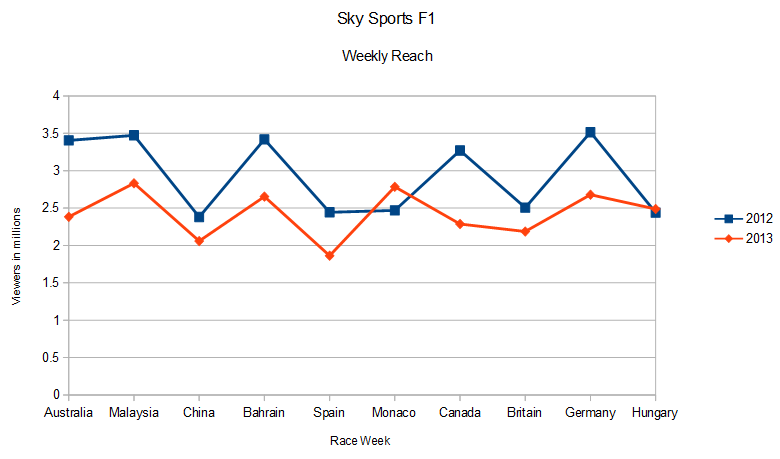
As the graph shows, only two races for them this season have increased in terms of reach, Monaco, one of their exclusive races, and Hungary due to no Olympics clash. Regarding programme averages for them, only Britain, Monaco and Hungary have increased. Unfortunately, it is difficult to find many positives for Sky as the picture is mainly decreases. Overall, the 2013 season is currently averaging 4.47 million viewers, or 4.70 million viewers when taking into account Sky’s long programming length.
– 2009 – 4.38 million
– 2010 – 4.41 million
– 2011 – 4.62 million
– 2012 – 3.89 million / 4.10 million
– 2013 – 4.47 million / 4.70 million
Typically, viewing figures drop in the second half of the season due to the run of Asian based races, whilst Belgian and Italy tend to be low too. Nevertheless, the headline figures are very, very positive. If you were to look at the first ten races of previous seasons, then you get:
Averages (Aus, Mal, Chn, Bah, Spa, Mon, Can, GB, Ger, Hun)
– 2009 – 4.30 million
– 2010 – 4.63 million
– 2011 – 4.86 million
– 2012 – 3.82 million / 4.06 million
– 2013 – 4.47 million / 4.70 million
Which places 2013 between 2010 and 2011 as I noted earlier. I expect 2013 to drop like 2010 and 2011 did, to end up with a season average of around 4.20 million / 4.50 million. The only reason 2009 increased towards the end of the year was because of Jenson Button, whilst the first half of 2012 was hurt by other sporting events as I’ve said multiple times. However, if Lewis Hamilton does put up a title fight, the figures of the season so far could be maintained.
Now, some people will rightfully say “yeah, but Germany was inflated by Wimbledon, so in reality 2013 is not up versus 2012”. Removing Germany takes the average down to 4.30 million / 4.53 million viewers. So at this stage it makes some difference, but come the end of the season, it will mean an increase of about 0.1 million to the total average, which is not a significant amount in the grand scheme of things.
If we are to compare further back, using data from 2000 onwards for Australia, Spain, Monaco, Britain and Hungary, we see the following:
Averages for the above five races
– 2000 – 4.29 million
– 2001 – 3.83 million
– 2002 – 3.49 million
– 2003 – 3.37 million
– 2004 – 2.99 million
– 2005 – 3.09 million
– 2006 – 2.58 million
– 2007 – 3.52 million
– 2008 – 4.12 million
– 2009 – 4.31 million
– 2010 – 4.54 million
– 2011 – 4.74 million
– 2012 – 3.79 million / 3.98 million
– 2013 – 3.95 million / 4.16 million
Interestingly, while that does show an increase, the increase is not as severe as the main headline figure. I think, in every season, some Formula 1 ratings have good luck and bad luck attached to them, and at the end of the year, it balances it all out. By the above measure, ratings are up versus 2012, but not as much as I said above.
A similar method would be to look at the first ten races only of the season:
Averages for the first ten races
– 2006 – 2.85 million
– 2007 – 3.66 million
– 2008 – 3.74 million
– 2009 – 4.36 million
– 2010 – 4.45 million
– 2011 – 4.66 million
– 2012 – 3.88 million / 4.12 million
– 2013 – 4.47 million / 4.70 million
At this point, no matter how many averages you take, the overriding point is that viewing figures are up versus last year. Are they near to 2011? It appears so, but the full picture will emerge as the season progresses, and more importantly if a title fight emerges. I’m pleased to see ratings increase, it is never a good sight to see ratings drop, so I’m happy to see a turn in the right direction. What is interesting is that all of the increase is due to the BBC. The move to sacrifice screening Monaco live has paid off dividends, it meant that they could pick Canada as a live race and being in primetime meant higher viewing figures for the latter.
Another brilliant move of their behalf was choosing Germany as a highlights race. It meant a combined average of 6 million viewers, which is unheard of for Formula 1 today. It is with BBC where the viewers lie, and clearly there is a section of the audience who have decided not to view Sky live this season and instead settle with the highlights. Cost? Who knows. I suspect it is one of the reasons. If everyone with the HD Pack and no Sports Pack has a nasty surprise in the off-season, then Sky’s figures could drop further. Unfortunately that is what the viewing figures show. I may be called “anti-Sky” for saying that about Sky’s figures, but the figures do not lie.
Although there is still half of the season ahead, and viewing figures could drop substantially, I think the recovery proves that the Olympics was a major factor in Formula 1’s ratings dropping. I’ve said it before and I’ll say it again – even if every Formula 1 race last year was live on BBC I think ratings would have dropped. Without stating the obvious, 2012 was a big, big year for the UK and Formula 1 just was not a part of that, nothing was going to change that fact. The only surprise for me was the severity of the drop. But, it is good to see ratings back up. How much are they up, we will know the answer at the end of the season.
Qualifying also recovered from 2012, and surprisingly an average of 2.88 million so far means that it is the most watched Qualifying ‘season’ so far since records began. That surprises me a lot. Aside from Britain, which averaged 2.36 million viewers on BBC and Sky, every Qualifying programme has recorded an average above 2.6 million viewers, which is a fantastic achievement when you consider only five years ago the average was less than 2 million. Of course, it goes without saying that some race weekends had Qualifying on the fringes of primetime, but that should not take away from the above.
Outside of the main sessions, practice remained level with last year, whilst The F1 Show increased slightly, but the averages remain below 100,000 viewers. GP2 has increased from 34,000 to 38,000 for its feature and sprint races, GP3 has remained at 21,000 viewers for its average. Unfortunately, the signs of life that the support races have shown are few and far in between. That is it for the mid-Summer verdict on the blog. I hope you’ve enjoyed reading the pieces, and as always comments are welcome.
Note: All the figures quoted here are the averages for the whole race programme, not the race average as these figures are unavailable. Figures are official figures from BARB and Broadcast magazine. While I have made comparisons and analysis of figures, I should note that I do not have every single ratings figure. The figures for that races that I am missing are:
1992 – Australia, San Marino, France, Portugal, Japan (live and both for AUS, JPN)
1993 – France (live), Japan (highlights)
1994 – Pacific (highlights), San Marino, France, Hungary, Japan (live)
1995 – Australia, Argentina, San Marino, Spain, Japan (all live)
1996 – Canada, Japan (all live)
1997 – Japan (live)
1998 – Australia,France, Japan (all live)
2000 – Malaysia (live and re-run), Japan (live)
2001 – Japan (live)
2003 – Malaysia; Japan (both live)
2004 – China (live)
If anyone is reading and has any of them ratings, leave a comment.
 Motorsport Broadcasting