Vettel’s victory peaks with highest Bahrain number since 2015

Sebastian Vettel’s victory in the Bahrain Grand Prix peaked with nearly 4.5 million viewers, the highest peak figure for the Bahrain round of the championship in three years, overnight viewing figures show.

Race
Live coverage the weekend’s action aired across Channel 4 and Sky Sports. Channel 4’s broadcast, encompassing the build-up and the race itself from 15:00 to 18:10, averaged 2.37m (18.9%), a slight increase on last year’s figure of 2.23m (15.2%). For the purposes of the combined average below, the Channel 4 figure used will be the figure above, the same methodology as last year.

Channel 4’s average audience has changed very little over the past three years for Bahrain. Using the 15:00 to 18:30 time slot as the metric, we can see that the 210-minute slot averaged 2.30m (16.2%) in 2016, compared with 2.21m (15.0%) in 2017, and now 2.25m (16.0%) in 2018, a remarkably stable trajectory with very little to separate the three years.

Meanwhile, Sky Sports F1’s coverage from 15:00 to 18:30 averaged 524k (3.7%), a decrease on last year’s audience figure of 597k (4.1%). The average audience is Sky’s lowest for Bahrain since they started covering the sport in 2012.

The combined average audience of 2.89 million viewers is marginally up on both 2016 and 2017, by 50,000 viewers and 70,000 viewers respectively. The margins here are incredibly tight, although the gap may widen once you consider other methods of viewing, such as All 4, Sky Go and Now TV.

It is important to note that the Premier League opposition for the F1 was tougher last year (Chelsea versus Manchester United) compared with this year (Chelsea versus West Ham United), which will have affected audience figures.

An audience of 3.79m (28.2%) watched lights out at 16:15, slightly lower than 2016 and 2017, settling around the 3.9 million mark, once the Premier League game started from 16:30 onwards. As Chelsea gained the lead in the football, viewing figures jumped for the Grand Prix on both channels to a combined figure of 4.23m (28.4%) at 17:10.

The audience jump coincided with the pit lane incident involving Ferrari’s Kimi Raikkonen, which, combined with the on-track battle between Vettel and Mercedes’ Valtteri Bottas, helped figures remain above four million until the chequered flag.

A peak audience of 4.45m (27.2%) watched Sebastian Vettel win the Grand Prix at 17:40. At the time of the peak, 3.62m (22.1%) were watching Channel 4’s output, with a further 830k (5.1%) watching Sky’s coverage, a split of 81:19 in Channel 4’s favour.

Sky’s programme peaked earlier in the race at 16:25 with 884k (6.4%), this being the last five-minute segment before the second Premier League game of the day began on Sky Sports Main Event and their dedicated Premier League channel. Compared with 2017, Channel 4’s peak audience increased by 6.1 percent, whilst Sky’s peak dropped by 8.0 percent.

The combined peak audience of 4.45 million viewers is an increase of 111,000 viewers on last year’s peak figure of 4.34m (25.9%), and an increase of nearly half a million viewers on the 2016 peak of 4.01m (30.2%). However, audience figures remain a far cry from 2015 and before when F1 aired in some form on the BBC: 2015’s race peaked with 6.26m (36.3%).

Qualifying and Analysis
Live coverage of qualifying did not fare as well as the race, with viewing figures decreasing compared with 2016 and 2017. Live coverage of qualifying on Channel 4 from 15:00 to 17:45 averaged 1.08m (9.8%), down on last year’s average of 1.23m (12.7%).

Unusually, Channel 4 was third in its slot during qualifying, behind both BBC and ITV. At the same time, BBC were screening highlights of the Commonwealth Games along with Final Score, whilst ITV aired repeats of Tipping Point and The Chase.

Sky’s programming, simulcast across F1 and Mix, suffered the same fate as Channel 4, with an average of 273k (2.5%) comparing unfavourably with last year’s number of 349k (3.5%). Across the two channels, 246k (2.2%) watched via the F1 channel, and a further 27k (0.2%) watched via Mix.

The combined average of 1.36 million viewers is down 14 percent on last year’s average audience of 1.58 million viewers, the lowest average for Bahrain since 2007. The peak audience of 2.30m (18.5%) came at 17:05, a decrease of 9 percent compared with last year’s peak of 2.54m (22.6%)

Two races into the 2018 season, and overall, minus a few dips for qualifying, it is fair to say that Formula 1’s viewing figures year-on-year so far, are steady. It may be too early to state this as fact, but certainly the indications are that the Halo cockpit protection system has not had any significant bearing on the UK audience figures.

I am happy to hold my hands up and say ‘I was wrong’ where this was concerned given some of the predictions I made at the back-end of last year. Whilst the Halo is not the prettiest thing ever, I have become used to it quicker than I imagined, and it appears I am not alone in that regard.

The 2017 Bahrain Grand Prix ratings report can be found here.

overnights.tv-bannersF1

F1 2018 season opener starts on same footing as 2017

The 2018 Australian Grand Prix, which featured the same one-two finish as the year before, also remarkably had near identical audience figures in the United Kingdom across the weekend, overnight viewing figures show.

Race
As noted prior to the start of this season, this site will continue to use the three-and-a-half-hour time slot, or equivalent, for Sky’s race day broadcasts. For 2018, this encompasses the final half of Pit Lane Live, On the Grid and the race show itself. All audience figures are Live + VOSDAL (Video on Same Day as Live), they include simulcast (+1) channels as well as commercial breaks.

Live coverage of the race, which aired on both Sky’s Formula 1 channel and their Main Event channel, averaged 344k (18.4%) from 05:00 to 08:30. During this period, an audience of 256k (13.8%) watched via the dedicated F1 channel, with 88k (4.6%) watching via Main Event.

Sky’s race coverage across both channels peaked with 562k (20.4%) at 07:30 as Sebastian Vettel won the Grand Prix. This figure includes viewers who recorded the live airing to watch later in the day. At the time of the peak, 418k (15.2%) were watching Sky Sports F1, and a further 144k (5.2%) via Main Event.

Compared with 2017, Sky’s average audience is down by 12.9 percent, and their peak audience down by 11.6 percent. Last year’s programme averaged 395k (22.2%), peaking with 636k (38.7%). The figures are more favourable with 2016, only a slight dip in average (344k versus 360k), but an increase in the peak audience (562k versus 559k).

Seven hours after the race finished, Channel 4’s highlights broadcast averaged 1.71m (16.8%) from 14:30 to 17:15, an increase of 3.7 percent on last year’s figure of 1.65m (20.6%). Whilst an audience increase is always nice, the total television audience year-on-year was up by 2.2 million viewers in the slot, yet Channel 4’s F1 coverage only gained by 61,000 viewers, hence why the percentage share has dropped drastically.

Similarly, Channel 4’s show peaked with 2.15m (18.2%) at 16:40, compared with a peak of 2.07m (26.0%) twelve months ago. Both the average and peak metrics for 2018 are down by around 19 percent on Channel 4’s 2016 Australia audience figures.

The combined average audience of 2.05 million viewers is a very marginal increase on last year’s average of 2.04 million viewers, or to be exact an increase of 10,000 viewers, which is within the margin of error. The same applies for the combined peak audience of 2.71 million, which itself was up 13,000 viewers on last year’s figure of 2.70 million viewers.

Considering the relative heat wave the UK experienced this time last year, to start off on the same level as that is not a great way to start the season. The low audience shares are cause for concern, as the viewers were around on Sunday, they just chose to watch something other than the F1. Australia’s numbers only serve to continue the general downward trajectory for Formula 1 – on linear television at least.

Qualifying
Sky’s qualifying coverage aired from 05:00 to 07:45 across Sky Sports F1 and Main Event to an audience of 252k (13.2%). 181k (9.4%) watched via Sky’s F1 channel, with 71k (3.8%) choosing to watch via Main Event.

Coverage of qualifying peaked with 477k (14.6%) at 07:05 as Lewis Hamilton partied to pole position, in-line with last year’s peak figure of 481k (14.6%). Again, the average for 2018 of 252k was in-line with last year’s average of 254k (12.6%). Both metrics were up around 10 percent on 2016.

Later in the day, a further 1.18m (15.1%) watched Channel 4’s highlights show from 13:00 to 14:50, down 45,000 viewers on last year’s number of 1.22m (18.2%). The broadcast peaked with 1.62m (20.2%), marginally down year-on-year.

The combined average audience of 1.42 million viewers is slightly down on last year’s audience figure of 1.48 million viewers.

The 2017 Australian Grand Prix ratings report can be found here.
overnights.tv-bannersF1

Formula E highlights on BBC’s platforms “a one-off” – for now

Eagle eyed readers and followers of this site will have spotted that highlights from the Mexico City E-Prix appeared across the BBC’s platforms after the Formula E race last weekend.

The short-form content appeared on the BBC Sport website, as well as their social media channels, prompting speculation that the two sides had agreed some sort of deal. However, this site can confirm that there is no formal agreement yet between the BBC and Formula E, yet.

Speaking to this site, a BBC spokesperson said “The video was used as a one-off, rather than as part of a longer-term rights deal.”

The one-off video appearance was likely brokered by marketing firm CSM, whose partnership with Formula E has resulted in Formula E content appearing on a variety of UK-based news websites, including The Independent, The Daily Telegraph and the Daily Mirror.

On the television front, Channel 5’s free-to-air contract with Formula E expires at the end of the current season in July, with no word yet on the series’ destination from season five.

Mexico City E-Prix shows why Formula E needs free-to-air
The E-Prix itself, won by Daniel Abt, peaked with just under 150,000 viewers on Saturday evening according to overnight viewing figures.

Live coverage of the race aired on 5Spike from 21:30 to 23:20, averaging 63k (0.4%). Eurosport 2’s coverage added a further 26k (0.16%), bringing the combined audience for the live race showing to 89,000 viewers.

At its peak, 103k (0.7%) watched the race on 5Spike, with 45k (0.3%) on Eurosport 2. Both 5Spike and Eurosport 2’s viewing shares were in the same ballpark to 1.d.p. between Santiago and Mexico City, even though the latter E-Prix was aired in highlights form on Channel 5 the following morning.

For Santiago, Channel 5 did not air a highlights show on its main channel, whereas for Mexico they opted to do so. Channel 5’s Mexico City E-Prix highlights programme averaged 202k (2.6%) on Sunday morning from 10:45 to 11:50, peaking with 254k (3.2%), marginally above the slot average.

The numbers suggest that the highlights programme attracted ‘new’ viewers, who were unaware that the race aired live on 5Spike the previous evening, showing why Formula E needs prominence on free-to-air television, otherwise races fly under the radar. Three races have aired on 5Spike, and all have peaked with fewer than 200,000 viewers.

If Formula E wants to become mainstream in the UK, it needs to look closely at turning deals with the likes of the BBC permanent, even if it is not necessarily a television deal with the broadcaster. By giving Formula E a ‘shop window’, the exposure of the series increases, hopefully boosting television viewing figures in the medium to long term.

overnights.tv-bannersF1

Kay stands out as North One takes Channel 5’s Formula E coverage trackside

After an underwhelming first season covering the sport, Channel 5’s Formula E coverage has started its second year off on a fine note, with a little help from the electric series’ new production partners.

For the first four seasons, Aurora Media Worldwide produced Formula E’s World Feed, with UK broadcasters ITV and Channel 5 left to their own devices. As regular readers are aware, both broadcasters opted for studio-based coverage, although Formula E filmed features on-site on their behalf. All of that changed for this season.

Strong UK production…
Whilst Aurora remain involved, the addition of North One Television has bolstered Formula E’s UK presentation. Alongside their World Feed responsibilities, North One are also producing Channel 5’s programming, meaning that for the first time ever UK viewers get tailored, on-site coverage at every round.

North One have experience in this field: historically they produced ITV’s Formula 1 coverage until 2008, and have produced BT Sport’s MotoGP coverage since 2013. The production company relied on their two-wheeled personnel, led by British Superbikes director Richard Coventry, to produce Channel 5’s Formula E output.

In front of the camera, Vernon Kay replaced Andy Jaye as lead presenter. Kay’s appointment generated unnecessary criticism across social media, even though he has presented sporting events before on Channel 4. As I remarked at the time of his appointment, Kay is “enough of a veteran for me to feel that he will be just fine in the role.” Four races in, and I stand by this viewpoint.

Kay has interviewed drivers and team personnel, alongside his own miniature grid walk, something he looks like he has been doing for years. It helps that the Formula E grid is sparser than Formula 1, nevertheless you cannot help but be impressed by his work so far. Importantly, Kay has done his research, and is clearly passionate for Formula E on-screen, and has done his research, a vital asset for a series in its infancy.

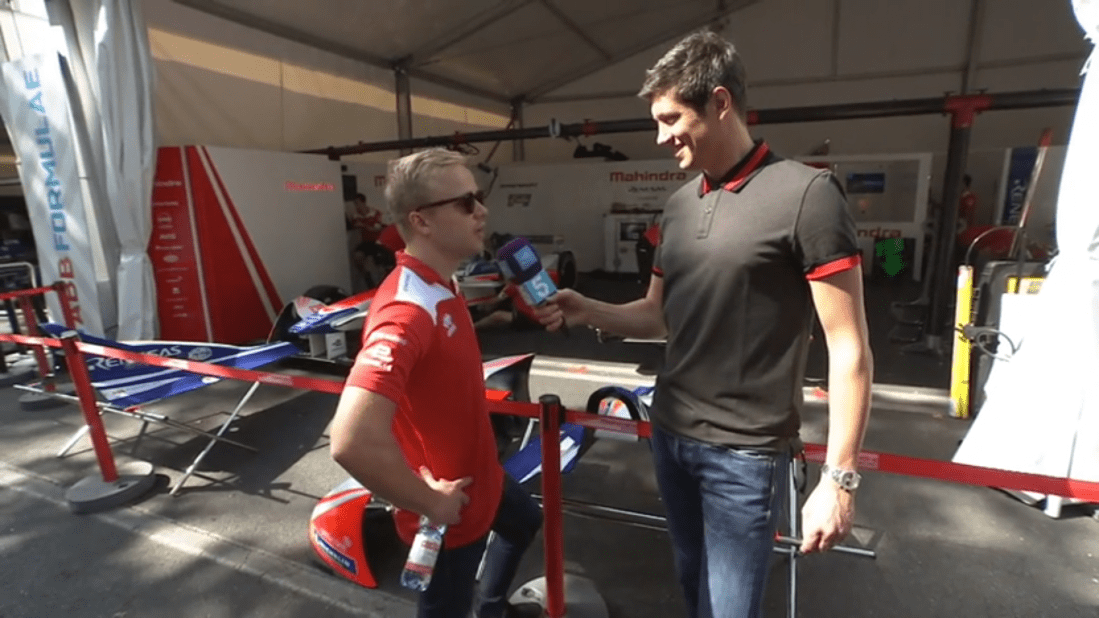
2018 Santiago EPrix - Vernon Kay and Felix Rosenqvist
Presenter Vernon Kay interviews Mahindra driver Felix Rosenqvist.

Because of the changes behind the scenes, Channel 5’s programming has felt significantly more polished than last season’s output. The build-up has contained a mixture of pre-recorded segments, such as the track guide, and a grid walk. The pre-recorded segments add to the programme, with Kay interviewing drivers prior to qualifying.

There is a tendency to focus on the British contingent of racers, but considering the stage Formula E is at within its life cycle, this is an understandable directive. The commentary team, consisting of Jack Nicholls, Dario Franchitti and Bob Varsha also have their own segment with Kay, helping viewers put a face to the voices.

Commercials have generally been well-timed, a vast improvement on the early offerings in their first season. Impressively, despite airing the race on a tape-delay, Channel 5 covered the whole of the red-flag period during the Hong Kong E-Prix broadcast.

…but poor scheduling lets down Channel 5’s coverage
If I gave the production standards a first-class rating, then the scheduling fits into the lower second-class category. Short-term pain, long-term gain should be Channel 5’s motto here, but I worry if Channel 5 are in this for the long-term.

On-site coverage is fantastic for Formula E. But, was that a decision by Formula E, or did Channel 5 influence the decision? Who is paying for the extra expenses in producing on-site coverage? If the answer to that question is Channel 5, then surely that would have served as an incentive to broadcast races live on their main channel…

And there is the crux of the problem. Both Hong Kong races aired on tape-delay, so whilst the production was excellent (by Formula E’s UK TV standards to-date), the races were not live. Arguably, it did not matter as much in Hong Kong, a tape-delay meant that the races aired at a more sociable hour.

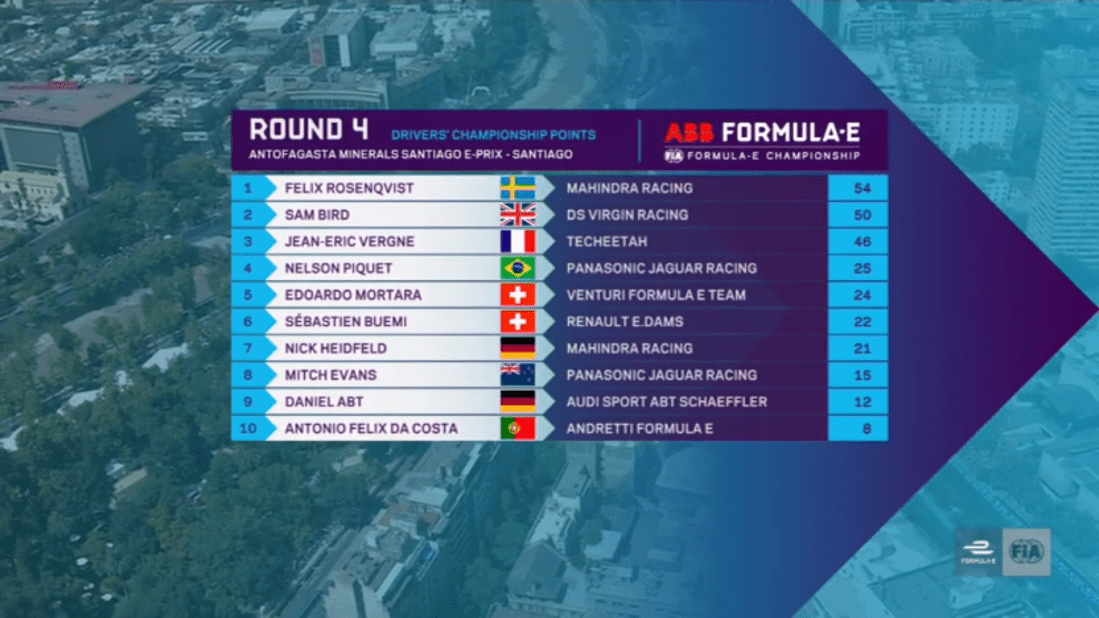
2018 Santiago EPrix - pre-race standings.png
A new-look broadcast package for Formula E’s fourth season. Here, the Drivers’ Championship standings is displayed prior to the race.

Marrakesh was live on Channel 5, but Santiago less than a month later aired on sister channel 5Spike, as the time difference meant that the race flowed into prime time. According to overnight viewing figures supplied by Overnights.tv, Channel 5 averaged 604k (3.1%) from 18:30 to 20:30 on Saturday 3rd February, not a great number considering a quarter of that covers the relaunched Blind Date.

The Buenos Aires E-Prix from February 2017 averaged 426k (2.2%) on Channel 5 in a similar time slot. Last weekend, the Santiago E-Prix struggled on 5Spike (even compared to 5Spike’s own numbers), averaging just 86k (0.4%), with Eurosport 2 adding a further 32k (0.17%), down on the combined Marrakesh number of 245,000 viewers.

In other words, viewing figures dropped by half the moment Formula E lost any sort of coverage on Channel 5’s main channel. Furthermore, Channel 5 failed to air a repeat of the Santiago round on their main channel, a strange decision. Mexico City is also airing on 5Spike, and Punta del Este is likely to follow suit.

How can Formula E gain momentum with inconsistent scheduling? If you are going to produce coverage on site, at least give the series a chance and air Santiago on the main channel. Airing the European phase of the season on Channel 5 is not enough, by that point the attention of the motor racing world is on the traditional season.

New broadcast package for season four
A new season, a new graphics suite. In their fourth season, Formula E are already on their third graphics set, a ‘throwing the kitchen sink at the wall and seeing what sticks’ approach.

The first set lasted for two seasons, however the broadcast package introduced at the start of season three only lasted for one season, despite being a vast improvement on their opening effort. I can forgive this change with North One coming on-board, but Formula E needs to build an on-screen identity, and you cannot do that by constantly changing the graphics.

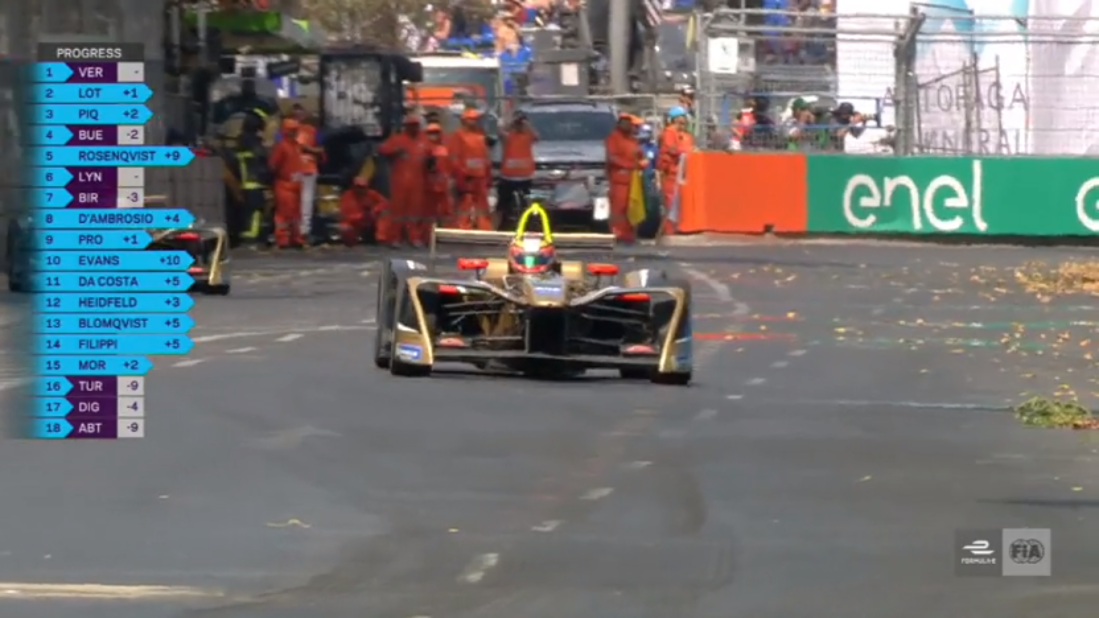
2018 Santiago EPrix - progression.png
Jean-Eric Vergne leads in his Techeetah, whilst the timing wall graphic on the left shows the number of positions a driver has gained or lost.

The third graphics set is an evolution of the second set, moving away from a sky-blue suite and more towards a blue and purple style (claret and blue might be the right phrase here). The major change for fans is that the timing tower now updates frequently at every sector, as opposed to once a lap.

Formula E has taken inspiration from MotoGP with their timing tower. MotoGP ‘groups’ the riders together based on who they’re battling with, however Formula E has gone a step further, grouping drivers but spreading them down the tower based on the size of the gap, a nice innovation. The tower also displays when a competitor has jumped ahead of their rival by switching colour, and shows progression (or lack of) for a driver.

For the opening races, an “activate start” VT sequence aired immediately prior to the start of the race, however did not appear in the Santiago show. Frustratingly, the World Feed direction remains troublesome. With Formula E in its infancy, it needs to knuckle down to hook new viewers.

Switching between battles constantly, yet failing to capture this information on-screen only serves to confuse the audience. On a new street circuit with no history, the viewer is unfamiliar with the layout so will be unaware if the director has jumped ahead or behind on the circuit. A simple caption ‘Battle for 8th’ for example, listing the drivers involved would solve the problem.

A second problem with the direction is the length it takes to react to incidents. In Santiago, the graphics indicated that reigning champion Lucas di Grassi was dropping out of contention, but the production team was far too slow to pick this up. You get the impression that no one in gallery is monitoring the timing graphics, otherwise the director would be faster in reacting to such developments. As social media demonstrated days later, further on-track incidents were unnoticed by gallery.

There are other smaller problems on the production side: too many reaction shots, arguably worse than F1 in this respect (use picture-in-picture where possible); and the pit lane car swap still disturbs the flow (but is no longer a problem from season five onwards).

Overall, Formula E’s coverage of season four in the UK has started promisingly with major strides compared to previous seasons. Elsewhere, the World Feed is not terrible by any stretch, but I feel tweaks are necessary moving forward.

overnights.tv-bannersF1

MotoGP’s UK audience rises thanks to Channel 5 switch

MotoGP’s viewing figures in the UK rose during 2017, because of the move of its highlights programming to Channel 5, overnight numbers show.

Background
As regular readers will know, MotoGP aired on the BBC until the end of 2013, regularly averaging around one million viewers. With pay-TV money arguably more important to MotoGP than it is to other forms of motor sport, Dorna left the BBC at the end of 2013, instead choosing BT Sport as their new home, the rights fee rising considerably as a result.

BT Sport has been the sole live broadcaster of MotoGP since 2014, with free-to-air highlights airing on ITV4 from 2014 until 2016. This season, Channel 5 took over the baton on that front, exposing MotoGP to a larger audience in the same Monday evening time slot. The one down side is that Channel 5 also have the rights to some England cricket highlights, which caused MotoGP to air in a midnight time slot for the British round in August, a less than ideal situation.

In 2017, the MotoGP championship battle between Marc Marquez and Andrea Dovizioso went down to the wire in Valencia, with Marquez coming out on top. This was the second season finale championship decider that BT have aired live, the first being the controversial tussle between Valentino Rossi and Jorge Lorenzo in 2015.

The BT Sport picture
Throughout 2017, BT Sport’s live coverage of race day, around five hours of coverage in total, has averaged 100k (1.7%), a decrease of around 12 percent on last year’s audience average of 114k (1.9%). BT’s average audience is their lowest since their opening year in 2014, which averaged 90k (1.4%).

All figures in this article are overnight audience figures (live, plus VOSDAL supplied by Overnights.tv, and exclude viewers who watched via BT Sport’s online platform, nor does it include fanatics who may have ventured towards the official MotoGP app to consume their coverage.

The patterns presented above repeated themselves for the other two key metrics: the MotoGP segment and the peak audience. The 18 races, using the 90-minute slot covering 30 minutes of build-up and a small wrap-up at the end, averaged 165k (2.6%), a slightly smaller drop of 9 percent compared with 2016’s equivalent audience of 181k (3.1%). In 2015, BT Sport’s coverage of each MotoGP race averaged 212k (3.6%), meaning that 2017’s numbers represent a 22 percent drop.

BT Sport’s coverage throughout 2017 peaked with 223,000 viewers for each race, a drop on last year’s peak audience of 245,000 viewers. The picture is the same throughout the trends, with BT Sport’s coverage of 2017 slotting in below 2015 and 2016, but ahead of 2014, despite this year’s action going down to the wire. In comparison, live coverage of British Superbikes peaks with around 130,000 viewers on Eurosport, inflated to 190,000 viewers if you include viewers watching on Quest. Contrary to popular belief, British Superbikes does not bring in higher audiences than MotoGP.

Marquez versus Dovizioso not a draw for UK audiences
In 2015, the season finale in Valencia recorded BT Sport’s highest ever audience for a MotoGP race, peaking with 433k (3.9%), a figure that has yet to be beaten. Whilst low compared with the BBC days, the figure showed that there was clearly a portion of the audience who do not normally tune into MotoGP, yet chose to watch the race on that day.

Fast-forward two years, and the 2017 season finale in Valencia peaked with 254k, not far above the season average, and not the highest peak audience of the season either. Live coverage of the season finale across the five hours of coverage from 09:30 to 14:15 averaged 125k (1.5%), with the MotoGP segment averaging 173k (1.9%). The programme average was 25 percent above the season average (and their highest programme average since Austin in April), but the MotoGP element was lower than the likes of Austria and San Marino just a few months earlier.

You normally expect a noticeable boost for any championship decider, yet such a boost did not materialise this year, suggesting that the battle between Marquez and Dovizioso did not appeal to BT’s audience. To put it another way, you may argue that BT not market the battle very well to their audience in other popular junctions (such as football). In 2016, Cal Crutchlow’s two victories helped BT Sport, Britain’s first premier class wins in over 30 years.

Channel 5’s highlights boosted compared to ITV4’s numbers
Highlights of MotoGP averaged 406k (2.4%) on Channel 5 this season, an increase of 42 percent on ITV4’s average audience from 2016 of 285k (1.4%), a pleasing rise. ITV4’s audience dropped across their three years, meaning that compared with 2014’s ITV4 number, Channel 5’s average audience is up 18 percent.

Channel 5’s highest audience in 2017 came with the Australian round of the season in October. The thrilling race, which arguably was the one which helped decide the destination of the championship, with Marquez winning and Dovizioso down in 13th, averaged 487k (2.6%) for the free-to-air broadcaster, peaking with 636,000 viewers. Audience figures like that show why MotoGP needs a free-to-air presence of some form after 2018.

Despite the promising numbers in some areas, Channel 5’s broadcasts lost steam after the Summer break, averaging 365k (2.3%) for the second half of the year, compared with 446k (2.5%) for the opening phase of the season. This impacted on the overall combined figures for the season…

Final thoughts and combined audiences
The switch to Channel 5 helped MotoGP bring in its highest combined audience since leaving the BBC, with an audience of 571,000 viewers watching. As noted above, the second half of the season struggled, with the phase from Austria through to San Marino struggling on Channel 5. An average of 632,000 viewers watched during the first half of the year, dropping to 509,000 viewers for the second half.

The Grand Prix of the Americas from Austin in April brought in a combined average audience of 701,000 viewers (split 475,000 to 226,000), peaking with 951,000 viewers (split 668,000 to 282,000). Including the BT Sport and MotoGP app, it is highly likely the peak audience will have exceeded one million viewers, a major achievement.

Aside from Britain, the Austrian Grand Prix was the low-light, averaging 456,000 viewers, whereas every other race before it had averaged 544,000 viewers or higher.

If the ITV4 trajectory is to go by from 2014 to 2016, then Channel 5’s audience figures might see a second-year dip in 2018. Next year will be fascinating on the MotoGP broadcasting front, as the destination of the series for 2019 onwards should be known, with BT Sport’s contract expiring.

Speaking to this site earlier this year, Dorna did not give anything away, but did say that they were happy with BT’s coverage and in negotiations with them post-2018. But do not rule out Sky or Eurosport snapping up the rights, with the latter becoming a more prominent player in the market. Where MotoGP ends up in 2019, is anyone’s guess.

overnights.tv-bannersF1