Scheduling: The Indian Grand Prix

Sixteen races gone. And only four remain, starting at the Buddh International Circuit for the Indian Grand Prix. From a broadcasting perspective, the race is somewhat unique in that it is the only race in the calendar to start at half past the hour. Bahrain used to, as did Japan, but both of them races now start on the hour, with India in its second year the only one to have a different start time.

Pedantry aside, Sky Sports F1 are live with every session as usual, while BBC have afternoon highlights. As is the norm now, expect Eddie Jordan to be away, Jordan only having appeared on the Australian and Italian highlight weekends. Over on Sky, Anthony Davidson is alongside Georgie Thompson back in London on the Sky Pad and Damon Hill back with them after a two race absence. For their news team, Craig Slater is in for the next three rounds with Rachel Brookes back for the season finale in Brazil.

Also, episode three of Britain’s Next F1 Star airs this Thursday featuring Josh Hill, the son of 1996 Drivers’ Champion Damon.

The full schedules, including the MotoGP from Phillip Island, is below. Interesting to note that the race day highlights programme length on BBC One is only 100 minutes long, suggesting that the race may only be getting a 50 minute race edit instead of the usual 70 minute race edit for the Asian based races. I’ve removed the forum as well, because, despite the claims made before the season started, more often than not the forum has not turned up on the website, BBC instead opting for a longer post-race show on BBC One for the highlights shows.

Thursday 25th October
10:30 to 11:15 – F1: Driver Press Conference (Sky Sports F1)
19:30 to 20:00 – Britain’s Next F1 Star (3/6) (Sky Sports F1)

Friday 26th October
05:15 to 07:20 – F1: Practice 1 (Sky Sports F1)
05:25 to 07:05 – F1: Practice 1 (BBC Radio 5 Live Sports Extra)
09:15 to 11:30 – F1: Practice 2 (Sky Sports F1)
09:25 to 11:05 – F1: Practice 2 (BBC Radio 5 Live Sports Extra)
11:30 to 12:15 – F1: Team Press Conference (Sky Sports F1)
13:30 to 14:30 – The F1 Show (Sky Sports F1)
18:45 to 19:00 – Inside F1 (BBC News Channel)

Saturday 27th October
06:15 to 07:40 – F1: Practice 3 (Sky Sports F1)
06:25 to 07:35 – F1: Practice 3 (BBC Radio 5 Live Sports Extra)
08:30 to 11:15 – F1: Qualifying (Sky Sports F1)
09:25 to 10:35 – F1: Qualifying (BBC Radio 5 Live Sports Extra)
13:00 to 14:15 – F1: Qualifying (BBC One)
18:45 to 19:00 – Inside F1 (BBC News Channel)

NOTE: Clocks go back one hour, with the change from British Summer Time to Greenwich Mean Time. The times below are GMT…

Sunday 28th October
04:30 to 06:00 – MotoGP: Phillip Island (BBC Two)
08:00 to 12:45 – F1: Race (Sky Sports F1)
09:25 to 11:30 – F1: Race (BBC Radio 5 Live)
14:05 to 15:45 – F1: Race (BBC One)

As always, if anything changes I shall update this blog if necessary.

“Inside Track: A Weekend with Marussia” added to Sky Sports F1 schedules

Just looking through the Radio Times website double checking the schedules for the Indian Grand Prix weekend, and I spotted that a thirty-minute programme focussing on Marussia’s Japanese Grand Prix weekend is being shown on:

– Friday 19th October, 21:00
– Saturday 20th October, 00:00
– Monday 22nd October, 00:15
– Thursday 25th October, 19:00

There probably are other showings dotted around that I have not spotted, and no doubt it will be on once or twice during the Indian Grand Prix weekend. Hopefully this will be an extended cut of the feature Sky did with Marussia which was shown during the Korea Grand Prix weekend, rather than just a reshowing of the original feature.

Korean Grand Prix live peaks with 2.5 million viewers

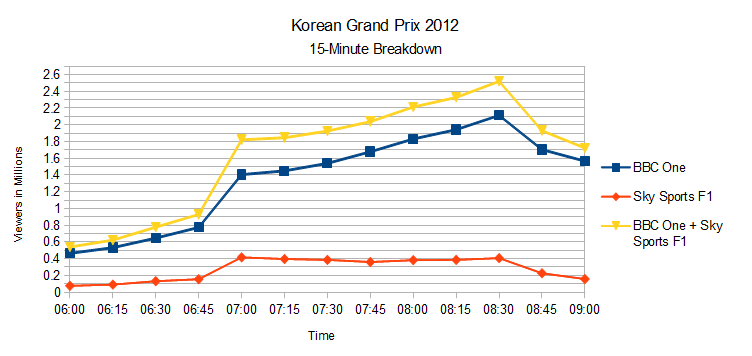
The Korean Grand Prix yesterday on BBC One and Sky Sports F1 had a 15-minute peak of 2.52 million viewers, overnight viewing figures show. Between 08:30 and 08:45, an average of 2.11 million viewers were watching on BBC One, with a further 407,000 viewers watching on Sky Sports F1. Whilst the peak, on paper looks good it is marginally down on 2010’s rain-affected race and nearly a million viewers down on the 3.39 million peak recorded at 08:30 last year.

Between 06:00 and 09:15, 1.35 million watched Formula 1 on BBC One and 274,000 watched on Sky Sports F1. I should note Sky’s programme average will be lower as the 274,000 excludes the first half an hour and the last 75 minutes. Here is a comparison between the three years:

2010 – 3.39 million (1.39 million live and 2.00 million repeat – live peak of 2.6 million at 09:00)
2011 – 4.09 million (2.17 million live and 1.92 million repeat – live peak of 3.4 million at 08:30)
2012 – 3.18 million (1.62 million live [see above] and 1.56 million repeat on BBC One – live combined peak of 2.5 million at 08:30)

Although it is a record low, using it in the title as a headline is a useless statistic in my opinion given that the event has only been running for three years, so for me even though the statement is true, it is not a headline figure. With only three sets of data available, there is little point of comparing with 2010 and 2011, in my opinion.

One thing I do want to look at though is the respective BBC and Sky breakdowns from yesterday, because it makes for interesting reading.

A 15-minute breakdown of the Korean Grand Prix 2012 viewing figures on BBC One and Sky Sports F1.

The first thing that caught my eye was the different trajectory for BBC One and Sky Sports F1 after 07:00. BBC’s viewership increases constantly until the peak at 08:30, partly thanks to people waking up while the race is progressing and turning straight to BBC One, whilst Sky Sports F1’s viewership actually goes slightly down. Which I do find odd. It’s not the first time I’ve seen that happen. Considering Sky Sports F1 is a dedicated channel, the fact that the audience declined slightly after the race started is worrying.

It also, for me, shows why Formula 1 has to stay on terrestrial television in some form, because sporting events catch the interest and can rise to a big peak on terrestrial, which very rarely happens on multichannel television. It looks like no one tuning in bothers to tune to Sky Sports F1 during the race. Between 07:00 and 07:15, 416,000 viewers were watching Sky Sports F1. Between 08:30 and 08:45, 406,000 viewers were watching the channel, a 10,000 viewer drop. BBC One in the same period increased 700,000 viewers.

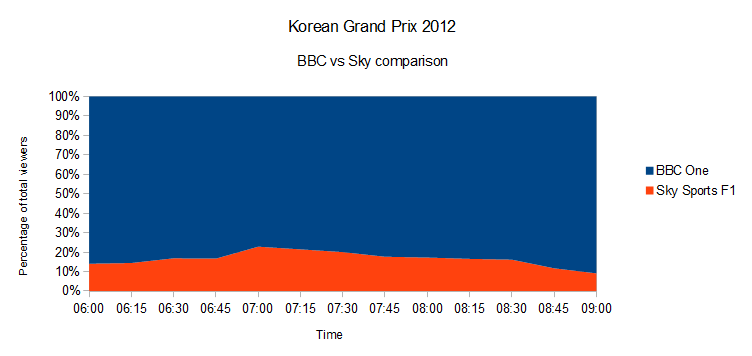
Another thing is that under 100,000 viewers were watching Sky Sports F1 between 06:00 and 06:30. That, and all the figures above, include viewers that timeshifted that exact block of programming up until 02:00 on Monday morning (which may also explain why BBC One suddenly jumped 700,000 at 07:00, which may be a few hundred thousand watching it later but not bothering with the build-up). A final graph, this time, the percentage difference:

A percentage comparison between BBC One and Sky Sports F1 during the Korean Grand Prix broadcast. (for some reason the quality of the image appears to be blurry, clicking on the image will solve that)

The smallest percentage gap between the two was in the 15-minutes from 07:00 when 77.2 percent were watching BBC One and the other 22.8 percent were watching Sky Sports F1. The gap grew again, however, by 08:00 it was 82.7 percent vs 17.3 percent and by 08:45 it was 88.3 percent versus 11.7 percent. For a early morning race, I would have expected the gap to be closer between the two, I would have expected the gap to be closer, but it turns out that has not been the case.

Thanks to gslam2 for kindly posting the 2012 breakdown on Digital Spy Forums.

Sky Sports F1 – Top 10 ratings (week ending 7th October, 2012)

From BARB:

1 – 390k – Live Japanese Grand Prix (Sunday, 06:00)
2 – 213k – Live Japanese Grand Prix: Qualifying (Saturday, 06:00)
3 – 121k – Japanese Grand Prix Replay (Sunday, 11:30)
4 – 113k – Live Japanese Grand Prix (Saturday, 29:30)
5 – 105k – Live Japanese Grand Prix: Qualifying (Friday, 29:00)
6 – 69k – Japanese Grand Prix Qualifying Replay (Saturday, 10:00)
7 – 64k – Japanese Grand Prix Qualifying Replay (Saturday, 14:00)
8 – 61k – The F1 Show (Friday, 10:00)
9 – 55k – Live Japanese Grand Prix: Practice 2 (Friday, 06:00)
10 – 47k – Live Japanese Grand Prix: Practice 1 (Thursday, 25:45)

Due to the way “TV days” work, TV operates from 06:00 to 06:00. Which is why there are some odd numbers above 24:00 in the above. To make things simple:

– 24:00 is midnight
– 25:00 is 01:00
– 26:00 is 02:00
– 27:00 is 03:00
– 28:00 is 04:00
– 29:00 is 05:00

The next thing is that any programmes in the above that go across 06:00 are split into two. Which is frustrating when trying to analyse things. To make things simple:

– Sky’s live Qualifying show from 05:00 to 07:45 averaged 174k.
– Sky’s live Race show from 05:30 to 10:15 averaged 360k.

Alarmingly, the numbers will be the lowest for Japan in nearly ten years. Even if you cut some of the build-up and post-race reaction from Sky, I could not see the live race getting above the 640,000 needed to break 3 million (combined with their only replay or not).

Apart from that, the only other valid comparison for Sky could be made with Australia which was a Sky exclusive race also and averaged 582,000 from 04:30 to 09:00. You could argue that the Australia race was the season opener, but even so, it doesn’t automatically mean that particular number should be ignored from comparison, especially when you also consider that Australia was an hour earlier! The channel also reached 1.92 million people, which compares with 3.41 million people for the Australia weekend. I haven’t had time to look at the reaches across the season, but 1.92 million might be the lowest yet for an exclusive Sky race.

Whichever way you spin it, the numbers don’t make for great reading.

A series suggestion for Sky Sports F1

Over the weekend, with Formula 1 being in Suzuka for the Japanese Grand Prix, I was thinking about classic Formula 1 race weekends where the entire weekend has told a story, whether it is about a driver, a team or a championship rivalry.

Which led me onto a series idea for Sky Sports F1 that I have. The idea is derived from the concept of the Senna film which was in the form of a documentary, except instead of covering a driver, it would cover a race weekend, from a documentary stand-point. The only problem here would be gathering up all the footage from a weekend from Formula One Management in Biggin Hill, watching it all, finding the best camera angles and editing it into a one-hour show which tells a story would be time consuming to say the least (although I would totally envy the person up for the task!).

I do think, as a concept though, it would be a brilliant, although potentially unrealistic, idea. As an hour programme (or 45 minutes without adverts), it could be edited down into:

0 minutes to 5 minutes – introduction
5 minutes to 10 minutes – Friday
10 minutes to 20 minutes – Saturday
20 minutes to 35 minutes – Sunday
35 minutes to 40 minutes – aftermath

By no means would it be a fast paced show, it would not be. The purpose would be to take you right into the heart of a race weekend, to put you into the shoes of X or Y driver. As an idea, I love it. In reality? The time consumed to look through the masses of footage for an hour programme deems this idea highly unlikely, especially considering their unwillingness to screen Classic F1 races.

In any case, we will roll with it. Pretending it was a six part series, I would use the following races in Formula 1 history to use:

1994 Australian Grand Prix
The first of two championship battles between Michael Schumacher and Damon Hill in what had been a mentally draining season on all concerned after the death of Ayrton Senna. The programme would look at Schumacher’s and Hill’s mindset going into the race weekend, and the possible influence of Nigel Mansell in deciding the destiny of the championship. From there, the swings and roundabouts of Friday’s and Saturday’s Qualifying sessions from Schumacher’s and Hill’s perspectives would be looked at in detail. And then, the race itself. Lap 36 of that race is one etched in Formula 1 history as Schumacher and Hill collided, handing Schumacher the championship. The immediate second by second aftermath would be analysed as Hill’s championship dreams were crushed and Schumacher’s were turning into a reality.

1997 European Grand Prix
Schumacher vs Villeneuve. Like 1994, this was another title battle involving Schumacher with a controversial ending. Before that, the programme would look at the respective Friday and Saturday performances from Schumacher and Villeneuve, and the dramatic Saturday Qualifying events that seen them both (along with Heinz-Harald Frentzen) record identical times. The race itself would keep track of Schumacher’s and Villeneuve’s progress and those outside of Ferrari and Williams who attempted to influence the outcome of the championship, namely Sauber and their driver Norberto Fontana. We would then get to the moment. The collision. This time, the Williams, however, did not retire. Villeneuve continued, and Schumacher was beached. From that, minute by minute we see Schumacher’s lonely walk back to the pit-lane as Villeneuve on track slowed, handing the lead to Mika Hakkinen.

2000 Japanese Grand Prix
The championship decider which left Michael Schumacher with his first championship since 1995 and Ferrari with their first in 21 years. But it was not all about Schumacher. Qualifying and the Race saw him in a titanic battle with Mika Hakkinen. There was no overtaking, but there did not need to be. The story here is “what you can do, I can do better”. And Schumacher did exactly that. The programme would look at the above and jump into the Ferrari celebrations after the race and the McLaren heartbreak. A tale, of two halves.

2002 Austrian Grand Prix
The pass. You can’t call it an overtake. It wasn’t. The programme would start exactly twelve months earlier, when the same happened as Rubens Barrichello let through Michael Schumacher for second on the final straight. It would then go onto Barrichello’s incredibly foreshadowing during interviews on Thursday before going through Qualifying and then a processional race, albeit with a horrifying crash from Takuma Sato. Afterwards, the aftermath would be felt up and down in the paddock, and later in front of the courts.

2005 United States Grand Prix
Possibly one of the more controversial Grand Prix’s in Formula 1 history. It would not be a lot about the racing, but the programme would dive into the uncomfortable setting that surrounded the Grand Prix, featuring comments as the events unfolded in a documentary style format from Friday through to the aftermath on Sunday evening as Formula 1 attempted to recover from the PR disaster.

2008 Brazilian Grand Prix
The greatest championship decider that I will probably live to ever see. Lewis Hamilton versus Felipe Massa. The dramatic build-up and their previous clashes would be outlined as well as Hamilton’s Qualifying problems. The race would be seen from unique, never before seen camera angles as Hamilton and Massa battled the elements. Massa was comfortably winning, and Hamilton was sixth. With one lap remaining, that was… and then in turned on it’s head. Hamilton passed Timo Glock on the final bend, winning the title. As in 2000, one side was celebrating, and the other was heartbroken. Except this time, it was role reversals.

As well as the above, you would get ‘as live’ quotes from the personalities involved, unique camera angles that captures the imagination and did not make it to TV as well as never before released footage from the FOM archive. Regarding the choices, you could have a lot more, but I wanted to stick to six recent ones that all Formula 1 fans, irrespective of age would remember instantly, everyone knows the races behind the moments. The documentaries, however, would dive deeper into the race weekend looking at unreleased footage to give the viewer an all rounded version of the weekend from a never before seen perspective.

Would you like to see a documentary series like this in the future if it was feasible enough?