The 2017 Formula One season moves onto Shanghai for round two of the championship in China, as fans hope for the battle between Lewis Hamilton and Sebastian Vettel to continue.
The Chinese round of the season switches with Bahrain, which follows the next weekend. Coverage from China will be broadcast exclusively live on Sky Sports, with highlights on Channel 4 later in the day. Readers may have noticed that, compared to last year, Channel 4’s highlights are slightly longer in length but are also being broadcast in a later time slot than 2016.
Over on BT Sport, their MotoGP coverage from Argentina is headed up by Craig Doyle for his first round of the 2017 season. In terms of returning championships, the World Touring Car Championship is back this weekend, live on Eurosport 2 from Morocco. Eurosport are also broadcasting the MAC3 time trial this season, which I do not believe was broadcast last year. Eurosport have split qualifying and the MAC3 time trial into two separate slots on the EPG (thanks Alex in the comments for the correction).
A noticeable omission in the schedule below is the Virgin Australia Supercars series. The series was broadcast live on BT Sport last season, but the arrangement appears to have stopped with Motorsport.tv taking over from the start of 2017. Unfortunately, it looks like that Motorsport.tv will not be airing the series live for the next few rounds at least, hence why it does not feature below.
Channel 4 F1 Sessions
08/04 – 13:00 to 14:30 – Qualifying Highlights
09/04 – 14:30 to 16:45 – Race Highlights
Sky Sports F1 Sessions
07/04 – 02:45 to 05:05 – Practice 1 (also on Sky Sports 1)
07/04 – 06:45 to 08:55 – Practice 2 (also on Sky Sports 1)
08/04 – 04:45 to 06:10 – Practice 3 (also on Sky Sports 1)
08/04 – 07:00 to 09:40 – Qualifying
09/04 – 05:30 to 10:10 – Race
=> 05:30 – Track Parade
=> 06:00 – Pit Lane Live
=> 06:30 – Race
=> 09:30 – Paddock Live
Supplementary Programming
05/04 – 20:30 to 21:00 – F1 Report: Preview
06/04 – 08:00 to 09:00 – Driver Press Conference
06/04 – 20:45 to 21:00 – Paddock Uncut
07/04 – 09:00 to 09:30 – Team Press Conference (also on Sky Sports 1)
07/04 – 09:30 to 10:00 – The F1 Show (also on Sky Sports 1)
BBC Radio F1
06/04 – 20:00 to 21:00 – Preview (BBC Radio 5 Live)
07/04 – 02:55 to 04:35 – Practice 1 (BBC Radio 5 Live Sports Extra)
07/04 – 06:55 to 08:35 – Practice 2 (BBC Radio 5 Live Sports Extra)
08/04 – 04:55 to 06:05 – Practice 3 (BBC Radio 5 Live Sports Extra)
08/04 – 06:55 to 08:05 – Qualifying (BBC Radio 5 Live Sports Extra)
09/04 – 06:30 to 09:00 – Race (BBC Radio 5 Live)
IndyCar Series – Long Beach (BT Sport//ESPN)
09/04 – 21:30 to 00:00 – Race
MotoGP – Argentina (BT Sport 2)
07/04 – 13:00 to 20:00
=> 13:00 – Practice 1
=> 15:45 – Reaction and Build-Up
=> 17:00 – Practice 2
08/04 – 13:00 to 20:15
=> 13:00 – Practice 3
=> 16:00 – Qualifying
09/04 – 13:30 to 15:15 – Warm Up
09/04 – 16:30 to 22:00
=> 16:30 – Moto3 race
=> 18:15 – Moto2 race
=> 19:45 – MotoGP race
=> 21:00 – Chequered Flag
MotoGP – Argentina (Channel 5)
10/04 – 19:00 to 20:00 – Highlights
World Rally Championship – France 07/04 – Day 1 Highlights
=> 22:30 to 23:00 (BT Sport 1)
=> 22:35 to 23:05 (Motorsport.tv) 08/04 – 15:00 to 16:00 – Stage 1 (BT Sport//ESPN) 08/04 – Day 2 Highlights
=> 22:00 to 22:30 (BT Sport 3)
=> 23:05 to 23:35 (Motorsport.tv) 09/04 – 11:00 to 12:30 – Power Stage (BT Sport 1) 09/04 – Day 3 Highlights
=> 22:00 to 22:30 (BT Sport 2)
=> 22:35 to 23:05 (Motorsport.tv) 11/04 – 19:00 to 20:00 – Highlights (Channel 5)
World Touring Car Championship – Morocco (British Eurosport 2)
08/04 – 15:15 to 17:30
=> 15:15 – Qualifying
=> 16:30 – MAC3 time trial
09/04 – 16:30 to 18:30
=> 16:30 – Race 1
=> 17:30 – Race 2
As always, I will update the above schedule if anything changes.
Formula 1 returned to the television screens this past weekend with the Australian Grand Prix, as Ferrari’s Sebastian Vettel claimed victory. In the UK, viewing figures continued to struggle off the back off last year, but there are some promising signs going forward.
To start the year, I want to remind readers that all viewing figures presented on the site are Live + VOSDAL (Video on Same Day as Live). As an example, if you recorded Channel 4’s highlights programme, and watched it before 02:00 the same day, you would be counted as a viewer in the Live + VOSDAL viewing figures (also known as ‘overnight viewing figures’).
The overnight viewing figures reported include advertisements. Secondly, the numbers include Channel 4’s +1 service. Over on Sky Sports F1, the reported number of this site is for their three-and-a-half-hour slot which covers Pit Lane Live and the Race itself, so for example from 12:00 to 15:30.
Race
Live coverage of the race, broadcast on Sky Sports 1 and Sky Sports F1 from 05:00 to 08:30, averaged 395k (22.2%), an increase on last year’s audience of 360k (24.8%). The raw share is down slightly year-on-year, which is due to the clocks moving forward by one hour, meaning that the total available audience for breakfast programming was slightly higher. The race peaked with 636k (38.7%) at 06:35 as Sebastian Vettel claimed the lead, a nice increase of 14 percent on last year’s peak figure of 559k (37.4%).
In terms of the split, 315k watched on the dedicated F1 channel, with a further 80k watching on Sky Sports 1. Including VOSDAL, an audience of 552k (37.2%) were watching Sky’s coverage as the race started at 06:05. This grew consistently as the battle between Vettel’s Ferrari and Lewis Hamilton’s Mercedes continued in the early stages, hitting the peak of 636k at 06:35. At this point, audiences dropped back down to 585k (35.7%), stabilising just under 600k before jumping back up to 622k (27.1%) as Vettel took the chequered flag. Bear in mind that, in this context, the drops and increases are likely to be viewers ‘fast playing’ through their recordings or vice versa.
Highlights of the race, broadcast on Channel 4 from 14:00 to 16:35, averaged 1.65m (20.6%), a drop of 22 percent on 2016’s average audience of 2.11m (19.0%). The total television audience yesterday whilst Formula 1 was on-air was significantly lower than twelve months ago: 8.0m vs 11.1m, contributing to the audience drop. Channel 4’s coverage peaked with 2.07m (26.0%) at 15:10, a drop of around 600k on last year’s peak audience of 2.67m (21.9%). Again, note the stark difference in share year-on-year. In comparison, the BBC’s highlights coverage in 2014 peaked with 3.15m (26.4%). Therefore, the raw shares for 2017 are not a problem, but the low audience is an issue.
The combined average audience of 2.04 million viewers is the lowest for Australia on record, and down 424k on last year’s audience of 2.47 million viewers. Compared with 2015, the combined audience has dropped 42 percent. The combined peak audience of 2.70 million viewers is down on 2016’s peak audience of 3.23 million viewers.
Qualifying
Live coverage of qualifying across Sky Sports 1 and Sky Sports F1 from 05:00 to 07:40 averaged 254k (12.6%), a slight increase on last year’s audience of 235k (14.7%). The session itself peaked with 481k (14.6%) at 07:05 as Lewis Hamilton claimed pole position. Although the average audience increased year-on-year, Sky’s combined audience is down on the figures recorded for 2014 and 2015 by around 25 percent.
Channel 4’s highlights programme, which aired from 13:00 to 14:45 on Saturday afternoon, averaged 1.22m (18.2%). The number decreased in volume compared to 2016 (1.38m/15.4%), but increased in share thanks to the warmer weather. A peak audience of 1.69m (24.6%) were watching Channel 4’s coverage at 14:20, compared with 1.74m (17.9%) last year. Small drops all around for the broadcaster, but the numbers are healthy enough to not be concerning at this stage.
The combined audience of 1.48 million viewers is the lowest for the Australian Grand Prix qualifying session on record, however the combined peak audience held up with 2.17 million, above last year’s combined peak audience by just 9,000 viewers! The story here is that fewer people watched qualifying ‘live’ (for both broadcasters) compared to previous years, spinning through advert breaks and deflating the average audiences slightly as a result.
Analysis
One of the beautiful things about working with data is that there is never simply one answer to why a given data point shows X. The Australian Grand Prix viewing figures are a fantastic example of where the data on the surface looks extremely poor, but there are justifiable reasons to back up why the data shows what it does.
On track, both the live coverage on Sky and Channel 4’s highlights programme peaked when Sebastian Vettel took the lead. That should not be a surprise as the main action ‘ended’ at that point. Afterwards in both broadcasts, the audience dropped slightly. Certainly Vettel taking the lead at the stage that he did, combined with no supplementary battles to keep the viewer enticed, led to figures dropping away.
Off track, there were two main factors, both of which relate to Channel 4. The weather was warmer over the weekend. Warmer weather means that there are fewer people inside watching the television. By the time the evening came around, some viewers may have already found out the result via other means, and deleted the recording. Secondly, it was Mother’s Day in the UK, which again would have depleted viewing figures. Formula 1’s audience on Channel 4 was down 424k year-on-year, yet the total available audience for the slot was down 3.1 million year-on-year. Lack of football on Sky should have helped Channel 4, but the warm weather and Mother’s Day countered that effect.
I am not defending the figures by any stretch, but it is critical to place viewing figures into context. It is too early to say whether the drops seen in Melbourne are a sign of things to come, or a one-off occurrence to start the 2017 season.
The 2016 Australian Grand Prix ratings report can be found here.
2017 marks Formula 1’s sixth season with half of the races exclusively live on pay television in the United Kingdom, with this weekend’s Australian Grand Prix the first of ten races this year exclusively live on Sky Sports F1.
The cost of pay TV has been on the rise for years, an increase that is showing no signs of slowing down. This has led to Sky introducing the likes of Now TV, which aims to bring in a different type of customer. So, how much money do readers need to part company with to watch Sky Sports F1 in 2017?
The below information is primarily aimed at new customers on each of these platforms. As regular readers for these services will be aware, if you threaten to leave (otherwise known as ‘haggling’), expect Sky or Virgin to offer a cost reduction to secure your custom. This is not a guarantee, but likely if the pay TV company values your services, and if you have been a long-term customer. Note that all of the comparisons exclude double and triple play choices, such as phone and broadband deals.
Sky
This year, Sky customers have an extra mechanism of viewing Formula 1 content, thanks to the introduction of F1 in ultra-high definition through the Sky Q service. There should be three tiers: standard definition (SD), high-definition (HD) and ultra-high definition (UHD). However, the ultra-high definition option splices off into two sub categories.
There are a few points to note. There is still a distinction between standard definition and high-definition. The Original Bundle, Sky’s ‘entry level’ television package, does not give you access to Sky Sports content in high definition.
Not only does this require the consumer to upgrade from the Original Bundle to the Box Set Bundle (at a cost of £16.00 extra per month), but it also means that they need to pay a further £6.00 per month to view Sky Sports HD. At this stage, high-definition should be the ‘new norm’, but Sky still considers high definition a speciality from a pricing perspective.
A second point to note is that, to view content in ultra HD, customers require the Sky Q 2TB box and Sky Q Multiscreen, the latter of which is an extra £12.00 a month. The reason for the ultra HD option being split into two is because, having a Sky Q 2TB box does not give you access to HD content. As a result, you could find yourself watching Formula 1 sessions in ultra HD, but the rest of the channels’ content in standard definition. Unusually, this combination is cheaper than the all high-definition option, but that is likely a result of little ultra HD content currently available on Sky’s platform. Both the Sky standard and high definition options have increased by around £35.00 compared to last year.
I do not know how Liberty Media can influence Sky’s strategy, but in my opinion, a monthly cost of £49.50 to view every Formula 1 race is more than an average family could afford.
Virgin Media
The pricing for Virgin Media is simpler than Sky, but the raw pricing does not differ significantly.
The entry-level Mix TV package is £20.00 (including the TiVo 500GB box). I should note that Virgin Media does offer a free Player TV package, however you are unable to combine this with the Sky Sports Collection.
The standard definition option ends up more expensive than the Sky equivalent, but the HD option is cheaper, simply because the base package is identical irrespective of the picture quality for Sky Sports. An extra £7.00 a month gets you Sky Sports in high-definition through Virgin Media, compared to a potential extra of £22.00 if you are with Sky.
Now TV
Outside of the traditional pay TV subscription, there is a cheaper option in the form of Now TV, also owned by Sky. There are three Now TV tiers for Sky Sports. The daily pass is £6.99, the weekly pass is £10.99 and the monthly pass is £33.99. However, the monthly pass is currently half price at £16.99 for a limited time only.
Based on the 2017 calendar, you can watch every race live by purchasing six monthly passes throughout the year:
– pass 1 can be used from March 24th to April 24th (Australia and China) – half price
– pass 2 can be used from May 11th to June 11th (Spain and Canada)
– pass 3 can be used from July 1st to August 1st (Austria and Hungary)
– pass 4 can be used from August 22nd to September 22nd (Italy)
– pass 5 can be used from October 1st to November 1st (Japan and Mexico)
– pass 6 can be used from November 1st to December 1st (Brazil)
The six Now TV monthly passes works out at a cost of £186.94 across the year. The cheaper option would be to purchase ten Now TV weekly passes, at a cost of £109.90 across the year. To further decrease the cost, if you just watched to watch the ten races that Channel 4 are not covering live, forgetting qualifying and extra material, you could purchase ten Now TV daily passes at a cost of £69.90 across the year. Personally, I think the weekly passes offer the best value for money and offer more flexibility. The reality is that there is not a one size fits all solution, and that you probably want to mix and match depending on your own circumstances.
Now TV is a great option if you want to dip in and out and do not want to watch Sky Sports all year round. If you do, the pricing mechanism is not much different to Sky or Virgin Media. As I have mentioned before, the daily pass should be priced lower.
Sky Sports Mobile TV
The last and cheapest option is Sky Sports Mobile TV for iPhone and Android users. Priced at £9.99 per month, six months in the same way as above works out at a nifty £59.95 across the year. There is a huge cost saving that can be made for consumers.
In summary, if you are a Formula 1 fan, here are the key numbers, including installation where applicable:
– £1,062.00 a year – Sky (UHD + HD other content)
– £873.00 a year – Sky (HD)
– £798.00 a year – Sky (UHD + SD other content)
– £719.99 a year – Virgin Media (HD)
– £635.99 a year – Virgin Media (SD)
– £609.00 a year – Sky (SD)
– £186.94 – Now TV (Monthly Pass x 6)
– £109.90 – Now TV (Weekly Pass x 10)
– £69.90 – Now TV (Day Pass x 10)
– £59.95 – Sky Sports Mobile TV
The gulf between pay TV and ‘cord cutting’ methods, such as Now TV and Sky Sports Mobile TV is increasing by the year. In the future, there is a good chance that the F1 App will be added to the above list, in which consumers will start consuming things by individual sports as opposed to by broadcaster, but that is some years down the road yet in the UK at least.
Pricing and information correct as of March 24th, 2016. Pricing is subject to change.
To celebrate the fifth anniversary of The F1 Broadcasting Blog, we are looking back at five races from the archive and chewing over them. Being a broadcasting site, these races are not being analysed from a racing standpoint, but instead from a media perspective.
The five races include Grand Prix from the BBC and ITV eras, crossing over from the Americas, into Europe and Australia. Some races picked are your usual affair, whilst others have major significance in Formula 1 history. I did think about looking at five ‘major’ races, but each race has equal merit from a broadcasting standpoint, irrespective of how great the race was.
The fifth and final race of the initial series keeps us in Australia, for very good reason. The 2012 Australian Grand Prix marked the start of a brand new era in Formula 1 broadcasting and was, partly, one of the drivers behind this site starting one month later. The race was the first that Sky Sports F1 covered.
This piece gives us an opportunity not only to look back at how Sky’s coverage started, but also to see what has changed and evolved since their inaugural race five years ago. On track, the 2012 season saw six World Champions on the grid: Schumacher, Hamilton, Vettel, Button, Alonso and Raikkonen. It was arguably the strongest field Formula 1 ever had. The key broadcast details can be found below:
Date: Sunday 18th March 2012
Channel: Sky Sports F1
Time: 04:30 to 09:15
Presenter: Simon Lazenby
Presenter: Georgie Thompson
Reporter: Ted Kravitz
Presenter: Natalie Pinkham
Commentator: David Croft
Commentator / Analyst: Martin Brundle
Analyst: Damon Hill
Analyst: Anthony Davidson
It was a stacked line-up to begin Sky’s coverage. Five out of the eight people listed above defected from the BBC, two of the eight were internal to Sky, whilst Damon Hill was the only person making a return to the TV broadcasting scene, having previously been part of F1 Digital+ in 2002. Sky’s Formula 1 channel launched on Friday 9th March, with a live studio show, followed by the Australian weekend one week later.
Pre-Race
Sky used stylish VTs in the opening minutes to cover the past greats for newer fans of the sport who may not be aware of the sport’s legacy. The channel set the scene for the season ahead; introducing fans to the various methods of watch Sky’s Formula 1 coverage, making it clear that they intend to cover the sport from all angles. Presenter Simon Lazenby introduced viewers to the rest of the team, with the crew stationed around Albert Park. Anthony Davidson and Georgie Thompson are in the Sky Pad, Ted Kravitz in pit lane and Natalie Pinkham in the paddock.
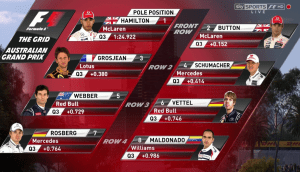
Sky’s qualifying grid graphics following their qualifying report.
Following the qualifying wrap-up is a discussion about HRT’s abysmal performance, the team having failed to make the 107 percent rule. Martin Brundle in particular was scathing of his assessment of them. Further discussion follows about the Mercedes concerning that innovative ‘F Duct’.
One feature that was prominent during the build-up was the usage of live driver interviews from the paddock. Our first is with Williams driver Pastor Maldonaldo (the timing of which slightly amused me given that it directly followed some promotion for Sky’s Legends of F1 series). Nevertheless, it is a good interview with comment given on his live qualifying performance. A paddock interview with Romain Grosjean followed later in the pre-race broadcast. It is not clear whether these interviews are actually live, the impression is that they are, but the timing is slightly suspect as Grosjean is not in his race gear at this stage.
However, if it makes for a more compact show, I am all for that approach. My only criticism of these is that the interviews are brief, which is unfortunate. There are more in-depth pit lane interviews with Christian Horner and Martin Whitmarsh. Whitmarsh says that the tyres look better which may “detract from the show and the challenge”, Whitmarsh also commenting on the relationship between Hamilton and Button in their third season.
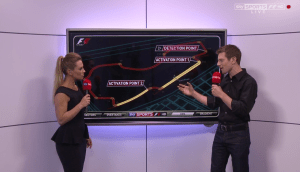
The Sky Pad segments are infrequent throughout the build-up, with Davidson and Thompson housed inside a miniature studio, making them feel detached from the rest of the programme. Neither Sky Pad segment is in great depth, showing that Sky did not know how to best utilise the tool at this stage, but this is very early in its development cycle. The analysis itself was great, with Davidson on top form already.
In 90 minutes time with the world watching with bated breath those five red lights will go out and the 2012 Formula One season will have begun. Many are saying it’s the greatest field ever assembled. Six world champions they and the rest of the grid gunning for one thing. To be called the best driver on the planet. – Sky presenter Simon Lazenby introducing the programme
Thompson introduced us to the track walk with Brundle and Hill focussing on the key parts of the circuit. Again, this feature shows off Sky’s virtual graphics (courtesy of New Zealand company Virtual Eye). The show flows well at this point, with Kravitz next up talking about the various strategies that could play out during the Grand Prix. Brundle notes that the tyres look a “bit too good and durable to me!”
Unlike the ITV races we have previously covered, there is a lot of ‘still to come’ and ‘coming up’ in Sky’s initial broadcast, with extensive promotion of Sky’s new ‘Legends of F1’ series and paid advertising from Hilton Honours leading in and out of adverts, along with Brundle’s Ferrari feature receiving attention. There is too much filler leading in and out of commercial breaks, resulting in shorter paddock discussion.
The Brundle piece at Ferrari’s Fiorano base featured contributions from John Surtees, Nigel Mansell and from Stefano Domenicalli. The feature was promoted too much by Sky, meaning that the viewer expected more than what was aired during the programme. As a feature, it was good but not memorable. Arguably, this segment should have been a standalone 30-minute programme in its own right. As Brundle said moments after the VT aired, he ran at Fiorano for 40 laps, so we should have seen a greater depth of footage instead of small snippets.
Anthony Davidson and Georgie Thompson overseeing the Sky Pad. Note the amount of white space…
On the other side of the break, there is a second recap of the grid, but the top ten this time is presented in a different format to previously with focus on the individual drivers, going from 10th to 1st using virtual animations. Brundle’s first grid interview is with the youngest driver on the grid, rookie Jean-Eric Vergne in the Toro Rosso.
The grid walk shows off how vibrant Formula 1 is, helped by the sunshine and blue skies beaming down onto the circuit. It is a great grid walk, with various voices heard from celebrities to drivers and onto the pit crew, from Leo Sayer through to Ciaron Pilbeam. The grid walk was unrestricted by the national anthem at quarter to the hour; drivers back in 2012 were not required to walk to the front of the grid. Thompson takes viewers through the various viewing options, with Sky Race Control available through the Red Button, iPad and online. There are a few interviews in pit lane before a further Sky Pad bit with Thompson and Davidson, and then, it is race time!
Race
One of Sky’s early changes was to show key interview snippets in a picture-in-picture format during the warm-up lap, I cannot remember whether Sky dropped this after the first race though.
Brundle and David Croft handled the start sequence well, with a lot of energy on display throughout a frantic opening phase of the Grand Prix. We also saw one of the classic Brundle phrases in relation to Sebastian Vettel, as the German fought his way past Nico Rosberg at turn nine, “and that’s the man they said can’t race in Formula 1, he can only win from the front apparently, I don’t think so!” Moments later, Maldondo successfully overtook Grosjean, but ended up whacking the Lotus in the process, eliminating the French driver from the race.
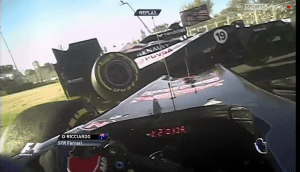
Toro Rosso driver Daniel Ricciardo finds himself with a face full of Bruno Senna’s Williams.
FOM caught the majority of drama, but the opening laps also shows why you cannot be trigger-happy with replays in the early phases. Nevertheless, the replays did help to show what unfolded in the second half of the field at the start. The on-board footage, notably from the Red Bull and Ferrari drivers, showed how badly the Pirelli tyres were to handle towards the end of a stint, as showcased on various occasions with drivers struggling with understeer and oversteer. The on-board of Vettel also captured Schumacher heading off the circuit and into retirement.
The only commentary bugbear, which became clear early on, was a Sauber and Williams misidentification. Other than that, commentary was good, and more importantly, Croft and Brundle gelled, doing well to keep on top of the changing order during the pit stop phases. There was a ‘talk too much’ tendency at times more so in the early laps, but this brews back to Croft’s 5 Live days, radio commentary and television commentary are two different beasts, and it takes time to transition from one to the other.
I forgot how good this race was, to be honest! Australia’s Melbourne circuit has always shown off the speed of the cars, and this race is no exception as Button streaks off up front with Hamilton behind.
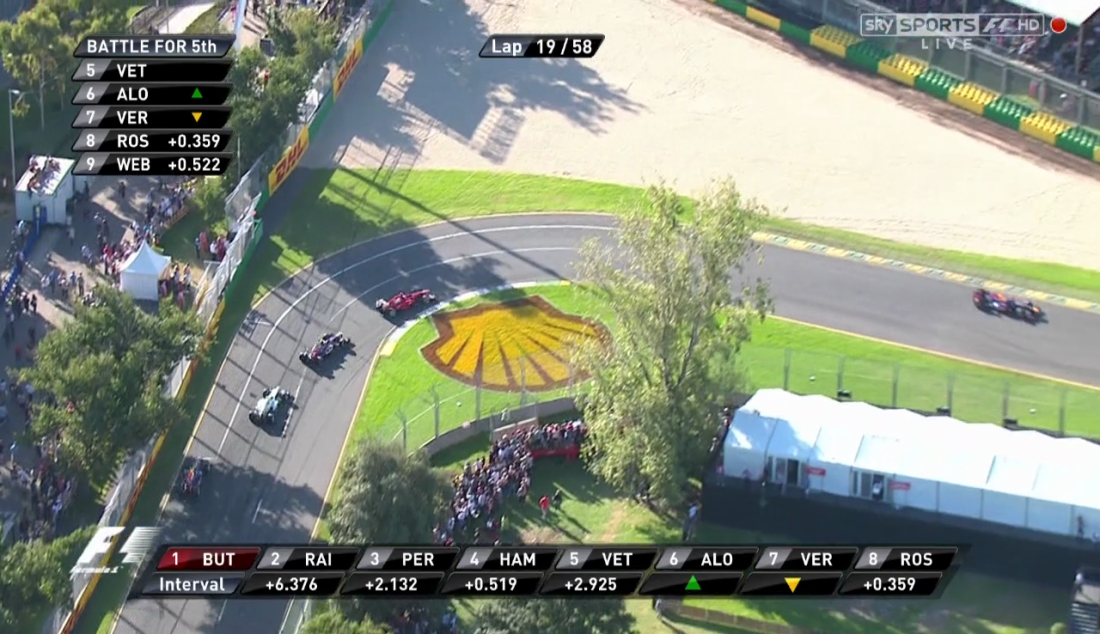
The helicopter shots at Melbourne: a beautiful picturesque scene panning over the Melbourne skyline, whilst also helping to show the various gaps during the first pit stop sequence.
The focus is on Sauber’s Sergio Perez, attempting a one-stop strategy against a two-stop strategy for the other leading runners. The artificial DRS overtakes do not detract from Perez’s brilliant race, which Brundle and Croft sell brilliantly. At this point, Pinkham also gets a paddock interview with John Button, which is unfortunate timing as the Sauber of Kobayashi and Raikkonen bang wheels in a clean fight.
The longer this race lasts, the more I realise how weird the FOM graphics set looks from an alignment perspective. The graphics set is not 4:3 safe, nor are they fully 16:9 centric. It is a halfway house to appease both the old and new worlds. However, the graphics are more informative: the ‘ticker’ at the bottom of the screen helps decipher the gaps between various drivers, which becomes critical during the pit stop periods. FOM also use a ‘Previous Gaps’ graphics regularly to show the variation, as Jenson Button increases his lead over Lewis Hamilton up front.
Petrov’s stranded Caterham on the start-finish straight causes a Safety Car immediately after both McLaren’s pit. Vettel jumps up to second after his pit stop as a result with Maldonaldo exiting just behind Alonso.
I might be alone in this, but I don’t like this rule. It’s the luck of the draw, if the leaders have to get through some backmarkers on the restart, so what. They’re the best drivers in the world, let’s see them negotiating them. I think we should get rid of blue flags, you’ll hear me say that once every three races, passing backmarkers is a core skill of being a racing driver. We’ve wasted a lap, we should be racing now. – Brundle on the lapped cars may now overtake rule.
Attention focuses on the battle between Vettel and Hamilton for second, as Massa and Senna collide in an extremely clumsy accident. “At least it’s not Hamilton he’s crashing into this year,” jokes Croft. The two Red Bull cars separate Hamilton’s McLaren, as Brundle and Croft remind viewers of Webber’s difficult start to the race. There are several stories still unfolding in the last few laps, with drivers scrapping over the last few points.
Regrettably for Maldonaldo, having had his performance praised by Brundle and Croft throughout, the commentators’ curse strikes on the last lap, crashing out of fifth position. “It is Button’s day down under!” Croft declares. Behind the leaders is a mess, with cars moving positions both on and off the circuit. The FOM replays just about pick up what happened, which was very difficult with a lot going on in the background!
Post-Race
Under the Melbourne sunset, Button, Hamilton and Vettel take to the podium to celebrate the start of the 2012 season. Hill’s comments about McLaren are quite sad now given their current predicament, Hill referring to their “technical expertise”, also noting, “When they’re down, they get back up”. The first post-race interview is with John Button, describing his son’s win as “an incredible start to the season”.
Winner.
Lazenby covers Sky’s Malaysian Grand Prix programming, including the GP2 Series before heading off for the first ad-break. Lazenby and Hill analyse the race with Whitmarsh, although it turns into more of a chat, with Hill and Whitmarsh bouncing thoughts off one another, which makes for great television I feel.
Some interviews from Pinkham in the pen are aired next, starting with Mark Webber in fourth position. We start to move towards the more relaxed setting of the paddock, as Lazenby covers the various ways to contact the team, including Twitter and e-mail (no #AskCrofty back then). The McLaren theme continues, with a brief VT covering Button’s key moments, although it does not amount to much as his race was relaxed! Some of the discussion that follows does ramble a little bit with it being ad-lib, but overall it is good post-race discussion. Brundle is holding the show together and at times appears to lead the questioning.
This year is a very special year in Formula 1, last year was also having five world champions, but having six world champions and so many competitive teams, it’s good to see that Formula 1 is in a great place right now and it’s a great sport to be a part of – McLaren’s Jenson Button speaking in the post-race press conference
The rest of the post-race broadcast follows a similar structure, with ample discussion given to Red Bull, Lotus and Williams, the team conducting interviews with Christian Horner, Eric Boullier and Adam Parr respectively. All three interviews are structurally similar, touching on the various sporting and technical elements for each team, including the blown diffuser ban in relation to Red Bull. Sky did not air any FOM material during these interviews, meaning that the paddock analysis suffered as a result.
Thompson and Davidson in the Sky Pad covered the analysis, analysing the start and then the Maldonaldo and Grosjean incident later on. It is clear that, like in the pre-show earlier, Sky were unclear on how to integrate the Sky Pad segments into the overall package, something that they have worked to perfect. Intertwined in this was further pen interviews with both McLaren drivers and a paddock walk with comment given on Sauber’s strong performance.
Attention turns back to pit lane as Sky’s team assemble around the McLaren garage to wrap up the show under the Melbourne sunset. Viewers are shown tweets on-screen, which is followed by a final word with Button. Four and a half hours after Sky’s programme started with Just Drive, it is left for Insomnia’s Faithless to play out coverage of Sky’s inaugural Formula 1 race.
A changing of the guard has occurred in Formula 1 over the winter. A champion retired on top of the world. A mass-media corporation ousted an elder statesman, who grappled with the sport for a lifetime. The machinery has become faster, louder and maybe even sexier.
The Formula 1 roadshow that greets us next weekend for the Australian Grand Prix is a significantly different one to the one that left us last November in Abu Dhabi. Nevertheless, for everything that changes, some aspects remain the same.
Channel 4 and Sky Sports have retained broadly the same line-up as last season. Steve Jones will continue to lead Channel 4’s line-up, with the likes of David Coulthard, Mark Webber and Karun Chandhok providing analysis. Over on Sky, Simon Lazenby begins their sixth season of covering Formula 1 as presenter, Martin Brundle, Johnny Herbert and Damon Hill are nearby as always in the wings.
The major change for Sky this season is that former Williams technical director Pat Symonds will provide commentary on a number of races alongside Brundle and David Croft. It will be interesting to see how Sky uses Symonds during the race itself, whether they will use him throughout the race or in the quieter phases only.
Over on the BBC, Jack Nicholls returns as 5 Live lead commentator with Allan McNish, Tom Clarkson, Jennie Gow and Mark Gallagher again completing their line-up. Nicholls will miss the Hungarian round this season due to his Formula E commitments. On the scheduling front, note that Friday’s timings are half an hour earlier than previous years, so practice one starts at 01:00 UK time, whilst Sky’s weekend coverage is simulcast on Sky Sports 1. For those with ultra HD, F1 will be available in 4K for the first time through Sky Q.
MotoGP also makes its return next weekend, with Channel 5 providing highlights on Monday evenings, replacing ITV4 in this respect. BT Sport will continue to cover the championship live, with Suzi Perry presenting live for 11 of the 18 races including the opening race of the season in Qatar. Keith Huewen and Julian Ryder will again be covering commentary this season, whilst the likes of Gavin Emmett and Neil Hodgson will be down in pit lane.
NOTE: Clocks go forward one hour on Sunday 26th March, with the change from Greenwich Mean Time to British Summer Time. The times listed are for GMT on Saturday and before; BST for Sunday and afterwards…
Channel 4 Sessions
25/03 – 13:00 to 14:50 – Qualifying Highlights
26/03 – 14:00 to 16:40 – Race Highlights
Sky Sports F1 Sessions
24/03 – 00:30 to 02:45 – Practice 1
24/03 – 04:45 to 06:55 – Practice 2
25/03 – 02:45 to 04:10 – Practice 3
25/03 – 05:00 to 07:40 – Qualifying (also Sky Sports 1)
26/03 – 04:30 to 09:10 – Race (also Sky Sports 1)
=> 04:30 – Track Parade
=> 05:00 – Pit Lane Live
=> 05:30 – Race
=> 08:30 – Paddock Live
Supplementary Programming
22/03 – 20:30 to 21:00 – Report: Australia Preview
23/03 – 04:00 to 04:30 – Driver Press Conference
23/03 – 20:45 to 21:00 – Paddock Uncut: Australia
24/03 – 07:00 to 07:30 – Team Press Conference
24/03 – 07:30 to 08:00 – The F1 Show
29/03 – 20:30 to 21:00 – Report: Australia Review
BBC F1 Sessions
21/03 – 20:30 to 21:30 – Preview, Part 1 (BBC Radio 5 Live)
23/03 – 21:00 to 22:00 – Preview, Part 2 (BBC Radio 5 Live)
24/03 – 00:55 to 02:35 – Practice 1 (BBC Radio 5 Live Sports Extra)
24/03 – 04:55 to 06:35 – Practice 2 (BBC Radio 5 Live Sports Extra)
25/03 – 02:55 to 04:05 – Practice 3 (BBC Radio 5 Live Sports Extra)
25/03 – 05:55 to 07:05 – Qualifying (BBC Radio 5 Live Sports Extra)
26/03 – 05:00 to 08:00 – Race (BBC Radio 5 Live)
Supplementary Programming
20/03 – 21:00 to 22:00 – Crash and Burn: The Story of Tommy Byrne (BBC One Northern Ireland)
=> also 27/03 at 21:00 on BBC Four
MotoGP – Qatar (BT Sport 2)
23/03 – 14:00 to 19:45
=> 14:00 – Preview
=> 15:00 – Practice
24/03 – 14:45 to 18:45 – Practice
25/03 – 14:30 to 18:30 – Qualifying
26/03 – 13:45 to 21:00 – Races
=> 13:45 – Warm Ups
=> 15:30 – Moto3
=> 17:15 – Moto2
=> 18:45 – MotoGP
=> 20:00 – Chequered Flag


 Motorsport Broadcasting