David Croft, the lead commentator for Sky Sports’ F1 coverage, has given his full backing for Ben Edwards to lead Channel 4’s commentary team this season, whilst also stating that Sky’s own line-up will remain unchanged for the 2016 Formula One season.
Speaking about the lead commentator role at the AUTOSPORT Show with Henry Hope-Frost on Thursday afternoon, Croft backed Edwards for the role at Channel 4, noting that “I sent Ben Edwards a text message before Christmas saying ‘Look I hope the only thing that changes next year is that you have got a different logo on your shirt mate and that you’re still in the commentary box next to me,’ because Ben’s a top bloke and a terrific commentator. I’d love to be commentating on Sky F1 with Ben commentating on Channel 4 and then when we put the mike down we’ll stand and have a chat about what we’ve just seen which is what we do all the time.” In a survey on this site, a clear majority of you backed Edwards for the lead commentator position with the broadcaster.
While on the AUTOSPORT stage, Croft commented on BBC’s television demise from Formula 1, looking back at his time with the BBC “As a man who came into Formula 1 working for BBC Radio 5 Live and who worked for the BBC for many, many years, I think it’s a real shame that the BBC couldn’t afford to keep Formula 1. It was much loved Formula 1 on the BBC. It was much watched as well and it pushed and challenged us at Sky. It challenged us to hopefully not only be as good as the BBC coverage but be better.”
Croft referenced the fact that Whisper Films’ personnel, such as former BBC producer Mark Wilkin have been producing Formula 1 television for many years. “I think Channel 4 will be fab for the sport and they will be great for us at Sky F1 as well. They’ll push us, we’ll push them and the net result hopefully for you guys watching here will be that you get the best F1 coverage in the world. As far as I’m concerned, bring on Channel 4 and whoever joins David Coulthard in front of the camera, and whoever is there behind the scenes as well. When the cameras stop rolling, we’re all very good mates in the paddock, there is no rivalry to that extent,” Croft said.
One piece of news that came from Croft is that it looks like the Sky Sports F1’s team will remain unchanged for the 2016 season. Croft commented “As far as I know the Sky team will be unchanged. Natalie Pinkham will be taking another little break mid-season when she goes and has child number two.”
The first three quarters of 2015 saw a lot of ‘mini stories’, from Formula One Management overhauling their online output to the inaugural Formula E season coming to a successful conclusion. But the events of the last two weeks have set the scene for what looks set to be a busy start to 2016.
A lot is going to unfold over the course of the next three months concerning Channel 4’s Formula 1 coverage. In no particular order, Channel 4’s…
– line-up
– production
– scheduling (and pick process with Sky Sports)
Each one of those bullet points sets off a new story. Does Channel 4’s line-up have any new faces? Is Channel 4’s scheduling different to that we have seen on the BBC in the past four years since 2012? How will their production fare, will Channel 4 be on location for every race? There are endless number of questions that we do not know the answer to at this stage. The countdown is on until the Australian Grand Prix.
Aside from Channel 4, there will be inevitably be other broadcasting stories in the Formula 1 landscape. With the BBC now back to their pre-2009 coverage level, attention turns to Sky Sports F1’s coverage as Sky enter year five. Over on the social media side, surely 2016 is the year we see Formula One Management launch an official presence on Facebook. “A day late and a dollar short” is the phrase, but FOM cannot afford to be a dollar short with this one.
Elsewhere, there will be the usual articles covering BT Sport’s MotoGP coverage and ITV’s Formula E programming. MotoGP was fantastic this season, and I hope that 2016 is just as good on BT Sport. Formula E looks set to get a boost from season three onwards with Jaguar joining the fray, although the alarmingly low UK viewing figures as of late should be a cause for concern. As for Formula 1, I’m hopeful that the talking in 2016 happens on the track rather than off it as was the case in 2015.
When I wrote the original BBC and Sky Sports calendar predictions post for the 2016 Formula One season back in the Summer, no one could have anticipated what was going to unfold in the months that followed. Readers are probably now well aware that Channel 4 are the new terrestrial television rights holders, succeeding the BBC who have exited their contract with immediate effect.
So yes, Channel 4 will be broadcasting the 2016 Australian Grand Prix on Sunday 20th March. My post from the Summer is completely redundant now and serves no purpose. I thought it would be easier to create a new post rather than to completely rework that post. It is apt that the biggest calendar shake-up happens alongside the broadcasting shake-up, with the 2016 season containing 21 races, starting in March. It is tradition for The F1 Broadcasting Blog each year to predict the pick order, for the next three years that will be the Channel 4 and Sky pick order (if you’re not used to reading that yet, you will be soon!).
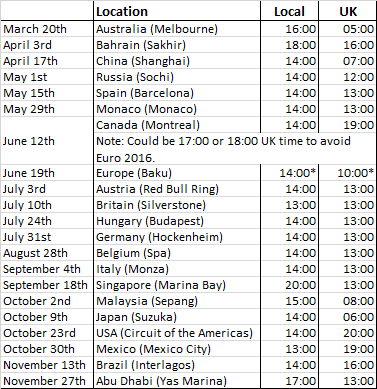
The finalised calendar is as follows:
The confirmed 2016 Formula One calendar.
I have done the calendar above as a table, given the amount of year-on-year changes, notably Russia and Malaysia swapping on the calendar. Furthermore, I have received confirmation from Channel 4 that the ‘pick’ process is identical to the previous BBC and Sky deal. The races that Channel 4 pick will be shown live on Channel 4 and Sky Sports F1, while the races that Sky pick will be shown exclusively live on Sky Sports F1, with highlights on Channel 4. The picks go as follows:
– Channel 4 pick three races (pick 1, 2 and 3)
– Sky pick three races (pick 4, 5 and 6)
– Channel 4 pick one race (pick 7)
– Sky pick one race (pick 8)
This continues until every race has been picked. There are 21 races on the calendar, so Channel 4 will screen ten races live with Sky screening eleven races exclusively live. If a race is dropped from the calendar, the picks do not change retrospectively. Germany was dropped from the 2015 calendar, but the picks stayed the same, meaning BBC were able to broadcast three races in a row live. Channel 4’s live sporting contracts consist of the Paralympics and horse racing, the latter of which occurs on the majority of Saturdays round the year. Avoiding every race that Channel 4 show is going to be incredibly difficult, however Channel 4 will be looking to avoid the major race days where possible. Bumping either a live major horse race or Formula 1 qualifying to E4 or More4 will do no one any favours.
Another factor that we need to consider is whether Channel 4 want the majority of their live races to be European based. Whilst it may not change the end result, it will influence the picking order in my view. There have already been questions about whether Channel 4’s current deal is commercially viable. David Elstein, a former executive of both Channel 5 and Sky, believes the deal is viable based on sponsorship alone, but notes that highlights will have adverts included, as we expected. Again, this post is only for discussion and a bit of fun with the pick orders. I am doing this a bit smarter though than previously, and applying all the rules that come along with the picking process as we go through the post. My tally for 2015 of getting 11 out of 19 correct was slightly better than usual though, which is good!
Channel 4 pick Britain, Abu Dhabi and Mexico (picks 1 to 3). Whether Britain and Abu Dhabi are compulsory picks I do not know, but given that one is the home race and the other is the final race, both of these are expected picks. Unfortunately, Britain will not rate well again in 2016 as it clashes with the first part of the Wimbledon final on BBC One. Channel 4’s third pick is between Canada, USA, Mexico and Brazil. Canada is not an option this early due to Euro 2016. USA starts at 20:00 and would mean interrupting Homeland mid-run (I know the F1 would rate higher, but let us not annoy Channel 4’s existing audience). Mexico therefore gets the nod over Brazil because it starts in primetime, but would still finish before 21:00. If anything, you could do something different and ‘wrap’ the F1 around Homeland, with studio based post-race analysis following Homeland at 22:00 (more on that line of thinking in a separate blog post in the next week or so).
The above means Sky automatically get Brazil (pick 21). Sky cannot have three exclusive races in a row, and Channel 4 cannot broadcast three live races in a row. Just to clarify, the above text says ‘pick 21’ as Sky would not waste a pick up front for Brazil when they know they are guaranteed the race regardless. Channel 4 will not be too fussed about losing Brazil given that it clashes with Sky’s second Ford Super Sunday game and the live viewing figures would be dented as a result. Therefore, Sky pick USA, Canada and Monaco (picks 4 to 6). USA and Canada are primetime races, whilst Monaco is the blue ribbon race on the calendar. I do think there is a choice between Monaco and Bahrain. Bahrain is the better timeslot, but it overlaps with the Premier League season, so I think Sky will opt for Monaco.
By Sky picking Monaco, it means Channel 4 automatically get Spain (pick 17) and Channel 4 automatically get Europe (pick19). Europe does fall in the same weekend as the Royal Ascot, but the time difference means that the Grand Prix qualifying session in Baku should have wrapped up before the horse racing action gets underway. In fact, having the two back-to-back could lead to a bumper day for Channel 4 on June 18th. In turn, Sky automatically get Austria (pick 20), otherwise Channel 4 would be screening Europe, Austria and Britain live consecutively. Next up, Channel 4 pick Bahrain (pick 7). The logic here is that it is simply the best timeslot left to pick from. In response, Sky pick Hungary (pick 8). The other choice is Australia, but Hungary is the much better timeslot and tends to pick up good numbers with it being the last race before the Summer shutdown. Plus, Sky may want to try and force Channel 4 to pick Australia knowing that it will be their first race, but let’s see if that tactic works in our predictions.
We are left in this position:
March 20th – Australia (Melbourne)
April 3rd – Bahrain (Sakhir) – Channel 4 (pick 7)
April 17th – China (Shanghai)
May 1st – Russia (Sochi)
May 15th – Spain (Barcelona) – Channel 4 (pick 17 – automatic)
May 29th – Monaco (Monaco) – Sky (pick 6)
June 12th – Canada (Montreal) – Sky (pick 5)
June 19th – Europe (Baku) – Channel 4 (pick 19 – automatic)
July 3rd – Austria (Red Bull Ring) – Sky (pick 20 – automatic)
July 10th – Britain (Silverstone) – Channel 4 (pick 1)
July 24th – Hungary (Budapest) – Sky (pick 8)
July 31st – Germany (Hockenheim)
August 28th – Belgium (Spa)
September 4th – Italy (Monza)
September 18th – Singapore (Marina Bay)
October 2nd – Malaysia (Sepang)
October 9th – Japan (Suzuka)
October 23rd – USA (Circuit of the Americas) – Sky (pick 4)
October 30th – Mexico (Mexico City) – Channel 4 (pick 3)
November 13th – Brazil (Interlagos) – Sky (pick 21 – automatic)
November 27th – Abu Dhabi (Yas Marina) – Channel 4 (pick 2)
I think at this point; Channel 4 will be looking for live early morning races where they can screen highlights/replays at a later time with adverts to a higher audience. Personally, Channel 4 pick Malaysia (pick 9). Malaysia is the best choice because of its unique timeslot. At 08:00, it means Channel 4 can screen it live and then broadcast highlights with adverts at around 15:00, so it is a win-win race for them. In response, Sky pick Russia (pick 10). It is either Russia or Italy, Italy is more prestigious, but Russia has a longer runtime and is therefore likely to bring in higher ratings. It also means that Channel 4 can now kill three birds with one stone. Channel 4 pick Italy (pick 11). Italy is the shortest race on the calendar, so there will only be around 90 minutes of air time without adverts which makes it more attractive to the commercial station.
Furthermore, Channel 4 picking Italy means that Sky automatically get Singapore (pick 18). This is good news for Channel 4 because Singapore clashes with the Paralympic Games, it is not in Channel 4’s interests to have two of their biggest events clashing with each other. Having Singapore as a highlights race means that Channel 4 can have a live race elsewhere.
The schedule therefore looks like this:
March 20th – Australia (Melbourne)
April 3rd – Bahrain (Sakhir) – Channel 4 (pick 7)
April 17th – China (Shanghai)
May 1st – Russia (Sochi) – Sky (pick 10)
May 15th – Spain (Barcelona) – Channel 4 (pick 17 – automatic)
May 29th – Monaco (Monaco) – Sky (pick 6)
June 12th – Canada (Montreal) – Sky (pick 5)
June 19th – Europe (Baku) – Channel 4 (pick 19 – automatic)
July 3rd – Austria (Red Bull Ring) – Sky (pick 20 – automatic)
July 10th – Britain (Silverstone) – Channel 4 (pick 1)
July 24th – Hungary (Budapest) – Sky (pick 8)
July 31st – Germany (Hockenheim)
August 28th – Belgium (Spa)
September 4th – Italy (Monza) – Channel 4 (pick 11)
September 18th – Singapore (Marina Bay) – Sky (pick 18 – automatic)
October 2nd – Malaysia (Sepang) – Channel 4 (pick 9)
October 9th – Japan (Suzuka)
October 23rd – USA (Circuit of the Americas) – Sky (pick 4)
October 30th – Mexico (Mexico City) – Channel 4 (pick 3)
November 13th – Brazil (Interlagos) – Sky (pick 21 – automatic)
November 27th – Abu Dhabi (Yas Marina) – Channel 4 (pick 2)
With not many races left, Sky have no exclusivity in the first part of 2016, until Sky pick China (pick 12). It is 50/50 between China and Australia, but the latter has lost a lot of its potential with the race starting at 05:00 UK time.
Australia, Germany, Belgium and Japan are the four races left to choose from. Inevitably, Channel 4 pick Belgium (pick 13). The shorter the race, the more adverts Channel 4 can cram in around the race, so Belgium is a great race for them in that respect. It also means that Sky automatically get Germany (pick 16). The weekend of Germany clashes with Glorious Goodwood, so Channel 4 will be happy that Sky get Germany exclusively live. Which leaves Australia and Japan. As they have done every year since 2012, Sky pick Australia (pick 14), meaning Channel 4 pick Japan (pick 15).
Which leaves us with this final calendar:
March 20th – Australia (Melbourne) – Sky (pick 14)
April 3rd – Bahrain (Sakhir) – Channel 4 (pick 7)
April 17th – China (Shanghai) – Sky (pick 12)
May 1st – Russia (Sochi) – Sky (pick 10)
May 15th – Spain (Barcelona) – Channel 4 (pick 17 – automatic)
May 29th – Monaco (Monaco) – Sky (pick 6)
June 12th – Canada (Montreal) – Sky (pick 5)
June 19th – Europe (Baku) – Channel 4 (pick 19 – automatic)
July 3rd – Austria (Red Bull Ring) – Sky (pick 20 – automatic)
July 10th – Britain (Silverstone) – Channel 4 (pick 1)
July 24th – Hungary (Budapest) – Sky (pick 8)
July 31st – Germany (Hockenheim) – Sky (pick 16 – automatic)
August 28th – Belgium (Spa) – Channel 4 (pick 13)
September 4th – Italy (Monza) – Channel 4 (pick 11)
September 18th – Singapore (Marina Bay) – Sky (pick 18 – automatic)
October 2nd – Malaysia (Sepang) – Channel 4 (pick 9)
October 9th – Japan (Suzuka) – Channel 4 (pick 15)
October 23rd – USA (Circuit of the Americas) – Sky (pick 4)
October 30th – Mexico (Mexico City) – Channel 4 (pick 3)
November 13th – Brazil (Interlagos) – Sky (pick 21 – automatic)
November 27th – Abu Dhabi (Yas Marina) – Channel 4 (pick 2)
We should know the final picks early into the New Year, definitely within the next few weeks I imagine. But that is how I imagine the picks turning out.
The 2015 Formula One season concluded in November with Mercedes finishing a dominant season. Off the track, what the future holds no one seems to know. As usual, the blog asked readers to give their opinion on BBC’s and Sky’s 2015 coverage, and the response was in stark contrast to last year.
Last year, many readers noted that Sky Sports F1’s coverage had improved. The opposite can be said this year, with multiple readers not keen on their 2015 service.
I enjoyed 2012 and 2013 seasons but since then it seems like Sky has lost its glory. A very limited production, no more season reviews, no more F1 Legends etc. very limited Classic races, they are not as active as they used to be in the first two seasons. – Ayrton01CZ
Overall, I thought that the BBC did a much better job in dealing with a dud season, whilst Sky came up with too many sensationalist non-stories, terrible features and montages, and also had naff commentary. – craighypheno
Jack Picko is also not keen on Sky’s coverage, notably the Fogglebox feature during the United States Grand Prix weekend, however did state that Ted Kravitz is still the “pound for pound the best reporter/presenter/commentator in the Formula 1 business”. The commentary duo of Martin Brundle and David Croft for Sky resulted in a lot of conflicting opinions, Rishi made an interesting comment in response to a lot of negativity directed towards the pair in comparison to the BBC commentary team:
Bit surprised to see Crofty and Brundle knocked so much in the comments. I actually think they’re the better commentary duo; in particular, I also think they’re better at reading a race and getting the drivers right. Ben Edwards has disappointed me somewhat at the Beeb as he tends to make fairly basic errors (naming drivers, getting results or strategies wrong); a shame as overall he has a good pedigree and is a commentator I respect (having listened to him back when A1 GP was around). We’re all human though and it is a tough job of course.
Given the news over the past few weeks, and potential developments that may or may not unfold soon, there was a lot of reflection focussing on BBC’s coverage:
BBC seem more comfortable in their own skin these days. They recognise it’s not 2010 any more in terms of personnel, budget or on track product and set their stall out accordingly. There’s a reasonable range of views, some sort of concession to the casual viewer and they don’t present in an uncritical manner. I also suspect that they do a good job of keeping Sky on their toes. – Richard
By far the best aspect of the BBC’s coverage were some of it’s VT’s, which as this blog has consistently pointed out, have been thoughtful and extremely well constructed. Cases in point: The Button Rallycross piece and the Max/Jos Verstappen feature. Clearly shot and edited by people who love the sport and make use of every penny to make sure it goes towards what’s on screen. – uf1redster
Lesmo makes a fascinating suggestion about a potential hybrid programme to save costs for both BBC and Sky, presenting value for money:
We could soon be back to the days of watching the race only, as I did in the ITV days. And on that note, if the resources of the BBC and Sky were pooled in some way; perhaps we’d get to keep the coverage and enjoy the quality of show we do today. Food for thought.
If ITV were to take BBC’s Grand Prix rights, questions would quickly turn to personnel. And, based on the feedback, Suzi Perry is one of the main choices for the presenter role:
Suzi Perry’s improved (see how little Coulthard has been surprised this year by the line of questioning) – Richard
Suzi Perry is growing on me now, she is the far better presenter of the two broadcasters. – Jack Picko
The Sky presenting team generated a lot of mixed responses, especially in response to their coverage of Lewis Hamilton, as alluded to earlier. Ayrton01CZ gives a summary of the current situation:
I still don’t understand what Lazenby is doing there, he is like an alien in the F1 paddock and clearly has nothing in common with the sport. The rest of the team sounds good on the paper, but (and here we go) to make everything around Lewis Hamilton is wrong. Yes, he’s British, he’s successful, but to praise him and to make a coverage all around him are two very different things. And to even have a problem to admit that someone else could be simply faster and it is not down to the technical problem… no, no, no. The basic rules of journalism are to be impartial and objective. Whatever is the reason (no theories here), it should not happen and they should go back to enjoying F1, the sport itself.
There were again one or two comments comparing the UK coverage to other parts of the world. As we come to the end of 2015 in uncertain muddy waters, this is a good comment to end on.
My point is simply that in the UK and EU, you have a cornucopia of excellent motorsport coverage – and a choice between not just one but TWO F1 broadcasters – and here in the USA we are living in the desert. You are very fortunate indeed to even entertain a discussion about “BBC F1 versus Sky Sports F1.” – geeyare
As always, the original post has a lot of detailed comments worth reading, the above is just a taster of what readers are talking about.
Normally British success in sport leads to an increase in television audiences for that particular event. In Formula 1, over the past eighteen months, the opposite appears to have occurred. Based on unofficial overnight viewing figures, the 2015 Formula One season recorded the lowest average audience since the 2007 season. Lewis Hamilton’s and Mercedes’s dominance has not had the intended effect.
> BBC records lowest average in modern times > Sky average drops back to 2013 level > Only two out of last eight races increased year-on-year
As I have done in previous years, it is worth re-iterating what exactly the numbers represent for those of you that are new to the blog. For Sky Sports F1, all viewing figures are for the three and a half hour race day slot. This covers the ‘Pit Lane Live’ and ‘Race’ segments in the EPG, the reason for this is to allow a fair comparison year-on-year. As thus, the equivalent slots are used for 2012, 2013 and 2014 to present a transparent picture and so the viewing figures presented are not misleading. Numbers also include any Sky simulcasts on Sky Sports 1, where applicable. For the BBC, the figures are all programme averages, irrespective of whether the programme was live or in highlights form, and irrespective of channel. Repeats are accounted for where Asian-based races were covered by the BBC live. As always, viewing figures do not include over the top methods of viewing such as BBC iPlayer and Sky Go.
The 2015 story
The trajectory that the 2015 season took is largely similar to that from two years ago. In my Summer post, I stated that 2015 was up on 2012 and 2014, but down on 2013. In 2013, the dominance of Sebastian Vettel sent audiences tumbling. In 2015, it is the dominance of Mercedes that appears to have a profound effect on viewing figures.
Sky Sports F1’s race day programme has averaged 638k from 12:00 to 15:30, or equivalent this season. That number is down 19.3 percent on 2014’s figure and down 0.4 percent on 2013’s figure of 640k. 2015’s average is also down 10.3 percent on 2012’s average of 711k. By a margin of around two thousand viewers, Sky’s average Formula 1 viewing figures are at their lowest level since they joined the sport in 2012. Given that the gap between 2013 and 2015 is only two thousand viewers, I’m reluctant to read too much into it as two thousand viewers is within the margin of error.
So what has happened here? In essence, any gain that Sky made last season has disappeared. A near 20 percent drop in viewers is bad, whichever way you look at it. There is perhaps some knowledge to be gained in stating that Sky’s numbers are back at 2013 levels when you consider both season’s followed similar patterns on the track. Whilst Sky was no doubt hampered by some races starting earlier, it is a fact that only four races increased year-on-year: Spain (+5.0%), Austria (+4.4%), Britain (+27.3%) and Italy (+7.5%). Twelve races recorded double digit drops compared with 2014, including the US Grand Prix which dropped 15.3 percent. That is not good and is a stark contrast to this time last year. The comparisons include the relevant Sky Sports 1 simulcasts for this year. I think Sky’s drop is a combination of the on-tract action being resolved early this year and also viewer apathy towards the product that Sky Sports have been putting out this year.
The BBC’s figures have dropped year-on-year by 3.6 percent, recording an average of 3.11m. It is their lowest average under this current deal, and therefore their lowest since the BBC returned to the sport in 2009. 2014 averaged 3.22m, whilst 2013 averaged 3.42m. At a time when the BBC’s current coverage is under threat, any drop does not make for good reading. However, eleven races actually increased their average audience compared with 2014. The biggest gainers were Bahrain (+60.9% – BBC showed highlights in 2014), Britain (+28.6%) and Austria (+27.0%). The reason that BBC’s average number is down is because of Mexico, a low-rating highlights race, plus the fact that three races lost over a quarter of their audience year-on-year (Singapore, Japan and Abu Dhabi). Undoubtedly, BBC’s biggest problem, and one of the major flaws in this current contract was that Lewis Hamilton’s championship victory was not screened live on free-to-air television.
An eight year low in the TV same day world
The combined average of 3.74m is down 6.7 percent on 2014’s 4.01m, down 7.3 percent on 2013’s 4.06m and down 4.5 percent on 2012’s 3.92m. For the first time since the current rights agreement between BBC and Sky started, both channels dropped year-on-year based on overnight viewing figures. Last year I commented on the closeness of the figures from 2012 to 2014. 2015 has dipped below that line as it were, meaning this season sits between 2007 and 2008 in the popularity stakes. Considering Formula 1 has a British world champion, the idea that viewing figures have dropped to an eight year low in the UK may be considered alarming to those within the sport.
The most watched race in 2015 was the Canadian Grand Prix which averaged 5.35m, whilst the season ending Abu Dhabi Grand Prix falls at the opposite end of the spectrum with 2.61m. As I noted earlier, all the numbers exclude online viewing, including iPlayer, Sky Go and Now TV. Including those methods of viewing would send 2015 above 2008’s average of 3.94m, but I would be surprised if it made much of a difference year-on-year, unless there has been drastic changes of viewing habits to more online methods from Grand Prix fans. If people are changing their viewing habits in relation to Formula 1, the question is why. There is always a reason if habits have changed, a live viewer does not become an on-demand viewer for an event which should be viewed live without a good reason.
It would be amiss I feel to write off 2015 as saying “well, online would increase numbers”. To do so would ignore the bigger picture. Formula 1 has well documented issues on and off the track at the moment concerning the spectacle the sport is presenting. One team dominating is historically a turn off for the casual viewer. Ferrari’s dominance in the mid 2000s led to a worldwide switch off (Germany and Italy aside). If the dominance of Mercedes is leading to the same pattern, then you have to be concerned. The casual viewer does not want to watch one team dominating. You can’t punish dominance, of course you can’t. But it does not help when that same team appears to be anti-racing, repeatedly. That is a switch off. Maybe you could blame Lewis Hamilton himself as the reason for the decline, in that he is in BBC’s and Sky’s coverage too much, and there is an argument that features with him as the main attraction do not move television ratings at the moment.
Heading into 2016
A dominant Mercedes or not, Formula 1 needs three things in 2016 if viewing figures are to move in a positive direction. A resurgent McLaren. Formula 1 cannot have two world champions at the back of the field. Fernando Alonso and Jenson Button should be near the front, competing for points and podiums, week in, week out. Secondly, Ferrari to challenge Mercedes. We did see flashes of it at the start of this season, but nothing ever materialised, aside from Singapore.
From a media perspective, Lewis Hamilton versus Sebastian Vettel writes itself. We never quite got it when Vettel was at Red Bull, plus other drivers were involved in the championship battle too. Hamilton versus Vettel, Mercedes vs Ferrari. It is something the casual audience would watch and become invested in. One of the reasons why 2011 was the most watched season in the modern era was not only because of Vettel, but because of Hamilton’s on-track duels with Felipe Massa. We need to see Hamilton versus Vettel, and I hope we see that in 2016. It would draw audiences, not only in the UK but in Germany too. In my opinion, Hamilton vs Nico Rosberg is not something the general public are interested in and the viewing figures reflect that.
Lastly, Formula 1 needs the BBC. Formula 1 needs the BBC more than the BBC needs Formula 1. The BBC could replace Formula 1 with repeats on a Sunday afternoon and claim one million viewers, whereas Formula 1 would need to find a new home on ITV or Channel 4, to a significantly reduced audience, more so on the latter. I’ll finish this piece with a quote from David Coulthard: “My personal view is that if F1 allows itself to lose free-to-air television coverage in the UK, it will not only affect the popularity of the sport, and by extension the teams’ ability to raise money to compete, but it will also reduce its exposure to the next generations of engineers and mechanics. F1 has inspired people to enter a workforce that numbers tens of thousands of people – the drivers are just the lucky ones at the end of the rainbow.”


 Motorsport Broadcasting