Unsurprisingly, both channels contain masses of Grand Prix footage dating back to before the war. The majority of the footage covers the period before 1982 – i.e. pre Formula One Management – however there is still some archive material that is clearly from FOM’s archive (but also AP’s, evidently) on the channel:
Unfortunately, given what has unfolded in the past week, the first page of results when searching for ‘Grand Prix‘ on AP’s YouTube channel are a few safety related videos, although this video in the aftermath of the 1994 San Marino Grand Prix is one that I have not seen before. It shows Max Mosley addressing the media on the Wednesday following the events of that weekend:
More recently, we have the outcome of the McLaren 2007 spying case, with Norbert Haug, Ron Dennis and Pedro de la Rosa trying to escape the court room:
I don’t know how many motor racing videos have been uploaded to the AP’s and Movietone’s YouTube channel, but there will almost certainly be some hidden gems in the collection that has been uploaded.
The Formula 1 paddock returns from its first Summer break to what is going to be a sombre weekend at the Hungaroring, for the Hungarian Grand Prix.
The scheduling details can be found below:
BBC F1 BBC TV – Sessions
24/07 – 08:55 to 10:35 – Practice 1 (BBC Two)
24/07 – 13:00 to 14:40 – Practice 2 (BBC Two)
25/07 – 09:55 to 11:10 – Practice 3 (BBC Two)
25/07 – 12:10 to 14:20 – Qualifying (BBC One)
26/07 – 12:15 to 15:15 – Race (BBC One)
26/07 – 15:15 to 16:15 – Forum (BBC Red Button)
BBC Radio – Sessions
24/07 – 08:55 to 10:35 – Practice 1 (BBC Radio 5 Live Sports Extra)
24/07 – 12:55 to 14:35 – Practice 2 (BBC Radio 5 Live Sports Extra)
25/07 – 09:55 to 11:05 – Practice 3 (BBC Radio 5 Live Sports Extra)
25/07 – 12:55 to 14:05 – Qualifying (BBC Radio 5 Live)
26/07 – 12:30 to 15:00 – Race (BBC Radio 5 Live)
Supplementary Programming
23/07 – 21:00 to 22:00 – Preview (BBC Radio 5 Live)
24/07 – 18:45 to 19:00 – Inside F1 (BBC News Channel)
25/07 – 11:10 to 12:10 – F1 Rewind (BBC Two)
25/07 – 19:45 to 20:00 – Inside F1 (BBC News Channel)
Sky Sports F1 Sessions
24/07 – 08:45 to 11:00 – Practice 1
24/07 – 12:45 to 15:00 – Practice 2
25/07 – 09:45 to 11:15 – Practice 3
25/07 – 12:00 to 14:35 – Qualifying (also Sky Sports 1)
26/07 – 11:30 to 16:15 – Race (also Sky Sports 1)
=> 11:30 – Track Parade
=> 12:00 – Pit Lane Live
=> 12:30 – Race
=> 15:30 – Paddock Live
Supplementary Programming
23/07 – 14:00 to 14:30 – Driver Press Conference
23/07 – 20:45 to 21:00 – Paddock Uncut: Hungary
24/07 – 16:00 to 16:45 – Team Press Conference
24/07 – 17:00 to 18:00 – The F1 Show: A Tribute to Jules (also Sky Sports 1)
29/07 – 20:30 to 21:00 – Midweek Report
GP2 Series – Hungary (Sky Sports F1)
24/07 – 11:00 to 11:50 – Practice
24/07 – 14:50 to 15:30 – Qualifying
25/07 – 14:35 to 16:05 – Race 1
26/07 – 09:30 to 10:45 – Race 2
GP3 Series – Hungary (Sky Sports F1)
25/07 – 08:45 to 09:25 – Qualifying
25/07 – 16:15 to 17:15 – Race 1
26/07 – 08:20 to 09:20 – Race 2
If anything changes, I will update the schedule above.
The 2014-15 Formula E season came to a thrilling climax on June 28th from Battersea Park in London, with Nelson Piquet, Jnr clinching the championship in a finale that could be described as the electric version of the 2008 Brazilian Grand Prix. Overall, the inaugural season has been a success, ten cities hosting eleven rounds. But what has gone well, what hasn’t gone well and what could be improved for season two? There are a lot of lessons that the championship could learn going forward, but also some things that they should be congratulated on.
Viewing figures and scheduling
According to overnight viewing figures from overnights.tv, the inaugural season of Formula E averaged 216k (2.6%) on ITV4 for their eleven race day programmes, with an average peak audience of 366k (4.1%). It is worth remembering that the championship decider was broadcast live on ITV to an audience of 700k (6.9%). Removing that number brings Formula E’s average down to 168k (2.2%), with an average peak of 285k (3.4%). Broadcasting the final race live on ITV’s main channel made a huge difference to the season average. The audiences for ITV4 have been solid, but they have not been spectacular. In my opinion, I don’t think ITV is all to blame for that.
Formula E: the future?
Some of Formula E’s scheduling decisions during season one were bad, some their own fault, and some beyond their own control as we saw with Malaysia being moved from October to November, thus creating a two month gap between rounds one and two. Their season two calendar unfortunately does not fill me with much hope. The Formula One season starts in April, and I had hoped that Formula E would take advantage of that fact. Instead, what the provisional calendar shows is an seven week gap between rounds three and four, with a further six week gap between rounds four and five, neither gap makes much sense. Formula E should capitalise on Formula 1’s absence with a race every three weeks (Christmas aside), if feasibly possible.
The season two problems are compounded by Battersea Park’s date currently showing as TBA. The calendar needs to be more compact, to get the viewers into a routine in the off-season. From ITV’s perspective, it is difficult to promote something that is not on regularly. There’s less incentive for ITV to broadcast races on their main channel with long gaps. As of writing, we don’t know whether ITV will be covering Formula E for season two. I assume the answer is yes, given that ITV’s Formula E presenter Jennie Gow has referenced Formula E in some of her tweets recently, in but this has yet to be confirmed to me. I would outline what I think ITV should do scheduling wise for season two, but I think it is worth waiting until official confirmation that they are actually screening season two live first…
Graphics and Direction
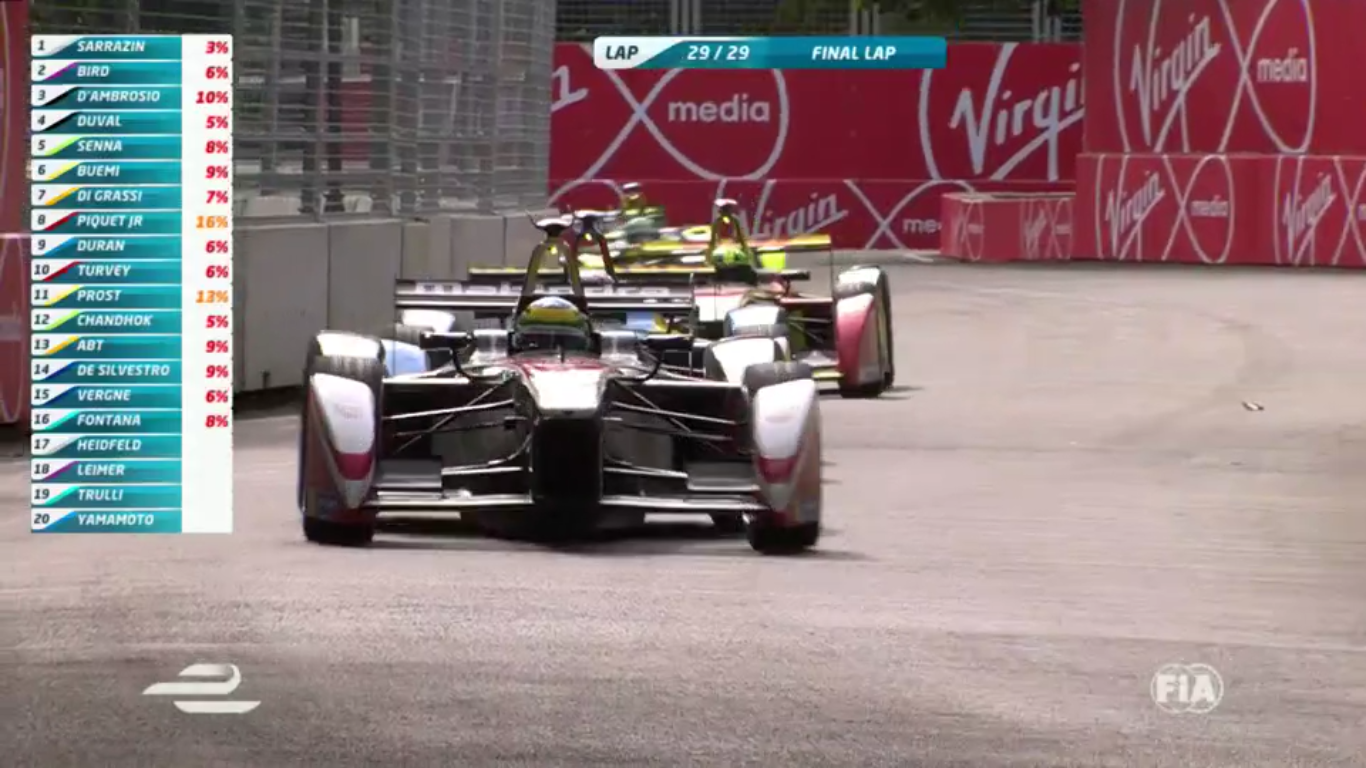
The World Feed for Formula E’s inaugural season was produced by Aurora Media, who packaged each session with their own broadcast crew, led by Nicki Shields, with Jack Nicholls and Dario Franchitti on commentary (more on that later). From a graphical perspective, the package was slick, and looked great in high definition. Unfortunately, the graphics did not stand up very well in standard definition, which was evident when I watched the races live on ITV4. The main timing graphics wall, which included the energy percentages, was superb. Easy on the eye, allowing the casual viewer to easily track the story of the race. Kudos to whoever came up with that idea for the percentages on screen, because it was executed fantastically. There were two graphics in my opinion which suffered from fatal flaws.
The first problem was the speedometer, which stayed the same for the entire season. The problem here was that too much information was being conveyed in a small amount of space. One of the core fundamentals of any user interface is that the user should be able to understand what it is telling you within around 10 seconds. When I’m looking at the speedometer, what exactly am I focusing on? And is that information important for the casual viewer? If the guy who watches every race struggles to understand or digest the graphic, then the casual viewer has no chance. It is good that this information is being provided to the viewer, but it certainly needs to be separated out to be made more useful (aka. separation of concerns).
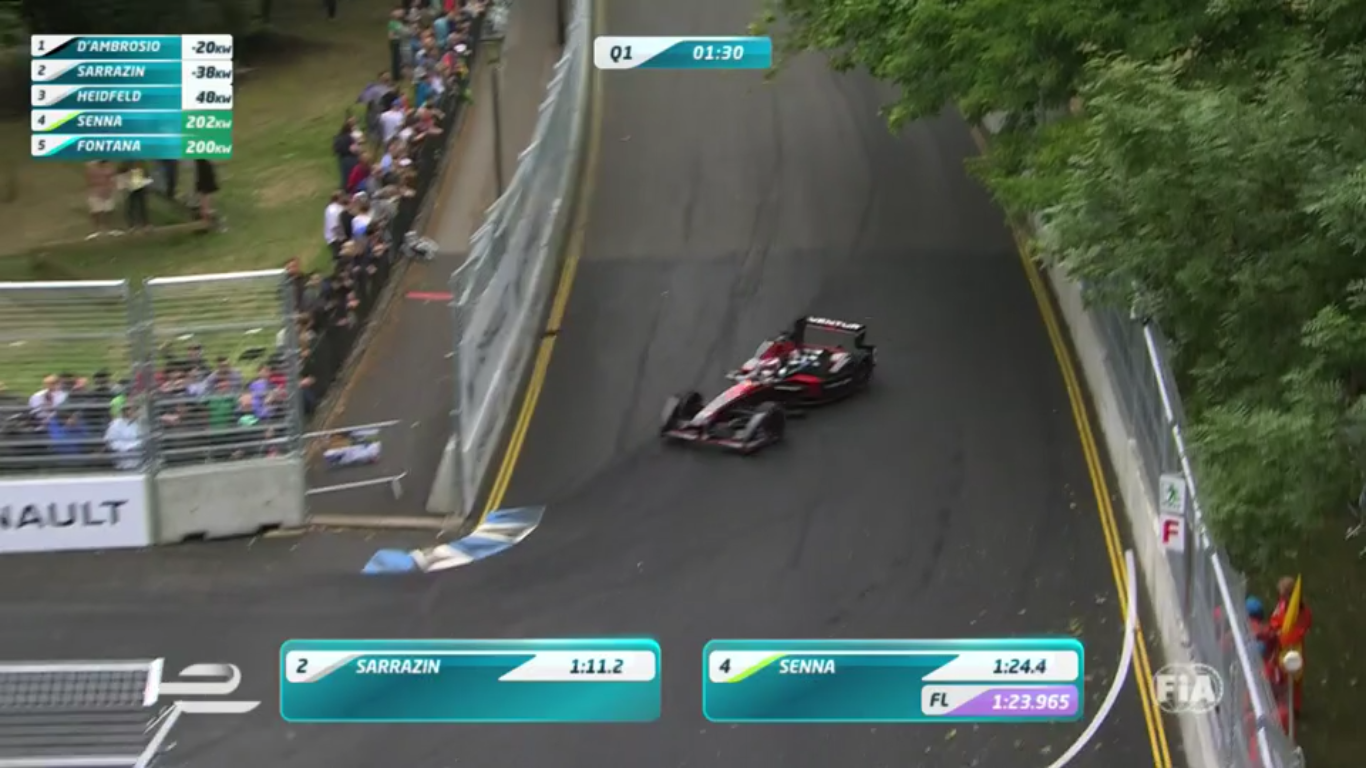
The qualifying kW output during the second 2015 London ePrix.
The second problem I found concerned the qualifying graphics. I also want to put this under the “let’s make the commentators job easier” category. The graphic itself is an addition to the timing wall, and normally sits to the right of it, which shows the amount of kilowatts that the driver is currently using. Normally, it is either 150 kW for a slower lap and 200 kW for a fast lap. The problem I have is that the graphic fluctuates considerably as the driver goes round the lap, sometimes even going into negative values. I mentioned this on Twitter a while back, and the reaction to the graphic seemed positive so it may be just me that feels this way.
Across the season, the direction was largely good, highlighted by the superb camera angles. I don’t think you can ever get tired of seeing Formula E cars leap over kerbs and hurl themselves towards the fence and the onlooking camera. One worry before the season was whether the camera angles would convey the speed well, however for me this was quickly dispelled with round one in Beijing, as described above. Not every round was perfect, I didn’t think the open airfield of Berlin portrayed the cars well, as it meant that the camera angles were not generally as close as previous rounds. But overall, it was good and for the most part it was clear that the team were learning as they went along, the pit sequence an example of something which improved significantly as the season progressed, helped by the aforementioned on-screen graphics.
However, as with the graphics, there were two aspects about the direction that I wasn’t a fan of: cutaways and heli-cam. I can understand the occasional cutaway to Alain Prost or whoever in the pit lane. But as the season progressed, the cutaways felt more intrusive on the coverage, and also held onto the subject for far too long, some shots seemingly stuck forever. A separate issue was heli-cam. It works the majority of time in Formula 1 as it can help visualise the speed at places like Monza. But when the Formula E cars are slower than other single-seaters as it is, you really shouldn’t use any shots that highlights this fact. The heli-cam was used frequently in London, and I wasn’t a fan. I don’t like saying this, but the direction behind the restart of the second London race was a mess as a result.
Commentary, other bits and looking ahead
The commentary team of Jack Nicholls and Dario Franchitti does not need much explanation, nor analysis. Why? Because it was Nicholls and Franchitti that helped made Formula E what it became during season one. It would not be an exaggeration to say that Nicholls and Franchitti are currently the best motor sport commentary duo around. The young, energetic style of Nicholls alongside the veteran analysis from Franchitti is a fantastic combination, and one that I hope is maintained for season two. It certainly deserves to be.
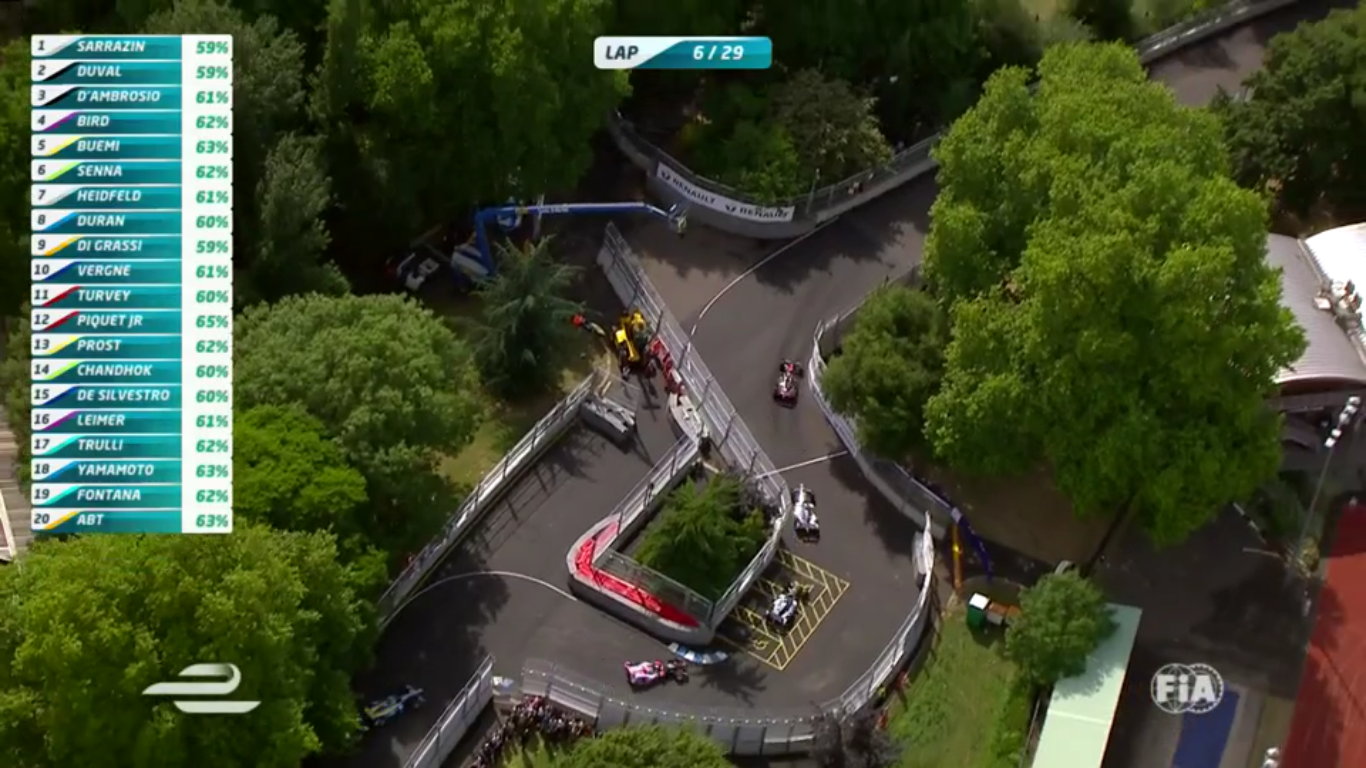
A helicopter shot looking down at Battersea Park during the second 2015 London ePrix.
A few other bits to round off. Social media is good, with great use of Grabyo for instantly sharing clips from the race, which has paid off with famous stars sharing the clips. Weirdly though, there has not been much direct interaction with fans from Formula E themselves, in the form of Q&A’s and the like. Furthermore, I found that Formula E did not promote their own live streaming, which was incredibly bizarre. I mean, if you want someone to access the live streaming, surely you would provide a direct link to it? As I say, the social media content itself is great, but the interaction, not so. The website is okay, but it is not optimised for mobile browsing as far as I can see. Speaking of live streaming, if you didn’t have a direct link to it, chances are you would find it difficult to spot it. It is silly that the Video page, linked from the homepage, has none of the full sessions listed, but the Live Streaming page, not linked from the homepage, has every session listed. A goldmine if you want to grab new fans, if you ask me, which is not being exploited.
Season one for Formula E has gone incredibly well. Have they proved the naysayers wrong? I’d like to think so. The points I have outlined above will only serve to get better as time progresses. The cars will only get faster, the technology will become more mainstream and attract a bigger audience. Formula E has its baseline. But the race is not over. The chase for viewers is only just beginning. Please, just don’t do anything stupid. Keep it free and accessible, and you will attract more viewers.
Oh, and the segway is fantastic. Never forget the segway.
Note: This post is now rendered obsolete following the announcement that Channel 4 will be taking over the BBC’s rights from 2016 onwards. A new post will be uploaded in due course.
In the biggest shake-up of the Formula 1 calendar in quite some time, the 2016 season will contain 21 races, with a bit of a calendar reshuffle. The season was originally set to start in April, but now it looks like a March start is back on the cards. It is tradition for The F1 Broadcasting Blog each year to predict the BBC and Sky pick order. The main changes are that Malaysia and Russia swap ends on the calendar. Baku, listed as the European Grand Prix, has been added in June, controversially clashing with the 24 Hours of Le Mans. 2016 is the fifth year of the current BBC and Sky broadcasting contract. The calendar, as it is stands, is therefore as follows:
The 2016 Formula One calendar.
I’ve done the calendar above as a table, given the amount of year-on-year changes, it means that there are a few timing changes which may influence the pick order – although sadly for BBC, the Australian Grand Prix will not be on at 07:00 UK time! Because of the way the BBC and Sky deal works, both sides have to ‘pick’ races. The races that BBC pick will be shown live on BBC One and Sky Sports F1, while the races that Sky pick will be shown exclusively live on Sky Sports F1, with highlights on BBC One. The picks go as follows:
– BBC pick three races (pick 1, 2 and 3)
– Sky pick three races (pick 4, 5 and 6)
– BBC pick one race (pick 7)
– Sky pick one race (pick 8)
This continues until every race has been picked. There are 21 races on the calendar, so BBC will screen ten races live with Sky screening eleven races exclusively live. We found out earlier this year that the picks do not change in the event of a race being dropped from the calendar. Even though Germany was dropped from the 2015 calendar, the picks stayed the same, meaning BBC were able to broadcast three races in a row live. There are a lot of different factors in the 2016 season, more so than usual, with the European Championships playing a part throughout the middle phase of the season. However, crucially, the Olympic Games does not clash with the Formula 1, which is a genius move. Again, this post is only for discussion and a bit of fun with the pick orders. My tally for 2015 of getting 11 out of 19 correct was slightly better than usual though, which is good!
BBC pick Britain, Abu Dhabi and Brazil – Abu Dhabi and Britain are compulsory picks being the last race of the season and the home race respectively. From the BBC’s perspective, USA and Mexico run deep into primetime at a time of the year where they will have big programming, and Canada clashes with the opening weekend of Euro 2016, so again Brazil is the only option for their third pick in my view. What it does mean is that they definitely cannot pick Mexico, as they can’t have three live races in a row. Does the fact that the title race looks likely to be resolved earlier than usual change things? I don’t think so given that Mexico and USA run deeper into primetime than Brazil, and thus would disrupt BBC One’s schedule more. I’d expect to see Sky picking Canada, USA and Australia. It’s a tie between Australia and Monaco really, but the season opener is still a big deal in the eyes of Sky. BBC could in theory pick Australia instead of Brazil, but they haven’t picked Australia since this deal began, and I don’t see that changing. There might have been more chance of BBC picking Australia had it stayed in April, but not now. Ridiculously, the British Grand Prix now falls on the same day as not only the Wimbledon final (meaning demotion to BBC Two) but also with the final of Euro 2016.
Mexico and Monaco I would expect to be on BBC’s and Sky’s agenda early, a primetime race and a prestigious race. Bahrain too has to figure somewhere, arguably its positioning makes it a great pick for BBC. I can see BBC picking Bahrain, and as discussed earlier, Sky pick Mexico. In reality, Mexico would probably be left until the end given that BBC have already gone for the last two places, but I’m trying to do it blocks so the post does not get too confusing. Mexico takes priority over Monaco because it could be a championship decider.
We are left in this position:
March 20th – Australia (Melbourne) – Sky
April 3rd – Bahrain (Sakhir) – BBC
April 17th – China (Shanghai)
May 1st – Russia (Sochi)
May 15th – Spain (Barcelona)
May 29th – Monaco (Monaco)
June 12th – Canada (Montreal) – Sky
June 19th – Europe (Baku)
July 3rd – Austria (Red Bull Ring)
July 10th – Britain (Silverstone)
July 24th – Hungary (Budapest)
July 31st – Germany (Hockenheim)
August 28th – Belgium (Spa)
September 4th – Italy (Monza)
September 18th – Singapore (Marina Bay)
October 2nd – Malaysia (Sepang)
October 9th – Japan (Suzuka)
October 23rd – USA (Circuit of the Americas) – Sky
November 6th – Mexico (Mexico City) – Sky
November 13th – Brazil (Interlagos) – BBC
November 27th – Abu Dhabi (Yas Marina) – BBC
Normally, at this stage, I’d work down from start to finish, but Euro 2016 complicates matters. For that reason, I think we will see BBC pick Monaco and Sky pick Italy. It is unusual for me to label Monaco as pick nine, but I do think BBC will consider Bahrain high priority, whilst the addition of Mexico bumps it further down the order. BBC are certainly not going to jump for any race that clashes indirectly or directly with Euro 2016. Sky probably would want some exclusive live F1 content during the Summer next year, but it certainly won’t be at the sacrifice of screening either USA or Mexico exclusively live, for example. Following that, BBC pick Germany, Sky pick Belgium, BBC pick Singapore and Sky pick Malaysia. Lastly in this set, BBC pick Russia and Sky pick Spain. Spain does clash with the end of the Premier League season though, which is worth bearing in mind.
The schedule therefore looks like this:
March 20th – Australia (Melbourne) – Sky
April 3rd – Bahrain (Sakhir) – BBC
April 17th – China (Shanghai)
May 1st – Russia (Sochi) – BBC
May 15th – Spain (Barcelona) – Sky
May 29th – Monaco (Monaco) – BBC
June 12th – Canada (Montreal) – Sky
June 19th – Europe (Baku)
July 3rd – Austria (Red Bull Ring)
July 10th – Britain (Silverstone) – BBC
July 24th – Hungary (Budapest)
July 31st – Germany (Hockenheim) – BBC
August 28th – Belgium (Spa) – Sky
September 4th – Italy (Monza) – Sky
September 18th – Singapore (Marina Bay) – BBC
October 2nd – Malaysia (Sepang) – Sky
October 9th – Japan (Suzuka)
October 23rd – USA (Circuit of the Americas) – Sky
November 6th – Mexico (Mexico City) – Sky
November 13th – Brazil (Interlagos) – BBC
November 27th – Abu Dhabi (Yas Marina) – BBC
We’re left with China, Baku, Austria, Hungary and Japan. BBC cannot pick China or Hungary, Sky cannot pick Japan, otherwise they would be showing three races in a row live, which they cannot do unless something drops out. At this stage, it is between Baku and Austria. It is assumed that Baku will clash with the final few hours of the 24 Hours of Le Mans but not the end of the race. Austria clashes with the London ePrix, but it is not a direct clash – the ePrix starts at 16:00 UK time, although there will be personnel clashes. I think BBC pick Austria as it forms a double-header with Britain. Sky pick Baku, BBC pick Japan and Sky pick both China and Hungary.
Which leaves us with this final calendar:
March 20th – Australia (Melbourne) – Sky
April 3rd – Bahrain (Sakhir) – BBC
April 17th – China (Shanghai) – Sky
May 1st – Russia (Sochi) – BBC
May 15th – Spain (Barcelona) – Sky
May 29th – Monaco (Monaco) – BBC
June 12th – Canada (Montreal) – Sky
June 19th – Europe (Baku) – Sky
July 3rd – Austria (Red Bull Ring) – BBC
July 10th – Britain (Silverstone) – BBC
July 24th – Hungary (Budapest) – Sky
July 31st – Germany (Hockenheim) – BBC
August 28th – Belgium (Spa) – Sky
September 4th – Italy (Monza) – Sky
September 18th – Singapore (Marina Bay) – BBC
October 2nd – Malaysia (Sepang) – Sky
October 9th – Japan (Suzuka) – BBC
October 23rd – USA (Circuit of the Americas) – Sky
November 6th – Mexico (Mexico City) – Sky
November 13th – Brazil (Interlagos) – BBC
November 27th – Abu Dhabi (Yas Marina) – BBC
I don’t think we will know the actual picks until the New Year, as the Euro 2016 draw does not take place until December. Either way, this is an initial guess at how things will transpire.
The date: Friday 29th July 2011. The location: Budapest. The time: 07:00 UK.
The press release went out. The paddock left to clean up the mess, as the fans looked on in shock and disbelief. “BBC TV and Sky Sports have been awarded the live rights to Formula 1™ between 2012 and 2018”, were the words at the top of the press release.
It was something that the majority of Formula 1 fans in the UK feared would happen. The move was a result of the licence fee settlement the previous Autumn, which meant that the BBC had to tighten budgets in all departments. It was either Six Nations, Wimbledon or Formula 1 that was going to be chopped. Axing Wimbledon or the Six Nations, both of which have been BBC staples for decades, would have been extremely controversial, especially when you consider the number of people that play tennis and rugby at grass roots levels.
The axe swung towards Formula 1, as the BBC entered a deal with Sky Sports. The move was controversial, more so considering that the sport in the UK was at its peak in popularity. Despite Sebastian Vettel’s dominance, the majority of races in 2011 peaked with over six million viewers. Since then, numbers have dropped. When Formula 1 bosses wonder why some fans are more vocal than previously in relation to the current on-track product this season, I’d give the same answer that I gave to BBC’s chief F1 writer Andrew Benson on Twitter: “People are more likely to complain about something that they have to pay for rather than something that is free to air…”
So, why did the BBC go into allegiance with Sky and not another free-to-air broadcaster? Unfortunately for BBC, ITV had already allocated budgets for 2012 to cover the European Championships, and therefore could not be considered. Channel 4 were also not considered, despite their interest in securing the rights. I mention this in light of yesterday’s news that the Six Nations rights will be shared between BBC and ITV from 2016 to 2021. There are some similarities between the two, but also some interesting differences. The main similarity in both cases is that the original BBC contract ended early. For Formula 1, the BBC contract was originally 2009 to 2013. BBC renegotiated the contract in the middle of 2011. BBC’s current Six Nations contract was scheduled to last until 2017, except the shared offering with ITV means that the new contract will begin with immediate effect. The reasoning though is different. BBC were always going to get into discussions with the Six Nations Council at this stage it appears. However, Sky Sports also tabled a bid, which led BBC to go to ITV, tabling a joint bid to knock Sky off to stage left.
The key difference between the F1 situation and the Six Nations situation is that the BBC were able to bring ITV as partner on board for the rugby, which they couldn’t do for the F1 due to the point made above. The benefit of any joint BBC and ITV bid is that it is far more compelling for a rights holder to accept a joint bid from free-to-air broadcasters than a single one from a pay-TV broadcaster given the extra exposure that it would bring to the championship. However, BBC were left with no other choice. Had they not gone into partnership with ITV, then they risked either losing the Six Nations completely or needing to go into partnership with Sky Sports. The reaction to the last partnership would be a lot more volatile than the former option…
We’re half-way through the current Formula 1 contract. What happens next? For the next six to nine months, nothing. As mentioned earlier, the current contract between BBC, Sky and FOM runs out at the end of 2018. With the recent licence fee settlement that played out earlier this week. At the moment, no one knows what BBC Sport’s budget will or will not be in the years to come, but one thing is for sure, it will be lower, hence why BBC could not justify outbidding Sky for the Six Nations. The situation is complicated, and there are a lot of different factors that come into play. Do BBC and Sky want to continue their existing relationship? Or would BBC prefer to be in partnership with another free-to-air channel? And where does BT Sport fit into this, if anywhere?
My gut instinct tells me that the deal will be renegotiated before the end of the contract. By renegotiation, I do not mean BBC pulling out the contract. What I mean is BBC and Sky renegotiating their existing contract, in order to extend it to around 2021 or 2022. This assumes that the BBC are happy with the current product, the current viewing figures, what they are currently paying compared with what they are getting and whether they can afford to pay that much. If BBC cannot pay that much, could we realistically see a situation where the BBC only broadcasts only the British, first and last races live? I don’t know. But I definitely think the current deal will be renegotiated early, from the BBC’s longer term perspective that probably is the best option rather than letting the contract run until its end. It would also be to Sky’s benefit as well, as it would mean that BT Sport do not get a look in. Running the contract to the end risks BT Sport and Sky Sports fighting over the live contract alone, should they wish to. However, it also depends whether FOM wishes to take the money or the viewers. As motorcycling fans will know, we’ve been in this position before.
ITV’s F1 contract was meant to last until 2010. They exited in 2008.
BBC’s F1 contract was meant to last until 2013. They renegotiated in 2011.
BBC’s and Sky’s current F1 agreement is meant to last until 2018. I suspect 2016 will be a very interesting year in F1 broadcasting…


 Motorsport Broadcasting