F1 Broadcasting tackles Silverstone’s Single Seater Experience

Most of the motor racing world this past weekend was in Goodwood for the annual Festival of Speed. However, instead of watching the festival in person or via Sky Sports, this writer instead took a trip to Silverstone…

Despite having watched Formula 1 and other forms of motor sport for nearly two decades, I have never been near a live single-seater racing car to race in. The nearest I had ever come was through various go-karting outings for leisure, or sitting in the Jaguar R2 at the local factory many moons ago. So, Silverstone’s Single Seater Experience was a first for me, one day after my 25th birthday. I should note that this article is not a paid article, or an advertisement for that matter, but instead just somewhere for me to jot my musings.
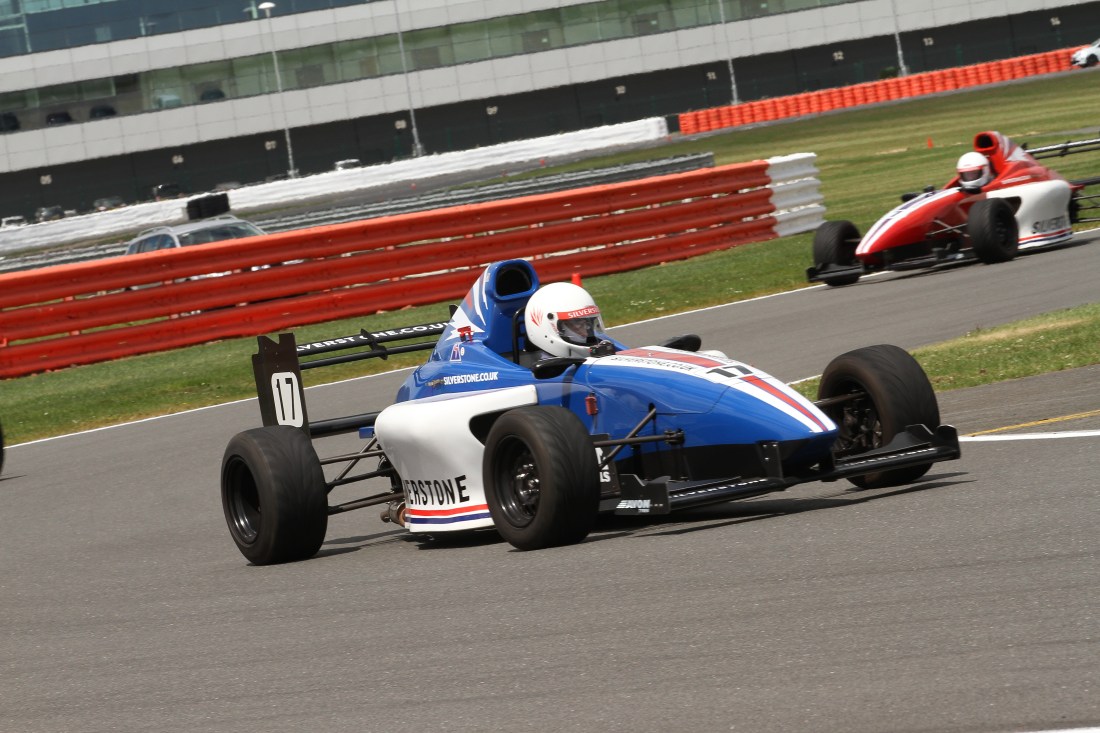
RK7_0081.JPG
On-track at Silverstone.

Before the experience is a 30 minute debrief, which for the motor sport nut, is nothing of surprise, but instead it serves as a reminder about the inherent dangers that single-seater racing brings. The key terminology, such as understeer and oversteer, is described language that the layman can understand. It is fundamentally clear from the outset that any transgressions will be immediately dealt with: safety comes before enjoyment.

The experience around Silverstone’s Stowe Circuit is 30 minutes long: 10 minutes behind the pace car and 20 minutes without, with eleven other drivers alongside you. Sometimes you hear Formula 1 drivers’ say that after 10 minutes of testing, you know whether you have a good car underneath you. The same can be said here. The first lap out of the pits is frankly nerve wracking. Where are the braking points? Am I in the right gear? Do I feel comfortable? Am I too close to the pace car? It sometimes can look so easy from the outside, but from the inside it is like juggling multiple balls.

As the laps progress, you start to get a better understanding of the car and those around you. You take that line here, this line there. It gets easier, but concentration must remain throughout. The instructors do a brilliant job beforehand to prepare you for the experience, but on the track, it is you making the split-second decisions.

I required a helmet change to a smaller size half way through, mainly because the wind and fast speeds down the back straight was ‘lifting’ the helmet up. I could have soldiered on for a few more laps, but (as the above video shows) I did the right thing by changing helmets to a smaller size.

As the instructor said: safety before enjoyment, and in this case the helmet issues was slightly detracting from the overall enjoyment. As the laps progresed, the lap times decreased, confidence growing, although at one point the car underneath me did come perilously close to the gravel trap at the North hairpin!

I had a huge amount of respect for motor racing drivers before I completed the Single Seater Experience. No matter how many times you watch motor racing on television, nothing can prepare you for the real machinery. The likes of Lewis Hamilton and Daniel Ricciardo make it look easy, when in reality it is completely the opposite, even when going down the one kilometre straight in Baku.

If anything, my experience at Silverstone solidifies the admiration I have for the drivers that race to entertain the viewing audience at home and in the grandstands. I would strongly recommend this (or any other Single Seater Experience) to other fans of the sport, it is seriously worth the price tag. Overall, it was a pretty amazing experience.

Looking at BBC’s 5 Live Formula 1 output

Throughout the past year and a half, most of focus on this site has been on the Formula 1 television coverage provided by Channel 4 and Sky Sports. If you have access to both of those channels, like myself, you probably do not consume much content that the third UK F1 broadcaster produces.

Whilst the BBC exited its Formula 1 television contract at the end of 2015, it extended its radio commitments until the end of 2021, also retaining a strong website presence. Jack Nicholls leads BBC’s radio coverage, with Tom Clarkson alongside him. Jennie Gow, Mark Gallagher and Allan McNish are the other regular experts, but this varies from race to race depending on their other commitments.

BBC’s 5 Live offering in terms of hours produced has stayed the same since the television team departed, but the resource involved has decreased. Cut backs meant that commentary on some of the fly away races occurred from 5 Live’s London studios. One race that fell into this category was the Canadian Grand Prix. Despite the obvious hurdles, the output that is as strong as ever.

At most races, a one-hour preview show airs preceding each race weekend, a staple of 5 Live’s programming since 2001. The Thursday show wraps up the day’s interviews along with some opinion and analysis, looking ahead to the weekend ahead. The BBC team was joined for the Canadian weekend by Nicholls’ former Blancpain sparring partner John Watson, Watson joining Nicholls in their London studio.

The main thing I appreciate about the preview show is the in-depth conversation that occurs. The preview show in Canada featured free-flowing conversation between Nicholls, Watson, Clarkson, and BBC website reporter Andrew Benson, as they discussed Ferrari’s Monaco race and Lance Stroll’s performances so far, this season (before his magnificent podium in Baku).

The big difference between commercial television and BBC 5 Live is that the latter can ‘afford’ to have chat of that nature, which the F1 team uses to their advantage. With commercial television, there is always pressure to get to the next feature or advert break, which is not an issue on radio. Yes, there may be pressure to hit the half hour news bulletin, but the pressure on commercial television producers is far greater in my view.

5 Live also airs live coverage of every practice session and qualifying, either online or through their digital radio station 5 Live Sports Extra, when there are no other sporting clashes. Their coverage focuses on the World Feed output only, with no additional analysis before or after the session. Additionally, the official F1 App takes the 5 Live commentary all season.

Most of the attention and resource is on the race itself, which can have up to half an hour of build-up, with some reaction provided afterwards. This amount is dependent on other sporting clashes, and with Formula 1 no longer on BBC television, motor sport inevitably it loses out in the event of a clash (as was the case one race later in Baku). Following the race, the team also produces a podcast for listeners to download.

Despite Nicholls and Watson presence in London, you would have not known that from a cursory glance at their commentary. If anything, the difference for being ‘off tube’ in 2017 is significantly less than twenty years ago. The BBC would have used a single monitor, a microphone and a ghost commentator back in the 1990s, whereas nowadays you have monitors showing multiple feeds (World Feed, on-board, driver tracker). There is also social media, which will help commentators (irrespective of location) gather facts if the World Feed does not pick something up. So being off site is less of a disadvantage in 2017 than previous eras.

The post-race discussion after the podium is concise, allowing 5 Live to head off to their next sporting commitment. However, the BBC team produces a post-race review show, also in podcast form for listeners to download, useful for the Monday morning commute. Whilst I listen to the podcast far less than what I probably should, on this occasion it is an enjoyable listen, with a variety of interviews from drivers and team personnel.

At 24 minutes in length for the Canada podcast, there is enough time to discuss the Mercedes and Ferrari battle, with discussion not just on Hamilton and Vettel, but also on the number two role that Valtteri Bottas played. The Force India squabbles (which boiled over one race later) and the contrasting fortunes of the Red Bull drivers were also up for discussion. The only disappointment is that Lance Stroll’s strong performance (at the time) only got a passing mention, so there is some restriction on the time length involved, the show is replayed overnight in a 30-minute slot, which may explain the restriction.

The BBC deciding to get out of their television contract at the end of 2015 inevitably had a knock on effect for their radio coverage, who no longer had the TV team alongside them to share personnel with. Nevertheless, BBC’s 5 Live output for Formula 1 remains remarkedly strong from a programming perspective despite the obvious funding constraints: yes, being in London for the flyaways is not an ideal situation, but on the other hand I’m grateful that we (as a result, you could argue) hear voices that we don’t usually hear – and I would be keen to hear Watson more in 5 Live’s output.

Brilliant Baku helps Formula 1 attract season high

Formula 1 attracted its highest average audience of the season thanks to a dramatic Azerbaijan Grand Prix, overnight viewing figures in the United Kingdom show.

Race
Even though this was the first race under the Azerbaijan Grand Prix banner, it was the second race held at the Baku City Circuit. Given that both races in Baku have occurred in June, it makes sense to compare to the equivalent European Grand Prix viewing figures from twelve months ago. Live coverage of the race overran on Sky Sports due to the red flag period, with their programme finishing at 17:45. As thus, the figure in this section is from 13:00 to 17:00 for Sky, whilst Channel 4’s audience is from 13:00 to 16:40 instead of ten past the hour as in previous races.

Channel 4’s coverage from 13:00 to 16:40 averaged 2.26m (21.6%), the channel’s highest Formula 1 audience of the year so far. I should note that Channel 4 have circulated a figure of 2.6m (25.2%) to the written press, which excludes all the pre-race and post-race discussion. The release compares it to last year’s programme average audience of 2.03m (19.3%), an apple and oranges comparison. So, the average audience is up by 227,000 viewers and 2.3 share points, but other media outlets may report a larger increase. Importantly though, the release does note that Channel 4’s programme had “the largest share of 16-34 year old viewers across the afternoon”, which is good news for Formula 1.

Compared with the difference in peak (more on that further down), the average audience increase year-on-year is not as high as you might expect considering that the race filled a higher proportion of the air-time because of the red flag. The explanation for this is that the build-up started poorly, a result of Channel 4 following Sky’s approach of ‘splitting’ their programme into chunks. It may inflate their ‘race’ average, but it is a detriment to the overall average, as they are offering viewers an excuse to by-pass their pre-show completely.

Sky’s programme, excluding Paddock Live, averaged 730k (7.0%) across Sky Sports 1 and their dedicated F1 channel. Sky simulcast their coverage last year to an audience of 613k (5.7%) across the two channels, so the year-on-year comparison is valid. An audience of 541k (5.2%) watched on Sky Sports F1, with the remaining 189k (1.8%) watching via Sky Sports 1. It is good news for Sky to see a healthy increase, aided by no clash with the 24 Hours of Le Mans.

A dramatic race, won by Daniel Ricciardo, helped the combined average audience hit its highest number of the year with 2.99 million viewers, up 344,000 viewers on last year’s average audience of 2.64 million viewers. The audience helps show the power of free-to-air television: Canada just two weeks ago aired in highlights form on Channel 4, with a combined audience of just 1.93 million tuning in.

The action started at 14:00 with 3.39m (35.7%) watching. During the early stages, audiences stayed steady around the 3.65 million mark, reaching a high of 3.75m (36.0%) at 14:45 as Lewis Hamilton and Sebastian Vettel collided. Viewing figures dipped during the red flag period to 3.45m (32.4%) at 15:00, but jumped back to 4.07m (35.5%) at 15:20. Impressively, the audience remained above four million as Hamilton and Vettel fought through the pack, with 4.31m (35.4%) watching the closing laps at 16:05.

At the time of the peak, 3.25 million viewers were watching Channel 4, with a further 1.06 million viewers watching across Sky Sports 1 and F1. The combined peak audience of 4.31 million viewers is the second highest of 2017, marginally behind Bahrain’s peak audience of 4.34m (25.9%). In that instance, the majority of the Bahrain Grand Prix was below four million viewers in the overnight viewing figures, showing the difference between a good race and a great one. The peak audience is up 464,000 viewers and 3.2 share points year-on-year.

Qualifying
Channel 4’s live coverage of qualifying, which aired from 12:55 to 15:30, averaged 1.19m (15.4%), an increase of 104,000 viewers and 3.9 share points on last year’s average audience of 1.08m (11.5%).

When factoring in Sky Sports 1, Sky’s programming performed well, averaging 405k (5.2%), compared with an audience last year of 306k (3.2%). Sky Sports F1 alone though was down year-on-year, averaging 281k (3.6%), with no simulcast in play last year.

Coverage of qualifying peaked with 2.21m (25.9%) at 15:05 as Hamilton claimed his 66th pole position. At the time of the peak, 1.59 million viewers were watching on Channel 4, with a further 656,000 viewers watching on Sky Sports, a ratio of 70:30. Channel 4’s coverage peaked slightly higher than 1.59m, with 1.62 million viewers (19.3%) watching at 14:55.

The combined average audience of 1.59 million viewers is up on last year’s audience of 1.39 million, a healthy increase. The peak audience of 2.21 million is up as well, albeit a smaller margin, with an increase of 55,000 viewers on last year’s number of 2.16 million viewers (20.3%).

We are moving into a phase of the season where viewing figures tend to increase, with three European races following in quick succession: Austria, Britain, and Hungary, which normally results in good viewing figures. The championship battle between Hamilton and Vettel will only help viewing figures further as we head towards the half way point of the season.

The 2016 European Grand Prix ratings report can be found here.

overnights.tv-bannersF1

Bratches: Liberty Media “to honour and respect” Sky’s UK deal post-2018

Liberty Media is “to honour and respect” Sky’s deal to cover Formula 1 exclusively in the United Kingdom from 2019 to 2024.

Speaking to The Guardian amongst other media at the FIA Sport Conference, F1’s Managing Director for Commercial Operations, Sean Bratches said “Free to air is critically important to us. My vision as it relates to media rights is a hybrid of free to air and pay. Our plan is to balance the two but have a prominent, over the year, free-to-air voice.”

The exclusive deal between Formula One Management (FOM) and Sky Sports was announced following the 2016 Australian Grand Prix, three months after BBC television announced their exit from the sport and just after Channel 4’s first race covering Formula 1. Overnight viewing figures supplied by Overnights.tv showed that Channel 4’s race day coverage averaged 1.96 million viewers in 2016, with Sky bringing in a further 669,000 viewers.

“There is the cauldron full of cash on the pay side and on the other side of the scale you have brand and reach. My view is a 30-70 model of free-to-air to pay, where you have a number of grands prix to be on free to air and then we can play and toil with the pay side to generate revenue that we can reinvest back into the sport,” Bratches continued.

As Bratches alludes to, Formula 1’s outfits should benefit financially from the Sky contract, helping to offset the loss of viewers and sponsors, which was a concern when the deal was first announced. Estimates produced by this site suggested that each team could gain around £6 million per season depending on how the revenue generated is distributed, and assuming the teams see every single penny.

Based on a 20-race calendar and a ’30-70 model’, the ideal situation would see around six of the 20 races live on free-to-air television. This would likely entail the season opener and closure, along with the ‘home race’ and three other rounds of the championship. However, this scenario is impossible in the UK now until 2025, by which point the landscape may be fundamentally different again.

“That deal is an agreement that we inherited. They are done between adult parties at an arm’s length and my suspicion is that Sky is very happy and we are going to honour and respect the deals that were in place when we arrived,” Bratches said.

The comments made by Bratches are not surprising, you cannot tear up a legally binding broadcasting contract unless one side violates the agreement or activates a get-out clause. It is also unlikely that highlights will find a home elsewhere, other than Sky Sports Mix as announced previously.

Elsewhere at the FIA Sport Conference, it was revealed that regionalised graphics will be introduced for the 2018 season. Depending on location, some countries will see miles per hour (mph) in their graphics set, whilst others will see kilometers per hour (kph). Personally, I have no issue seeing both kph and mph, but I assume that FOM are planning on making other graphical changes, otherwise introducing a regionalised version feels like an unnecessary overhead.

519,000 viewers watch Le Mans climax

The 24 Hours of Le Mans performed well in the United Kingdom over the weekend despite hot weather depleting the total available audience, overnight viewing figures show.

Live coverage of the race aired across Eurosport, Quest TV and ITV4. Eurosport and Quest TV had the same arrangements as 2015 and 2016, with Eurosport airing the whole race live. ITV4 joined the fray this year, airing the last four and a half hours live. The viewing figures in this piece exclude those who watched via the Eurosport Player, FIA World Endurance Championship (WEC) App or via other online means.

The race from 13:45 on Saturday to 14:15 on Sunday averaged 98k (1.6%), when taking into account the various outlets, an increase on last year’s number of 73k (0.9%) and in-line with 2015‘s average audience of 98k (1.5%). To be level with 2015’s number, despite a live presence from ITV4 could appear disappointing, but television over the weekend took a hit due to the weather.

Eurosport’s coverage of the complete race averaged 58k (0.99%) from 13:45 on Saturday, peaking with 166k (2.52%) as the race ended at 14:00 on Sunday. Their 2016 average is in-line with last year’s number of 60k (0.79%), although the audience share is significantly up. Both metrics are down on 2015, which averaged 70k (1.1%).

For the second year in a row, Quest TV’s coverage struggled compared to 2015, with all their shows recording under 100,000 viewers. An audience of 89k (1.59%) watched the race start on Quest from 13:30 to 15:30 on Saturday, whilst 98k (0.66%) watched their evening update.

Quest TV’s Sunday programming struggled badly, suggesting a significantly overlap between their demographic and ITV4’s core audience. Quest’s Sunday update at 10:00 averaged just 14k (0.25%), with the race conclusion from 13:00 to 14:30 averaging 39k (0.62%). Certainly, the evidence would suggest that live coverage should air on Quest or ITV4, but not both at the same time.

ITV4’s live programme on Sunday aired from 09:30 to 14:30 and averaged 146k (2.4%). Considering that the broadcasters’ coverage was relatively unadvertised, with little promotion from series organisers, this is a solid number. ITV4’s coverage grew to a peak of 284k (4.3%) at 14:00.

The combined peak audience of 519k (7.9%) came on Sunday at 14:00 as the race ended, with 284k watching on ITV4, 166k on Eurosport and a further 69k on Quest TV. It is the highest Le Mans peak in the UK for many years, with an excellent combined share as well across the three networks.

However, whilst it is great to see Le Mans broadcast on three networks, there is evidence to suggest that one network with full live coverage and another free-to-air network broadcasting some action live. Assuming there are no clashes, I think the free-to-air network in question should be ITV4 given that the network reaches more viewers than Quest.

Most of the talent working on Quest’s coverage had either or currently do work on ITV4’s motor sport portfolio, so it would make sense to rationalise the output with emphasis on promoting ITV4’s live coverage as well. To the contrary though, Quest is part of the Discovery family (which Eurosport is a part of), so they get Le Mans as a ‘freebie’ to promote Eurosport’s programming which Discovery would probably be keen to keep.

The 2016 24 Hours of Le Mans ratings report can be found here.

overnights.tv-bannersF1