Mercedes continue to lead Formula 1’s social media landscape

With another championship battle going down to the wire between Nico Rosberg and Lewis Hamilton, it is no surprise that Mercedes continued to benefit massively on social media during 2016, analysis of the leading three social media websites show.

Hamilton is the second biggest motor sport star currently
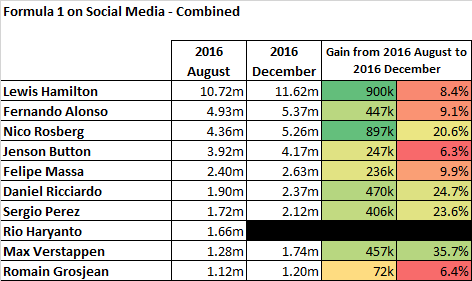
Across Facebook, Twitter and Instagram, Lewis Hamilton is the second biggest motor sport star out there currently. With a combined audience of 11.62 million followers, Hamilton is comfortably ahead of his nearest rival Fernando Alonso, who reaches 5.37 million accounts. In front of both Hamilton and Alonso is the MotoGP superstar Valentino Rossi, who reaches 21.53 million accounts. Rossi dwarfs Hamilton’s and Alonso’s numbers on Facebook, with 13.10 million accounts ‘liking’ Rossi through that service.

Marc Marquez and Jorge Lorenzo are both ahead of Alonso overall, with a reach of 7.76 million and 6.80 million accounts respectively. From a social media point of view, MotoGP has more superstars than Formula 1 currently and with neither Rossi, Marquez or Lorenzo retiring any time soon, that picture looks set to continue. It is one thing that Formula 1 has struggled to do: build superstars on social media. The reason for that is MotoGP’s large audience of Facebook, which Formula 1 is only starting to replicate (see below).

> September 2016: In conversation with Ian Wheeler (part one; part two)

Away from the MotoGP and Formula 1 comparisons, Nico Rosberg bows out with 5.26 million combined followers across Facebook, Twitter and Instagram. Losing three of the five biggest names on social media in 2017 will hurt Formula 1. Jenson Button in fourth can reach out to 4.17 million combined followers, whereas Sergio Perez who sits in seventh reaches out to 2.12 million combined accounts. That’s a sizeable difference. It takes time to build up the younger stars which is why the older stars are still up top. But that is where FOM and Liberty Media come into play by working with the teams, in the same way Dorna did with MotoGP’s outfits to build up a strong social media presence.

Red Bull utilise the power of Facebook Live whilst Mercedes use Rosberg’s exit to generate hits
Facebook Live is becoming increasingly important to reach out to new audiences, something Red Bull have exploited in the latter half of the season. More and more teams are using these tools, but clearly Red Bull are doing something right in this space as their combined audience jumped by almost a million accounts between August and December, jumping from 8.08 million to 8.95 million, an increase of 10.9 percent. Red Bull’s Facebook videos have a lot more views and interaction than Mercedes despite having a lot less ‘likes’. No other team can boast that activity aside from Mercedes, and it is clear fans are liking the antics of Daniel Ricciardo and Max Verstappen… for now.
social-media-december-2016-f1
Four of the leading ten drivers from 2016 will not be in Formula 1 next season, a big loss for Formula 1’s social media profile.

Nico Rosberg’s retirement sent shock waves across social media, with the BBC reporting over two million unique hits for its article on the subject. Whilst the news itself generated attention that Formula 1 would never usually see in the off-season, Mercedes capitalised on it brilliantly from a social media standpoint. A spoof advert appeared in AUTOSPORT Magazine, which in turn led to several ex-drivers and media personalities ‘applying’ for the role via Twitter!

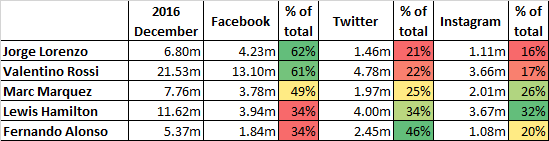
It is difficult to stand out from the social media crowd without a coherent social media strategy. You get the impression that Formula 1 is really starting to get the handle of what content works on social media and what doesn’t. When looking into greater detail, it’s interesting to note how the follower profile differ between MotoGP’s leading riders and Formula 1’s leading drivers. The overriding conclusion is that MotoGP skews firmly towards Facebook with over 60 percent of its social media audience coming from that platform. In comparison, Formula 1’s social media is much more ‘thinly’ spread out between Facebook, Twitter and Instagram.
social-media-december-2016-motogp-vs-f1
How MotoGP’s leading riders and Formula 1’s leading riders perform across Facebook, Twitter and Instagram: a stark difference depending on the platform.

Are casual fans more likely to ‘like’ superstars on Facebook and monitor their activity there, rather than create a Twitter account and follow them via that medium? As previously mentioned on this site, the grower in this space at the moment is Instagram, which is eating slowly into Facebook’s market share where Formula 1 is concerned having gone from a combined following of 8.57 million accounts in December 2015 to 19.13 million accounts in December 2016 (all teams, drivers and official F1 included).

MotoGP has the largest presence overall
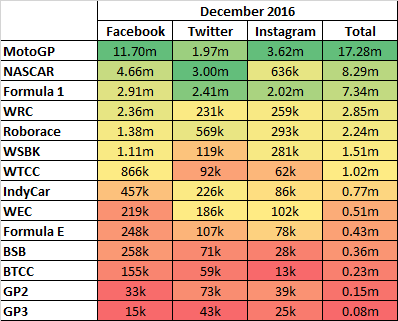
The official Formula 1 accounts across Facebook, Twitter and Instagram have a combined audience of 7.34 million, up 14.4 percent from August and up a massive 211.5 percent on December 2015. This time last year, their combined following was just 2.36 million, although the large increase is due to their Facebook migration back in March. Nevertheless, the numbers should help Formula One Management (FOM) see how important social media is to the Formula 1 brand. In Abu Dhabi, FOM did their first #F1Live broadcast on Facebook, which was a success story (more on this in the next few days).

However, the official MotoGP accounts across social media are followed by a combined audience of 17.28 million people, thanks to a large Facebook following, as noted above with Rossi, Lorenzo and Marquez. Behind MotoGP is NASCAR, which is helped by a strong Twitter profile. MotoGP, NASCAR and Formula 1 are the ‘big’ three motor sport series and this translates across to social media.
social-media-december-2016-series-by-series
A comparison of the leading motor sport series across Facebook, Twitter and Instagram.

At the other end of the spectrum, a combined audience of just 433,000 people follow the official Formula E channels, which puts it in line with the World Endurance Championship and the British Superbike Championship. The other point to note down the latter end of the table is the very small profile for both GP2 and GP3, showing why Liberty Media desperately need to integrate both series’ into Formula 1’s overall offering as they are firmly treated at the moment as a ‘bit on the side’.

Lastly, Roborace. A combined audience across Facebook, Twitter and Instagram of 2.24 million having never turned a wheel in anger during a real race. Fake followers? I think so…

Channel 4’s F1 team: The 2016 Verdict

Two months, 26 days and 18 hours. That is the length of time from the BBC’s Formula 1 television exit on Monday 21st December 2015 to the start of the Australian Grand Prix on Sunday 20th March 2016.

Putting a television programme together of a high-quality standard is an immensely difficult task. From the on-air team, through to the editorial team, creating the visual graphics, and so on. So, how did Channel 4 and production company Whisper Films perform in their first season covering Formula 1?

Jones impresses as lead presenter
For any broadcast, it is critical that the lead partner is up to standard and can steer the ship. Ask anyone who worked on Channel 4’s athletics coverage in 2011 about Ortis Deley and they will tell you how throwing someone into the deep end can undermine the reputation of an entire programme.

A motor racing presenter needs to be able to present in all conditions, outside the confines of a studio and into the heat of Malaysia or the soaking wet weather in Interlagos, whilst ad-libbing as guests appear or disappear with a moment notice. Before 2016, Steve Jones had never presented a live sporting event. When I found out that Jones was going to be presenter, I was surprised. An unusual and unexpected option. But, we can safely say an inspired choice. Nervous in Bahrain, Jones has evolved throughout the year into his own style.

Occasionally, his presenting comes across as ‘hammy’ but overall, I’ve enjoyed listening to him this year. Jones has been better than I imagined. Early indications are that Jones will remain with Channel 4’s team in 2017. The best part is that Jones does not imitate other presenters before him. He is not the next Jake Humphrey, or the next Suzi Perry. He is the first Steve Jones, and that is clear from his delivery. I hope we see Jones around for the next few years.

Jones was helped by those who provided expert opinion alongside him. I enjoyed seeing Mark Webber, David Coulthard and Eddie Jordan as pundits throughout the year. Webber and Coulthard have great rapport with one another, whilst Susie Wolff was a pleasant surprise as well.

The winning commentary formula continues
Whilst Channel 4 made changes on the punditry front compared with the BBC, one area they kept the same was commentary. Across the year, we heard some fantastic commentary calls, including one of the best modern-day commentary moments I think we have heard in a long time. It is critical that the lead commentator can concisely sell and get ‘over’ the key moments in the season. Ben Edwards’ commentary on Lewis Hamilton’s retirement in the Malaysian Grand Prix was a season defining moment with commentary to back it up:

Ben Edwards: Hamilton’s in trouble! Hamilton’s engine has blown! His race is run here in Malaysia! And when it looked like he was going to take the lead in the championship, would you believe it! He has never had a non-finish here.
Lewis Hamilton [Team Radio]: Oh no, no!
Ben Edwards: But he’s had a non-finish when it counts in Malaysia, only his second of the year!

Sometimes it is easy to over exaggerate the gravitas of a moment, but the commentary in the moment from Edwards was perfect. People don’t remember the 88 minutes of commentary in a football game where nothing happened and it is the same in Formula 1. The race defining calls have to be perfect, and this one was. You won’t get them all spot on, but the call in Malaysia was on the money. Similarly, Edwards and Coulthard conveyed the drama of Abu Dhabi well I felt.

The Edwards and Coulthard combination is now heading into season six. I enjoy the combination, but would appreciate hearing more of Mark Webber in the commentary box next season. Webber joined Edwards and Coulthard for commentary at Silverstone, but the three-team team was not repeated elsewhere. However, Channel 4 used Karun Chandhok and Lee McKenzie more during the race as the year progressed, which was a welcome change compared to how McKenzie has been used in the past. I hope we see more three-team commentary line-ups in 2017. I hear someone called ‘Jenson’ has a little experience in this area too…

Unfulfilled promises
When Channel 4 announced their line up in March, there were promises of a rotating line-up. This didn’t happen as much as I had hoped for throughout the season. Alain Prost was announced as part of their line up but only utilised properly in Spain (with a fleeting appearance in Abu Dhabi).

Nicolas Hamilton, Alex Zanardi and Bruno Senna were all announced but never appeared despite a fantastic VT being shown during the press morning with relation to Zanardi (he ended up appearing in a segment during Sky’s Mexican Grand Prix coverage). Senna appeared as part of Channel 4’s Brazilian Grand Prix opener, but no further. Considering how much Senna brought to Sky’s coverage in the early years, it was disappointing that he was not a regular part of Channel 4’s team.

The tip here is to only announce people who you intend to use on air regularly. Don’t announce stars who are unlikely to be around, as this will only annoy the watching punter. I did feel that the quality of the programming dropped slightly in the second half of the season, and adding a bit of variety would have helped in that respect, or even bringing Chandhok into the pre-race build-ups.

Channel 4’s 2016 live punditry line-up (excluding David Coulthard)
Bahrain: Mark Webber, Eddie Jordan, Susie Wolff
Spain: Alain Prost, Susie Wolff
Europe: Eddie Jordan
Britain: Mark Webber, Eddie Jordan, Susie Wolff
Hungary: Susie Wolff
Belgium: Mark Webber
Italy: Eddie Jordan
Malaysia: Mark Webber
Mexico: Mark Webber, Eddie Jordan
Abu Dhabi: Mark Webber, Eddie Jordan, Susie Wolff

It is a minor gripe, but one that should be noted, the last thing Channel 4 wants to happen is to head into ‘Skyfall’, that is the trap that Sky have fallen into in recent years of having the same standard line-up at every race weekend. Eventually, this becomes a turn off, which Channel 4 will be acutely aware of. I’m not suggesting that Coulthard and Webber were turn offs in Belgium and Italy, but more I’m thinking of ways to keep the programming fresh with new opinions.

Whilst Britain and Abu Dhabi unsurprisingly had the ‘hands on deck’ treatment, it is important not to neglect the rounds in between, which might have happened slightly this year. It was noted pre-season that Channel 4’s line-up would be adjusted depending on how the season progressed, but not many visible changes occurred. I won’t be surprised if this was unavoidable given the number of races in such a short period. There will probably be changes for 2017 if Channel 4 try to rope in the likes of Jenson Button, Felipe Massa and Nico Rosberg for a few appearances throughout the year.

Overall though, when you consider the amount of time Channel 4 and Whisper Films had to prepare for F1 2016, the channel and production company did a fantastic job to gather the team that they did for 2016. They will go into 2017 in better shape knowing what works and what doesn’t, which can only be a good thing for those watching their programming.

The second part of the 2016 Verdict looking at Channel 4’s programming will be posted around the 17th December.

After Rosberg’s exit, what happens next?

In my Abu Dhabi Grand Prix ratings report, I said that the UK viewing public did not find the duel between Lewis Hamilton and Nico Rosberg in 2016 as exciting as their first battle in 2014. This comes from purely anecdotal observations, the impression that I got was that the Hamilton and Rosberg rivalry did not excite or bring in new fans to the sport. This, alongside general apathy in recent years thanks to rule tinkering for example, has resulted in declining interest.

I noted how Formula 1 needed someone new and different to challenge the authority in 2017. Just five days after Abu Dhabi, the bombshell was confirmed: the reigning champion Nico Rosberg would be retiring from Formula 1 with immediate effect. Immediately, 2017 just became much more interesting. Potentially. Liberty Media and Bernie Ecclestone will be keeping a close eye on what happens next, and perhaps even trying to influence who joins Lewis Hamilton at Mercedes.

I rarely venture into speculation within the drivers’ market, but the potential impact on viewing figures both here in the UK and overseas will be significant depending on what direction Mercedes heads into. I’m going to assume that the pecking order will remain roughly the same with the Silver Arrows in front, however the rule changes could lead to a shake-up. Here, we examine the possibilities and which combination will serve up the most enticing season:

Scenario 1 – Sebastian Vettel partners Lewis Hamilton at Mercedes
Despite Sebastian Vettel’s dominance at the head of Formula 1 between 2010 and 2013, viewing figures held up remarkably well in the UK. 2010 and 2011 saw the highest Formula 1 ratings in the UK for a generation, although it is unknown whether that was down to him or instead due to the other stories of that time. His controversial win in the 2013 Malaysian Grand Prix peaked with six million viewers, whilst two years later his surprise win against Hamilton peaked with a similar audience.

You cannot outright claim that X or Y driver ‘draws’ more viewers without sufficient evidence, as there are a wide variety of factors involved: time of day, weather, other sporting events and so on, but races where Vettel is leading tend to draw a larger audience than where he is struggling. Vettel’s dominance was done in such a way that it became appealing to audiences watching: the style in which he was able to throw his car into places others were unwilling to tread. A Vettel and Hamilton partnership would help viewing figures in both Germany and the UK. It would also remove Vettel from Ferrari, where he has been the underdog against Mercedes in recent times.

This scenario is unlikely (Vettel himself denied it shortly after this piece was written), but if you wanted two champions in one team, Vettel has to be at the top of Mercedes’ Christmas list. I think a Vettel move would also create another battle for the Ferrari number one seat, which could result in a further domino effect.

Scenario 2 – Mercedes swoop for one Red Bull driver, Kvyat takes the spare Bull seat
The idea of Max Verstappen and Lewis Hamilton at this stage of Verstappen’s career is a mouth-watering prospect, but one that the British driver would probably veto. A reverse of 2007 is not a situation Hamilton would want to be in. From the casual punter perspective, interest would surge in the Netherlands as a result of this move. Verstappen would find himself in potentially a title-winning position in only his third season. However, interest is likely to increase anyway if Verstappen continues to improve.

You could have a blockbuster 2017 with Verstappen and Hamilton at Mercedes, but would the two drivers coexist? And if so, for how long? I couldn’t see this partnership lasting beyond a season. If Hamilton walked, would he walk from Formula 1 as a whole? For Formula 1, this scenario is far more dangerous than the others mentioned. If Verstappen joined Mercedes, it could trigger a series of moves over the next season or two assuming Hamilton did not want to work with Verstappen.

Interest would increase, but with more volatility the bubble could burst far, far quicker if this avenue was explored. I wouldn’t like to predict this one…

Scenario 3 – Fernando Alonso partners Lewis Hamilton at Mercedes, Button comes out of retirement
A rekindling of their 2007 rivalry, and more in line with the first scenario. Alonso in the Mercedes would help reignite interest in Formula 1 in Spain, which has dwindled slightly since his title-winning years in 2005 and 2006. Now that Alonso is in the latter stages of his career, this opportunity could be his last chance of winning a championship. You would imagine that the respect between Alonso and Hamilton is greater now than what it was back in 2007.

If McLaren let Alonso go, in theory it could lead to the return of Jenson Button to partner Stoffel Vandoorne. Abu Dhabi did have some kind of ‘finality’ to it though and I don’t see Button wanting to return to McLaren if a vacancy did appear. An alternative would be for Button to jump to Mercedes for a final swan song whilst they prepare the man mentioned below…

Scenario 4 – Pascal Wehrlein partners Lewis Hamilton at Mercedes
This is a difficult situation. As a fan, I want to see new talent up at the sharp end in Formula 1. But, I fear that another season of Mercedes domination would result in a Hamilton walkover in this scenario. Yes, Wehrlein is ready for Formula 1, of course he is. Some of his standout qualifying performances with Manor this year support that theory.

But, if Mercedes were a clear front-runner, and if Wehrlein was a clear number two driver, then the 2017 season will lack a championship battle. That won’t be good for worldwide viewing figures. You don’t want an artificial fight by any stretch of the imagination. I would prefer to see the likes of Valtteri Bottas or Nico Hulkenberg receive a chance at Mercedes, with Wehrlein promoted elsewhere.

I say all the above without having seen a 2017 car turned in anger yet. Mercedes could be a flop with the new regulations (highly unlikely, I know). For me, the idea of having Lewis Hamilton partner either Verstappen, Alonso, Vettel or Ricciardo with both drivers running the same equipment is a prospect that I would love to see, whether it happens for one season or five. Some of those combinations will bring new fans to Formula 1. The next few weeks could dictate the prospects for the next few seasons. Will Mercedes shake the Formula 1 cart, or will they go with the ‘safer’ option in Wehrlein? We’re about to find out…

Rosberg’s title victory peaks with 5 million viewers

A peak audience of 4.99 million viewers watched Nico Rosberg clinch his first ever Drivers’ Championship at the Abu Dhabi Grand Prix, overnight UK viewing figures show.

Race
Live coverage of the race, broadcast on Channel 4 from 12:00 to 16:35, attracted 2.25m (19.1%), peaking with 3.85m (29.5%) at 14:35 as Lewis Hamilton won the Grand Prix. The average was depleted more than usual due to the longer broadcast. From 12:00 to 15:30, an average of 2.57m (22.3%) watched the broadcast.

Of course, Channel 4’s viewing figures were always going to be down on the BBC’s past title deciders, but the scale of the drop is higher than anticipated. In 2014, when Hamilton became a two-time champion, BBC’s coverage peaked with 6.53m (42.1%). So, at the time of the peak, Channel 4’s coverage was down by around 2.7 million viewers (or 41 percent) compared with the BBC in 2014.

Yes, the BBC reaches a lot more viewers than Channel 4. But, on the other hand you would expect Channel 4 to claw back some viewers with it being the championship decider. Channel 4’s coverage did thrash its own slot average, but the audiences were marginally down on Silverstone in July and Mexico last month. In 2010 and 2014, when Abu Dhabi was the last race and played host to the title decider, it soared to season high numbers by a comfortable margin. That didn’t happen yesterday.

Sky Sports’ coverage of the race from 12:00 to 15:30 averaged 770k (6.7%). 557k (4.8%) watched on the Formula 1 channel, with a further 212k (1.9%) watching on Sky Sports 2. Sky’s programme peaked with 1.15m (8.8%) at 14:35. Both metrics are down around 15 percent on 2014’s average of 963k (7.1%) and peak audience of 1.36m (8.8%). So, despite a far more exciting race yesterday than in 2014, viewing figures were down. Sky planting a triple bill of football against the F1 couldn’t have helped.

The race started off with 3.95m (36.3%) at 13:00. Audiences climbed during the first phase of the Grand Prix to 4.55m (39.2%) at 13:25. At this point, audiences stabilised around the 4.4 million mark, which isn’t too much of a surprise as there was a mid-race ‘lull’ as Hamilton temporarily disappeared into the distance. At 14:10, 4.40m (36.0%) were watching and it was at this point where casual viewers started to tune into the F1. The audience climbed again, peaking with 4.99m (38.3%) at 14:35.

The combined audience of 3.01 million viewers is up on last year’s non-title deciding number, but heavily down on 2010 and 2014 by around 2.5 million viewers. The combined peak audience of 4.99 million viewers is the third highest of 2016, only behind Silverstone and Mexico. Again, the peak was down on the 2010 peak audience of 7.35m (46.3%) and the 2014 peak audience of 7.89m (50.9%).

Qualifying and Analysis
Live coverage of qualifying averaged 1.15m (13.7%) on Channel 4, with Sky Sports F1 adding a further 330k (3.9%). The combined audience of 1.48 million viewers is actually on the lower end of the spectrum for the 2016 season as a whole.

I don’t fully blame Channel 4 for this. I do, however, blame them for the lack of advertising in the latter end of the season. A genius move would have been to not only advertise on their own channel but to buy slots on other channels to get word out about the season decider. Advertising through the season is critical, and some of the low figures above may be attributed to failing to get word out to the harder to reach audiences.

However, the figures also tell us that interest simply was not as high as first time around for a battle between Hamilton and Rosberg. For all the previous title battles that went to the wire, the fight was new: Hamilton vs Massa in 2008, the four-way fight in 2010 and Hamilton vs Rosberg in 2014. They were new and would have hooked on a significant portion of new viewers. Hamilton versus Rosberg, part II was not interesting. Unfortunately for Formula 1, the abject failure of Ferrari not turning up in 2016 has meant that we have gone another season without a compelling, multi-team championship battle.

There will be more analysis on this in a next few weeks, but if a Verstappen or Ricciardo or Vettel or Raikkonen challenges Rosberg and Hamilton for the championship in 2017, then viewing figures will rise. That I admit is easier said than done…

The 2015 Abu Dhabi Grand Prix ratings report can be found here.

overnights.tv-bannersF1

Channel 4 F1 versus Sky Sports F1: Your 2016 Verdict

The 2016 Formula One season has come to a climax in Abu Dhabi, with Nico Rosberg being crowned Drivers’ Champion! The season has also seen Max Verstappen continue to make an impression, whilst Ferrari have faltered on numerous occasions. On the broadcasting side, 2016 marked Channel 4’s first year covering Formula 1 after BBC TV’s shock exit at the end of 2015.

I’ve written countless words concerning both Channel 4’s and Sky’s coverage this season. Now, it is your opportunity to have a say. Have Channel 4 done Formula 1 justice? How can both they and Sky Sports improve in 2017? Has Steve Jones lived up to the billing as “F1 presenter”? Do you want Channel 4 to continue covering Formula 1 in some form from 2019 onwards?

Of course, the BBC did stay in the radio game, so for anyone listening via that form of communication, all thoughts are welcome on the BBC’s radio coverage and anything else on the broadcasting landscape, including Formula One Management’s (FOM) television coverage. Has the way you consume Formula 1 changed under the new rights deal?

The best thoughts and opinion will be collated into a new piece, which will be published in a few weeks’ time.