After Lewis Hamilton made history last weekend in the Algarve, F1 heads east to Italy for the return of Imola to the calendar!
Because of the 24 hour distance between the two locations by car, unusually the F1 weekend is only two days long, with a 90-minute practice session taking place on Saturday morning, followed by qualifying later.
The race itself starts at 12:10 UK time, primarily because of the early sunset. If you think that is earlier than usual, brace yourselves for the Turkish Grand Prix, which begins at 10:10 UK time a fortnight later.
Elsewhere, there is little to report with the World Touring Car Cup heading to Aragon for the penultimate event of its heavily truncated season.
Channel 4 F1
31/10 – 17:15 to 18:45 – Qualifying Highlights
01/11 – 18:30 to 21:00 – Race Highlights
Sky Sports F1 Sessions
31/10 – 08:30 to 10:45
=> 08:30 – Welcome to the Weekend
=> 09:00 – Practice
31/10 – 12:00 to 14:30 – Qualifying
01/11 – 10:30 to 15:30 – Race
=> 10:30 – Grand Prix Sunday
=> 12:05 – Race
=> 14:00 – Chequered Flag
=> 15:00 – Notebook
Supplementary Programming
04/11 – 19:30 to 21:00 – F1 Pro Series Race 4 and 5
04/11 – 21:00 to 21:30 – Midweek Debrief
05/11 – 19:30 to 21:00 – F1 Pro Series Race 6
BBC Radio F1 All sessions are available live on BBC’s F1 website
29/10 – 21:30 to 22:00 – Preview (BBC Radio 5 Live)
31/10 – 08:55 to 10:35 – Practice (BBC Radio 5 Live Sports Extra)
31/10 – 12:55 to 14:05 – Qualifying (BBC Radio 5 Live Sports Extra)
01/11 – 12:00 to 14:15 – Race (BBC Radio 5 Live Sports Extra)
World Touring Car Cup – Spain (Eurosport 2)
31/10 – 12:15 to 13:15 – Qualifying
01/11 – 08:00 to 09:00 – Race 1
01/11 – 11:00 to 12:00 – Race 2
01/11 – 13:00 to 14:00 – Race 3
If any details change, this article will be updated.
Sky Sports have reaped the rewards of a truncated Formula 1 season as the season heads towards its finale in Abu Dhabi, analysis of viewing figures conducted by Motorsport Broadcasting shows.
After a four month delay due to the COVID-19 pandemic, the 2020 season eventually started in Austria on Sunday 5th July.
Since then, a further ten races have taken place across Europe, with six more currently scheduled to take place between now and the middle of December.
Analysis of the first 10 races suggests that Sky’s audience figures have increased significantly, according to consolidated data produced by BARB.
As always, viewing figures below are for the TV set only, excluding on-demand platforms such as Now TV, Sky Go, All 4, as well as those who consume their F1 experience via BBC Radio 5 Live.
Sky’s viewing figures increase…
The pandemic means that year-on-year comparisons are very difficult, however it is still possible to draw some high-level conclusions from the current data points.
During the pandemic world, Sky have split their race day programme into three segments: the pre-race build-up, the race itself, and post-race analysis.
Every race this season has averaged comfortably above one million viewers on the pay TV platform, with 1.20 million viewers tuning into the action on average, an increase by around 17 percent compared to the final position last year.
Last year’s races (excluding build-up and post-race analysis) averaged around 1.02 million viewers, although this figure includes races such as Australia, Singapore, and Mexico.
Removing all Asian and American-based races from the 2019 data set makes little difference, as the Asian and American time-zones races largely off-set each other (Asian races draw low audiences, American races draw higher audiences).
In other words, Sky’s 17 percent increase year-on-year is a true reflection of reality, and not a massaged picture because of the unusual 2020 calendar.
Last year, seven European races struggled to reach one million viewers on Sky. Excluding Britain, last year’s European races stretched from 799,000 viewers (for Spain) to 1.41 million viewers (for Bahrain).
The inaugural Styrian Grand Prix is this year’s nadir for Sky so far at 1.05 million viewers, with the season-opening Austrian Grand Prix hitting a 2020 high of 1.37 million viewers one week earlier, a far smaller spread than previous years.
As well as Austria, the Spanish Grand Prix was Sky’s other big rater so far in 2020, helped by its Sky Sports Main Event simulcast. The race itself averaged 1.33 million viewers, almost double last year’s figure.
Normally, the Barcelona race clashes with the final weekend of the football season, whereas this year’s running in mid-August meant it ran with little sporting opposition compared to usual, boosting numbers.
Pierre Gasly’s shock win in the Italian Grand Prix drew fewer viewers, averaging 1.22 million viewers, however did not enjoy the luxury of also airing live on Main Event.
…helping the overall picture
Overall, Channel 4’s highlights programming has brought in a similar average audience to last year. Excluding Silverstone (which the free-to-air broadcaster covered live), their highlights have averaged 1.75 million viewers on average, including pre- and post-race analysis.
In comparison, highlights of last year’s European races averaged 1.81 million viewers, a slight year-on-year drop, perhaps surprisingly when you consider that Channel 4 are airing a longer race edit compared to twelve months ago.
Last year, highlights of the Monaco and German rounds exceeded two million viewers, a barometer this year’s highlights have yet to hit.
Helped by the chaos in the early phases, highlights of the Tuscan Grand Prix proved to be Channel 4’s high point from a highlights perspective so far this year, averaging 1.99 million viewers.
Overall, an audience just shy of three million viewers on average are watching each race across Sky and Channel 4, peaking with around four million viewers. At its peak, the figures suggest around 1.5 million viewers are watching on Sky, with a further 2.5 million viewers following on Channel 4.
The key overriding message is that Formula 1’s viewing figures have remained incredibly stable throughout the pandemic. Are there lessons to learn for the championship moving forward?
Arguably the pandemic is an excellent opportunity to review the fundamental structure of the Grand Prix calendar, grouping races into clusters and making it easier for fans to follow the championship through the season, boosting audience figures.
Critically for Sky, their viewing figures show no sign of any ‘second season’ dip in the second year covering F1 exclusively, with viewing figures not only increasing for Formula 1, but also increasing for feeder series’ Formula Two and Formula Three.
Viewing figures may drop if, as looks likely, Lewis Hamilton does clinch the championship with a few races to spare, but so far, the picture is looking good.
For the first time in 24 years, Formula 1 heads to Portugal for the Portuguese Grand Prix!
Instead of heading to Estoril, which hosted the last race there in 1996, the championship instead heads to the 2.9-mile circuit in the Algarve for its inaugural visit.
Live coverage of the race airs as usual on Sky Sports F1, the Grand Prix itself beginning at 13:10 UK time.
Later, the IndyCar Series concludes with the race that was meant to begin its COVID-19 disrupted year in St Petersburg. Scott Dixon looks set to clinch the crown, but Josef Newgarden is close in his mirror.
As if that was not enough, Sky are also airing live coverage of the Spa 24 Hours on Sky Sports F1! The majority of the 24 hours air live on the channel. I would expect the remainder to air live behind the Red Button, but this is unconfirmed as of writing.
With F1 and IndyCar, it means there is over 37 hours of live motor sport on Sky next weekend.
Elsewhere, the British Touring Car Championship starts earlier than usual on ITV4, as the nights draw in heading into the Winter months.
NOTE: Clocks go back one hour on Sunday 25th October, with the change from British Summer Time to Greenwich Mean Time. The times listed are for BST on Saturday and before; GMT for Sunday and afterwards…
Channel 4 F1
24/10 – 17:30 to 19:00 – Qualifying Highlights
25/10 – 18:30 to 21:00 – Race Highlights
Sky Sports F1 Sessions
23/10 – 10:30 to 12:45 (also Sky Sports Main Event)
=> 10:30 – Welcome to the Weekend
=> 11:00 – Practice 1
23/10 – 14:45 to 16:45 – Practice 2
24/10 – 10:45 to 12:10 – Practice 3
24/10 – 13:00 to 15:30 – Qualifying
25/10 – 11:30 to 16:30 – Race
=> 11:30 – Grand Prix Sunday
=> 13:05 – Race
=> 15:00 – Chequered Flag
=> 16:00 – Notebook
Supplementary Programming
23/10 – 16:45 to 17:15 – The Story so Far
25/10 – 16:30 to 17:30 – Race to Perfection
28/10 – 21:00 to 21:30 – Midweek Debrief
BBC Radio F1 All sessions are available live on BBC’s F1 website
25/10 – 13:00 to 15:20 – Race (BBC Radio 5 Live Sports Extra)
MotoGP – Teruel (BT Sport 2) Also airs live on MotoGP’s Video Pass (£)
23/10 – 08:00 to 10:45 – Practice 1
23/10 – 12:00 to 15:00 – Practice 2
24/10 – 08:00 to 15:15
=> 08:00 – Practice 3
=> 11:00 – Qualifying
25/10 – 07:45 to 15:00
=> 07:45 – Warm Ups
=> 09:30 – Moto3
=> 11:30 – MotoGP
=> 13:15 – Moto2
=> 14:30 – Chequered Flag
On the eve of the Nürburgring’s return to the Formula One calendar, Motorsport Broadcasting has decided to be a little nostalgic, with a throwback to the 2000 European Grand Prix!
Funnily enough, many fans remember the events of the 1999 running of the Grand Prix far more than 2000, as Johnny Herbert climbed to victory in mixed weather from 14th on the grid. But, reviewing that race from a broadcasting perspective feels too obvious.
And, whilst the 2000 race may not have been thrilling in quite the same way, it for me is still a classic wet weather race in the Eifel mountains with twists and turns along the way.
Would McLaren be able to outsmart Ferrari, or would Michael Schumacher’s wet weather prowess show once again? Here we go…
Date: Sunday 21st May 2000
Time: 12:15 to 15:15
Presenter: Jim Rosenthal
Reporter: James Allen
Reporter: Louise Goodman
Commentator: Murray Walker
Commentator: Martin Brundle
Analyst: Tony Jardine
By this point in their coverage, ITV dedicated around 45 minutes of build-up to the European races, with another 30 minutes for analysis post-race. The build-up gradually expanded in length year-on-year, and before we know it, the commercial broadcaster was dedicating an hour of programming to build-up.
Pre-Race
Following Simon Taylor’s departure from ITV’s Formula 1 line-up, the team opted to bring an additional guest into their studio for some of the build-up, an array which included the likes of Sir Stirling Moss, Bernie Ecclestone, and even Ant and Dec!
For Nürburgring, it was the turn of Mercedes’ Sporting Director Norbert Haug in the studio, Haug joining Jim Rosenthal and Tony Jardine.
The build-up for this race feels split in two: the first 20 minutes focusing heavily on the McLaren and Ferrari scrap, with the latter 20 minutes looking at some of the other stories making the F1 agenda.
In my view, the format works, and more importantly covers a lot of ground across the segments, meaning that the viewer feels well versed in the world of F1 by the time the lights go green.
Haug’s insights were not the most engaging however, but nevertheless helped bring additional context to the McLaren and Ferrari battle.
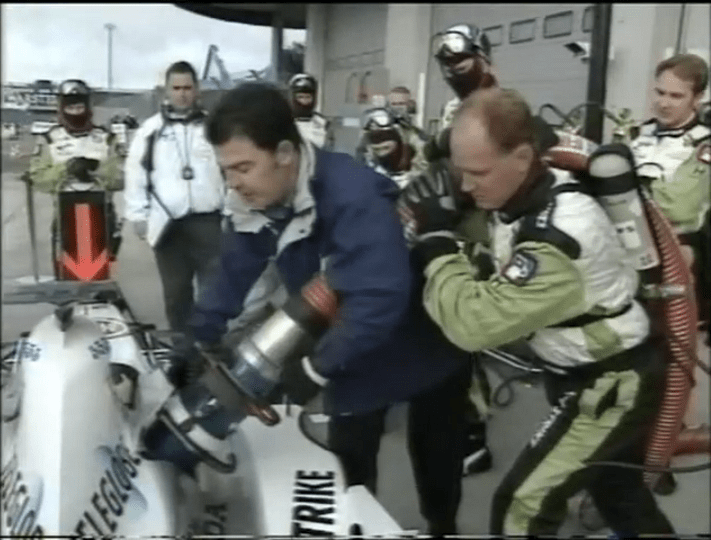
ITV’s pit lane reporter James Allen goes behind the scenes with the BAR team during refuelling practice.
Following the usual qualifying round-up and summary, conversation moves onto the big incident from the previous round in Spain: a botched refuelling pit stop from Ferrari resulting in a broken ankle for Nigel Stepney.
The conversation provides the opener to an excellent segment from James Allen, who joined BAR during their pit stop practice to demonstrate the many roles and responsibilities during the pit stop sequence.
McLaren versus Ferrari remains the theme in the pit stop piece, with comment from McLaren’s Ron Dennis and Ferrari’s Ross Brawn. Next-up, on-board for a lap of the Nurburgring with Rubens Barrichello!
A thrills and spills VT showing Johnny Herbert’s spectacular victory from 1999 follows, with a segment on the other side of the ad-break taking us further into the world of F1 through Martin Brundle’s ‘Inside Track’ series.
Brundle’s piece for round six of 2000 looks at F1’s strict weight limits, well timed given that Prost’s Nick Heidfeld was thrown out of the weekend after qualifying for fielding an underweight car.
Attention turns further down the pecking order to two F1 struggles: Jaguar, and Jacques Villeneuve. Jaguar had yet to capitalise on Stewart’s strong 1999 season, the team the subject of Louise Goodman’s segment.
The thing I really like here is that the segment was not a ‘talk to camera’ segment, but rather an all-rounded segment that offered different perspective, with the opinions of technical director Gary Anderson and drivers Eddie Irvine and Johnny Herbert on show. The editors made clear the purpose of the segment from the outset, which made it even more engaging.
An interview segment between Brundle and Villeneuve followed. You really got the impression from these two segments that every second of the broadcast counts, there is no waffle, no glitziness to the output, but why should there be?
The piece touches on Villeneuve’s disappointment with his move to BAR, his relationship with Craig Pollak and whether he, in Brundle’s words, can “really walk away from a works Honda deal?”
An excellent camera angle as the cars head out of the final bend onto the start-finish straight.
Rosenthal and Jardine filled the gaps in between the VTs, but this was a segment heavy build-up, with Brundle’s famed grid walk not in sight, for this round at least. In ITV’s early days, the team did not overuse the grid walk, gradually bringing it in until it became a permanent fixture at most races from the mid-2000s onwards.
With the scene set at “a cool 10 degrees,” it is race time!
Race
I have mentioned this before, but the 2000 grid is gorgeous, with the red Ferrari’s, green Jaguar’s, and yellow Jordan’s amongst the colours on offer.
Back in the early 2000s, F1’s television operation for most viewers was decentralised. ITV directed the British Grand Prix, Fuji Television would direct the Japanese Grand Prix, and here at the Nürburgring, it was German broadcaster RTL who controlled of the European round from Germany.
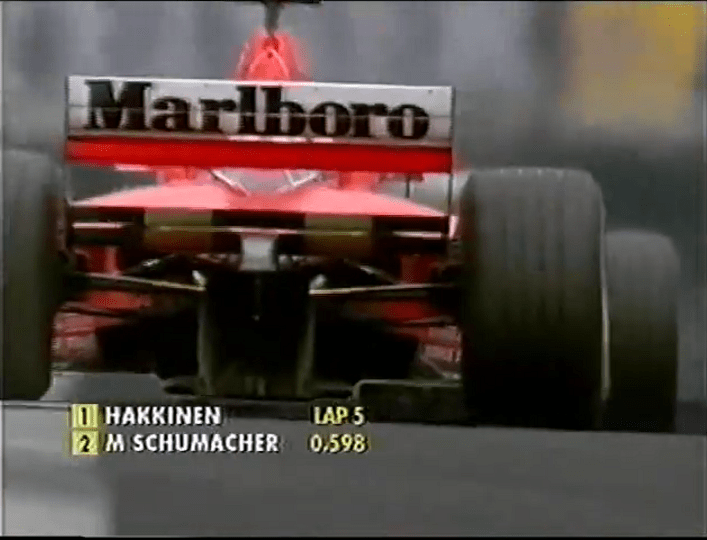
Off the line, Hakkinen stormed into the lead from third, swapping places with Coulthard, as Schumacher remained in second. The first of Murray Walker’s prophetic pe-race predictions came true, as Villeneuve in the BAR jumped up to fifth from ninth on the grid.
Only four drivers are on the harder compound Bridgestone tyre. They’ve got the super soft tyre here for the first time this year, and the soft tyre, which is actually the harder one here today, is being used by both the Ferrari drivers [Rubens] Barrichello and Michael Schumacher, by Jacques Villeneuve and by Jos Verstappen. And I certainly know in the case of the Ferrari’s that, as Martin has said, it’s because they just get a better balance on the car. They tend to go off after about ten laps, so Michael Schumacher will be looking to get ahead as soon as the race begins, and in order to do that, he’s got to pass David Coulthard. – Murray Walker talking tyres.
The local RTL director had a limited choice of exterior angles to play with for replays of the start, with no on-board angles during this sequence.
Remember that the local director was ‘competing’ against F1’s own digital operation during this era, meaning that on-board angles were rare for most viewers worldwide.
Shots from Heinz Harald Frentzen’s Jordan, Jean Alesi’s Prost and Rubens Barrichello’s Ferrari were on offer throughout the mixed weather race, none of whom ever had a chance at victory (and Frentzen’s race lasted just a single lap).
Unsurprisingly, the director focussed firmly on Schumacher’s attempts to take the lead off Hakkinen, the German harassing the two-time champion lap after lap, meaning Walker ended up reciting the order every so often.
With rain threatening, a lot of chatter was about refuelling, with Brundle adequately explaining the rationale behind a heavier fuel load at race start.
The director did miss Benetton’s Giancarlo Fisichella overtaking Villeneuve live in the early phases, but under the circumstances, an understandable omission. Schumacher eventually dived down the inside of Hakkinen into the chicane he designed, as the forecast rain intensified.
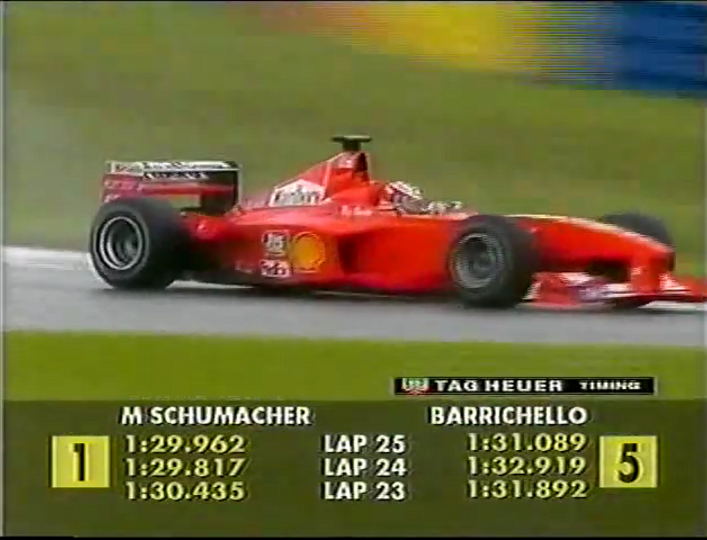
The rainmeister at work, two seconds a lap faster than his team mate.
At which point, the race kicked off in many different directions: Jos Verstappen, Marc Gene, and Pedro Diniz all lost it in the tricky conditions. Considering how patchy some of the television direction was back in the day, the German director on this day in history did fantastically well to catch the key bits.
Both Walker and Brundle through this race relied on the World Feed pictures and just one timing monitor, as the front runners carved their way back through those who had yet to switch to wet tyres.
The commentary felt very instinctive, but it also felt like they were living through the moment with us, which made it all the better. Walker described it as a “commentator’s nightmare,” Brundle called it a “commentator’s dream!”
Also inspired was ITV’s lop-sided ad-break structure for the Grand Prix, with the first 26 minutes running without adverts. It did mean more frequent adverts later (five ad-breaks in total), but was unavoidable at time. ITV did capture Schumacher’s overtake on Hakkinen live, so you cannot complain, really.
A late pit stop meant that Barrichello dropped back through the field, which probably pleased the director given the on-board camera on Barrichello’s car!
As the order and conditions settled down, so did the coverage, with the director focusing more on the battles in the latter half of the points paying positions, with heavy focus on Arrows, BAR and Benetton. On the commentary side, Allen provided additional analysis on the movers and shakers from pit lane throughout the Grand Prix.
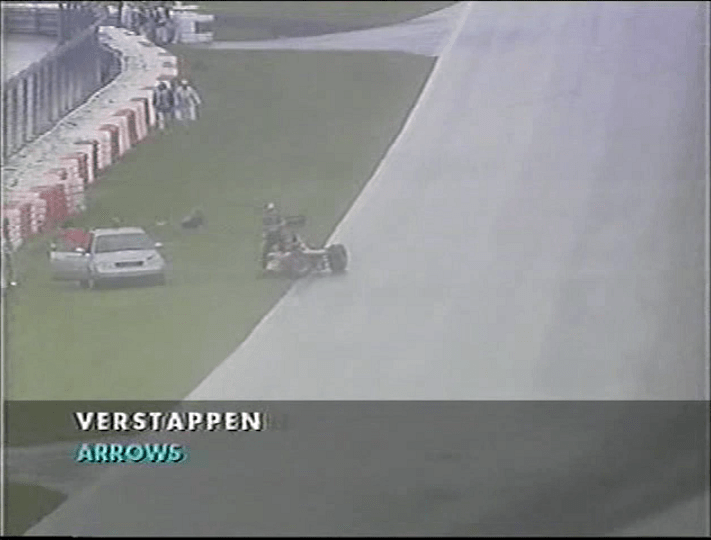
One battle caught in its entirety was a three-way scrap between Irvine in the Jaguar, Ralf Schumacher’s Williams, and Verstappen’s Arrows. Unfortunately, it ended with both Irvine and Schumacher eliminated at the first corner, followed by Verstappen shunting into the wall towards turn ten.
This is where you can see how radically Formula 1 has changed in even twenty years: Verstappen’s off would have necessitated a Safety Car nowadays, but back then controlled under yellow flags.
One man making a good impression was Verstappen’s team mate Pedro de la Rosa who had crept up to third, which Walker hyped on commentary as “something F1 really needs!” In the end, de la Rosa did need to pit again, dropping him further back.
If anything, the direction for this race was not too dissimilar to a Grand Prix in recent times, given what the director had to work with. Safety Cars aside, the major differences were the lack of team radio and on-board angles, both of which would have added an extra dimension.
RTL’s director caught Ferrari’s error in under fuelling Barrichello at his second stop instantly, which the ITV team picked up many laps later.
A huge off for Jos Verstappen prompts yellow flags, but not a Safety Car.
In the end at the front of the field, Schumacher picked up his fourth win of the 2000 season, with Hakkinen finishing 13 seconds behind! Coulthard and Barrichello finished in third and fourth, but one lap behind…
Post-Race
With the race overrunning slightly, analysis from ITV was thin on the ground, but nevertheless covered the key events.
Brundle called the race “a very significant day in this year’s World Championship.” As it turned out, Ferrari would only win two of the next seven races, with McLaren largely dominating the Summer months before the tide turned in Italy.
Paul Stoddart is an interesting sighting during the podium celebrations with the Ferrari crew. Although not yet a Formula 1 team boss, Stoddart was present in the paddock, his European Aviation outfit sponsoring the Arrows team.
Following the podium procedure and an ad-break, a young sounding Tom Clarkson is the man asking the questions in the post-race press conference.
Coulthard was amiss to explain the issues with his McLaren, although the ITV team were keen to praise him afterwards, Jardine calling his performance a “very, very brave effort”, the bravery cited due to the plane crash he was involved in a few weeks earlier.
Back in the paddock, Allen interviews Barrichello to wrap up analysis of the big two teams. A brief comment on Jaguar follows, tying up the loose ends from the pre-race build-up, before a few promos and standings concludes ITV’s broadcast of the European Grand Prix!
If the action is anything as thrilling this Sunday, we are in for a treat…
Formula 1 returns to the Nürburgring for the first time in seven years this weekend, for the inaugural Eifel Grand Prix!
Live coverage of the race weekend airs on Sky Sports with Ted Kravitz and Simon Lazenby re-joining the team. It is unclear if Martin Brundle is also back with the line-up as of writing.
Elsewhere, with Triumph’s visitor experience centre in Hinkley reopening to the public, BT Sport’s MotoGP coverage is moving.
The crew are relocating to the BT Tower in central London for the remainder of 2020.
The main races for F1 and MotoGP this weekend both begin an hour earlier. F1’s change is driven by the earlier sunset times as the European season concludes later than usual, dictating a change for MotoGP to avoid a head to head clash.
Channel 4 F1
10/10 – 17:30 to 19:00 – Qualifying Highlights
11/10 – 18:30 to 21:00 – Race Highlights
Sky Sports F1 Sessions
09/10 – 09:30 to 11:50
=> 09:30 – Welcome to the Weekend
=> 10:00 – Practice 1
09/10 – 13:45 to 15:45 – Practice 2
10/10 – 10:45 to 12:10 – Practice 3
10/10 – 13:00 to 15:35 – Qualifying
11/10 – 11:30 to 16:30 – Race
=> 11:30 – Grand Prix Sunday
=> 13:05 – Race
=> 15:00 – Chequered Flag
=> 16:00 – Notebook
Supplementary Programming
09/10 – 16:30 to 17:00 – The Story so Far
09/10 – 17:00 to 18:30 – F1 Pro Series Draft
10/10 – 21:00 to 22:00 – Race to Perfection
14/10 – 19:30 to 21:00 – F1 Pro Series Race 1 and 2
14/10 – 21:00 to 21:30 – Midweek Debrief
15/10 – 19:30 to 21:00 – F1 Pro Series Race 3
BBC Radio F1 All sessions are available live onBBC’s F1 website
09/10 – 09:55 to 11:35 – Practice 1 (BBC Radio 5 Live Sports Extra)
09/10 – 21:00 to 21:30 – Preview (BBC Radio 5 Live)
10/10 – 10:55 to 12:05 – Practice 3 (BBC Radio 5 Live Sports Extra)
11/10 – 13:00 to 15:00 – Race Updates (BBC Radio 5 Live)
MotoGP – France (BT Sport 2) Also airs live onMotoGP’s Video Pass(£)
09/10 – 08:00 to 10:45 – Practice 1
09/10 – 12:00 to 15:00 – Practice 2
10/10 – 08:00 to 16:00
=> 08:00 – Practice 3
=> 11:00 – Qualifying
=> 15:00 – MotoE
11/10 – 07:45 to 15:00
=> 07:45 – Warm Ups
=> 09:30 – Moto3
=> 11:30 – MotoGP
=> 13:15 – Moto2
=> 14:30 – Chequered Flag
MotoGP – France (Quest)
12/10 – 18:00 to 19:00 – Highlights
British Touring Car Championship – Croft (ITV4)
11/10 – 11:30 to 18:05 – Races
World Rally Championship – Italy (All Live) Also airs live onWRC+ (£)
09/10 – 06:45 to 16:45 – Stages 1 to 6 (BT Sport Extra 1)
=> 06:50 – Stage 1
=> 07:44 – Stage 2
=> 09:40 – Stage 3
=> 10:34 – Stage 4
=> 15:14 – Stage 5
=> 15:59 – Stage 6
10/10 – 06:00 to 17:45 – Stages 7 to 12 (BT Sport Extra 3)
=> 06:38 – Stage 7
=> 07:30 – Stage 8
=> 09:07 – Stage 9
=> 10:00 – Stage 10
=> 15:00 – Stage 11
=> 16:02 – Stage 12
11/10 – 06:15 to 12:45 – Stages 13 to 16 (BT Sport Extra 1)
=> 07:15 – Stage 13
=> 08:00 – Stage 14
=> 10:10 – Stage 15
=> 11:00 – Stage 16
World Rally Championship – Italy
10/10 – 00:30 to 01:00 – Day 1 Highlights (BT Sport 3)
10/10 – 07:30 to 08:30 – Stage 8 (BT Sport 3)
10/10 – 10:00 to 11:00 – Stage 10 (BT Sport 3)
10/10 – 15:00 to 16:00 – Stage 11 (BT Sport 3)
11/10 – 02:00 to 02:30 – Day 2 Highlights (BT Sport 3)
11/10 – 08:00 to 09:00 – Stage 14 (BT Sport 1)
11/10 – 11:00 to 12:30 – Stage 16 [Power Stage] (BT Sport 1)
11/10 – 20:30 to 21:00 – Day 3 Highlights (BT Sport 2)
TBA – 19:00 to 20:00 – Highlights (ITV4)
World Touring Car Cup – Slovakia (Eurosport)
11/10 – 07:55 to 12:00 – Race 1
11/10 – 11:30 to 12:30 – Race 2

 Motorsport Broadcasting