As many of you know, I have been running The F1 Broadcasting Blog for nearly seven years. The site has generated attention inside and outside of motor racing paddocks, both domestically and internationally.
In that time, the site has covered major stories in the motor sport media landscape, and has revealed some exclusives too. In the capacity of site editor, I have attended events on two wheels and four wheels, as well as the launch of Channel 4’s F1 coverage and the Autosport Show, amongst other events.
At those events, it has been a pleasure to hear people who I enjoy watching and respect, say how they enjoy reading my thoughts and opinions, and that this site is their place to go for broadcasting news. I run this site myself alongside my day job, there is no large group of people or backing behind the site, and I have been amazed at the growth it has had over the seven years.
I initially named the site The F1 Broadcasting Blog, as Formula 1 was, and still is, the focus. However, in recent years, I have focused increasingly on the broadcasting efforts of other championships, including the likes of Formula E, MotoGP, and the World Rally Championship.
Because of the effort from myself to diversify into different areas, it means that the original name of the site is, perhaps, no longer the most accurate. On the eve of the 2019 season, I have taken the opportunity to rebrand the site to better reflect the content that I write.
The website content will not change, with an emphasis on behind the scenes content, news, scheduling, viewing figures, television rights, social media; spanning across the motor sport spectrum. For the moment, the Facebook and Twitter handles will remain in the same case, but the intention in the medium to longer term is to change these.
It has not been an easy decision to re-brand the site, but I feel that now is as good a time as any, ahead of the new season, rather than performing a re-brand half way through the season. I am hopeful the site will continue to lead the way on reporting the broadcasting stories that matter to fans of this wonderful sport.
Thanks,
Dave
Owner and Editor of Motorsport Broadcasting
Organisers of the World Rally Championship have struck a deal to remain on Channel 5 network in the UK.
The championship has regularly aired in highlights form on Channel 5’s main outlet since 2016, with 60-minute highlights airing in a week day time slot at 19:00. However, coverage of the first round of the 2019 season, the Monte Carlo rally did not air on any of Channel 5’s outlets, nor on any other free-to-air television network, leaving WRC’s free-to-air future in limbo.
Now, the series will continue on the Channel 5 network, with highlights for the Sweden round airing on their sister channel 5Spike this upcoming Monday at 19:00.
A WRC spokesperson said “We have an agreement with Channel 5 and the Sweden highlights will be broadcast on Spike next Monday.”
It is unclear whether the season as a whole will air on 5Spike, which may be considered a demotion compared with the past three years when highlights aired on Channel 5’s main channel, or whether this is a one-off move before reverting to the main Channel 5 station from Mexico.
Formula E hurdles towards one-third distance as the second leg of its South American tour takes it to Mexico for the Mexico City E-Prix.
The electric championship uses part of the Formula 1 circuit, encompassing the famous stadium section. As usual, the race airs live across the BBC’s digital platforms, with BT Sport, Eurosport and Formula E’s YouTube channel also covering the action.
Formula E’s support series, the Jaguar I-Pace eTrophy returns in Mexico, with both qualifying and race airing live on BT Sport. Sweden plays host to round two of the World Rally Championship, where one expects much more snow than what fans saw in Monte Carlo for the season opener.
Meanwhile, Formula 1 testing gets underway in Barcelona, where the big news is that the first test will air live across F1’s over-the-top platform and Sky Sports F1. However, the F1 TV stream is only available to Pro users (which UK fans do not have access to), meaning that UK fans will need to watch Sky F1 for testing.
Sky are covering each of the four afternoon sessions live as well as the review show, whereas F1 TV is covering the complete day live. Sky are not repeating the live action, so if you want to watch it, you will need to set your recorders. Little is known about the presentation team currently, although Karun Chandhok has alluded to his involvement on Twitter.
Elsewhere, the Williams documentary premieres on BBC Two having been released on DVD in 2017. Whilst I am happy to see it premiere on a major platform, the decision to air it against Formula E on the Red Button is an odd move by BBC’s schedulers.
Formula E – Mexico City Shakedown, Practice and Qualifying also air live on YouTube…
15/02 – 21:45 to 22:30 – Shakedown (BT Sport 1)
16/02 – 13:15 to 14:30 – Practice 1 (BT Sport 3)
16/02 – 15:45 to 16:45 – Practice 2 (BT Sport 3)
16/02 – 17:30 to 19:00 – Qualifying (BT Sport 3 and Eurosport 2)
16/02 – 21:30 to 23:30 – Race: World Feed
=> live on BBC’s digital platforms from 22:00
=> live on BT Sport 3
=> live on Eurosport 2
16/02 – 21:30 to 23:10 – Race: Voltage (YouTube)
18/02 – 00:00 to 01:00 – Highlights (Quest)
Formula E Radio – Mexico City (BBC Radio 5 Live Sports Extra)
16/02 – 17:40 to 19:10 – Qualifying
16/02 – 21:45 to 23:15 – Race
F1 Testing– Barcelona 1 (Sky Sports F1)
13/02 – 15:00 to 15:30 – Racing Point Launch
14/02 – 12:00 to 12:30 – McLaren Launch
18/02 – 13:00 to 18:00 – Day 1
=> track action from 13:00 (also Sky Sports Main Event)
=> review at 17:00
18/02 – 19:55 to 20:55 – Day 1 Review (R)
19/02 – 13:00 to 18:00 – Day 2
=> track action from 13:00 (also Sky Sports Main Event until 14:00)
=> review at 17:00
19/02 – 20:25 to 21:25 – Day 2 Review (R)
20/02 – 13:00 to 18:00 – Day 3
=> track action from 13:00 (also Sky Sports Main Event)
=> review at 17:00
20/02 – 20:05 to 21:05 – Day 3 Review (R)
21/02 – 13:00 to 18:00 – Day 4
=> track action from 13:00 (also Sky Sports Main Event)
=> review at 17:00
21/02 – 20:05 to 21:05 – Day 4 Review (R)
Jaguar I-Pace eTrophy Series – Mexico City(BT Sport 3)
16/02 – 14:30 to 15:15 – Qualifying
16/02 – 19:45 to 20:45 – Race
Williams Film (BBC Two)
16/02 – 21:00 to 22:45
World Rally Championship – Sweden (All Live – BT Sport Extra 1) Every stage also live viaWRCPlus.com
14/02 – 09:45 to 11:15 – Shakedown
14/02 – 18:30 to 20:00 – Stage 1
15/02 – 06:45 to 17:15 – Stages 2 to 8
16/02 – 06:00 to 19:15 – Stages 9 to 16
17/02 – 05:30 to 12:45 – Stages 17 to 19
World Rally Championship – Sweden
14/02 – 19:00 to 20:00 – Stage 1 (BT Sport 1)
15/02 – 21:45 to 22:15 – Day 1 Highlights (BT Sport 3)
16/02 – 08:30 to 09:30 – Stage 11 (BT Sport 2)
16/02 – 14:00 to 15:00 – Stage 14 (BT Sport/ESPN)
16/02 – 22:00 to 22:30 – Day 2 Highlights (BT Sport 2)
17/02 – 11:00 to 12:30 – Stage 19 [Power Stage] (BT Sport/ESPN)
17/02 – 20:00 to 20:30 – Day 3 Highlights (BT Sport 2)
18/02 – 19:00 to 20:00 – Highlights (5Spike)
As always, I will update this site as and when further details confirmed.
Update on February 15th – Two pieces of good news. WRC highlights will air on 5Spike on Monday, whilst Formula E makes it BBC radio debut on BBC Radio 5 Live Sports Extra. Formula E has its own bespoke radio commentary, with Claire Cottingham, Tom Gaymor and Marc Priestley in the booth for Mexico.
Steve Jones has confirmed that he will continue to present Channel 4’s Formula 1 programming this year.
Jones has hosted Channel 4’s coverage since its inception in 2016, presenting both their live and highlight races. With Channel 4’s coverage changing for 2019 because of Sky’s exclusive Formula 1 deal, Jones will present the races in highlights form, as well as live coverage of the British Grand Prix.
Writing on his Twitter feed, Jones said “I’m back in 2019! Here I am in the gym pumping some serious iron, like the drivers, I need to be in peak condition to hold some heavy @C4F1 mic this season. See you in Melbourne.”
In his presenting role, Jones has impressed during the past three seasons, gelling well inside the Formula 1 paddock and with the on-air pundits alongside him including David Coulthard, Eddie Jordan, and Mark Webber.
Lee McKenzie and Karun Chandhok are not returning to Channel 4’s coverage for 2019, McKenzie focusing on activities outside of Formula 1, whilst Chandhok has signed up with Sky Sports for this season.
As revealed before Christmas, John Curtis, who previously worked with Sky, is now leading up Whisper Films’ F1 production team, with Mark Wilkin stepping aside, whilst the length of the individual race edits are set to decrease slightly compared with previous years.
An official announcement on Channel 4’s finalised coverage plans for the 2019 season is expected imminently.
From print media, through to the small screen and now across multi-platform, James Allen is a name that is familiar with Formula 1 fans in the UK and beyond. Allen’s career has spanned multiple decades, but he was most famous as ITV’s lead Formula 1 commentator from 2002 to 2008 alongside Martin Brundle.
Now part of the Motorsport Network ship, I caught up with Allen during the Autosport Show weekend to look back at the three chapters in his broadcasting career to date. In the style of his own blog name, this post is ‘James Allen on…’ as he reflects on his story so far.
…the start of his broadcasting career
“My first broadcasting job in Formula 1 was in 1992. I had been working with Screensport, which was a forerunner of Eurosport, on their coverage of the Le Mans 24 Hours from 1990 and 1991. I got a call from ESPN, as their pit lane reporter couldn’t do the 1992 Hungarian Grand Prix, and we’d done Le Mans as a co-production between Screensport and ESPN the previous year. It was the race where Nigel won the championship, and I got a great interview with Nigel.
“I enjoyed myself very much doing the live pit lane work, so much so that ESPN offered me the job as broadcast reporter for 1993. ’93 was the season of Ayrton Senna and Michael Andretti as team mates, obviously Andretti being an American driver was exciting, so I was in the middle of all of that.
“I went to America to do Nigel Mansell’s second IndyCar season in 1994, Nigel and I got on really well. I spent a very happy year covering IndyCars and making the show for ITV working with Chrysalis, which went onto be North One.
“I carried on working with ESPN in Formula 1, until the BBC lost the UK rights in 1996 to ITV. ITV were looking for a production company from 1997 onwards, and I drafted part of the bid to win the production contract for Chrysalis, having worked with them on IndyCar, and that was the beginning of the ITV F1 adventure.”
…becoming pit lane reporter for ITV
“I’d done a lot of broadcasting before I became F1 pit lane reporter, I’d done Le Mans for two years running, which was 24 hours in the pit lane! It was much freer in those days, you could do whatever you wanted.
“There was a lot of scope for improvisation, I had a live camera with me, I could do anything I wanted with that live camera. I could interview anyone I wanted, doorstep anybody, it was a very deregulated environment back then. It did become progressively more difficult as the years went on, but it was great fun on the whole.
“I brought an American training to it, I’d spent four years by then working with really, really good sports TV directors and producers. I was very lucky to be mentored by some of the best US sports directors, so I knew exactly how to engage the audience, what kind of stuff they were looking for, how to think beyond the obvious, don’t just say what’s happened, but what that means for what happens next, and all that kind of thing. I was very lucky and brought that to the coverage on ITV.
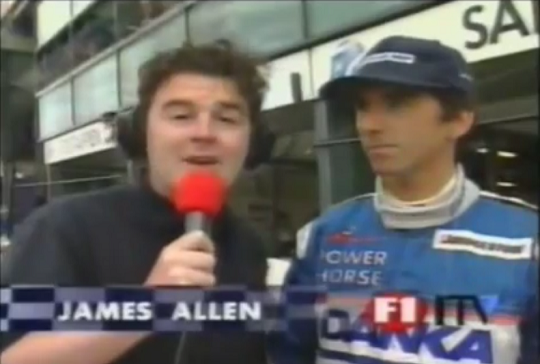
In ITV’s first live qualifying show at the 1997 Australian Grand Prix, James Allen interviews Arrows newest recruit and 1996 champion Damon Hill.
“Editorially I had worked at Autosport for two years, and prior to that I worked for Brabham with Martin Brundle, so I knew him very well from those days. Having worked on the inside of a Formula 1 team, I knew how that worked, how it operates, how it succeeds, how it fails.
“The pit lane role involved looking around for stories, looking around for insights. I’ve always been interested in providing insight and analysis wherever possible. I think the who, what, where and when is great, but I’ve always been interested in the how and the why.”
…his first F1 commentary
“I stood in for Murray when he bust his hip at the 2000 French Grand Prix, which was very useful because I was always the understudy, in case there was a ‘what if’ moment. I’d done a lot of commentary early in my career, Paris Dakar, Formula 3000, you name it, thousands of hours that hardly any people saw in the early satellite days. It was a great opportunity to commentate with Martin, to have a look at it and see how it sounded.
“I had a very intense post-French GP debrief with ITV’s Head of Sport Brian Barwick, who was very good to me and a very big influence on my career. He meticulously went through that commentary, what I’d done wrong, what I could have done better, what I done well, we spent hours going through it.
“It meant that the following year, when we did the transition where I did five races and Murray did the rest, I knew what I was trying to do. There was never any doubt in my mind about being commentator, it’s what I wanted to do since I was 15 years old.”
…succeeding Murray Walker
“It’s a double edge sword. On the one hand, the timing was good, plenty of other people would have liked to have followed on from Murray, but he kept going for a very long time. He and I worked very close together for the first four years [with ITV F1], and I drove him round Europe, he didn’t like driving in Europe so I always did the driving. We spent a lot of time together, which was wonderful, some very rich memories.
“It’s the job I always wanted to do, mass market, free-to-air TV in UK, Australia, South Africa, Canada, tens of millions of people watching, but on the flip-side he’s probably one of the most popular sports broadcasters there has ever been. You’re never going to be him, but nor should you ever try to be.
“I just said ‘listen, he has to stop’ because he’s 77 years old and can’t do this anymore, physically, it was taking its toll on him, and he wanted to go out on the top, so someone’s got to take over from him, and it might as well be me! I took it as a responsibility, I knew that there would be plenty of people who didn’t like it, I knew that there would have been people who did like it.
“Barry Davies, the football commentator whose daughter worked at Jordan at the time, said to me, ‘listen, you’re probably taking on the toughest job in sports broadcasting. If I can give you one piece of advice: stay philosophical, don’t listen to the people who cane you, and don’t listen to the people who think you’re the best thing since sliced bread, because you’re neither of those things. You’re neither a complete loser or the best thing since sliced bread, just somewhere in the middle, and be yourself’, and that was great advice, and that’s the way I played it for eight years.”
…commentating on motor racing
“What makes it tough is that there’s not one point of focus. If you commentate on a horse race, yes, you’ve got 20 horses, but they tend to focus on what is going on at the front because they all tend to be tightly packed together. If you are talking about a football match, or pretty much any ball sport, you basically follow what the ball does. Cycling is another one where you’ve got to talk about multiple narratives in one commentary, and it goes on for four hours.
Allen and Brundle here analysing the 2008 Australian Grand Prix qualifying session. Little did they know at this point was that 2008 would be ITV’s final year covering F1.
“I always looked at it in terms of a front race, a middle race and a back race. I would do it 60 percent front race, 30 percent middle race and 10 percent back race, so I gave a balanced narrative to the coverage. I always got on very well with Martin, he was very supportive. We had a lot of things that we wanted to try, we were always thinking about ‘let’s try this, let’s try that’, we never wanted to stay the same, we wanted to try to move forward. Having a racing driver like him alongside you means you’re always improving things with the broadcast coverage.
“We had some very difficult seasons to cover, ’01 was great, ’02 and ’04 were difficult, but a lot of people think that the 2005 to 2008 period is their favourite period in Formula 1. There was a lot of different winners, the cars were exciting to watch, and we had a great time.”
…ITV’s F1 exit
“We went out on a high with Lewis winning the World Championship. It was the only time in our twelve years of doing Formula 1 that we had a British champion crowned on our live coverage. It was a great moment, with 13 million watching, mass-market free-to-air TV, it was just fantastic.
“The contract we had with Formula 1 ran until 2010, and in my head, I was thinking I’d get to 2010 and do something else outside of commentary. I had a young family at that point with two young sons, and had been to every single race for 16 years. It was a little bit of a shock in ’08, when ITV decided to prioritise Champions League over Formula 1, and the BBC got the rights.
“But equally, I had also started exploring the digital media space with blogs, and so I went into that. I realised that there was a very good business to be had there, around the monetisation of blogs with sponsored brands and things. It was about leveraging my personal brand that I’d built up on the broadcast side on a blog, and then working with companies that wanted to attach themselves to it. That was like chapter two of the story, which was really interesting.
“Would I still have been commentating on Formula 1 on television in 2011 or 2012? No. I’m a bit restless, I do things for a while, then I feel like I want to move on.”
…his post-ITV exploits
“I did the blog thing, which you’re now doing very successfully, and then the BBC came knocking in 2012, to ask me if I wanted to be their F1 correspondent on 5 Live. The only reason I said yes was because I had never done radio, ever. Most people do it the other way round, they do radio first then go into television.
“The radio has been reinvented by the internet, you can really do a lot with radio, and I just wanted to see if I could do it, and actually, it’s much more difficult than television. I set myself a challenge, I really wanted to master this. I had four years in that role which I really enjoyed. I enjoyed working with the BBC radio network, trying to provide insights for people alongside running the blog and the business. Four years was just about enough, time to move on.
“I’m in the third chapter of my career now, which is building this unique vision we have at Motorsport Network. I’m in a management role, I manage 500 to 600 people in 21 countries. We’ve got the Autosport Awards, Autosport International, Autosport.com, Motorsport.com, all the digital media platforms.
“It’s a very interesting business, three different segments, media, experiences and eSports, we’re talking in the back of the Le Mans eSports truck. We’re the only ones that are across everything, it’s a unique project, no one has ever tried it before and will ever try it again. So far, it’s going well, it’s really difficult, it’s a big challenge, but I love it.”


 Motorsport Broadcasting