Channel 4 benefits from thrilling Italian Grand Prix

Channel 4 benefited from a thrilling Italian Grand Prix last Sunday, with the Whisper Films-produced highlights programme delivering their second biggest Formula 1 highlights audience on record, overnight viewing figures show.

What do these figures cover?
For newer readers of the regular viewing figures articles on this site, it is worth a reminder of what we are comparing. From the outset, all the numbers presented are overnight viewing figures, known in the industry as live plus VOSDAL (Video on Same Day as Live), supplied by Overnights.tv and exclude on demand outlets such as Sky Go and Now TV.

To ensure we paint a consistent picture across different seasons, this site typically uses a three-and-a-half-hour time slot for Sky’s Formula 1 coverage. As a general guideline, for European races, the slot is from 13:00 to 16:30, or 12:00 to 15:30 from 2012 to 2017.

The 210-minute block currently covers the final half of Sky’s ‘Pit Lane Live’ programme, ‘On the Grid’, and their billed ‘Race’ programme. There may be slight deviations to the time slot if the race ran shorter or longer than anticipated. Using just the ‘Race’ block paints an inaccurate picture as Sky have shortened the length of their ‘Race’ billing over the years.

For Channel 4, this site uses their complete highlights programme, and their ‘Build-Up’ and ‘Race’ segments for their live programming, the reasoning again to present a fair and accurate picture when comparing audience figures to previous years.

Race
Historically, the early season football international break has coincided with the Italian Grand Prix, which allows Formula 1 to hoover up casual sports viewers who may otherwise be engaged in football. This past weekend was the first time since 2011 that the race did not fall during the football international break period, and the UK audience figures echo that.

Live coverage of the race, which aired exclusively on Sky Sports F1, averaged 626k (7.6%) from 13:00 to 16:30, a decrease of 26.9 percent on last year’s average audience figure of 857k (9.5%) across a slightly shorter 200-minute time slot. Last year, Sky aired the race across their F1 channel, and Sky Sports Main Event, as well as going to their post-race show ten-minutes early, which the number published on this site reflected.

The race started with 1.09m (13.5%) at 14:15, quickly reaching a peak of 1.13m (14.0%) five-minutes later at 14:20 as the race restarted following the initial Safety Car period. Viewing figures hovered around one million viewers for the duration of the race, with 1.04m (11.9%) watching Mercedes driver Lewis Hamilton overtake Ferrari’s Kimi Raikkonen at 15:15.

Sky’s peak audience dropped compared to last year’s peak figure of 1.38m (15.0%) across the F1 channel and Main Event. Without any context, a decrease in audience figures considering the quality of the race yesterday is poor. However, the competition on Sky, such as Cardiff versus Arsenal and the conclusion of the cricket test match between England versus India, meant that F1 lost potential viewers yesterday.

Some viewers may have streamed the Grand Prix off a second device, but not all. As a collective, over two million sports fans were watching Sky yesterday afternoon, an excellent number for them, but resulted in an isolated drop for their Formula 1 audience year-on-year. It is easy to go ‘that’s a huge drop’, but there are valid reasons why on this occasion.

Highlights of the race aired on Channel 4 from 18:45 to 21:00, to an audience of 2.33m (12.5%), an increase on last year’s number of 2.15m (11.6%). Against BBC One stalwart Countryfile and ITV’s The X Factor, Channel 4’s number is excellent. It is Channel 4’s second highest number ever for a highlights show, only behind Spain which averaged 4,000 more viewers!

Unlike last year’s highlights programme, which peaked with 2.72m (16.2%) at the start of the edit and lost viewers throughout, this year, the audience increased during the edit. The broadcast climbed to a peak of 3.02m (15.5%) at 20:00, showing how the quality of the racing can also impact the free-to-air highlights positively or negatively.

The combined average audience of 2.96 million viewers is marginally down on last year’s audience of 3.01 million viewers, but up on the 2016 figure of 2.57 million viewers. In contrast, the combined peak audience of 4.15 million viewers is the highest for Italy since 2015, an increase on the past two year’s peak audiences of 4.02 million viewers and 4.11 million viewers.

Qualifying
Coverage of Raikkonen grabbing pole position struggled across both Sky and Channel 4 on Saturday, with decreases in both audience and viewing share.

Live coverage of qualifying on Sky Sports F1 averaged 245k (3.6%) from 13:00 to 15:40. The average audience is down on last year’s number of 363k (5.0%), however this figure is over a much longer five-hour time slot due to the rain delays Formula 1 experienced last year.

The peak audience for Sky year-on-year is roughly identical: a peak of 539k (7.8%) at 14:55 last weekend compared with 543k (6.7%) last year. Nevertheless, Sky’s figures are their lowest ever for an Italian qualifying session.

Channel 4’s highlights programme brought in 1.03m (9.4%) from 17:00 to 18:30, a drop on last year’s figure of 1.39m (11.5%) in a later time slot. Their programme peaked with 1.46m (12.0%), also down on the peak audience in 2017 of 1.92m (14.0%). Certainly, the earlier time slot hurt both metrics for Channel 4.

The combined average audience of 1.27 million viewers is down by half a million viewers on the 2017 number of 1.75 million viewers; with the peak audience of 2.00 million viewers down by a similar margin.

The 2017 Italian Grand Prix ratings report can be found here.

overnights.tv-bannersF1

Behind the scenes with BT Sport’s MotoGP production team: evolution

From Qatar to Valencia, from Friday morning to Sunday evening, BT Sport cover every session of the MotoGP season exclusively live. Their coverage encompasses both the main championship as well as the feeder Moto2 and Moto3 championships.

North One Television produce BT Sport’s coverage, and in the second and final part of this series, I went behind the scenes with them during the British Grand Prix weekend last month to find out how their programming has evolved.

If you have yet to read part one, head over here

When BT’s MotoGP coverage started in 2014, North One did not cover every race on-site, with BT’s Olympic Park studio in regular use. Fast forward four years, and North One now take the same size team to every race, with all the action presented on-site.

“What we want to do is make sure we offer the same service to fans, whether it is on in the middle of the night for the fly away races, or in prime time viewing hours,” explains Kevin Brown, who is MotoGP series editor for North One. “We want to serve the people who care and want to switch on in the middle of the night, they should get the same service as they would do if the race was on at 1 on a Sunday afternoon.”

2018 British MotoGP - BT commentary booth.jpg
The BT Sport commentary booth. Note that BT do not commentate from the main grandstand, or in Silverstone’s case from Woodcote. Instead, they commentate from one of their TV compound buildings, allowing them to easily rotate the commentary duo throughout the day.

26 people make up the MotoGP production team for North One, a number that includes on-air talent as well. Removing the seven on-air talent means that there are 19 people behind the lens that work on BT’s MotoGP programming race in, race out, including floor managers, researchers, producers, a sound assistant, and so on.  For Silverstone, the number is slightly higher to accommodate the additional material that BT puts out on-air.

Brown is happy with how the team currently operates with one another. “We’re very lucky that we do have a team that gets on exceptionally well with each other, and works exceptionally hard to make it happen.”

“When we get here, we have to hit the ground running, they need to know what their jobs are, what they are doing. As an example, you land in Japan, you are as jet-lagged as you can be. But you still get in a car, drive to the circuit, and have to perform as you would have done in Europe.”

“‘I’ll tell you what, let’s have a day off because we need to!’ is not an option in live sports broadcasting. Generally, everyone working for us are bike fans, we have a group of people who in some cases also work on other bike sports, and that is because they love it.”

Viewers watching at home may not realise that, but some of the production crew working on BT Sport’s MotoGP coverage also work on other aspects of motor racing. For example, Charlie Hiscott, who is a reporter for Eurosport’s World Superbikes coverage, works with North One during MotoGP weekends as a floor manager.

After an unsettled start, BT’s MotoGP coverage started to find its gear as their second season in 2015 progressed, something that Gavin Emmett acknowledges. “The first year or two we were just trying to work out what was going on, and since then we have only got better as we’ve become familiar with each other,” says Emmett.

2018 British MotoGP - BT touch-screen
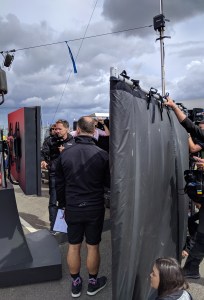
The glamarous life of broadcasting. Neil Hodgson, furthest from the camera, analyses action on BT’s touch-screen device. The black tarpaulin is around the outside to prevent shadows from appearing on the screen.

“We have had changes over the years, whether it has been the presenters or Julian [Ryder] leaving at the end of last year. Like anything, as people become more familiar with it, and as fans become more familiar with us, hopefully they see the little things we throw in there.”

Suzi Perry presents BT’s output, with a six-man band led by Keith Huewen on commentary. Emmett, James Toseland, Colin Edwards, Neil Hodgson, and Michael Laverty provide analysis, Laverty the latest addition to their team for 2018. All of them bring a wealth of motorcycling knowledge from their years in the paddock and out on the race track.

The departure of Ryder from their coverage at the end of 2017 left a hole in the show, but the strength of BT’s team has allowed them to cover for Ryder’s absence. Instead of a single commentary team throughout the day, North One opted to rotate the commentary line-up. Emmett joins Huewen for Moto3, with Toseland on Moto2 duty and Hodgson giving his opinion on the MotoGP action.

“We all love Jules, but he wanted a break from all the travelling,” Emmett tells me. “The change has meant that we can experiment with commentary pairings, and I quite like that, it keeps it all fresh.”

“You keep the familiarity with each series, but you also get different voices throughout the day which keeps it interesting. When you have the same two people all through the day, it’s hard to then get ‘up’ for MotoGP at the end of it, but if you’re changing it up, the co-commentator then has energy for that race. I like it.”

For Emmett, 2018 is a return to the commentary box, having done commentary work for Dorna prior to joining BT’s coverage. His long-standing paddock reputation means that he is the ‘go-to’ man for stories, as well as his multilingual background.

“Gavin is the best-connected man in the paddock, he knows everyone,” says Brown. “Gavin finds the stories that you can see, but also those that you can’t see, that people will tell him because of who you are.”

“I’ve been lucky because I’ve been in this paddock since 2001. I’ve seen most of these riders grow up. I remember giving Jorge his first interview I remember on his birthday in Jerez. I speak Spanish, French and Italian, so I’ve got to know them in their own language, you get to know them on a different level which helps.

“We all have different ways of getting information as well, mine are through getting to know people, everyone feeds in their own little bit and that comes together over a weekend.” – Gavin Emmett

Brown is confident that North One have plugged the gap left by Ryder, thanks to the strength and depth of their team. “Our audience are people who know and care about bikes, and we can’t pull the wool over their eyes, we have to make sure we are providing the right information. That comes from a great on-screen talent team.”

“We have these people who know it so deeply, and that then feeds back into the production team,” Brown tells me. “Editorially we’re joining up as well as we have ever been. I would say that story-telling is our strongest aspect at the moment. We have story-tellers, we have the access to the people in the paddock to tell the stories properly.”

“The teams help us out an awful lot, and when we ask, we tend to get the right people even though they know we’re going to ask a difficult question. They know we’re not trying to mess around with them, we’re just asking a genuine question and we’d like a genuine answer. We’re not trying to misrepresent anything, we’re always trying to tell the right story.”

What does the future hold for BT’s coverage of MotoGP? Earlier this year, BT retained the rights to the championship, keeping the series until the end of 2021. A new aspect for 2018 has been the touch-screen. Like the Sky Pad seen in Sky’s coverage of Formula 1, it allows BT to give viewers a perspective they have not seen before.

“With the touch-screen, we can show people things that they wouldn’t otherwise have seen. We can have a feed of the helicopter to show different lines, or for example the sheer power of the Ducati compared to the Honda, just things that help people’s understanding. It’s easy to tell them ‘what’ but it’s harder to tell them ‘why’,” says Brown.

And Brown is keen to continue using the touch-screen moving forward. “I think that’s what our guys are very good at, and if we can give them the tools to do that better then that’s good. BT are a technology company, and they want us to be using technology, and we are happy to use it, to help people’s understanding of what is a brilliant sport.”

You can argue about BT’s pricing structure, and whether the service is too expensive. But one thing is for certain. Neither BT or North One leave MotoGP fans short-changed. And long may that continue.

2018 British MotoGP - BT on Saturday.jpg

Scheduling: The 2018 Italian Grand Prix

Formula 1 heads straight from the Ardennes forest to Italy, for round 14 of the championship.

Channel 4 are showing highlights of the Monza round, with live coverage on Sky Sports F1 throughout the weekend. For those that like the added extras on Sky, you will be pleased to know the Sky Race Control from Italy onwards will be available on all devices as opposed to just the iPad.

On the personnel front, Nico Rosberg returns to Sky’s team for this weekend. Over on radio, the BBC have a half-hour special focusing on Fernando Alonso’s career on Friday evening. Into the weekend, they have truncated coverage of the race weekend, due to cricket action between England and India, and tennis action from the US Open.

Although an air-time is unconfirmed, expect Jennie Gow’s documentary featuring Billy Monger and Alex Zanardi to air on the BBC News Channel over the weekend. The documentary called Human Endeavour premieres on BBC World News at 13:30 local time next Saturday, so expect it to appear on BBC iPlayer shortly afterwards.

Elsewhere on the motor racing spectrum, the IndyCar Series heads into the final phase of its season, with the penultimate race at Portland taking place on Sunday evening.

Channel 4 F1
Sessions
01/09 – 17:00 to 18:30 – Qualifying Highlights
02/09 – 18:45 to 21:00 – Race Highlights

Sky Sports F1
Sessions
31/08 – 09:45 to 11:50 – Practice 1
31/08 – 13:45 to 15:50 – Practice 2
01/09 – 10:45 to 12:15 – Practice 3
01/09 – 13:00 to 15:40 – Qualifying
=> 13:00 – Pre-Show
=> 13:55 – Qualifying
02/09 – 12:30 to 17:10 – Race
=> 12:30 – Pit Lane Live
=> 13:30 – On the Grid
=> 14:05 – Race
=> 16:30 – Paddock Live

Supplementary Programming
30/08 – 14:00 to 14:30 – Driver Press Conference
30/08 – 17:00 to 17:30 – Welcome to the Weekend
01/09 – 16:55 to 17:30 – The F1 Show

BBC Radio F1
30/08 – 21:30 to 22:00 – Preview (BBC Radio 5 Live)
31/08 – 21:30 to 22:00 – Fernando Alonso Special (BBC Radio 5 Live)
02/09 – 14:00 to 16:00 – Race (BBC Radio 5 Live)

Blancpain GT Sprint Series – Hungary (BT Sport/ESPN)
01/09 – 13:15 to 15:00 – Race 1
02/09 – 13:45 to 15:45 – Race 2

Euroformula – Silverstone
01/09 – 14:00 to 15:00 – Race 1 (BT Sport 3)
02/09 – 12:30 to 13:30 – Race 2 (BT Sport 1)

Formula Renault Eurocup – Hungary (BT Sport/ESPN)
01/09 – 15:00 to 16:00 – Race 1
02/09 – 12:30 to 13:45 – Race 2

Formula Two – Italy (Sky Sports F1)
31/08 – 11:50 to 12:45 – Practice
31/08 – 15:50 to 16:30 – Qualifying
01/09 – 15:40 to 16:55 – Race 1
02/09 – 09:50 to 10:55 – Race 2

GP3 Series – Italy (Sky Sports F1)
31/08 – 16:45 to 17:25 – Qualifying
01/09 – 09:25 to 10:20 – Race 1
02/09 – 08:35 to 09:20 – Race 2

IndyCar Series – Portland (BT Sport 2)
02/09 – 19:30 to 22:00 – Race

International GT Open – Silverstone
01/09 – 15:00 to 16:45 – Race 1 (BT Sport 3)
02/09 – 13:30 to 15:00 – Race 2 (BT Sport X2)

Porsche Supercup – Italy
02/09 – Race
=> 11:00 to 12:00 (Eurosport 2)
=> 11:05 to 11:50 (Sky Sports F1)

The schedule above will be updated if anything changes.

Belgian Grand Prix records highest peak audience in five years

Formula 1 benefited from poor weather across the United Kingdom last Sunday, with excellent audience figures for the Belgian Grand Prix, overnight viewing figures show.

Race
Live coverage of the race aired on Channel 4 from 13:00 to 16:30, with 2.15m (18.4%) watching, an increase of around half a million viewers on last year’s audience of 1.65m (19.6%) across a shorter 190-minute time slot. It is the highest Belgium figure for the free-to-air component of the audience since 2015, when BBC One’s broadcast averaged 2.44m (22.3%).

Sky simulcast their programming across their F1 channel and Sky 1 to a weighted total audience of 657k (5.6%). Sky Sports F1’s broadcast averaged 582k (5.0%) from 13:00 to 16:30, with Sky 1’s shorter show from 14:00 averaging 104k (0.9%). It is Sky’s highest audience for Spa on record, beating their previous highest of 617k (6.3%) in 2016.

For both broadcasters, the audience shares are slightly down on previous years, the dip representative of a higher viewing audience due to the poor weather conditions experienced across the United Kingdom. However, the dips are marginal rather than anything profound, showing that F1 grew almost in-line with the total audience increase.

The race started with 4.26m (36.1%) at 14:15 across Channel 4 and Sky. Apart from a ten-minute period from 14:40 to 14:50 where the audience level dropped below four million viewers due to British Touring Car Championship action on ITV4, viewing figures remained north of four million viewers. There was a brief surge to 4.23m (34.8%) as the top of the hour hit, before dipping back towards four million viewers.

An audience of 4.04m (33.0%) watched Sebastian Vettel take victory at 15:30. In a parallel universe, the peak could have been closer to 4.5 million viewers if the action on-track was closer, but it was not to be: the peak occurred at the start of the race.

At the time of the peak, an audience of 3.22m (27.2%) were watching Channel 4’s coverage, with a further 1.04m (8.8%) watching across Sky’s two channels, a split of 76:24. Sky’s peak came later in the afternoon, as 1.06m (8.8%) watched in the five-minute segment from 15:25. The F1 channel peaked with 921k (7.8%) at 14:15, with Sky 1 peaking with 180k (1.5%) at 15:30.

It is easily Sky’s highest peak for Belgium ever, beating their previous best of 969k (9.3%) in 2016. For Channel 4, the same fact is true: their peak audience was only 164,000 viewers lower than the BBC’s peak in 2015 of 3.38m (27.5%).

The combined average audience of 2.80 million viewers is comfortably the best for Belgium since 2015, when 2.91 million viewers watched across BBC One and Sky Sports. Last Sunday’s audience increased by 27.8 percent compared with last year’s average audience figure of 2.19 million viewers.

The peak audience of 4.26 million viewers is the highest for the Belgian Grand Prix since the 2013 running of the event when a peak audience of 4.52m (41.9%) watched, a fantastic number. The peak audience increased year-on-year by 22.2 percent, and compared with 2016 was up by 8.2 percent.

To have a peak audience higher than two BBC years (4.04 million in 2014 and 4.15 million in 2015) is highly unusual, and shows just how good Belgium’s audience figures are in the grand scheme of things. Of course, some of that is down to the weather conditions last Sunday, but increases compared to the past two years are now becoming par for the course for F1 in 2018.

Qualifying
Both Channel 4 and Sky Sports recorded slightly higher numbers for qualifying than twelve months ago.

Channel 4’s live broadcast of qualifying aired from 12:55 to 15:45, to an audience of 940k (12.3%), an increase – just – on last year’s figure of 937k (12.5%). The audience for Sky’s qualifying show followed the same trajectory, averaging 269k (2.5%) compared with 262k (2.5%) last year.

The combined audience of 1.21 million viewers is as a result up marginally on last year’s number of 1.20 million viewers.

The bigger difference comes with the peak figure. The qualifying session peaked with 2.09m (25.5%) at 14:55 across Channel 4 and Sky, an increase compared with last year’s figure of 2.01m (25.1%), and the highest for Belgium since 2015.

A peak of 1.62m (19.8%) watched Channel 4’s programme, an increase of 108,000 viewers compared with last year, but Sky’s peak figure of 468k (5.7%) is down 26,000 viewers.

BTCC performs well, but average for Speed with Guy Martin
Elsewhere, live coverage of the British Touring Car Championship from a rainy Knockhill averaged 216k (2.0%) from 11:00 to 18:15 on ITV4 on Sunday, a good number considering the competition. Race 1 averaged 277k (3.5%) from 11:50, peaking with 320k (3.9%).

The second race of the day clashed with the F1, but still fared well, averaging 220k (1.8%) from 14:25, peaking with 271k (2.2%) as the race was red flagged due to the poor weather conditions. Later, 392k (2.9%) watched Tom Chilton win the third and final race from 17:20, his victory peaking with 405k (2.8%) at 17:50.

Impressively, not once during the F1 did the touring car support programme drop below 100,000 viewers, showing how well the extended show works for ITV4 overall.

On Monday evening, a new episode of Speed with Guy Martin, averaged 1.54m (7.9%) on Channel 4 from 21:00 to 22:30, the lowest number so far for Martin’s F1 themed specials.

The show faced tough competition from BBC One’s new drama Bodyguard, as well as Monday Night Football action on Sky Sports between Tottenham and Manchester United.

The 2017 Belgian Grand Prix ratings report can be found here.
overnights.tv-bannersF1

Behind the scenes with BT Sport’s MotoGP production team: planning

From Qatar to Valencia, from Friday morning to Sunday evening, BT Sport cover every session of the MotoGP season exclusively live. Their coverage encompasses both the main championship as well as the feeder Moto2 and Moto3 championships.

North One Television have produced BT Sport’s coverage since it started in 2014, and in this two-part series, I went behind the scenes with them at last weekend’s British Grand Prix to find out how their programming has evolved…

Kevin Brown has been involved in BT’s MotoGP coverage since its inception, and moved into the Series Editor role following the 2017 season. In his role, Brown has the final say on what goes out on-screen.

“My role is to develop the programmes and to make the coverage as good as it can be,” says Brown, who sat down with me on the Thursday of the Silverstone weekend. “It involves working with our on-screen talent to get the best out of them. BT own the rights, it’s their coverage, and I do it for them. If they have feedback then they certainly give it to me.”

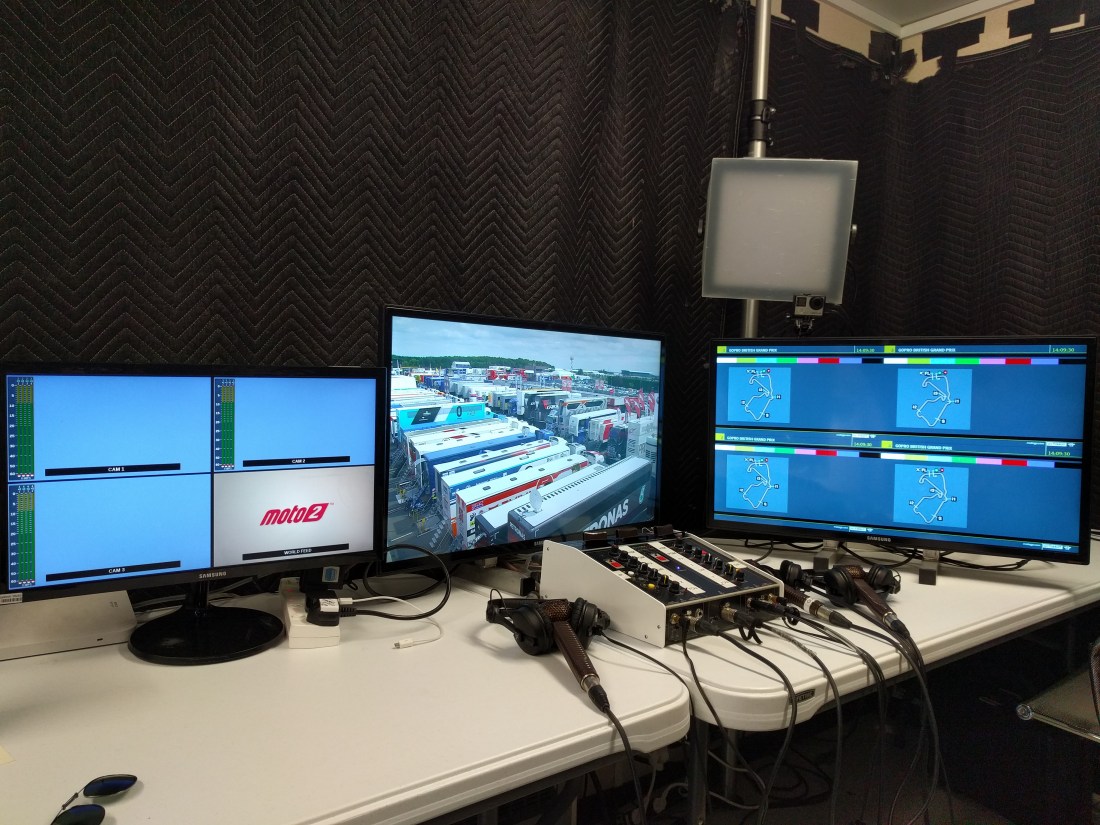
Whilst North One are not responsible for MotoGP’s World Feed, that being in the hands of commercial rights holder Dorna, they are responsible for all of BT Sport’s pre-race build-up and post-race analysis, as well as providing their own commentary over the top of the MotoGP feed.

Planning
BT’s coverage of a race weekend consists of around eight hours per day, totalling 25 hours. Although the broadcaster does not go on-air until 15 minutes before Friday practice, planning for the weekend starts the moment the previous race ends.

“You can’t turn up at a live outside sports broadcast event unprepared otherwise you’ll get caught out,” explains Brown. “Immediately following the previous race, you start to think about what the upcoming stories are. There’s a lot of contact between myself, the on-screen guys, and the producers. We spend a lot of time talking between races, it must drive our families mad!”

2018 British MotoGP - BT on Friday.jpg
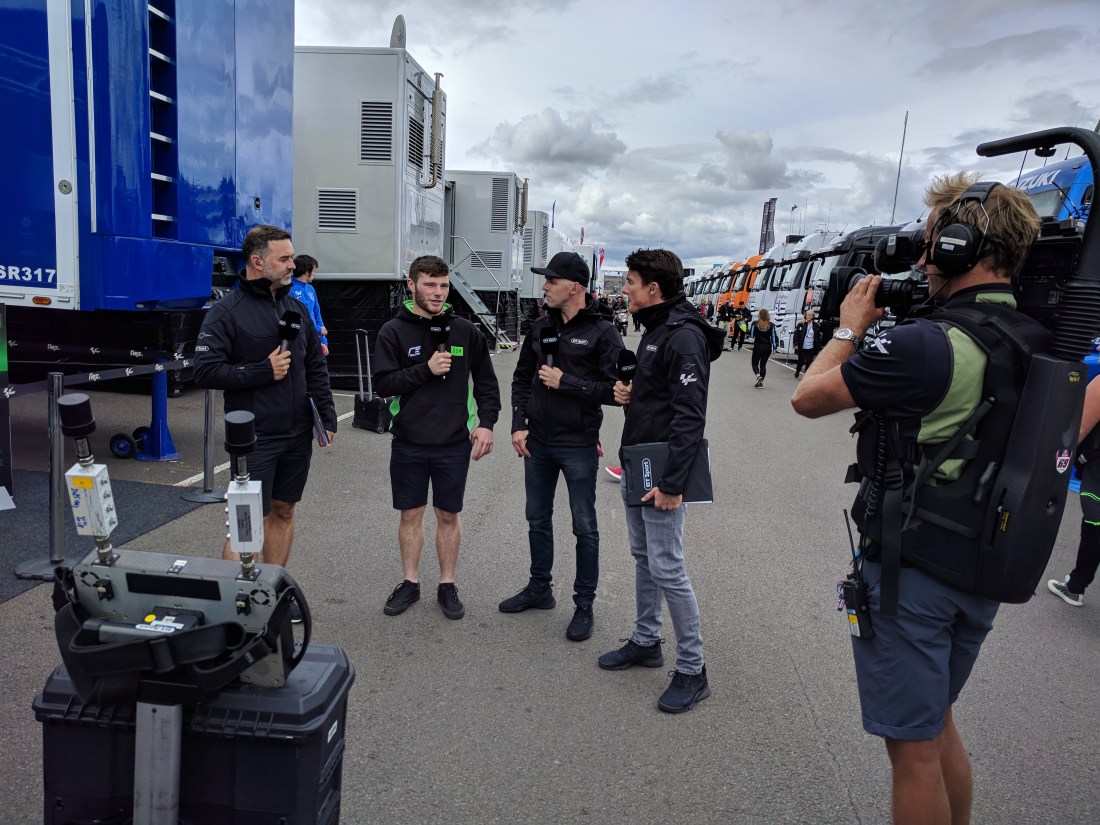
During the Friday lunch break at Silverstone, the BT Sport team of Gavin Emmett, Michael Laverty and James Toseland interview British GP2 rider Josh Owens, a series that runs alongside the British Superbikes championship.

The team starts to arrive to a race weekend on the Wednesday, but it is Thursday when the action steps up a gear. A production meeting on Thursday morning sets the scene for the weekend ahead, before all the key interviews take place in the afternoon.

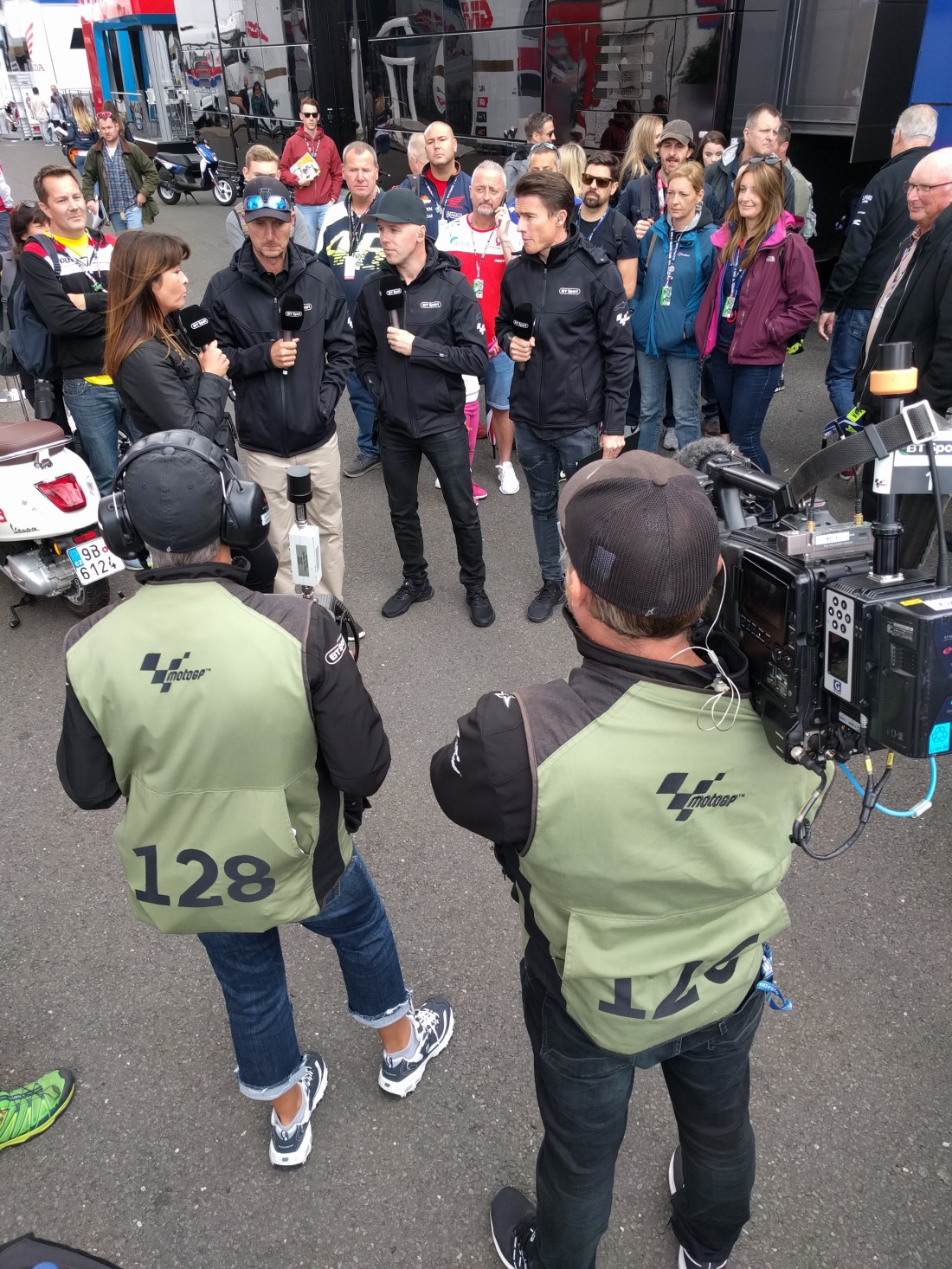
That sounds easy enough, except the interviews take place in a very short period at the respective motor homes. Broadcasters cannot attend every media scrum, they pick which ones to attend depending on where the stories are within the paddock. It also depends on what questions the broadcaster may want to ask the rider.

The key topic prior to the Silverstone weekend was the new surface that could cause riders issues (little did we know at the time, the poor condition of the track led to the cancellation of all three races on Sunday). For North One as the production company for a UK broadcaster, the priority is the British riders, Cal Crutchlow leading the way. Thursday morning threw a curve ball, a positive one, as Crutchlow signed with LCR Honda for an additional year until the end of 2020.

“We usually have an extended sit-down interview set up with Cal before the British round, but his news changes the emphasis of the interview as it would have been slightly different otherwise,” explains Brown. “We have to be able to respond and adapt quickly to emerging stories.” Thursday is also an opportunity to film any features with riders, typically a track guide, and to ensure all the systems are working as expected, ironing out any loose ends that crop up.

Gavin Emmett leads the ship on Fridays, presenting BT’s coverage of practice, encompassing Moto3, Moto2 and MotoGP. However, whilst the race track is silent during the lunch break, BT Sport remains live on-air during the 75-minute gap, using the break to their advantage.

2018 British MotoGP - Emmett and Rossi
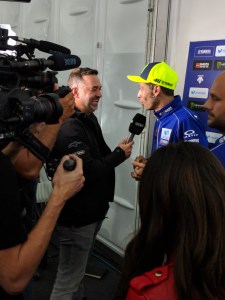
Gavin Emmett interviews Valentino Rossi in the Silverstone media centre following Thursday’s press conference.

“Not many people know about it, but for those that do, it is something we’ve built on this year, by staying live during the break,” notes Emmett. “We take our time over that break, bringing everyone up to speed with what’s been happening and what’s going on.” Here at Silverstone, Emmett and Neil Hodgson used the gap to analyse Marc Marquez and Jorge Lorenzo’s last-lap battle during the Austrian Grand Prix, an excellent use of the down-time over the lunch break.

Suzi Perry takes over hosting duties for Saturday and Sunday, whilst Emmett juggles different roles depending on the series that is on-track. “For Moto3, I am up here in the commentary box, and in parc ferme for MotoGP grabbing those interviews.”

“What people don’t realise is when you’re not on-air, while Moto2 is on, I’m doing interviews with the MotoGP riders as they’ve just finished their session. It’s pretty much the same on Sunday. You are non-stop, but that’s what it takes.”

But Emmett is happy to be covering multiple classes is his BT role. “At the end of the day Moto2 and Moto3 are World Championships. The names may have changed, but they are the pinnacle of the light weight and middle weight classes.” Of course, what the above does not consider is rain delays, which the MotoGP pit lane encountered frequently during the Silverstone weekend.

“The on-screen chemistry that our team have is as good as any time that I have worked with. What you see on-screen is genuine, and it continues off-screen as well. We get in the car to go home, and if there has been a debate on TV about a nudge on-track, that continues afterwards into dinner!

“It’s not just about the sport, it’s about our personal lives, we all care about each other and I think that is really important, and that applies for the whole crew. We’ve got cameramen who are ex-speedway riders, their opinion is relevant. There’s no one who feels that another person’s opinion is not good enough. We all listen to each other. It’s an important dynamic, but it’s one that I think we have perfected.” – Kevin Brown

In between delivering the core elements of the weekend, Brown emphasises that the team is continuously striving to improve.

“I spend most of the time between races on the phone or in the WhatsApp group, where we’re all chucking in thoughts and ideas. Some of them make it, some of them don’t, but it’s nice that we all have the ideas. We all care about the product we’re putting on-air.”

As part of an ongoing effort to bring the sport closer to the fans, an additional hour of MotoGP programming aired on BT Sport during last weekend’s British Grand Prix as a trial. New for this season, ‘In Case You Missed It’ has been BT’s Friday evening wrap-up show, but for Silverstone, BT aired the show live for the first-time directly from the Woodlands campsite.

“For me, it is all about taking people to an event they can’t go to, that’s always the important thing,” says Brown, who was also part of the North One team who produced ITV’s Formula 1 coverage.

“It’s easy to get a bit blasé about going to another race track, and another, and another, but there are thousands of people out there who would give their right arm to go to Brno or the Sachsenring. It’s really important to capture the flavour of the event.”

“Here at Silverstone, one of the things we can do is get them in the campsite and see that there’s 10,000 people in there, who are giving up their time, spending their money to be a part of what the British Grand Prix is.”

In part two, we take a look at how BT’s coverage of MotoGP has evolved since 2014, and what the future may hold…