British Grand Prix helps F1 hit 2018 high

Despite England’s World Cup performance dominating headlines on Saturday, the British Grand Prix still attracted a healthy audience the following day, overnight viewing figures show.

Race
Live coverage of the race aired across Channel 4 and three of Sky’s television outlets, with the race starting at 14:10 UK time.

Channel 4’s coverage averaged 2.39m (24.4%) from 13:00 to 16:30, a marginal increase on their 2016 and 2017 average audiences of 2.36m (17.9%) and 2.20m (20.4%) respectively. Of note is that the percentage shares for Formula 1 increased significantly compared with the past few years, reflecting the low television audience around yesterday.

Meanwhile, Sky’s programming across their dedicated F1 channel, Sky Sports Main Event and Sky 1 averaged 671k (6.9%). An audience of 384k (3.9%) watched via Sky Sports F1, with 180k (1.8%) watching via Main Event and a further 107k (1.1%) on Sky 1, a split of 57:27:16.

The total audience for Sky is up on last year’s combined figure of 652k (6.0%), but down on 2016’s figure of 736k (5.8%); in both years the race did not air on Sky 1 but did air on Sky Sports Main Event. Sky F1’s audience increased year-on-year, however Main Event’s audience dropped, reflecting the fact that Sky’s 2018 programme aired across Main Event and Sky 1.

The race itself started with 4.29m (42.7%) across Channel 4 and Sky, an excellent starting point for the Grand Prix considering Austria seven days earlier started with 3.25m (35.5%) in the same time slot. Admittedly, Austria had World Cup football to compete with, whereas the British Grand Prix had a free reign, on race day at least.

Fans remained hooked on the race throughout, audiences never dipping below 4.1 million viewers. Viewing figures climbed in the latter stages, reaching a peak of 4.55m (43.0%) at 15:30 as Sebastian Vettel claimed victory.

At the time of the peak, 3.50m (33.2%) were watching Channel 4’s broadcast, with 1.04m (9.9%) watching one of Sky’s outlets, a split of 77:23. Across Sky, the F1 channel peaked with 610k (5.8%) at 15:30, with Main Event peaking with 315k (3.1%) at the start of the race. Sky 1’s coverage peaked with 153k (1.5%) at 15:10.

The combined average audience of 3.06 million viewers is the highest of 2018 so far, and an increase of 7.1 percent on last year’s average of 2.86 million viewers. The 2018 average however is marginally down on the average audience recorded in 2016 of 3.10 million viewers.

The peak audience of 4.55 million viewers follows the same pattern as the average: an increase on 2017’s peak of 4.45 million viewers and a 2018 high, but down 9.0 percent on the 2016 peak audience of 4.99 million viewers. The shares at the time of the peak are considerably higher for 2018 (43.0%) than in the past two years (31.5% and 34.6%), again reflecting the low total audience.

Despite being the highest F1 peak of 2018, it is not Channel 4’s highest peak of 2018 as you might expect, suggesting a few more viewers sampled Sky’s coverage because of the simulcast on Sky 1.

Qualifying and Analysis
As widely anticipated, qualifying badly suffered at the hands of England versus Sweden, which clashed with the closing seconds of the session.

Live coverage of qualifying on Channel 4 averaged 1.06m (8.3%) from 12:55 to 15:50, a significant decrease of 319,000 viewers compared with 2017’s average audience of 1.38m (15.2%). Airing across four channels did not help Sky: their average audience for Silverstone qualifying dropped from 413k (4.5%) in 2017 to 277k (2.5%) this year.

Sky Sports F1’s programme averaged 198k (1.8%), with Sky 1, Main Event and Mix averaging 44k (0.42%), 30k (0.30%) and 5k (0.04%) respectively.

The combined average audience of 1.33 million viewers is unsurprisingly down 25 percent on last year’s average of 1.79 million viewers and the lowest for Britain since 2006. The qualifying session itself peaked with 1.92m (15.0%) at 14:40, compared with last year’s peak audience of 2.64m (27.3%).

In hindsight, and as stated beforehand, FOM should have moved qualifying earlier to prevent a clash, a clash which clearly dented viewing figures in the UK significantly. Thankfully, the Saturday clash did not harm Sunday’s numbers, with some excellent shares.

The raw audience is in-line with last year, a major achievement considering the heatwave that the UK is currently experiencing. If anything, this was an audience figure badly needed after the past three races: Canada and France did not air live on free-to-air television, whilst World Cup action overshadowed both the French and Austrian race days.

The 2017 British Grand Prix ratings report can be found here.

overnights.tv-bannersF1

Channel 4 set to continue airing Formula 1 beyond 2018

Channel 4 are set to continue their coverage of Formula 1 beyond the 2018 season, according to a new report from the BBC.

The free-to-air broadcaster currently airs half of the championship live, with the remaining portion of the season aired in highlights form, a deal that will end following this season

From 2019, Sky Sports will air Formula 1 exclusively live, however live coverage of the British Grand Prix and highlights of all qualifying and race sessions must be available on a “free-to-air” basis, in a deal believed to be worth just shy of £1 billion across the six seasons.

As noted at the time of the announcement, it was unclear what free-to-air means in this context, whether Sky intended to air content on Pick TV (available to all Freeview viewers) or sub-let that element to another broadcaster, such as the BBC, ITV, Channel 4 or Channel 5. It now appears that the free-to-air element of the contract is heading Channel 4’s way, continuing their coverage of Formula 1 that started in 2016, albeit on a reduced level.

The BBC’s Andrew Benson reports that Channel 4 “is on the verge of concluding a deal to take on this aspect of the contract.” Channel 4 have yet to comment, but a source has told the BBC that the agreement “is very close”, with “still a couple of areas to be resolved between C4 and Sky.”

Speaking to this site in January, Channel 4’s analyst Karun Chandhok said “If Channel 4 can do a highlights package, with a bit of pre and post-race analysis, then I think they would be open to at least a conversation. They’ve been very happy with the eyeballs they’ve had for F1. They really enjoy having F1 on their channel, from what the executives have been saying.”

This site understands that Channel 4’s production team were informed of the deal on Saturday morning at Silverstone. I understand the deal between Channel 4 and Sky could include other sports as part of a wider ranging package between the two networks. One of the sticking points surrounds the production of the show, with Whisper Films keen to retain production instead of that element heading to Sky.

There are many, many questions this news presents, namely the timing and duration of highlights coverage, and whether Channel 4’s current line-up will remain largely intact; or whether it will be a slimmed down package in duration.

Scheduling: The 2018 British Grand Prix

Silverstone plays host to the third and final part of Formula 1’s triple-header marathon, and it is a news worthy event for all of the UK’s Formula 1 broadcasters.

Button joins Sky for one weekend…
The major news story is that 2009 Formula One champion Jenson Button will join Sky Sports F1’s regular line-up for the Grand Prix weekend, strengthening their presentation team. It is Button’s first foray into Formula 1 broadcasting since he retired at the end of 2016.

Speaking to the Sky Sports website, Button said, “The British Grand Prix is an iconic part of the sporting landscape in this country, and as my home race, was always one that was really special for me. I’m really looking forward to being part of the Sky Sports F1 team, and to having the opportunity to ask questions of the drivers, rather than answering them!”

Scott Young, Sky’s Head of Formula 1, added, “Sky Sports F1 is respected for its knowledge and few people know Silverstone as well as [Jenson] does. That expertise and currency will provide engaging insights for our viewers on what it’s like to take on one of the most challenging circuits of the season.”

…but is also filming with Channel 4
Button is also assisting Channel 4 with filming of Speed with Guy Martin. The new commission follows Martin’s previous Formula 1 themed programming, the first of which aired in March 2016 (bike versus racing car), with the second following on in September 2017 (pit stop challenge).

This show sees Williams Heritage rebuild their FW08C car for Martin to race at Silverstone. Martin challenges Button, who will be in the banned six-wheel Williams FW08B car, which the team were going to race in the 1983 Formula One season. The challenge takes place this Thursday prior to the main weekend.

Although only officially announced last month, the documentary has been in development since the start of the year, with Channel 4’s analyst Karun Chandhok closely involved alongside Martin.

Sky One gets in on the action
As with the Spanish Grand Prix in May, both qualifying and the race air live on Sky One. This appears to be a new direction from Sky, perhaps ahead of further simulcasts in 2019 when viewing Formula 1 fundamentally changes for those without Sky Sports in this country.

Elsewhere in Sky’s line-up, The F1 Show for Silverstone remains in its live Thursday evening time slot in front of the main grandstand, however it does mean that there is no F1 Show on Saturday.

Sky are not airing the Masters Historic races, meaning that their schedule on Sunday morning looks emptier than usual. Sunday contains a hole from the end of Formula Two at 10:35 to the start of Porsche Supercup an hour later.

Slicks-0-Six returns, as does EJ…
The BBC’s radio coverage has been knocked for six recently due to the World Cup, but this weekend the race transmits live on BBC Radio 5 Live, with a special Slicks-0-Six chat show airing from 18:00. Slicks-0-Six returns having last aired after the British Grand Prix in 2015.

On the personnel front, Eddie Jordan returns to Channel 4’s coverage, in what is likely to be his, and a lot of people’s, last British Grand Prix as a broadcaster.

Channel 4 F1
Sessions
06/07 – 10:00 to 11:35 – Practice 1
06/07 – 13:55 to 16:00 – Practice 2
07/07 – 10:55 to 12:25 – Practice 3
07/07 – 12:55 to 15:50 – Qualifying
08/07 – 13:00 to 17:35 – Race
=> 13:00 – Build-Up
=> 13:40 – Race
=> 16:30 – Reaction

Sky Sports F1
Sessions
06/07 – 09:30 to 11:50 – Practice 1 (also Sky Sports Main Event)
06/07 – 13:45 to 15:50 – Practice 2
07/07 – 10:45 to 12:15 – Practice 3 (also Sky 1)
07/07 – 13:00 to 15:40 – Qualifying (also Sky 1 [until 15:30], Sky Sports Mix and Sky Sports Main Event)
=> 13:00 – Pre-Show
=> 13:55 – Qualifying
08/07 – 12:30 to 17:10 – Race (also Sky 1 [until 17:00])
=> 12:30 – Pit Lane Live (also Sky Sports Main Event)
=> 13:30 – On the Grid (also Sky Sports Main Event)
=> 14:05 – Race (also Sky Sports Main Event)
=> 16:30 – Paddock Live

Supplementary Programming
04/07 – 20:30 to 21:00 – The F1 Report: Preview
05/07 – 15:00 to 15:30 – Driver Press Conference
05/07 – 18:00 to 19:00 – The F1 Show
05/07 – 20:45 to 21:00 – Paddock Uncut
11/07 – 20:30 to 21:00 – The F1 Report: Review

BBC F1
08/07 – 14:00 to 16:00 – Race (BBC Radio 5 Live)
08/07 – 18:00 to 19:00 – Slicks-0-Six (BBC Radio 5 Live)

British Superbikes – Knockhill
07/07 – 15:30 to 18:00 – Qualifying (Eurosport 2)
08/07 – 13:00 to 18:00 – Races (Eurosport 2)
11/07 – 20:00 to 21:00 – Highlights (ITV4)

Euroformula – Hungaroring (BT Sport 1)
07/07 – 13:30 to 14:30 – Race 1
08/07 – 12:00 to 13:00 – Race 2

Formula Two – Britain (Sky Sports F1)
06/07 – 11:50 to 12:50 – Practice
06/07 – 16:05 to 16:50 – Qualifying
07/07 – 15:40 to 17:00 – Race 1
08/07 – 09:15 to 10:15 – Race 2 (also Sky Sports Main Event)

GP3 Series – Britain (Sky Sports F1)
06/07 – 17:00 to 17:45 – Qualifying
07/07 – 09:20 to 10:15 – Race 1
08/07 – 08:00 to 08:55 – Race 2 (also Sky Sports Main Event)

IndyCar Series – Iowa 300
08/07 – 19:00 to 22:00 – Races

International GT Open – Estoril (BT Sport 1)
07/07 – 14:30 to 16:15 – Race 1
08/07 – 13:00 to 14:30 – Race 2

Porsche Supercup – Britain (Sky Sports F1)
08/07 – 11:20 to 12:05 – Race (also Sky Sports Main Event)

Speedway Grand Prix – Sweden (BT Sport 1)
07/07 – 17:45 to 21:15 – Races

Virgin Australia Supercars – Townsville (Motorsport.tv)
07/07 – 06:50 to 08:45 – Race 1
08/07 – 06:50 to 08:45 – Race 2

World Superbikes – Misano
06/07 – 08:40 onwards (Eurosport 2)
=> 08:40 to 09:30 – SBK: Practice 1
=> 11:25 to 12:20 – SBK: Practice 2
=> 13:55 to 14:55 – SSP: Practice 2
=> 14:55 to 15:55 – SBK: Practice 3
07/07 – 09:00 to 14:00 – Qualifying and Race 1 (Eurosport 2)
08/07 – 10:00 to 15:00 – Support and Race 2 (Eurosport 2)
10/07 – 20:00 to 21:00 – Highlights (ITV4)

As always, the schedule will be updated if anything changes.

Updated on July 4th to reflect GP3 moving back to Saturday morning.

Austrian Grand Prix falls foul of poor scheduling

Poor scheduling from Formula One Management hurt viewing figures for the Austrian Grand Prix in the UK this past weekend, overnight viewing figures suggest.

Race
The race aired live across Channel 4 and Sky Sports, starting at 14:10 UK time. The latter phase of the Grand Prix clashed with the World Cup round of 16 clash between Spain and Russia, which had an adverse impact on audience figures. Last weekend was the first time Austria aired live on free-to-air television since 2003.

Live coverage of the race averaged 1.52m (15.8%) on Channel 4 from 13:00 to 16:30, their worst average audience for a live European round. Their previous lowest was for last year’s Belgian Grand Prix, which averaged 1.65m (19.6%) in the August Bank Holiday slot.

Sky’s race day show aired across their F1 channel and Main Event from 13:00 to 16:25 to an audience of 423k (4.4%), Sky’s lowest European audience since the 2015 Abu Dhabi Grand Prix. 327k (3.4%) watched via the F1 channel, with 97k (1.0%) watching on Main Event.

The race started with 3.25m (35.5%) at 14:15 watching across Channel 4 and Sky Sports, around half a million viewers lower than other European races this season, such as Azerbaijan and Monaco. Nevertheless, the audience remained above three million, with 3.03m (29.9%) watching at 14:55.

However, the audience share dropped rapidly throughout the race, with new viewers heading straight for the football on BBC One. By 15:05, around half a million viewers had switched from the F1 to the football: 2.57m (23.4%) were now watching the Grand Prix, significantly lower than you would expect for a live free-to-air round at this phase of the season.

An audience of 2.50m (21.2%) watched Max Verstappen win the race at 15:30, with 1.87m (15.9%) watching via Channel 4, and 625k (5.3%) watching via one of Sky’s two channels covering the race. The audience dropped more than usual during the post-race analysis: Channel 4’s post-race show averaged fewer than half a million viewers from 16:15 onwards.

The combined average audience of 1.94 million viewers is the third race in a row where Formula 1 has recorded an average below two million viewers. The average is down 16.9 percent on last year’s figure of 2.34 million viewers when Channel 4 aired highlights, although there are clearly other factors in play this year.

Due to the unique circumstances, the peak audience came at the start of the race, with the aforementioned 3.25 million viewers at 14:15, slightly higher than last year’s peak of 3.20 million. At the time of the peak, 2.52m (27.5%) were watching on Channel 4, with 733k (8.0%) watching on Sky. Sky’s own peak actually came at 14:55, 743k (7.3%) watched the race with them during the five minutes before Spain versus Russia started.

Qualifying and Analysis
The audience quickly bolted following the qualifying session, in the same way they did the following day. Channel 4’s programme averaged 948k (12.6%) from 12:55 to 15:40, with Sky’s show averaging 246k (3.3%) from 13:00 to 15:40.

Qualifying itself peaked with 1.95m (22.1%) at 14:55, with 1.46m (16.6%) watching via Channel 4, and 489k (5.5%) watching via Sky’s F1 channel. As soon as qualifying finished, the audience slumped to under one million viewers. By 15:15, 589k (6.2%) were watching analysis on either Channel 4 or Sky.

The combined audience of 1.19 million viewers and peak audience of 1.95 million viewers are roughly around where you would expect given the strong competition and the warm weather conditions. However, both figures are down on last year’s qualifying audience for Austria.

In my piece last week, I mentioned that F1 would suffer trying to face the World Cup, and that is now turning into reality. Why F1 is being stubborn, I do not know. Next Sunday’s British Grand Prix does not face the World Cup; however, the qualifying session could clash with the build-up to England’s quarter-final clash, assuming they beat Colombia tomorrow.

The 2017 Austrian Grand Prix ratings report can be found here.
overnights.tv-bannersF1

Changing times: Analysing F1’s willingness to work around the World Cup

Formula 1’s audience figures for the French Grand Prix in the United Kingdom did not paint a rosy picture, with low numbers across the board.

Below the surface here, there is a secondary story, and that is F1’s resistance to move out of the way of the World Cup. But, have things always been that way? Before I wrote this piece, I thought the answer was ‘yes’, it feels like F1 has failed to acknowledge the World Cup’s existence this year.

I have analysed all the World Cup tournaments since 2002 to see if the statistics and timings support my theory…

World Cup 2002 – Korea and Japan
Being eight hours ahead of the UK meant that most matches from Korea and Japan in 2002 occurred during the early hours, but that did not stop the disruption to F1’s European season. Back then, the 60-minute qualifying session started at 12:00 UK time.

But for the European Grand Prix, F1 moved qualifying on Saturday 22nd June to 11:15 UK time, avoiding a quarter-final game between Senegal and Turkey, which kicked off at 12:30 UK time.

The change gave broadcasters suitable time to cover the session, with additional post-session analysis (10 minutes the par for the course at this stage for ITV1), before heading off-air.

World Cup 2006 – Germany
Four years later, the tournament from Germany fell during the same period as three F1 races, causing F1’s organisers to make multiple changes to their weekend schedules.

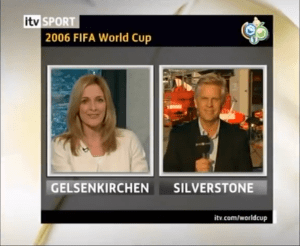
F1 moved both qualifying and the race for the British Grand Prix to avoid a clash with the group stages of the football competition: the qualifying session on Saturday 10th June started 30 minutes earlier at 12:30 UK time on ITV1, to avoid a potential overlap with England versus Paraguay.

The race the following day started even earlier at 12:00 UK time, preventing a clash between the Grand Prix and Serbia and Montenegro’s clash with the Netherlands, which kicked off at 14:00 on BBC One.

2006 British GP - World Cup ITV
Gabby Logan does a live link to Steve Rider at Silverstone during ITV’s coverage of their first game at the 2006 FIFA World Cup.

A rare occasion followed during the weekend of the 24th June, when ITV simulcast the Canadian Grand Prix on ITV4. Formula 1’s broadcasters who aired both the football and the Grand Prix faced multiple problems heading into the weekend, and the following weekend with the US Grand Prix.

The knockout games on both weekends kicked off at 16:00 UK time. With qualifying and the race starting at 18:00 UK time, it meant that extra time on either weekend would result in a clash with the F1. England versus Ecuador on Sunday clashed with ITV’s Canadian race build-up but did not go into extra time. Nevertheless, the clash caused significant damage to ITV’s audience figures.

A secondary problem, and the reason for the ITV4 simulcast, was that ITV selected Portugal versus the Netherlands as their live game, which kicked off at 20:00. Clearly the timings were far too tight, with ITV opting for the simulcast so post-race analysis could continue on ITV4. Cutting it tight, indeed…

The qualifying session from Indianapolis on Saturday 1st July did clash partially, even if it was not by design: England versus Portugal went into extra time, clashing with F1 qualifying. For UK viewers it did not really matter, ITV in that era aired qualifying for the North American races on a tape delay late at night.

World Cup 2010 – South Africa
Although three races in 2010 fell into the same period as the World Cup, Formula One Management did an excellent job to avoid direct clashes.

The Canadian Grand Prix occurred on the opening weekend of the tournament. BBC moved live coverage of qualifying, which started at 18:00 UK time on Saturday 13th June, to BBC Two, primarily so Doctor Who could air in its primetime BBC One slot before England versus USA started on ITV at 19:30.

BBC One – Sunday 13th June 2010
16:05 – F1: Canadian Grand Prix Live (race start: 17:00)
19:15 – BBC News

ITV – Sunday 13th June 2010
14:20 – World Cup 2010 Live (match start: 15:00)
17:00 – Midsomer Murders (R)
18:30 – ITV News
19:00 – World Cup 2010 Live (match start: 19:30)

The Montreal race remained on BBC One where it mopped up the floating football audience, becoming the most watched show on BBC One on that day. Starting at 12:00 local time (17:00 UK time), the race started minutes after Serbia’s game with Ghana finished on ITV yet finished before Germany’s tie with Australia started at 19:30. To F1’s advantage, the games in 2010 were spread out across the day better than compared with 2018.

Two weeks later, it was heartbreak for England against Germany on Sunday 27th June. The match kicked off at 15:00, with a risk of overlap between the game and the European Grand Prix, which started at 13:00 UK time. As a result, the BBC moved the F1 to BBC Two, primarily so that they could run an extended build-up, but in the end the two events did not overlap.

Silverstone hosted the British Grand Prix on the same day as the World Cup final, the F1 race serving to be a great warm-up act for the main event to follow later in the evening.

World Cup 2014 – Brazil
With F1 in Europe, no clashes occurred between the football competition in 2014 and the Grand Prix.

World Cup 2018 – Russia
Up until this point, F1 under its previous ownership had done its best to avoid World Cup clashes. Placing a triple header though in the middle of the World Cup was asking for trouble.

During the French Grand Prix weekend, World Cup fixtures kicked off at 13:00, 16:00 and 19:00 UK time, leaving around a 75-minute gap between each game. An F1 race lasts around 90 minutes, meaning a clash of some kind was inevitable. In the end, Liberty Media opted to start qualifying at 15:00 UK time, the closing seconds clashing with South Korea game against Mexico.

As predicted last December, F1 pushed the race back to 15:10 to avoid a clash with England versus Panama, but by moving the race, the latter half of the Grand Prix clashed with Japan versus Senegal. Like in 2006 with England versus Ecuador, F1’s audience figures for the build-up suffered, it was a lose-lose situation for the sport.

Even if the teams are unknown, the dates are known years in advance, and Liberty Media should have had this weekend at the top of their ‘to avoid’ list. Things do not get better for the sport in the next two weeks.

The latter seconds of both the Austrian and British Grand Prix qualifying sessions will clash with a World Cup game. The former on Saturday 30th June will see a slight clash with France versus Argentina, whilst Silverstone’s qualifying session clashing with the opening seconds of a quarter-final clash.

Lastly, the second half of the Austrian Grand Prix will clash with Spain’s round of 16 clash with Russia. What is interesting is that the majority of the clashes could have been avoided had the sessions started at the same time they did in 2017, before Liberty Media tweaked the weekend schedule.


So, when we see the headline “F1 hits new audience low”, we should also remember that an F1 race before 2018 had never faced a World Cup game the 21st century. When Bernie Ecclestone was at the helm, he was sensible enough to move qualifying or the race a couple of hours here or there, avoiding even the slightest potential of a clash, because he knew it would harm the sports audience in the affected territories.

Another element to this is that Formula 1 has significantly more pay-TV contracts now than it did in the mid-2000s, meaning that the number of broadcasters airing both F1 and the World Cup may have decreased, resulting in less pressure towards Formula One Management to change its time slots.

I love Formula 1 and motor racing but I, like millions of others, also enjoy the spectacle that is the World Cup. Even if you do not follow club football, the World Cup has the power to reach cross sections of the population that many other sporting platforms fail to reach. Expecting F1 to come out unscathed from any kind of clash is somewhat naive.

In my opinion, Liberty Media are failing to see the global sporting picture, and where F1 fits in. The World Cup is a once in four years event, and they must be prepared to work around events such as that if F1 is to sustain a healthy audience throughout the course of the season. Liberty Media’s stubbornness is likely to cost the sport millions of viewers worldwide over the forthcoming weeks.

F1 session times have been sourced from FORIX. TV scheduling details have been sourced from Overnights.tv’s programme search.