The 2018 Australian Grand Prix, which featured the same one-two finish as the year before, also remarkably had near identical audience figures in the United Kingdom across the weekend, overnight viewing figures show.
Race
As noted prior to the start of this season, this site will continue to use the three-and-a-half-hour time slot, or equivalent, for Sky’s race day broadcasts. For 2018, this encompasses the final half of Pit Lane Live, On the Grid and the race show itself. All audience figures are Live + VOSDAL (Video on Same Day as Live), they include simulcast (+1) channels as well as commercial breaks.
Live coverage of the race, which aired on both Sky’s Formula 1 channel and their Main Event channel, averaged 344k (18.4%) from 05:00 to 08:30. During this period, an audience of 256k (13.8%) watched via the dedicated F1 channel, with 88k (4.6%) watching via Main Event.
Sky’s race coverage across both channels peaked with 562k (20.4%) at 07:30 as Sebastian Vettel won the Grand Prix. This figure includes viewers who recorded the live airing to watch later in the day. At the time of the peak, 418k (15.2%) were watching Sky Sports F1, and a further 144k (5.2%) via Main Event.
Compared with 2017, Sky’s average audience is down by 12.9 percent, and their peak audience down by 11.6 percent. Last year’s programme averaged 395k (22.2%), peaking with 636k (38.7%). The figures are more favourable with 2016, only a slight dip in average (344k versus 360k), but an increase in the peak audience (562k versus 559k).
Seven hours after the race finished, Channel 4’s highlights broadcast averaged 1.71m (16.8%) from 14:30 to 17:15, an increase of 3.7 percent on last year’s figure of 1.65m (20.6%). Whilst an audience increase is always nice, the total television audience year-on-year was up by 2.2 million viewers in the slot, yet Channel 4’s F1 coverage only gained by 61,000 viewers, hence why the percentage share has dropped drastically.
Similarly, Channel 4’s show peaked with 2.15m (18.2%) at 16:40, compared with a peak of 2.07m (26.0%) twelve months ago. Both the average and peak metrics for 2018 are down by around 19 percent on Channel 4’s 2016 Australia audience figures.
The combined average audience of 2.05 million viewers is a very marginal increase on last year’s average of 2.04 million viewers, or to be exact an increase of 10,000 viewers, which is within the margin of error. The same applies for the combined peak audience of 2.71 million, which itself was up 13,000 viewers on last year’s figure of 2.70 million viewers.
Considering the relative heat wave the UK experienced this time last year, to start off on the same level as that is not a great way to start the season. The low audience shares are cause for concern, as the viewers were around on Sunday, they just chose to watch something other than the F1. Australia’s numbers only serve to continue the general downward trajectory for Formula 1 – on linear television at least.
Qualifying
Sky’s qualifying coverage aired from 05:00 to 07:45 across Sky Sports F1 and Main Event to an audience of 252k (13.2%). 181k (9.4%) watched via Sky’s F1 channel, with 71k (3.8%) choosing to watch via Main Event.
Coverage of qualifying peaked with 477k (14.6%) at 07:05 as Lewis Hamilton partied to pole position, in-line with last year’s peak figure of 481k (14.6%). Again, the average for 2018 of 252k was in-line with last year’s average of 254k (12.6%). Both metrics were up around 10 percent on 2016.
Later in the day, a further 1.18m (15.1%) watched Channel 4’s highlights show from 13:00 to 14:50, down 45,000 viewers on last year’s number of 1.22m (18.2%). The broadcast peaked with 1.62m (20.2%), marginally down year-on-year.
The combined average audience of 1.42 million viewers is slightly down on last year’s audience figure of 1.48 million viewers.
The 2017 Australian Grand Prix ratings report can be found here.
The 2018 Australian Grand Prix saw Formula One Management (FOM) unveil a new-look to their television product, with a new introduction five-minutes before the race and a new graphics set.
Admittedly, some of the riskier and controversial options on the table, such as introducing a highlights reel half way through the race, did not make it to fruition, for Australia at least. Inevitably, comparisons will be made between this set of graphics and previous iterations. But which set is your favourite? Here is a look at each graphics set, along with a poll at the bottom of this post.
I have made a conscious decision to leave out any of the graphics set from before 1994, as my knowledge of what happened before then in this area is limited. I also am unaware whether there was a consistent graphics set used for complete years, or whether it was the decision of each of the local hosts. What I do know though, is that from 1994, things became a lot more consistent.
Also, the content in this article is copied from the equivalent 2015 version, except with a few minor rewording tweaks here and there, plus a new section for 2018. When I ran this post in 2015 to mark the introduction of the previous set, 748 people voted as follows:
14.4% – 1994 to 2003
7.1% – 1996 to 2002 (F1 Digital+)
9.0% – 2004 to 2009
27.1% – 2010 to 2014
42.4% – 2015
How will you vote this time around? First, here is a summary of the different packages…
1994 to 2003
Anyone who began watching Formula 1 in the late 1990’s will remember this graphics set fondly. Probably dubbed as the classic graphics set, the World Feed graphics were standardised for the beginning of 1994 and remained in place for a decade.
The classic graphics set on display during the 2000 Australian Grand Prix Qualifying session.
For its time, the graphics did their job perfectly, but towards the end, the graphics set had outlived their welcome as viewers wanted more data and detail, especially those that had returned to the World Feed from the defunct F1 Digital+ platform. Plus, it is fair to say that those graphics would be unsuitable in a widescreen era, and unusable in a three-part qualifying session if not tweaked significantly.
1996 to 2002 – F1 Digital+
Whilst the majority of the world were accustomed to the classic graphics set seen above, a small portion of the audience who subscribed to the F1 Digital+ service across Europe (and in the UK through Sky during 2002) received a different graphics set, which was arguably ahead of its time.
The F1 Digital+ graphics set in action during practice for the 2002 United States Grand Prix.
Those who watched via the standard World Feed did see the F1 Digital+ graphics set once, during the 2002 United States Grand Prix, but apart from that, it was hidden away on the pay-per-view service. Once the service collapsed, the graphics set was discontinued, although the collapse of the service was what probably led to the World Feed graphics getting an overhaul for the beginning of the 2004 season.
2004 to 2009
The 2004 to 2009 graphics set was notable given the number of new features that came with it, such as the timing tower, which I do not believe was included in the F1 Digital+ set. This was also the first graphics set that made heavy use of the three lettered abbreviations that are now commonplace in motor sport. What I do not know is whether these were FOM innovations within motor racing, or a trend that began elsewhere – anyone who watches football will know that abbreviations have been around for decades.
The no flash, more modern graphics set on display during qualifying for the 2006 Australian Grand Prix.
Items such as the rev-counter, which commonly appeared on F1 Digital+, soon became integrated into this graphics set. As with every graphics set, the set was adjusted as time progressed, but the basic template remained the same throughout. As FOM made the transition to widescreen for the 2007 season, the graphics set remained within the 4:3 safe area until they were replaced at the end of 2009. It may not have been the flashiest graphics set ever, however it did its job fine.
2010 to 2014
All of the previous graphics set up until 2010 had featured straight lines, either horizontally or vertically. The graphics set introduced at the 2010 Bahrain Grand Prix went for a more slanted approach, this was presumably done so it matched the slanted aspect of the F1 logo. Yes, the graphics did look ‘sexier’ than previous versions, but did it provide anything that the previous versions did not? Well, not really.
A picture of FOM’s graphics set, as seen during Q2 at the 2013 Japanese Grand Prix.
When I compared Dorna’s MotoGP graphics with FOM’s graphics in October 2013, I concluded that “if you are looking for something easy on the eye, then FOM wins, but if you want a data driven set, then Dorna with their MotoGP graphics is a clear winner.”
Like the previous version, this set of graphics went through multiple iterations from 2010 until 2014, but the overall vision remained the same, with not much changing under the surface during the five years.
2015 to 2017
Minimalist was the name of the game, and with branding around the world heading that way in the past five years, this iteration of FOM’s graphical package followed that trend. ‘Keep it simple’ is another way of saying it, and I was a fan of this set.
The 2015 to 2017 graphics set on display during practice two at the 2015 Australian Grand Prix.
Maybe this set was too clean for what the ‘new’ Liberty Media style Formula 1 brand is trying to be? In terms of value added, again you could argue that FOM did not revolutionise with this graphics set, leading to a stale television product. But what they had was good, in my view. Part of me wishes that FOM iterated with that set, rather than ripping up the form book again for 2018.
But, if the code that generates the graphics is unwieldy, complex and has what is known in the field as ‘technical debt’, then starting back from square one is worth it in the long term.
2018
It was inevitable that with Liberty Media’s take over a new graphics set would arrive ready for 2018. Whilst the new package has potential, and already has several strong points, there are one or two areas that need to change.
Looking at McLaren’s Stoffel Vandoorne during the 2018 Australian Grand Prix qualifying session.
The very basic point to start with is that the font size on the timing wall needs to be larger. Compared to the previous two iterations, the size of the font is smaller, making it difficult to read on different devices – squinting at the television is not the best method for watching Formula 1! Secondly, FOM need to iron out the colour clashes (the ‘purple sector’ problem is one of these).
One the other hand, the timing wall is clearly more flexible than the previous iteration with information about the driver, such as their team logo, displayed occasionally to help the newer fan coming into the sport. The wall also clearly identifies when a driver has overtaken someone else in practice or the race, through red and green markers.
A further post will be coming up in the next week or so with detailed analysis looking at all aspects of FOM’s package for 2018. Of course, there are always room for improvements with any graphics set, but, as with the 2015 set, these are mainly tweaks. If the font size does not change moving forward, there should be cause for concern. But, where does the 2018 graphics set stack up for you historically?
Do you like the approach taken by FOM, or do you wish we could travel back in time to the 1990’s and get the ‘black and yellow’ colour scheme back? It is time to have your say in the poll below and as always, your views and opinions are welcome.
Fans in the United Kingdom have a variety of options to watch Sky’s coverage of Formula 1, however the cheapest options are experiencing a price rise for 2018, the latest analysis shows.
With pay TV growth heading towards saturation point, Sky are trying to try to prevent fans from illegal methods of viewing the sport, something that has been ongoing for several years, but are now attempting more aggressively.
Since the start of the 2017 season, two major developments have happened. The first, in July last year, saw Sky unveil a new look for their Sports offering, getting rid of the previous 1, 2, 3 system and introducing channels branded around specific content, such as Sky Sports Football, Cricket and Golf, offering customers the opportunity to subscribe to just one of these, including F1.
The second is the yet to be launched (and now delayed) over-the-top service, which will not be available in the UK. Why is this of importance? Although Formula One Management (FOM) will do everything possible to prevent fans in the UK from accessing the service, some may still slip through the net, hurting Sky’s audience figures marginally in the process.
The below information is primarily aimed at new customers on both Sky and Virgin Media. As regular readers for these services will be aware, if you threaten to leave (otherwise known as ‘haggling’), expect Sky or Virgin to offer a cost reduction to secure your custom. This is not a guarantee, but likely if the pay TV company values your services, and if you have been a long-term customer. Note that all the comparisons exclude double and triple play choices, such as phone and broadband deals.
Sky
For the second year running, you can view Formula 1 in standard definition (SD), high definition (HD) and ultra-high definition (UHD) with Sky. The price increases with each tier. As in 2017, the UHD option splits into two sub-categories, depending on whether you want the remainder of your content available in high or standard definition.
There are two tables below. One, if you wish to view Sky Sports F1 only within the Sky Sports portfolio, and a second option if you wish to access all of Sky Sports’ portfolio of channels.
For Sky, it is all change since the start of 2017. The Original and Box Set Bundles, priced at £22.00 and £38.00 respectively (the latter you needed to watch sport in high definition), have gone. In its place is Sky’s entry level Entertainment offering, priced at £20.00 for the first 18 months, increasing to £25.00. Simplification is the name of the game, to try and hook customers into their offering.
As alluded to above, sports fans can now purchase individual channels. Sky Sports F1 on top of the basic package is £18.00 more, one might argue that is too expensive for a specific channel, nevertheless it is an improvement over other Sky TV options if you are only interested in Formula 1. If you are into a range of sports, the complete Sky Sports Pack is more appropriate.
I should note that there are significant offers currently related to the above. Firstly, if you purchase Sky Sports F1 only, you get Sports free in high definition. Secondly, there is currently an offer getting you Sky Sports for £20.00 instead of £27.50, almost rendering the Sky F1 only option redundant.
In addition, the Entertainment entry-level price of £20.00 only applies for the first 18 months, following which the pack is £25.00. Why have I not included the Sky Sports offers in the two tables? Because it is unclear how long these offers will last for, the Sky website does not specify an expiry date.
Virgin Media
Compared with 2017, Virgin Media’s pricing structure is largely unchanged with a £2.00 rise for Mix TV, and then a £5.01 rise for installation the only two things of note.
I have triple checked their website, and most of Virgin Media’s existing offers relate to their Broadband offering meaning that, at this moment in time, Sky is the more viable option for new customers entering the pay TV market.
Now TV
For those of you unwilling to pay a large pay TV subscription, Now TV is an attractive option, and their most appetising offer expires at 23:59 on March 25th. The F1 Season Pass gives you access to all Sky Sports channels for the equivalent of £16.67 a month, or £150.00 across the nine months.
Beyond that, there are three Now TV tiers for Sky Sports. The bad news is that the day pass and the weekly pass have increased compared to twelve months ago. The day pass costs £7.99 (up £1.00), whilst the weekly pass is £12.99 (up £2.00). The monthly pass remains £33.99.
Other than the F1 Season Pass, you can watch every race live by purchasing six monthly passes this year:
– pass 1 can be used from March 24th to April 24th (Australia and China)
– pass 2 can be used from May 11th to June 11th (Spain and Canada)
– pass 3 can be used from June 23rd to July 23rd (France and Germany)
– pass 4 can be used from July 28th to August 28th (Hungary)
– pass 5 can be used from September 1st to October 1st (Italy and Russia)
– pass 6 can be used from October 25th to November 25th (Mexico and Brazil)
The six Now TV monthly passes work out at a cost of £186.94 across the year. A cheaper option would be to buy eleven weekly passes, at a cost of £142.89 across the year, but this option is more expensive than 2017 with one additional race, combined with the rise in price for the weekly pass. If you are only interested in the race, eleven different day passes will cost you £87.89 across the year. Is Now TV slowly losing its value for money status? It will be fascinating to track Now TV’s prices this year to see if further rises follow, or whether the status quo returns.
Sky Sports Mobile TV
The cheapest option for fans remains Sky Sports Mobile TV for iPhone and Android. Although the premium tier has risen in price by £1.00 compared with last year to £10.99 per calendar month, it remains value for money, costing fans £65.94 for six calendar months.
In summary, here are the key numbers for Formula 1 fans, including installation. I have compared to the equivalent prices from 2017 to give a sense of the change for each year-on-year.
– £851.00 a year – Sky (All – UHD + HD other content) – down £211.00
– £779.00 a year – Sky (All – UHD + SD other content) – down £19.00
– £749.00 a year – Virgin Media (HD) – up £29.01 – £737.00 a year – Sky (F1 – UHD + HD other content) – new – £665.00 a year – Virgin Media (SD) – up £29.01 – £665.00 a year – Sky (F1 – UHD + SD other content) – new – £662.00 a year – Sky (All – HD) – down £211.00 – £590.00 a year – Sky (All – SD) – down £19.00 – £548.00 a year – Sky (F1 – HD) – new – £476.00 a year – Sky (F1 – SD) – new
– £186.94 – Now TV (Monthly Pass x 6) – £150.00 – Now TV (F1 Season Pass) – expires on March 25th
– £142.89 – Now TV (Weekly Pass x 11) – up £32.99
– £87.89 – Now TV (Day Pass x 11) – up £17.99
– £59.95 – Sky Sports Mobile TV
Remember that Sky owns Now TV, which may explain why their highest-tier packages have dropped in price, with Sky instead passing some of the cost back onto entry-level Now TV subscribers. It feels like Sky Sports Mobile TV goes under the radar but is an increasingly viable option with Now TV prices on the rise.
With Sky’s premium tier prices decreasing, you must ask the question: what happens to existing customers who are on packages that no longer exist? The answer: you stay on that tier. See also, the pockets of customers who remain on the legacy Sky F1 HD pack that was created at the start of 2012.
There is a very good chance that you might be paying more than what you should be and may be able to get your package reduced onto one of the tiers outlined above. Many customers may not notice, but it is worth checking your bill to make sure the pricing reflects the information above.
Have you spotted anything worth adding? Is Sky F1 available via any other legal avenues not mentioned in this piece? Drop a line in the comments section below.
Pricing and information correct as of March 24th, 2018. Pricing is subject to change.
Last year marked the twentieth anniversary of Martin Brundle’s grid walk, a much-loved segment of Formula 1’s pre-race programming. Here, we look at how the grid walk has evolved, from inception to present day.
The origins of the grid walk go back to the late 1980’s. It was the 1989 British Grand Prix, Nigel Mansell’s first season in a Ferrari, when he played a part in the first ever grid interview. But, things did not quite go to plan between him and BBC presenter Steve Rider.
Writing in his book, Rider recalled “Nigel caught my eye, winked and nodded, even though he was still wearing a full-face helmet. At exactly the same moment the floor manager indicated that Murray Walker had handed down to me with Nigel Mansell.”
“I had to go for it. I shoved the mike into his helmet and he seemed to be giving me a lucid, animated reply, although with no off-air sound I had no idea what he was saying.”
“But, suitably encouraged when he stopped talking I asked another question. It went on like this for a few minutes, and it was only later that I was told that Nigel, in fact, was talking to his pit-crew and was desperately trying to get me to shut up.”
For a variety of reasons, logistics notwithstanding, the BBC did not attempt a full Formula 1 grid walk in their original stint up until the end of 1997.
“We didn’t think of doing a proper grid walk at the BBC, and it’s also the fact that you were restricted as to where you could go by FOM,” explained Tony Jardine, who worked as the BBC’s pit lane reporter at the time.
“I was literally arrested by Pasquale Lattuneddu, Bernie’s number two man, by going over some yellow line, and had to sit outside the [Formula One Management] office for several hours like a naughty school boy!”
In the BBC’s later years, the broadcaster interviewed selected British drivers on the grid. As time went by, the gates opened to the introduction of a fully fledged grid walk, which ITV used to their advantage, starting in 1997. Louise Goodman, ITV’s pit lane reporter for the duration of their coverage, watched events unfold.
“It was ITV’s first year of covering Formula 1, and we wanted to do something special to mark our home race, the British Grand Prix,” Goodman noted, in a chat to me at the Autosport Show. “We wanted to do something new, bringing the viewers closer to the drivers and cars, making the sport more accessible not only to current fans, but to bring in a new audience to Formula 1.”
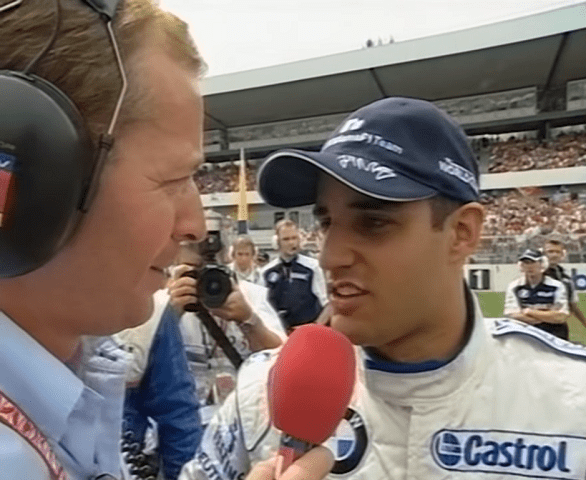
The grid walk segment shines a light on all angles of Formula 1. From the glitz and glamour, through to the technical directors, as well as interviewing drivers at both ends of the grid. Here, Martin Brundle interviews pole sitter Juan Montoya prior to the 2001 German Grand Prix.
The responsibility was placed on the shoulders of Martin Brundle, who retired from Formula 1 racing at the end of the 1996 season, having started 158 races. Being at the forefront of the sport for the previous 15 years meant that Brundle was well equipped to interview the stars of the show, even if there was trepidation to begin with.
“When Neil [Duncanson, executive producer at Chrysalis] first floated the idea to Martin, Martin wasn’t actually that keen on doing it,” Goodman tells me. “It’s an unpredictable live TV situation, and Martin was only in his first year as a broadcaster at that point, so I can understand why he was a little bit apprehensive to do it.”
Of course, walking the grid was not just a Formula 1 thing. At the same time in the mid-1990s, Jonathan Green and Steve Parrish started doing the same for Sky Sports’ coverage of World Superbikes, as did other personalities elsewhere in the motor sport spectrum, but it was arguably Brundle that took the concept mainstream.
“People think that Martin is just wandering around on the grid, but there is a lot of organisation that goes into it. You’ve got to have that knowledge to fill those moments where you are just wandering around looking for your next person to talk to,” explains Goodman, who herself has been in the grid walk role now for the past nine years with ITV’s British Touring Car Championship coverage.
“It is a daunting task to have a camera on you for five or six minutes. I remember when I first did it for touring cars, it was like ‘oh my god, I’ve got to fill all that space!’ And now, everybody does a grid walk. It was Martin’s character and personality, alongside his knowledge that made it what it was.”
“During the grid walk, you have three or four other people talking in your ears, so you’re trying to hear the driver, but you’re also hearing all the production chat that’s going on.”
“You learn to go with the flow of it, you could have had an interview set up, and when it comes to it, and this happens quite frequently in touring cars, the driver you planned to start the grid walk with, his car is not there, so you then make it up as you go along, grab somebody else, the first person that comes to mind. It’s a very fluid environment.”
For Jardine, Brundle’s knowledge and expertise shone out prior to his ITV days. In 1995, as well as car-sharing with Aguri Suzuki at Ligier, Brundle spent the remainder of races alongside Murray Walker and Jonathan Palmer in the BBC commentary box. “Martin could explain technical things in a very simplistic manner, not talking down to people, but just bringing it to a language you could understand, and maybe even have a little quip to boot.”
“Towards the end of the BBC’s tenure, Jonathan was with Murray in the commentary box and they brought Martin in as a third commentator. Brundle saw the race unfolding, and made a prediction which Palmer disagreed with, and the rest of it. But, what Brundle said was concise, he had a great idea of the strategy, and it was a great drivers’ perspective of what was going on.”
“It was a no brainer for ITV to bring him on-board. He took all that incredible knowledge, wit, wisdom, connectivity with drivers into the grid walk which we know and love. The art of good broadcasting is that you make it look easy, but believe you me, when you’re actually doing it, it’s not.”
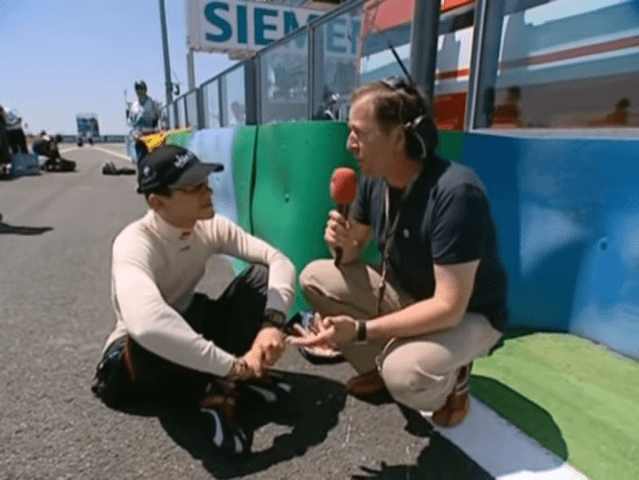
The grid walk became an opportunity for viewers to learn about drivers’ further down the starting order. Here, Brundle interviews Minardi’s Patrick Friesacher prior to the 2005 French Grand Prix, a face and voice that was unrecognisable to the UK audience at that point in time.
Although Brundle’s first grid walk at Silverstone 1997 was prone to technical difficulties, the foundations were there for years to come. Fast-forward over twenty years, and the grid walk is now a staple of motor racing television worldwide. Imitation here is absolutely the sincerest form of flattery.
Natural progression and evolution suggests that grid interviews would have become commonplace at some point in time, but Brundle helped stamp his authority on the segment that no one else has since.
Brundle made the format his own, with memorable grid walks across his years at ITV, BBC and now Sky Sports. One of the Brundle’s more memorable grid walks that garnered attention worldwide came with the 2005 United States Grand Prix, Brundle attempting to play peace keeper whilst the Formula 1 spectacle imploded around him.
Many broadcasters have walked in Brundle’s footsteps, including David Coulthard, Jennie Gow, Neil Hodgson, Will Buxton and Goodman herself.
Because the grid walk is now so frequent across all motor racing output, it has lost some of its edge that it had in the early years. However, some of that is a result of drivers being heavily PR trained rather than anything a particular broadcaster has done wrong.
Despite the drivers being more media savvy than yesteryear, the grid walk still creates memorable, special, off the cuff moments that broadcasting rarely has in the modern age.
As for the next twenty years? The aim of the grid walk in 1997 was to bring fans watching around the world closer to the drivers and the cars, which remains ever true today. Since then, and into the digital era, broadcasters have gone beyond the grid walk.
In 2014, Sky went behind the scenes with Williams at the Italian Grand Prix, following their every movement immediately before the race, from garage through to the starting grid, removing a barrier typically there for viewers.
And as 2018 begins, fans have access to every single car through F1 TV Pro, a service that aims to revolutionise Formula 1 viewing. But, for everything that changes, the basics remain the same.
The grid walk is ingrained into motor racing broadcasts that it is difficult to see it disappearing. At least, not just yet…
After much speculation and intrigue, Will Buxton has announced that will be part of Formula 1’s in-house team covering the sport this season, including their brand new over-the-top service.
Buxton joins the commercial rights holder, having previously commentated on F1’s feeder series GP2, and more recently was part of NBC’s F1 coverage over in America. He will present content across Formula One Management’s digital platforms, including Facebook, Twitter, and their new streaming service.
Writing on Twitter, Buxton said “Touch down in Melbourne. No better time to be able to say that I’m over the moon to have joined the Formula 1 family as presenter of digital. Incredibly proud to become part of the @F1 team as it begins a tremendously exciting new era. Can’t wait to get started.”
Joining Buxton is his NBC sparring partner Jason Swales, who will produce some of Formula One Management’s (FOM) output. Swales historically produced BBC’s 5 Live Formula 1 coverage, more recently producing NBC’s output stateside.
As previously revealed, race commentary on the over-the-top service will be provided by broadcasters who already cover Formula 1, such as Sky Sports for the English based version and Canal+ for the French version.
Outside of the on-air roles, various Formula 1 personalities are joining FOM. Former BBC and Autosport website writer Lawrence Barretto moves to F1 as the sports Senior Website Editor, whilst RACER writer Chris Medland is also writing pieces for F1 this year.




 Motorsport Broadcasting