Kay stands out as North One takes Channel 5’s Formula E coverage trackside

After an underwhelming first season covering the sport, Channel 5’s Formula E coverage has started its second year off on a fine note, with a little help from the electric series’ new production partners.

For the first four seasons, Aurora Media Worldwide produced Formula E’s World Feed, with UK broadcasters ITV and Channel 5 left to their own devices. As regular readers are aware, both broadcasters opted for studio-based coverage, although Formula E filmed features on-site on their behalf. All of that changed for this season.

Strong UK production…
Whilst Aurora remain involved, the addition of North One Television has bolstered Formula E’s UK presentation. Alongside their World Feed responsibilities, North One are also producing Channel 5’s programming, meaning that for the first time ever UK viewers get tailored, on-site coverage at every round.

North One have experience in this field: historically they produced ITV’s Formula 1 coverage until 2008, and have produced BT Sport’s MotoGP coverage since 2013. The production company relied on their two-wheeled personnel, led by British Superbikes director Richard Coventry, to produce Channel 5’s Formula E output.

In front of the camera, Vernon Kay replaced Andy Jaye as lead presenter. Kay’s appointment generated unnecessary criticism across social media, even though he has presented sporting events before on Channel 4. As I remarked at the time of his appointment, Kay is “enough of a veteran for me to feel that he will be just fine in the role.” Four races in, and I stand by this viewpoint.

Kay has interviewed drivers and team personnel, alongside his own miniature grid walk, something he looks like he has been doing for years. It helps that the Formula E grid is sparser than Formula 1, nevertheless you cannot help but be impressed by his work so far. Importantly, Kay has done his research, and is clearly passionate for Formula E on-screen, and has done his research, a vital asset for a series in its infancy.
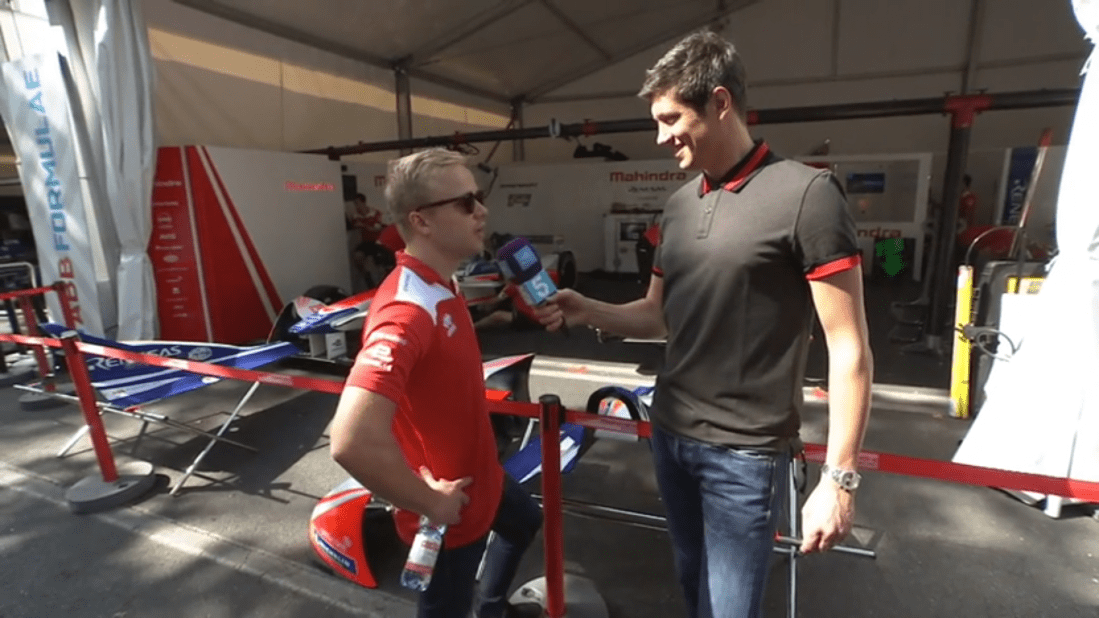
2018 Santiago EPrix - Vernon Kay and Felix Rosenqvist
Presenter Vernon Kay interviews Mahindra driver Felix Rosenqvist.

Because of the changes behind the scenes, Channel 5’s programming has felt significantly more polished than last season’s output. The build-up has contained a mixture of pre-recorded segments, such as the track guide, and a grid walk. The pre-recorded segments add to the programme, with Kay interviewing drivers prior to qualifying.

There is a tendency to focus on the British contingent of racers, but considering the stage Formula E is at within its life cycle, this is an understandable directive. The commentary team, consisting of Jack Nicholls, Dario Franchitti and Bob Varsha also have their own segment with Kay, helping viewers put a face to the voices.

Commercials have generally been well-timed, a vast improvement on the early offerings in their first season. Impressively, despite airing the race on a tape-delay, Channel 5 covered the whole of the red-flag period during the Hong Kong E-Prix broadcast.

…but poor scheduling lets down Channel 5’s coverage
If I gave the production standards a first-class rating, then the scheduling fits into the lower second-class category. Short-term pain, long-term gain should be Channel 5’s motto here, but I worry if Channel 5 are in this for the long-term.

On-site coverage is fantastic for Formula E. But, was that a decision by Formula E, or did Channel 5 influence the decision? Who is paying for the extra expenses in producing on-site coverage? If the answer to that question is Channel 5, then surely that would have served as an incentive to broadcast races live on their main channel…

And there is the crux of the problem. Both Hong Kong races aired on tape-delay, so whilst the production was excellent (by Formula E’s UK TV standards to-date), the races were not live. Arguably, it did not matter as much in Hong Kong, a tape-delay meant that the races aired at a more sociable hour.
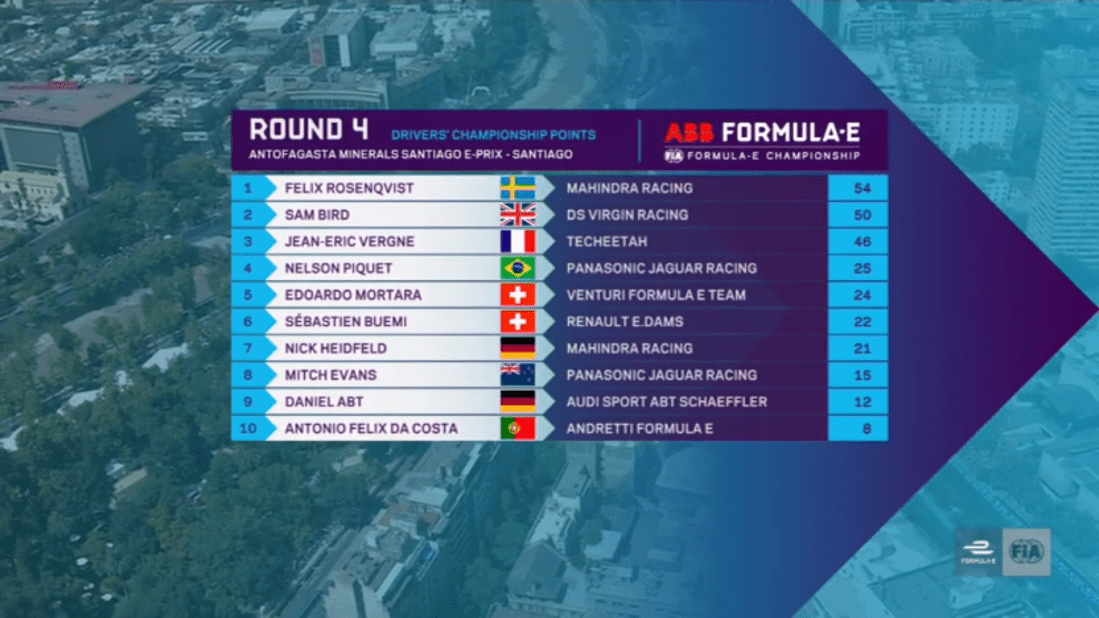
2018 Santiago EPrix - pre-race standings.png
A new-look broadcast package for Formula E’s fourth season. Here, the Drivers’ Championship standings is displayed prior to the race.

Marrakesh was live on Channel 5, but Santiago less than a month later aired on sister channel 5Spike, as the time difference meant that the race flowed into prime time. According to overnight viewing figures supplied by Overnights.tv, Channel 5 averaged 604k (3.1%) from 18:30 to 20:30 on Saturday 3rd February, not a great number considering a quarter of that covers the relaunched Blind Date.

The Buenos Aires E-Prix from February 2017 averaged 426k (2.2%) on Channel 5 in a similar time slot. Last weekend, the Santiago E-Prix struggled on 5Spike (even compared to 5Spike’s own numbers), averaging just 86k (0.4%), with Eurosport 2 adding a further 32k (0.17%), down on the combined Marrakesh number of 245,000 viewers.

In other words, viewing figures dropped by half the moment Formula E lost any sort of coverage on Channel 5’s main channel. Furthermore, Channel 5 failed to air a repeat of the Santiago round on their main channel, a strange decision. Mexico City is also airing on 5Spike, and Punta del Este is likely to follow suit.

How can Formula E gain momentum with inconsistent scheduling? If you are going to produce coverage on site, at least give the series a chance and air Santiago on the main channel. Airing the European phase of the season on Channel 5 is not enough, by that point the attention of the motor racing world is on the traditional season.

New broadcast package for season four
A new season, a new graphics suite. In their fourth season, Formula E are already on their third graphics set, a ‘throwing the kitchen sink at the wall and seeing what sticks’ approach.

The first set lasted for two seasons, however the broadcast package introduced at the start of season three only lasted for one season, despite being a vast improvement on their opening effort. I can forgive this change with North One coming on-board, but Formula E needs to build an on-screen identity, and you cannot do that by constantly changing the graphics.
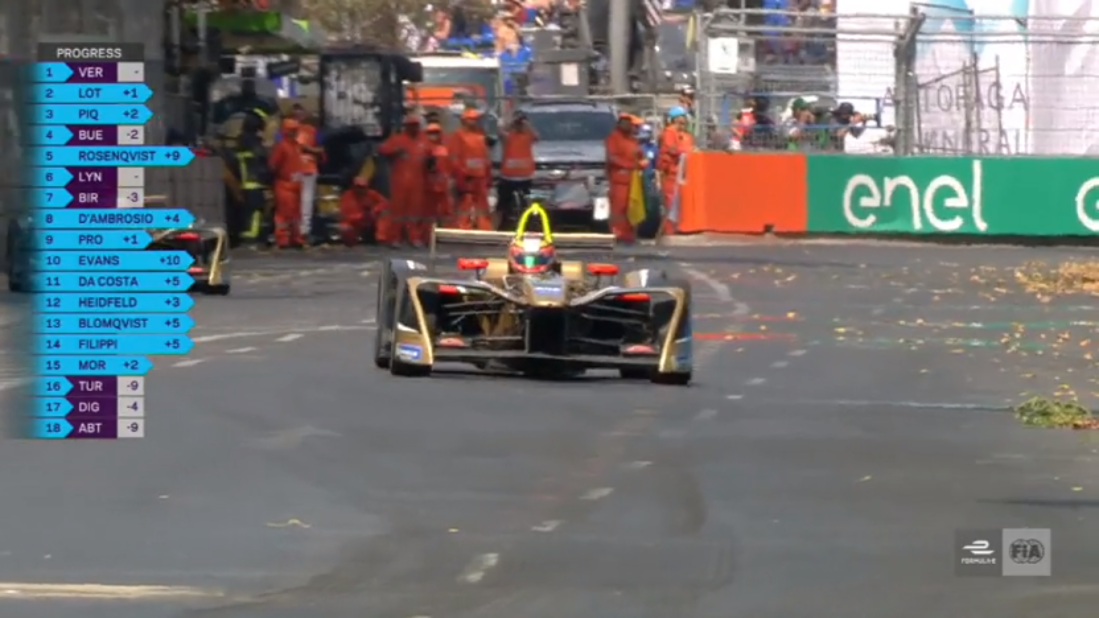
2018 Santiago EPrix - progression.png
Jean-Eric Vergne leads in his Techeetah, whilst the timing wall graphic on the left shows the number of positions a driver has gained or lost.

The third graphics set is an evolution of the second set, moving away from a sky-blue suite and more towards a blue and purple style (claret and blue might be the right phrase here). The major change for fans is that the timing tower now updates frequently at every sector, as opposed to once a lap.

Formula E has taken inspiration from MotoGP with their timing tower. MotoGP ‘groups’ the riders together based on who they’re battling with, however Formula E has gone a step further, grouping drivers but spreading them down the tower based on the size of the gap, a nice innovation. The tower also displays when a competitor has jumped ahead of their rival by switching colour, and shows progression (or lack of) for a driver.

For the opening races, an “activate start” VT sequence aired immediately prior to the start of the race, however did not appear in the Santiago show. Frustratingly, the World Feed direction remains troublesome. With Formula E in its infancy, it needs to knuckle down to hook new viewers.

Switching between battles constantly, yet failing to capture this information on-screen only serves to confuse the audience. On a new street circuit with no history, the viewer is unfamiliar with the layout so will be unaware if the director has jumped ahead or behind on the circuit. A simple caption ‘Battle for 8th’ for example, listing the drivers involved would solve the problem.

A second problem with the direction is the length it takes to react to incidents. In Santiago, the graphics indicated that reigning champion Lucas di Grassi was dropping out of contention, but the production team was far too slow to pick this up. You get the impression that no one in gallery is monitoring the timing graphics, otherwise the director would be faster in reacting to such developments. As social media demonstrated days later, further on-track incidents were unnoticed by gallery.

There are other smaller problems on the production side: too many reaction shots, arguably worse than F1 in this respect (use picture-in-picture where possible); and the pit lane car swap still disturbs the flow (but is no longer a problem from season five onwards).

Overall, Formula E’s coverage of season four in the UK has started promisingly with major strides compared to previous seasons. Elsewhere, the World Feed is not terrible by any stretch, but I feel tweaks are necessary moving forward.

overnights.tv-bannersF1

Scheduling: The 2018 Barcelona test 1 on Sky Sports F1

The cold, long winter is ending, and it is almost time to hear the sound of Formula 1 cars again!

As usual, Sky Sports F1 are covering both Barcelona tests. The first test features a 15-minute round-up show fronted by Craig Slater at the start of the hour. Rachel Brookes is recovering from her knee surgery at the end of 2017, so expect her not to return until Australia. After the round-up, Ted Kravitz is back with his Notebook on each of the four days.

So far, that is what we know, and can confirm. Whether any additional live elements come to fruition, as mooted during Sky’s coverage of the 2017 Abu Dhabi Grand Prix, remains to be seen. The closer we get, the more unlikely it appears that F1’s new over-the-top service will launch in time for testing, so the best bet is for live streaming via YouTube or elsewhere, alongside live action on Sky, if FOM decide to head down that avenue.

Monday 26th February
21:00 to 21:45 – Day 1 Highlights
– round-up at 21:00
– Ted’s Notebook at 21:15

Tuesday 27th February
10:00 to 10:45 – Day 1 Highlights (R)
21:00 to 21:45 – Day 2 Highlights
– round-up at 21:00
– Ted’s Notebook at 21:15

Wednesday 28th February
10:00 to 10:45 – Day 2 Highlights (R)
21:00 to 21:45 – Day 3 Highlights
– round-up at 21:00
– Ted’s Notebook at 21:15

Thursday 1st March
10:00 to 10:45 – Day 3 Highlights (R)
21:00 to 21:45 – Day 4 Highlights
– round-up at 21:00
– Ted’s Notebook at 21:15

As always, I will update this site as and when, or if, further details confirmed.

Update on February 24th – For those of you who have not spotted the earlier post, there is no live coverage of testing.

How Formula 1’s new weekend schedule will impact UK fans in 2018

Formula 1 has today announced a raft of changes to their weekend schedule, ahead of the 2018 Formula One season.

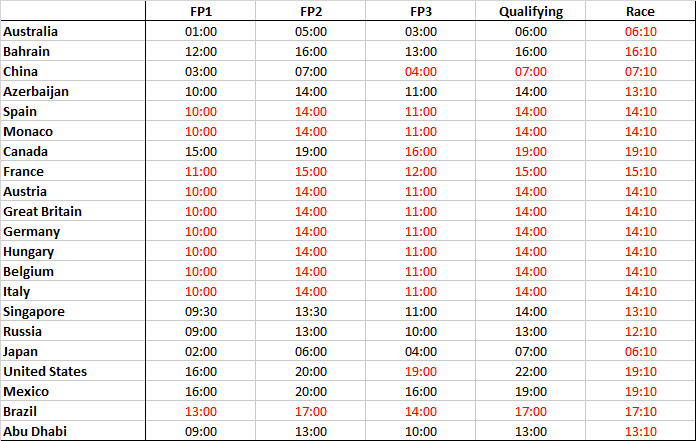
The changes include starting every race at ten minutes past the hour. Formula 1 says this change will cater for broadcasters, such as new American broadcaster ESPN, who wish to start their coverage at the top of the hour. Previously, broadcasters who joined on the hour, missed “the tension and emotion that characterize the minutes before the start of each Grand Prix.”

A second adjustment involves moving European race weekends, and the Brazilian Grand Prix back by one hour which, according to Formula 1 will allow the sport to reach a “wider TV audience [..] later in the afternoons, especially in the summer months.”

An unintended impact, which no one has mentioned, is that the later start time will result in the podium ceremony potentially running over the top of the hour, especially for races such as Hungary. Bad news for broadcasters who want F1 confined to a specific two hour time slot…

How do the changes impact UK fans?

UK F1 2018 session start times
The times UK F1 fans can expect to see Formula 1 in 2018. Anything in red is a timing change compared with 2017.

It means that European races will start at 14:10, instead of 13:00, an arrangement which dated back to the late 1990’s. Monaco was historically the exception, races in the principality started at 14:30 local time, however this agreement ended following the 1997 season.

As predicted in December, the French Grand Prix has also moved to avoid clashing with England versus Panama in the football World Cup. The race will now start at 15:10 UK time, with the latter stages of the race clashing with Japan versus Senegal on BBC One.

Although not a timing change for this year, the switch of the Azerbaijan Grand Prix to late-April, has resulted in a minor clash with the Paris E-Prix. It means that the final moments of qualifying are likely to overlap with the start of the E-Prix, however thankfully for Formula E, that is the extent of the clashes.

For MotoGP, the Assen TT and British Grand Prix fall on the same day as Formula 1’s Austrian and Belgium rounds. In previous years, MotoGP has worked around F1’s scheduling, with the British MotoGP race starting at 15:30. However, Formula 1 may have done Dorna a favour. By moving their start-time to 14:10 UK time, it means the MotoGP main event could feasibly start at 13:00 UK time with no overlap, barring a red flag or other unusual circumstances.

Elsewhere, Channel 4’s highlights programming for the European rounds and Brazil may air an hour later, depending on what the contract between them and F1 states, starting at 19:00 instead of the usual 17:30 or 18:00 start time. Formula 1’s press release makes no reference to Formula Two or GP3, although one would hope that they benefit because of this change, and become more integrated into F1’s weekend activities.


Channel 4 and Sky confirm 2018 scheduling details

Channel 4 and Sky Sports have today confirmed their 2018 Formula One calendar picks, the final time this process takes place under the terms of original BBC and Sky deal from 2012 to 2018.

The picks are as follows:

2018 Schedule Details
March 25th – Australia (Melbourne) – Sky
April 8th – Bahrain (Sakhir) – Channel 4 and Sky
April 15th – China (Shanghai) – Sky
April 29th – Azerbaijan (Baku) – Channel 4 and Sky
May 13th – Spain (Barcelona) – Sky
May 27th – Monaco (Monaco) – Channel 4 and Sky
June 10th – Canada (Montreal) – Sky
June 24th – France (Paul Ricard) – Sky
July 1st – Austria (Red Bull Ring) – Channel 4 and Sky
July 8th – Britain (Silverstone) – Channel 4 and Sky
July 22nd – Germany (Hockenheim) – Sky
July 29th – Hungary (Budapest) – Sky
August 26th – Belgium (Spa) – Channel 4 and Sky
September 2nd – Italy (Monza) – Sky
September 16th – Singapore (Marina Bay) – Channel 4 and Sky
September 30th – Russia (Sochi) – Sky
October 7th – Japan (Suzuka) – Channel 4 and Sky
October 21st – USA (Circuit of the Americas) – Channel 4 and Sky
October 28th – Mexico (Mexico City) – Sky
November 11th – Brazil (Interlagos) – Sky
November 25th – Abu Dhabi (Yas Marina) – Channel 4 and Sky

The return of the French Grand Prix will air exclusively live on Sky Sports F1, whether it will go up against England versus Panama is something that should be confirmed one way or the other in forthcoming weeks.

Channel 4’s Head of F1, Stephen Lyle said: “We’re set for another compelling, action packed season and viewers can follow the whole story on C4, All4 and @C4F1. Once again the most iconic races are available Live and free to air as well as the season finale, with all fans hoping this one goes right to the wire.”

Sky’s new Head of F1, Scott Young said: “There is huge anticipation this year; can Hamilton create even more history, how will Ferrari and Red Bull close the gap, where will the young drivers emerge in the reckoning? Each season we look to find new ways to improve the coverage and entertain our viewers and this year will be no different.”

There are no significant pieces of news other than the schedule to come out of either side, other than Sky referencing Formula Two, GP3 and The F1 Report as usual. Channel 4’s press release confirms that they will continue to offer their live races advert free from lights out to chequered flag.

Sky’s line-up appears to be broadly the same as previous years. Although not mentioned, expect Simon Lazenby to return as presenter alongside the likes of Martin Brundle, David Croft, Ted Kravitz and Anthony Davidson. Earlier suggestions of Johnny Herbert leaving Sky appear to have not come to fruition.

Over on Channel 4, Steve Jones continues to anchor the team, with David Coulthard, Mark Webber, Suzi Wolff and Eddie Jordan providing analysis. Ben Edwards will again lead the commentary team, whilst Lee McKenzie will rove the pit lane at most races.

Compared with my predictions post, 13 out of the 21 races were correctly predicted. The stretch from Azerbaijan through to Germany was spot on, eight races in a row, as was the final hurdle from USA onwards, four races in a row! Even I admitted writing the post that the idea of Channel 4 picking Australia was “highly unlikely”, but went for it anyway.

What it does mean that the Australian Grand Prix last aired live on free-to-air television in the UK in 2011, a shame in my view and one reason Formula 1’s viewing figures have struggled off the line in recent years. In any event, we can safely say that unless anything changes, 2018 will be the final year every race, excluding Britain, airs live, free-to-air in the UK.

Reviewing WRC’s new ‘All Live’ offering

Every round. Every stage. Live.

That was the promise made to World Rally Championship fans at the start of 2018, and this past weekend saw the launch of their new service with the Monte Carlo Rally, the first round of the 2018 season.

The term ‘new era’ is bandied around for many different reasons, but for rallying, WRC’s ‘All Live’ offering is a revolution not just for fans, but for the sport as a whole, especially considering the state it was in just ten years ago. As commentator Becs Williams pointed out during coverage, teams have previously “just seen a tracking map and split times.”

Priced at around £8.00 a month, the premium tier is available to fans worldwide, with no geo-blocking in place. £8.00 for the first month would get you access to the opening two rounds of the season, an excellent deal. Outside usual circles, it does feel like the offering has yet to make a buzz in the wider motor sport community, something I hope changes as the year progresses.

Producing a rally across four days is a major logistical and technical challenge that is difficult to put into words, on a much larger geographical scale than many other motor racing events. Bearing that in mind, the idea of a ‘All Live’ offering is beyond anything that has happened before.

Presentation team strong, but lacks depth
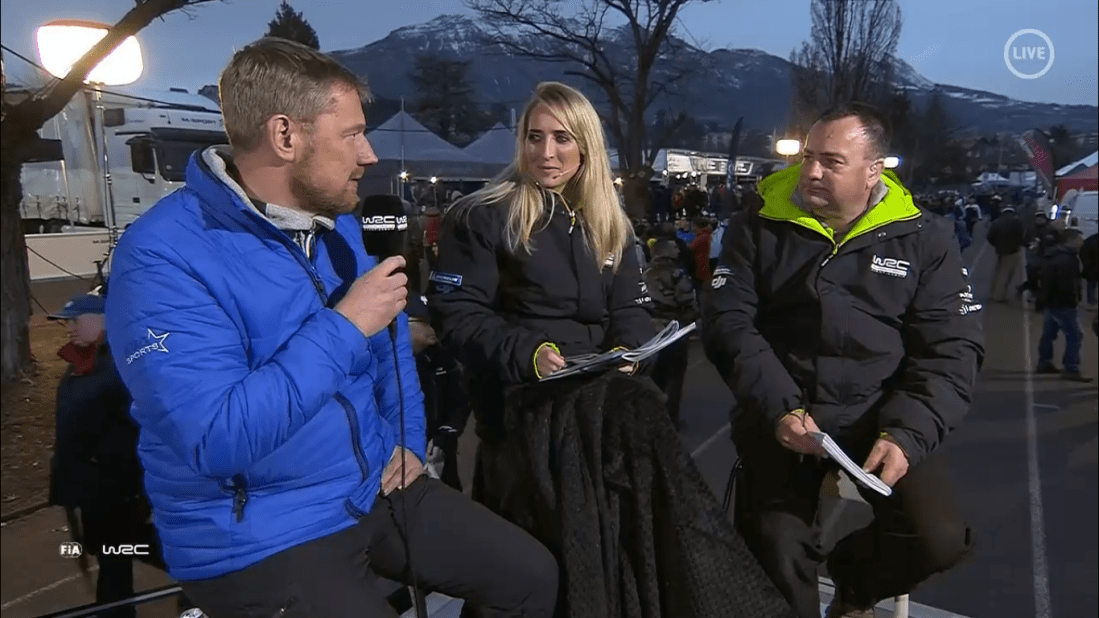
Kiri Bloore presented the four days of coverage from Thursday through to Sunday, with Williams leading the commentary line-up. Jon Desborough, Julian Porter and Paul King rotated in and out of the makeshift studio at the Gap service park, and commentary booth during the weekend. Molly Pettit provided reports from the start of each stage as well as interviewing the key drivers.

The team was on-air for around 30 hours across the four days, from dawn to dusk including mid-day intervals, helping fans get closer to the action. If the number of hours remains similar at each rally, WRC should consider adding two or three on-air personnel to keep the coverage fresh, and to avoid the existing crew becoming exhausted (some of the personnel also are part of WRC’s radio output, hence Williams’ absence from the visual output on Sunday).

2018 Monte Carlo Rally - Gap.png
Kiri Bloore and Julian Porter escape the makeshift studio on Friday evening to interview Jarmo Lehtinen, former manager of Toyota’s WRC operation.

A second presenter and reporter, who could double up as a commentator would do the trick nicely. Additional bodies would allow the schedule to be split into ‘blocks’, with someone new presenting in the afternoon as an example. The sharing of resources between visual (TV) and radio was noticeable on Sunday morning, as fans heard no commentary or could see any footage for half of stage 14 whilst personnel moved between bases.

Pettit was the highlight of the weekend, with her interviews and reporting style, the segments at Gap following Friday’s running helped bring fans closer to the action, and into an area not previously seen. Bloore was fine as presenter, whilst Williams up in commentary was engaging throughout. What I really like is that all three are genuinely passionate about rallying, and that comes through on-screen.

The location of the studio left a lot to be desired. Instead of showing off the mountainous Alps, Bloore and her analyst were against a generic WRC backdrop for most of the studio segments, not the most atmospheric position they could be in.

Stunning imagery, but haphazard timing
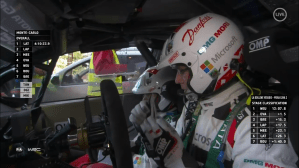
One of the beauties of rallying is the images it provides, and the Monte Carlo Rally is no different. Of course, every stage live means that we were treated to all angles, from the night stages on Thursday night, through to the treacherous, snowy conditions on Saturday morning. The on-board camera angles throughout the weekend showed various drivers fighting their machinery, trying to survive and live for another day. Importantly, the imagery makes you appreciate just how difficult rallying is, and how much effort goes into putting the show on the road.

2018 Monte Carlo Rally - Jari-Matti Latvala
WRC’s crew were on hand to chat to drivers as soon as each stage had concluded. Here, Jari-Matti Latvala is about to be interviewed.

The on-screen graphics were slick, passing the keep it simple test with ease. The graphics, showing key details such as elevation change and speed, are easy to understand, and thankfully do not overload the screen. However, as one might expect with a new service of this nature, Thursday’s coverage suffered teething problems, some of which continued throughout the weekend, making the rally confusing to follow at times.

In normal circuit racing, you know when someone is heading towards the Bus Stop at Spa, or around the final bend at Melbourne. However, you do not have a visual of when Sebastien Ogier is close to finishing his stage, which is why a constant timer on-screen is vital. Unfortunately, timing graphics during each stage were at a premium for the first half of the weekend, making stages difficult to follow without anything to reference, and the commentators appeared to be in the same position.

I liked the GPS virtual map that was on display throughout the weekend, although it may serve better within a picture-in-picture type format, to help show how far away drivers are to finishing their stage. At times, the map felt like a holding screen whilst the director looked for the next car to focus upon.

Telling the story
An important aspect of motor sport is to decipher the various on-track stories throughout the weekend, and even with every stage covered, it felt like something was missing from the package. I did wonder if the production team had access to every on-board in the gallery, the impression I had watching the rally was that they only had access to a limited number of cars to play out live, restricting what fans could see. Williams mentioned several incidents in commentary, but clips never aired until later in the day.

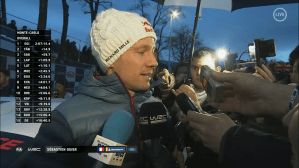
2018 Monte Carlo Rally - Sebastien Ogier interview
Sebastien Ogier is grilled by the media on Friday evening.

From an early stage, it became clear that Ogier was battling against Ott Tanak for victory, yet the direction did not reflect this fact. Split-screen was one technique WRC could have utilised to show the two cars, and to show how far Tanak was behind Ogier at each split (or vice versa), therefore showing why Ogier has the upper hand. If not possible during the stage, it is something that could take place during one of the service breaks to help viewers understand why the rally is following the way it is. To try new things like this though, you need the right number of people in front of the camera…

Frustratingly, Ogier called the first stage on Saturday morning the worst of his career in the snow, yet viewers saw very little of it. Split-screen could have helped demonstrate this, as well as showing conditions improve with every passing driver. The direction felt repetitive during some phases of the rally: instead of focussing on emerging battles, the director focussed on cars one-by-one during their final two minutes.

The best round-up of events that I watched was during the Power Stage on Sunday afternoon, possibly because the segment was packaged as a standalone TV show for those broadcasters airing that stage. There was no sign of the studio during the 90-minute Power Stage, nor were any references made to All Live. Desborough presented this part, disappointingly no sign of either Bloore or Williams.

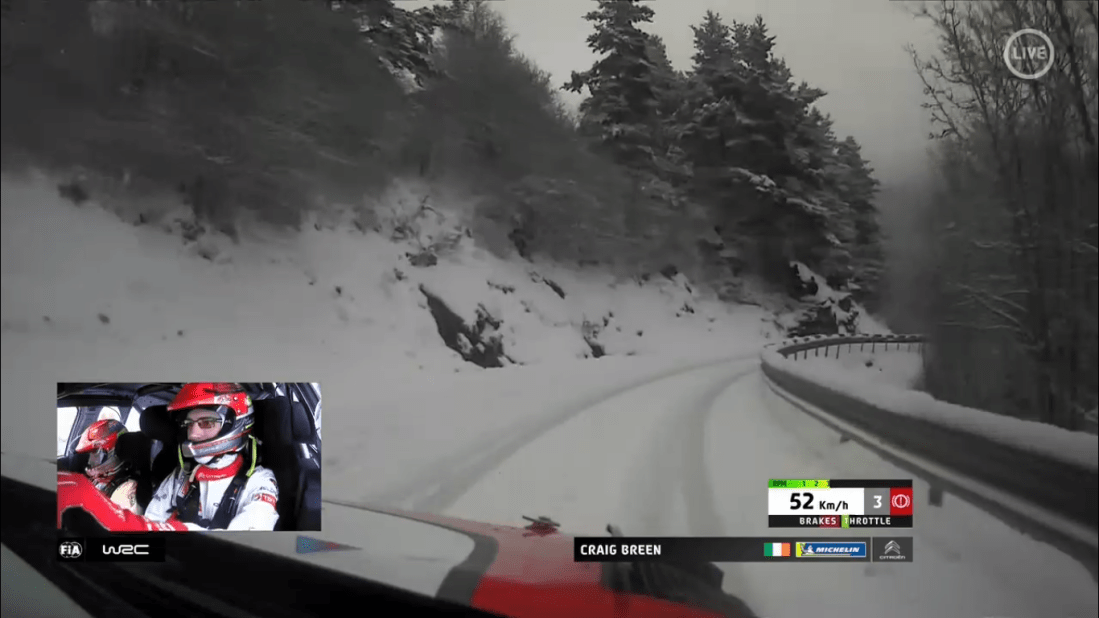
2018 Monte Carlo Rally - Craig Breen.png
Craig Breen was the first driver to experience the snow on Saturday morning. The graphic on the right shows RPM (top); speed, gear and whether the hand brake is active (middle); and how much pressure Breen applied to the brakes and throttle (bottom).

An aspect of rallying I like returned on Saturday, with fans hearing pace notes from Dan Barratt towards Elfyn Evans. Evans was one of the many drivers’ door stepped at the end of stage by Pettit and Porter, showing the immediate raw emotion, whether it was satisfaction or disappointment. As the action played out, the pecking order from 4th to 7th turned on its head significantly in the Power Stage with Esapekka Lappi falling down the order due to an off-track excursion, all of this caught by the live cameras (Lappi’s reaction as you can imagine over the line was a little more than disappointment).

The online service and app
The video player provided by WRC is basic, but does the job on both laptop and through their Android app. Impressively, every stage is immediately available after its initial broadcast, with no delay whatsoever.

Like MotoGP’s Video Pass, I do think WRC should consider adding ‘markers’ in their live programme for people arriving late, or for those who want to relieve a key moment. Ogier’s spin during stage seven was a key moment on Friday, but to find this in the live offering you had to manually trawl back through the various clips to find it.

Following the conclusion of each stage, fans have access to every on-board camera, allowing you to compare two drivers with one another, very similar to what I think would be useful to see in the live stream. Until I clicked on the ‘Onboard Action’ section did I realise that you could access every on-board through here. Again, the user interface feels slightly rough round the edges, but is usable.

Many things above I am acutely aware are a result of this being WRC’s first ‘All Live’ weekend, and will improve over time. Live broadcasting is difficult at the best of times, and considering this is the first time WRC have transmitted every stage live to fans, they have started fantastically.

As I mentioned at the start of this piece, rallying is one of the most difficult forms of motor sport to cover from a broadcasting perspective, yet the team covered the full weekend without any major breakdowns. Yes, there are areas to improve, but that will happen as the season progresses. If Monte Carlo was a minimum viable product, then for rallying fans, the broadcasting revolution has only just started…

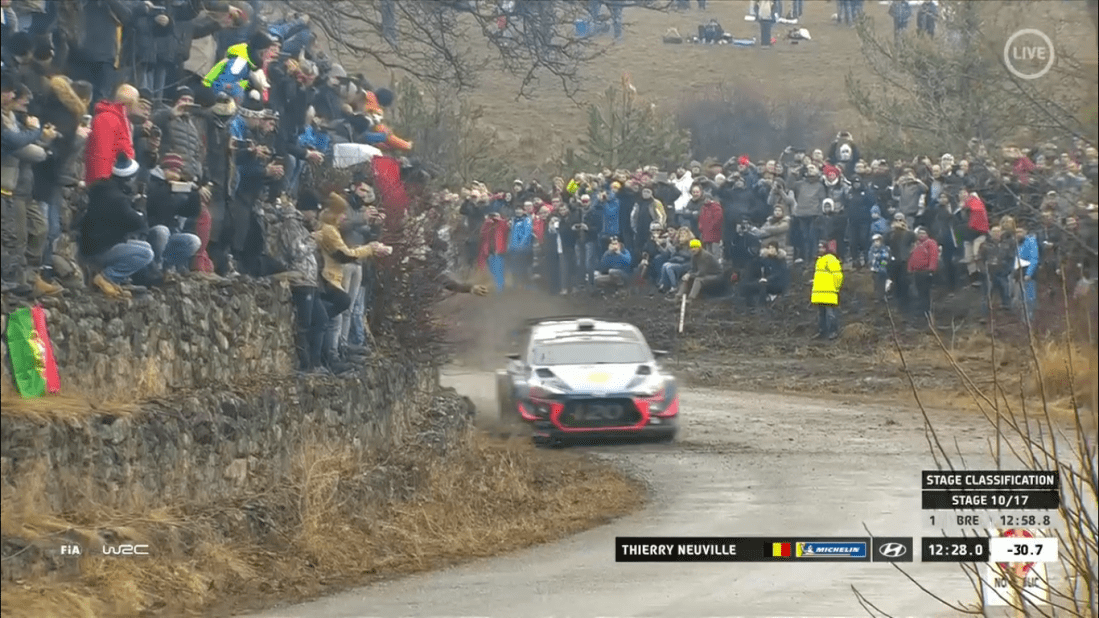
2018 Monte Carlo Rally - Thierry Neuville.png