World Rally Championship to broadcast every stage live this season

The World Rally Championship will broadcast every stage live this season online, organisers of the series have confirmed, in the biggest revolution of coverage the series has seen in years.

Speaking at the Autosport Show, WRC’s commercial rights holder, led by Oliver Ciesla, said “From 2018 onwards, starting with the Rallye Monte Carlo, we will offer to the fans all the stages, of all the rallies live. This means approximately 25 hours of live content from every rally starting with the opening ceremony, covering the stages, in between the stages, going into the studio for analysis and interviews. As a fan, you can go in and out whenever your time allows.”

“The service will be available on WRC+. It is a revolution in how this sport is broadcast, you can imagine that covering rally on television is a tremendous effort, as we have to cover more than 300 stage kilometers, so we have helicopters, drones, a lot of exciting onboard footage,” Ciesla continued.

“The positive thing is the flexibility that the fan has. You can still watch the transmissions with the broadcast partners, and whenever time allows on this digital service. You take your mobile phone, you use the app, you take your computer, you come in, maybe you’re on the train or bus and want to watch. You can follow the rally whenever you want, wherever you are, live.”

“This is an absolute game changer in how rallying is covered.” Pricing for the new WRC All Live package is €8.99 a month, or €89.99 across the whole year. For UK fans, based on the current exchange rate, this works out at £7.97 a month, or £79.81 across the year, a very reasonable price considering the amount of content on offer.

Channel 5 and BT Sport retain UK TV rights
Speaking exclusively to The F1 Broadcasting Blog, Ciesla also confirmed that Channel 5 and BT Sport would remain holders of WRC’s UK rights.

“For 2018, the TV situation will be unchanged, and Channel 5 and BT are the broadcast partners in the UK,” Ciesla said. Ciesla noted BT Sport have the “option” to show every stage live as part of their contract, as do all pay-TV providers worldwide.

Channel 5’s highlights programming in 2017 averaged 283k (1.54%) according to overnight figures supplied by Overnights.tv, down on their 2016 audience of 343k (1.78%).

McLaren continues social media gains despite Honda relationship

The 2017 Formula One season saw the split of two brands after three painful years together. Re-entering Formula 1 at the start of 2015, Honda aimed to take McLaren back to championship winning ways. Just two and a half years later, and very little to celebrate, their marriage ended, with McLaren pairing up with Renault from 2018 onwards.

McLaren’s relationship with Honda has caused damage to their on-track reputation: their last podium visit was at the 2014 Australian Grand Prix. But has the damage for both McLaren, and their lead driver Fernando Alonso, extended to off the track and onto social media?

The F1 Broadcasting Blog has analysed the number of social media followers across Facebook, Twitter and Instagram that Formula 1’s teams and drivers have obtained going back to the middle of 2015, reporting on progress at checkpoints half way through the season and at the end of the season. Generally, you expect to see all metrics increase, as drivers become more popular throughout their career, growing their fan base. Similarly, fans may switch allegiances depending on which team their favourite driver heads to.

At this point, I hear you say “why are you not tracking engagement”, and maybe saying “the number of followers is useless if no one interacts with the brand.” Both points are equally valid. However, engagement data is not readily available in the public domain, and it would be extremely difficult to track and record the engagement data across three platforms, covering potentially thousands of different data points (platform, multiplied by 33 accounts, multiplied by individual statuses).

No two tweets generate the same amount of engagement. There is no “one size fits all” approach to presenting this data. For the moment, it is what we have, although I am open for other ways of analysing the data. I would argue that, as a measure of popularity, the number of followers one driver has compared to another is still an interesting statistic.

McLaren continues to rise, but at a slower rate of knots
In July 2015, McLaren reached 4.37 million followers across the three main social media platforms. Fast forward two and a half years, and that number has increased by 64 percent (or 2.79 million followers) to 7.16 million followers. In isolation, it feels like a good increase, and not one that suggests apathy from new fans engaging with the brand. Given the brand history of McLaren, it should be looking to grow at the same rate as its nearest rivals, such as Ferrari and Red Bull.

Interestingly, Ferrari’s number of followers over the same time has also increased by 64 percent, from 4.82 million followers to 7.90 million followers. So, despite having a much poorer period than their Italian neighbours, McLaren kept the pressure on, rising by an identical percentage from a similar baseline.
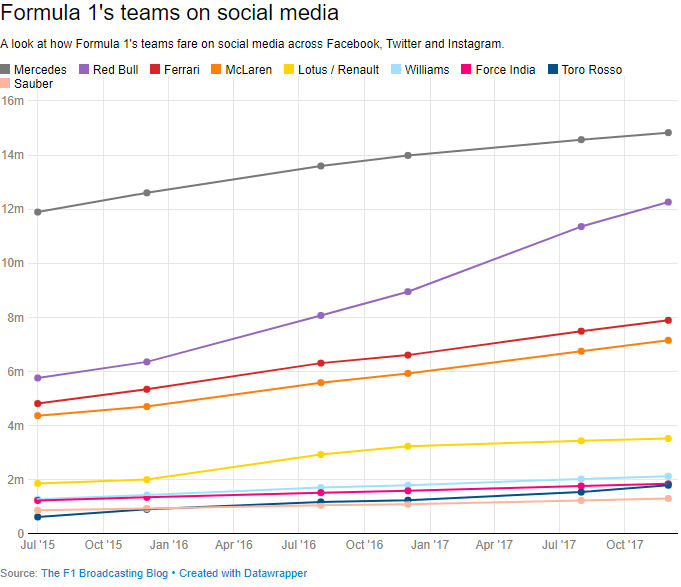
Social media - 2018-01 - F1 Teams

The problem for both Ferrari, McLaren and Mercedes is the onslaught from Red Bull. The drinks company has increased their following by 113 percent, rising from 5.77 million followers in July 2015 to a whopping 12.27 million followers. Whilst still shy of Mercedes, their positive and fun social media strategy, with Daniel Ricciardo and Max Verstappen at the helm, has caused a surge in their following, bringing new fans to their outlets. As noted during the Summer break, Mercedes’ social media growth has slowed in the past year.

For allegedly such an important brand to Formula 1, Red Bull is now streets ahead of Ferrari in the social media game. And, to their credit, McLaren’s following has continued to rise despite their poor on-track performance. One of the drawbacks with this data is that we do not know the overlap of followers between teams. How many of Red Bull’s new followers are new Formula 1 social media followers? If the answer happened to be ‘the majority’, from a Liberty Media perspective, this is a group of people that they should be interested in tailoring their output to.

Hamilton wipes social media history as Raikkonen joins the fray
Fernando Alonso’s social media profile has also risen, but to a slower degree. Comparing Alonso’s performance across social media with other leading drivers on social media is difficult as there are only four other drivers who were in a similar situation in July 2015. They are Lewis Hamilton, Daniel Ricciardo, Sergio Perez and Max Verstappen.

Unsurprisingly, Ricciardo’s and Verstappen’s following has surged and both have increased in larger share and volume than Alonso. Alonso’s performance flat lined in the second half of 2017, but the gulf between him and the remainder of the field means that his social media position is not under threat. Of course, Hamilton is still comfortably out in front. For the moment…
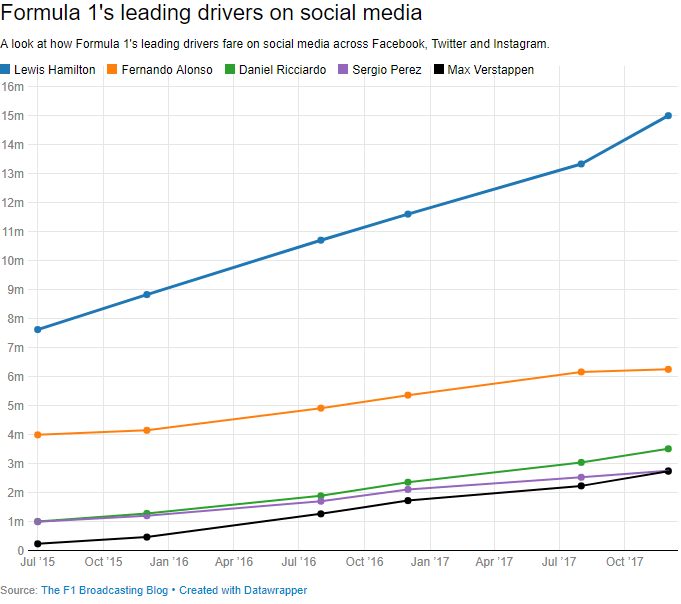
Social media - 2018-01 - F1 Drivers

Following the gathering of the statistics behind this post, things went south for Hamilton, and his social media profile has come under scrutiny in recent weeks. As a result, the four-time Drivers’ Champion has wiped his complete Instagram account, and his Twitter account dating back to October 2013. If any of them disappear completely, his large profile of over 15 million profiles will be gone in a flash, and places a major dent in Formula 1’s social media presence.

We live in a bizarre world now where Kimi Raikkonen has more Instagram posts than Hamilton. No, that is not a misprint. Yes, the Finnish driver has joined Instagram, already amassing over 300,000 followers in a week, ahead of the likes of Stoffel Vandoorne, Esteban Ocon and Kevin Magnussen.

Outside of Hamilton, the Red Bull drivers and Perez, no one else stood out in the second half of 2017, in what was a quiet end to the social media year. The one team further down the field that impressed was Toro Rosso, who are on course to overtake Force India, a surprising development considering Toro Rosso was the lowest ranked team on social media just two years ago. Toro Rosso’s large increase is likely due to their driver rotations this year, bringing in a wider variety of fans as a result to their social media pages.

A long way to go for F1, and motor racing as a whole
Formula 1’s official social media pages have shown strong growth across 2017. Between March and November, their profiles grew by 39 percent, reaching 11.04 million followers, overtaking NASCAR during 2017. However, Formula 1 remains some way behind MotoGP overall, thanks to a significant gulf in following on Facebook, and is unlikely to overtake MotoGP for many years.
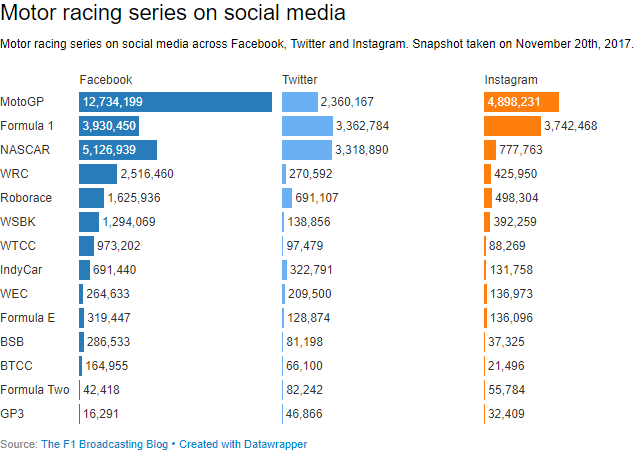
Social media - 2018-01 - Series

Liberty Media themselves have touted Formula 1’s growth on the official F1 website. Whilst F1 has indeed grown proportionally compared to other brands, their reach remains far, far lower. La Liga, which according to F1 has grown just under 30 percent year-on-year, has 34 million followers on Facebook, dwarfing anything motor sport has to offer.

The F1 website also points out Formula E’s growth on social media, which is amusing considering how it is not in the same category as any of the other major brands listed. IndyCar’s PR team may be mystified at how they have not made the list considering it has a far greater social media presence than Formula E and grew their number of followers by 33 percent between March and November.

Proportionally speaking, F1’s following is spread equally between Facebook, Twitter and Instagram, something Liberty needs to work on changing as Facebook is a far bigger platform than Twitter and Instagram. Different content works for different audiences across the three platforms, and that is something F1 needs to explore further in 2018 if it is to unlock the potential that Facebook presents.

Scheduling: The 2018 Marrakesh E-Prix

After a break for Christmas, the Formula E series returns with race three of the 2017-18 season taking place in Marrakesh.

Channel 5 are airing live coverage of the race, having broadcast the double-header from Hong Kong on tape-delay. The broadcaster appears to complimenting their coverage with an hour-long build-up, the longest since ITV covered the championship. I did wonder if the first half hour was an episode of Formula E’s Street Racers magazine show, but there is no indication that this is the case.

In further good news, Channel 5’s sister channel 5Spike (previously Spike) are airing qualifying live. As in Hong Kong, Vernon Kay will be on hand to present their output, including qualifying, with Jack Nicholls, Dario Franchitti and Bob Varsha providing World Feed commentary.

Eurosport will also air the race live, with qualifying on tape-delay. Expect to see them add their own flavour over the World Feed broadcast, with Tom Gaymor and Mike Conway at the helm.

Formula E – Marrakesh (online via YouTube)
13/01 – 07:55 to 08:55 – Practice 1
13/01 – 10:25 to 11:10 – Practice 2

Formula E – Marrakesh
13/01 – 10:30 to 11:25 – Preview (Channel 5)
13/01 – 11:45 to 13:10 – Qualifying (5Spike)
13/01 – 15:00 to 17:15 (Eurosport)
=> 15:00 – Preview
=> 15:15 – Qualifying [tape delay]
=> 16:00 – Race
13/01 – 15:30 to 17:15 – Race (Channel 5)

If the schedule changes, I will update the above.

Update on January 13th at 11:40 – It looks like Channel 5’s schedule changed late in the day, as the Preview show was actually a Season Preview, and moved to 10:30, extended to an hour in length. So, their live Marrakesh show actually starts at 15:30 UK time.

Looking ahead to 2018

Heading into 2018, there are several stories which promise to keep bubbling away during the next twelve months, some of which have significant relevance to UK readers.

A new look Formula 1 will greet fans at the start of the 2018 season, both on and off the track. On track, we say hello to the Halo. Will the introduction of the cockpit protection system cause a ratings drop worldwide for F1, or will audiences continue to be enticed by the machinery on offer?

Off the track, F1 unveiled its new branding at the end of the Abu Dhabi Grand Prix, which will be rolled out across all forms of media at the start of 2018. How will fans react to the new visual on-screen look? Friendly, more playful is the intention, we wait to see if fans like what they see come Melbourne, if not earlier.

Also, Formula 1’s new over-the-top services are highly anticipated, which should launch in a number of countries. Sean Bratches publicly confirmed the service during the Abu Dhabi Grand Prix weekend, but early 2018 will see firm details unveiled, such as pricing and content. Will an entry level tariff allow F1 to reach new fans and markets? Will the platform make a noise to start with if the initial user base with access is low?

With an over-the-top network comes personnel. Will Formula One Management poach personnel from their existing broadcasters’, or bring new pundits into the sport? Will we see the likes of Will Buxton and Jason Swales (both part of NBC’s former F1 line-up) play a part?

In the UK, as readers are aware, Sky Sports hold exclusive television rights from 2019 to 2024, marking a significant shift in the market. However, is there appetite from them to sublet a highlights-only package to a free-to-air station, allowing Formula 1 to continue to reach the masses? As it stands, 2018 will be Channel 4’s third and last season covering Formula 1.

We should also in the first half of 2018 find out which UK broadcaster will air MotoGP from 2019 onwards. BT Sport’s contract expires at the end of 2018. They are expected to retain the rights, but it is not a nailed on certainty, and Eurosport could still steal back the premier motorcycling sport.

So many questions unanswered as we head into 2018. If you love your broadcasting news, do not change the channel…

Rosberg highlights strong end to 2017 for Sky’s F1 coverage

Gone are the days of Sky being the new kids on the block. 2017 marked Sky Sports’ sixth season covering Formula 1. Simon Lazenby again led the presentation team, alongside the likes of David Croft, Ted Kravitz and Martin Brundle, a situation that has remained status quo since 2012. But, has Sky’s coverage improved since their early years?

Regular readers of this site will know that I have been critical of Sky’s Formula 1 coverage historically past from time to time. Like everything in life, you have your difficult periods, the times where you need to regroup and refocus. Sky launched their F1 channel at the beginning of 2012, but efficiency savings have restricted what the channel can offer in recent years. Sky axed the studio editions of The F1 Show, whilst F1 Legends is currently on a hiatus.

The savings inevitably have had a downstream effect on the weekend product that Sky’s F1 team could offer to viewers. However, the latter half of 2017 saw a notable uptick in the quality of Sky’s broadcasts, with emphasis on taking viewers behind the scenes, with a fresher punditry line-up complimenting their coverage.

Access all areas
The reasons for the quality increase are likely two-fold. As noted recently, there have been changes at the top of the Sky F1 hierarchy, with their Executive Producer Martin Turner retiring. In situations like this, new creative talent rises to the top and fresh ideas generally come to the forefront, which may be the case here. That is not to dismiss the excellent work that happened previously, merely to acknowledge that changes at a senior level influences those further down the food chain.

In addition, Liberty Media’s takeover of Formula 1 may have loosened the red tape where broadcasters are concerned. It is unusual that, in year six of Sky’s coverage, a burst of creativity emerged. The impact of Liberty’s takeover means that broadcasters can be more creative in their overall output, and the viewer wins as a result.

Following the Summer break, Sky teamed up with Sauber, filming their every move from Spa Francorchamps to Monza between the Belgium and Italian races. The aim was to show how Formula 1’s teams transport equipment between races. Billed as ‘The Race Between Races’, a short VT aired during Sky’s weekend output, whilst a feature-length 30-minute episode aired prior to the Abu Dhabi Grand Prix.

But that was not all from Sky: they also went behind the scenes with the FIA Medical Team in Singapore, inside the FIA stewards room in Japan, and then dived into the Formula One Management (FOM) production truck during the Mexican Grand Prix weekend. It felt as if someone had given Sky the magic keys, and they took advantage immediately.

Yet, the problem with some of their features is the “so what?” test, otherwise known as the memorability test. Sky’s pieces varied in quality: the Sauber segment and the medical team piece both hit the mark. The latter deserves more than a few words, because it is an element rarely covered by broadcasters. Sky righted this wrong, with a brilliant piece of television that made you fully appreciate the job that the medical team performs week in, week out.

In comparison, the stewards room and the FOM production truck pieces were not as memorable, and felt rushed in comparison. A few years ago, Formula E uploaded a fantastic piece to their YouTube channel showing how a TV recce works. At eight minutes in length, an equivalent F1 piece might not be appropriate as one cut in a television broadcast, but it would work split across two different shows, something Sky should have considered doing with the production truck piece.

The Sauber piece stands out alongside Guy Martin’s Pit Stop Challenge in terms of quality. Martin’s documentary, which aired on Channel 4, was enough to breathe outside the of the confines of the usual race day coverage. A lesson for Sky is that their pieces should go into ample detail, and not scrape over the surface to fit a given time limit. The BBC used to do this on occasion, with Top Gear style pieces, but it is something that we have lost somewhat with F1 now on commercial television.

Rosberg’s punditry allows for new perspective
Sky’s coverage took on a new element during the Japanese Grand Prix weekend when 2016 Drivers’ Champion Nico Rosberg appeared as a pundit during their qualifying and race day programming.

When Sky first announced this, I was worried that the hype would be unfulfilled, with only short appearances on-screen. As it turned out, Rosberg went the extra mile than what you may expect, appearing as a fully fledged member of Sky’s line-up alongside Lazenby, Brundle and Anthony Davidson. Japan was arguably Sky’s strongest team of 2017 as a result, and Rosberg’s contributions did not disappoint.

A bit of variety never hurts broadcasting, and that was the case here. Rosberg was keen to give his expertise and opinion on current events, whilst also reflecting on his own title challenges prior to last season. His rapport with the current Formula 1 line-up was evident throughout the weekend live interviews, notably with Red Bull drivers Daniel Ricciardo and Max Verstappen, only strengthening Sky’s coverage more.

My only minor criticism is that Sky did not manage to get Rosberg behind the scenes in the Mercedes garage, maybe interviewing one or two of the people who Rosberg worked with during this time there. As much as I would like to see Rosberg return, RTL have snapped him up instead for 2018, which is unfortunate from a UK broadcasting perspective, but brilliant for RTL and the German audience.

Pat Symonds was also a fresh face with Sky for 2017, appearing sporadically throughout the season. Fresh off his stint with Williams as technical director, Symonds helped strengthen Sky’s output throughout the year. Symonds assisted with Sky Pad analysis alongside Ted Kravitz, ensuring that Sky was the place to be for technical coverage.

One person who was not with Sky as much as in previous years was Johnny Herbert. Eagle eyed readers will have spotted him working with FOM, both during the race build-up and around their Esports output towards the end of 2017. Unconfirmed, but Herbert may well end up with FOM a little bit more than just ‘occasionally’ in 2018.

Overall, I think Sky have made encouraging strides in the latter half of 2017, with new voices appearing, and exposing areas previously hidden. But, some areas remain formulaic (such as the usage of ‘Coming Up’ trailers), and need to change for 2018. Nevertheless, I am hopeful the wave of creativity from Sky continues into 2018. If there was ever a year to try to hook new viewers into their broadcasts, 2018 is the year….