Flashback: 2009 Australian Grand Prix

After twelve years of F1 on commercial television in the United Kingdom, Formula 1 returned to the BBC ten years ago this weekend, with live coverage of the 2009 Australian Grand Prix.

To celebrate the anniversary, Motorsport Broadcasting looks back at their race day offering from the opening race. The BBC’s offering was over a year in the making, with ITV pulling out of the sport in March 2008.

Every session live, multiple video streams, a new presentation team led by Jake Humphrey, 2009 marked the start of a new era of Formula 1 broadcasting in the UK.

ITV’s coverage ended on a high note the previous year, with Lewis Hamilton winning his first ever championship in dramatic fashion. Now, it was time for BBC to stamp their authority on the sport that they arguably neglected thirteen years earlier.

  • Date: Sunday 29th March 2009
  • Channel: BBC One / BBC Red Button
  • Time: 06:00 to 09:00 / 09:00 to 10:00
  • Presenter: Jake Humphrey
  • Reporter: Lee McKenzie
  • Reporter: Ted Kravitz
  • Commentator: Jonathan Legard
  • Commentator: Martin Brundle
  • Analyst: David Coulthard
  • Analyst: Eddie Jordan

Only Ted Kravitz and Martin Brundle made the jump from ITV to the BBC in the off-season.

The BBC’s in-house commentator Jonathan Legard, who previously was the voice of F1 for Radio 5 Live, joined Brundle in the box, whilst Lee McKenzie joined Kravitz as the BBC’s roving reporter.

In addition, the BBC’s radio offering, with David Croft, Anthony Davidson and Holly Samos leading the coverage took on added impetus, as the BBC not only covered practice in audio form, but now visually via the Red Button.

> BBC archive blog: F1 editor, the best job in the world (Mark Wilkin, Editor – Friday 06/03/09)

Formula 1’s return to the corporation was supported by a significant cross-platform campaign spanning digital, radio and television, bringing the sport into the digital age. Their pre-season trailer, filmed in South Africa, depicted a car chase between a yellow car and black car, which ended with a familiar bass riff. Welcome back, ‘The Chain’…

Pre-Race
But before The Chain, there is the small matter of ‘The Scream of Science’, an 80 second promo intended to get the heart racing. Voiced by Louis Mellis, it is one of the best trailers for Formula 1 full-stop, and one that fans watch ten years later, which is a sign of just how good it is.

The BBC’s actual title sequence, produced by Liquid TV, was fully computer generated (CGI), ending with various racing cars converging into one, with The Chain in full voice in the background.

“A brand-new season, and a new channel,” were the words that greeted viewers, as Humphrey walked down the Albert Park pit lane. The BBC ditched ITV’s ‘blazer style’, which had greeted their coverage for the past three years in favour of a more casual style.

As a collective, the BBC’s coverage focused heavily on the Brawn story. The team, led by Ross Brawn, rising from the ashes of Honda in spectacular style. The story went beyond Formula 1, and into sporting history. Think Leicester City style for readers unfamiliar with the Brawn story.

Interspersed with the Brawn angle were video edits shining the light on the remainder of the 2009 field, with Legard providing voiceover. Kravitz provided his own voiceover for the qualifying report.

The main feature in the build-up focused on the bushfires that hit Australia in the weeks before the Grand Prix, as a film crew travelled with Red Bull driver Mark Webber through the aftermath to meet some of the victims, a stark reminder of the contrast beween F1 and some of the outside world.
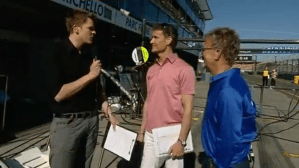
2009 Australian GP - BBC pre-show
The BBC’s presentation team of Jake Humphrey, David Coulthard and Eddie Jordan in pit lane before the race.

As the discussion becomes more fluid in the half hour before lights out, it is clear Humphrey has done a huge amount of research, coming across to the viewer as knowledgeable, yet down to earth, for what is his first Grand Prix presenting. At this stage, the show and discussion feel raw, with all three new to their paddock roles.

Pleasingly, the build-up strikes a balance on Formula 1’s technical aspects (diffusers, otherwise known as ‘confusers’ in Jordan’s dictionary), explaining them without alienating the casual viewer, whilst giving an introduction on key motor sport terminology through a ‘Behind the Formula’ segment narrated by Brundle.

The CGI which featured in the opening title sequence is a running theme through the BBC’s 2009 output, with CGI fly-overs of the Melbourne circuit leading into the calendar graphic, as well as being utilised during the track guide with Brundle and Coulthard. The track guide is informative, both using their previous Melbourne experience to their advantage, aiding the broadcast.

Attention turns back to the British drivers, with Brawn sponsor and Virgin owner Richard Branson joining in on proceedings, as we approach lights out, and Brundle’s first BBC grid walk!

A media scrum of sizeable proportions greets Brundle on the grid, the media trying to grab both Jenson Button and Rubens Barrichello, but Brundle manages to navigate through the scrums. The highlight is Brundle’s front wing analysis, suggesting that the wings would be more aesthetically pleasing with “brown paper bags over them.”

Brundle – Jenson, can you do this?
Button – Yes.
Brundle – How?
Button – By crossing the line first at the end of the race.

After the grid walk, Coulthard and Jordan wrap up the pre-show discussion, outlining what activities take place between now and lights out. Ferrari’s Chris Dyer adds additional insight on Brawn with Kravitz, giving suggestions as to why Brawn are out in front.

And then, for the first time since the 1996 Japanese Grand Prix, is a F1 race airing live and uninterrupted for UK fans!

Race
For Brundle, 2009 was his thirteenth season in the F1 commentary box. For Legard, it was his first F1 television commentary, although at that stage he was a veteran in his own right, if not in that given context.

One of the new regulations for 2009 was that F1 teams had to declare the weight of their car following qualifying, the information sensibly used by Formula One Management (FOM) in their graphics set. However, there were no graphics related to tyres, even if they played a pivotal part in the race as various drivers hit the ‘cliff’ and slumped down the pecking order.

What a difference a year makes. Lewis Hamilton dominated this event last year, now he needs a set of binoculars to see the lights go out. – BBC co-commentator Martin Brundle commenting on Hamilton’s trajectory.

Brawn’s fortunes off the line are mixed, with Barrichello tumbling down the order, causing mayhem at turn one. Legard’s commentary at the start is far too fast (almost as if he was commentating on radio…), but he soon settles down into a rhythm.

Brundle’s expertise is invaluable from the get-go, making sense of Ferrari’s early progress, due to their soft tyres combined with the Kinetic Energy Recovery System (KERS), as well as fantastic analysis of the turn one crash.

The KERS device has a significant impact on the race as a whole, not only for Ferrari, but also Hamilton yet, speedometer aside, does not play a part in F1’s graphics set. Unlike in more recent years, when you can see the rear wing opening for the Drag Reduction System (DRS), there is no obvious way the viewer can see when a driver is using KERS to overtake.

With high-definition not yet a thing for Formula 1, the graphics set (on the BBC feed at least) remains within the 4:3 ‘safe zone’, with timing information sporadically scrolling across the bottom of the screen, although this is far too infrequent for my liking.

Despite the inferior graphics, Legard utilises the timing screens on offer to him fantastically to spot when cars are hitting the cliff and informing the viewer, although there was a feeling of repetitiveness as the race unfolded. At one stage, BMW’s Robert Kubica was six seconds off the pace due to tyre degradation before his pit stop resulting in significant field spread.

Nakajima helped close the field back up by crashing his Williams, the BBC using the Safety Car opportunity to promote their post-race forum show, no Twitter back then and instead an e-mail address!
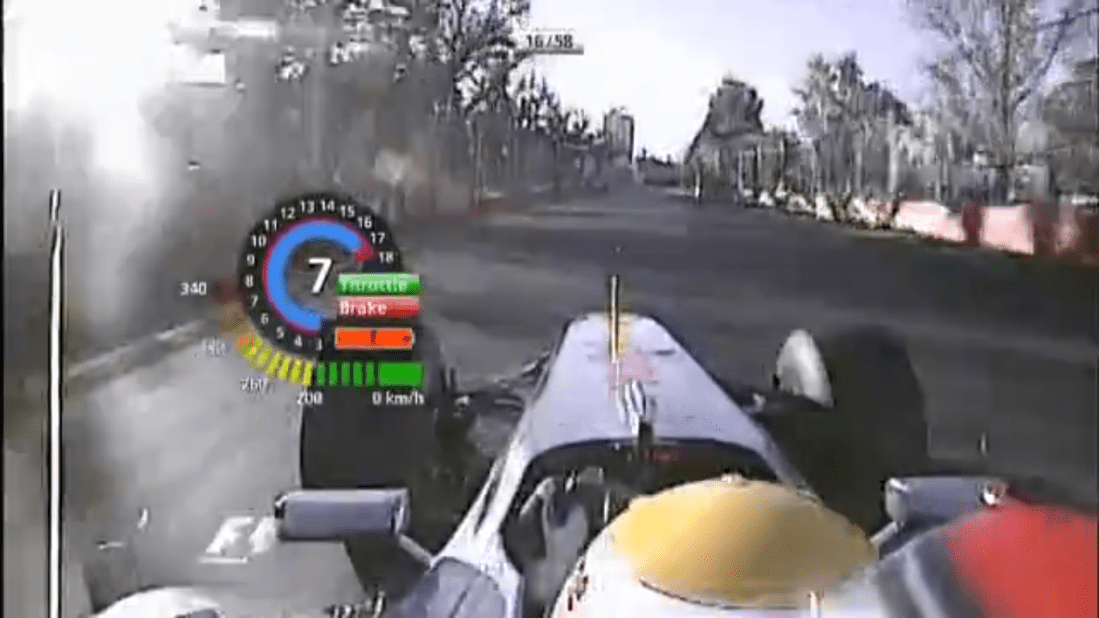
2009 Australian GP - Hamilton and speedometer.png
On-board with McLaren’s Lewis Hamilton during the 2009 Australian Grand Prix. Featured on FOM’s graphic is the speed, rev counter, throttle and brake usage, and amount of KERS battery left.

The camera angles were noticeably higher at some corners here than what we have currently, FOM under Liberty Media’s ownership reverting to some of the old F1 Digital angles to capture the speed, which was not as noticeable during 2009. Saying that, I did enjoy seeing a camera angle panning down between turns five and six, showing the speed following the fast right turn.

Following Nakajima’s crash and into the latter stage, the race is all about “who is going to hit the cliff first” where the tyres are concerned. One thing that occurred to me as the race progressed was that I was complaning about the direction less, primarily because there were fewer graphics that alerted viewers of emerging battles. In other words, if the commentary team did not alert viewers that driver X was closing on Y, the fans watching at home would be totally oblivious.

The cliff eventually does hit, with Nico Rosberg and Sebastian Vettel suffering the most: Rosberg’s Williams being overtaken by multiple drivers, whilst Vettel’s race ended in a ‘clumsy’ collision with BMW’s Robert Kubica. The drama, which is explained well in commentary, promotes Barrichello to second, and gifting Brawn GP a one-two finish on their debut!

Post-Race
Prior to the podium celebrations on the cool down lap, there is some good discussion between Legard and Brundle talking about Brawn’s winter, and why Brawn were right to pick Barrichello over Bruno Senna, who media expected to take the second Brawn seat.

20 minutes from chequered flag to off-air was just about enough for the BBC to squeeze in the podium, top three press conference, as well as interviews with Hamilton and Nick Fry.

The whole of the post-race segment on BBC One had a feel-good factor to it with the underdog effect playing its part, in what was a fantastic news story for the whole of Formula 1.
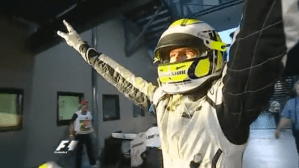
2009 Australian GP - Button
Winner.

Of course, it was not just 20 minutes, because following the BBC One transmission, for the first time ever was an additional 60-minutes of analysis and chatter via the BBC’s interactive Red Button service.

The team decamped to the Force India area within the Melbourne paddock, with Humphrey, Coulthard and Jordan accompanied by single camera set-up for most of the broadcast.

An additional four Brawn interviews followed during the F1 Forum, with both drivers in the interview ‘pen’, Branson, and Button’s engineer Andrew Shovlin during the forum. One may argue that this is over-the-top, but the size of the story arguably justifies this.

A secondary factor is that, back in 2009, there was no concept of the interview ‘pen’ beyond the top three, meaning that it was anywhere goes in the paddock. On one hand, that is to the detriment of the broadcast meaning that we do not get to hear all the stories, but meant that we heard a variety of different voices from on and off the track as the show progressed.

During the broadcast, Kravitz interviewed team bosses Martin Whitmarsh (McLaren) and Mario Theissen (BMW), with Vijay Mallya (Force India) joining the presentation team live, all three teams discussed in detail, which may not have been possible in the ITV days with limited air-time.

> BBC archive blog: Reflecting on a memorable Melbourne weekend (Jake Humphrey – 30/03/09)
> BBC archive blog: The morning after the morning before (Roger Mosey, Head of BBC Sport – 30/03/09)

More importantly, the conversation flowed from one subject to another, instead of the BBC treating them as standalone entitles: Whitmarsh’s interview touched on Ferrari and Brawn, whilst Mallya’s interview focused on Force India’s late development due to the timing of their engine agreement, and how McLaren in turn helped seal the deal in that respect.

All of this helped the programme, which aired without significant constraints or the worry of any upcoming commercials, a breakthrough for Formula 1 broadcasting in the UK.

The three analysts referred to their own experience at various points, Coulthard leading Brundle into a conversation about Brawn’s car design, relying on Brundle’s experience from working with Brawn in sports cars.

The crew dissected the race ending incident between Vettel and Kubica, Coulthard “very disappointed” with both, whilst Brundle brought up Vettel’s past in this area, having smashed into Webber in Japan 2007. The debate led to the first of many friendly disagreements between Jordan and Coulthard, the two disagreeing on whether Vettel should have apologised to close friend and BMW boss Theissen (which the BBC’s cameras captured in the paddock).

In addition to the World Feed analysis, having access to additional race feeds meant that the BBC could play these into the Red Button broadcast, such as analysis from Hamilton’s own on-board.
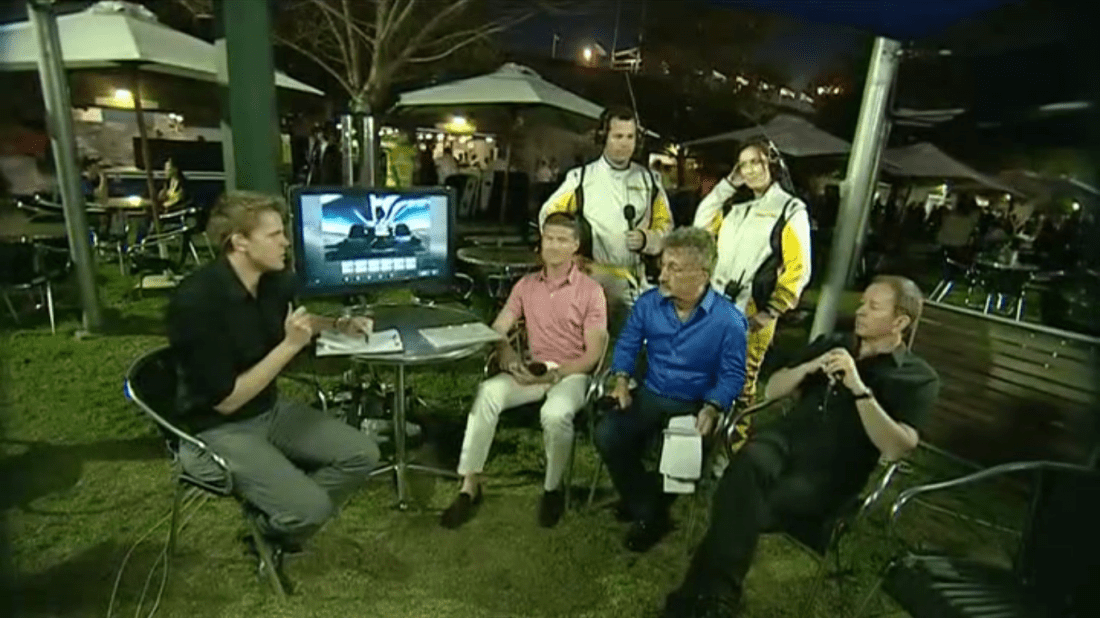
The first BBC F1 forum at the 2009 Australian Grand Prix. Jake Humphrey (l), Ted Kravitz and Lee McKenzie (top r), David Coulthard, Eddie Jordan and Martin Brundle (bottom r).

In later years, the forum went on for as long as deemed necessary, but to start with, the programme ran to time. Only one e-mail managed its way into the broadcast, but irrespective, the question generated an open-end discussion, paving the way for what was to come in future.

Kravitz and McKenzie joined Humphrey, Coulthard, Jordan and Brundle in the temporary Force India set-up, to reflect on their first weekend in Melbourne.

Times Like These by Foo Fighters played out the BBC’s first Formula 1 television broadcast in nearly thirteen years, a marathon four-hour broadcast across two outlets.

Overnight viewing figures quickly justified their expansive coverage: a staggering peak audience of nearly seven million viewers watched the race, with many millions more reached across digital and radio.

For Brawn, for Button, for Barrichello, and for the Beeb, Melbourne 2009 really was a fairy tale.
Scheduling: The 2019 Bahrain Grand Prix / Argentine MotoGP

From Australia, Formula 1 heads onto Bahrain, for the second round of the 2019 season.

2016 Drivers’ Champion Nico Rosberg and Anthony Davidson join Sky Sports F1 for the first time this year. As announced during Melbourne, Ted Kravitz returns to their weekend coverage in China. Sky are again airing the race across both their F1 channel and their general entertainment outlet Sky One.

The Grand Prix faces tough competition, as qualifying on Saturday starts at the same time as the 15:00 football matches, whilst the race goes head-to-head with Liverpool versus Tottenham, a match that could prove pivotal in the Premier League title race.

Channel 4’s highlights air later in the evening, the race programme starting at 21:00, with Billy Monger providing analysis alongside David Coulthard and Steve Jones.

Excluding adverts, the length of the highlights show is not too dissimilar to the BBC highlights show for Bahrain. From 2012 to 2014, the BBC’s three race day shows lasted 80, 95 and 90 minutes respectively, although the amount of action in Channel 4’s show this Sunday will be shorter than BBC’s previous efforts.

Elsewhere, in the Sky Sports F1 schedule, Natalie Pinkham’s pre-season interview with Renault’s Daniel Ricciardo gets a 30-minute run-out at various points in the build-up to Bahrain, whilst the Formula Two series returns for a new season.

Further west, Argentina plays host to round two of the MotoGP season, and the World Rally Championship heads to France for the Tour de Corse.

NOTE: Clocks go forward one hour on Sunday 31st March, with the change from Greenwich Mean Time to British Summer Time. The times listed are for GMT on Saturday and before; BST for Sunday and afterwards…

Channel 4 F1
30/03 – 19:00 to 20:30 – Qualifying Highlights
31/03 – 21:00 to 23:00 – Race Highlights

Sky Sports F1
Sessions
29/03 – 10:45 to 12:45 – Practice 1 (also Sky Sports Main Event)
29/03 – 14:45 to 16:45 – Practice 2 (also Sky Sports Main Event)
30/03 – 11:45 to 13:30
=> 11:45 – Practice 3
=> 13:10 – Paddock Walkabout
30/03 – 14:00 to 16:30 – Qualifying (also Sky One)
=> 14:00 – Pre-Show
=> 14:55 – Qualifying (also Sky Sports Main Event)
31/03 – 14:30 to 19:00 – Race (also Sky One)
=> 14:30 – Pit Lane Live
=> 15:30 – On the Grid
=> 16:05 – Race
=> 18:00 – Paddock Live

Supplementary Programming
28/03 – 15:00 to 15:30 – Drivers’ Press Conference
28/03 – 17:00 to 17:30 – Welcome to the Weekend
30/03 – 16:30 to 17:00 – The F1 Show (also Sky Sports Main Event)
03/04 – 18:30 to 19:00 – F1 Midweek Debrief

BBC Radio F1
28/03 – 21:00 to 22:00 – Preview (BBC Radio 5 Live)
29/03 – 11:00 to 12:30 – Practice 1 (BBC Radio 5 Live Sports Extra)
29/03 – 15:00 to 16:30 – Practice 2 (BBC Radio 5 Live Sports Extra)
31/03 – 16:00 to 18:10 – Race (BBC Radio 5 Live Sports Extra)

MotoGP – Argentina (BT Sport 2)
29/03 – 11:45 to 19:00 – Practice 1 and 2
30/03 – 12:00 to 19:00
=> 12:00 – Practice 3
=> 15:00 – Qualifying
31/03 – 13:30 to 21:00
=> 13:30 – Warm Ups
=> 15:15 – Moto3
=> 17:00 – Moto2
=> 18:30 – MotoGP
=> 20:00 – Chequered Flag

MotoGP – Argentina (Quest)
01/04 – 18:00 to 19:00 – Highlights

Formula Two – Bahrain (Sky Sports F1)
29/03 – 08:25 to 09:20 – Practice (also Sky Sports Main Event)
29/03 – 13:45 to 14:20 – Qualifying
30/03 – 10:00 to 11:20 – Race 1
31/03 – 12:05 to 13:10 – Race 2

World Rally Championship – Tour de Corse (All Live – BT Sport Extra 1)
Every stage also live via WRCPlus.com
29/03 – 07:00 to 18:45 – Stages 1 to 6
30/03 – 06:00 to 17:30 – Stages 7 to 12
31/03 – 08:00 to 12:45 – Stages 13 and 14

World Rally Championship – Tour de Corse
29/03 – 21:45 to 22:15 – Day 1 Highlights (BT Sport 3)
30/03 – 15:00 to 16:00 – Stage 11 (BT Sport/ESPN)
31/03 – 22:30 to 23:00 – Day 2 Highlights (BT Sport 1)
31/03 – 11:00 to 12:30 – Stage 14 [Power Stage] (BT Sport 2)
31/03 – 19:00 to 19:30 – Day 3 Highlights (BT Sport 1)
01/04 – 19:00 to 20:00 – Highlights (5Spike)

This post will be amended if anything changes.

Scheduling: The 2019 Australian Grand Prix

A new year, a new era.

Formula 1 roars back into life, with the championship starting down under in Melbourne for the Australian Grand Prix!

For UK fans, the action airs exclusively live on Sky, with highlights on Channel 4. If you are not yet accustomed to hearing that sentence yet, you will soon, as that sentence applies for 20 of the 21 races this season, and (partially) applies until the end of 2024.

Change at Sky…
A lot has happened since both broadcasters went off the air at the end of 2018. Karun Chandhok and Jenson Button have joined Sky for the upcoming season, adding depth to their line-up.

The rest of Sky’s line-up remains the same as last year, 2019 marking their eighth season covering the sport. Simon Lazenby will continue to front their coverage, with David Croft and Martin Brundle on commentary.

Nico Rosberg, Paul di Resta, Anthony Davidson, Johnny Herbert, and Damon Hill will provide analysis throughout the season, with Natalie Pinkham and Rachel Brookes also contributing to Sky’s coverage.

However, Sky have reduced Ted Kravitz’s contribution for 2019, after u-turning on an earlier decision to axe him from their coverage. Kravitz is with Sky for 14 races this season, whilst his Notebook output is no more based on current schedules. Kravitz is presenting a midweek show called Midweek Debrief, but this is an F1 production as opposed to an in-house Sky production.

On the programming front, Sky have extended their Thursday preview show, added a 30-minute wrap-up show on Friday, and kept The F1 Show on Saturday’s after qualifying. On race day, Sky have also extended Paddock Live to an hour, but it also starts half an hour earlier, meaning that Sky will head off-air earlier on Sunday’s than previously.

Sky are simulcasting their programming throughout the weekend across Sky One and Sky Sports Main Event. On Sunday, they are replaying the race five times in full across the F1 channel, Sky One and Main Event before Channel 4’s highlights programme has even started!

…and at Channel 4…
With Chandhok moving over to Sky, Channel 4 have added Billy Monger and Stefano Domenicali to their line-up. Both of them join Steve Jones, David Coulthard and Mark Webber in Melbourne, with Ben Edwards continuing to commentate alongside Coulthard. The broadcaster has retained Lee McKenzie, despite McKenzie previously intending to move onto pastures new this season.

As expected, Channel 4’s highlights programme is shorter than last year, with decreases of 20 minutes (18%) and 45 minutes (27%) for qualifying and the race respectively. The decreases are bigger than expected, as Australia received a generous edit from Channel 4 historically compared to races later in the season.

Decreases aside, fans will notice change from the very first second of Channel 4’s programme. Fleetwood Mac’s The Chain is no more. In its place I understand is a new, modern theme to kick-start Channel 4’s 2019 coverage.

…and at the Beeb
For those of you without Sky, the BBC’s 5 Live coverage of Formula 1 remains. The broadcaster has not officially confirmed their radio line-up, although expect no changes on the personnel side. IMG are producing their coverage this season after winning the contract from USP Content last October.

Elsewhere in the motor sport spectrum, the World Endurance Championship returns to action in Sebring, whilst Supercars plays its part on the F1 support bill, which UK viewers will have access to for the first time.

Channel 4 F1
16/03 – 12:00 to 13:30 – Qualifying Highlights
17/03 – 14:00 to 16:00 – Race Highlights

Sky Sports F1
Sessions
15/03 – 00:30 to 02:45 – Practice 1 (also Sky Sports Main Event)
15/03 – 04:45 to 06:45 – Practice 2 (also Sky Sports Main Event)
16/03 – 02:45 to 04:30 – Practice 3
=> 02:45 – Practice 3
=> 04:10 – Paddock Walkabout
16/03 – 05:00 to 07:30 – Qualifying (also Sky One and Sky Sports Main Event)
=> 05:00 – Pre-Show
=> 05:55 – Qualifying
17/03 – 03:30 to 08:00 – Race (also Sky One and Sky Sports Main Event)
=> 03:30 – Pit Lane Live
=> 04:30 – On the Grid
=> 05:05 – Race
=> 07:00 – Paddock Live

Supplementary Programming
13/03 – 06:00 to 07:00 – Melbourne F1 Launch Show (also Sky Sports Main Event)
14/03 – 05:00 to 06:00 – Drivers’ Press Conference
14/03 – 07:00 to 08:00 – Welcome to the Weekend (also Sky Sports Main Event)
15/03 – 07:00 to 07:30 – The Story so Far (also Sky Sports Main Event)
16/03 – 07:30 to 08:00 – The F1 Show (also Sky Sports Main Event)
20/03 – 18:00 to 18:30 – Midweek Debrief

BBC Radio F1
14/03 – 21:00 to 22:00 – Preview (BBC Radio 5 Live)
15/03 – 00:55 to 02:35 – Practice 1 (BBC Radio 5 Live Sports Extra)
15/03 – 04:55 to 06:35 – Practice 2 (BBC Radio 5 Live Sports Extra)
16/03 – 02:55 to 04:05 – Practice 3 (BBC Radio 5 Live Sports Extra)
16/03 – 05:55 to 07:05 – Qualifying (BBC Radio 5 Live Sports Extra)
17/03 – 04:30 to 07:00 – Race (BBC Radio 5 Live)

Asia Talent Cup – Thailand (BT Sport 3)
16/03 – 07:15 to 08:15 – Race 1
17/03 – 04:30 to 05:30 – Race 2

Virgin Australia Supercars – Melbourne (BT Sport 2)
15/03 – 06:30 to 08:15 – Race 1
16/03 – 01:15 to 02:30 – Race 2
16/03 – 07:00 to 08:45 – Race 3
17/03 – 02:15 to 03:45 – Race 4

World Endurance Championship – 1000 Miles of Sebring
15/03 – 19:30 to 04:30 – Race (BT Sport 3)
15/03 – 19:45 to 04:30 – Race (Eurosport)

World Superbikes – Thailand
16/03 – 05:30 to 10:00 – Qualifying and Race 1 (Eurosport 2)
17/03 – 05:30 to 10:15 – Support and Race 2 (Eurosport 2)
21/03 – 20:00 to 21:00 – Highlights (ITV4)

As always, I will update the schedule if anything changes.

Update on March 12th – Added Ted Kravitz’s new show with F1 TV (also airing on Sky), plus updated the Supercars schedule.

Update on March 15th – Added Stefano Domenicali to Channel 4’s line-up. Also, Supercars has disappeared from BT Sport’s schedules. Historically, there were restrictions around what broadcasters could air from Supercars in Melbourne as it falls under the F1 support package, restrictions which still apply. The only place for UK fans to see the action is via SuperView,.

Scheduling: The 2018 Ad Diriyah E-Prix / Christmas reviews

A bass riff may not accompany Formula E, nor may it be airing on one of the BBC’s traditional television outlets, but nevertheless, the electric series takes a major step into the future as season five begins, with live coverage across the BBC’s digital platforms.

The start of the 2018-19 season takes the championship to a new, perhaps controversial, location as the series descends on Saudi Arabia for the Ad Diriyah E-Prix.

For UK fans, as well as the BBC and incumbents Eurosport, the actions airs live on BT Sport and YouTube for the first time. The BBC’s coverage is of the race itself, from the five-minute sting to after the chequered flag, excluding the pre-race festivities.

In a departure from last season, Eurosport are taking the World Feed commentary with Bob Varsha, Jack Nicholls and Dario Franchitti, a surprise considering Eurosport usually provide their own commentary feed for motor racing events.

However, BT Sport is the only UK television station that will air every Formula E session live, including the Shakedown on Friday afternoons, as well as practice on Saturday mornings. For non-BT Sport fans, the good news is that every session airs live via YouTube. Additionally, highlights air on Discovery-owned channel Quest following their Football League highlights show on Saturday, with a repeat on Sunday morning.

Vernon Kay and Nicki Shields complete the World Feed line-up. Kay stays in the Formula E paddock after impressing as Channel 5’s presenter last season. Last year, North One Television produced Channel 5 output, North One also forming part of Formula E’s worldwide output alongside Aurora.

Laurence McKenna hosts the tailored YouTube race programme, called ‘Voltage’, with Becky Evans alongside him. Neither are names regular readers will recognise, but both are young and active in the car scene on social media, and are exactly the right people to grow Formula E’s presence amongst the younger generation.

Red Bull profiled Evans here, whilst McKenna has presented a variety of social media output and podcasts in the past few years. KSI and Zerkaa, who form part of the Sidemen (a group of YouTube personalities), join McKenna and Evans in the YouTube London hub.

Elsewhere, December is packed with season reviews. BT Sport are going the extra mile with their MotoGP review show airing live from The Bike Shed in London. Suzi Perry presents as usual, with special guests including Bradley Smith, Sam Lowes, and triple MotoGP champion Jorge Lorenzo.

Sky’s F1 review show premieres on Christmas Eve, whilst Channel 4 are not airing a formal Christmas show following their short review during the Abu Dhabi Grand Prix weekend.

Formula E – Ad Diriyah
All sessions air live via YouTube and the following UK channels…
14/12 – 11:45 to 12:30 – Shakedown (BT Sport 1)
15/12 – 04:00 to 04:45 – Practice 1 (BT Sport/ESPN)
15/12 – 06:00 to 06:45 – Practice 2 (BT Sport/ESPN)
15/12 – 07:30 to 09:00 – Qualifying (BT Sport/ESPN and Eurosport 2)
15/12 – 11:00 to 13:30 – Race: World Feed
=> live on BBC’s digital platforms from 12:00
=> live on BT Sport/ESPN
=> live on Eurosport 2
15/12 – 11:30 to 13:10 – Race: Voltage (YouTube)
15/12 – 22:30 to 23:30 – Highlights (Quest)

Jaguar I-Pace eTrophy Series – Ad Diriyah (BT Sport/ESPN)
15/12 – 04:45 to 05:30 – Qualifying
15/12 – 09:30 to 10:30 – Race

MotoGP (BT Sport 2)
09/12 – 19:30 to 21:00 – Season Review

BBC Radio F1
TBC – Season Review

Sky Sports F1
24/12 – 19:00 to 21:00
=> 19:00 – Alonso / Johnson Car Swap
=> 19:30 – Jean Todt Exclusive: Future of F1
=> 20:00 – Season Review

In the run-up to Christmas, keep an eye on this post in the event of any changes to the review programming over the festive period.

Tracking BBC’s and Channel 4’s Formula 1 picks from 2012 to 2018

Over the past seven years, the BBC and Channel 4 have negotiated with Sky on a yearly basis to decide which races they would like to broadcast live, and which races they will air in highlights form.

The picking process is complex, and required compromise, strategic thinking, and scheduling discussion with other departments to avoid significant clashes. For example, a live Formula 1 race on free-to-air television clashing with an England World Cup game would not be in anyone’s interests.

With seven years of data, we have enough information to work with to pick out some trends. Which races were popular with free-to-air broadcasters, and which races failed to scratch the surface? In addition, is there any correlation between a driver winning, and the race airing live on free-to-air television in the UK? The second part is not entirely serious, the analysis was more out of intrigue rather than trying to seriously suggest there was a genuine pattern.

For readers unfamiliar, the pick process worked as follows:

  • BBC / Channel 4 make three live picks
  • Sky make three exclusively live picks
  • BBC / Channel 4 make one live pick
  • Sky make one exclusively live pick
  • BBC / Channel 4 makes one live pick
  • Sky make one exclusively live pick

The process continues until there are no more races to select. The free-to-air broadcaster cannot air three races live consecutively, and similarly Sky cannot air three races exclusively live in a row. In the end, there should be a balance of races live on free-to-air television, with no skew towards one way or the other.

Both sides have their priorities, and restrictions because of the rules around the process. 139 races have taken place across the seven seasons, 25 distinct races, whilst 15 races have kept their place on the Formula 1 calendar between 2012 and 2018.

There are some obvious skews to this data, in that the free-to-air broadcaster aired the British Grand Prix as well as the final race of the season live every year as part of the agreement.

Hamilton and Mercedes more likely to win when F1 airs exclusively live on pay-TV
If you are hoping for a competitive 2019 when F1 moves primarily onto pay television, look away now. Since 2012, 68 races aired live on free-to-air television, with the other 71 airing in highlights form.

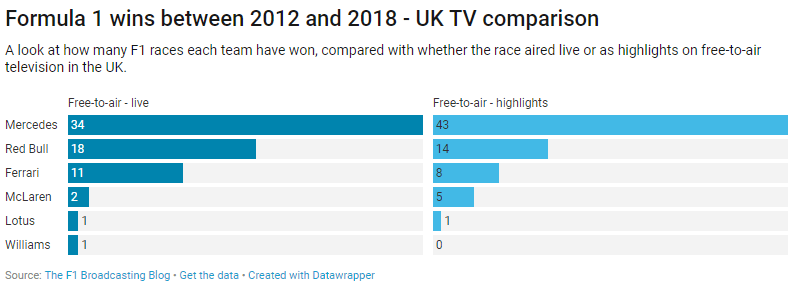
Of the races that aired in highlights on free-to-air, Mercedes have won 61 percent of them, compared to 51 percent when F1 airs live on free-to-air. In 2016, Mercedes were victorious in all the races that Channel 4 aired as highlights, with the only two non-Mercedes victories (by Red Bull in Spain and Malaysia) airing live on Channel 4.

UK F1 - wins between 2012 and 2018

Overall, the chances of Red Bull and Ferrari winning increases by 7 and 5 percentage points respectively when F1 airs live on free-to-air compared to in highlights form. This season, Mercedes won eleven races, of which seven aired exclusively live on Sky. Four of Ferrari’s victories aired live on Channel 4, with their other two (Australia and Canada) covered exclusively live by Sky.

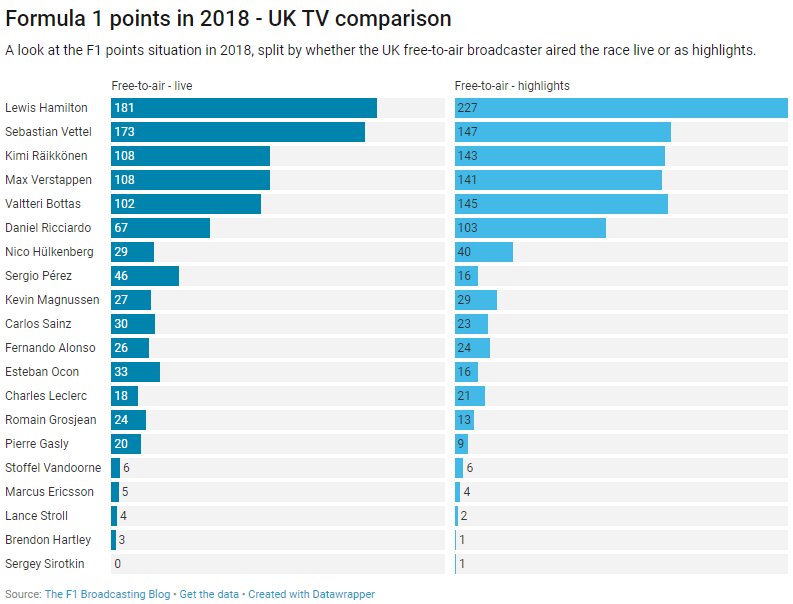
In a parallel universe where only races that aired live on free-to-air television in the UK counted towards the F1 championship, Sebastian Vettel comes within a whisker of winning the championship, losing out to Lewis Hamilton by just eight points.

Unfortunately for Vettel, it is not quite as simple as that, as in the ‘Sky exclusive’ championship, Hamilton waltzes away with an 80-point lead, Vettel finishing the season in a four-way scrap for second, also involving Valtteri Bottas, Kimi Raikkonen and Max Verstappen, separated by just six points!

It does, however, highlight the absurdness of the 2012 to 2018 deal. Imagine choosing to only watching the races that aired on free-to-air television live, you would be bemused as to how Hamilton won the 2018 championship relatively comfortably in the end.

Although Vettel did not have it all his own way in 2018, the balance of wins for him between free-to-air and pay-TV is similar at 15 and 16 wins respectively over the course of the seven year period. Both Hamilton, and ex-Mercedes team-mate Nico Rosberg’s win ratios skew towards pay-TV, whilst Daniel Ricciardo skews in the opposite direction.

Of course, races such as Austria, China and Italy have traditionally been pay-TV strangleholds, as well as Mercedes’ playground, explaining some of the skews in play here.

UK F1 - 2018 points

Australia left out in the cold
Since 2012, there have been 31 early morning races, 77 afternoon races and 30 prime time races for UK fans.

If you liked your early morning doses of Formula 1, the 2012 to 2018 contract did not live up to expectation, with only 12 of the 31 races (or 39 percent) of them airing live on free-to-air television.

Despite being the season opener on all seven occasions, the Australian Grand Prix had a raw deal from the BBC and Channel 4, the race has now not aired live on free-to-air since 2011.

More recently, the Chinese round did not receive good treatment, only airing live in 2012 and 2013. Despite a similar timeslot to China, the Japanese Grand Prix received a much better bite of the cherry, airing live in four out of the 7 seasons.

13 of the 30 prime time races aired live on either the BBC or Channel 4, whilst 55 percent of all afternoon races between 2012 and 2018 (42 out of 77 races) aired live on free-to-air television.

Airing the early morning races as highlights made little difference to the fan at home, but airing the prime-time evening races in highlights form several hours later meant a very late night for UK fans without Sky.

Aside from Britain (a compulsory pick), the Belgian Grand Prix aired live on all seven occasions, possibly a result of following directly after the Summer break. Abu Dhabi aired live on six occasions thanks to its season ending time slot, but there was no obvious trend for the other races, this depending on their exact placement on the calendar.

During their time covering Formula 1, the BBC avoided picking either the USA or Mexican rounds live, Sky picking these races as part of their opening set of picks. The pendulum swung their way in the Channel 4 years, but at the expense of both the Canadian and Brazilian rounds, neither of which aired live on Channel 4.

The joys of the system meant that Sky had two or three prime time races locked in from the outset, making it difficult for the free-to-air broadcaster to get a look in.

If you believe statistics can predict the future, then expect Hamilton to dominate the 2019 Formula One season, with around 14 victories to his name. Joking aside, it is fascinating how your interpretation of a given season can differ depending on where, or rather who in the case of F1’s broadcasters, you watched the show with.