Liberty Media helps bring F1 social media strategy on-track

The direction from Liberty Media, through Formula One Management, to pour resources into Formula 1’s official social media platforms appears to be paying off, figures for the first half of 2017 show, with Formula 1 the fastest growing motor racing series.

Liberty Media helps F1 to significant growth…
This site has tracked the cumulative number of followers for the likes of F1, MotoGP and the IndyCar Series across Facebook, Twitter, and Instagram since March. The results for Formula 1 are impressive, with a 20 percent boost in the cumulative number, going from 7.9 million followers in March to 9.6 million followers at the end of July, racing past NASCAR. Assuming the rate of trajectory continues, I would expect F1 to reach 12 million followers across the three platforms by the end of the season.

At the foot of the table, Formula Two and GP3 continue to struggle, below the likes of the British Touring Car Championship. As I mentioned briefly last December, Liberty needs to work hard to help promote Formula Two, after all it should feature the next generation of Formula 1 stars, such as Charles Leclerc. A few video highlights on Facebook and Twitter would significantly help the series’ reach, as would cross-promotion with the F1 channels. Instead, Formula Two and GP3 hides their video highlights away exclusively on their website. I suspect Liberty needs more resources dedicated both of their social media channels. It is absurd for example that Formula Two still does not have an active YouTube channel.
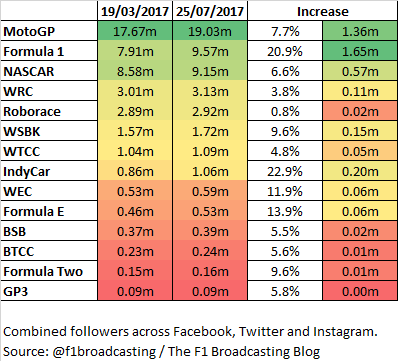
Social media - August 2017 - motor sport series comparison
Comparing the leading motor sport series on social media, showing their cumulative follower growth between March and July 2017.

Fernando Alonso’s drive in the 2017 Indianapolis 500 has helped IndyCar’s standing on social media, jumping from 860,000 followers to 1.06 million followers, a percentage rise higher than F1’s outlined above. The social media strategy around #AlonsoRunsIndy worked, although I suspect any long-term impact for IndyCar will be minimal, unless he returns next year! Further back, the electric Formula E series gained around 60,000 followers from March to July, a jump of 13.9 percent (note: figure recorded prior to the season finale). Formula E is rising at a similar rate to the World Endurance Championship, which is not a great statistic considering the interest from manufactures in the former. Certainly, Formula E’s social media standing is reflective of their viewing figures worldwide in my opinion.

The small rise for Roborace is because of the removal of ‘bot’ followers from their various platforms, meaning that they only see a jump of around 2,000 followers. As mentioned before, I am highly suspect of Roborace’s numbers, I would be unsurprised if the real number was a quarter, or even a tenth, of what the statistics suggest.

…but Mercedes’ F1 growth stagnates…
The loss of Nico Rosberg has hurt Mercedes’ social media portfolio, with Red Bull Racing the major winners. The drinks company has seen growth for the past two years, which has continued in the first half of 2017, their platforms (excluding drivers) rising from 8.95 million followers last December to 11.36 million cumulative followers, a substantial rise of 26.9 percent. In comparison, Mercedes following increased from 13.99 million followers to 14.57 million, a smaller jump of just 4.2 percent. Their Facebook following has stalled at around 11 million followers for the past year and a half, suggesting that it may have peaked in that department.

Social media - August 2017 - F1 team increase
Comparing Formula 1’s ten teams on social media, looking at their cumulative followers and growth between December 2016 and August 2017.

Whilst Liberty Media’s aggressive social media helped the official F1 channels, the loss of Jenson Button and Nico Rosberg hurt the series as Stoffel Vandoorne and Lance Stroll replaced them once the dominos fell into place. Rosberg and Button were Formula 1’s third and fourth biggest stars on social media, behind Lewis Hamilton and Alonso. The pair leave behind a significant gap, with Daniel Ricciardo now F1’s third star on social media, currently half of Alonso’s following and less than a quarter of Hamilton’s combined number.

Moreover, Hamilton and Alonso are still recording the biggest growths on social media with no signs of slowing down. In the first half of 2017, Hamilton acquired 1.73 million new followers, with Ricciardo acquiring 683,000 new followers. The loss of Rosberg, who was Formula 1’s first new champion since 2010, is extremely apparent when you look at the numbers. It continues to be the case that neither Sebastian Vettel or Kimi Raikkonen have a social media presence, both would likely fill that gap in another world.

…as Ricciardo becomes the third top dog
The loss of Rosberg and Button may explain why audience figures have struggled to rise, for example in the UK, where Button would have had a strong and loyal fan base. Hopefully, this is a short-term pain, long-term gain situation, whereby Ricciardo and Verstappen fill the gap left behind in the years to come, assuming both drivers have the equipment underneath them to deliver the results on the circuit. F1 on the list below does skew older age wise than MotoGP, which is a major issue moving forward.

Social media - August 2017 - F1 vs MotoGP
Comparing how Formula 1’s and MotoGP’s top drivers line-up against each other on social media.

The problem illustrated above will be one that MotoGP faces when Valentino Rossi retires, although you could easily see Rossi going another three to five years. Whilst Rossi is firmly top dog on social media, the championship is in a situation where there are other stars on the track building their reputation. MotoGP’s rider numbers are generally lower than Formula 1, as one might expect. From an age perspective, Marc Marquez, Max Verstappen and Maverick Vinales are the stars with potential in the next ten years in the new media platforms.

It will be fascinating to track the trajectories in both MotoGP and F1 as the baton moves from Rossi and Hamilton respectively. Of course, this assumes that Facebook, Twitter, and Instagram are still around. Instagram is the platform continuing to surge, with it set to overtake Twitter in terms of F1 team and driver influence within the next six months to a year, despite only having a quarter of the F1 following two years ago.

F1’s live London prototype sets vision for the future

Formula One Management (FOM) headed into a brave new world last week with their first foray into live event hosting through its new F1 Live brand. The experiment, which intends to take the sport to the fans, started in London’s Trafalgar Square and was a resounding success overall for what was essentially a live prototype aired worldwide.

FOM streamed the event live across social media last week, with television stations such as Sky Sports F1 also picking up coverage. Given the intended audience, it appears that non F1 broadcasters will have the ability to show the F1 Live events in the future, based on a comment made by David Coulthard during Channel 4’s British Grand Prix coverage.

Live streaming was moderately successful on YouTube, with a peak number of around 35,000 devices. The figure is half the number that watched Fernando Alonso’s first laps preparing for the Indianapolis 500, but you must remember that Alonso’s practice run was only available online, so it is not a completely fair comparison.

F1 Live London averaged 81,000 viewers (0.5%) in the United Kingdom on television from 18:00 to 21:00 on Wednesday across Sky Sports and the local London Live channel according to overnight viewing figures supplied by Overnights.tv, a healthy audience considering the lack of promotion for the event.

Fans were critical about the promotional aspect heading into the event, although the justification was sound given recent terrorist attacks in London and Manchester. The event might have been jeopardised had the mainstream media revealed details weeks in advance. The 2004 demonstration attracted half a million people to the capital and it was inevitable that security would be much tighter this time around.

Velocity Experience, a new start-up company with David Coulthard and Guy Horner at the helm, led the promotion, branding, and organisation elements of the event. Coulthard’s presence remained throughout the presentation line up, which was reminiscent of the BBC’s 2011 Formula One team.

Jake Humphrey, Martin Brundle, Eddie Jordan, Natalie Pinkham and Coulthard all played their part, with Rochelle Humes also involved. It is important to note though that whilst Coulthard and Humphrey were involved, to my knowledge, Whisper Films (the production company owned by Humphrey, Coulthard and Sunil Patel) were not involved in the event.

The three-hour live broadcast went as well as you could expect, the only noticeable technical problems were brief in the opening minutes. The picture quality on the live stream was ‘blocky’ during the demonstration itself, an issue that FOM fixed later in the broadcast. Luckily, the British weather held out, which is always a bonus! The event was well planned with the live demonstration supplemented by live music, a driver’s parade and various features highlighting the sport.

In my opinion, the balance between music and F1 did not feel right, with too little emphasis on the motor racing side of things. The last 40 minutes turned into a glorified Kaiser Chiefs concert – as a Kaiser Chiefs fan I cannot complain, but others might disagree!

I would have preferred a chat with some of the leading F1 drivers as a substitute for a Kaiser Chiefs song, such as Red Bull drivers Daniel Ricciardo and Max Verstappen, who were clearly popular with the audience. It did not make a major difference, but something for Liberty to learn from I feel.

Furthermore, the demonstration did feel slightly on the short side, I guess in a three-hour show I was expecting it to take up more than 45 minutes of airtime. The direction and camera angles were generally good, and following the event FOM uploaded a range of on-board angles online, which showed off some of the more unique angles that you typically do not see during a race weekend.

Coulthard and Brundle were on commentary, a joy to hear the duo back together again. The driver introductions onto stage did make up for the short demonstration, as referenced above. And how good was it to see the F1 Drivers Championship trophy in a public setting like that?

The VTs were one of the highlights of the evening, and a reminder of just why we love Formula 1. It was your typical trip down memory lane, but with an added extra bonus thanks to Tom Grennan’s backing track All Goes Wrong (if you have not yet seen it, I would go out of your way to watch). We need VTs like that to help promote this wonderful sport.

FOM receives some dissension from fans on social media, but this is one occasion where the team thoroughly deserves to be praised. I am hopeful that some of the VTs will be released on F1’s official YouTube channel during the Summer break, so keep an eye out. I imagine Liberty Media and all other involved parties have learnt a significant amount from the first F1 Live.

So, are you ready for the second event?

Formula 1 to live stream London demonstration run online

Formula One Management (FOM) are to live stream London’s F1 street demonstration online, the Commercial Rights Holder has confirmed.

The demonstration will be streamed on the Formula 1 website and their YouTube channel. The event, which takes place on Wednesday evening (12th July) from 18:00 to 21:00 UK time, will also be broadcast live across Sky Sports’ portfolio of channels.

It is the first broadcast of this magnitude that FOM, now under the control of Liberty Media, have streamed online. The event is taking place at London’s Trafalgar Square. Jennie Gow, Jake Humphrey, Martin Brundle, David Coulthard, Eddie Jordan, Natalie Pinkham, Rochelle Humes and Sam Power forms the extensive presentation line up. The event will feature “appearances from Formula 1 stars and legends as well as a number of celebrity guests.”

Sean Bratches, Managing Director, Commercial Operations at Formula 1 said: “F1 Live London is the most striking example yet of Formula 1’s evolution this year. We feel there is no better way to celebrate the exciting season we have had so far than to have this landmark event in London on the eve of the British Grand Prix. This is all about giving our fans the opportunity to get closer to the teams, cars and drivers they love.”

Mayor of London, Sadiq Khan, said: “F1 Live London is a brilliant opportunity to show young people in our city that learning about science and engineering can provide them with fantastic careers, and can be great fun. It will also bring fans of all ages and backgrounds together to celebrate a sport they are passionate about and in which Britain is a world leader.”

The “missed” handshake

In sport, the media amplifies rivalries by reporting on the action in front of them. Whether this reporting concerns on the football pitch, the boxing arena or the tennis court, media outlets, both print and visual, are looking for that moment. Sometimes though, the journalism goes beyond the sporting arena to further a rivalry, leaning towards reporting of a deceitful nature.

The battle between Lewis Hamilton and Sebastian Vettel came to a head in the Azerbaijan Grand Prix, with Vettel side-swiping Hamilton. The media reported the story from every angle, Fleet Street had their say as did broadcasters everywhere. Whilst the two championship protagonists have moved on, the media around them are still looking for opportunities to further elongate their rivalry.

With that, we come to the “missed” handshake. Did Lewis Hamilton refuse to shake Vettel’s hand? Or did Hamilton shake Vettel’s hand earlier in proceedings, in a more natural manner? And either way, does it matter whether he did or did not?

From the World Feed, moments after qualifying and just before the post-qualifying interviews, an overhead camera captured Vettel and Hamilton shaking hands. The two did not make a big deal of it, the handshake was part of the informal pleasantries before the post-qualifying grid interviews. The overhead shot was probably not the close-up angle Formula One Management (FOM) wanted.

The problem comes later when, after the interviews, Davide Valsecchi asked the two drivers to shake hands. Hamilton refused, stating that the two had already shaken hands prior to the interviews. Media outlets used this refusal to further their rivalry. Except, the refusal was a non-story for reasons described above.

Whilst it is easy to criticise Valsecchi, who is also a reporter for Sky Italia and Formula Two commentator, it is possible that the directive to throw the handshake line in there actually came from FOM, aka. Liberty Media to get a handshake on television in front of the large viewing audience. It felt like an incentive was thrown to stir up trouble.

Either way, certain aspects of the media spun the story by directly referencing Hamilton’s “refusal” to shake Vettel’s hand, choosing to leave out the latter half of the story. Sky Sports F1 tweeted, with video, that Hamilton rejected “a public show of reconciliation”, despite the fact he and Vettel shook hands minutes earlier, in front of the public! Sky were not alone, The Mirror chose the same approach with their headline, almost as if alternative facts existed. Other broadcasters no doubt went down the same route.

Again, I re-iterate the above point: does it matter? In the grand scheme of things, probably not. This time tomorrow, the handshake will be history as we analyse the Grand Prix. But, this ‘episode’ is a symptom of sensationalism that is ever more creeping into Formula 1 journalism, as journalists are eager to find stories and build on their hits.

The concern for me too is that Sky will be UK’s only F1 television broadcaster from 2019. Personally, I want to see them tone down their tabloid reporting such as the above – not every single incident requires verbiage. Today’s build-up from Sky was excellent in my view, but unfortunately their tabloid style post-race with this has let the broadcaster down, and not for the first time.

Bratches: Liberty Media “to honour and respect” Sky’s UK deal post-2018

Liberty Media is “to honour and respect” Sky’s deal to cover Formula 1 exclusively in the United Kingdom from 2019 to 2024.

Speaking to The Guardian amongst other media at the FIA Sport Conference, F1’s Managing Director for Commercial Operations, Sean Bratches said “Free to air is critically important to us. My vision as it relates to media rights is a hybrid of free to air and pay. Our plan is to balance the two but have a prominent, over the year, free-to-air voice.”

The exclusive deal between Formula One Management (FOM) and Sky Sports was announced following the 2016 Australian Grand Prix, three months after BBC television announced their exit from the sport and just after Channel 4’s first race covering Formula 1. Overnight viewing figures supplied by Overnights.tv showed that Channel 4’s race day coverage averaged 1.96 million viewers in 2016, with Sky bringing in a further 669,000 viewers.

“There is the cauldron full of cash on the pay side and on the other side of the scale you have brand and reach. My view is a 30-70 model of free-to-air to pay, where you have a number of grands prix to be on free to air and then we can play and toil with the pay side to generate revenue that we can reinvest back into the sport,” Bratches continued.

As Bratches alludes to, Formula 1’s outfits should benefit financially from the Sky contract, helping to offset the loss of viewers and sponsors, which was a concern when the deal was first announced. Estimates produced by this site suggested that each team could gain around £6 million per season depending on how the revenue generated is distributed, and assuming the teams see every single penny.

Based on a 20-race calendar and a ’30-70 model’, the ideal situation would see around six of the 20 races live on free-to-air television. This would likely entail the season opener and closure, along with the ‘home race’ and three other rounds of the championship. However, this scenario is impossible in the UK now until 2025, by which point the landscape may be fundamentally different again.

“That deal is an agreement that we inherited. They are done between adult parties at an arm’s length and my suspicion is that Sky is very happy and we are going to honour and respect the deals that were in place when we arrived,” Bratches said.

The comments made by Bratches are not surprising, you cannot tear up a legally binding broadcasting contract unless one side violates the agreement or activates a get-out clause. It is also unlikely that highlights will find a home elsewhere, other than Sky Sports Mix as announced previously.

Elsewhere at the FIA Sport Conference, it was revealed that regionalised graphics will be introduced for the 2018 season. Depending on location, some countries will see miles per hour (mph) in their graphics set, whilst others will see kilometers per hour (kph). Personally, I have no issue seeing both kph and mph, but I assume that FOM are planning on making other graphical changes, otherwise introducing a regionalised version feels like an unnecessary overhead.